Refugee Status Florida Resettlement: Your 2026 Guide
For those seeking safety in Florida, understanding refugee status and the resettlement process is crucial. This comprehensive guide for 2026 details eligibility, the step-by-step application, essential documentation, and the support systems available through the Office of Refugee Resettlement (ORR) and local agencies, particularly in areas like Homestead. Learn about the path from initial referral to achieving self-sufficiency in the Sunshine State. We also cover common mistakes to avoid and when expert legal counsel from Florida Immigration Lawyers is essential to ensure a smooth transition and successful integration.
Refugee status in Florida allows individuals fleeing persecution to find safety and rebuild their lives. The refugee status Florida resettlement process involves a multi-stage application reviewed by USCIS, followed by integration support from federal and local agencies like the Office of Refugee Resettlement (ORR) once approved. This guide details eligibility, the step-by-step process, and available assistance for 2026.
- Refugee status is for those outside their country fleeing persecution.
- The process is complex, requiring referrals and USCIS approval.
- Florida provides vital resettlement services, including in areas like Homestead.
- Legal assistance is crucial for navigating eligibility and the application.
- After one year, refugees can apply for lawful permanent residency.
Starting a new life in a foreign country, especially when fleeing persecution, presents immense challenges. For those seeking safety in the United States, particularly within our vibrant state, understanding refugee status Florida resettlement is paramount. Florida, with its diverse communities and established support networks, offers a pathway for refugees to rebuild their lives and integrate into society.
This comprehensive guide will walk you through everything you need to know about obtaining refugee status and navigating the resettlement process in Florida for 2026. We will cover eligibility criteria, the detailed application steps, essential documentation, expected timelines, and the critical support systems available. We specifically consider the context of communities like Homestead, where many new arrivals seek to establish themselves.
Navigating these complex immigration laws can be overwhelming. If you or a loved one needs assistance with refugee status or any immigration matter in Florida, do not hesitate to seek expert legal guidance. Call Florida Immigration Lawyers at 1-844-967-3536 for a free consultation to discuss your specific situation and how we can help you.
Understanding Refugee Status and Resettlement in Florida
Refugee status is a humanitarian protection granted to individuals who have fled their home country due to a well-founded fear of persecution. This persecution can be based on race, religion, nationality, membership in a particular social group, or political opinion. The definition is strictly outlined in U.S. immigration law.
Unlike asylum seekers, who apply for protection from within the U.S. or at a port of entry, refugees apply from outside the United States. The process is managed by the U.S. Refugee Admissions Program (USRAP) in coordination with international bodies and U.S. government agencies.
What is Refugee Status?
Under U.S. immigration law, specifically the Immigration and Nationality Act (INA) Section 101(a)(42), a refugee is defined as a person who is outside any country of such person's nationality or, in the case of a person having no nationality, is outside any country in which such person last habitually resided, and who is unable or unwilling to return to, and is unable or unwilling to avail himself or herself of the protection of, that country because of persecution or a well-founded fear of persecution. This fear must be based on one of the five protected grounds mentioned above. Understanding this definition is the first step in comprehending the refugee status Florida resettlement journey.
The determination of refugee status is a rigorous process. It involves detailed interviews and thorough background checks to ensure eligibility. The U.S. government works with international organizations to identify individuals who meet these stringent criteria.
The Role of Florida in Refugee Resettlement
Florida plays a significant role in the U.S. Refugee Admissions Program, welcoming thousands of refugees each year. The state is a primary destination for many new arrivals, particularly in southern Florida areas like Homestead, Miami, and Orlando. These communities offer diverse support networks and economic opportunities for refugees.
The state's involvement in Florida refugee assistance is largely facilitated by the Office of Refugee Resettlement (ORR), a program of the Administration for Children and Families (ACF) within the U.S. Department of Health and Human Services. ORR funds and oversees state programs and local resettlement agencies. These agencies provide critical services to help refugees achieve self-sufficiency.
Local agencies in Florida, often non-profit organizations, are on the front lines of assisting refugees. They help with initial housing, cultural orientation, English language training, job placement, and access to social services. These efforts are vital for successful integration into Florida communities.
For more information on general immigration pathways and legal services, please visit our Immigration Practice Area page.
Navigating the Refugee Status Florida Resettlement Process: A Step-by-Step Guide
The path to refugee status Florida resettlement is a multi-stage process that typically begins outside the United States. It involves several government agencies and international organizations working together. Here is a general step-by-step guide to what you can expect:
-
Initial Referral to the U.S. Refugee Admissions Program (USRAP): Most refugees are referred to the USRAP by the United Nations High Commissioner for Refugees (UNHCR), a U.S. Embassy, or a specially designated non-governmental organization (NGO). You cannot directly apply for refugee status to the U.S. government from outside the country without such a referral.
This referral is crucial as it initiates your consideration for resettlement in the U.S. The UNHCR plays a vital role in identifying individuals who meet the international definition of a refugee.
-
USCIS Interview and Adjudication: Once referred, you will undergo an in-depth interview with an officer from U.S. Citizenship and Immigration Services (USCIS). During this interview, you must clearly articulate your fear of persecution and provide consistent information regarding your claim. The USCIS officer will determine if you meet the legal definition of a refugee.
This interview is a critical stage, and your credibility is paramount. Providing accurate and detailed information is essential for a positive outcome. You can find more information about USCIS procedures on their official website: U.S. Citizenship and Immigration Services (USCIS).
-
Medical Examination and Security Checks: If your refugee claim is approved by USCIS, you will then undergo a mandatory medical examination. This is to ensure you do not have any inadmissible health conditions. Simultaneously, extensive security background checks are conducted by various U.S. government agencies.
These checks are comprehensive and designed to ensure national security. The process can take a significant amount of time due to the thoroughness required.
-
Cultural Orientation: Before traveling to the U.S., many refugees participate in cultural orientation programs. These programs provide vital information about life in the United States, including American laws, customs, and expectations. They prepare you for your new environment.
This preparation helps ease the transition and provides practical knowledge for everyday living in Florida.
-
Travel to the U.S. and Arrival in Florida: Once all clearances are obtained, travel arrangements are made. Refugees typically arrive in the U.S. with assistance from the International Organization for Migration (IOM). Upon arrival in Florida, you will be met by representatives from a local resettlement agency.
This agency is responsible for your initial reception and placement. They will help you begin your new life in the Sunshine State.
-
Post-Arrival Resettlement Services: Upon arrival, the local resettlement agency provides immediate support. This includes initial housing assistance, food, clothing, and enrollment in various programs. These programs are funded through the Office of Refugee Resettlement Florida and aim to help you achieve economic self-sufficiency.
Services typically include English language classes, job search assistance, school enrollment for children, and access to medical care. These services are time-limited, generally lasting for the first few months after arrival, but some support can extend longer.
Essential Documents for Refugee Status and Resettlement
Gathering and maintaining accurate documentation is critical throughout the refugee status Florida resettlement process. While the specific documents required can vary based on your individual case and country of origin, here is a general checklist of essential items you will likely need:
- Identity Documents: Any form of identification you possess, such as passports, national ID cards, birth certificates, or marriage certificates. Even if expired or difficult to obtain, these are important.
- Proof of Persecution: Any evidence that supports your claim of a well-founded fear of persecution. This can include police reports, arrest warrants, medical records documenting injuries, news articles, witness statements, or letters from organizations.
- Biometric Data: You will be required to provide fingerprints and photographs as part of the security screening process. This is a standard procedure for all applicants.
- Medical Records: Any existing medical records, especially those detailing conditions that may be relevant to your case or health history, should be provided. A full medical examination will also be required as part of the process.
- Referral Letters: Documentation from UNHCR or other referring organizations that initially recommended you for the U.S. Refugee Admissions Program.
- Family Information: Documents proving family relationships, such as birth certificates for children or marriage certificates, if you are applying with family members or seeking to reunite with them.
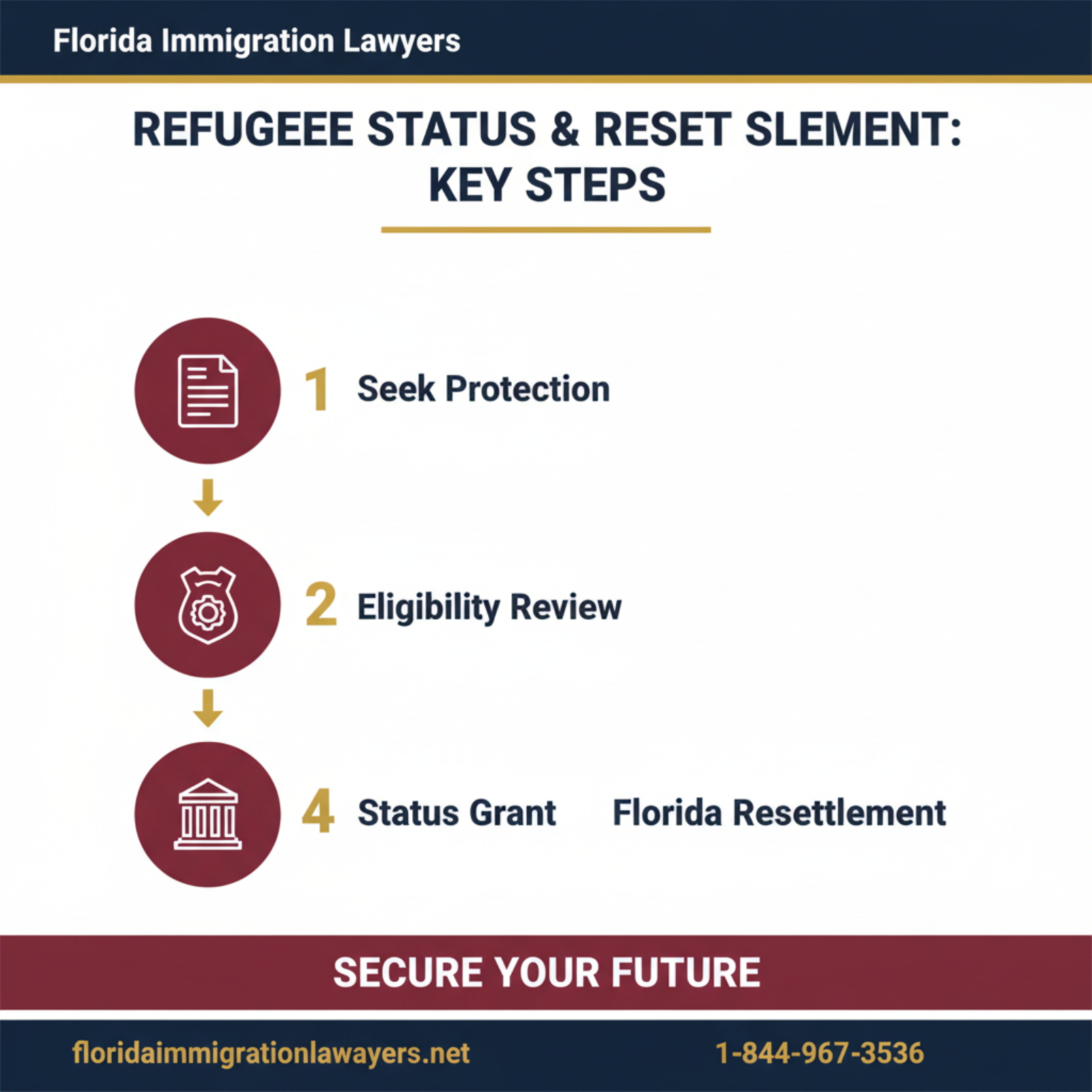
It is crucial to keep all original documents safe and have copies readily available. Inconsistent documentation or missing crucial evidence can significantly delay your case. Working with an attorney from Florida Immigration Lawyers can help you organize and present your documents effectively.
Timeline and Processing Expectations for Refugee Cases in Florida
The timeline for obtaining refugee status Florida resettlement can vary significantly. There is no fixed duration, and the process can take anywhere from a few months to several years. Many factors influence how quickly a case is processed, and it is important to manage expectations.
Factors that impact processing times include your country of origin, the complexity of your case, the volume of applications USCIS is currently handling, and the efficiency of security checks. Global events and policy changes can also affect processing speeds.
After a refugee is admitted to the U.S. and resettled in Florida, they are typically granted lawful permanent resident (LPR) status one year after their arrival. This adjustment of status is usually applied for using Form I-485, Application to Register Permanent Residence or Adjust Status. The application must be filed within the one-year window to maintain eligibility.
Once you receive your green card, you become a lawful permanent resident. This status offers more stability and a clearer path to eventual U.S. citizenship. For details on this next step, explore our Citizenship Practice Area page.
It is important to remember that delays are common. Maintaining patience and staying informed about your case status is advisable. Your resettlement agency and legal counsel can provide updates and guidance throughout this period.
Cost Factors and Fee Breakdown in Refugee Resettlement
For individuals granted refugee status Florida resettlement, the U.S. government generally covers the direct costs associated with the application process itself. There are typically no filing fees for the initial refugee application or for the medical examination conducted overseas.
However, once a refugee arrives in Florida, they will face various living expenses. While initial resettlement agencies provide some support, it is important to understand what is covered and what you will need to manage. The goal of resettlement programs is to help refugees achieve self-sufficiency, not to provide long-term financial assistance.
Initial support often includes a small sum for basic necessities and housing for a limited period. Programs like Refugee Cash Assistance (RCA) and Refugee Medical Assistance (RMA) offer temporary financial and healthcare support. These refugee benefits Florida are usually time-limited, typically lasting for up to eight months.
Legal fees are an important consideration if you choose to hire an attorney to assist with your case. While not mandatory, legal representation can significantly improve your chances of success and help navigate the complexities. Florida Immigration Lawyers offers free consultations to discuss your options and potential costs for our services.
Do not navigate this process alone. The complexities of immigration law require expert guidance. Contact Florida Immigration Lawyers today to secure the support you need for your refugee status or resettlement journey.
Common Mistakes to Avoid During Refugee Status and Resettlement
The process of obtaining refugee status Florida resettlement is intricate, and even minor errors can lead to significant delays or denials. Being aware of common pitfalls can help you avoid them and strengthen your case:
-
Providing Inconsistent Information: Any discrepancies in your testimony or documentation can severely undermine your credibility. Ensure all statements, whether written or verbal, are truthful and consistent across all interviews and forms. Inconsistencies can lead to intense scrutiny or even a finding of fraud.
-
Missing Deadlines: Immigration processes are strict about deadlines. Failing to submit required documents or attend interviews on time can result in your case being delayed or even closed. Always keep track of all scheduled appointments and submission dates.
-
Failing to Disclose Criminal History: Attempting to hide any criminal record, no matter how minor, is a serious mistake. U.S. immigration authorities conduct thorough background checks. Undisclosed criminal history will likely be discovered and can lead to immediate inadmissibility or denial.
-
Not Seeking Legal Counsel: Navigating complex immigration laws without legal guidance can be perilous. An experienced immigration attorney can help you understand eligibility, prepare your case, gather evidence, and represent you in interviews. This significantly increases your chances of a positive outcome.
-
Misunderstanding Resettlement Obligations: Refugees have certain responsibilities upon arrival, such as working towards self-sufficiency and cooperating with resettlement agencies. Failing to engage with these programs or meet expectations can impact ongoing support.
-
Traveling Internationally Without Permission: Once you have refugee status, leaving the U.S. without proper travel documents (like a Refugee Travel Document) can lead to the loss of your status. Always consult with an attorney or USCIS before planning any international travel.
-
Relying on Unofficial Sources for Information: Immigration laws are constantly evolving. Relying on outdated information from unofficial websites or non-legal advisors can lead to costly mistakes. Always refer to official government websites or consult with a qualified attorney.
-
Neglecting to Learn English: While not a legal requirement, proficiency in English is crucial for successful integration, employment, and communication in Florida. Neglecting language acquisition can hinder your ability to adapt and thrive.
-
Not Adapting to Local Culture and Laws: Understanding and respecting local laws and cultural norms in Florida is important for smooth integration. Failure to do so can lead to misunderstandings or legal issues.
-
Delaying Adjustment of Status: After one year in the U.S., refugees must apply for lawful permanent resident status. Delaying this application beyond the one-year window can jeopardize your ability to obtain a green card and future citizenship.
-
Ignoring Mental Health Support: Fleeing persecution and resettling in a new country can be traumatizing. Ignoring mental health needs can impact your overall well-being and ability to integrate. Many agencies offer mental health services for refugees.
-
Failing to Update Contact Information: Moving without notifying USCIS and your resettlement agency of your new address can lead to missed notices, interview appointments, or important documents. Always keep your contact information current.
When to Call a Lawyer for Refugee Status and Florida Resettlement
While resettlement agencies provide invaluable support for basic needs, the legal aspects of refugee status Florida resettlement are best handled by an experienced immigration attorney. There are specific scenarios where legal representation becomes not just beneficial, but often essential for a successful outcome.
You should consider contacting Florida Immigration Lawyers if your case involves:
- Complex Persecution Claims: If your claim of persecution is intricate, involves multiple forms of harm, or relies on nuanced legal arguments, an attorney can help articulate your story effectively and present compelling evidence.
- Previous Denials or Challenges: If you have previously been denied refugee status or faced significant challenges in your application, an attorney can review your case, identify weaknesses, and help you appeal or reapply.
- Criminal History or Inadmissibility Issues: Any past criminal convictions or issues that could render you inadmissible to the U.S. require immediate legal intervention. An attorney can assess the impact and explore potential waivers or defenses.
- Family Reunification: If you are seeking to bring family members to the U.S. after obtaining refugee status, the family reunification process can be complex. An attorney can guide you through the necessary petitions and requirements.
- Deportation Concerns: If you are a refugee and face any risk of deportation or removal proceedings, immediate legal counsel is critical. An attorney can defend your rights and explore options to protect your status. Learn more on our Deportation Defense page.
- Overlap with Asylum Claims: While distinct, refugee status and asylum are related. If you are already in Florida and fear returning to your country, you might be eligible for asylum. An attorney can help you understand the differences and apply for the correct protection. Visit our Asylum Practice Area for more information.
Florida Immigration Lawyers has extensive experience in all aspects of immigration law, including refugee and asylum cases. We understand the specific challenges faced by individuals seeking protection in Florida, including those in Homestead and surrounding areas. Our dedicated attorneys are here to provide compassionate and effective legal representation.
Frequently Asked Questions (FAQ) about Refugee Status in Florida
What benefits do refugees get in Florida?
Refugees in Florida are eligible for various time-limited benefits designed to assist with initial resettlement and integration. These include Refugee Cash Assistance (RCA) to cover basic living expenses, Refugee Medical Assistance (RMA) for healthcare, and comprehensive resettlement services. These services typically encompass housing assistance, cultural orientation, English language training, and employment services. The goal is to help refugees achieve economic self-sufficiency quickly. These benefits are generally available for a limited period, often up to eight months, though some services may extend longer.
What happens after 5 years of refugee status?
After one year of being granted refugee status in the U.S., refugees are generally required to apply for adjustment of status to become lawful permanent residents (green card holders). This transition typically occurs within the first year. After five years as a lawful permanent resident, you may become eligible to apply for U.S. citizenship, provided you meet all other naturalization requirements, such as continuous residency and good moral character. Most direct refugee assistance programs are time-limited and would have concluded well before the five-year mark, as the focus shifts to permanent residency and integration.
Can refugee status be deported?
Yes, individuals with refugee status can be deported under certain circumstances. While refugee status provides significant protection, it is not absolute. Grounds for deportation can include committing certain crimes, engaging in terrorist activities, or if it is determined that the individual no longer meets the definition of a refugee (e.g., if the fear of persecution ceases to be well-founded because conditions in their home country have fundamentally changed, or if they voluntarily return to their home country). It is crucial to adhere to U.S. laws and consult with an immigration attorney if you face any issues that could jeopardize your status.
How much money does a refugee get in the USA?
Refugees do not receive a lump sum of money upon arrival in the U.S. Instead, they receive temporary financial assistance through programs like Refugee Cash Assistance (RCA), which is administered by states and local resettlement agencies. The amount of RCA varies by state and is typically equivalent to the state's Temporary Assistance for Needy Families (TANF) program. This assistance is time-limited, usually for up to eight months, and is intended to help cover basic living expenses while refugees work towards self-sufficiency. Additionally, resettlement agencies provide initial support for housing, food, and other necessities, but these are not direct cash payments to the refugee.
About Florida Immigration Lawyers
Florida Immigration Lawyers is a leading law firm dedicated to providing comprehensive and compassionate immigration legal services across the entire state of Florida. We understand the profound impact immigration matters have on individuals and families, and we are committed to guiding our clients through every step of their legal journey.
Our experienced attorneys offer a wide range of immigration services, including assistance with refugee and asylum claims, family-based petitions, employment visas, deportation defense, and naturalization. We pride ourselves on offering personalized attention, strategic advice, and zealous advocacy for each client.
Why choose Florida Immigration Lawyers? We are available 24/7 to address your urgent concerns, and we offer free consultations to help you understand your options without financial commitment. Our team is bilingual, fluent in both English and Spanish, ensuring effective communication and culturally sensitive representation. We serve clients in all Florida counties, including those in Homestead, Miami, Orlando, and Tampa.
Your future in Florida is our priority. Contact us today to learn how our dedicated legal team can assist you. Visit our website at https://www.floridaimmigrationlawyers.net or call us directly at 1-844-967-3536.
Sources and References
- U.S. Citizenship and Immigration Services (USCIS)
- Executive Office for Immigration Review (EOIR)
- Office of Refugee Resettlement (ORR) - Administration for Children and Families (ACF)
- 8 U.S.C. Chapter 12 - Immigration and Nationality Act (INA)
- INA Section 101(a)(42) - Definition of Refugee
- INA Section 207 - Annual Refugee Admissions and Procedures
- 8 CFR Part 207 - Refugee Procedures
This article provides general legal information and is not intended as legal advice. Every case is unique, and outcomes depend on specific facts and circumstances. Contact an attorney for advice about your particular situation. Immigration laws are subject to change.
Understanding and navigating the refugee status Florida resettlement process can be a life-altering journey. Florida Immigration Lawyers is here to provide the expert legal support you need. Do not face this process alone. For a free, confidential consultation to discuss your specific circumstances, call us today at 1-844-967-3536. Se Habla Español - Estamos aquí para ayudarle.
Need help with Immigration?
Our Florida immigration attorneys offer free consultations. Call today or schedule online.
Frequently Asked Questions
Florida Immigration Lawyers
Legal Team
Our experienced attorneys at Florida Immigration Lawyers have been serving clients across Florida for over 20 years. We specialize in immigration, personal injury, criminal defense, workers compensation, and family law.