Derived Citizenship in Florida: Guide for Children of US Parents
Understanding derived citizenship is vital for Florida families seeking to confirm their child's U.S. citizenship through a parent. This guide from Florida Immigration Lawyers details the Child Citizenship Act, step-by-step application process for Form N-600, required documents, and potential costs. Learn about eligibility criteria, common mistakes to avoid, and when to seek legal counsel to ensure a smooth process for your child's future. We serve families across Florida, including West Palm Beach, offering expert guidance and free consultations.
Derived citizenship allows certain children, typically under 18, to automatically become U.S. citizens when their U.S. citizen parent naturalizes or meets specific criteria. This process generally applies to children lawfully residing in the U.S. with their citizen parent, without needing to file a separate naturalization application.
- Children under 18 may qualify if a parent becomes a U.S. citizen.
- Proof of a qualifying parent-child relationship is essential.
- The child must be a lawful permanent resident residing with the U.S. citizen parent.
- A Certificate of Citizenship (Form N-600) confirms derived citizenship.
- Consulting an immigration lawyer is crucial for complex cases in Florida.
Are you a parent in Florida wondering if your child is already a U.S. citizen, or if they can become one through your citizenship? The process of acquiring U.S. citizenship for children can seem complex, especially when they were born outside the United States or when parents naturalize after their birth.
Understanding the nuances of derived and acquired citizenship is vital for families across Florida, from West Palm Beach to Miami. This comprehensive guide from Florida Immigration Lawyers will walk you through the requirements, steps, and common pitfalls to ensure your child's path to citizenship is clear.
If you have questions about your child's citizenship status or need assistance with the application process, do not hesitate to reach out. Call Florida Immigration Lawyers at 1-844-967-3536 for a free consultation today.
Understanding Derived and Acquired Citizenship in Florida
In the realm of U.S. immigration law, there are two primary ways children gain citizenship through their parents: derived citizenship and acquired citizenship. While often used interchangeably, these terms have distinct legal meanings and requirements, particularly under the Child Citizenship Act of 2000 (CCA).
Acquired citizenship typically refers to a child born outside the U.S. who becomes a citizen at birth because one or both parents were U.S. citizens at that time and met certain residency requirements. This type of citizenship is automatic and established at the moment of birth.
Derived citizenship, the focus of this guide, applies when a child automatically becomes a U.S. citizen through the naturalization of one or both parents. This usually happens after the child's birth but before they turn 18. It requires the child to be a lawful permanent resident and residing in the U.S. in the legal and physical custody of the naturalizing parent.
For families in Florida, understanding these distinctions is critical. Whether you are in West Palm Beach, Orlando, or Tampa, the rules for your child's citizenship are governed by federal law, but local USCIS field offices will handle your case.
Key Provisions of the Child Citizenship Act (CCA)
The Child Citizenship Act of 2000 (CCA), codified primarily in INA Section 320 (8 U.S.C. § 1431), streamlined the process for foreign-born children of U.S. citizens to obtain citizenship. Before the CCA, many children had to go through a complex naturalization process themselves. The CCA simplified this by making citizenship automatic for eligible children.
Specifically, under INA 320, a child born outside the U.S. automatically becomes a U.S. citizen when all of the following conditions are met:
- At least one parent is a U.S. citizen by birth or naturalization.
- The child is under 18 years of age.
- The child is a lawful permanent resident (has a green card).
- The child is residing in the United States in the legal and physical custody of the U.S. citizen parent.
It is important to note that the CCA applies to children who meet these criteria on or after February 27, 2001. If your child met the requirements before this date, different rules might apply, and expert legal advice is essential.
Distinguishing Derived Citizenship from Naturalization
While both lead to U.S. citizenship, derived citizenship is distinct from naturalization. Naturalization, typically processed via Form N-400, is an application process for individuals who wish to become citizens. Derived citizenship, on the other hand, is generally automatic once the qualifying conditions are met, without the need for the child to file their own N-400 application.
However, to obtain proof of this derived citizenship, such as a U.S. passport or a Certificate of Citizenship (Form N-600), an application still needs to be filed. This application serves to document, rather than grant, the citizenship that the child already possesses.
Step-by-Step Guide to Proving Derived Citizenship for Your Child in Florida
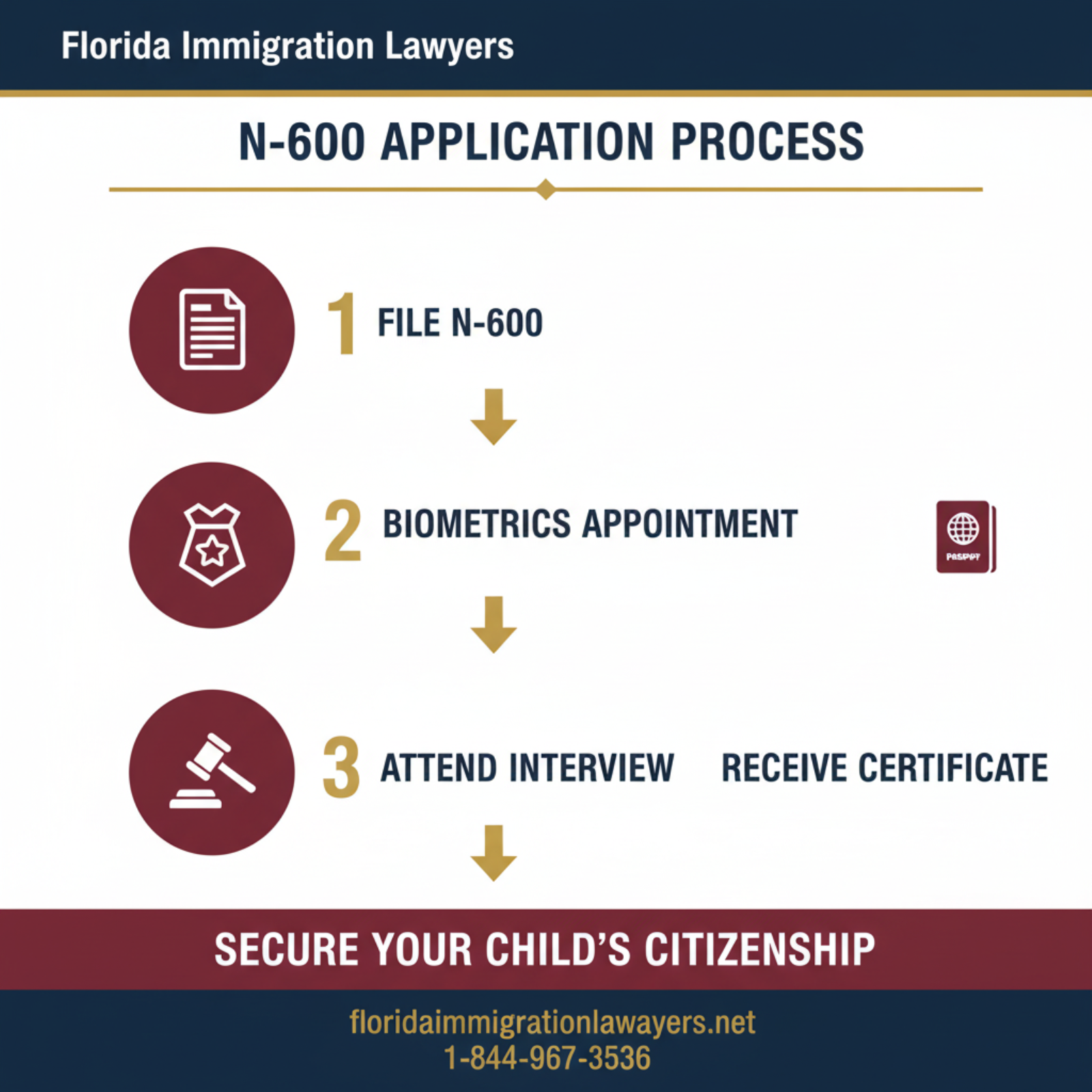
Once your child has met the criteria for derived citizenship, the next step is to obtain official documentation of their status. This usually involves applying for a Certificate of Citizenship (Form N-600). Here is a step-by-step guide to help Florida families through the process:
- Confirm Eligibility: Before beginning, ensure your child meets all the criteria under INA Section 320 (8 U.S.C. § 1431). This includes having a U.S. citizen parent, being under 18, holding lawful permanent resident status, and residing in the U.S. in the legal and physical custody of the U.S. citizen parent.
- Gather Required Documents: Collect all necessary supporting evidence. This includes proof of the parent's U.S. citizenship, the child's birth certificate, proof of the child's lawful permanent resident status (e.g., green card), and evidence of the parent-child relationship. We will detail these documents in the next section.
- Complete Form N-600, Application for Certificate of Citizenship: Fill out the Form N-600 accurately and completely. This form is used to apply for a Certificate of Citizenship, which serves as official proof of your child's U.S. citizenship. Pay close attention to all sections and provide truthful information.
- Pay the Filing Fee: Submit the required filing fee with your application. USCIS fees are subject to change, so always check the most current fee schedule on the USCIS website for Form N-600. Fee waivers may be available for eligible applicants.
- Mail the Application Packet: Send the completed Form N-600, all supporting documents, and the fee to the appropriate USCIS Lockbox facility. The specific mailing address depends on where you live and the service you are using (U.S. Postal Service or express mail). Always verify the correct address on the USCIS website.
- Attend Biometrics Appointment (If Required): USCIS may require your child to attend a biometrics appointment at an Application Support Center (ASC) in Florida, such as those in West Palm Beach, Orlando, or Miami. This appointment is for collecting fingerprints, photographs, and signatures.
- Attend Interview (If Required): In some cases, USCIS may schedule an interview for the child and/or the U.S. citizen parent at a local field office. This is to verify information and clarify any discrepancies. Prepare to answer questions about your family history and residency.
- Receive Decision: After USCIS reviews the application and any interviews, they will issue a decision. If approved, your child will receive a Certificate of Citizenship. This document is proof of their U.S. citizenship and can be used to apply for a U.S. passport.
Navigating these steps requires careful attention to detail. Any errors or omissions can lead to delays or even denials. Seeking guidance from an experienced immigration attorney in Florida can significantly streamline this process.
Essential Document Checklist for Derived Citizenship
To successfully prove derived citizenship for your child, meticulous documentation is crucial. Having all necessary papers organized and readily available will help prevent delays. Here is a comprehensive checklist of documents typically required when filing Form N-600:
- Child's Birth Certificate: Original or certified copy, showing the child's birth information and parentage.
- Child's Lawful Permanent Resident Card (Green Card): Front and back copy of Form I-551, proving the child's green card status.
- Parent's Proof of U.S. Citizenship:
- U.S. Birth Certificate (if citizen by birth).
- Certificate of Naturalization (Form N-550 or N-570) (if citizen by naturalization).
- U.S. Passport.
- Form FS-240 (Report of Birth Abroad of a Citizen of the United States of America).
- Parent's Marriage Certificate: If applicable, to prove the legal marital relationship between the parents.
- Proof of Legal and Physical Custody:
- Court orders regarding custody.
- School records, medical records, or other documents showing the child lives with the U.S. citizen parent.
Step-by-Step Process Guide - Proof of Residence: Documents demonstrating the child's residence in the U.S. with the U.S. citizen parent (e.g., utility bills, lease agreements, school enrollment records).
- Divorce Decrees or Death Certificates: If applicable, for any previous marriages of the U.S. citizen parent or if one parent is deceased.
- Adoption Decree: If the child was adopted by the U.S. citizen parent.
- Photographs: Two identical passport-style photographs of the child.
- Previously Issued Certificates: Any prior Certificates of Citizenship or Naturalization for the child or parents, if applicable.
All foreign language documents must be accompanied by a complete English translation certified by a competent translator. Missing or incorrect documents are a common reason for RFEs (Requests for Evidence) and processing delays. Our team at Florida Immigration Lawyers can help you compile and review your documentation.
Timeline and Processing Expectations for Derived Citizenship in Florida (2026)
Understanding the timeline for derived citizenship applications can help manage expectations. While USCIS aims for efficiency, processing times can vary significantly based on several factors, including the volume of applications, the complexity of the case, and the specific USCIS field office handling the review.
Current Processing Times
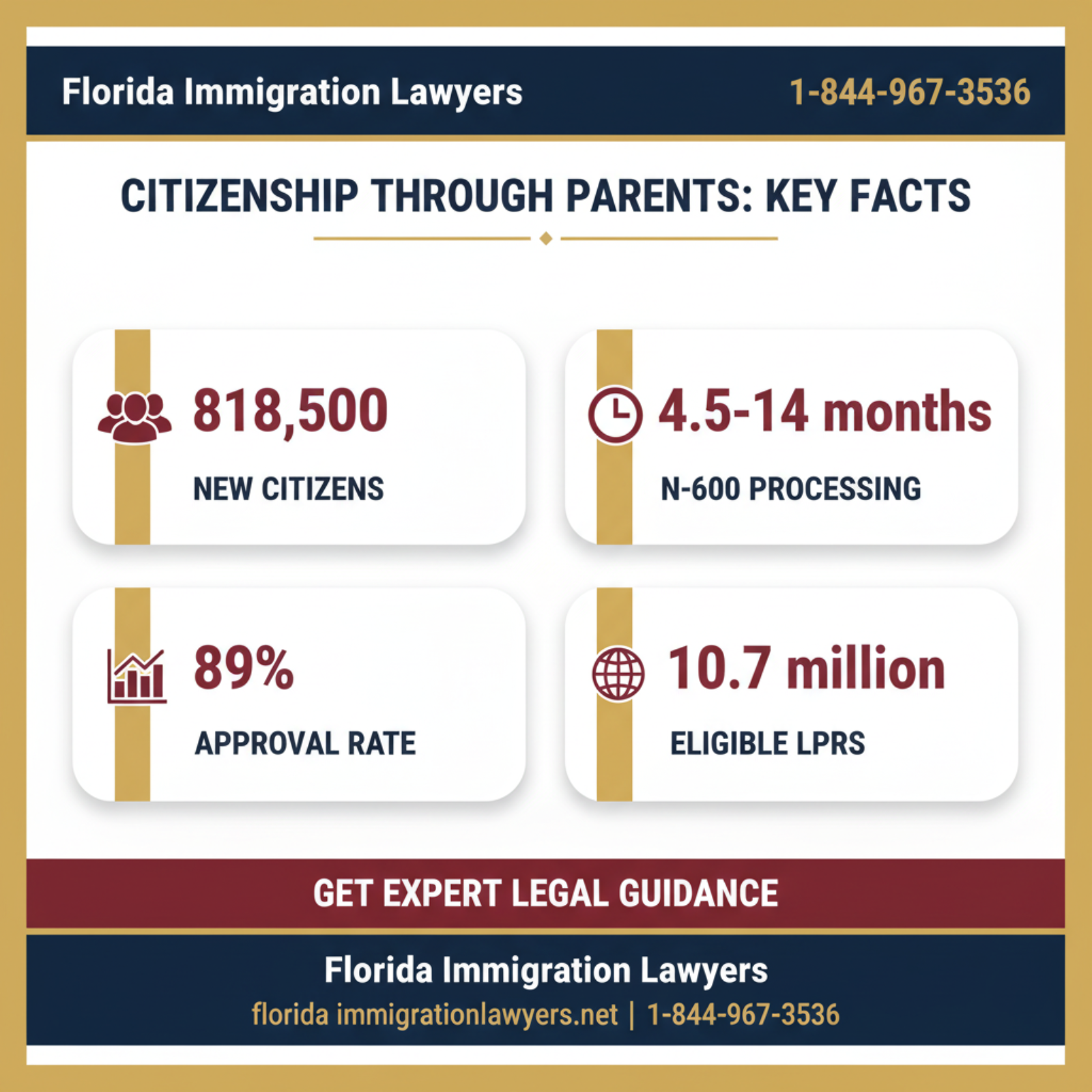
As of 2026, general processing times for Form N-600, Application for Certificate of Citizenship, can range from 6 months to over 2 years. You can check the most up-to-date processing times for your specific USCIS field office or service center on the official USCIS website. For Florida residents, this might involve offices serving areas like West Palm Beach, Miami, or Orlando.
Factors that can influence processing times include:
- Completeness of Application: A fully completed application with all required supporting documents will generally be processed faster.
- Requests for Evidence (RFEs): If USCIS issues an RFE, it will pause your application's processing until you submit the requested information, adding significant delays.
- Interview Requirements: If an interview is required, scheduling can add several weeks or months to the overall timeline.
- Background Checks: All applicants undergo background checks, and any issues can prolong the process.
What to Expect After Filing
After filing your N-600 application, you will typically receive a receipt notice (Form I-797C, Notice of Action) within a few weeks. This notice confirms that USCIS has received your application and provides a receipt number you can use to track your case online.
Next, your child may receive an appointment notice for biometrics collection. This usually happens within a few months of filing. If an interview is deemed necessary, you will receive a separate notice with the date, time, and location. Finally, upon approval, you will receive the Certificate of Citizenship.
It is important to remain patient during this process. While delays can be frustrating, responding promptly and accurately to any USCIS requests is crucial. For specific concerns about delays in Florida, consulting with Florida Immigration Lawyers can provide clarity and potential solutions.
Cost Factors and Fee Breakdown for Derived Citizenship
Applying for a Certificate of Citizenship involves certain fees. Understanding these costs beforehand can help you prepare financially for the process. It is important to remember that USCIS fees are subject to change, so always verify the current amounts on the official USCIS website.
USCIS Filing Fees
The primary cost associated with documenting derived citizenship is the filing fee for Form N-600, Application for Certificate of Citizenship. This fee is paid directly to the U.S. Citizenship and Immigration Services (USCIS) when you submit your application. There is a separate fee for Form N-600K, Application for Citizenship and Issuance of Certificate Under Section 322.
As a general safety rule, we do not provide specific dollar amounts for USCIS fees as they can change. Please refer to the USCIS website for current fee information. It is crucial to submit the correct fee; incorrect amounts can lead to your application being rejected and returned.
In some limited circumstances, applicants may be eligible for a fee waiver. Eligibility for fee waivers is based on income and other specific criteria. You would file Form I-912, Request for Fee Waiver, along with your N-600 application if you believe you qualify.
Additional Potential Costs
Beyond the USCIS filing fee, other costs may arise during the process:
- Biometrics Fee: While often included in the N-600 filing fee, sometimes a separate biometrics fee might apply or be included in other forms if filed concurrently.
- Document Translation Fees: If any of your supporting documents are not in English, you will incur costs for certified translations.
- Photographs: Passport-style photos for the application will have a small associated cost.
- Mailing Costs: Fees for certified mail or courier services to send your application securely to USCIS.
- Legal Fees: Engaging an experienced immigration attorney, such as those at Florida Immigration Lawyers, will involve legal fees. While an investment, this often saves time, prevents mistakes, and improves the likelihood of a smooth process.
While the legal fees are an additional expense, the peace of mind and expert guidance provided by an attorney can be invaluable. Our firm offers transparent fee structures and free initial consultations to discuss your specific needs in Florida.
The journey to securing your child's U.S. citizenship is a significant one, filled with detailed requirements and potential complexities. Do not navigate this process alone. Contact Florida Immigration Lawyers today to ensure every step is handled with precision and expertise. We are here to support families in West Palm Beach and throughout Florida.
Common Mistakes to Avoid When Seeking Derived Citizenship
Applying for a Certificate of Citizenship can be a straightforward process if all requirements are met and the application is properly prepared. However, several common mistakes can lead to significant delays or even denial. Be aware of these pitfalls:
- Misunderstanding Eligibility Requirements: One of the most frequent errors is assuming eligibility without thoroughly reviewing the criteria under INA Section 320. Forgetting that the child must be a lawful permanent resident or reside in the U.S. in the parent's custody at the time the parent naturalizes (or on/after Feb 27, 2001) can halt the process.
- Incomplete or Inaccurate Form N-600: Failing to fill out every section of Form N-600 completely and accurately. Any blank fields or inconsistent information can trigger a Request for Evidence (RFE) or outright denial.
- Insufficient Supporting Documentation: Not providing all required evidence, such as proof of the parent's citizenship, the child's LPR status, or the parent-child relationship. Missing documents like birth certificates, marriage certificates, or adoption decrees are common issues.
- Incorrect Filing Fees: Submitting an incorrect filing fee or failing to include it. USCIS strictly enforces fee requirements, and an incorrect payment will result in the return of your entire application packet.
- Poor Quality or Missing Translations: Submitting foreign language documents without certified English translations. Every document not in English must be accompanied by a full and accurate translation, along with a translator's certification.
- Failing to Prove Legal and Physical Custody: Not adequately demonstrating that the child is residing in the legal and physical custody of the U.S. citizen parent. This is a critical requirement under the CCA.
- Applying for the Wrong Type of Citizenship: Confusing derived citizenship with acquired citizenship or naturalization. This can lead to filing the wrong form or pursuing an incorrect legal strategy.
- Ignoring Deadlines for RFEs: If USCIS sends a Request for Evidence, failing to respond within the specified timeframe. Missing this deadline almost always results in a denial.
- Not Updating USCIS of Address Changes: Moving without notifying USCIS of a change of address. This can lead to missed notices, interviews, or decisions, severely impacting your case.
- Lack of Attorney Review: Attempting to navigate the complex immigration system without the guidance of an experienced attorney. A lawyer can identify potential issues, ensure all documents are correct, and represent your interests.
Avoiding these common errors is key to a smooth application process. Florida Immigration Lawyers can provide the expertise needed to meticulously prepare and submit your application.
When to Call a Florida Immigration Lawyer for Derived Citizenship
While the concept of derived citizenship is designed to be automatic, the process of proving it and obtaining the Certificate of Citizenship can be intricate. There are many scenarios where the expertise of an experienced immigration lawyer is not just helpful, but essential. Florida Immigration Lawyers are dedicated to guiding families through these complexities.
Specific Scenarios Requiring Legal Help:
- Complex Family Situations: If the child was born out of wedlock, adopted, or if the U.S. citizen parent naturalized after the child turned 18.
- Divorce or Custody Issues: If there are questions about legal or physical custody of the child, especially in cases of divorce or separation.
- Criminal History: If the child or the U.S. citizen parent has any criminal record, which could impact eligibility or admissibility.
- Previous Immigration Denials: If a prior application for citizenship or other immigration benefit for the child was denied.
- Documentation Challenges: If you are struggling to obtain necessary documents from abroad or to prove your relationship.
- Residency Issues: If there are questions about whether the child "resided in the United States" with the U.S. citizen parent for the required period.
- Travel History Concerns: If the child has extensive travel history outside the U.S. that could raise questions about their continuous residence.
- Expedited Processing Needs: In rare cases where an urgent need for the Certificate of Citizenship arises, an attorney can help explore options.
Warning Signs and Red Flags:
Any of the following situations should prompt you to seek legal counsel immediately:
- You receive a Request for Evidence (RFE) from USCIS.
- Your application is denied.
- You receive a Notice of Intent to Deny (NOID).
- USCIS schedules an interview and you feel unprepared.
- There are significant delays in your case beyond published processing times without clear explanation.
- You are unsure about any part of the eligibility criteria or documentation.
The attorneys at Florida Immigration Lawyers have extensive experience with derived citizenship cases across Florida, including West Palm Beach. We can assess your unique situation, prepare a robust application, respond to USCIS inquiries, and represent your family's best interests. Our goal is to make the process as smooth and successful as possible for your child.
About Florida Immigration Lawyers
Florida Immigration Lawyers is a leading immigration law firm dedicated to serving individuals and families throughout Florida. With a deep understanding of U.S. immigration laws and a commitment to our clients, we strive to provide exceptional legal representation and compassionate support.
Our Services
We offer a comprehensive range of immigration legal services, including but not limited to: family-based immigration, business immigration, asylum applications, deportation defense, citizenship and naturalization, and visa petitions. Our attorneys are equipped to handle complex cases and provide strategic advice tailored to your unique circumstances.
Why Choose Us?
Choosing the right immigration attorney is crucial for your future. At Florida Immigration Lawyers, we offer:
- Expertise: Our team possesses extensive knowledge of immigration law and stays updated on the latest policy changes.
- Client-Centered Approach: We prioritize your needs and communicate clearly throughout the entire process.
- Proven Track Record: We have a history of successfully helping clients achieve their immigration goals.
- Accessibility: We are available 24/7 to address your urgent concerns and offer free consultations to get you started.
- Bilingual Services: Our team is fluent in English and Spanish, ensuring effective communication for a diverse clientele.
We are proud to serve all of Florida, assisting clients from West Palm Beach to Jacksonville, Orlando, Tampa, and Miami. Your family's future is our priority.
Visit our website at https://www.floridaimmigrationlawyers.net or call us anytime at 1-844-967-3536 to schedule your free consultation.
Sources and References
- U.S. Citizenship and Immigration Services (USCIS)
- USCIS Form N-600, Application for Certificate of Citizenship
- USCIS Processing Times
- USCIS Filing Fees
- Executive Office for Immigration Review (EOIR)
- 8 U.S.C. Chapter 12 - Immigration and Nationality Act (INA)
- INA Section 320 (8 U.S.C. § 1431) - Citizenship of children born outside the United States and residing permanently in the United States.
- INA Section 322 (8 U.S.C. § 1433) - Children born outside the United States; naturalization requirements.
- 8 CFR Part 320 - Regulations for automatic acquisition of citizenship for children.
- 8 CFR Part 322 - Regulations for naturalization of children.
This article provides general legal information and is not intended as legal advice. Every case is unique, and outcomes depend on specific facts and circumstances. Contact an attorney for advice about your particular situation.
Do not leave your child's future to chance. Navigating the complexities of derived citizenship requires precise legal knowledge and careful preparation. For expert guidance and dedicated representation in Florida, trust the experienced team at Florida Immigration Lawyers.
Call us today at 1-844-967-3536 for a free, confidential consultation. Se Habla Español - Estamos aquí para ayudarle.
Need help with Immigration?
Our Florida immigration attorneys offer free consultations. Call today or schedule online.
Frequently Asked Questions
Florida Immigration Lawyers
Legal Team
Our experienced attorneys at Florida Immigration Lawyers have been serving clients across Florida for over 20 years. We specialize in immigration, personal injury, criminal defense, workers compensation, and family law.