Consular Processing for Florida Applicants: Your 2026...
Navigating consular processing from Florida in 2026 requires understanding a multi-stage process involving USCIS, the National Visa Center (NVC), and a final embassy interview abroad. This comprehensive guide details each step, from petition filing and document submission to timelines and cost factors. We explore essential documents, common mistakes to avoid, and crucial situations when legal counsel is indispensable. Florida Immigration Lawyers provides expert assistance to ensure a smooth journey toward obtaining an immigrant visa and achieving lawful permanent residency for applicants and their beneficiaries.

Consular processing is the pathway for individuals outside or ineligible for adjustment of status within the U.S. to obtain an immigrant visa at a U.S. embassy or consulate abroad. For Florida applicants sponsoring relatives or employees, this process ensures legal permanent residency is granted overseas before entry. It involves USCIS, the National Visa Center (NVC), and a final interview.
- It is for applicants residing outside the U.S. or those ineligible for Adjustment of Status.
- Involves a multi-stage process with USCIS, NVC, and a U.S. embassy or consulate.
- Requires comprehensive documentation and a mandatory interview abroad.
- Can lead to obtaining an immigrant visa, allowing legal entry and permanent residency in the U.S.
- Expert legal guidance is crucial for navigating complexities and avoiding delays.
Are you a Florida resident sponsoring a family member or employee for an immigrant visa, and the beneficiary lives abroad? Or perhaps you are an applicant in Florida who needs to pursue your visa through an overseas U.S. consulate? Navigating the U.S. immigration system can feel overwhelming, especially when it involves international travel and multiple government agencies.
Understanding the intricacies of consular processing is crucial for a successful outcome. This comprehensive guide from Florida Immigration Lawyers will walk you through every step of the consular processing journey for 2026. We will cover everything from initial petition filing to the final embassy interview, specifically addressing the needs of Florida applicants.
Do not navigate this complex path alone. For personalized guidance and to ensure your application is handled correctly, call Florida Immigration Lawyers at 1-844-967-3536 for a free consultation. Our experienced team is here to help you and your family.
Understanding Consular Processing for Florida Residents
For many individuals seeking to immigrate to the United States, consular processing is the essential pathway. This process is typically required when the applicant resides outside the U.S. or is ineligible to adjust their status while within the country. It culminates in an interview at a U.S. embassy or consulate in their home country.
Florida, with its diverse population and strong international ties, sees countless residents sponsoring loved ones or employees through this route. Whether you are in Tallahassee, Miami, Orlando, or anywhere else in the Sunshine State, understanding this process is vital for those you wish to bring to the U.S.
What Exactly is Consular Processing?
Consular processing refers to the procedure where an individual applies for an immigrant visa at a U.S. embassy or consulate abroad. This is distinct from "adjustment of status," where an applicant applies for a Green Card while already present in the United States. The legal framework for this process is primarily found in the Immigration and Nationality Act (INA), specifically INA 221(a) (8 U.S.C. § 1201(a)) and further outlined in 8 CFR § 42.1.
The goal is to obtain an immigrant visa stamp in the applicant's passport. This visa allows them to travel to the U.S. and be admitted as a lawful permanent resident. Upon entry, they will receive their physical Green Card.
Who Typically Needs Consular Processing?
You will generally pursue consular processing if you are living outside the United States. This also applies if you are currently in the U.S. but entered without inspection, overstayed a visa by a significant margin, or are otherwise ineligible for adjustment of status. Many family-based and employment-based immigrant visa applicants fall into this category.
Florida residents sponsoring relatives often find their beneficiaries require this path because the family member lives overseas. Our firm frequently assists clients throughout Florida in navigating these international applications efficiently.
The Step-by-Step Consular Processing Journey
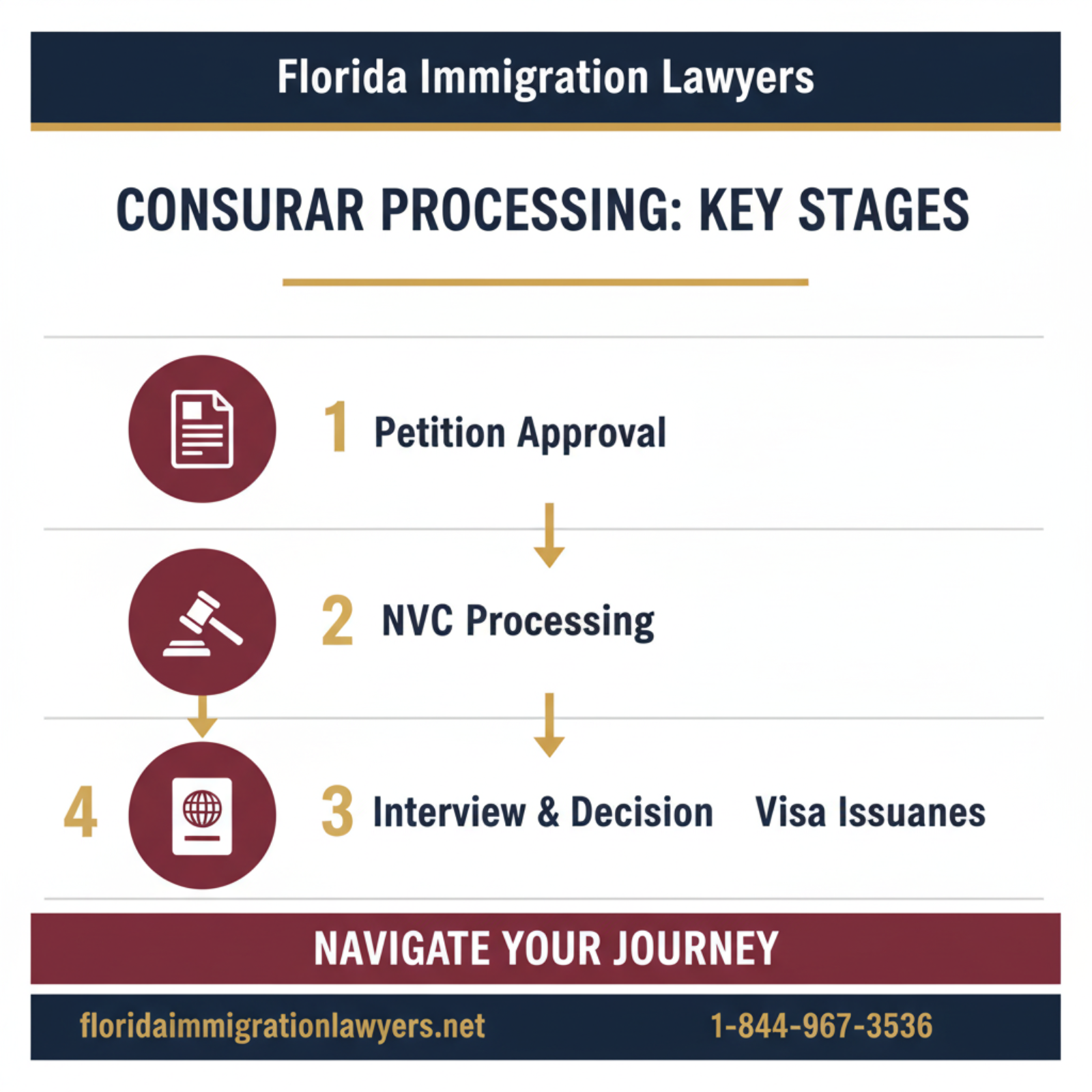
Embarking on the consular processing journey involves several critical stages, each with its own requirements and potential complexities. Understanding each step can help you prepare and avoid common pitfalls. Here is a detailed breakdown of the process for 2026:
- Step 1: Filing the Immigrant Petition (USCIS)
The process begins when a U.S. citizen or lawful permanent resident (the petitioner) files an immigrant petition with U.S. Citizenship and Immigration Services (USCIS). This is typically Form I-130, Petition for Alien Relative, for family-based immigration, or Form I-140, Immigrant Petition for Alien Worker, for employment-based cases. - Step 2: USCIS Approval and Transfer to NVC
Once USCIS approves your petition, they will send it to the National Visa Center (NVC). The NVC is a component of the Department of State that handles pre-processing of immigrant visa applications. They will assign a case number and invoice ID number, which are essential for accessing your case online. - Step 3: NVC Processing and Fee Payments
The NVC will send instructions for paying the required fees. These include the Immigrant Visa Application Processing Fee and the Affidavit of Support Fee. You must pay these fees online through the NVC Consular Electronic Application Center (CEAC) portal. - Step 4: Submitting Required Documents to NVC
After paying the fees, the applicant and petitioner must submit all required civil documents and financial documents to the NVC. This includes the online Immigrant Visa Application, Form DS-260, completed by the visa applicant. All supporting civil documents must be scanned and uploaded to CEAC. - Step 5: NVC Review and Interview Scheduling
The NVC will review all submitted documents for completeness. If everything is in order, your case will be deemed "documentarily qualified." The NVC will then schedule an interview at the appropriate U.S. embassy or consulate, based on visa availability according to the Visa Bulletin and the applicant's country of residence. - Step 6: Medical Examination and Interview Preparation
Before your scheduled interview, you must undergo a medical examination with an authorized panel physician in the country where the interview will take place. This examination is mandatory, and you will receive instructions directly from the NVC or the embassy website. Thoroughly prepare for your interview by gathering all original documents. - Step 7: Attending the Embassy Interview
This is the final and often most nerve-wracking step. The applicant attends an embassy interview with a consular officer at the U.S. embassy or consulate. The officer will review your application, verify your documents, and ask questions to determine your eligibility for an immigrant visa. Honesty and clarity are paramount during this interview. - Step 8: Visa Issuance and Entry to the U.S.
If the interview is successful and the consular officer approves your application, your immigrant visa will be stamped into your passport. You will receive a sealed visa packet, which you must hand to the Customs and Border Protection (CBP) officer upon your first entry into the United States. Upon entry, you become a lawful permanent resident, and your Green Card will be mailed to your U.S. address.
Essential Documents for Your Immigrant Visa Application
Successfully navigating consular processing hinges on providing a complete and accurate set of documents. Missing or incorrect paperwork is a leading cause of delays or even denials. Ensure you have the following essential documents ready for submission to the NVC and for your interview:
- Petition Approval Notice: Form I-797, Notice of Action, showing the approval of your I-130 or I-140 petition.
- Valid Passport: Your passport must be valid for at least six months beyond your intended date of entry into the United States.
- Birth Certificates: Original or certified copies for the applicant and all derivative family members.
- Marriage Certificates: If applicable, for the applicant and any derivative spouses. Divorce decrees or death certificates for previous marriages must also be provided.
- Police Certificates: From all countries where the applicant has lived for certain periods, typically since age 16.
- Affidavit of Support (Form I-864) and Supporting Financial Documents: Filed by the petitioner (sponsor), along with tax transcripts, W-2s, and employment letters to prove financial ability.
- Medical Examination Report: Completed by an embassy-approved panel physician. This report is usually sent directly to the embassy or given to you in a sealed envelope.
- Two Passport-Style Photographs: Meeting specific U.S. Department of State requirements.
- Confirmation Page of DS-260, Immigrant Visa Application: The online application you submitted to the NVC.
- Court and Prison Records: If you have any criminal history, even minor offenses.
- Military Records: If applicable.
Always check the specific requirements outlined by the NVC and the U.S. embassy or consulate where your interview will take place. Requirements can vary slightly by location and visa category.
Consular Processing Timelines and Expectations (2026)
One of the most common questions Florida applicants have is, "How long will consular processing take?" The truth is, there is no single answer, as timelines can vary significantly. Several factors influence the overall duration, and it is essential to manage your expectations for 2026.
General Timeline Factors
The total time from initial petition filing to visa issuance can range from several months to several years. Key factors include:
- Visa Category: Immediate relatives (spouses, unmarried children under 21, and parents of U.S. citizens) typically have faster processing times as immigrant visas are always available. Other family preference categories and employment-based categories are subject to annual numerical limits.
- Country of Origin: Processing times can differ based on the caseload and efficiency of the specific U.S. embassy or consulate.
- NVC Backlog: The National Visa Center processes thousands of cases. Delays can occur if there is a high volume of applications or if documents are incomplete.
- Petitioner's Financial Standing: Issues with the Affidavit of Support can cause significant delays.
- Applicant's Background: Any criminal history, previous immigration violations, or medical inadmissibility issues will prolong the process, often requiring waivers.
Visa Bulletin and Priority Dates
For preference categories, visa availability is determined by the monthly Visa Bulletin published by the Department of State. Your "priority date" is the date USCIS received your initial petition. You cannot proceed to the interview stage until your priority date becomes current. This is a crucial aspect of consular processing time.
It is vital to monitor the Visa Bulletin regularly to understand when your case might become current. Our attorneys at Florida Immigration Lawyers can help you interpret the bulletin and understand its implications for your specific situation.
Average Processing Times
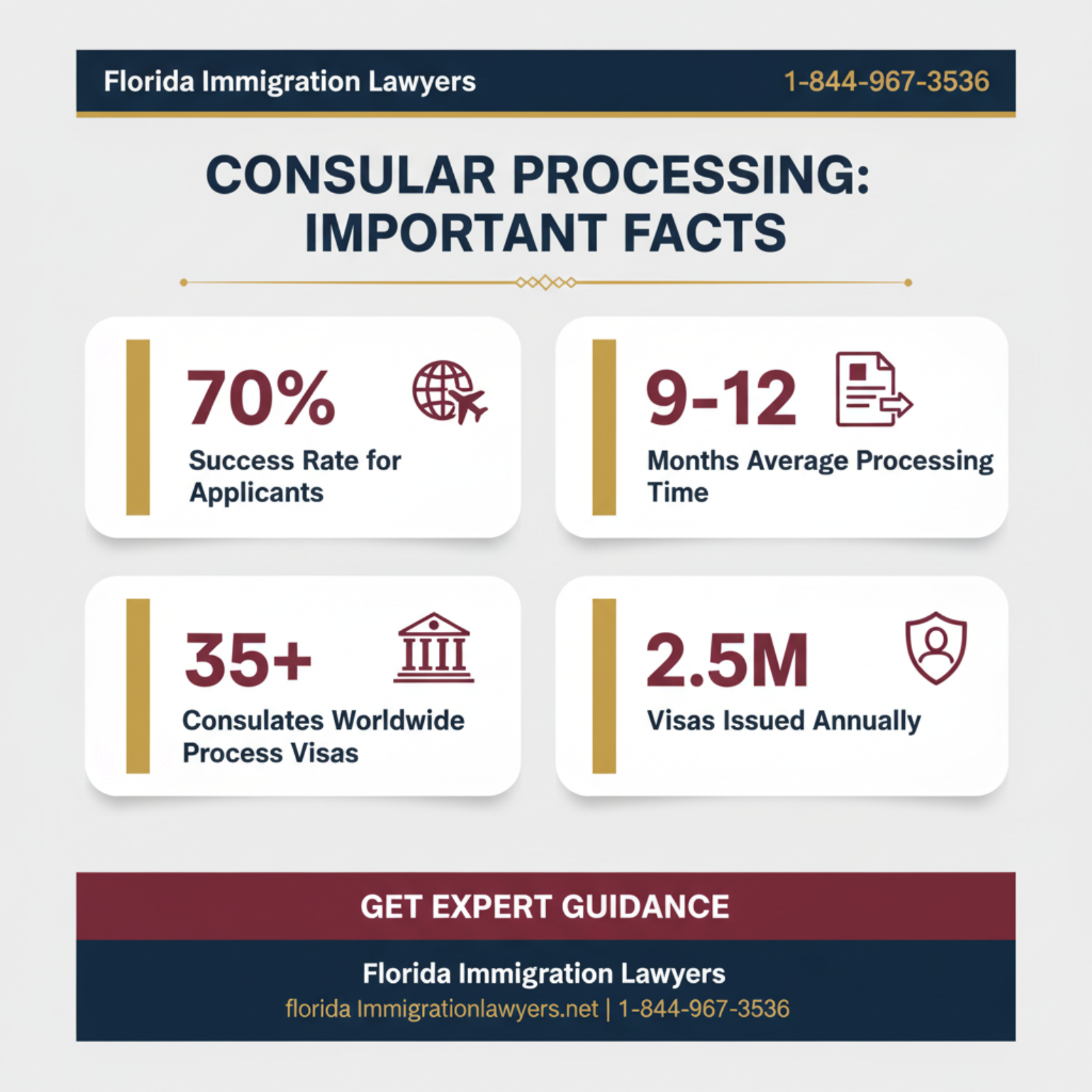
While specific guarantees are impossible, here's a general breakdown for 2026:
- USCIS Petition (I-130/I-140): 6 months to 2 years, depending on the service center and petition type.
- NVC Processing: 2-6 months after USCIS approval, assuming all documents are submitted promptly and correctly.
- Interview Scheduling & Visa Issuance: 1-4 months after NVC documentarily qualifies the case, depending on embassy availability and visa category.
Overall, immediate relative cases often conclude within 12-18 months from start to finish, while preference categories can take several years due to visa backlogs. This is why professional guidance is invaluable.
Understanding Consular Processing Costs and Fee Breakdown
Beyond the time commitment, consular processing involves various fees that applicants and petitioners must consider. These costs are subject to change, so it is always best to check the official USCIS and Department of State websites for the most current amounts. Here is a breakdown of the typical expenses you can expect:
- USCIS Petition Filing Fee: This is paid when the initial I-130 or I-140 petition is filed. The fee varies by petition type.
- NVC Immigrant Visa Application Processing Fee: Paid to the Department of State for processing the DS-260 application.
- Affidavit of Support Fee (Form I-864): A separate fee for processing the financial sponsorship documents.
- Medical Examination Fee: Paid directly to the panel physician. This fee is set by the individual physician and country, so it varies widely.
- USCIS Immigrant Fee: Paid after the immigrant visa is issued and before traveling to the U.S. This fee covers the cost of producing and mailing the Green Card.
- Attorney Fees: While not government fees, legal fees for an experienced immigration attorney are a crucial investment. Florida Immigration Lawyers offers comprehensive services to manage your case, saving you time, stress, and potential costly errors.
- Other Potential Costs: This can include translation services for foreign documents, travel expenses to the medical exam and interview, and postage.
Budgeting for these costs is an important part of your immigration planning. Our team can help you understand the financial aspects involved and ensure all fees are paid correctly and on time.
Do not navigate this complex process alone. The stakes are too high to risk errors or delays. Contact Florida Immigration Lawyers today at 1-844-967-3536 for expert assistance with your consular processing case. We are here to provide the clarity and support you need.
Common Mistakes Florida Applicants Must Avoid in Consular Processing
Even a minor error in the consular processing journey can lead to significant delays, requests for additional evidence, or even a denial. Florida applicants should be particularly vigilant to avoid these common mistakes:
- Submitting Incomplete or Incorrect Documentation: Missing birth certificates, outdated police records, or improperly filled forms are frequent issues. This will cause NVC to reject your documents and delay your case significantly.
- Providing Inconsistent Information: Discrepancies between your current application and previous immigration forms, or even social media, can raise red flags with consular officers. Always be truthful and consistent.
- Failing to Meet Financial Sponsorship Requirements: The Affidavit of Support (Form I-864) is critical. If the petitioner's income or assets do not meet the poverty guidelines, or if the form is incorrectly filled, the case will be delayed or denied on public charge grounds (INA 212(a)(4), 8 U.S.C. § 1182(a)(4)).
- Missing Deadlines: The NVC provides specific deadlines for fee payments and document submissions. Missing these can lead to case termination, requiring you to start the entire process over.
- Poor Interview Preparation: Arriving unprepared for the embassy interview, not having original documents, or being unable to clearly answer questions can result in a denial or a request for more evidence.
- Not Disclosing All Relevant Information: Attempting to hide a criminal record, previous immigration violation, or medical condition is a severe offense. It can lead to a permanent bar from the U.S. for misrepresentation (INA 212(a)(6)(C)(i)).
- Leaving the U.S. Without Proper Advice (for those already in the U.S.): If you are in the U.S. and decide to pursue consular processing, leaving the country without first understanding the potential bars to re-entry (e.g., 3/10 year bar) can have catastrophic consequences. Always consult an attorney.
- Ignoring Medical Exam Instructions: Not completing the medical exam with an approved physician or failing to follow their instructions can invalidate your results and delay your interview.
- Not Updating Contact Information: Moving without informing USCIS, NVC, or your attorney can result in missed notices and critical communications.
- Misunderstanding the Visa Bulletin: For preference categories, misinterpreting the Visa Bulletin can lead to false expectations about interview dates or even missing the window of opportunity when your priority date becomes current.
When to Call Florida Immigration Lawyers for Consular Processing
While this guide provides a comprehensive overview, consular processing is rarely a straightforward path for every applicant. The complexities of immigration law, coupled with constantly evolving policies, make professional legal assistance invaluable. If any of the following scenarios apply to you or your beneficiary, it is time to consult with Florida Immigration Lawyers:
- Complex Case History: If there have been previous visa denials, immigration violations, or issues with other U.S. government agencies.
- Criminal Record: Any criminal convictions, even minor ones, can lead to inadmissibility. An attorney can assess your situation and determine if a waiver is available.
- Previous Deportation or Removal Orders: These are serious bars to entry and require specialized legal intervention, often involving waivers like Form I-212, Application for Permission to Reapply for Admission into the United States After Deportation or Removal. Our deportation defense team can assist.
- Medical Inadmissibility Issues: Certain health conditions can make an applicant inadmissible. We can help explore waivers (e.g., Form I-601, Application for Waiver of Grounds of Inadmissibility).
- Need for Waivers: If you or your beneficiary are inadmissible for any reason, a waiver might be necessary. Applying for waivers is highly complex and requires expert legal drafting and evidence.
- Issues with NVC Processing: If your case is stuck at the NVC, documents are being rejected, or you are having trouble accessing the CEAC portal.
- Language Barriers: If the applicant or petitioner struggles with English, our bilingual team can provide clear communication and ensure all forms are understood and completed correctly.
- Uncertainty About Required Documents: We can provide a precise, tailored document checklist and ensure all submissions meet NVC and embassy standards.
- Desire for Peace of Mind: Knowing that experienced professionals are managing your case can significantly reduce stress and increase the likelihood of a positive outcome.
Our attorneys at Florida Immigration Lawyers are adept at handling even the most challenging consular processing cases. We serve clients across Florida, from Tallahassee to Miami, ensuring that your journey to a Green Card is as smooth as possible. We are committed to protecting your rights and achieving your immigration goals. Contact us today.
Frequently Asked Questions (FAQ) about Consular Processing
Here are answers to some of the most common questions Florida applicants have regarding consular processing:
How long is the consular processing process?
The duration of consular processing varies widely based on the visa category, the applicant's country of origin, and current NVC and embassy workloads. Immediate relative cases (spouses, parents, unmarried children under 21 of U.S. citizens) can take 12-18 months. Preference categories, which are subject to visa availability through the Visa Bulletin, can take several years. It is crucial to monitor the Visa Bulletin and prepare thoroughly to avoid delays.
How risky is consular processing?
Consular processing carries inherent risks, primarily due to the discretion of consular officers and the potential for inadmissibility findings. Risks include interview denials, findings of misrepresentation, or being deemed inadmissible for criminal history, medical issues, or previous immigration violations. These risks are significantly mitigated by thorough preparation and expert legal counsel from firms like Florida Immigration Lawyers.
What is the denial rate for consular processing?
There isn't a universally published "denial rate" for consular processing, as statistics vary by embassy, visa type, and year. However, common reasons for denial include incomplete documentation, inadmissibility grounds (e.g., criminal history, public charge, misrepresentation), or failing to establish a bona fide relationship or employment offer. Consulting an attorney vastly improves your chances of approval by addressing potential issues proactively.
Who qualifies for consular processing?
Individuals living outside the United States who are beneficiaries of an approved immigrant petition (Form I-130, I-140, etc.) qualify for consular processing. Additionally, individuals in the U.S. who are not eligible for Adjustment of Status (e.g., those who entered without inspection or have certain immigration violations) may also need to pursue this path. Eligibility depends on the specific visa category and adherence to all legal requirements.
About Florida Immigration Lawyers
Florida Immigration Lawyers is a leading immigration law firm dedicated to serving individuals and families across the entire state of Florida. Our experienced team of attorneys understands the complexities and emotional challenges often associated with immigration matters. We are committed to providing compassionate, effective, and results-driven legal representation.
We offer a comprehensive range of immigration services, including family-based immigration, employment visas, deportation defense, asylum, citizenship applications, and, of course, expert guidance through the intricate consular processing pathway. Our firm prides itself on personalized attention and clear communication, ensuring our clients are informed and supported at every stage.
Why Choose Florida Immigration Lawyers?
- Experienced Team: Our attorneys possess deep knowledge of U.S. immigration law and practice.
- Client-Centered Approach: Your goals and well-being are our top priority.
- Bilingual Services: Se Habla Español – ensuring effective communication for our diverse clientele.
- Accessibility: We are available 24/7 to address your urgent needs.
- Free Consultations: Start your journey with a no-obligation discussion of your case.
- Statewide Service: Proudly serving all of Florida, including Tallahassee, Miami, Orlando, Tampa, and Jacksonville.
Let us be your trusted partner in achieving your immigration dreams. Call us today at 1-844-967-3536 or visit our website at https://www.floridaimmigrationlawyers.net to learn more and schedule your free consultation.
Sources and References
- U.S. Citizenship and Immigration Services (USCIS)
- U.S. Department of State - Visa Bulletin
- U.S. Department of State - Immigrant Visa Process
- 8 U.S.C. Chapter 12 - Immigration and Nationality Act (INA)
- INA 212(a)(4) - Public Charge Ground of Inadmissibility
- INA 212(a)(6)(C)(i) - Misrepresentation Ground of Inadmissibility
- 8 CFR § 42.1 - General Definitions for Immigrant Visas
This article provides general legal information and is not intended as legal advice. Every case is unique, and outcomes depend on specific facts and circumstances. Contact an attorney for advice about your particular situation. Immigration laws are subject to change.
The journey through consular processing can be complex, but you do not have to face it alone. Florida Immigration Lawyers is here to provide the expert legal guidance and support you need every step of the way. Our dedicated team is ready to assist you in achieving your immigration goals.
Do not delay your path to permanent residency. Call Florida Immigration Lawyers today at 1-844-967-3536 for a free, confidential consultation. Se Habla Español - Estamos aquí para ayudarle.
Do Not Navigate This Process Alone
Our experienced immigration attorneys are ready to fight for you. Get a free, confidential consultation today.
Se Habla Español
Frequently Asked Questions
Florida Immigration Lawyers
Immigration Attorney | Founder, Vasquez Law Firm
U.S. Air Force veteran and immigration attorney with thousands of cases resolved. J.D., NCCU School of Law. AILA member. Admitted to the 4th, 5th, and 11th Circuit Courts.
Available 24/7 - Free Evaluations
Related Legal Services
Our Florida immigration attorneys can help you with immigration practice areas, free immigration consultation and experienced immigration attorneys. Call today at 1-844-967-3536 for a free consultation.
Related Links
Related Topics
Free Legal Consultation
Discuss your case with our experienced attorneys. We're available 24/7.
Se Habla Español - Estamos aquí para ayudarle.
Related Articles
Withholding of Removal Florida Defense: Your Guide
If you are facing deportation in Florida and fear persecution or torture upon return to your home country, you may be eligible for withholding of removal or protection under the Convention Against Torture (CAT). These forms of relief are crucial for individuals who cannot return safely. Understanding the strict eligibility requirements, the complex legal process, and the high burden of proof is vital for a successful defense. Florida Immigration Lawyers specializes in deportation defense, offering expert guidance to navigate these challenging cases in courts across Florida. We are here to help you protect your future and explore every possible defense.
Voluntary Departure vs Deportation in Florida | VLF Florida
Explore the differences between voluntary departure and deportation in Florida. Understand the implications for immigrants and learn when to seek legal help. Call Florida Immigration Lawyers at 1-844-967-3536.
Consular Return After Visa Denial in Florida | VLF Florida
Facing a visa denial in Florida can be daunting. Learn about the consular return process after a 221(g) notice and get professional help.
Immigration Lawyer Fort Lauderdale: Your Florida Guide 2026
Navigating immigration law in Fort Lauderdale, Florida, requires expert guidance. Our comprehensive guide for 2026 delves into why securing a skilled immigration lawyer Fort Lauderdale is essential. We cover key immigration pathways such as family-based visas, employment-based petitions, asylum claims, and crucial deportation defense strategies specific to Broward County. Learn about the step-by-step process of working with our firm, understanding the costs involved, and setting realistic expectations for timelines. We also highlight common mistakes to avoid and critical scenarios when legal counsel from Florida Immigration Lawyers becomes indispensable. Our firm offers dedicated support for individuals and families across Florida, including Hialeah, ensuring your rights are protected throughout the complex immigration system. Contact us for a free consultation to start your journey with confidence.
