Premium Processing I-140 Timelines in Florida
Explore I-140 premium processing in Florida, especially for EB-2 and EB-3 categories. Discover timelines, steps, and when to consult a lawyer. Contact Florida Immigration Lawyers for guidance.

Understanding the I-140 Petition
The I-140 petition, also known as the Immigrant Petition for Alien Worker, is a critical component of the employment-based immigration process in the United States. This petition is filed by a U.S. employer on behalf of a foreign national who seeks to work and reside permanently in the U.S.
In Florida, particularly in cities like Fort Lauderdale, the demand for skilled professionals is high, making the I-140 a common pathway for many immigrants.
The premium processing option allows for expedited adjudication, typically within 15 calendar days, offering a significant advantage in time-sensitive situations.
The I-140 petition is more than just a form; it's a formal declaration by a U.S. employer that they have a bona fide job offer for a foreign worker and that the worker meets the minimum qualifications for that position. For most EB-2 (Professionals Holding Advanced Degrees or Persons of Exceptional Ability) and EB-3 (Skilled Workers, Professionals, or Other Workers) categories, a certified Labor Certification (PERM) from the Department of Labor is a prerequisite, confirming that no qualified U.S. workers were available for the role.
This petition lays the groundwork for the foreign national to eventually apply for lawful permanent resident status, either through Adjustment of Status (Form I-485) if they are already in the U.S. or through Consular Processing if they are abroad. Understanding the nuances of each step, from PERM to I-140, is crucial for a successful outcome, and the team at Florida Immigration Lawyers can guide you through every stage.
The Role of Premium Processing
Premium processing is an optional service provided by the U.S. Citizenship and Immigration Services (USCIS), allowing for faster processing of certain immigration petitions, including the I-140. This service is particularly beneficial for those in the EB-2 and EB-3 categories who may face long wait times otherwise.
Learn more from USCISThe core advantage of premium processing lies in its guaranteed processing timeframe. While regular I-140 petitions can languish for many months, premium processing ensures a response within 15 calendar days. This accelerated timeline is invaluable for employers who need to onboard critical talent quickly or for beneficiaries whose non-immigrant visas might be expiring, necessitating a swift transition to permanent residency status.
For instance, a software engineer in Fort Lauderdale whose H-1B visa is nearing its maximum limit might opt for premium processing to ensure their I-140 is approved in time for their I-485 application, preventing potential gaps in employment authorization. This service minimizes uncertainty and allows for better long-term planning, making it a strategic investment for many businesses and individuals in Florida.
Step-by-Step Guide to Filing I-140 with Premium Processing
Filing an I-140 petition, especially with a premium processing request, demands meticulous attention to detail and a thorough understanding of USCIS requirements. This comprehensive guide outlines the essential steps to ensure a smooth and expedited process, helping you avoid common pitfalls and delays.
- Determine Eligibility: Ensure your employment category (EB-2 or EB-3) qualifies for premium processing.
- File Form I-140: Complete and submit the I-140 form along with supporting documents.
- Submit Form I-907: File the Request for Premium Processing Service (Form I-907) concurrently with your I-140 petition or separately if the I-140 is pending.
- Pay the Premium Processing Fee: Include the required fee via check or money order.
- Receive USCIS Receipt: Once submitted, you will receive a receipt notice from USCIS confirming your premium processing request.
- Adjudication within 15 Days: USCIS guarantees that within 15 calendar days, they will either approve, deny, or request further evidence.
Filing Tips
Ensure that all forms are completed accurately and all required documentation is included to avoid delays.
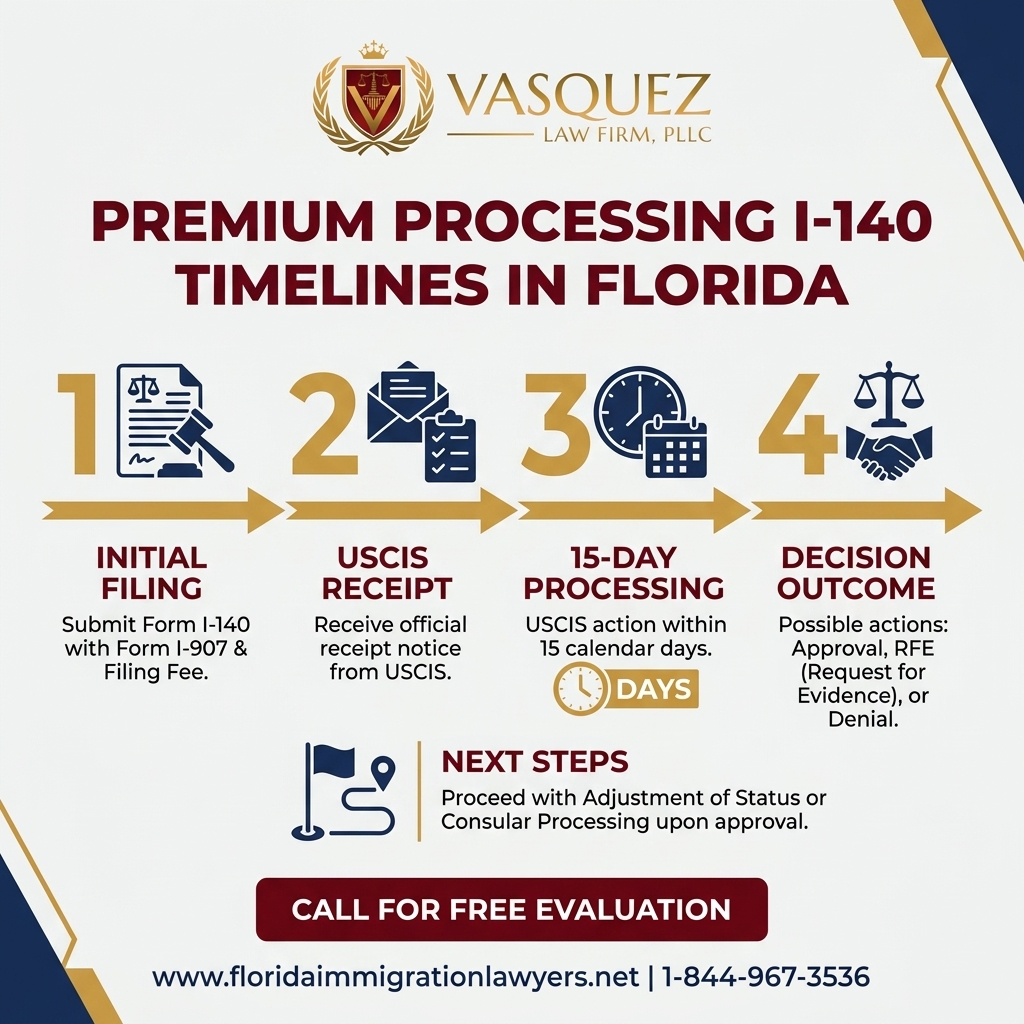
While the steps seem straightforward, each stage involves specific legal and administrative considerations. For example, accurately completing Form I-140 requires precise information about the employer, the beneficiary, and the job offer, all of which must align with the underlying Labor Certification. Any discrepancies can lead to Requests for Evidence (RFEs) or even denials, significantly delaying the process.
Many individuals find immense value in consulting with an experienced immigration attorney, such as those at Florida Immigration Lawyers, before embarking on this process. Their expertise ensures that all eligibility criteria are met, forms are correctly prepared, and all necessary supporting documents are meticulously organized, thereby maximizing the chances of a swift approval within the premium processing timeframe. They can also advise on the best strategy for your specific circumstances, whether it's concurrent filing or upgrading a pending petition.
Document Checklist for I-140 Premium Processing
A well-organized and complete documentation package is paramount for a successful I-140 premium processing application. Missing or incorrect documents are among the most common reasons for delays, RFEs, or even denials. Reviewing this checklist thoroughly will help ensure your submission is robust.
- Completed Form I-140
- Form I-907 for premium processing
- Evidence of the beneficiary's qualifications (e.g., degrees, certifications)
- Employer’s financial documentation
- Proof of job offer and labor certification
- Filing fees
Beyond simply gathering the documents, understanding the purpose of each item is crucial. For instance, evidence of the beneficiary's qualifications must directly support the requirements outlined in the Labor Certification, demonstrating that the foreign national possesses the necessary education, skills, and experience for the role. Similarly, the employer's financial documentation must clearly show their ability to pay the offered wage from the priority date until the beneficiary obtains permanent residency.
It's advisable to create a detailed checklist and cross-reference every item before submission. Consider making copies of all documents for your records. A thorough review by an immigration attorney from Florida Immigration Lawyers can help catch any omissions or errors that might otherwise jeopardize your expedited processing, ensuring that your application is as strong and complete as possible.
Timeline and Processing Expectations
With premium processing, the USCIS commits to processing the I-140 petition within 15 calendar days. This rapid timeline is crucial for applicants in Fort Lauderdale who may need quick decisions due to work obligations or travel plans.
However, if USCIS issues a Request for Evidence (RFE), the 15-day clock resets upon the submission of the requested information.
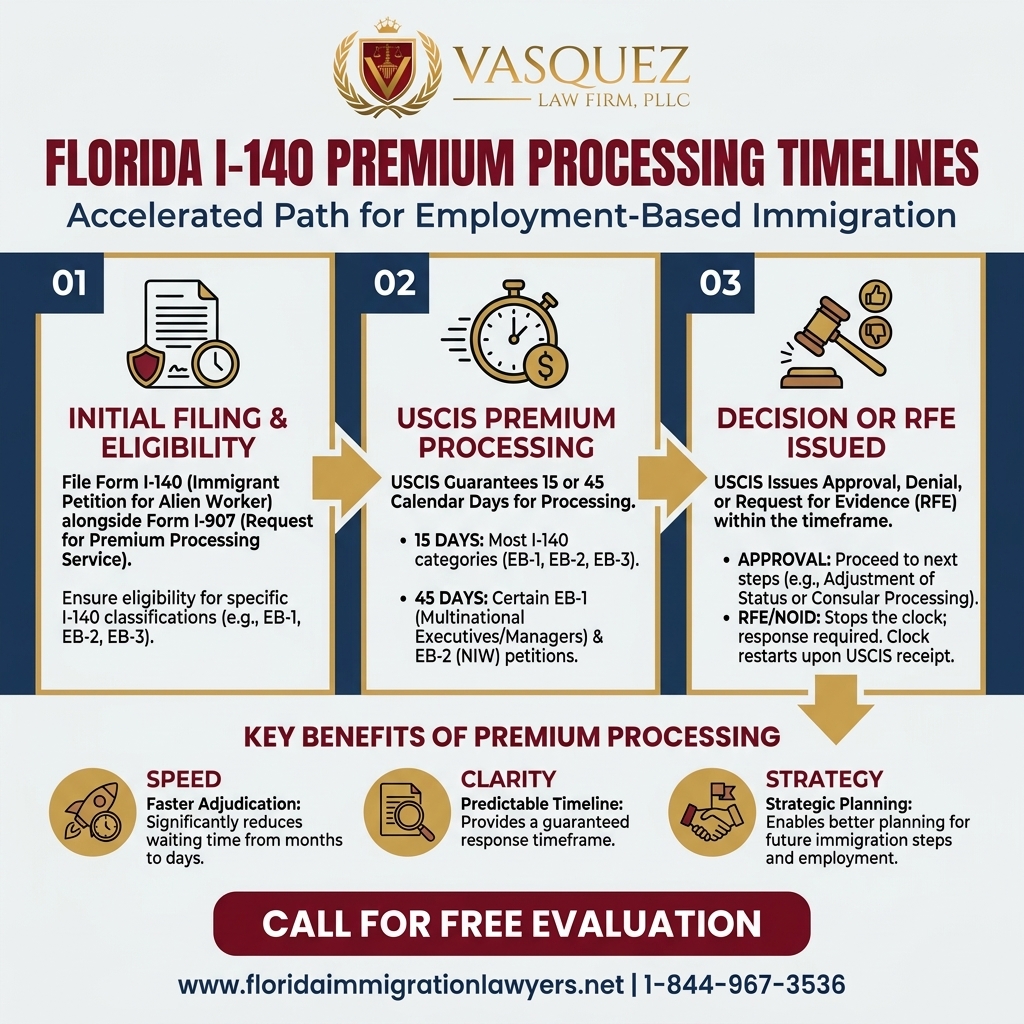
The 15-day guarantee for premium processing means USCIS will issue an approval, denial, or a Request for Evidence (RFE) within that timeframe. While an RFE means the clock resets, responding promptly and accurately is key. For example, if a hospital in Miami needs a specialized surgeon to start immediately, premium processing ensures a decision on their I-140 within two weeks, allowing for quicker progression to the final green card application.
This predictability is a significant relief for both employers and employees, enabling them to plan with greater certainty. Without premium processing, I-140 petitions can take many months, or even over a year, to be adjudicated, creating immense uncertainty and potential disruptions to employment or personal plans. Florida Immigration Lawyers can help you prepare for potential RFEs and ensure your response is comprehensive, maintaining the expedited nature of your application.
Regular Processing vs. Premium Processing
Regular processing times can vary significantly, often taking several months. Premium processing offers a predictable timeframe, which can be advantageous in planning relocations and employment transitions.
Cost Factors and Fee Breakdown
While premium processing requires an additional fee, it can be a worthwhile investment for those needing expedited results. The fee is separate from the standard filing fees and must be paid with each premium processing request.
Employers and employees should consider these costs when deciding whether to pursue premium processing for their I-140 petition.
Explore more about business immigrationThe premium processing fee is a separate charge from the base I-140 filing fee, and it's important to budget for both. While the exact amount can change, it represents a substantial investment. However, for many, the value of time saved, the certainty it provides, and the ability to quickly secure employment authorization or adjust status far outweigh the monetary cost. For instance, a tech startup in Orlando needing to secure a lead developer quickly might view the premium processing fee as a small price to pay to avoid delays that could impact project timelines and market competitiveness.
It's also important to understand who typically bears this cost. While the employer files the I-140 petition, the premium processing fee can sometimes be paid by the beneficiary, provided certain conditions are met and it doesn't violate labor certification rules. Consulting with Florida Immigration Lawyers can clarify these financial arrangements and ensure compliance with all regulations, helping both parties make informed decisions about this valuable expedited service.
Frequently Asked Questions (FAQ)
Can I apply for premium processing for all employment-based categories?
No, premium processing for I-140 is generally available for specific employment-based categories, primarily EB-1 (certain subcategories like Extraordinary Ability and Outstanding Professors/Researchers), EB-2, and EB-3. It's crucial to verify your specific subcategory's eligibility with the latest USCIS guidelines or consult Florida Immigration Lawyers at 1-844-YO-PELEO to confirm if your petition qualifies for this expedited service.
What happens if my premium processing request is denied?
If your I-140 petition is denied after premium processing, USCIS will issue a denial notice explaining the reasons for the decision. You may have options such as filing a motion to reconsider/reopen the case or filing a new petition entirely. It is highly advisable to consult an experienced immigration attorney like Florida Immigration Lawyers to understand your next steps and evaluate the best course of action based on the specific reasons for denial.
Can I upgrade a pending I-140 to premium processing?
Yes, you absolutely can upgrade a pending I-140 petition to premium processing. You would do this by filing Form I-907, Request for Premium Processing Service, and paying the required fee. USCIS will then begin the 15-calendar-day processing clock from the date they receive your I-907, providing a faster resolution for your existing petition.
Is the premium processing fee refundable if my I-140 is denied?
No, the premium processing fee is generally not refundable, even if your underlying I-140 petition is ultimately denied. The fee covers the expedited service provided by USCIS, guaranteeing a decision or action within 15 days, not the outcome of the adjudication. Therefore, it's essential to ensure your petition is as strong and complete as possible before requesting premium processing.
What is the difference between an RFE and a NOID?
An RFE (Request for Evidence) is issued when USCIS needs additional documents or information to support your petition, suggesting the case might be approvable with more data. A NOID (Notice of Intent to Deny) indicates USCIS intends to deny your petition unless you provide compelling reasons or evidence to change their decision. Both require prompt and thorough responses, and legal counsel from Florida Immigration Lawyers is highly recommended to address them effectively.
Do not navigate this process alone. Contact Florida Immigration Lawyers today.
Common Mistakes to Avoid
Even with premium processing, errors in your I-140 petition can lead to significant delays, Requests for Evidence (RFEs), or even outright denials. Being aware of these common pitfalls and taking proactive steps to avoid them is crucial for a smooth and successful outcome.
- Incomplete Forms: Ensure all required fields are filled out accurately.
- Missing Documents: Include all necessary supporting documents to prevent delays.
- Incorrect Fee Payment: Verify the fee amount and payment method.
- Not Meeting Eligibility Criteria: Confirm that your category qualifies for premium processing.
- Ignoring RFEs: Respond promptly to any Requests for Evidence from USCIS.
- Inaccurate Job Titles: Ensure job descriptions match labor certification.
- Delaying Submission: Submit forms as soon as possible to avoid expiration of job offers or certifications.
One of the most frequent mistakes is submitting incomplete forms or missing crucial supporting documents. A seemingly minor omission, such as a missing signature or an uncertified copy of a degree, can trigger an RFE, which resets the premium processing clock and adds weeks or months to your timeline. Always double-check every field and attachment before submission.
Another critical error is failing to respond adequately or promptly to a Request for Evidence (RFE). An RFE is your opportunity to address USCIS concerns, and a weak or delayed response can lead to a denial. If you receive an RFE, it's imperative to consult with an experienced immigration attorney like Florida Immigration Lawyers at 1-844-YO-PELEO immediately to formulate a comprehensive and timely reply.
When to Call a Lawyer
Consider consulting an immigration attorney if you encounter complex situations such as multiple RFEs, denial of your I-140 petition, or changes in employment status. Florida Immigration Lawyers can provide the necessary guidance to navigate these challenges effectively.
Beyond reactive situations, engaging an immigration lawyer from the outset can be a proactive measure that saves time, stress, and money in the long run. An attorney can help assess your eligibility, ensure all documentation aligns with USCIS requirements, and strategize the most efficient path forward. This is particularly true for complex cases involving unusual job duties, self-employment, or intricate corporate structures in cities like Tampa or Jacksonville.
Furthermore, if there are any changes in your employment, such as a promotion, a change in job duties, or a shift in the employer's financial situation, it's crucial to consult with legal counsel. These changes can impact the validity of your I-140 petition or subsequent I-485 application, and advice from Florida Immigration Lawyers can help you understand the implications and take appropriate action to protect your immigration journey.
About Florida Immigration Lawyers
Florida Immigration Lawyers is dedicated to assisting clients across Florida with their immigration needs. Our experienced attorneys provide personalized services, including business immigration, family immigration, and deportation defense. Contact us at 1-844-YO-PELEO or visit our website for a free consultation.
Our firm prides itself on a deep understanding of the intricacies of U.S. immigration law and a commitment to serving the diverse communities of Florida. From skilled professionals in Fort Lauderdale seeking permanent residency to families navigating complex visa applications, we offer tailored legal strategies designed for success. We are passionate about helping individuals and businesses achieve their immigration goals.
With offices strategically located to serve clients throughout the state, Florida Immigration Lawyers combines local insight with extensive legal experience. We are here to provide clear, compassionate, and effective legal representation, ensuring that your immigration journey, whether through I-140 premium processing or other pathways, is handled with the utmost care and professionalism.
Sources and References
- U.S. Citizenship and Immigration Services (USCIS)
- Executive Office for Immigration Review (EOIR)
- 8 U.S.C. Chapter 12 - Immigration and Nationality Act
Related services: immigration practice areas, family immigration services.
This article provides general legal information and is not intended as legal advice. Every case is unique, and outcomes depend on specific facts and circumstances. Contact an attorney for advice about your particular situation.
Ready to expedite your immigration process? Call Florida Immigration Lawyers at 1-844-YO-PELEO for a free consultation. Se Habla Espanol - Estamos aqui para ayudarle.
If you need legal assistance, learn more about learn about our immigration practice, or call us at 1-844-YO-PELEO for a free consultation.
Do Not Navigate This Process Alone
Our experienced immigration attorneys are ready to fight for you. Get a free, confidential case review today.
Se Habla Español
Or leave your details and we’ll call you:
Free Evaluation in 24 Hours
Or talk to us right now

AI voice assistant — available 24/7
FreeFrequently Asked Questions

William J. Vásquez
Founding Attorney · Vasquez Law Firm
U.S. Air Force veteran and immigration attorney with years of hands-on U.S. immigration experience. J.D., NCCU School of Law. AILA member. Admitted to the 4th, 5th, and 11th Circuit Courts.
Available 24/7 - Free Evaluations
Reviewed for legal accuracy by William J. Vásquez
Licensed in North Carolina; U.S. immigration is federal practice.
Related Legal Services
Our Florida immigration attorneys can help you with deportation defense, family immigration services and immigration lawyer cost in Florida. Call today at 1-844-YO-PELEO for a free case review.
Related Links
Related Topics
Free Legal Case Review
Discuss your case with our experienced attorneys. We're available 24/7.
Se Habla Español - Estamos aquí para ayudarle.
Related Articles
EB-5 Investor Green Card in Florida: A 2026 Guide
Explore how to obtain an EB-5 investor green card in Florida. Learn about the investment requirements, processes, and benefits of participating in this program. Discover how Florida's economic landscape can be an ideal setting for your investment. Contact Florida Immigration Lawyers for a free case review.
Certificate of Eligibility for Expungement in Florida 2026
For non-U.S. citizens in Florida, understanding how a state expungement impacts immigration status is critical. A certificate of eligibility for expungement in Florida allows a criminal record to be sealed or expunged under state law. However, federal immigration agencies often disregard such state-level relief, still considering the original criminal offense as a conviction for immigration purposes. This can have severe implications for visa applications, green card eligibility, naturalization, and even lead to deportation. This guide clarifies the Florida expungement process, its limited effect on federal immigration law, and key steps to protect your status in 2026. Learn about common mistakes, required documents, timelines, and when to seek expert legal counsel from Florida Immigration Lawyers to navigate these complex issues effectively.
Immigration Lawyer Orlando Free Consultation in Florida
For individuals and families in Orlando, Florida, navigating the complexities of U.S. immigration law requires expert guidance. An immigration lawyer in Orlando offers crucial support for everything from visa applications and green card processes to naturalization and deportation defense. This comprehensive guide details what a free consultation covers, providing a step-by-step overview of immigration pathways, essential document checklists, and expected timelines in 2026. We also highlight common mistakes to avoid, discuss the critical role of legal counsel in deportation and asylum cases, and explain why choosing a local Orlando immigration attorney is beneficial. Florida Immigration Lawyers is dedicated to serving the diverse community of Orlando with compassionate, effective legal solutions, ensuring you receive personalized advice and robust representation for a successful immigration journey.
F-1 Visa Guide for Florida University Students 2026
International students looking to study at Florida universities need to understand the F-1 visa process. This guide covers eligibility, application steps, required documents, and common pitfalls. Learn how Florida Immigration Lawyers can help you navigate your educational journey in the U.S.