Change of Status Student Florida: Your F-1 Visa Guide
For international individuals in Florida seeking to transition to an F-1 student visa, understanding the change of status process is crucial. This comprehensive guide from Florida Immigration Lawyers details the eligibility requirements, the step-by-step application process, and essential documentation needed for a successful submission to USCIS. We cover key aspects such as maintaining your current non-immigrant status, securing an I-20 from an SEVP-approved school, and demonstrating sufficient financial support. Learn about typical processing timelines, potential costs, and common mistakes to avoid, such as late filing or failing to show non-immigrant intent. Whether you are in Kissimmee, Orlando, or Miami, navigating these regulations can be challenging. Our firm provides expert legal assistance to streamline your application and help you achieve your academic aspirations in Florida. Contact us for a free consultation to ensure your change of status is handled correctly and efficiently.

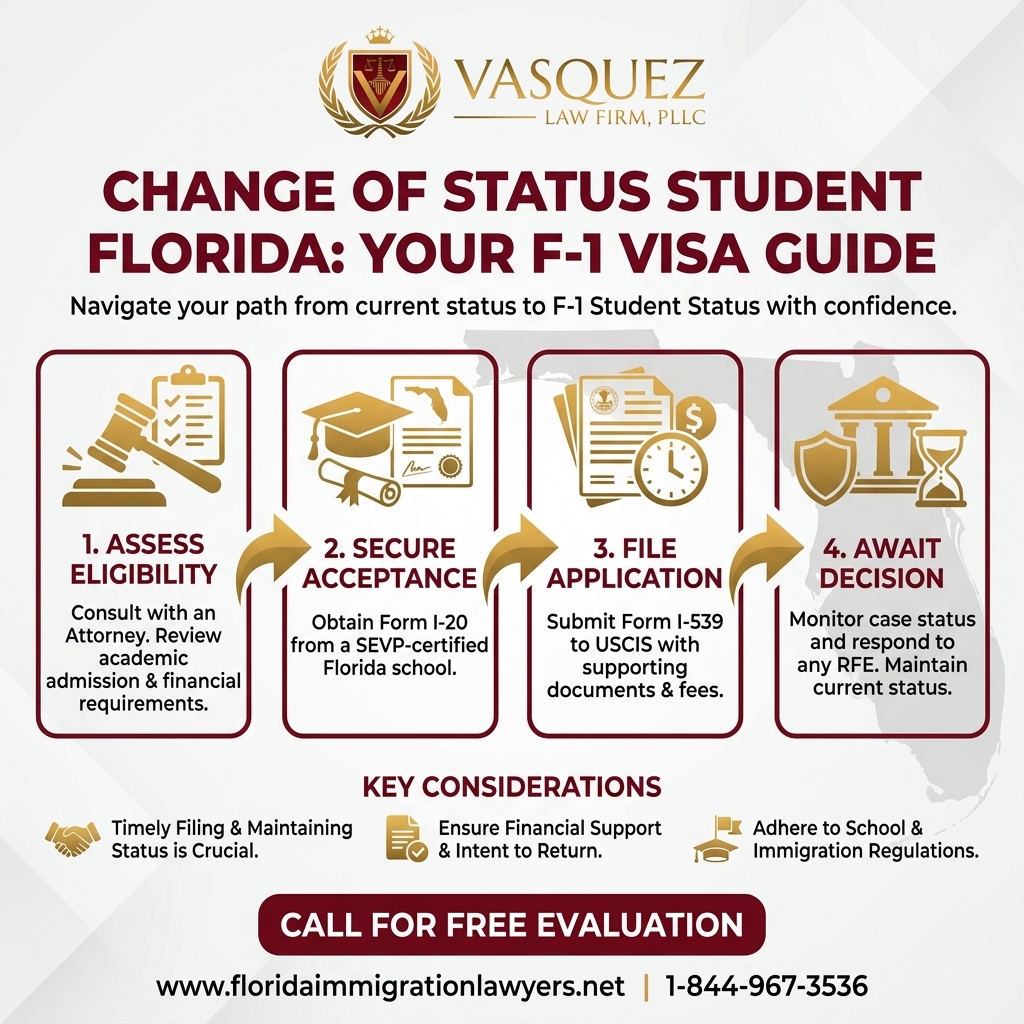
To pursue an F-1 student visa change of status in Florida, individuals typically need to be in a valid non-immigrant status, have been accepted by a U.S. Student and Exchange Visitor Program (SEVP)-certified school, and demonstrate sufficient financial resources. The process primarily involves submitting Form I-539, Application to Extend/Change Nonimmigrant Status, to USCIS, along with a Form I-20 from your designated school official (DSO). Timely filing, maintaining your current status throughout the application period, and clearly demonstrating non-immigrant intent are crucial for a successful outcome. Consulting with an experienced immigration attorney can significantly streamline this complex process.
- Maintain valid non-immigrant status until filing.
- Secure acceptance from an SEVP-approved school and obtain an I-20.
- File Form I-539 with USCIS before your current status expires.
- Demonstrate adequate financial support and non-immigrant intent.
- Seek legal guidance to navigate complexities and avoid common errors.
Florida, with its vibrant culture, diverse population, and world-class educational institutions from Miami to Gainesville, attracts thousands of international students each year. Many arrive on various non-immigrant visas, only to discover a passion for learning that leads them to consider enrolling in a U.S. school. If you are currently in Florida on a non-immigrant visa, such as a B-1/B-2 visitor visa, and wish to pursue academic studies, you may be eligible for a change of status student Florida to an F-1 student visa. This process allows you to transition legally from one non-immigrant category to another without leaving the United States.
Navigating the complexities of U.S. immigration law can be daunting, especially when dealing with specific requirements for student visas. This comprehensive guide from Florida Immigration Lawyers will walk you through the essential steps, eligibility criteria, required documentation, and potential challenges involved in changing your status to an F-1 student in the Sunshine State. Understanding these nuances is key to a successful application. Do not hesitate to call Florida Immigration Lawyers at 1-844-967-3536 for a free consultation to discuss your specific situation and ensure a smooth transition to your academic journey in Florida. We are here to help you every step of the way.
Understanding Change of Status for Students in Florida
A change of status allows a non-immigrant individual to switch from one visa category to another while remaining in the United States. For prospective students in Florida, this often means moving from a visitor visa (B-1/B-2), an employment visa (H-1B), or another non-immigrant classification to an F-1 student visa. The F-1 visa is specifically designed for international students pursuing academic studies at an accredited U.S. college, university, seminary, conservatory, academic high school, elementary school, or other academic institution, including language training programs.
The primary benefit of a change of status is avoiding the need to depart the U.S., apply for a new visa at a U.S. embassy or consulate abroad, and then re-enter. This can save significant time, travel costs, and stress, particularly for individuals settled in areas like Kissimmee, Orlando, or Tampa. However, it is crucial to understand that a change of status to F-1 does not grant you a new visa stamp in your passport. Instead, it changes your authorized immigration status within the U.S. If you later travel outside the U.S., you will need to apply for an F-1 visa stamp at a U.S. embassy or consulate to re-enter as an F-1 student. This distinction is vital for long-term planning.
Eligibility for a change of status is governed by Section 248 of the Immigration and Nationality Act (INA), found at 8 U.S.C. § 1258. It generally requires that you have maintained your current non-immigrant status, have not violated any immigration laws, and are eligible for the new status you are seeking. For F-1 students, this means demonstrating a genuine intent to study and return to your home country after completing your program. Florida Immigration Lawyers are adept at navigating these legal requirements, ensuring your application meets all necessary criteria. For more details on immigration regulations, you can refer to the USCIS website.
Eligibility Requirements for an F-1 Student Change of Status
Successfully changing your status to an F-1 student in Florida requires meeting several key eligibility criteria set forth by U.S. Citizenship and Immigration Services (USCIS). These requirements are designed to ensure that applicants genuinely intend to pursue academic studies and comply with immigration laws. Understanding these points is fundamental to preparing a strong application for a change of status student Florida.
First and foremost, you must currently be in a valid non-immigrant status. This means you entered the U.S. legally with a visa or through a visa waiver program and have not overstayed your authorized period of admission. For example, if you are in Kissimmee on a B-2 tourist visa, you must apply for the change of status before your I-94 admission period expires. You also must not have violated the terms of your current status, such as engaging in unauthorized employment. Any violation could make you ineligible for a change of status.
Secondly, you must be accepted by a U.S. Student and Exchange Visitor Program (SEVP)-certified school. This is a critical step, as only SEVP-approved institutions can issue the necessary Form I-20, Certificate of Eligibility for Nonimmigrant Student Status. Your chosen school, whether a university in Orlando or a language school in Miami, must be authorized by the Department of Homeland Security (DHS) to enroll international students. Once accepted, the Designated School Official (DSO) at your school will issue the Form I-20, which is a pivotal document for your application.
Finally, you must demonstrate that you have sufficient funds to cover your tuition, living expenses, and other costs for the duration of your program. This financial proof is essential to show that you will not become a public charge and can support yourself without working illegally. You must also maintain the intent to depart the U.S. after completing your studies, as the F-1 visa is a non-immigrant visa. Florida Immigration Lawyers can help you gather and present all necessary documentation to satisfy these stringent requirements, ensuring your eligibility is clearly established for your immigration goals.
Step-by-Step Guide to Applying for F-1 Change of Status
The process of obtaining an F-1 change of status student Florida involves several distinct steps, each requiring careful attention to detail. Following this guide can help you navigate the application process effectively, particularly if you are in Florida and unfamiliar with USCIS procedures. Missing a step or submitting an incomplete application can lead to significant delays or even denial, making thorough preparation essential.
-
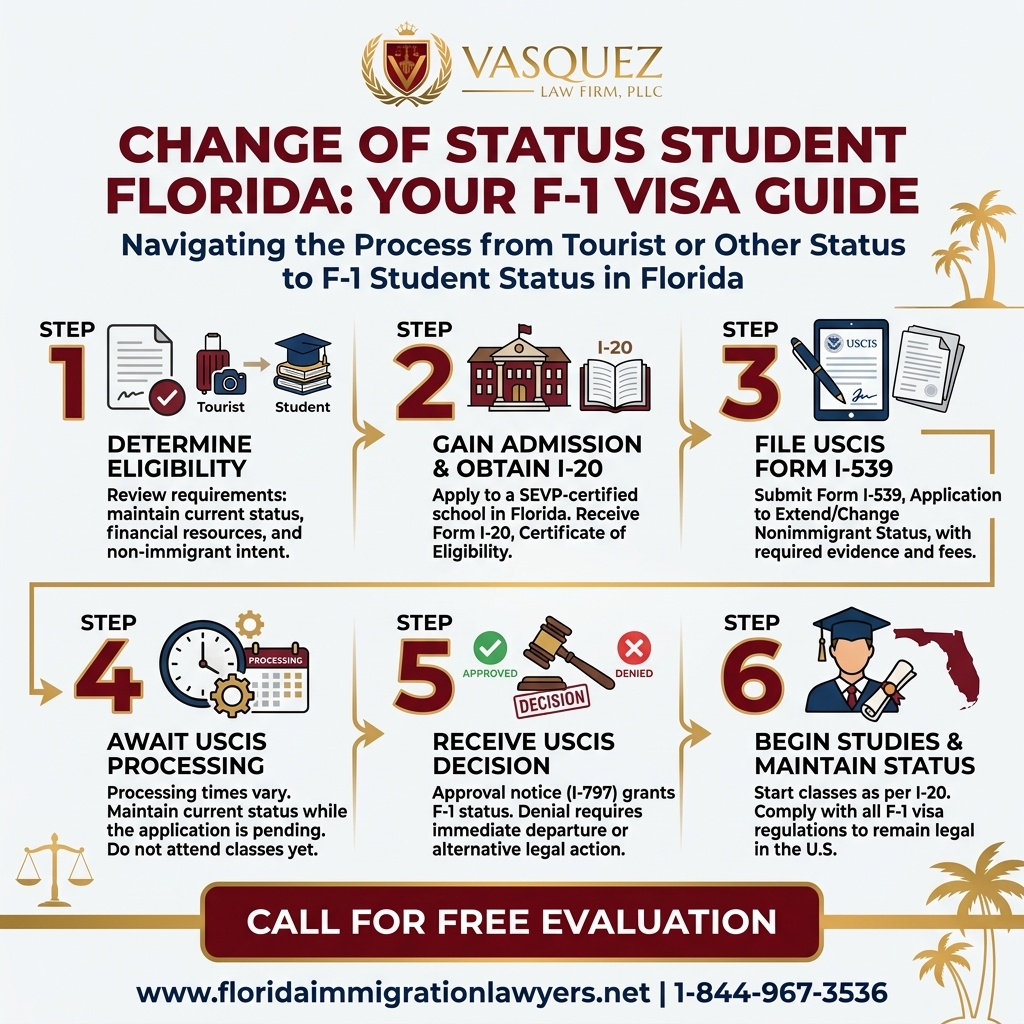
Secure Acceptance from an SEVP-Approved School and Obtain Form I-20: Your journey begins by applying to and being accepted by an educational institution approved by the Student and Exchange Visitor Program (SEVP). Once accepted, the school's Designated School Official (DSO) will issue you a Form I-20, Certificate of Eligibility for Nonimmigrant Student Status. This document confirms your enrollment, program details, and estimated costs. Ensure all information on your I-20 is accurate, as any discrepancies could cause issues during your application.
-
Pay the SEVIS I-901 Fee: Before filing your change of status application, you must pay the SEVIS I-901 fee. This fee supports the Student and Exchange Visitor Information System (SEVIS), which tracks international students and exchange visitors. You can pay this fee online through the official SEVIS website. Keep a copy of your payment receipt, as it will be required with your application.
-
Prepare Form I-539, Application to Extend/Change Nonimmigrant Status: This is the primary form for your change of status request. Complete all sections accurately and truthfully. If you have dependents (spouse or children) who also need to change to F-2 status, they can be included on the same Form I-539. Pay close attention to the instructions provided by USCIS to avoid common errors that can delay processing.
-
Gather Supporting Documents: Collect all necessary supporting documents, including proof of financial support, copies of your passport, current visa, I-94 record, and any previous educational transcripts. A detailed checklist is provided in the next section. Organize these documents meticulously to present a clear and comprehensive application.
-
File Your Application with USCIS: Mail your completed Form I-539, I-20, SEVIS fee receipt, and all supporting documents to the correct USCIS lockbox facility. The filing address depends on your current status and the type of application, so always check the USCIS website for Form I-539 instructions. It is highly recommended to send your application via certified mail with a return receipt to confirm delivery.
-
Await Decision and Maintain Status: Once USCIS receives your application, they will send a receipt notice (Form I-797C). During the processing period, it is crucial to continue maintaining your current non-immigrant status. This means not overstaying your authorized period of admission and adhering to any restrictions of your original visa. If your current status is set to expire while your change of status is pending, you are generally allowed to remain in the U.S. until a decision is made, provided you filed on time. However, you cannot begin your F-1 studies until your change of status is approved. This period of authorized stay is critical, and Florida Immigration Lawyers can provide guidance on managing it while seeking citizenship or other immigration goals.
Essential Document Checklist for Your F-1 Application
A well-organized and complete application package is vital for a successful change of status student Florida request. USCIS requires specific documents to verify your eligibility, financial stability, and intent to study. Prepare each item carefully to avoid Requests for Evidence (RFEs) or denial. This checklist outlines the critical documents you will need to submit, ensuring your application is as robust as possible.
- Form I-539, Application to Extend/Change Nonimmigrant Status: The original, completed, and signed form. Ensure all sections are filled out accurately and completely.
- Form I-20, Certificate of Eligibility for Nonimmigrant Student Status: The original I-20 issued by your SEVP-approved school. Both you and your Designated School Official (DSO) must sign it.
- SEVIS I-901 Fee Payment Receipt: Proof that you have paid the required SEVIS fee.
- Copy of Current Passport: Include a copy of the biographical page with your photo, passport number, and expiration date.
- Copy of Current U.S. Visa Stamp (if applicable): A copy of your most recent U.S. non-immigrant visa stamp in your passport.
- Copy of Form I-94, Arrival/Departure Record: This record proves your legal entry into the U.S. and indicates your authorized period of stay. You can usually retrieve this online from the Customs and Border Protection (CBP) website.
- Proof of Financial Support: Documents demonstrating you have sufficient funds to cover your tuition, living expenses, and other costs for your entire program. This can include:
- Bank statements (personal or sponsor's)
- Scholarship letters
- Affidavit of Support (Form I-134) from a sponsor, if applicable, along with their financial documentation.
- Academic Transcripts and Diplomas: Copies of your academic records from previous institutions, both U.S. and foreign, if relevant to your application.
- Statement of Intent: A personal statement explaining why you wish to change your status to F-1, your academic goals, and how your chosen program aligns with your future plans in your home country. This statement should clearly articulate your non-immigrant intent.
- Copies of Any Previous I-20s or DS-2019s: If you have previously held F-1 or J-1 status, include copies of those forms.
- Marriage Certificate and Birth Certificates: If applying with dependents (F-2 status), include copies of marriage certificates for spouses and birth certificates for children.
Remember that USCIS may request additional documents or information (Request for Evidence - RFE) if your initial submission is deemed insufficient. Adherence to 8 CFR 214.2(f) for F-1 non-immigrants is essential for document preparation. Florida Immigration Lawyers can help you compile a robust application package, ensuring no critical document is overlooked.
Navigating Processing Timelines and Potential Delays in Florida
The processing time for an F-1 change of status student Florida application can vary significantly, ranging from several months to over a year. These timelines are influenced by factors such as the current USCIS workload, the specific service center handling your application, and the completeness of your submission. It is crucial for applicants in Florida, particularly those in areas like Kissimmee, to understand these potential delays and plan accordingly to maintain legal status throughout the process.
You can check the estimated processing times for Form I-539 on the USCIS website. These estimates are updated regularly and provide a general idea, but they are not guarantees. For instance, an application filed at the California Service Center might have a different processing time than one filed at the Vermont Service Center. The specific USCIS field offices in Florida, such as the ones in Orlando or Miami, do not directly process I-539 applications for change of status; these are handled by the service centers, though you might interact with local offices for biometrics appointments.
One of the most critical aspects of the timeline is ensuring your current non-immigrant status does not expire before your I-539 application is filed. If you file before your I-94 authorized period of stay ends, you are generally permitted to remain in the U.S. while your change of status application is pending, even if your original status expires. This is known as a "period of authorized stay." However, you cannot begin your F-1 studies until your change of status is officially approved by USCIS. Engaging in F-1 activities, such as attending classes, before approval is a violation of status and could lead to denial.
If your application is delayed, USCIS may issue a Request for Evidence (RFE) if they require more information or clarification. Responding promptly and thoroughly to an RFE is essential to avoid further delays or denial. In some cases, premium processing may be available for Form I-539, which can significantly expedite the adjudication, often within 15 calendar days. However, this option is not always available for all I-539 categories, so check the USCIS website for current eligibility. Florida Immigration Lawyers closely monitor USCIS processing trends and can advise you on the most strategic timing for your application and how to manage potential delays effectively, helping you plan your academic future with confidence in Florida.
Cost Factors and Fee Breakdown for Change of Status
Understanding the financial commitment involved in an F-1 change of status student Florida application is crucial for proper planning. The total cost can vary depending on several factors, including government filing fees, SEVIS fees, and potential legal or ancillary expenses. These fees are subject to change, so it is always important to verify the most current amounts on the official USCIS website before filing your application.
The primary government fee is the USCIS filing fee for Form I-539, Application to Extend/Change Nonimmigrant Status. This fee is mandatory for all applicants and is paid directly to USCIS. If you are including dependents (spouse and/or children) on the same I-539 application, there may be an additional fee per dependent, or the fee may cover all applicants on one form, depending on current USCIS policy. It's vital to check the latest fee schedule. For example, as of our last update, the fee for Form I-539 typically covers the primary applicant and any co-applicants filing together. However, always refer to the USCIS Fee Schedule for the most up-to-date information.
Another mandatory cost is the SEVIS I-901 fee. This fee is paid to the Student and Exchange Visitor Program (SEVP) to maintain the SEVIS system, which monitors international students. This fee is separate from the USCIS filing fee and must be paid before you submit your Form I-539. You will need to include proof of payment with your application. The amount for the SEVIS I-901 fee is standardized, but like other fees, it can be adjusted by the government.
Beyond government fees, you should budget for potential legal fees if you choose to hire an immigration attorney. While not legally required, legal representation can significantly enhance your chances of approval and reduce stress by ensuring your application is meticulously prepared and submitted correctly. Attorney fees vary based on the complexity of the case and the firm's experience. Additionally, consider ancillary costs such as mailing fees (certified mail is highly recommended), translation services for foreign documents, and fees for obtaining certified copies of records. For individuals in Kissimmee or other Florida cities, these costs are a necessary investment in your educational future. Florida Immigration Lawyers offers transparent fee structures and provides free initial consultations to help you understand the full financial scope of your change of status application.
Do not navigate this process alone. The complexities of immigration law, combined with the strict requirements for a change of status student Florida, make legal guidance invaluable. Contact Florida Immigration Lawyers today for expert assistance. We are committed to helping you achieve your academic dreams in Florida with confidence.
Common Mistakes to Avoid During Your F-1 Change of Status Application
Applying for an F-1 change of status student Florida can be a complex process, and even minor errors can lead to delays, Requests for Evidence (RFEs), or outright denial. Being aware of common pitfalls can significantly improve your chances of a successful outcome. Avoid these mistakes to ensure a smoother transition to student status in Florida:
-
Filing Too Late: One of the most critical errors is failing to submit your Form I-539 before your current non-immigrant status expires. Filing late can result in your application being denied and could lead to you accruing unlawful presence, which has severe future immigration consequences. Always aim to file well in advance of your I-94 expiration date.
-
Not Maintaining Current Status: You must strictly adhere to the terms of your current visa while your change of status is pending. This includes not working without authorization, not overstaying, and not violating any conditions of your current status. Any breach can jeopardize your application.
-
Insufficient Funds or Inadequate Financial Proof: Failing to demonstrate sufficient funds to cover your tuition and living expenses for the entire duration of your program is a common reason for denial. Ensure your bank statements or sponsor letters clearly show adequate, readily available funds.
-
Incomplete or Incorrect Forms: Submitting a Form I-539 or I-20 with missing information, incorrect dates, or unsigned sections will almost certainly lead to an RFE or rejection. Double-check every field and ensure all required signatures are present.
-
Failing to Show Non-Immigrant Intent: The F-1 visa requires applicants to demonstrate that they intend to return to their home country after completing their studies. If your application or supporting documents suggest an intent to remain in the U.S. permanently, your change of status may be denied.
-
Starting Studies Before Approval: You absolutely cannot begin your F-1 program or engage in F-1 related activities (like attending classes) until your change of status to F-1 has been officially approved by USCIS. Doing so is a direct violation of immigration law and will result in denial.
-
Not Consulting Your Designated School Official (DSO): Your school's DSO is a crucial resource. They issue your I-20 and can provide guidance on maintaining F-1 status. Failing to communicate with your DSO about your change of status plans can lead to misunderstandings or issues with your I-20.
-
Ignoring Requests for Evidence (RFEs): If USCIS sends an RFE, it means they need more information to make a decision. Failing to respond by the deadline, or providing an inadequate response, will result in the denial of your application. Always respond thoroughly and on time.
-
The 90-Day Rule Misinterpretation: While not an official rule, USCIS scrutinizes applications for change of status filed within 90 days of entry, especially from B-1/B-2 visitors. If you change your status too soon after entry, it might be perceived that you misrepresented your intent at the time of entry. It's generally safer to wait beyond 90 days if possible.
-
Lack of Professional Legal Review: Attempting to navigate the intricate immigration system without legal counsel can lead to costly mistakes. An experienced immigration attorney can identify potential issues, ensure all documents are correct, and strengthen your application, preventing common errors that often trip up self-filers.
When to Call a Lawyer for Your Change of Status in Florida
While some individuals may attempt to file an F-1 change of status student Florida application independently, the complexities of immigration law often warrant professional legal assistance. Engaging an experienced immigration attorney, especially one familiar with Florida-specific scenarios, can significantly enhance your chances of approval and alleviate stress. It is particularly advisable to contact Florida Immigration Lawyers in the following situations:
- Complex Immigration History: If you have any previous visa denials, overstays, or other immigration violations, your case will be more scrutinized. An attorney can help address these issues and present a compelling argument for your eligibility.
- Tight Deadlines: If your current non-immigrant status is nearing its expiration, an attorney can help expedite the preparation and filing of your application, ensuring it is submitted on time and correctly.
- Previous Denials or RFEs: If you have previously applied for a change of status and were denied, or received a Request for Evidence (RFE), an attorney can analyze the reasons for the setback and help you strategize a stronger reapplication.
- Criminal Record or Other Inadmissibility Issues: Any criminal history, no matter how minor, can affect your immigration eligibility. An attorney can assess potential inadmissibility issues and advise on waivers or other solutions.
- Dependents Included in Application: If you are applying for F-2 status for your spouse or children, an attorney can ensure all family members' applications are correctly prepared and linked to yours.
- Unclear Non-Immigrant Intent: If your personal circumstances make it difficult to clearly demonstrate your intent to return to your home country after studies, an attorney can help you gather compelling evidence and craft a persuasive statement.
- Lack of Confidence or Understanding: If you feel overwhelmed by the forms, requirements, or legal jargon, a lawyer can provide clear explanations and handle the intricate details on your behalf.
Florida Immigration Lawyers possesses a deep understanding of USCIS policies and procedures. We can provide personalized guidance, prepare all necessary documentation, and represent your interests throughout the entire change of status process, whether you are in Kissimmee, Fort Lauderdale, or anywhere else in Florida. Our goal is to make your transition to student status as smooth and successful as possible.
About Florida Immigration Lawyers
Florida Immigration Lawyers is a leading immigration law firm dedicated to serving individuals and families across the entire state of Florida. With a profound commitment to our clients, we provide comprehensive legal services in various areas of immigration law, including family-based immigration, business immigration, deportation defense, asylum, and family immigration. Our team of experienced attorneys understands the unique challenges immigrants face and offers compassionate, results-driven representation.
We pride ourselves on our client-focused approach, offering personalized attention and strategic advice tailored to each individual's circumstances. Our attorneys are highly knowledgeable in the latest immigration policies and procedures, ensuring that our clients receive the most current and effective legal solutions. We are committed to upholding the rights of immigrants and helping them achieve their American dreams, whether that involves securing a student visa, obtaining a green card, or defending against deportation.
Choosing Florida Immigration Lawyers means partnering with a team that genuinely cares about your future. We offer free consultations to assess your case and provide clear guidance on your best path forward. Our dedicated staff is available 24/7, ready to assist you. Contact us today at 1-844-967-3536 or visit our website at https://www.floridaimmigrationlawyers.net to learn how we can help you navigate the complexities of U.S. immigration law. We serve all of Florida, from Jacksonville to Key West, ensuring that expert legal help is always within reach.
Sources and References
- U.S. Citizenship and Immigration Services (USCIS)
- USCIS Fee Schedule
- Form I-539, Application to Extend/Change Nonimmigrant Status
- USCIS Processing Times
- Executive Office for Immigration Review (EOIR)
- 8 U.S.C. Chapter 12 - Immigration and Nationality Act (INA)
- INA § 248 (8 U.S.C. § 1258) - Change of Nonimmigrant Classification
- 8 CFR 214.2(f) - Students
- U.S. Department of State - Bureau of Consular Affairs
Related services: immigration practice areas, experienced immigration attorneys.
This article provides general legal information and is not intended as legal advice. Every case is unique, and outcomes depend on specific facts and circumstances. Contact an attorney for advice about your particular situation.
Embarking on an academic journey in the U.S. through a change of status student Florida can be a life-changing experience. Do not let the complexities of immigration law deter you. Florida Immigration Lawyers is here to provide the expert guidance and support you need to achieve your educational goals. We offer free, confidential consultations to discuss your case and outline a clear path forward. Call us today at 1-844-967-3536. Se Habla Espanol - Estamos aqui para ayudarle.
If you need legal assistance, learn more about Florida immigration legal team, or call us at 1-844-967-3536 for a free consultation.
Do Not Navigate This Process Alone
Our experienced immigration attorneys are ready to fight for you. Get a free, confidential consultation today.
Se Habla Español
Frequently Asked Questions
Florida Immigration Lawyers
Immigration Attorney | Founder, Vasquez Law Firm
U.S. Air Force veteran and immigration attorney with thousands of cases resolved. J.D., NCCU School of Law. AILA member. Admitted to the 4th, 5th, and 11th Circuit Courts.
Available 24/7 - Free Evaluations
Related Legal Services
Our Florida immigration attorneys can help you with immigration practice areas, free immigration consultation and experienced immigration attorneys. Call today at 1-844-967-3536 for a free consultation.
Related Links
Related Topics
Free Legal Consultation
Discuss your case with our experienced attorneys. We're available 24/7.
Se Habla Español - Estamos aquí para ayudarle.
Related Articles
H-1B Visa Guide for Florida Employers | VLF Florida
Discover how Florida employers, especially in Hialeah, can effectively sponsor H-1B visas. Learn about eligibility, application procedures, common mistakes, and more with our comprehensive guide. Call Florida Immigration Lawyers for a free consultation.
Immigration Services in Port St Lucie and Treasure Coast
Explore crucial immigration services in Port St Lucie and the Treasure Coast to navigate your path to residency and citizenship in Florida. Learn about the necessary steps and common mistakes to avoid in this comprehensive guide. Call Florida Immigration Lawyers at 1-844-967-3536 for expert assistance.
VAWA Self-Petition in Florida: Abused Spouse Guide 2026
For abused non-citizen spouses in Florida, the VAWA self-petition (Form I-360) offers a confidential path to legal status without the abuser's involvement. This guide from Florida Immigration Lawyers details eligibility, the step-by-step application process, essential documents, and what to expect regarding timelines and costs in 2026. We cover how VAWA provides crucial protections against deportation and outlines the journey from I-360 approval to obtaining a Green Card and eventually U.S. citizenship. Learn about common mistakes to avoid and when to seek legal counsel to navigate this complex yet vital immigration relief.
N-600 Certificate of Citizenship Florida Children | VLF Florida
For Florida families, obtaining an N-600 Certificate of Citizenship for children born abroad is essential for official proof of U.S. citizenship. This guide details eligibility under derived or acquired citizenship, the step-by-step application process, required documents, and processing timelines. Learn how to navigate USCIS requirements, avoid common mistakes, and understand the cost factors involved. Whether your child automatically became a citizen or needs an N-600K, understanding the nuances of INA 320 and INA 322 is critical. Florida Immigration Lawyers offers expert legal assistance, ensuring your child's status is properly documented for passports, federal benefits, and peace of mind. Contact us for a free consultation to secure your child's future.
