Combo Card: EAD & Advance Parole for Florida I-485 Pending
For Florida residents with a pending I-485, a combo card is essential. This single document combines an Employment Authorization Document (EAD), allowing you to work legally, and Advance Parole, permitting international travel without abandoning your green card application. Understanding eligibility, the application process, required documents, and potential pitfalls is crucial for maintaining your status and stability. This comprehensive guide provides detailed steps and critical advice for navigating the combo card application, ensuring you can work and travel while awaiting your permanent residency. Florida Immigration Lawyers offers expert guidance to help you secure your combo card and protect your immigration future.
A combo card is a single document issued by USCIS to certain individuals with a pending Form I-485, Application to Register Permanent Residence or Adjust Status. This card combines two crucial benefits: Employment Authorization Document (EAD), which allows you to work legally in the U.S., and Advance Parole, which grants permission to travel internationally and re-enter the U.S. while your green card application is pending. For Florida residents awaiting I-485 approval, securing a combo card can provide stability for employment and the flexibility to travel without abandoning your adjustment of status application, ensuring continuity in your life and work.
- Allows legal employment in the U.S.
- Permits international travel and re-entry.
- Issued to individuals with a pending I-485 application.
- Prevents abandonment of adjustment of status during travel.
- Provides significant flexibility and peace of mind for applicants in Florida.
Navigating the complex landscape of U.S. immigration law can feel like a daunting journey, especially when your future in Florida hinges on critical documents like the green card. Many individuals awaiting permanent residency face a dilemma: how to work legally and travel internationally without jeopardizing their adjustment of status application. Fortunately, for those with a pending Form I-485, the combo card offers a powerful solution, combining both employment authorization and travel permission into one convenient document. This guide is specifically tailored for Florida residents, providing comprehensive insights into securing and utilizing your combo card, EAD, and advance parole. Understanding these vital components is essential for maintaining your stability and progress while you wait for your green card approval. Don't navigate this intricate process alone; call Florida Immigration Lawyers at 1-844-YO-PELEO for a free consultation and personalized guidance today.
What is a Combo Card? EAD and Advance Parole Explained
The term "combo card" refers to a single physical document that serves as both an Employment Authorization Document (EAD) and an Advance Parole (AP) document. This innovative approach by U.S. Citizenship and Immigration Services (USCIS) streamlines the process for many applicants, particularly those with a pending Form I-485, Application to Register Permanent Residence or Adjust Status. Instead of receiving two separate cards, eligible individuals receive one card that clearly states it is valid for both employment and travel. This card typically includes your photo, name, category, and expiration date, making it a crucial piece of identification for immigrants in Florida.
An Employment Authorization Document (EAD), often called a work permit, legally permits foreign nationals to work in the United States. For I-485 applicants, this authorization is granted under 8 CFR § 274a.12(c)(9). Obtaining an EAD means you can seek and hold employment in Florida without needing a separate work-authorized visa. This provides significant economic stability for individuals and families in Tallahassee and across the state, allowing them to contribute to the local economy while their green card application progresses. It's a fundamental benefit that alleviates financial stress during what can often be a lengthy waiting period.
Advance Parole (AP), conversely, grants permission to individuals to travel abroad and re-enter the United States without abandoning their pending adjustment of status application. Under section 212(d)(5) of the Immigration and Nationality Act (INA), AP is a discretionary benefit. Without it, leaving the U.S. while your I-485 is pending may be considered an abandonment of your application, leading to severe consequences. For Florida residents with family abroad or urgent travel needs, Advance Parole is indispensable. The combo card eliminates the need to carry two separate documents, making international travel less cumbersome and providing peace of mind that your journey will not negatively impact your path to permanent residency.
Eligibility Requirements for a Combo Card in Florida
To be eligible for a combo card, the primary requirement is generally having a pending Form I-485, Application to Register Permanent Residence or Adjust Status. This means you have filed your green card application and it is currently being processed by USCIS. While the I-485 is pending, you are considered to be in a period of authorized stay, which makes you eligible for ancillary benefits like employment authorization and advance parole. This eligibility extends to various categories of applicants, including those adjusting status through family-based petitions, employment-based petitions, or certain special immigrant categories.
Specific eligibility criteria for the EAD (Form I-765) and Advance Parole (Form I-131) must also be met. For the EAD, your I-485 must be properly filed and pending. For Advance Parole, you must demonstrate a legitimate reason for travel, although often the mere existence of a pending I-485 is sufficient. It is crucial that you do not have any disqualifying factors, such as certain criminal convictions or immigration violations that could make you inadmissible or ineligible for adjustment of status. USCIS reviews each application on a case-by-case basis, and any issues in your immigration history could impact your eligibility for the combo card.
For individuals in Florida, it is important to ensure all aspects of your I-485 application are robust and accurate. If your underlying I-485 petition is denied or withdrawn, your eligibility for the combo card will cease. This underscores the importance of working with experienced legal counsel. Our attorneys at Florida Immigration Lawyers can help assess your specific situation, confirm your eligibility, and prepare a strong application to maximize your chances of approval. Whether you are in Miami, Orlando, or Tallahassee, understanding these nuances is critical to a successful application for your combo card.
The Application Process: Step-by-Step Guide for Florida Residents
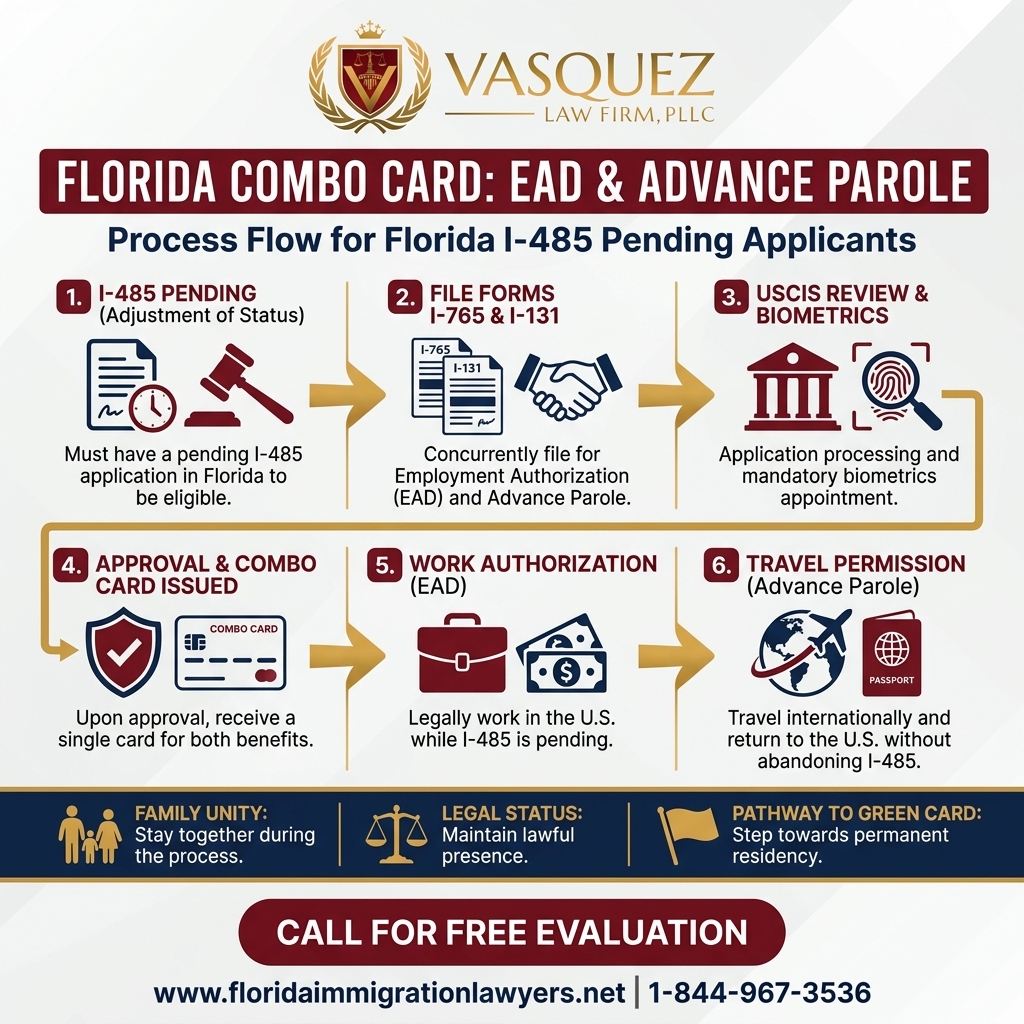
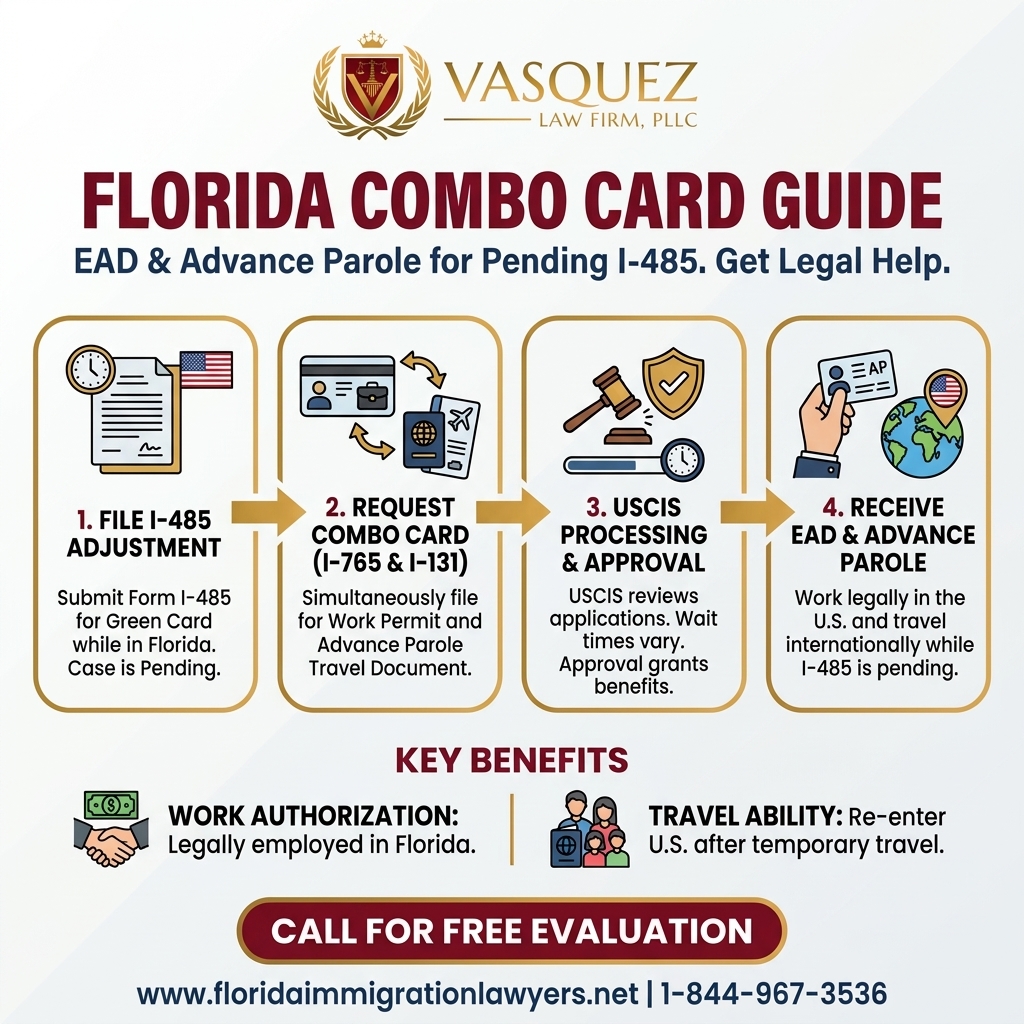
Applying for a combo card involves filing two forms concurrently with or subsequent to your Form I-485: Form I-765, Application for Employment Authorization, and Form I-131, Application for Travel Document (Advance Parole). For many applicants, these forms are filed together with the I-485, often resulting in a fee waiver for the EAD and AP applications if filed with the primary adjustment of status. Here is a detailed step-by-step guide for Florida residents:
- File Your Form I-485: The foundation of your combo card eligibility is a properly filed Form I-485. Ensure all supporting documents for your green card application are complete and accurate. This form establishes your intent to adjust status and initiates the process.
- Complete Form I-765 (EAD): Fill out Form I-765 accurately. For I-485 pending applicants, the eligibility category is typically (c)(9). Ensure all personal details match your other immigration documents.
- Complete Form I-131 (Advance Parole): Fill out Form I-131. For I-485 pending applicants, select option 1.d. 'I am filing Form I-485, Application to Register Permanent Residence or Adjust Status.' You generally do not need to provide a specific reason for travel if your I-485 is pending.
- Gather Required Supporting Documents: Collect all necessary evidence for both forms, including copies of your I-485 receipt notice, passport, birth certificate, marriage certificate (if applicable), previous EAD/AP cards, two passport-style photos, and Form I-94 arrival/departure record. We will detail these in the next section.
- Prepare Your Application Package: Assemble all forms and supporting documents neatly. If you are filing I-765 and I-131 with your I-485, typically all forms are sent together. If filing separately, include a copy of your I-485 receipt notice.
- Mail Your Application to USCIS: Send your completed package to the appropriate USCIS Lockbox facility. The mailing address depends on the specific form and your current state of residence. Always check the USCIS website at www.uscis.gov for the most current filing addresses. For Florida residents, this usually means sending to a lockbox facility in Chicago or Phoenix.
- Attend Biometrics Appointment: After filing, you will receive a notice for a biometrics appointment at a local Application Support Center (ASC) in Florida, such as those in Orlando, Miami, or Jacksonville. This appointment is crucial for fingerprinting and photo capture, which are used for background checks and card production.
- Await Decision and Card Production: USCIS will process your application. You may receive Requests for Evidence (RFEs) if more information is needed. Once approved, your combo card will be mailed to your address in Florida.
Essential Documents Checklist for Your Combo Card Application
A meticulous approach to document preparation is paramount for a smooth combo card application process. Missing or incorrect documents are among the most common reasons for delays or denials. Ensure you gather all required items and make copies for your records before submitting your application to USCIS. Here is a comprehensive checklist of documents typically needed for your I-765 (EAD) and I-131 (Advance Parole) applications, especially when filed based on a pending I-485:
- Form I-485 Receipt Notice: A copy of the receipt notice (Form I-797C) for your pending I-485 application, proving your eligibility.
- Form I-765, Application for Employment Authorization: The completed and signed form.
- Form I-131, Application for Travel Document: The completed and signed form.
- Two Passport-Style Photographs: Taken within 30 days of filing, meeting USCIS specifications (2x2 inches, white background, full face front view).
- Copy of Government-Issued Photo Identification: Such as your passport identity page, driver's license (if applicable), or other national identity card.
- Copy of Your Last I-94 Arrival/Departure Record: Proving your lawful entry and status in the U.S.
- Copy of Birth Certificate: With certified translation if not in English.
- Copy of Marriage Certificate (if applicable): With certified translation if not in English.
- Copy of Previous EAD Card (if applicable): Both front and back.
- Copy of Previous Advance Parole Document (if applicable): Both front and back.
- Copy of Visa Page from Passport: The page showing the visa stamp you used to enter the U.S.
- Copy of Passport Bio Page: The page with your photo and personal information.
- Proof of Relationship to Petitioner (for family-based I-485): Such as marriage certificates for spouses or birth certificates for children.
- Any Relevant Court Dispositions or Police Records (if applicable): Even if minor, it's best to disclose and provide documentation.
Organizing these documents thoroughly will expedite your application process. Always provide certified English translations for any foreign language documents. Our team at Florida Immigration Lawyers can help you compile a complete and accurate packet, minimizing the risk of RFEs and ensuring your application is as strong as possible.
Navigating Processing Timelines and Expectations in 2026
Understanding the processing timelines for combo cards, EADs, and Advance Parole can help manage expectations for Florida applicants. USCIS processing times fluctuate significantly based on various factors, including the volume of applications, staffing levels, and the specific service center handling your case. While we cannot provide exact dates, we can outline general expectations and how to monitor your application in 2026.
Typically, after filing your I-765 and I-131, you can expect to receive a receipt notice within 2-4 weeks. The biometrics appointment usually follows within 4-8 weeks. The actual processing time for the combo card itself can range from 6 months to over 18 months, depending on the service center and current backlogs. For I-485 pending cases, sometimes the EAD and AP are processed faster than the green card itself. It's important to remember that these are estimates, and individual experiences may vary. You can check current processing times on the USCIS website by selecting Form I-765 or I-131 and your specific service center.
Factors influencing processing times include the complexity of your case, completeness of your application, and whether you receive a Request for Evidence (RFE). An RFE will inevitably extend your processing time as USCIS waits for your response. Local USCIS field offices in Florida, such as those in Orlando, Miami, or Tampa, primarily handle interviews for I-485 applications, but the initial processing of EAD and AP often happens at national service centers. Keeping your address updated with USCIS is crucial to ensure you receive all correspondence promptly. If your application falls outside the normal processing times, you may be able to submit an inquiry with USCIS. Our firm regularly assists clients in Florida with tracking their applications and addressing delays.
Understanding the Benefits and Limitations of Your Combo Card
The combo card provides significant benefits, offering a bridge of stability and flexibility for individuals awaiting their green card in Florida. The most apparent advantage is the ability to work legally in the United States. This authorization allows you to accept job offers, change employment, and earn an income to support yourself and your family without fear of violating immigration laws. This economic freedom is crucial for many, reducing dependence and fostering integration into Florida's vibrant communities. For those residing in areas like Tallahassee, having a valid EAD means access to a wider range of job opportunities and greater financial security.
Secondly, the Advance Parole component empowers you to travel internationally. This is a critical benefit for individuals who may need to visit family abroad, attend important events, or handle urgent matters in their home country. Without Advance Parole, leaving the U.S. while your I-485 is pending could result in the abandonment of your green card application, forcing you to start the entire process over. The combo card ensures you can travel and return lawfully, maintaining your pursuit of permanent residency. This flexibility is invaluable for maintaining personal and family connections across borders.
However, it is equally important to understand the limitations and potential risks associated with the combo card. A combo card is not a green card. It does not grant you permanent resident status. It is a temporary document that provides certain permissions while your I-485 is pending. Traveling with Advance Parole, while generally safe, carries inherent risks. USCIS can deny re-entry at the port of entry if new issues arise, such as a criminal conviction or a finding of inadmissibility. Additionally, individuals who accrued unlawful presence may face issues upon re-entry even with Advance Parole. Certain categories, such as those who entered without inspection or have a history of deportation, should exercise extreme caution and consult an attorney before traveling. Always carry your combo card and any I-485 receipt notices when traveling. Consulting an immigration lawyer before any international travel is highly recommended to assess your specific situation and minimize potential risks.
Do not navigate this complex process alone. Contact Florida Immigration Lawyers today for expert guidance and peace of mind. Our experienced team is ready to assist you.
Cost Factors and Government Fees for Combo Card Applications
Understanding the financial aspects of applying for a combo card is an important part of the planning process for Florida residents. While the combo card itself is a single document, it represents the combined benefits of the Employment Authorization Document (EAD) and Advance Parole (AP), which are typically applied for using Form I-765 and Form I-131, respectively. The fees associated with these forms can vary, and it is crucial to consult the official USCIS website for the most current fee schedule, as these amounts are subject to change. USCIS typically updates its fees periodically, and using an outdated fee can lead to your application being rejected.
Generally, if you file Form I-765 and Form I-131 concurrently with or after your Form I-485, there is often no separate fee for the I-765 or I-131. The fee for the I-485 application usually covers the cost of these ancillary benefits. This is a significant advantage for I-485 applicants, as it avoids additional filing expenses for work and travel authorization. However, if you are filing for an EAD or AP under a different eligibility category not tied to a pending I-485, or if you are renewing an existing EAD/AP and your I-485 was filed under certain older fee structures, separate fees may apply. Always verify the fee requirements for your specific situation on the USCIS fee page.
Beyond government filing fees, applicants should also consider other potential costs. These can include fees for obtaining necessary supporting documents, such as birth certificates, marriage licenses, or certified translations. Professional passport photos also incur a small cost. Most importantly, legal fees for assistance from an experienced immigration attorney, like those at Florida Immigration Lawyers, are a vital investment. While not mandatory, legal representation can significantly increase the accuracy and completeness of your application, reducing the likelihood of delays, RFEs, or denials. An attorney can help you navigate complex eligibility rules, gather appropriate documentation, and respond effectively to USCIS inquiries, providing invaluable support throughout the entire process. We offer free consultations to help you understand the potential costs and benefits of legal representation in your specific case in Florida.
Common Mistakes to Avoid When Applying for a Combo Card
Applying for a combo card, EAD, and Advance Parole requires precision. Even minor errors can lead to significant delays or even denial of your application. Florida residents should be especially vigilant to avoid these common pitfalls:
- Filing Incomplete or Incorrect Forms: Submitting forms with missing information, unchecked boxes, or incorrect details is a frequent cause of rejection. USCIS is very strict about form completeness. Always double-check every section.
- Failing to Include All Supporting Documents: Forgetting to attach a copy of your I-485 receipt, passport photos, or a necessary birth/marriage certificate can lead to a Request for Evidence (RFE) or outright denial. Ensure your document checklist is thoroughly followed.
- Not Providing Certified Translations: Any document not in English must be accompanied by a complete and accurate English translation, certified by the translator. Failure to do so renders the document unusable.
- Traveling Internationally Without Advance Parole: Leaving the U.S. while your I-485 is pending, but before receiving your Advance Parole, typically results in the abandonment of your adjustment of status application. This is a critical mistake with severe consequences.
- Assuming Automatic Renewal: Your combo card has an expiration date. Do not wait until the last minute to file for renewal. File your renewal application well in advance (typically 120-180 days before expiration) to avoid gaps in employment authorization or travel ability.
- Ignoring Requests for Evidence (RFEs): If USCIS sends an RFE, it means they need more information or clarification. Failing to respond by the deadline, or responding inadequately, can lead to denial. Always take RFEs seriously and seek legal advice.
- Not Updating Your Address with USCIS: Moving within Florida or out of state without notifying USCIS using Form AR-11 can result in missed notices, RFEs, and even final decisions, potentially leading to abandonment or denial without your knowledge.
- Having Undisclosed Criminal History: Any past arrests, charges, or convictions, even minor ones, must be disclosed and properly documented. Failure to do so can be considered misrepresentation and lead to severe immigration consequences, including inadmissibility.
When to Call a Florida Immigration Lawyer
While the application process for a combo card may seem straightforward, certain situations warrant the immediate attention and expertise of an experienced immigration attorney. Florida Immigration Lawyers are here to provide crucial support, guidance, and representation through every stage of your journey to permanent residency, especially when complexities arise.
You should consider calling an immigration lawyer if you have a complex immigration history, such as previous visa denials, periods of unlawful presence, or prior deportations. These factors can significantly complicate your I-485 and combo card application, potentially leading to inadmissibility issues that only an attorney can effectively address. Similarly, if you have any criminal history, even minor offenses, it is imperative to consult with legal counsel. Certain convictions can render you ineligible for adjustment of status or make you inadmissible to the U.S., and an attorney can assess the impact and advise on potential waivers or defense strategies.
Furthermore, if you receive a Request for Evidence (RFE) from USCIS, it is a strong indicator that professional legal assistance is needed. RFEs can be complex and require precise, well-documented responses to avoid denial. An attorney can help you understand the RFE, gather the necessary evidence, and craft a compelling response. Delays in processing your application beyond the typical timeframe, or concerns about international travel risks, are also valid reasons to seek legal advice. Our team at Florida Immigration Lawyers is well-versed in handling these challenges, providing peace of mind and increasing your chances of a successful outcome for clients across Florida, from Tallahassee to Miami. We can guide you through the intricacies of immigration law, including family immigration and deportation defense, ensuring your rights are protected.
About Florida Immigration Lawyers
Florida Immigration Lawyers is a leading law firm dedicated to providing comprehensive and compassionate legal services to immigrants across the entire state of Florida. With a deep understanding of the intricacies of U.S. immigration law, our experienced attorneys are committed to guiding individuals and families through their unique immigration journeys. We pride ourselves on offering personalized attention, strategic advice, and aggressive representation to achieve the best possible outcomes for our clients.
Our firm specializes in a wide range of immigration matters, including but not limited to, adjustment of status, family-based petitions, employment visas, deportation defense, asylum claims, and naturalization. We understand the challenges and anxieties that often accompany immigration processes, and we strive to make the experience as smooth and stress-free as possible. Our commitment to our clients is unwavering, and we work tirelessly to protect their rights and advocate for their futures in Florida.
Choosing Florida Immigration Lawyers means choosing a team that is available 24/7 to address your concerns. We offer free, confidential consultations to assess your case and provide clear, actionable advice. Our bilingual staff ensures that language is never a barrier to effective communication. Whether you are in Tallahassee, Orlando, Miami, or any other part of the Sunshine State, trust Florida Immigration Lawyers to be your dedicated legal partner. Contact us today at 1-844-YO-PELEO or visit https://www.floridaimmigrationlawyers.net to learn how we can help you achieve your immigration goals.
Sources and References
- U.S. Citizenship and Immigration Services (USCIS)
- USCIS - Form I-485, Application to Register Permanent Residence or Adjust Status
- USCIS - Form I-765, Application for Employment Authorization
- USCIS - Form I-131, Application for Travel Document
- U.S. Department of State (Travel.State.Gov)
- Executive Office for Immigration Review (EOIR)
- 8 U.S.C. § 1255 - Adjustment of status of nonimmigrant to that of person admitted for permanent residence
- 8 U.S.C. § 1182(d)(5) - Authority to waive requirements of sections 1182 and 1184
- 8 CFR § 274a.12(c)(9) - Classes of aliens authorized to accept employment
Related services: immigration practice areas, citizenship and naturalization, asylum protection, business immigration.
This article provides general legal information and is not intended as legal advice. Every case is unique, and outcomes depend on specific facts and circumstances. Contact an attorney for advice about your particular situation. Immigration laws are subject to change.
Don't leave your immigration future to chance. Secure the expert legal representation you deserve with Florida Immigration Lawyers. Call us today for a free consultation at 1-844-YO-PELEO. Se Habla Español - Estamos aquí para ayudarle.
Do Not Navigate This Process Alone
Our experienced immigration attorneys are ready to fight for you. Get a free, confidential case review today.
Se Habla Español
Or leave your details and we’ll call you:
Free Evaluation in 24 Hours
Or talk to us right now

AI voice assistant — available 24/7
FreeFrequently Asked Questions

William J. Vásquez
Founding Attorney · Vasquez Law Firm
U.S. Air Force veteran and immigration attorney with years of hands-on U.S. immigration experience. J.D., NCCU School of Law. AILA member. Admitted to the 4th, 5th, and 11th Circuit Courts.
Available 24/7 - Free Evaluations
Reviewed for legal accuracy by William J. Vásquez
Licensed in North Carolina; U.S. immigration is federal practice.
Related Legal Services
Our Florida immigration attorneys can help you with deportation defense, family immigration services and immigration lawyer cost in Florida. Call today at 1-844-YO-PELEO for a free case review.
Related Links
Related Topics
Free Legal Case Review
Discuss your case with our experienced attorneys. We're available 24/7.
Se Habla Español - Estamos aquí para ayudarle.
Related Articles
EAD Advance Parole Combo Card in Florida 2026
For individuals with a pending Form I-485, Application to Register Permanent Residence or Adjust Status, the EAD Advance Parole Combo Card is an essential document. This single card combines the authorization to work legally in the U.S. (Employment Authorization Document - EAD) with permission to travel internationally and re-enter without abandoning your green card application (Advance Parole). This guide from Florida Immigration Lawyers provides a comprehensive overview for applicants in Florida in 2026, covering eligibility, the step-by-step application process, required documents, expected processing times, and associated costs. We also highlight common mistakes to avoid and when to seek legal counsel to ensure a smooth and successful immigration journey. Understanding this vital card is key to maintaining stability while awaiting your permanent residency approval.
Immigration Lawyer Orlando Free Consultation in Florida
For individuals and families in Orlando, Florida, navigating the complexities of U.S. immigration law requires expert guidance. An immigration lawyer in Orlando offers crucial support for everything from visa applications and green card processes to naturalization and deportation defense. This comprehensive guide details what a free consultation covers, providing a step-by-step overview of immigration pathways, essential document checklists, and expected timelines in 2026. We also highlight common mistakes to avoid, discuss the critical role of legal counsel in deportation and asylum cases, and explain why choosing a local Orlando immigration attorney is beneficial. Florida Immigration Lawyers is dedicated to serving the diverse community of Orlando with compassionate, effective legal solutions, ensuring you receive personalized advice and robust representation for a successful immigration journey.
Green Card Holders Issued New Warning in Florida
Green card holders face new warnings in Florida. Learn about marriage-based green cards, spouse visas, and avoid common pitfalls. Contact Florida Immigration Lawyers for guidance.
STEM OPT Extension Immigration Lawyer: Florida 2026 Guide
For F-1 students in Florida with STEM degrees, the 24-month Optional Practical Training (OPT) extension is a critical step towards building a career in the U.S. This comprehensive guide covers everything from eligibility requirements and the step-by-step application process to essential documentation, processing timelines, and associated costs as of 2026. We delve into specific challenges faced by Florida graduates, such as navigating E-Verify employers and understanding evolving federal policies. Learn how to avoid common mistakes that can jeopardize your application, like late filing or incomplete paperwork. Discover when it's crucial to consult an experienced STEM OPT extension immigration lawyer to ensure your application is robust and compliant, protecting your F-1 status and future in Florida. Florida Immigration Lawyers offers expert guidance and free case reviews to help you succeed.