RFE Florida Response: Guide to USCIS Request for Evidence
Received a Request for Evidence (RFE) from USCIS in Florida? This guide explains what an RFE means, the critical steps to prepare a strong response, and why legal assistance is vital. Learn how to gather essential documents, understand timelines, and avoid common mistakes that could lead to denial. Florida Immigration Lawyers offers expert guidance for your RFE response, ensuring your case is presented accurately and effectively. Don't risk your immigration future; get professional help.

Receiving a Request for Evidence (RFE) from USCIS can be a critical moment in your immigration journey, especially in Florida. An RFE means USCIS requires more information or documentation to make a decision on your application or petition. It is not a denial, but a crucial opportunity to strengthen your case. A timely and comprehensive response, often with legal guidance, is essential to avoid delays or potential denials. Understanding the specific reasons for the RFE and providing precise, well-organized evidence is paramount for a successful outcome.
- An RFE is a request for more information, not a denial.
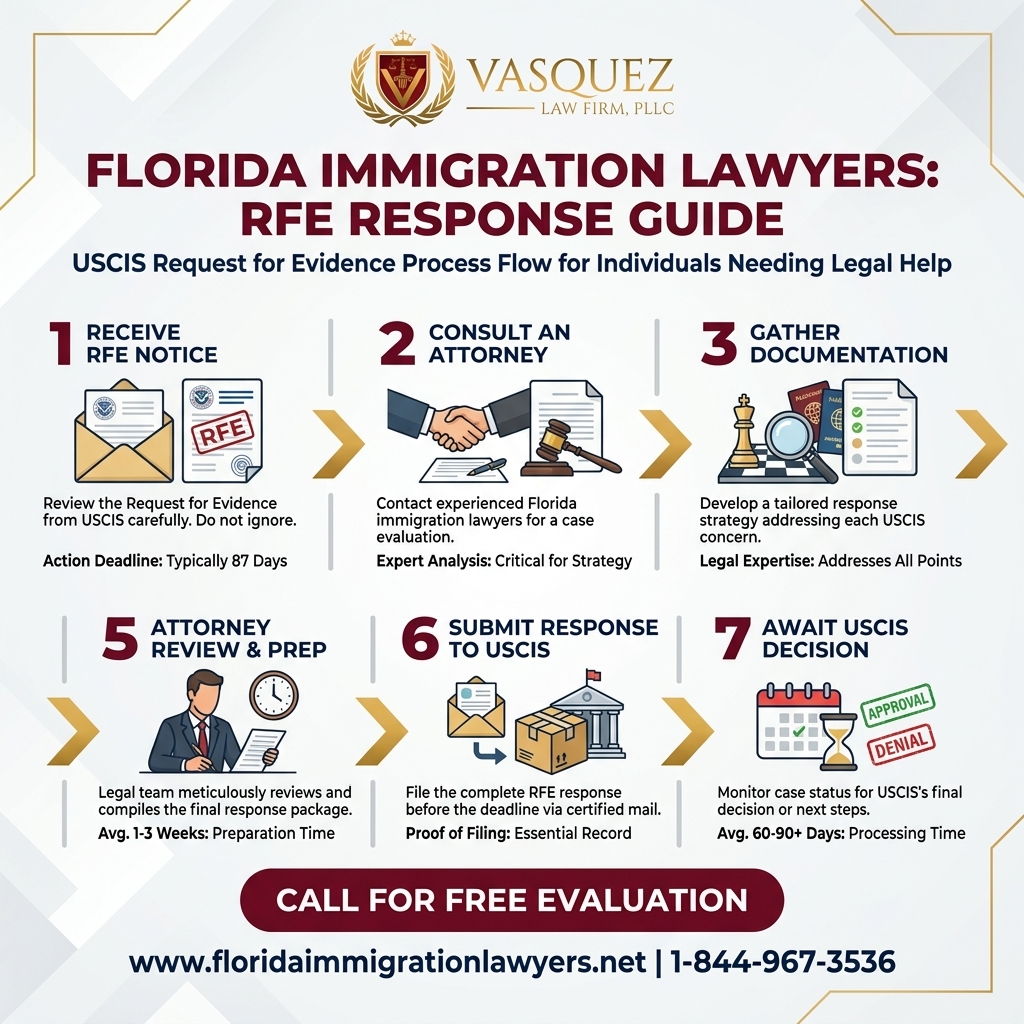
- You have a specific deadline to respond, typically 30-87 days.
- Provide all requested evidence, and often more if it strengthens your case.
- Incomplete or late responses can lead to denial.
- Consulting an immigration lawyer can significantly improve your chances.
Navigating the complex world of immigration can be challenging, and encountering a Request for Evidence (RFE) from USCIS can feel like a significant roadblock. For individuals and families across Florida, from the vibrant communities of Jacksonville to the bustling cities of Miami and Orlando, an RFE demands immediate and strategic attention. It signals that the U.S. Citizenship and Immigration Services (USCIS) needs more information to process your application, whether it's for a green card, visa, or naturalization.
Many Floridians find themselves asking, "What exactly is an RFE, and how do I respond effectively?" This comprehensive guide from Florida Immigration Lawyers aims to demystify the RFE process. We will walk you through what an RFE means, the steps to prepare a robust response, and why expert legal assistance is often the key to a favorable outcome. Do not let an RFE deter your immigration dreams. Instead, view it as an opportunity to reinforce your case with precise and compelling evidence. Call Florida Immigration Lawyers at 1-844-967-3536 for a free consultation and let us help you navigate this critical stage.
Understanding Your USCIS Request for Evidence (RFE) in Florida
A Request for Evidence (RFE) is an official notice from USCIS indicating that your submitted immigration application or petition lacks sufficient evidence or information. It is a common occurrence and does not necessarily mean your case will be denied. Instead, it provides you with a chance to submit additional documents or clarifications that USCIS deems necessary to make a final decision.
For applicants in Florida, receiving an RFE can be particularly stressful due to the state's diverse immigrant population and the high volume of cases processed by local USCIS field offices in cities like Miami, Orlando, and Tampa. The RFE letter will clearly state what information is missing or unclear. It will also specify a deadline for your response, typically ranging from 30 to 87 days from the date the RFE was issued. Missing this deadline can lead to a denial of your application, making a timely and thorough response absolutely critical.
What is an RFE?
An RFE is a formal communication from USCIS. It serves as a detailed list of questions or requests for specific documents that were either not included in your initial submission, were incomplete, or require further clarification. For example, if you are applying for a family-based green card, an RFE might request additional proof of your relationship or financial support. USCIS relies on the Immigration and Nationality Act (INA) and its associated regulations (e.g., 8 CFR) to determine what evidence is required for each benefit. An RFE ensures that all statutory and regulatory requirements are met before a final decision is made.
Common Reasons for an RFE
RFEs can arise for many reasons. Some of the most common include:
- Missing Documentation: Failing to include a required form, signature, or supporting document like a birth certificate or marriage certificate.
- Insufficient Evidence: Submitting documents that do not adequately prove a claim, such as insufficient evidence of a bona fide marriage or a qualifying employment relationship.
- Discrepancies: Inconsistencies between different documents or information provided in the application.
- Outdated Information: Submitting evidence that is no longer current or valid.
- Eligibility Concerns: USCIS may need more proof to confirm you meet all eligibility criteria for the benefit sought.
- Public Charge Rule: Requests for more financial evidence to ensure the applicant will not become a public charge, especially after recent policy changes.
Navigating the RFE Response Process Step-by-Step
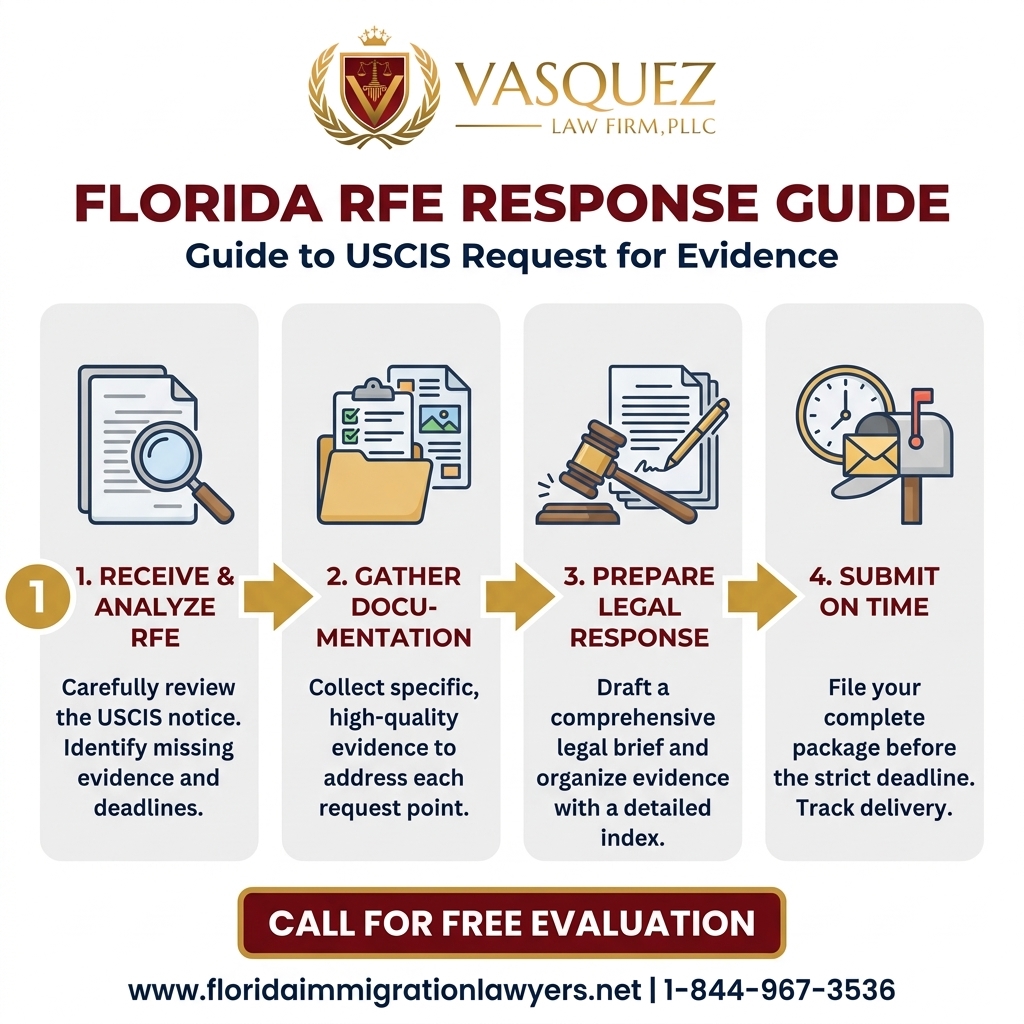
Responding to an RFE requires a methodical and precise approach. Following these steps can help ensure your response is complete and submitted correctly, improving your chances of approval. This process is crucial for anyone in Florida dealing with an RFE, whether from the USCIS National Benefits Center or a local field office.
- Read the RFE Carefully and Completely: This is the most critical first step. Do not skim. Understand every single request. Note the deadline clearly. The RFE will outline exactly what is needed and why. Sometimes, an RFE can be lengthy and complex, requiring careful analysis to fully grasp its implications.
- Consult with an Experienced Immigration Lawyer: Immediately after receiving an RFE, contact a knowledgeable immigration attorney, especially one familiar with Florida immigration law. An attorney from Florida Immigration Lawyers can help you understand the RFE's specific demands, identify the best evidence to provide, and strategize your response. This legal insight can be invaluable, particularly for complex cases or if the RFE suggests potential issues with your eligibility.
- Gather All Requested Documents: Collect every document specifically mentioned in the RFE. Ensure all copies are clear, legible, and properly translated if necessary. For original documents requested, make copies for your records before sending them. Do not submit original documents unless explicitly requested by USCIS.
- Provide Additional Supporting Evidence: Sometimes, merely providing what is requested is not enough. Your attorney may advise you to submit additional, relevant evidence that further strengthens your case, even if not explicitly asked for. This proactive approach can help preempt future RFEs or concerns.
- Write a Cover Letter: A well-organized cover letter from your attorney can summarize the contents of your response. It should list each item requested in the RFE and indicate where in your submission the corresponding evidence can be found. This helps USCIS officers quickly review your packet.
- Organize and Assemble Your Response: Arrange your documents logically. Use tabs or dividers to separate different types of evidence. Include a copy of the RFE notice on top of your submission. This meticulous organization reflects professionalism and helps the USCIS officer process your case efficiently.
- Mail Your Response by the Deadline: Ensure your RFE response is mailed well before the deadline. Send it to the address specified in the RFE letter, typically the USCIS service center or field office handling your case. Use a trackable mailing service (e.g., USPS Certified Mail, FedEx, UPS) and keep the tracking number for your records. This provides proof of timely submission.
- Keep Copies of Everything: Maintain a complete copy of your entire RFE response packet, including the RFE notice, cover letter, and all submitted evidence. This is crucial for your records and if further correspondence with USCIS is needed.
Essential Document Checklist for a Strong RFE Response
Preparing a comprehensive RFE response involves more than just gathering documents; it requires strategic selection and presentation. The exact documents needed will vary significantly based on the type of RFE you received. However, this general checklist covers common categories of evidence that may be requested or beneficial to include. Always refer to your specific RFE letter and consult with your attorney.
- Copy of the RFE Notice: Always include the original RFE notice on top of your response packet.
- Cover Letter: A detailed letter from your attorney outlining the contents and addressing each point of the RFE.
- Proof of Identity: Copies of passports, birth certificates, or national identity cards.
- Proof of Relationship: For family-based petitions, this might include marriage certificates, birth certificates, joint bank statements, utility bills, leases, photos, affidavits from friends and family, and communication records. For employment-based petitions, this might involve employer letters, organizational charts, and pay stubs.
- Financial Documentation: Tax returns (Form 1040), W-2s, pay stubs, bank statements, affidavits of support (Form I-864), and employment verification letters.
- Educational Credentials: Diplomas, transcripts, evaluation reports, and professional licenses.
- Employment History: Letters from employers, offer letters, pay stubs, W-2s, and resumes.
- Medical Records: If the RFE relates to medical inadmissibility or waivers, include relevant medical reports, vaccination records, and physician statements.
- Affidavits: Sworn statements from individuals who have personal knowledge of facts relevant to your case, such as a bona fide marriage or a specific work experience.
- Correction of Discrepancies: Any documents or detailed explanations that clarify inconsistencies previously identified by USCIS.
- Translations: Certified English translations for any document not originally in English, accompanied by a translator's certification.
RFE Timelines, Processing Expectations, and Florida Considerations
Understanding the timeline for an RFE is crucial for managing expectations and planning your next steps. Once USCIS issues an RFE, you have a specific window to respond, typically 30 to 87 days. The exact deadline will be clearly stated in the RFE letter. It is imperative to submit your response well before this deadline to avoid any risk of denial due to late submission.
After your RFE response is received by USCIS, the processing clock essentially restarts. USCIS aims to make a decision within 60 days of receiving your complete response, but actual processing times can vary significantly. These times depend on the specific USCIS service center or field office handling your case, the complexity of the RFE, and the current caseload. You can check current processing times on the official USCIS website using your receipt number.
USCIS Processing Times
The overall processing time for your application will be extended by the RFE. For example, if your application typically takes 10 months and you receive an RFE at month 6, the 60-day period for your RFE response and subsequent USCIS review adds to the total. It is not uncommon for cases involving an RFE to take several additional months to reach a final decision. Patience and consistent monitoring of your case status online are advisable.
Florida-Specific Nuances
In Florida, the high volume of immigration cases at local USCIS field offices in Miami, Orlando, and Tampa means that processing times can sometimes be longer than the national average. Additionally, the diverse nature of Florida's immigrant population means that RFEs can cover a wide range of issues, from complex family relationships to intricate business immigration matters. Attorneys at Florida Immigration Lawyers are well-versed in the specific expectations and common RFE trends seen in Florida's USCIS offices and immigration courts, providing a localized advantage in preparing your response. For cases that might eventually involve an immigration court, understanding the nuances of the Executive Office for Immigration Review (EOIR) is also important.
Cost Factors and Legal Fees for Your RFE Response
Responding to a Request for Evidence (RFE) involves various potential costs, and understanding these can help you budget and plan effectively. The primary costs generally fall into two categories: USCIS fees (if applicable) and legal fees for attorney assistance. It is important to note that USCIS does not charge a separate fee for submitting an RFE response itself, as it is part of an existing application. However, you might incur costs for obtaining new evidence.
For example, if the RFE requests an updated medical exam, you will be responsible for the physician's fees. If it requires certified translations of foreign documents, you will pay for those services. Obtaining official government records, such as updated birth certificates or police clearances, may also involve nominal fees. These ancillary costs can add up, so it is wise to anticipate them.
The most significant cost factor for many Floridians is the legal fees associated with hiring an immigration attorney. While not mandatory, legal representation for an RFE response is highly recommended due to the complexity and high stakes involved. Attorneys at Florida Immigration Lawyers charge fees based on the complexity of the RFE and the estimated work required. This often includes:
- Reviewing the RFE and your original application.
- Strategizing the best approach to gather evidence.
- Assisting with document collection and organization.
- Drafting a compelling cover letter and legal arguments.
- Communicating with USCIS on your behalf.
Investing in legal expertise can save you time, reduce stress, and significantly increase the likelihood of a successful outcome, potentially preventing a denial that would require costly appeals or refiling. We offer free consultations to discuss your RFE and provide a clear fee structure.
Florida-Specific Immigration Landscape and RFE Impact
Florida's unique position as a gateway to the Americas profoundly shapes its immigration landscape. With a large and diverse immigrant population, the state sees a substantial volume of immigration applications processed by USCIS. This high volume, coupled with specific regional enforcement priorities and judicial interpretations, means that RFEs in Florida can have particular nuances that applicants and their legal counsel must understand.
USCIS field offices in major Florida cities like Miami, Orlando, and Tampa handle thousands of cases annually, ranging from family-based petitions to employment visas and asylum claims. The types of RFEs issued often reflect common issues seen in these local contexts. For instance, in areas with significant family immigration, RFEs related to bona fide marriage evidence or financial sponsorship (Form I-864) are prevalent. In business hubs, RFEs for employment-based petitions might focus on the validity of job offers, the applicant's qualifications, or the employer's ability to pay.
Furthermore, recent policy changes, such as those impacting permanent residents or public charge rules, can influence the types of evidence USCIS requests. For example, the need for robust financial documentation has become even more critical, leading to more detailed RFEs for affidavits of support. Our attorneys at Florida Immigration Lawyers stay abreast of these evolving policies and their specific application within Florida's immigration system. We understand the local USCIS offices' tendencies and common requests, providing tailored advice for our clients throughout the state, including those in Jacksonville and surrounding areas. This localized knowledge is a significant advantage when crafting a comprehensive and persuasive RFE response.
Do not navigate this process alone. A seemingly minor detail in your RFE response can have significant long-term consequences. Contact Florida Immigration Lawyers today at 1-844-967-3536 for a free consultation. Our experienced team is ready to provide the guidance and representation you need.
Common Mistakes to Avoid When Responding to an RFE
Responding to an RFE is a critical juncture in your immigration case. Avoiding common pitfalls can significantly increase your chances of a positive outcome. Many denials stem from errors that could have been prevented with careful attention and professional guidance.
- Ignoring the Deadline: This is perhaps the most fatal mistake. Failing to submit your response by the specified date will almost certainly lead to a denial without further review. Always mark your calendar and aim to submit well in advance.
- Not Understanding the RFE: A superficial reading of the RFE can lead to an incomplete or irrelevant response. Each point in the RFE must be addressed directly and comprehensively.
- Submitting Incomplete Evidence: Providing only a portion of the requested documents or evidence that does not fully satisfy USCIS's concerns. Ensure every specific request is met.
- Sending Irrelevant Information: While providing additional supporting evidence can be helpful, submitting vast amounts of irrelevant documents can overwhelm the officer and obscure the crucial information. Be strategic and focused.
- Failing to Provide Certified Translations: Any document not in English must be accompanied by a complete and certified English translation and a certification from the translator. Failure to do so renders the document unusable.
- Sending Original Documents: Unless explicitly requested, never send original documents. Always send clear copies. USCIS generally does not return original documents unless specifically asked.
- Lack of Organization: A disorganized response packet can frustrate the USCIS officer, making it difficult for them to find the necessary evidence. Use tabs, cover letters, and a logical structure.
- Assuming USCIS Knows: Do not assume USCIS has access to information or documents from other applications you've filed. Treat each RFE as a standalone request requiring full documentation.
- Providing Inconsistent Information: Submitting new information that contradicts previous statements or documents without a clear explanation can raise red flags and lead to further scrutiny or denial.
- Not Consulting an Attorney: Attempting to respond to a complex RFE without legal counsel is a significant risk. An attorney can identify hidden issues, formulate strong legal arguments, and ensure compliance with all regulations, including INA Section 212 or 245.
- Using Outdated Forms or Information: Ensure any forms you submit as part of your RFE response are the latest version. Policies and forms change frequently, and using an outdated version can lead to rejection.
- Poor Quality Copies or Illegible Documents: Always ensure all copies are clear and easy to read. Blurry or unreadable documents are as good as not submitting them at all.
When to Call a Florida Immigration Lawyer for Your RFE
While some straightforward RFEs might seem manageable, the vast majority benefit immensely from professional legal guidance. Knowing when to call an immigration lawyer can be the difference between approval and denial, especially for applicants in Florida facing complex immigration challenges. You should contact Florida Immigration Lawyers immediately if any of these scenarios apply to your RFE:
- Complex Legal Issues: If the RFE raises questions about your eligibility, legal status, criminal history, or any other complex legal matter (e.g., inadmissibility under 8 U.S.C. § 1182), an attorney is essential.
- Ambiguous or Vague RFE: If the RFE is unclear or you are unsure exactly what USCIS is asking for, a lawyer can interpret the request and guide you on the appropriate evidence.
- Difficulty Obtaining Evidence: If you are struggling to gather the requested documents, especially from foreign sources or if they are difficult to replace, an attorney can advise on alternative evidence or strategies.
- Previous Denials or Immigration History: If you have a history of immigration denials, deportations, or complex immigration filings, your RFE response needs expert handling.
- Short Deadline: If the response deadline is very tight, an attorney can prioritize tasks and expedite the process effectively.
- Concern for Future Implications: If you are worried about how your RFE response might impact future immigration applications or your long-term goals, seek legal advice.
- Any RFE for an Employment-Based Petition: These often involve intricate legal and evidentiary requirements that are best handled by an experienced attorney.
Florida Immigration Lawyers understands the unique pressures faced by immigrants in Jacksonville, Miami, Orlando, and across the state. We offer comprehensive services for RFE responses, ensuring your case is presented strongly and accurately. Do not take chances with your future. Visit our contact page or call us to schedule your free consultation.
About Florida Immigration Lawyers
Florida Immigration Lawyers is a leading immigration law firm dedicated to serving individuals, families, and businesses throughout the Sunshine State. With a deep understanding of U.S. immigration laws and the unique needs of Florida's diverse communities, our experienced attorneys provide compassionate yet tenacious legal representation. We are committed to helping our clients navigate the complexities of the immigration system, ensuring their rights are protected and their goals are achieved.
Our firm specializes in a wide range of immigration matters, including family-based petitions, employment visas, asylum, deportation defense, citizenship applications, and, crucially, responding to complex USCIS RFEs. We pride ourselves on offering personalized legal strategies tailored to each client's specific circumstances. Our team is available 24/7, providing free consultations to discuss your case and outline your best path forward. We serve all of Florida, from Jacksonville to Miami, ensuring expert legal help is always within reach. Your immigration journey is our priority. Learn more about our immigration services.
Sources and References
- U.S. Citizenship and Immigration Services (USCIS)
- USCIS Check Case Processing Times
- Executive Office for Immigration Review (EOIR)
- 8 U.S.C. Chapter 12 - Immigration and Nationality Act (INA)
- 8 CFR (Code of Federal Regulations, Title 8 - Aliens and Nationality)
- USCIS Policy Manual
Related services: immigration practice areas, experienced immigration attorneys.
This article provides general legal information and is not intended as legal advice. Every case is unique, and outcomes depend on specific facts and circumstances. Immigration laws are subject to change. Contact an attorney for advice about your particular situation.
Do not let a Request for Evidence create uncertainty in your immigration journey. Take proactive steps to protect your future. Contact Florida Immigration Lawyers today for a free, confidential consultation. Our dedicated team is here to provide the expert legal support you deserve. Call us now at 1-844-967-3536. Se Habla Español - Estamos aquí para ayudarle.
Do Not Navigate This Process Alone
Our experienced immigration attorneys are ready to fight for you. Get a free, confidential consultation today.
Se Habla Español
Frequently Asked Questions
Florida Immigration Lawyers
Immigration Attorney | Founder, Vasquez Law Firm
U.S. Air Force veteran and immigration attorney with thousands of cases resolved. J.D., NCCU School of Law. AILA member. Admitted to the 4th, 5th, and 11th Circuit Courts.
Available 24/7 - Free Evaluations
Related Legal Services
Our Florida immigration attorneys can help you with free immigration consultation, experienced immigration attorneys and business immigration. Call today at 1-844-967-3536 for a free consultation.
Related Links
Related Topics
Free Legal Consultation
Discuss your case with our experienced attorneys. We're available 24/7.
Se Habla Español - Estamos aquí para ayudarle.
Related Articles
Understanding the Stokes Interview for Marriage Fraud in Florida
Facing a Stokes interview in Florida for marriage fraud concerns? Learn what to expect and how to prepare effectively. Contact Florida Immigration Lawyers for expert guidance and a free consultation.
Tampa Immigration Lawyer: Your Florida Bay Area Guide
Navigating U.S. immigration law in the Tampa Bay Area can be complex, whether you're seeking a visa, green card, or citizenship, or facing deportation. An experienced immigration lawyer in Tampa provides essential guidance, ensuring applications are accurate, deadlines are met, and your rights are protected. Florida Immigration Lawyers offers comprehensive services for family-based visas, employment immigration, naturalization, and deportation defense. With local expertise in Tampa Bay Area USCIS procedures and immigration court practices, our attorneys are equipped to handle even the most challenging cases. Learn about common immigration pathways, typical processing timelines, and crucial mistakes to avoid. Secure your future in Florida with trusted legal representation. Contact us for a free consultation today.
Immigration Attorney Lakeland Polk County FL - Free Consult
Navigating the U.S. immigration system can be daunting, especially in a growing region like Lakeland, Polk County, Florida. An experienced immigration attorney in Lakeland, Polk County, provides crucial guidance for complex processes like visa applications, green card petitions, naturalization, and deportation defense. Our firm understands the local nuances and federal laws, offering personalized support to ensure your case is handled accurately and efficiently. Learn about common immigration pathways, essential documentation, processing times at Florida USCIS and EOIR offices, and critical mistakes to avoid. Discover when professional legal assistance is indispensable for protecting your rights and achieving your immigration goals in Central Florida.
Conditional Green Card Removal Florida: I-751 Guide 2026
For individuals in Florida holding a conditional green card, the process of removing conditions is a critical step towards permanent residency. This involves filing Form I-751 with USCIS within a strict 90-day window before your two-year conditional status expires. Understanding the requirements, gathering comprehensive evidence of a bona fide marriage, and navigating potential challenges like divorce or abuse waivers are essential. This guide provides a detailed overview of the I-751 process, including step-by-step instructions, a document checklist, processing timelines, and cost factors. Learn how to avoid common mistakes and when to seek professional legal assistance from Florida Immigration Lawyers to secure your future in the U.S.
