I-601 Waiver Florida Guide: Overcoming Inadmissibility
Navigating inadmissibility in the U.S. immigration system can be a major hurdle, but the I-601 waiver offers a crucial pathway for many in Florida. This waiver allows individuals to overcome certain legal barriers, such as past immigration violations or criminal issues, preventing them from obtaining a green card or visa. The core requirement is proving "extreme hardship" to a U.S. citizen or lawful permanent resident spouse, parent, or fiancé(e). Our comprehensive guide explains the eligibility criteria, the detailed step-by-step application process, the extensive documentation needed, and what to expect regarding processing times and costs. We also highlight common mistakes to avoid and emphasize when legal counsel is essential to ensure a successful outcome. For anyone in Homestead, Miami, or across Florida facing inadmissibility, understanding the I-601 waiver is vital. Contact Florida Immigration Lawyers for a free consultation to protect your family's future.

An I-601 waiver, officially known as the Application for Waiver of Grounds of Inadmissibility, allows certain non-citizens in Florida and across the U.S. to overcome specific legal barriers preventing them from obtaining a visa or green card. These barriers, or grounds of inadmissibility, can stem from past immigration violations, criminal offenses, or misrepresentations. To qualify, applicants must typically demonstrate that their U.S. citizen or lawful permanent resident spouse, parent, or fiancé(e) would suffer extreme hardship if the waiver is not granted. The process is complex, requiring substantial documentation and a compelling legal argument, making professional legal guidance essential for success.
- The I-601 waiver addresses various grounds of inadmissibility.
- Applicants must prove extreme hardship to a qualifying relative.
- Extensive documentation and a strong legal argument are crucial.
- Waivers are often necessary for those seeking green cards or certain visas.
- Legal assistance significantly improves the chances of approval.
Navigating the U.S. immigration system can be a complex and often daunting journey, especially when facing unexpected obstacles like inadmissibility. For many individuals and families in Florida, the dream of legal residency or citizenship can be jeopardized by past issues, ranging from minor immigration missteps to more serious offenses. When a person is deemed inadmissible to the United States, it means they are legally barred from entering or remaining in the country, even if they otherwise qualify for a visa or green card. This is where the I-601 waiver, also known as the Application for Waiver of Grounds of Inadmissibility, becomes a critical tool.
The I-601 waiver provides a pathway for individuals to overcome certain grounds of inadmissibility, allowing them to pursue their immigration goals. Whether you are in Homestead, Miami, Orlando, or anywhere else in Florida, understanding this vital process is key to securing your future. This comprehensive guide from Florida Immigration Lawyers will demystify the I-601 waiver, explaining who is eligible, the application process, required documentation, and what to expect. We understand the profound impact immigration decisions have on families, and our goal is to provide clear, actionable information to help you navigate this challenging terrain. Do not let inadmissibility define your future. Call Florida Immigration Lawyers at 1-844-967-3536 for a free consultation to discuss your specific situation and explore your options.
Understanding the I-601 Waiver and Grounds of Inadmissibility
The I-601 waiver is a specific legal remedy designed to forgive certain grounds of inadmissibility that would otherwise prevent an individual from obtaining an immigrant visa, adjustment of status, or certain nonimmigrant visas. Grounds of inadmissibility are outlined in the Immigration and Nationality Act (INA) and cover a broad spectrum of issues. These can include health-related grounds, criminal grounds, security and related grounds, public charge grounds, illegal entry and immigration violations, and misrepresentation. For example, individuals who have been unlawfully present in the U.S. for more than 180 days may be subject to a 3-year or 10-year bar, as per INA § 212(a)(9)(B), which the I-601 waiver can potentially overcome.
For many families in Florida, particularly those with deep roots in communities like Homestead, an inadmissibility finding can be devastating. It can mean separation from U.S. citizen or lawful permanent resident (LPR) spouses, children, or parents. The purpose of the I-601 waiver is to provide relief in cases where such separation would cause extreme hardship to these qualifying U.S. relatives. It's crucial to understand that not all grounds of inadmissibility can be waived. For instance, certain serious criminal offenses or national security threats are generally non-waivable. Identifying the exact ground of inadmissibility is the first critical step, as it dictates whether an I-601 waiver is the appropriate solution. An immigration attorney can help you determine the specific legal basis for your inadmissibility and evaluate the feasibility of a waiver application.
The legal framework for waivers is complex, often involving interpretations of various sections of the INA and federal regulations (e.g., 8 CFR § 212.7). A successful I-601 waiver requires not only identifying the correct legal provision but also presenting a compelling case that demonstrates the qualifying relative's extreme hardship. This goes beyond mere inconvenience and requires showing severe impact on their health, finances, education, or emotional well-being. Understanding these nuances is essential for anyone considering an immigration waiver in Florida, and professional guidance can make all the difference in preparing a strong case.
Eligibility Criteria for the I-601 Waiver: Proving Extreme Hardship
Eligibility for an I-601 waiver hinges primarily on demonstrating extreme hardship to a qualifying relative. A qualifying relative for an I-601 waiver is typically a U.S. citizen or lawful permanent resident (LPR) spouse, parent, or fiancé(e). Importantly, a child is generally not considered a qualifying relative for demonstrating hardship in most I-601 cases, although their suffering can be a factor in demonstrating hardship to the parent. The burden of proof rests entirely on the applicant to show that their qualifying relative would experience significantly greater than normal hardship if the applicant is denied admission to the U.S. and is separated from them or if the qualifying relative were to relocate abroad.
USCIS considers a wide range of factors when evaluating extreme hardship. These factors are not exhaustive and are often considered in combination. They include, but are not limited to, the qualifying relative's health (chronic illnesses, need for specialized medical care), financial impact (loss of income, reliance on the applicant's support, property loss), educational disruption (for children, or the relative's own educational pursuits), psychological impact (depression, anxiety, need for counseling), family ties in the U.S., social and cultural integration, and the conditions in the foreign country if the qualifying relative were to relocate. For instance, a U.S. citizen spouse in Florida suffering from a severe medical condition who relies on the applicant for care and financial support would present a strong argument for extreme hardship.
The concept of extreme hardship is subjective and adjudicated on a case-by-case basis. There is no definitive list of criteria that guarantees approval; rather, it is the totality of the circumstances that USCIS examines. It is critical to provide detailed and well-documented evidence for each hardship claim. Simply stating that a relative will miss the applicant is insufficient. The evidence must clearly illustrate severe, unusual, or unique hardship. Preparing a robust extreme hardship argument is arguably the most challenging aspect of the I-601 waiver application. An experienced attorney can help identify and articulate all potential hardship factors, gather supporting evidence, and present a compelling narrative to USCIS, especially given the varied interpretations of hardship across different USCIS offices, including those serving the Florida region.
Step-by-Step I-601 Waiver Application Process
Applying for an I-601 waiver involves a meticulous, multi-step process that demands precision and thoroughness. Missing a single detail can lead to significant delays or even outright denial. Understanding each phase is crucial for a successful outcome, particularly for those navigating the system in Florida. Here's a general outline of the steps involved:
- Determine Eligibility and Ground of Inadmissibility: Before anything else, you must confirm that an I-601 waiver is the correct solution for your specific ground of inadmissibility. This typically requires a comprehensive review of your immigration history and any relevant criminal records. An attorney can help identify the precise legal basis for inadmissibility (e.g., unlawful presence, certain criminal convictions, misrepresentation) and confirm if it is waivable under INA § 212(i) or other provisions.
- Identify the Qualifying Relative: You must establish that you have a U.S. citizen or lawful permanent resident spouse, parent, or fiancé(e) who would suffer extreme hardship. Gather proof of their status and your relationship to them.
- Gather Evidence for Extreme Hardship: This is the most crucial and time-consuming step. Collect extensive documentation to support every claim of extreme hardship to your qualifying relative. This includes medical records, psychological evaluations, financial statements, employment letters, property documents, educational records, affidavits from friends and family, and country conditions reports if relocation is considered. Be specific and quantify hardship whenever possible.
- Complete Form I-601: Fill out Form I-601, Application for Waiver of Grounds of Inadmissibility, accurately and completely. Ensure all sections are addressed and no information is omitted. Pay careful attention to the specific questions regarding the ground of inadmissibility you are trying to waive.
- Prepare a Legal Brief/Statement: A well-crafted legal brief or personal statement is essential. This document synthesizes all the evidence, explains the legal arguments for extreme hardship, and directly addresses the factors USCIS considers. It should be persuasive, factual, and clearly articulate why your case warrants a waiver.
- Assemble the Application Package: Organize all forms, supporting documents, the legal brief, and the appropriate filing fee into a comprehensive package. Ensure everything is clearly labeled, and consider creating a table of contents for ease of review by USCIS officers.
- File the Application: The filing location for Form I-601 depends on your specific immigration process. If you are applying for an immigrant visa abroad, the I-601 is typically filed with USCIS after the interview at a U.S. Embassy or Consulate. If you are adjusting status in the U.S., it might be filed concurrently with Form I-485 or after, depending on the ground of inadmissibility. For those in removal proceedings, it is filed with the Executive Office for Immigration Review (EOIR) at the immigration court, such as the Miami Immigration Court. Always check the latest USCIS instructions for the correct filing address.
- Attend Interviews (If Required): While not always required for I-601 waivers, USCIS may request an interview to clarify information or assess the credibility of hardship claims. Be prepared to answer questions about your application and the hardship suffered by your qualifying relative.
- Receive Decision: USCIS will issue a written decision approving or denying your waiver. If approved, you can proceed with your visa or adjustment of status application. If denied, you may have options to appeal or refile, depending on the reasons for denial.
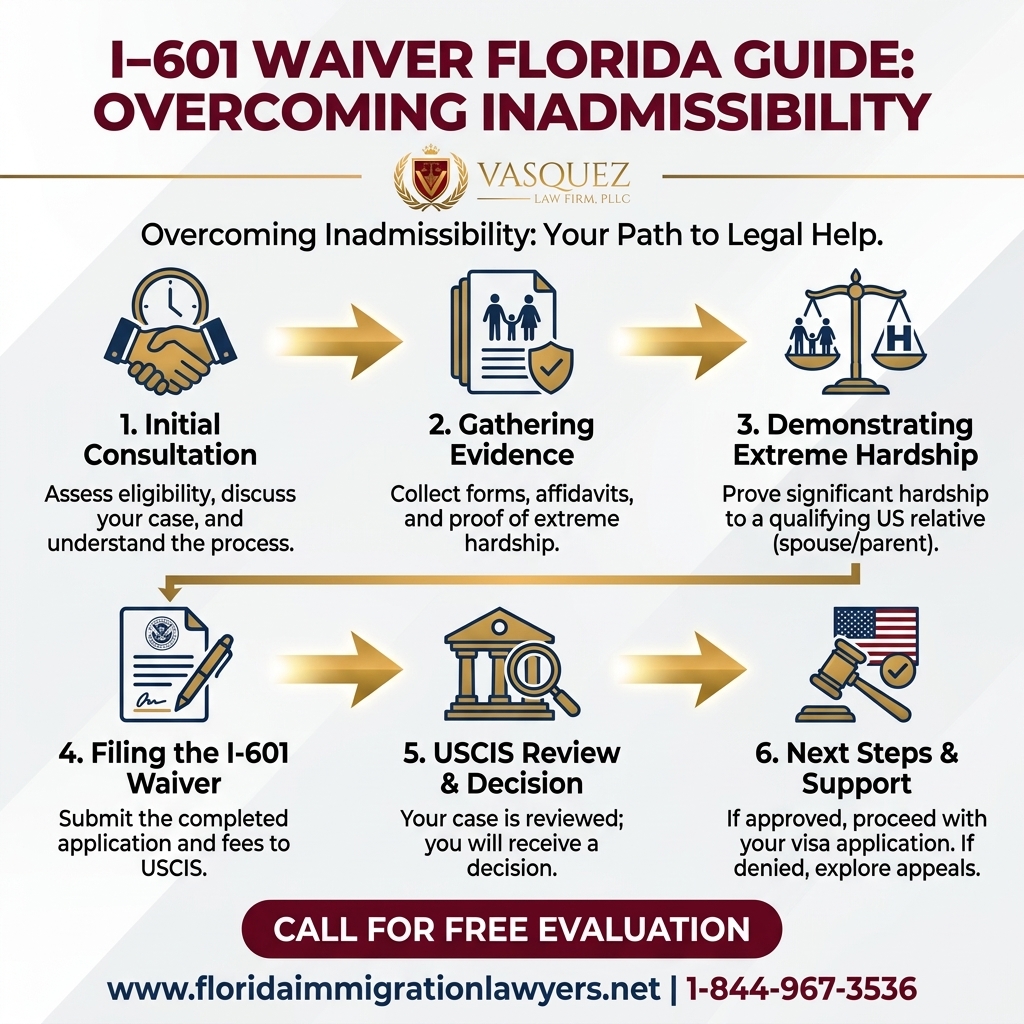
Each step requires meticulous attention to detail and a deep understanding of immigration law. Consulting with Florida Immigration Lawyers can help ensure your application is comprehensive, accurate, and strategically presented.
Required Documents Checklist for Form I-601
A well-organized and thorough documentation package is paramount for a successful I-601 waiver application. USCIS relies heavily on concrete evidence to assess claims of extreme hardship and to verify the facts of your case. Preparing this checklist carefully can significantly strengthen your application. Remember, quality and relevance of documents often outweigh sheer quantity.
- Form I-601, Application for Waiver of Grounds of Inadmissibility: The original, completed, and signed form.
- Filing Fee: Check the latest USCIS fee schedule on USCIS website for the current amount.
- Proof of Qualifying Relationship:
- Marriage certificate (if applicable).
- Birth certificates (to prove parent-child relationship).
- Divorce decrees or death certificates for any prior marriages.
- Proof of Qualifying Relative's U.S. Citizenship or LPR Status:
- Copy of U.S. passport, birth certificate, naturalization certificate, or green card (Form I-551).
- Detailed Personal Statement/Affidavits:
- A comprehensive statement from the applicant explaining the ground of inadmissibility, remorse, rehabilitation, and why the waiver should be granted.
- A detailed affidavit from the qualifying relative describing the extreme hardship they would face.
- Affidavits from friends, family, employers, or community members corroborating hardship claims.
- Medical Documentation (if applicable for hardship):
- Medical records, diagnoses, prognoses, and treatment plans for the qualifying relative.
- Letters from doctors, therapists, or specialists explaining the severity of conditions and need for care.
- Prescription records.
- Psychological Evaluations (if applicable for hardship):
- Reports from licensed psychologists or psychiatrists detailing the emotional or mental health impact on the qualifying relative due to separation.
- Financial Documentation (if applicable for hardship):
- Proof of income (pay stubs, tax returns for the past several years).
- Mortgage statements, rental agreements, utility bills.
- Bank statements, investment portfolios.
- Documentation of debts (credit card statements, loan agreements).
- Proof of ownership of property or business.
- Letters from employers regarding job security or dependence on applicant.
- Educational Documentation (if applicable for hardship):
- School enrollment records, transcripts for children or the qualifying relative.
- Letters from school officials regarding impact of relocation or separation.
- Country Conditions Information (if relocation is an option):
- Reports from reputable sources (e.g., U.S. Department of State, human rights organizations) about economic, social, political, or medical conditions in the applicant's home country. This can be crucial in demonstrating that the qualifying relative cannot reasonably relocate. Relevant information can often be found on Travel.State.Gov.
- Criminal Records (if applicable):
- Certified court dispositions for any arrests or convictions.
- Police clearances from all countries resided in.
- Immigration Records:
- Copies of all previous immigration applications, notices, and decisions.
- I-94 arrival/departure records.
- Any other relevant supporting documentation: Letters of support from community leaders, evidence of community involvement, etc.
All documents not in English must be accompanied by a certified English translation. This checklist is a general guide; your specific situation may require additional or different documents. Always consult with an immigration attorney to tailor your document submission to your unique case.
I-601 Waiver Processing Times and Expectations in Florida
One of the most common questions applicants have about the I-601 waiver process concerns how long it will take. Unfortunately, there is no single, fixed answer, as processing times can vary significantly based on several factors, including the specific USCIS service center handling your case, the complexity of your application, and the current workload. Generally, I-601 waiver processing times can range from several months to over a year, or even longer in some complex situations. USCIS publishes estimated processing times on its website, which can provide a general idea, but these are only estimates and are subject to change without notice.
For applicants in Florida, their I-601 waiver application will typically be processed by one of the USCIS service centers, such as the Nebraska Service Center or the California Service Center, depending on the specific filing instructions. While there isn't a dedicated Florida-based service center for I-601 adjudication, the local USCIS field offices in cities like Miami, Orlando, and Jacksonville may be involved if an interview is required or for related adjustment of status applications. It's important to monitor the USCIS website for updates on processing times and to check your case status online using the receipt number provided after filing.
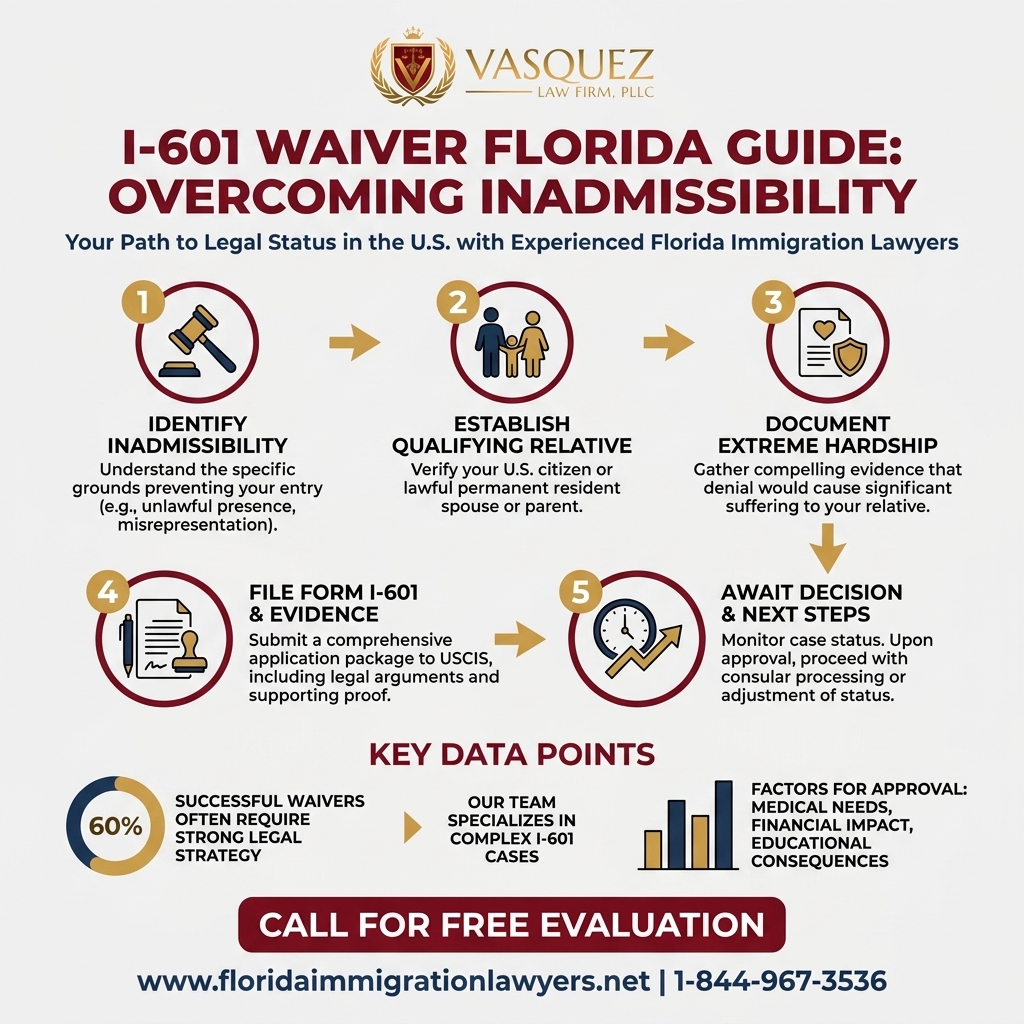
During the processing period, USCIS may issue a Request for Evidence (RFE) if they determine that your application is missing crucial information or if they need further clarification on your claims of extreme hardship. Responding promptly and thoroughly to an RFE is critical. Failing to provide the requested information by the deadline can lead to a denial. In some cases, USCIS may also issue a Notice of Intent to Deny (NOID), which provides an opportunity to submit additional evidence or arguments before a final decision is made. Receiving an RFE or NOID does not necessarily mean your case will be denied, but it does indicate that USCIS has questions that need to be addressed effectively. Being prepared for these possibilities and having legal counsel can help you navigate these challenges efficiently and strategically, ultimately affecting the overall timeline for your immigration waiver.
Cost Factors and Fee Breakdown for the I-601 Waiver
Understanding the financial aspects of filing an I-601 waiver is crucial for proper planning. The costs associated with this process extend beyond just the government filing fee and can include various other expenses that applicants in Florida should anticipate. While government fees are standardized across the U.S., other costs can vary based on individual circumstances and the level of legal assistance sought.
The primary cost is the USCIS filing fee for Form I-601. This fee is subject to change, so it is imperative to check the most current amount directly on the USCIS website before filing. USCIS fees are non-refundable, regardless of the outcome of your application. There are very limited circumstances under which a fee waiver might be granted for Form I-601, and eligibility is strict. Typically, applicants for I-601 waivers are not eligible for fee waivers.
Beyond the filing fee, applicants should budget for several other potential expenses:
- Attorney Fees: Legal representation is highly recommended for I-601 waivers due to their complexity. Attorney fees will vary based on the attorney's experience, the complexity of your case, and the services provided. These fees cover case evaluation, document preparation, legal brief writing, communication with USCIS, and representation.
- Translation Costs: Any document submitted to USCIS that is not in English must be accompanied by a certified English translation. Costs for professional translation services can add up, especially for extensive documentation.
- Medical and Psychological Evaluation Fees: If your hardship claim involves medical or psychological conditions, you may need to pay for evaluations and reports from licensed healthcare professionals. These can be significant, particularly for detailed assessments.
- Document Collection Costs: Obtaining certified copies of birth certificates, marriage certificates, court records, police clearances, and other official documents may incur small fees from government agencies or courthouses.
- Mailing and Courier Costs: Sending large application packages securely via certified mail or courier services can also add to the overall expense.
- Travel Expenses: If an interview is required, you may incur travel costs to a USCIS field office or U.S. Embassy/Consulate.
While the total cost can seem substantial, investing in a meticulously prepared and legally sound I-601 waiver application significantly increases your chances of approval, potentially saving you from future delays, appeals, or even deportation proceedings. Florida Immigration Lawyers offers transparent fee structures and can help you understand the full financial scope of your waiver application.
Common Mistakes to Avoid in Your I-601 Waiver Application
The I-601 waiver process is unforgiving of errors. Even small mistakes can lead to significant delays, Requests for Evidence (RFEs), or outright denial. Being aware of these common pitfalls can help you avoid them and strengthen your application, especially for those in Florida seeking to overcome inadmissibility.
- Failing to Identify the Correct Ground of Inadmissibility: Incorrectly identifying why you are inadmissible means you're applying for the wrong waiver or addressing the wrong issue, leading to inevitable denial. This requires careful legal analysis.
- Not Proving "Extreme Hardship" Adequately: This is the most common reason for denial. Applicants often provide vague statements or insufficient evidence, failing to demonstrate that the qualifying relative would suffer hardship beyond what is typical in separation cases.
- Lack of Sufficient Supporting Documentation: Submitting a poorly documented application with missing evidence, uncertified translations, or unorganized materials makes it difficult for USCIS to review and approve.
- Submitting Untimely or Incomplete Responses to RFEs: If USCIS requests additional evidence, failing to respond by the deadline or providing incomplete information will almost certainly result in denial.
- Misrepresenting Facts or Omitting Information: Any false statements or intentional omissions can lead to a finding of misrepresentation, which itself is a ground of inadmissibility and can result in a permanent bar. Honesty is paramount.
- Not Addressing All Grounds of Inadmissibility: If you have multiple grounds of inadmissibility, you must ensure the I-601 waiver (or other necessary waivers) addresses each one. Overlooking even one ground will result in denial.
- Failing to Provide a Compelling Legal Argument: Simply submitting documents is not enough. A well-written legal brief that ties all the evidence to the legal requirements of extreme hardship is crucial.
- Not Filing with the Correct USCIS Office or at the Correct Time: The filing location and timing depend on whether you are applying for an immigrant visa abroad (consular processing) or adjusting status in the U.S. (domestic filing). Incorrect filing can cause significant delays.
- Ignoring Rehabilitation or Positive Equities: While hardship is key, demonstrating rehabilitation (e.g., after a criminal offense) and positive contributions to the community (positive equities) can strengthen your case.
- Attempting to Self-Represent Without Sufficient Knowledge: The I-601 waiver is one of the most complex immigration applications. Without legal expertise, applicants often miss critical legal nuances, leading to errors and denial.
When to Call a Florida Immigration Lawyer for Your I-601 Waiver
Given the intricate nature and high stakes of an I-601 waiver application, knowing when to seek professional legal assistance is crucial. While some immigration forms might seem straightforward, the I-601 waiver is unequivocally not one of them. Its success hinges on demonstrating extreme hardship, a legal standard that requires nuanced understanding, strategic evidence gathering, and persuasive argumentation. Here are specific scenarios where contacting Florida Immigration Lawyers is not just advisable, but often essential:
- You have been found inadmissible: If USCIS or a Consular Officer has informed you that you are inadmissible, or if you suspect you might be due to past immigration violations, criminal history, or misrepresentations, an attorney can help confirm the exact ground of inadmissibility and determine if an I-601 waiver is applicable.
- You are unsure if you meet the "extreme hardship" criteria: Defining and proving extreme hardship is subjective and complex. An attorney can assess your circumstances, identify potential hardship factors, and guide you on gathering the specific evidence needed to meet this stringent legal standard.
- Your case involves complex immigration history or criminal records: If you have multiple entries, prior deportations, a history of unlawful presence, or any criminal convictions, your case will be significantly more complicated. An attorney can analyze your records, advise on the best strategy, and ensure all issues are properly addressed. For instance, some criminal grounds may require different waivers or may be non-waivable.
- You received a Request for Evidence (RFE) or Notice of Intent to Deny (NOID): These notices indicate that USCIS has concerns about your application. An attorney can help you understand the RFE/NOID, formulate a comprehensive and timely response, and provide additional legal arguments to strengthen your case.
- You are facing removal (deportation) proceedings: If you are in immigration court, an I-601 waiver might be a defense against deportation. Navigating immigration court, like the Miami Immigration Court, requires specialized legal expertise to present your case effectively to an Immigration Judge.
- You need to apply for other waivers concurrently: Some situations may require multiple waivers (e.g., I-601 and I-212 for prior removal). An attorney can identify all necessary waivers and ensure they are filed correctly and concurrently.
- You are confused about the filing process or documentation: The rules for filing location, timing, and required documents can be confusing and vary based on your specific immigration path (consular processing vs. adjustment of status). An attorney ensures compliance with all procedural requirements.
Attempting to handle an I-601 waiver without experienced legal counsel can lead to critical errors, delays, and potentially a denial that could result in long-term separation from your family. Florida Immigration Lawyers possesses the knowledge and experience to guide you through every step, safeguarding your rights and maximizing your chances of a successful outcome.
About Florida Immigration Lawyers
Florida Immigration Lawyers is a leading law firm dedicated to providing exceptional legal representation to individuals and families throughout Florida. With a deep understanding of the complexities of U.S. immigration law, our experienced attorneys are committed to helping clients achieve their immigration goals, including navigating challenging processes like the I-601 waiver. We proudly serve clients in Homestead, Miami, Orlando, Jacksonville, and all other communities across the Sunshine State.
Our firm specializes in a wide array of immigration services, including family immigration, deportation defense, asylum, citizenship, and business immigration. We understand that each case is unique and deeply personal, which is why we offer personalized attention and strategic solutions tailored to your specific needs. Our compassionate approach ensures that you feel supported and informed throughout your legal journey.
Choosing Florida Immigration Lawyers means partnering with a team that is available 24/7 to address your concerns. We offer free consultations to assess your case and provide clear guidance on your best course of action. Our attorneys are fluent in English and Spanish, ensuring effective communication and culturally sensitive representation for our diverse clientele. When your future and family's well-being are on the line, trust the dedicated professionals at Florida Immigration Lawyers to advocate fiercely on your behalf. Visit our website at https://www.floridaimmigrationlawyers.net or call us today at 1-844-967-3536 to schedule your free consultation.
Sources and References
- U.S. Citizenship and Immigration Services (USCIS)
- USCIS Fee Schedule
- U.S. Department of State (Travel.State.Gov)
- Executive Office for Immigration Review (EOIR)
- 8 U.S.C. Chapter 12 - Immigration and Nationality Act (INA)
- INA § 212(a) - General Classes of Aliens Ineligible for Visas and Admission
- INA § 212(a)(9)(B) - Aliens Unlawfully Present
- INA § 212(i) - Waiver of Grounds of Inadmissibility (Misrepresentation)
- 8 CFR § 212.7 - Waiver of certain grounds of inadmissibility
Related services: immigration practice areas, family immigration services, asylum protection.
This article provides general legal information and is not intended as legal advice. Every case is unique, and outcomes depend on specific facts and circumstances. Contact an attorney for advice about your particular situation. Immigration laws are subject to change.
Do not let the complexities of the I-601 waiver process hinder your path to a secure future in Florida. The dedicated team at Florida Immigration Lawyers is ready to provide the expert legal support you need. Take the first step towards overcoming inadmissibility and reuniting with your loved ones. Call us now for a free, confidential consultation at 1-844-967-3536. Se Habla Español - Estamos aquí para ayudarle.
Do Not Navigate This Process Alone
Our experienced immigration attorneys are ready to fight for you. Get a free, confidential consultation today.
Se Habla Español
Frequently Asked Questions
Florida Immigration Lawyers
Immigration Attorney | Founder, Vasquez Law Firm
U.S. Air Force veteran and immigration attorney with thousands of cases resolved. J.D., NCCU School of Law. AILA member. Admitted to the 4th, 5th, and 11th Circuit Courts.
Available 24/7 - Free Evaluations
Related Legal Services
Our Florida immigration attorneys can help you with deportation defense, citizenship and naturalization and family immigration services. Call today at 1-844-967-3536 for a free consultation.
Related Links
Related Topics
Free Legal Consultation
Discuss your case with our experienced attorneys. We're available 24/7.
Se Habla Español - Estamos aquí para ayudarle.
Related Articles
Asylum Interview Preparation in Florida: Key Steps
Prepare for your asylum interview in Florida with our comprehensive guide. Learn about the process, gather necessary documents, and consult with experienced attorneys to enhance your chances of success. Contact Florida Immigration Lawyers for a free consultation.
Immigration Services in Jacksonville, Florida | VLF Florida
Navigating immigration services in Jacksonville, Florida, can be challenging. Learn about the essential steps and how Florida Immigration Lawyers can assist you.
Immigration Services in Jacksonville, Florida | VLF Florida
Discover essential immigration services in Jacksonville, Florida. From visa applications to citizenship, learn how Florida Immigration Lawyers can assist you. Call 1-844-967-3536 for a free consultation.
DACA Renewal Florida 2026 Guide: Key Steps | VLF Florida
Navigating the DACA renewal process in Florida can be complex. This guide provides essential tips and steps for Dreamers in Naples and beyond. Call us for a free consultation to ensure your application is completed accurately and on time.
