Understanding Asylum One-Year Deadline in Florida
Learn about the asylum one-year deadline in Florida and how it affects your eligibility for asylum. Understand exceptions and the importance of timely filing. Contact Florida Immigration Lawyers for a free consultation.

Understanding Asylum One-Year Deadline in Florida
For individuals seeking safety and a new life in the United States, understanding the intricacies of asylum law is paramount. Among the most critical aspects is the asylum one-year deadline. This stringent requirement dictates that most asylum applications (Form I-589) must be filed within one year of an applicant's last arrival or entry into the U.S. Failure to meet this deadline without a valid exception can have devastating consequences, potentially barring an individual from ever being granted asylum. In Florida, a state with a significant immigrant population, navigating this deadline is a common challenge, making expert legal guidance indispensable. This comprehensive guide aims to demystify the one-year deadline, explore its crucial exceptions, and outline the asylum process, particularly for those in Florida.
The Asylum One-Year Deadline: A Critical Overview
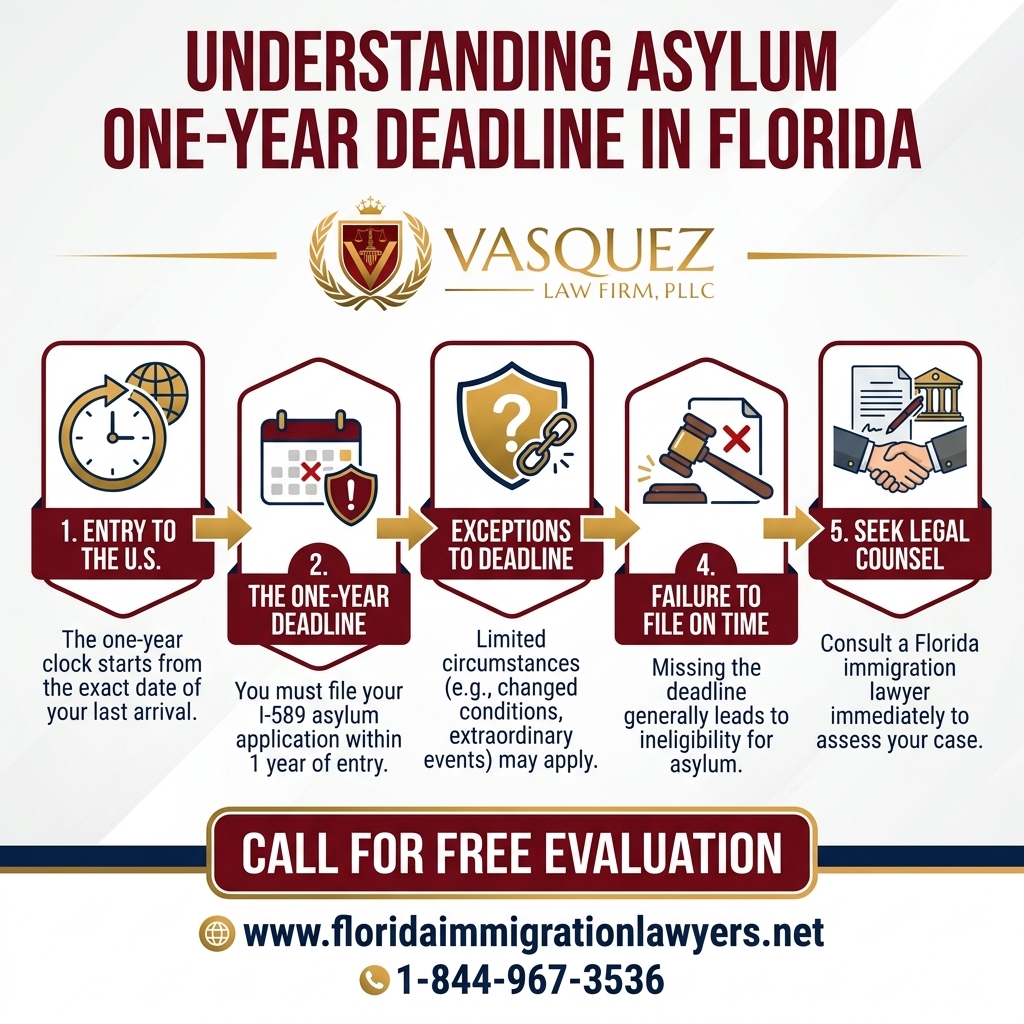
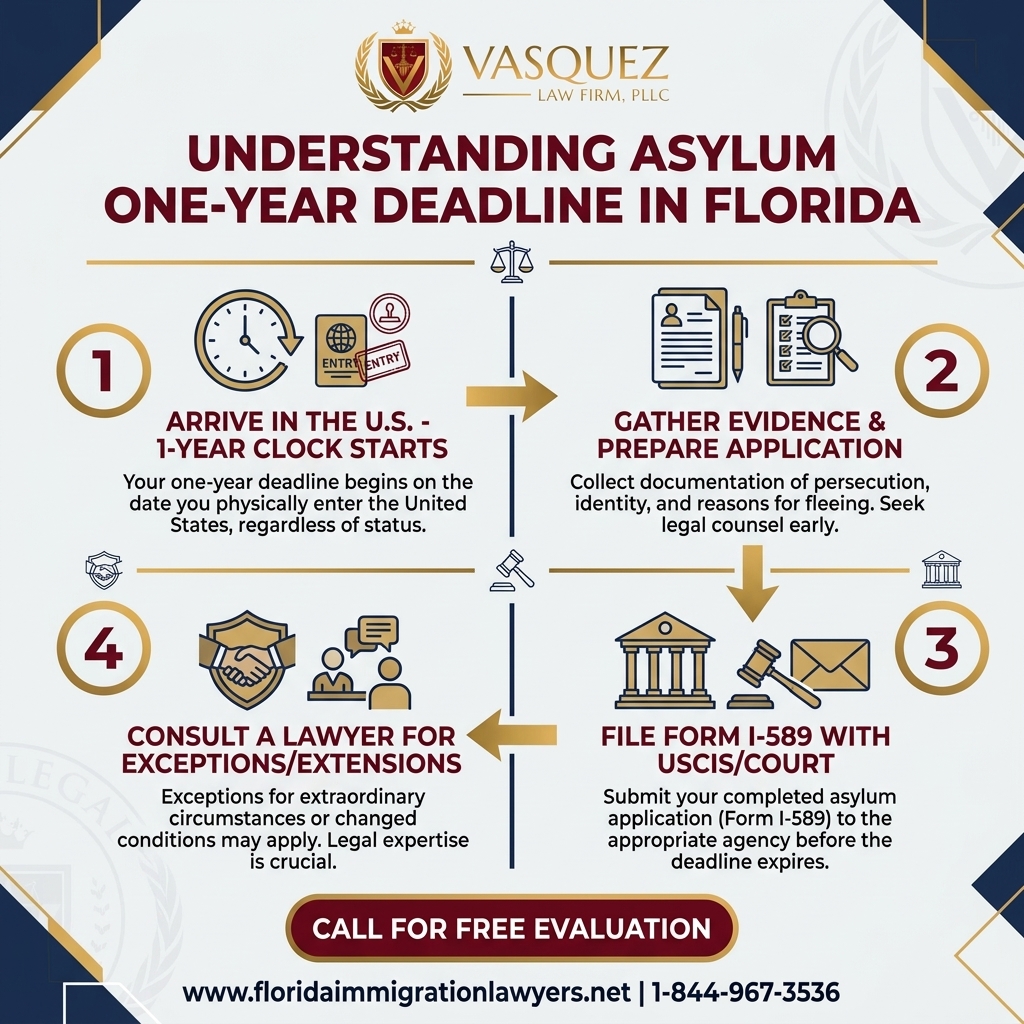
The one-year filing deadline for asylum applications was established by Congress as part of the Illegal Immigration Reform and Immigrant Responsibility Act (IIRIRA) of 1996. The primary intent behind this rule was to encourage prompt filing of asylum claims, thereby reducing the potential for fraudulent claims and ensuring that individuals with genuine fears of persecution come forward in a timely manner. For an asylum seeker, this means that the clock starts ticking from the date they last entered the United States, or, in some cases, from the date their non-immigrant status expired. The application, Form I-589, Application for Asylum and for Withholding of Removal, must be physically received by U.S. Citizenship and Immigration Services (USCIS) within this 365-day window.
The implications of this deadline are profound. If an application is filed even one day late, the applicant is generally deemed ineligible for asylum, unless they can demonstrate that they qualify for an exception. This strict adherence to the timeline underscores the urgency and importance of seeking legal counsel immediately upon arrival or as soon as the fear of persecution arises. Many individuals arrive in the U.S. unaware of this critical deadline, or they may spend precious time trying to understand the complex legal system on their own. This delay can prove fatal to their asylum claim. Therefore, it is not merely a procedural step but a fundamental requirement that can make or break an individual's chance at protection in the U.S. Understanding the "why" behind this rule – to ensure claims are fresh and credible – helps applicants appreciate the weight placed on timely submission. The process of gathering evidence, drafting a compelling narrative, and completing the extensive Form I-589 requires significant time and effort, further emphasizing the need to begin this process well in advance of the deadline.
Key Exceptions to the One-Year Deadline
While the one-year deadline is strict, U.S. immigration law recognizes that certain circumstances may prevent an individual from filing their asylum application on time. These exceptions are narrowly defined and require compelling evidence to prove. Successfully arguing for an exception is often the most challenging aspect of a late-filed asylum case and almost always necessitates the expertise of an experienced immigration attorney.
Changed Circumstances
One of the primary exceptions to the one-year deadline is based on "changed circumstances." This refers to significant changes that materially affect an applicant's eligibility for asylum. The applicant must demonstrate that these changes occurred after their arrival in the U.S. and that they filed their asylum application within a "reasonable period" after these changes occurred. Examples of changed circumstances include:
- Changes in Country Conditions: This is a common and often successful argument. If the political, social, or security situation in the applicant's home country has significantly deteriorated since their arrival in the U.S., making their return unsafe, this could be a changed circumstance. Examples include a coup d'état, the outbreak of civil war, a new regime coming to power that targets the applicant's particular social group, or a sudden increase in persecution against a specific minority.
- Changes in U.S. Law or Policy: While less common, a significant change in U.S. asylum law or policy that directly impacts the applicant's eligibility could be considered.
- Changes in Personal Circumstances: This can include events such as marriage to a U.S. citizen or lawful permanent resident, the birth of a child, or a family member being granted asylum, if these events directly create or reveal a new basis for the applicant's fear of persecution. For example, if a family member's asylum grant reveals a broader pattern of persecution against the family that was not previously known or understood.
- Minor at Time of Arrival: If the applicant was a minor when they arrived in the U.S. and files their asylum application within a reasonable period after turning 18, this can also be considered a changed circumstance. This acknowledges that minors may not have the capacity or agency to file an application on their own behalf.
Crucially, the applicant must not only prove the changed circumstance but also that they filed their application within a "reasonable period" after the change occurred. This "reasonable period" is not explicitly defined and is assessed on a case-by-case basis, making legal interpretation vital.
Extraordinary Circumstances
The second category of exceptions involves "extraordinary circumstances" that directly prevented the applicant from filing within the one-year period. Similar to changed circumstances, the applicant must demonstrate that they filed their application within a "reasonable period" after these extraordinary circumstances ceased to exist. Examples include:
- Serious Illness or Mental/Physical Disability: If the applicant or an immediate family member suffered from a severe illness or disability that incapacitated them and directly prevented timely filing. Medical documentation is essential here.
- Legal Disability: Being a minor (if not covered by the changed circumstances rule) or suffering from a severe mental impairment that rendered the applicant incapable of understanding or pursuing their asylum claim.
- Ineffective Assistance of Counsel: If a previous attorney's gross negligence or misconduct directly led to the late filing. This is a complex claim to prove and requires specific legal standards to be met, often involving filing a complaint against the previous attorney.
- Death or Serious Illness of a Legal Representative: If the attorney or representative handling the case died or became seriously ill, and this directly caused the delay.
- Delay in Receiving Documentation: If crucial documents necessary to support the asylum claim were delayed due to circumstances beyond the applicant's control (e.g., government delays in providing records from the home country).
- Unusual or Compelling Circumstances: This is a catch-all category for situations that are truly exceptional and directly prevented timely filing. It requires a strong argument and substantial evidence.
For both changed and extraordinary circumstances, the burden of proof rests entirely on the applicant. They must provide credible testimony and supporting evidence to substantiate their claims. This often involves detailed affidavits, country condition reports, medical records, police reports, and other documentary evidence. The complexity of proving these exceptions highlights why expert legal assistance is not just beneficial, but often indispensable, for anyone facing a late-filed asylum claim.
Navigating the Asylum Process Beyond the Deadline: What Happens Next?
Even after successfully navigating the one-year deadline and its exceptions, the asylum process itself is a multi-stage journey that can be lengthy and emotionally taxing. Understanding these subsequent steps is crucial for applicants to prepare adequately and manage expectations.
Initial Review and Interview Scheduling
Once Form I-589 is submitted, USCIS will send a receipt notice. Shortly thereafter, applicants will receive an appointment notice for biometrics (fingerprints, photos, and signature), which are used for background checks. The next significant step is the asylum interview. USCIS aims to schedule interviews for asylum applicants as quickly as possible, often within a few months of filing, though wait times can vary significantly based on caseload and location. The interview is a non-adversarial proceeding with an Asylum Officer, where the applicant will provide detailed testimony about their fear of persecution. An attorney can attend this interview, providing support and clarification.
The Asylum Interview
During the interview, the Asylum Officer will ask questions about the applicant's personal history, their reasons for fearing return to their home country, and the details of their persecution. It is a critical opportunity for the applicant to present their case verbally and for the officer to assess their credibility. Preparation is key: applicants should review their I-589 application thoroughly, understand their narrative, and be ready to answer detailed questions. Honesty and consistency are paramount. If the Asylum Officer determines the applicant is credible and meets the definition of an asylum seeker, they may grant asylum. However, if the case is complex, credibility issues arise, or if the officer believes the applicant does not meet the legal standard, the case will be referred to an Immigration Judge.
Referral to Immigration Court and Deportation Defense
If an Asylum Officer does not grant asylum, particularly in cases where the one-year deadline was missed and an exception is claimed, the case is typically referred to an Immigration Judge. This referral places the applicant into removal (deportation) proceedings. At this stage, the applicant is no longer just seeking asylum but is also defending against deportation from the U.S. This is where the landscape of the case shifts dramatically, becoming more formal and adversarial.
Immigration Court Proceedings
Proceedings in Immigration Court involve several stages:
- Master Calendar Hearings: These are initial appearances before an Immigration Judge. During these hearings, the applicant (or their attorney) will acknowledge receipt of the Notice to Appear (NTA), which is the charging document initiating removal proceedings. The applicant will plead to the allegations and charges in the NTA and inform the judge of their intention to apply for relief, such as asylum. The judge will then set a schedule for filing the asylum application (if not already filed) and other necessary documents, and schedule an Individual Hearing.
- Individual Hearings (Merits Hearing): This is the trial phase of the asylum case in Immigration Court. The applicant will testify before the Immigration Judge, present evidence, and may be cross-examined by the Department of Homeland Security (DHS) attorney. Witnesses may also testify on behalf of the applicant. The DHS attorney will have the opportunity to present their own evidence and argue against the asylum claim. The Immigration Judge will then make a decision based on the evidence and testimony presented.
- Other Forms of Relief: If asylum is denied, an applicant in removal proceedings may still be eligible for other forms of relief, such as Withholding of Removal or protection under the Convention Against Torture (CAT). These forms of relief have higher standards of proof but do not have a one-year filing deadline and can offer protection from deportation.
Appeals
If the Immigration Judge denies the asylum application, the applicant has the right to appeal the decision to the Board of Immigration Appeals (BIA). If the BIA upholds the denial, further appeals may be possible to the U.S. Court of Appeals for the circuit in which the case was heard. Each stage of appeal adds complexity and requires specialized legal knowledge.
Throughout this entire process, from the initial interview to potential federal appeals, the guidance of a knowledgeable and experienced immigration attorney is invaluable. They can help prepare for interviews, represent clients in court, present compelling legal arguments, and navigate the intricate procedural requirements, significantly increasing the chances of a successful outcome.
The Critical Role of Legal Counsel in Florida Asylum Cases
The asylum process, particularly when complicated by the one-year deadline or its exceptions, is incredibly challenging to navigate without professional legal assistance. For individuals in Florida, securing the right legal representation can make all the difference in the outcome of their case.
- Understanding Complex Laws: Asylum law is one of the most complex areas of U.S. immigration law, constantly evolving through court decisions and policy changes. An experienced attorney stays abreast of these developments and can apply them effectively to a client's case.
- Identifying and Proving Exceptions: As discussed, proving changed or extraordinary circumstances requires a deep understanding of legal definitions, evidentiary standards, and persuasive argumentation. Our attorneys are skilled at identifying valid exceptions and meticulously gathering the necessary evidence to support them.
- Preparing a Strong Application: A well-prepared Form I-589 is the foundation of a successful asylum claim. Attorneys ensure the application is complete, accurate, and supported by a robust declaration and comprehensive documentation, including country condition reports, medical records, and expert affidavits.
- Interview and Court Representation: An attorney can prepare clients for their asylum interview, accompanying them to provide support and intervene if necessary. In Immigration Court, an attorney is essential for representing clients during Master Calendar and Individual Hearings, presenting evidence, cross-examining witnesses, and making compelling legal arguments to the Immigration Judge. This is particularly crucial in deportation defense scenarios.
- Navigating Appeals and Further Options: If an asylum claim is denied, an attorney can advise on the feasibility of appeals to the BIA and federal courts, or explore other potential forms of relief from removal.
- Florida Specifics: A local Florida immigration attorney understands the nuances of the USCIS field offices and Immigration Courts within the state, including local procedures, common practices, and the tendencies of specific Asylum Officers or Immigration Judges. This local insight can be a significant advantage.
Attempting to handle an asylum case, especially one with a deadline issue, without legal representation is a high-risk endeavor. The stakes are incredibly high, often involving an individual's safety and future in the United States. Investing in experienced legal counsel provides peace of mind and significantly increases the likelihood of a positive outcome. We encourage anyone facing these challenges to contact us for a consultation to discuss their specific situation.
Consequences of Missing the One-Year Deadline Without an Exception
The consequences of failing to file an asylum application within the one-year deadline, and being unable to prove a valid exception, are severe and often irreversible. The most direct result is ineligibility for asylum. This means that even if an individual has a genuine and well-founded fear of persecution, they will be barred from receiving asylum protection. While they might still be eligible for other forms of relief like Withholding of Removal or protection under the Convention Against Torture (CAT), these protections are much harder to obtain and do not offer the same benefits as asylum, such as a direct path to lawful permanent residency.
Furthermore, missing the deadline often leads to the initiation of removal proceedings. Without asylum as a viable option, an individual may have very limited avenues to legally remain in the U.S., increasing their risk of deportation. This can lead to immense stress, uncertainty, and the potential forced return to a country where they face danger. The inability to secure asylum can also impact family members who might have been included in the application. Therefore, the one-year deadline is not merely a bureaucratic hurdle but a critical gateway to protection and stability in the United States.
Frequently Asked Questions About the Asylum One-Year Deadline
Here are answers to some common questions regarding the asylum one-year deadline:
- What is the asylum one-year deadline?
It's a U.S. immigration law requirement that most asylum applications (Form I-589) must be filed within one year of your last arrival or entry into the United States. - When does the one-year clock start ticking?
Generally, the clock starts from the date of your last entry into the U.S. or, in some cases, from the date your lawful status expired. - What happens if I miss the one-year deadline?
If you miss the deadline without a valid exception, you are generally barred from applying for asylum and may be placed in removal proceedings. - Are there any exceptions to the one-year deadline?
Yes, there are two main categories: "changed circumstances" and "extraordinary circumstances." You must prove these circumstances directly prevented timely filing and that you filed within a reasonable period after they ceased. - What are "changed circumstances"?
These are significant changes that materially affect your eligibility for asylum, such as a deterioration of country conditions, changes in U.S. law, or certain changes in your personal circumstances. - What are "extraordinary circumstances"?
These are events that directly prevented you from filing on time, such as a serious illness, legal disability, or ineffective assistance of previous counsel. - Do I need an attorney if I've missed the deadline?
Absolutely. Proving an exception to the one-year deadline is highly complex and requires strong legal arguments and evidence. An experienced immigration attorney is crucial for success. - What is Form I-589?
Form I-589 is the Application for Asylum and for Withholding of Removal, the official document used to apply for asylum in the United States.
The one-year deadline for asylum applications in Florida is a formidable barrier for many seeking protection. Its strict enforcement and the complexity of its exceptions underscore the critical need for timely action and expert legal guidance. If you or someone you know is considering applying for asylum, or has already missed the one-year deadline, do not delay. Understanding your rights and options is the first step toward securing your future. Contact Florida Immigration Lawyers today at 1-844-967-3536 for a free consultation. Our experienced team is ready to provide the dedicated legal support you need to navigate this challenging process.
Sources and References
- U.S. Citizenship and Immigration Services (USCIS)
- Executive Office for Immigration Review (EOIR)
- U.S. Department of State - Bureau of Consular Affairs
- Immigration and Nationality Act (INA), 8 U.S.C. Chapter 12
Do Not Navigate This Process Alone
Our experienced immigration attorneys are ready to fight for you. Get a free, confidential consultation today.
Se Habla Español
Frequently Asked Questions
Florida Immigration Lawyers
Immigration Attorney | Founder, Vasquez Law Firm
U.S. Air Force veteran and immigration attorney with thousands of cases resolved. J.D., NCCU School of Law. AILA member. Admitted to the 4th, 5th, and 11th Circuit Courts.
Available 24/7 - Free Evaluations
Related Legal Services
Our Florida immigration attorneys can help you with deportation defense, citizenship and naturalization and family immigration services. Call today at 1-844-967-3536 for a free consultation.
Related Links
Related Topics
Free Legal Consultation
Discuss your case with our experienced attorneys. We're available 24/7.
Se Habla Español - Estamos aquí para ayudarle.
Related Articles
EB-5 Investor Green Card Opportunities in Florida | VLF Florida
Explore opportunities with the EB-5 investor green card in Florida. Learn about investment requirements, application steps, and how to avoid common pitfalls. Call now for a free consultation.
F-1 Reinstatement Process for Florida Students | VLF Florida
Explore the F-1 reinstatement process for students in Florida. Learn about eligibility, required documents, and common mistakes. Contact Florida Immigration Lawyers for expert help.
I-601 Waiver Guide for Florida Residents | VLF Florida
Facing inadmissibility issues in Florida? Our comprehensive guide on the I-601 waiver process offers insights into eligibility, documentation, and more. Call us for expert assistance.
Dual Citizenship in Florida: A Comprehensive Guide
Dual citizenship in Florida offers the ability to hold two passports and enjoy the benefits of both nations. Learn about eligibility, the naturalization process, and more. Contact Florida Immigration Lawyers for expert guidance.
