Immigration Services Jacksonville Florida: Your 2026 Guide
Looking for comprehensive immigration services in Jacksonville, Florida? This guide for 2026 covers everything from visa applications and green card processes to naturalization and deportation defense. Learn about essential documents, timelines, and common mistakes to avoid. Florida Immigration Lawyers provides expert legal assistance throughout Florida, including Jacksonville and Homestead, offering personalized advice and unwavering support. Contact us for a free consultation to navigate your immigration journey with confidence and peace of mind. We are dedicated to helping you achieve your immigration goals with professional and empathetic legal representation.

Navigating immigration services in Jacksonville, Florida, involves understanding various visa types, green card processes, and potential paths to U.S. citizenship. Whether you are seeking family reunification, employment-based visas, or asylum, the process can be complex and requires meticulous attention to detail. Florida Immigration Lawyers offers comprehensive legal support for individuals and families across Florida, including Jacksonville and Homestead. Our dedicated team provides expert guidance through USCIS applications, interviews, and potential appeals, ensuring your case is handled with precision and care. We are committed to helping you achieve your immigration goals.
- Immigration processes vary significantly by case type (family, employment, humanitarian).
- Thorough documentation and adherence to deadlines are critical for all applications.
- Legal representation can significantly improve your chances of a successful outcome.
- Florida Immigration Lawyers serves all of Florida, offering free consultations.
Are you or a loved one seeking to navigate the complex world of immigration in Florida? Perhaps you are looking to reunite with family, pursue a career opportunity, or find safety and refuge in the United States. The journey through U.S. immigration law can be challenging, filled with intricate forms, strict deadlines, and ever-changing regulations. Understanding your options and fulfilling all requirements is paramount to a successful outcome. This guide aims to demystify the various immigration services in Jacksonville, Florida, and provide a clear roadmap for your journey in 2026.
From obtaining a visa to applying for a green card or even pursuing U.S. citizenship, each step requires careful planning and often, professional legal assistance. Florida's diverse population, including communities in Jacksonville and Homestead, frequently seeks guidance on these crucial matters. Our firm, Florida Immigration Lawyers, is dedicated to providing compassionate and effective legal representation to individuals and families throughout the state. We understand the unique challenges faced by immigrants and are here to offer unwavering support.
Do not attempt to navigate these complex legal waters alone. For personalized advice and to discuss your specific situation, call Florida Immigration Lawyers at 1-844-967-3536 for a free consultation. Our experienced team is ready to assist you.
Understanding Immigration Services in Jacksonville, Florida
Jacksonville, as one of Florida's largest cities, is a hub for diverse communities, including many immigrants seeking new opportunities and a better life. The demand for reliable immigration services in Jacksonville, Florida, is consistently high, covering a wide range of legal needs. These services typically include assistance with family-based petitions, employment visas, adjustment of status, naturalization, and defense against deportation.
Family-based immigration is often at the forefront, allowing U.S. citizens and lawful permanent residents to sponsor eligible relatives for green cards. This process involves proving bona fide relationships and navigating preference categories, which can impact waiting times significantly. Employment-based visas, on the other hand, cater to foreign nationals seeking to work in the U.S., often requiring sponsorship from an employer. These categories, such as H-1B for specialty occupations or EB-1 for individuals of extraordinary ability, have specific eligibility criteria and annual quotas.
Beyond these common pathways, humanitarian relief, like asylum or Temporary Protected Status (TPS), provides critical protection for those fleeing persecution or instability in their home countries. Florida, particularly with its proximity to the Caribbean and Latin America, sees a significant number of individuals seeking such protections. USCIS field offices, including the one in Jacksonville, play a vital role in processing these applications, conducting interviews, and making determinations. Understanding the specific jurisdiction and local procedures can be crucial for applicants in the region.
For those residing in Homestead and South Florida, the Miami USCIS Field Office and the Miami Immigration Court handle many cases. This regional variation underscores the importance of local expertise when seeking immigration assistance. A knowledgeable Florida immigration lawyer can provide invaluable insight into how local offices and courts operate, helping to prepare clients for what to expect. This localized understanding is a key component of effective legal representation.
Key Immigration Pathways Available
The U.S. immigration system offers several primary pathways for individuals seeking to live and work in the country permanently or temporarily. Each pathway has distinct eligibility requirements, application processes, and documentation needs. Understanding which path aligns with your goals is the first crucial step. For instance, immediate relatives of U.S. citizens often have a more direct route to a green card compared to those in preference categories, who may face lengthy waiting lists. This distinction is outlined in the Immigration and Nationality Act (INA).
Family-based immigration (INA Section 201, 203) allows U.S. citizens and lawful permanent residents to sponsor family members. This includes spouses, children, parents, and siblings. The process typically begins with filing Form I-130, Petition for Alien Relative, with USCIS. Employment-based immigration (INA Section 203(b)) provides avenues for foreign workers, investors, and individuals with extraordinary abilities to obtain green cards, often requiring a U.S. employer to sponsor them through a labor certification process. Humanitarian relief, such as asylum (INA Section 208) or refugee status, is available for individuals who have suffered persecution or have a well-founded fear of persecution in their home country. Other options include specific visas for victims of crime (U visas) or human trafficking (T visas).
Step-by-Step Guide to Common Immigration Processes in Florida
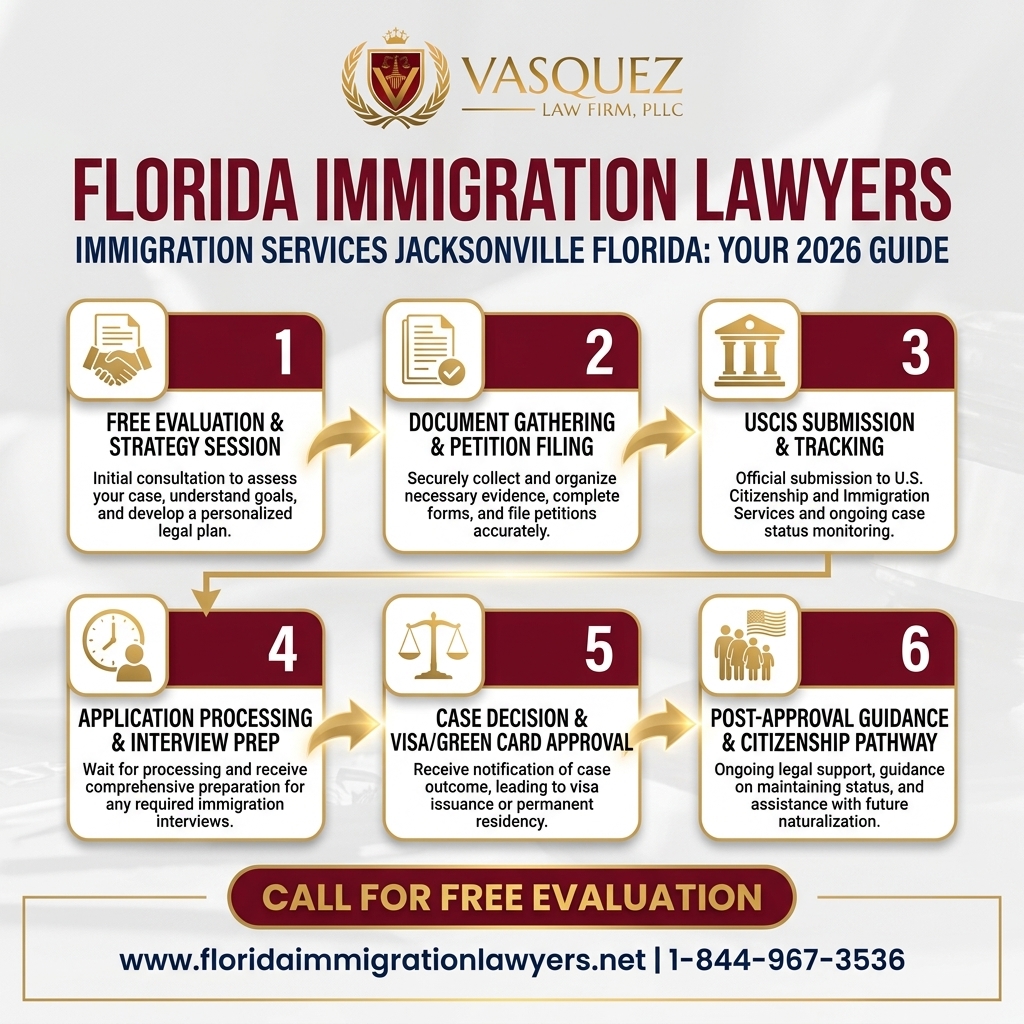
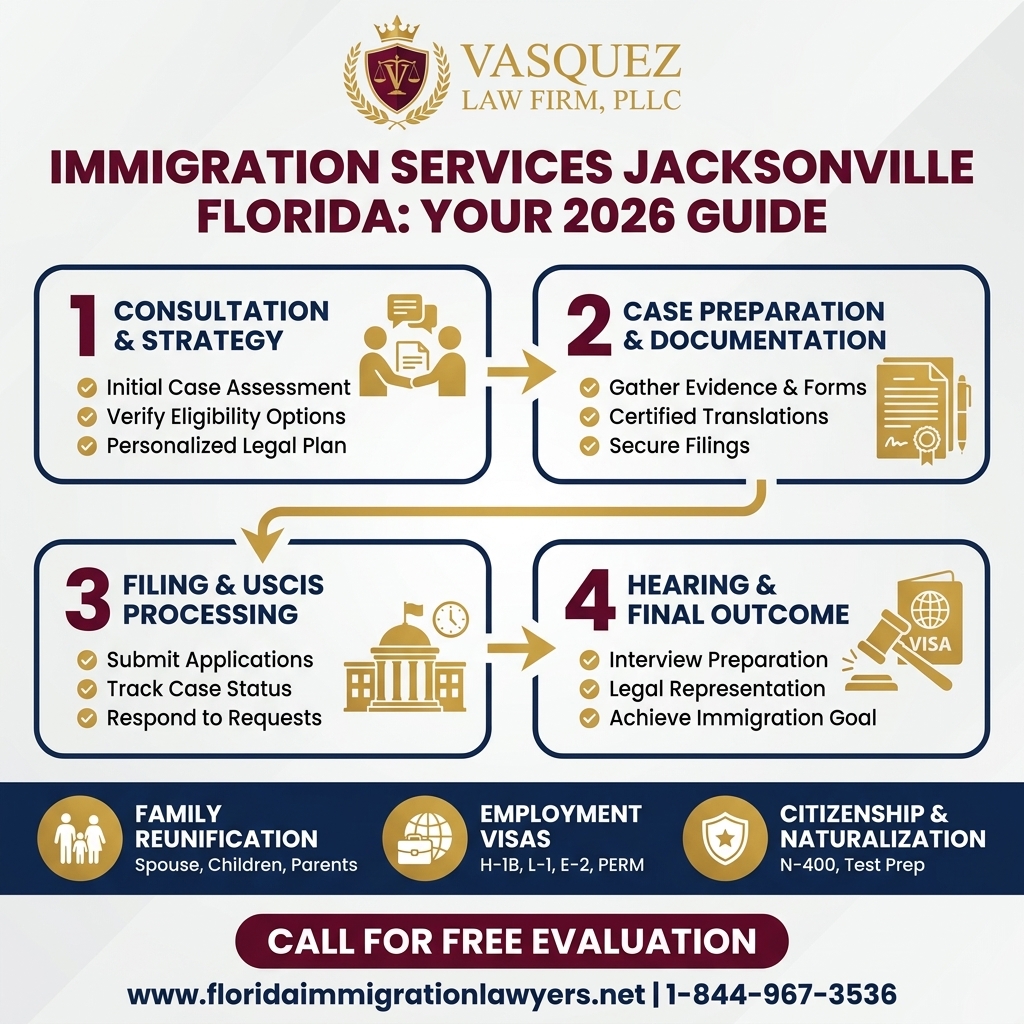
Navigating U.S. immigration processes, whether for a visa, green card, or citizenship, involves a series of specific steps that must be followed precisely. While each case is unique, a general framework applies to most applications. Understanding this framework can help you prepare for the journey ahead and manage expectations effectively. Our firm provides hands-on assistance through every stage, ensuring no detail is overlooked.
-
Determine Your Eligibility and Pathway: Before filing any forms, it is crucial to identify the correct immigration category for your situation. Are you eligible for a family-based visa, an employment-based visa, asylum, or another pathway? This initial assessment considers your relationship to a U.S. citizen or LPR, your skills, your country of origin, and your reasons for seeking immigration benefits. A Florida immigration lawyer can help you understand the complex eligibility criteria set forth by USCIS and the Department of State.
-
Gather Required Documentation: This is a critical step that can make or break your application. You will need to collect a wide array of documents, including birth certificates, marriage certificates, passports, financial records, educational transcripts, and police clearance certificates. For specific applications like asylum, detailed personal statements and corroborating evidence are essential. All foreign language documents must be translated into English by a certified translator. Incomplete or incorrect documentation is a leading cause of delays or denials.
-
File the Appropriate Forms with USCIS: Once all documents are prepared, the next step involves submitting the correct forms to U.S. Citizenship and Immigration Services (USCIS). For example, a family petition starts with Form I-130, while an adjustment of status typically involves Form I-485. Each form has specific instructions, filing fees, and supporting document requirements. Accuracy is paramount, as errors can lead to Requests for Evidence (RFEs) or even outright rejection. It is crucial to use the most current versions of forms, which are regularly updated.
-
Attend Biometrics Appointment: After filing certain applications, USCIS will send you an appointment notice for a biometrics collection. This appointment involves taking your fingerprints, photograph, and signature. These biometrics are used for background checks and identity verification. Missing this appointment without proper rescheduling can negatively impact your case.
-
Undergo Interview (if required): Many immigration processes, particularly green card applications (adjustment of status) and naturalization, require an interview with a USCIS officer. This interview is an opportunity for the officer to verify the information provided in your application and to assess your eligibility. You may be asked questions about your background, your relationship to the petitioner, your immigration history, and your intentions. Proper preparation, often with legal counsel, is vital for a successful interview. For those seeking asylum, the interview is a critical moment to present your case clearly and consistently.
-
Receive Decision and Next Steps: Following the interview or review of your application, USCIS will issue a decision. If approved, you will receive your green card, visa, or naturalization certificate. If denied, you may have options to appeal the decision or refile your application, depending on the reasons for denial. An experienced Florida immigration lawyer can help you understand the decision and explore any available remedies.
This streamlined overview provides a general idea. The specifics can vary greatly, and having a dedicated legal team from Florida Immigration Lawyers can make a significant difference in navigating these intricate steps successfully.
Essential Document Checklist for Immigration Applications
A comprehensive and accurate document checklist is fundamental to any successful immigration application. The specific documents required will vary depending on the type of application you are filing (e.g., family petition, employment visa, naturalization, asylum). However, certain categories of documents are almost universally needed. Failure to submit all required documents, or submitting incomplete or incorrect ones, is a common reason for delays, Requests for Evidence (RFEs), or even denials. It is always advisable to make copies of everything you submit for your records.
- Proof of Identity and Nationality: Valid passport, birth certificate, national identity cards.
- Marital Status Documents: Marriage certificates, divorce decrees, death certificates of former spouses.
- Financial Documentation: Affidavits of support (Form I-864), tax returns (Form W-2, 1099), pay stubs, bank statements, employment verification letters. These demonstrate that the applicant will not become a public charge in the U.S.
- Educational and Professional Records: Diplomas, transcripts, professional licenses, letters of employment, résumés (especially for employment-based visas).
- Medical Examination Results: Report of Medical Examination and Vaccination Record (Form I-693), completed by a USCIS-approved civil surgeon.
- Police Clearance Certificates: From your home country and any other country where you have lived for a specified period.
- Photographs: Passport-style photographs meeting USCIS specifications.
- Proof of Relationship (for family petitions): Birth certificates of children, marriage certificates, photographs, joint bank accounts, lease agreements, utility bills showing shared residence, affidavits from third parties.
- Biographic Information: Form G-325A (Biographic Information) or similar forms requesting personal history.
- Immigration History Documents: Copies of previous visas, I-94 arrival/departure records, previous application notices, deportation orders (if any).
- Court and Criminal Records: If applicable, certified copies of all court dispositions, arrest records, and probation documents.
- Proof of English Language and U.S. Civics Knowledge (for Naturalization): While not a document to submit, preparation for the tests is key.
Organizing these documents thoroughly before filing can significantly streamline your application process. Working with a Florida immigration lawyer ensures that your checklist is tailored to your specific case and that all documentation meets USCIS standards.
Immigration Processing Timelines and Expectations for 2026
Immigration processing times can vary significantly based on the type of application, the USCIS service center handling the case, and current caseloads. While it is challenging to provide exact timelines, understanding general expectations for 2026 can help manage stress and plan for the future. USCIS provides estimated processing times on its website, which are updated regularly. However, these are estimates and not guarantees. Delays are common and can be influenced by factors such as Requests for Evidence (RFEs), interview backlogs, or changes in policy, as seen in recent appeals court rulings regarding detention policy.
For common applications:
- Family-Based Petitions (I-130): Processing times for immediate relatives (spouses, unmarried children under 21, parents of U.S. citizens) can range from 7-15 months. For preference categories (e.g., adult children, siblings of U.S. citizens; spouses and children of LPRs), these times can extend significantly, often involving years, due to annual visa quotas as outlined in the Visa Bulletin published by the Department of State.
- Adjustment of Status (I-485): Once an immigrant visa is available, adjusting status to a lawful permanent resident can take anywhere from 8 months to over 2 years, depending on the USCIS field office (e.g., Jacksonville or Miami) and the complexity of the case. Factors like criminal history or previous immigration violations will prolong this.
- Naturalization (N-400): The path to U.S. citizenship typically takes 6-18 months from filing to oath ceremony. This includes processing the application, biometrics, interview, and decision. Local field office backlogs can impact this duration.
- Employment-Based Visas: These vary widely. Some, like O-1 for extraordinary ability, might be processed relatively quickly (a few months, with premium processing options). Others, especially those requiring PERM labor certification, can take several years.
- Asylum Applications: Affirmative asylum applications filed with USCIS can take several years to reach an interview, followed by a decision. Defensive asylum cases in immigration court (under the Executive Office for Immigration Review - EOIR) depend on court dockets and judge availability, often extending for multiple years.
It is important to remember that these timelines are subject to change. For the most current estimates, always refer to the official USCIS website. A Florida immigration lawyer can help you monitor your case status and provide realistic expectations based on current trends and your specific circumstances. They can also advise on strategies to minimize delays where possible.
Cost Factors and Fee Breakdown for Immigration Services
Understanding the financial aspects of immigration is a crucial part of the planning process. The overall cost of immigration services in Jacksonville, Florida, can be broken down into several categories: government filing fees, legal fees, and ancillary expenses. It is important to note that government fees are subject to change, and specific amounts are not provided here to ensure accuracy. Always check the official USCIS website for the most current fee schedule (8 CFR 103.7).
Government Filing Fees
These are mandatory fees paid directly to USCIS or the Department of State for processing your applications and petitions. Each form (e.g., I-130, I-485, N-400) has its own fee. Some applications may also require a biometrics fee. These fees can range from hundreds to over a thousand dollars per application. For example, an adjustment of status application often involves fees for Form I-485, Form I-765 (Employment Authorization Document), and Form I-131 (Advance Parole), plus the biometrics fee. Certain waivers may be available for individuals who meet specific poverty guidelines.
Legal Fees for Florida Immigration Lawyers
Hiring an experienced Florida immigration lawyer is an investment in the success of your case. Legal fees vary depending on the complexity of your case, the type of service required, and the attorney's experience. Our firm offers transparent fee structures, often on a flat-fee basis for specific services, providing clarity and predictability. Legal fees cover: initial consultation, case assessment, assistance with document gathering, preparation and filing of all necessary forms, communication with government agencies, representation at interviews, and ongoing case management. For complex cases like deportation defense or appeals, fees may be higher due to the extensive legal work involved. A free consultation with Florida Immigration Lawyers can provide a clear estimate of legal costs for your specific situation.
Ancillary Expenses
Beyond government and legal fees, you should budget for additional costs that can arise during the immigration process. These may include:
- Medical Examination Fees: Required for adjustment of status and certain visa applications, performed by USCIS-approved civil surgeons. These fees are paid directly to the doctor.
- Translation Services: If any of your supporting documents are not in English, you will need to pay for certified translations.
- Document Retrieval Fees: Costs associated with obtaining birth certificates, marriage licenses, police records, or other necessary official documents from government agencies.
- Travel Expenses: For attending interviews at USCIS field offices (e.g., Jacksonville or Miami) or consulates abroad, or for biometrics appointments.
- Postage and Courier Fees: For sending applications and supporting documents securely.
A comprehensive understanding of these cost factors allows for better financial planning throughout your immigration journey. Florida Immigration Lawyers is committed to providing clear information about all potential costs, helping you budget effectively.
Do not navigate this process alone. The complexities of immigration law require seasoned expertise. Contact Florida Immigration Lawyers today for a free consultation at 1-844-967-3536 to discuss your specific needs and how we can assist you.
Common Mistakes to Avoid in Your Immigration Journey
The U.S. immigration process is fraught with potential pitfalls that can lead to significant delays, denials, or even adverse consequences. Avoiding these common mistakes is crucial for a successful outcome. Here are some of the most frequent errors applicants make:
-
Submitting Incomplete or Inaccurate Applications: Many applications are rejected or delayed because forms are not fully completed, required questions are left blank, or information provided is inconsistent. Even minor errors can trigger a Request for Evidence (RFE) or outright denial. Always double-check all entries and ensure consistency across all submitted documents.
-
Failing to Provide All Required Supporting Documents: A common mistake is not including every single document requested by USCIS. This can include birth certificates, marriage licenses, financial records, or police clearances. Photocopies should be clear, and foreign documents must be accompanied by certified English translations. Missing documents will inevitably lead to delays.
-
Missing Deadlines: Immigration processes often have strict deadlines for filing applications, responding to RFEs, or attending appointments. Missing these deadlines can result in the automatic denial of your case or even lead to deportation proceedings. Always keep track of all notices and respond promptly.
-
Misrepresenting Information or Lying: Providing false information or attempting to conceal relevant facts on your application or during an interview can have severe and long-lasting consequences. This can lead to a finding of fraud or misrepresentation, making you permanently inadmissible to the U.S. Honesty and transparency are always the best policy.
-
Not Disclosing Criminal History: Even minor arrests or convictions, regardless of how long ago they occurred or if charges were dropped, must be disclosed on immigration forms. Failure to do so can be considered misrepresentation. A Florida immigration lawyer can advise on how to properly disclose and address any criminal history without jeopardizing your case.
-
Traveling Internationally While an Application is Pending: Depending on the type of application (e.g., Adjustment of Status), traveling outside the U.S. without obtaining advance parole can lead to the abandonment of your application and prevent your re-entry. Always consult with your attorney before making any international travel plans.
-
Failing to Update Contact Information with USCIS: If you move while your application is pending, you must inform USCIS of your new address promptly (Form AR-11). Failure to do so can mean missing critical notices, such as interview appointments or RFEs, which can lead to negative outcomes for your case.
-
Attempting to Navigate Complex Cases Without Legal Counsel: While some straightforward applications might be manageable for individuals, complex cases involving waivers, criminal history, or deportation defense almost always require professional legal assistance. Trying to handle such cases alone significantly increases the risk of denial or adverse outcomes.
When to Call a Florida Immigration Lawyer
While some immigration processes appear straightforward, the reality is that U.S. immigration law is incredibly complex and constantly evolving. Knowing when to seek professional legal guidance can be the difference between a successful outcome and significant setbacks. Florida Immigration Lawyers serves clients across the state, from Jacksonville to Homestead, offering expert advice for a wide array of situations.
You should consider calling a Florida immigration lawyer if you encounter any of the following scenarios:
- Complex Case Scenarios: If your case involves a criminal history, previous deportation orders, overstays, unlawful presence, or prior denials, it is highly advisable to seek legal counsel. These factors introduce significant complexities that require specialized legal knowledge to navigate effectively.
- Deportation or Removal Proceedings: If you or a loved one has been placed in removal proceedings, immediate legal representation is critical. A skilled deportation defense attorney can protect your rights, explore all possible defenses, and fight for your ability to remain in the U.S. This is an urgent situation where time is of the essence.
- Denied Applications or Appeals: If your visa, green card, or citizenship application has been denied, an attorney can help you understand the reasons for the denial, assess your options for appeal or re-filing, and guide you through the next steps.
- Uncertainty About Eligibility: If you are unsure which immigration pathway is best for you, or if you meet the eligibility requirements for a specific visa or benefit, an attorney can provide a thorough assessment and recommend the most appropriate course of action.
- Difficulty Gathering Documents or Understanding Forms: The volume and specificity of required documentation can be overwhelming. An attorney can help you compile the necessary evidence and ensure all forms are completed accurately and submitted correctly.
- Seeking Humanitarian Relief: Cases involving asylum, U visas for crime victims, or T visas for human trafficking victims are highly sensitive and require expert legal guidance to ensure all protections are sought and rights are upheld.
- Business or Investment Visas: These categories often involve intricate business plans, significant investments, and compliance with specific regulations. A lawyer specializing in business immigration can provide invaluable assistance.
Even for seemingly simple cases, an attorney can provide peace of mind, ensure accuracy, and help anticipate potential issues before they arise. Florida Immigration Lawyers is here to provide the expert guidance you need. We offer comprehensive immigration services and are ready to assist you.
About Florida Immigration Lawyers
Florida Immigration Lawyers is a leading law firm dedicated to providing exceptional immigration legal services to individuals, families, and businesses throughout the entire state of Florida. From the bustling streets of Jacksonville to the agricultural heartland of Homestead, and every community in between, our experienced attorneys are committed to helping clients achieve their immigration goals.
Our firm specializes in a broad spectrum of immigration law matters, including family-based visas, employment immigration, naturalization and citizenship, asylum and refugee claims, and robust deportation defense. We understand that each immigration journey is unique and deeply personal, which is why we offer personalized attention and strategic legal solutions tailored to your specific circumstances.
What sets Florida Immigration Lawyers apart is our unwavering commitment to our clients. We pride ourselves on clear communication, transparent processes, and a compassionate approach. Our team is fluent in both English and Spanish, ensuring that language is never a barrier to receiving top-tier legal representation. We are available 24/7 to answer your urgent questions and provide support.
Choosing the right legal partner is crucial. With Florida Immigration Lawyers, you gain an advocate who will tirelessly fight for your rights and guide you through every step of the complex immigration system. We offer free consultations to discuss your case and demonstrate how our expertise can benefit you. Visit our website at https://www.floridaimmigrationlawyers.net or call us directly at 1-844-967-3536 to schedule your free consultation today. Let us be your trusted guide in your journey to a new life in Florida.
Sources and References
- U.S. Citizenship and Immigration Services (USCIS)
- Executive Office for Immigration Review (EOIR)
- U.S. Department of State - Bureau of Consular Affairs
- 8 U.S.C. Chapter 12 - Immigration and Nationality Act (INA)
- 8 CFR 103.7 - Fees for immigration services
- INA Section 201 - Immigrant Visas: Worldwide Level of Immigration
- INA Section 203 - Preference Allocation for Immigrant Visas
- INA Section 208 - Asylum
Related services: immigration waivers, humanitarian protection programs, DACA renewal and applications.
This article provides general legal information and is not intended as legal advice. Every case is unique, and outcomes depend on specific facts and circumstances. Contact an attorney for advice about your particular situation.
Your immigration journey is important, and you do not have to face it alone. Whether you are in Jacksonville, Homestead, or anywhere else in Florida, Florida Immigration Lawyers is here to provide the expert legal support you deserve. We are committed to protecting your rights and helping you achieve your American dream. Call us today for a free consultation at 1-844-967-3536. Se Habla Espanol - Estamos aqui para ayudarle.
Do Not Navigate This Process Alone
Our experienced immigration attorneys are ready to fight for you. Get a free, confidential consultation today.
Se Habla Español
Or leave your details and we’ll call you:
Free Evaluation in 24 Hours
Or talk to us right now

AI voice assistant — available 24/7
FreeFrequently Asked Questions

William J. Vásquez
Founding Attorney · Vasquez Law Firm
U.S. Air Force veteran and immigration attorney with years of hands-on U.S. immigration experience. J.D., NCCU School of Law. AILA member. Admitted to the 4th, 5th, and 11th Circuit Courts.
Available 24/7 - Free Evaluations
Reviewed for legal accuracy by William J. Vásquez
Licensed in North Carolina; U.S. immigration is federal practice.
Related Legal Services
Our Florida immigration attorneys can help you with free immigration consultation, experienced immigration attorneys and business immigration. Call today at 1-844-967-3536 for a free consultation.
Related Links
Related Topics
Free Legal Consultation
Discuss your case with our experienced attorneys. We're available 24/7.
Se Habla Español - Estamos aquí para ayudarle.
Related Articles
Military Naturalization Expedited in Florida Bases
Explore military naturalization options for families at Florida bases, including parole in place benefits in Miami. Learn how to expedite your application with expert guidance from Florida Immigration Lawyers.
Immigration Lawyer Orlando Free Consultation 2026
Discover how to find an immigration lawyer in Orlando offering a free consultation. Understand the services available and why choosing Florida Immigration Lawyers can make a difference in your case.
TPS Honduras Updates 2026: What Hondurans in Florida Need
For thousands of Honduran nationals in Florida, the status of Temporary Protected Status (TPS) is crucial. As of 2026, TPS Honduras continues under specific legal frameworks and ongoing litigation, requiring beneficiaries to stay informed about re-registration periods and policy changes. This comprehensive guide from Florida Immigration Lawyers provides the latest updates, details eligibility, outlines the application process, lists necessary documents, discusses timelines, and explains associated costs. We also cover common mistakes to avoid and when to seek legal counsel, ensuring Honduran communities across Florida, including Tampa, are well-equipped to navigate these complexities. Our firm offers expert legal support to protect your status and explore your options.
Biometrics Appointment in Florida 2026: What to Expect
A USCIS biometrics appointment is a crucial step for most immigration applications in Florida, involving fingerprinting, photography, and signature collection for identity verification and background checks. This guide covers how to prepare, what to expect at your ASC appointment, typical timelines, and associated costs. We also highlight common mistakes to avoid and when it's essential to consult an experienced immigration lawyer. For residents in Tallahassee, Orlando, Miami, and throughout Florida, understanding this process is vital for a smooth application. Florida Immigration Lawyers offers expert guidance to ensure your biometrics appointment and overall immigration case proceed without complications. Don't risk delays; learn how to navigate this mandatory step effectively.