Green Card Holder ICE Detention Florida: Know Your Rights
Green card holders in Florida can face detention by ICE due to certain criminal convictions or immigration violations. Understanding your rights and the complex detention process is crucial to protecting your permanent resident status and fighting potential deportation. This guide details the reasons for detention, the step-by-step process, essential documents, timelines, and cost factors. It also highlights common mistakes to avoid and emphasizes the critical role of an experienced immigration lawyer. If you or a loved one is detained, immediate legal counsel is vital to navigate bond hearings and removal proceedings. Contact Florida Immigration Lawyers for a free consultation to safeguard your future.

Yes, green card holders can be detained by U.S. Immigration and Customs Enforcement (ICE) in Florida, especially if they have certain criminal convictions or immigration violations. While permanent residents have significant rights, they are not immune to detention or deportation proceedings. Understanding your rights and the legal process is critical. Seeking immediate legal counsel from an experienced immigration lawyer is the best course of action to protect your status and fight for release.
- Green card holders can face ICE detention for specific violations.
- Knowing your rights immediately upon encounter is crucial.
- Detention often leads to deportation proceedings in immigration court.
- Legal representation significantly increases chances of release and successful defense.
- Florida Immigration Lawyers offer vital support for detained individuals.
Imagine living your life in Florida, a permanent resident with a green card, believing your future is secure. Then, suddenly, an unexpected encounter with U.S. Immigration and Customs Enforcement (ICE) turns your world upside down. You or a loved one could be detained, facing an uncertain future and the terrifying prospect of deportation. This scenario is a harsh reality for many green card holders across Florida, from Orlando to Miami.
Understanding your rights and the complex legal landscape of green card holder ICE detention in Florida is absolutely vital. This comprehensive guide will walk you through the reasons for detention, the step-by-step process, essential documents, expected timelines, and the critical role legal representation plays. We will equip you with the knowledge to navigate this challenging situation. Do not face this daunting challenge alone; call Florida Immigration Lawyers at 1-844-967-3536 for a free consultation today. Our dedicated team is here to help.
Understanding Green Card Holder ICE Detention in Florida
As a permanent resident, holding a green card grants you significant rights and privileges in the United States. However, it does not provide absolute immunity from immigration enforcement actions. In Florida, just like other states, green card holders can unfortunately find themselves detained by ICE under specific circumstances. These situations often involve alleged criminal activity or violations of immigration law.
The primary reasons for a green card holder's detention typically stem from certain criminal convictions. Crimes involving moral turpitude, aggravated felonies, or drug offenses can trigger mandatory detention. Even minor offenses, if combined with other factors, might lead to an ICE hold. It is crucial to understand that the immigration consequences of a criminal conviction can be far more severe than the criminal penalties themselves.
ICE operates several detention facilities across Florida, including the Krome Service Processing Center in Miami, the Glades County Detention Center, and the Broward Transitional Center. Individuals detained in these facilities may face proceedings in immigration courts located in Orlando or Miami. The location of detention and the specific court can impact case timelines and legal strategies.
Many people ask, "Can ICE detain you if you have a green card?" The answer is unequivocally yes, under certain conditions. While green card holders possess due process rights, ICE has the authority to detain individuals it believes are removable from the country. This detention is not arbitrary; it is typically based on specific legal grounds outlined in the Immigration and Nationality Act (INA).
Another common question is, "Can green card holders be deported right now?" While detention is the first step, deportation is the ultimate goal of the government in many such cases. A green card holder facing detention is usually placed in removal proceedings, where an immigration judge will determine if they are deportable. The process is not immediate; it involves hearings and legal arguments. However, the risk of deportation is very real without proper legal defense. Protecting your permanent resident rights is paramount throughout this process.
The ICE Detention Process: A Step-by-Step Guide for Florida Residents
Navigating the ICE detention process can be overwhelming, especially for those unfamiliar with the intricate legal system. For green card holders in Florida, understanding each stage is crucial to preparing an effective defense. This guide outlines the typical steps involved.
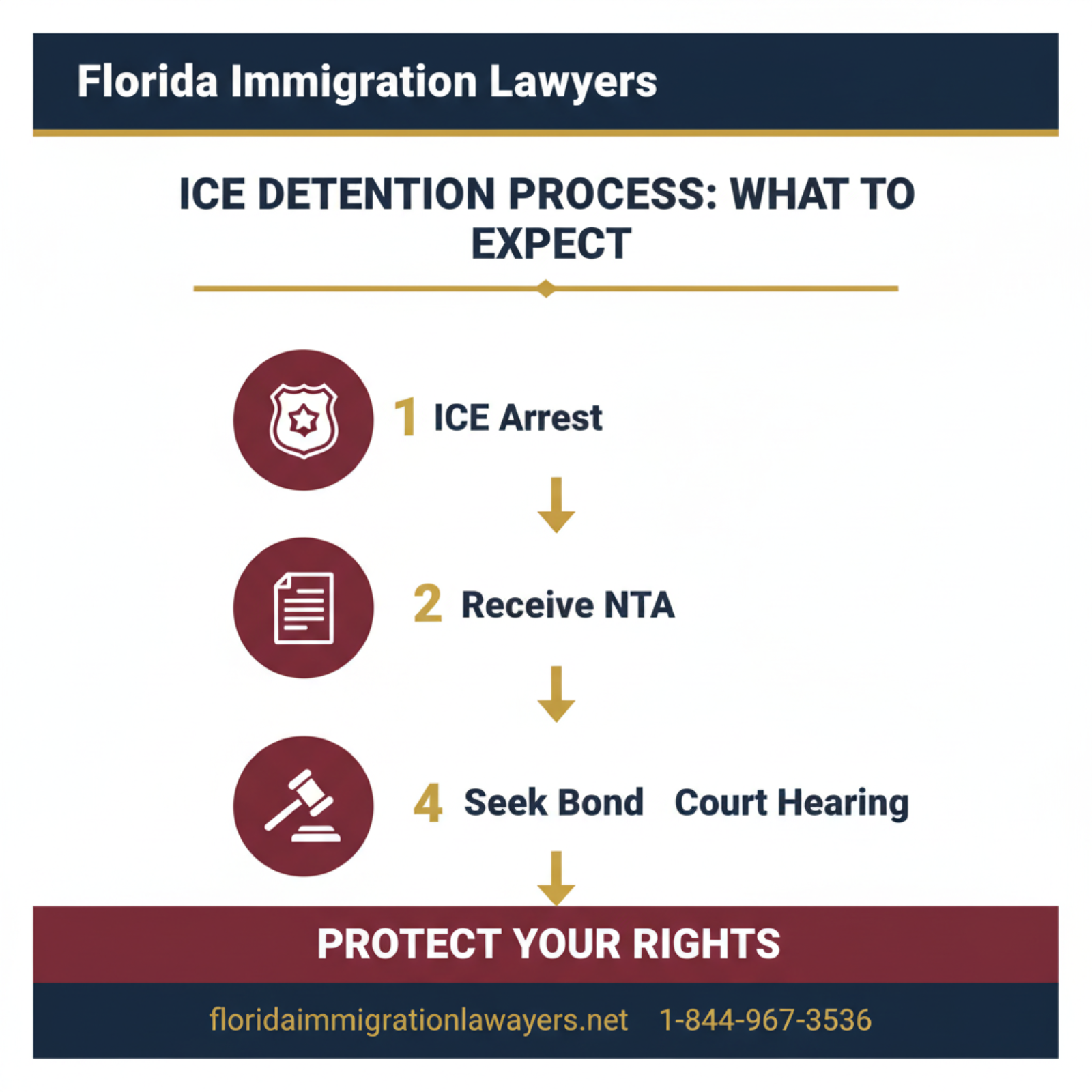
- Initial Encounter and Arrest: The process often begins with an encounter with law enforcement or ICE agents. This could be during a traffic stop, a home visit, or even after release from criminal custody. If ICE has reason to believe a green card holder is removable, they may be arrested. It is important to remember your right to remain silent and to request an attorney immediately. Do not sign any documents without legal advice.
- Transfer to an ICE Detention Facility: Following arrest, the individual will typically be transported to an ICE detention facility in Florida. Common facilities include the Krome Service Processing Center or Glades County Detention Center. During this transfer, family members may struggle to locate their loved one. An immigration lawyer Florida can assist in locating detained individuals.
- Issuance of a Notice to Appear (NTA): Once in ICE custody, the individual will generally be served with a Notice to Appear (Form I-862). This document formally initiates removal proceedings against the green card holder. The NTA will specify the alleged grounds for removability and indicate the immigration court where hearings will take place, such as the Orlando Immigration Court. It is vital to review this document carefully with legal counsel.
- Custody Determination and Bond Hearing: For some detained green card holders, a bond hearing may be an option. An immigration judge determines if the individual can be released on bond, and if so, sets the amount. Factors considered include ties to the community, flight risk, and danger to the community. However, certain criminal convictions trigger "mandatory detention" under INA Section 236(c) (8 U.S.C. § 1226(c)), making bond impossible. An experienced ICE bond hearing Orlando lawyer is essential to argue for release.
- Immigration Court Proceedings: Regardless of bond status, the green card holder will face immigration court proceedings. These hearings involve presenting evidence, calling witnesses, and making legal arguments before an immigration judge. The goal is to challenge the government's allegations of removability and demonstrate eligibility for relief from deportation, if available. This could include asylum or cancellation of removal. This is a complex process requiring skilled legal representation.
- Potential for Relief from Removal: Even if found deportable, a green card holder may be eligible for various forms of relief. These could include cancellation of removal for certain permanent residents, waivers of inadmissibility, or asylum, depending on the specific circumstances. Each form of relief has stringent eligibility requirements. Successfully applying for relief requires comprehensive preparation and presentation.
- Decision and Appeal: The immigration judge will issue a decision at the conclusion of the proceedings. If the judge orders removal, the green card holder typically has the right to appeal the decision to the Board of Immigration Appeals (BIA). Further appeals may be possible to a U.S. Circuit Court of Appeals. The appeals process is highly technical and time-sensitive.
Throughout this challenging process, having a knowledgeable immigration lawyer Florida by your side is not just beneficial, it is often critical. They can navigate the legal complexities, advocate for your rights, and work towards the best possible outcome.
Essential Documents for Green Card Holders in ICE Custody
When facing ICE detention or potential removal proceedings, having immediate access to critical documents can significantly impact your case. For green card holders in Florida, assembling these papers quickly is paramount. We advise having copies of these documents readily accessible to a trusted family member or your legal team.
- Proof of Permanent Resident Status: Your most important document is your Permanent Resident Card (Form I-551, commonly known as a green card). Also, bring any valid foreign passport with an I-551 stamp, or other USCIS documents confirming your lawful permanent resident status. This is fundamental for asserting your permanent resident rights.
- Personal Identification: Valid government-issued photo identification, such as a driver's license or state ID from Florida. While not immigration documents, they help establish your identity and residency.
- Financial Records for Bond Hearings: If eligible for bond, you will need documentation of financial stability. This includes bank statements, proof of employment, tax returns, and property deeds. These demonstrate your ties to the community and ability to pay bond.
- Criminal Records (if applicable): If you have any past arrests or convictions, gather all court disposition documents, sentencing records, and proof of completion of sentences. Your lawyer needs these to assess the immigration consequences. Even seemingly minor offenses can have major implications.
- Family Information: Birth certificates, marriage certificates, and other documents proving family relationships to U.S. citizens or other lawful permanent residents. This evidence can be crucial for establishing ties to the U.S. and eligibility for certain forms of relief.
- Proof of Residency in Florida: Utility bills, lease agreements, mortgage statements, or other official mail addressed to you in Florida. These documents help demonstrate your long-term presence and community ties in the state.
- Medical Records: Any relevant medical conditions or prescriptions. This information ensures proper care while in detention and can be important for humanitarian considerations.
- Immigration History Documents: Copies of any previous immigration applications, petitions, or court orders (e.g., I-130, I-485, N-400, prior NTA, asylum applications). A complete immigration history is vital for your defense.
Having these documents organized and accessible allows your immigration lawyer Florida to build a robust defense more efficiently. Delay in providing necessary paperwork can prolong detention and complicate your case.
Navigating Timelines and Processing Expectations in Florida ICE Cases
The timeline for green card holder ICE detention cases in Florida is rarely straightforward. Each case is unique, influenced by numerous factors that can either expedite or significantly delay the process. Understanding these variables can help manage expectations for you and your family.
Factors Influencing Case Duration
Several elements contribute to the variability of detention timelines. The specific immigration court where your case is heard, such as the Orlando Immigration Court, plays a role due to varying caseloads. The complexity of your case, particularly if it involves extensive criminal history or multiple grounds of removability, will also extend the timeline. Furthermore, the availability of an immigration judge and the government's attorney can impact scheduling.
Another significant factor is whether you are eligible for bond. If bond is granted and paid, you can pursue your case outside of detention, which, while still lengthy, can be less stressful. However, if you are subject to mandatory detention under INA 236(c) (8 U.S.C. § 1226(c)), you will remain in custody throughout your proceedings, which can span many months, sometimes even years. The current backlogs in the immigration court system also contribute to longer waiting times for hearings.
Typical Processing for Bond and Hearings
After detention, an initial custody review or bond hearing can sometimes occur within a few weeks, though this varies. If bond is denied or not applicable, the next step is the master calendar hearing. This is a preliminary hearing where charges are read and pleas are entered. Subsequent individual hearings, where evidence is presented, can be scheduled months, or even over a year, after the master calendar hearing.
The overall duration from detention to a final decision can range from several months to several years. For instance, a complex deportation defense Florida case involving appeals can extend for a considerable period. Throughout this time, your immigration lawyer will monitor your case closely, pushing for timely hearings and advocating for expedited processes where possible. Understanding these general timelines helps in preparing for the journey ahead.
Cost Factors and Fee Breakdown for Green Card Holder Detention Cases
Facing green card holder ICE detention not only brings immense stress but also significant financial burdens. Understanding the potential costs involved is crucial for families in Florida preparing to fight for their loved one's freedom and status. These costs can generally be categorized into bond amounts, attorney fees, and other associated expenses.
Bond Amounts
If an immigration judge grants bond, this is often the first major financial hurdle. Bond amounts for immigration cases in Florida can vary widely, typically ranging from a few thousand dollars to tens of thousands, depending on the individual's specific circumstances, flight risk, and danger to the community. The purpose of the bond is to ensure the individual appears for all future court hearings. It's important to note that if bond is posted, the money is usually returned at the conclusion of the case, provided all court appearances are met. However, if the individual fails to appear, the bond money can be forfeited. An ICE bond hearing Orlando lawyer can argue for a lower bond amount.
Attorney Fees
Legal representation is perhaps the most critical investment in these cases. Attorney fees for deportation defense Florida vary based on the complexity of the case, the attorney's experience, and the services required. A comprehensive defense, especially one involving multiple hearings, appeals, or complex legal arguments, will naturally incur higher costs. Many immigration law firms, including Florida Immigration Lawyers, offer payment plans to help manage these expenses. A free consultation is an excellent way to understand potential legal fees upfront without obligation. The value of an experienced lawyer far outweighs the cost, given the high stakes of potential deportation.
Other Associated Costs
Beyond bond and attorney fees, other expenses may arise. These can include fees for obtaining certified copies of documents, translation services for foreign language records, expert witness fees if needed, and travel expenses for family members attending hearings or visiting detention centers. While these might seem minor individually, they can add up. It is essential to discuss all potential costs with your immigration lawyer Florida early in the process to avoid surprises and plan accordingly. Investing in legal expertise is investing in your future and protecting your permanent resident rights.
Do not navigate this complex and frightening process alone. The stakes are incredibly high when facing green card holder ICE detention in Florida. Your freedom and your future in the United States hang in the balance. Contact Florida Immigration Lawyers today for dedicated and experienced legal representation. We are ready to fight for you.
Common Mistakes Green Card Holders Make During ICE Encounters
When facing an encounter with ICE, green card holders in Florida can inadvertently make critical mistakes that severely jeopardize their immigration status. Being aware of these pitfalls is the first step toward protecting yourself and your family.
- Not Carrying Your Green Card: Lawful permanent residents are required by law to carry their Permanent Resident Card (Form I-551) at all times. Failing to do so can lead to detention and delays while your status is verified.
- Giving False Information: Providing false or misleading information to an immigration officer can have severe consequences, including criminal charges and immediate grounds for deportation. Always be truthful, but you are not obligated to volunteer information beyond your identity.
- Signing Documents Without Understanding Them: Never sign any document presented by an ICE agent without fully understanding its contents and implications. Some documents, like a "Voluntary Departure" agreement, can waive your rights to a hearing and lead to immediate deportation. Always request to speak with an attorney first.
- Resisting Arrest or Obstructing Justice: While you have rights, actively resisting arrest or physically obstructing an officer can lead to criminal charges, which will only compound your immigration problems. Cooperate physically, but assert your right to remain silent and to speak with a lawyer.
- Failing to Appear in Immigration Court: Missing a scheduled immigration court hearing, even inadvertently, can result in an "in absentia" removal order. This means you could be ordered deported without having your case heard. Always confirm hearing dates and attend them.
- Not Disclosing Full Criminal History to Your Attorney: It is imperative to be completely honest with your immigration lawyer about any past arrests or convictions, no matter how minor. Your lawyer needs accurate information to properly assess your case and prepare a robust deportation defense Florida.
- Trying to Handle Your Case Alone: Immigration law is incredibly complex. Attempting to represent yourself in removal proceedings, especially in a green card holder ICE detention case, significantly reduces your chances of a favorable outcome. Legal expertise is invaluable.
- Ignoring Legal Notices from USCIS or Immigration Court: Failing to respond to Requests for Evidence (RFEs), Notices of Intent to Deny (NOIDs), or court hearing notices can lead to adverse decisions, including denial of benefits or an order of removal. Always open and read all official mail.
- Not Understanding the Terms of Your Bond: If you are released on bond, it comes with specific conditions. Failing to adhere to these conditions, such as reporting requirements or travel restrictions, can result in re-detention and forfeiture of your bond.
- Making Statements to ICE Without Legal Counsel: Anything you say to an ICE agent can be used against you in immigration court. Politely assert your right to remain silent and request to speak with your immigration lawyer Florida before answering substantive questions.
When to Call a Florida Immigration Lawyer for ICE Detention
The moment you or a loved one faces an encounter with ICE that leads to detention, time is of the essence. Prompt legal intervention can make a critical difference in the outcome of a green card holder ICE detention case. Knowing when to call an attorney is paramount to protecting your permanent resident rights and fighting potential deportation.
Immediate Detention or Arrest
If you or a family member is arrested by ICE and taken into custody, contact Florida Immigration Lawyers immediately. Do not wait. An experienced immigration lawyer Florida can help locate the detained individual, ascertain the reasons for detention, and begin strategizing for release. Early intervention can prevent mistakes and preserve crucial rights.
Receiving a Notice to Appear (NTA)
The NTA is the document that formally begins removal proceedings. If you receive an NTA, even if you are not detained, it is a serious matter requiring immediate legal review. An attorney can analyze the charges against you, identify potential defenses, and prepare you for your first immigration court hearing.
Issues with Mandatory Detention
Some green card holders, particularly those with certain criminal convictions, may be subject to "mandatory detention" under federal law, meaning they are not eligible for bond. However, the interpretation of these laws can be complex. An attorney can assess if you truly fall under mandatory detention or if there are legal arguments to be made for a bond hearing. This is where specialized deportation defense Florida expertise truly shines.
Complex Criminal History
If your detention is linked to a criminal record, no matter how old or seemingly minor, you absolutely need an attorney. The immigration consequences of criminal offenses are highly intricate and often different from criminal law penalties. An attorney can determine if your conviction makes you deportable and explore waivers or other forms of relief.
Seeking Release on Bond
If bond is an option, an attorney can represent you at your ICE bond hearing Orlando. They will argue for your release, present evidence of your ties to the community, and advocate for the lowest possible bond amount. Without legal representation, securing a favorable bond decision can be incredibly difficult.
Facing Deportation Proceedings
Ultimately, ICE detention is often a precursor to deportation proceedings. If you are in immigration court facing removal, a skilled attorney is your best defense. They can challenge the government's case, present evidence, and argue for forms of relief that could allow you to remain in the U.S.
Many people ask, "Can I sue ICE for detaining me as a citizen?" While this article focuses on green card holders, it's important to clarify: U.S. citizens cannot be lawfully detained by ICE. If a U.S. citizen is mistakenly detained, they should immediately assert their citizenship and demand release. Green card holders, however, can be detained legally under certain circumstances, as discussed. If you believe your detention is unlawful even as a green card holder, an attorney can assess the merits of a challenge.
Finally, "Who is at risk of being deported?" Any non-citizen, including green card holders, can be at risk of deportation if they violate immigration laws or commit certain crimes. The risk is significantly higher for individuals with criminal records, those who have committed fraud, or those who have violated the terms of their admission. Consulting with a Florida immigration lawyer can help you understand your specific risk factors and how to mitigate them.
Frequently Asked Questions (FAQs) About Green Card Holder ICE Detention
Navigating the complexities of immigration law can lead to many questions. Here, we address some of the most common inquiries regarding green card holder ICE detention in Florida.
Can ICE detain you if you have a green card?
Yes, absolutely. While holding a green card grants you lawful permanent resident status, it does not provide absolute immunity from detention by U.S. Immigration and Customs Enforcement (ICE). ICE can detain green card holders if there is probable cause to believe they are removable from the United States, typically due to certain criminal convictions or violations of immigration law. For example, aggravated felonies or crimes involving moral turpitude can trigger detention.
Can green card holders be deported right now?
Detention by ICE is generally the first step in a removal process, not an immediate deportation. Once detained, a green card holder is typically served with a Notice to Appear (NTA) and placed in removal proceedings before an immigration judge. During these proceedings, the individual has the right to present their case and seek relief from deportation. However, without a strong legal defense, the risk of a deportation order is very high. The process is not instant, but the threat is real.
Can I sue ICE for detaining me as a citizen?
U.S. citizens cannot be lawfully detained by ICE. If a U.S. citizen is mistakenly detained by ICE, they should immediately assert their citizenship and contact an attorney. In such cases of unlawful detention, individuals may have grounds to pursue legal action. However, this article specifically addresses green card holders, who, as non-citizens, can be lawfully detained under specific circumstances. If you are a green card holder and believe your detention is unlawful, an attorney can evaluate your specific situation.
Who is at risk of being deported?
Any non-citizen in the United States, including green card holders, is at risk of deportation if they violate immigration laws or commit certain types of crimes. Green card holders are particularly vulnerable if they have convictions for aggravated felonies, crimes involving moral turpitude, controlled substance offenses, or certain other criminal acts. Additionally, those who obtained their green card through fraud or marriage fraud are at high risk. Understanding your specific vulnerabilities with a deportation defense Florida lawyer is crucial.
About Florida Immigration Lawyers
Florida Immigration Lawyers is a leading law firm dedicated to providing exceptional legal representation to immigrants across the entire state of Florida. With years of specialized experience, our attorneys understand the profound impact immigration issues have on individuals and families. We are committed to offering compassionate and effective legal solutions.
Our firm specializes in a wide range of immigration services, including deportation defense Florida, family-based immigration, business immigration, asylum claims, and citizenship applications. We pride ourselves on our deep knowledge of immigration law and our unwavering commitment to our clients' success. When you choose Florida Immigration Lawyers, you are choosing a team that will tirelessly advocate for your rights.
We believe everyone deserves access to justice. That is why we offer free consultations to assess your case and provide clear guidance on your best path forward. Our dedicated team is available 24/7 to address your urgent needs. We serve all Florida communities, from Orlando to Miami, Tampa to Jacksonville. For reliable legal support, contact us today. Visit our website at https://www.floridaimmigrationlawyers.net or call us at 1-844-967-3536.
Sources and References
- U.S. Citizenship and Immigration Services (USCIS)
- Executive Office for Immigration Review (EOIR)
- U.S. Immigration and Customs Enforcement (ICE)
- 8 U.S.C. Chapter 12 - Immigration and Nationality Act (INA)
- INA Section 236(c) (8 U.S.C. § 1226(c)) - Detention of Criminal Aliens
- Code of Federal Regulations (CFR) Title 8 - Aliens and Nationality
This article provides general legal information and is not intended as legal advice. Every case is unique, and outcomes depend on specific facts and circumstances. Contact an attorney for advice about your particular situation.
If you or a loved one is facing green card holder ICE detention in Florida, do not hesitate. The time to act is now. Protect your rights and secure your future by speaking with an experienced legal team. Call Florida Immigration Lawyers at 1-844-967-3536 for a free, confidential consultation. We offer dedicated legal support across all of Florida. Se Habla Español - Estamos aquí para ayudarle.
Do Not Navigate This Process Alone
Our experienced immigration attorneys are ready to fight for you. Get a free, confidential consultation today.
Se Habla Español
Or leave your details and we’ll call you:
Free Evaluation in 24 Hours
Or talk to us right now

AI voice assistant — available 24/7
FreeFrequently Asked Questions

William J. Vásquez
Founding Attorney · Vasquez Law Firm
U.S. Air Force veteran and immigration attorney with years of hands-on U.S. immigration experience. J.D., NCCU School of Law. AILA member. Admitted to the 4th, 5th, and 11th Circuit Courts.
Available 24/7 - Free Evaluations
Reviewed for legal accuracy by William J. Vásquez
Licensed in North Carolina; U.S. immigration is federal practice.
Related Legal Services
Our Florida immigration attorneys can help you with experienced immigration attorneys, business immigration and asylum protection. Call today at 1-844-967-3536 for a free consultation.
Related Links
Related Topics
Free Legal Consultation
Discuss your case with our experienced attorneys. We're available 24/7.
Se Habla Español - Estamos aquí para ayudarle.
Related Articles
Immigration Lawyer Orlando Free Consultation 2026
Discover how to find an immigration lawyer in Orlando offering a free consultation. Understand the services available and why choosing Florida Immigration Lawyers can make a difference in your case.
Military Naturalization Expedited in Florida Bases
Explore military naturalization options for families at Florida bases, including parole in place benefits in Miami. Learn how to expedite your application with expert guidance from Florida Immigration Lawyers.
Immigration Lawyer Orlando Free Consultation: 2026 Policy
For those in Orlando, Pembroke Pines, and throughout Florida, understanding evolving immigration policies is crucial. With anticipated immigration policy changes in 2026, seeking expert legal guidance is more important than ever. This comprehensive guide details the expected shifts in federal and state immigration laws, their impact on various visa types and humanitarian relief, and essential steps for securing your future. Learn about the process for obtaining an immigration lawyer Orlando free consultation, what to expect regarding timelines and costs, and common mistakes to avoid. Florida Immigration Lawyers provides dedicated support, offering free consultations and 24/7 availability to help you navigate these complexities with confidence.
Immediate Relative Petition Tampa: Your 2026 Florida Guide
Securing a green card for an immediate relative in Florida involves a detailed process, starting with Form I-130. This guide, updated for 2026, explains who qualifies as an immediate relative-spouses, unmarried children under 21, and parents of U.S. citizens-and outlines the step-by-step journey from petition filing to green card issuance. We cover essential documents, expected timelines, and associated costs, emphasizing the critical difference of no visa backlogs for this category. Learn how to navigate USCIS procedures, whether through adjustment of status in cities like Tampa and Hialeah or consular processing abroad. We also detail common mistakes to avoid and highlight scenarios where legal counsel from Florida Immigration Lawyers is indispensable to ensure a smooth and successful family reunification.