Rear-End Collision Florida: Whiplash, Herniated Disc Claims
A rear-end collision in Florida can lead to severe injuries like whiplash and herniated discs, causing chronic pain and significant financial strain. Florida's no-fault PIP coverage often falls short, making it crucial to pursue a claim against the at-fault driver. Understanding the legal process, from immediate medical attention and evidence gathering to navigating insurance companies and potential litigation, is vital. This guide covers the common injuries, legal steps, evidence requirements, and cost factors involved in such claims. Learn about Florida's specific laws, including the 2-year statute of limitations and comparative negligence rules. Seeking timely legal advice from an experienced personal injury attorney, like Harold Estrada-Rodriguez at Florida Immigration Lawyers, is paramount to protect your rights and secure fair compensation. Don't delay; act quickly to ensure your claim is handled effectively.

After a rear-end collision in Florida, especially in areas like Tallahassee, victims often suffer severe injuries such as whiplash and herniated discs. These injuries can lead to chronic pain, extensive medical treatments, and significant financial burdens. Florida's no-fault insurance laws require Personal Injury Protection (PIP) coverage, but this often falls short of covering all damages. Pursuing a claim against the at-fault driver is crucial to seek full compensation for medical expenses, lost wages, pain, and suffering. Acting quickly and consulting with an experienced personal injury attorney is vital to protect your rights and ensure you receive the justice you deserve.
- Seek immediate medical attention, even for seemingly minor symptoms.
- Report the accident to law enforcement and your insurance provider promptly.
- Document everything: photos, witness contacts, medical records.
- Understand Florida's 2-year statute of limitations for personal injury claims.
- Consult a Florida personal injury attorney before speaking with insurance adjusters.
Introduction: Navigating a Rear-End Collision Claim in Florida
Driving on Florida's busy roads, from Orlando to Tallahassee, carries inherent risks. A sudden jolt, the screech of tires, and the impact of a rear-end collision can change your life in an instant. While some accidents result in minor bumps and bruises, many lead to debilitating injuries like whiplash and herniated discs, leaving victims with lasting pain and mounting medical bills. If you've been involved in a rear-end accident, understanding your rights and the legal process in Florida is paramount.
Florida's unique personal injury laws, including its no-fault system, can make navigating a claim complex. Dealing with insurance companies, documenting your injuries, and understanding the statute of limitations are critical steps. This comprehensive guide will walk you through the specifics of rear-end collision claims in Florida, focusing on common injuries such as whiplash and herniated discs. We will cover everything from the immediate aftermath of an accident to the legal procedures involved in seeking compensation, ensuring you are well-prepared to protect your interests.
At Florida Immigration Lawyers, we understand the physical, emotional, and financial toll these accidents can take. Our dedicated personal injury attorney, Harold Estrada-Rodriguez, Florida Bar No. 1041171, is here to help. If you or a loved one has suffered a rear-end collision in Florida, do not hesitate to seek expert legal guidance. Call Florida Immigration Lawyers at 1-844-967-3536 for a free consultation today. We are ready to assist you in Orlando, Kissimmee, and throughout Florida.
Understanding Rear-End Collisions and Common Injuries in Florida
Rear-end collisions are among the most frequent types of car accidents in Florida. They often occur due to driver inattention, distracted driving, speeding, or tailgating. Even a low-speed impact can cause significant injuries, as the sudden forward and backward motion of the body can exert tremendous force on the neck and spine. The human body is not designed to withstand such rapid deceleration and acceleration, leading to a range of potential health issues.
In Florida, all registered vehicles must carry Personal Injury Protection (PIP) insurance, as mandated by §627.736 of the Florida Statutes. This no-fault coverage typically provides up to $10,000 for medical expenses and lost wages, regardless of who was at fault. However, PIP coverage is often insufficient for serious injuries like whiplash and herniated discs, which can require extensive and costly long-term care. Furthermore, to access PIP benefits, you must seek initial medical treatment within 14 days of the accident.
Common injuries sustained in a rear-end collision in Florida include soft tissue injuries, fractures, and traumatic brain injuries. However, whiplash and herniated discs are particularly prevalent and often lead to chronic conditions if not properly diagnosed and treated. These injuries can have a profound impact on a victim's quality of life, affecting their ability to work, perform daily tasks, and enjoy recreational activities. Understanding the nature of these injuries is crucial for building a strong personal injury claim.
Whiplash and Herniated Discs: Serious Consequences After a Rear-End Crash
Whiplash is a common injury resulting from the rapid, forceful back-and-forth movement of the neck, similar to the cracking of a whip. This motion can damage the muscles, ligaments, and soft tissues in the neck and upper back. Symptoms may include neck pain and stiffness, headaches, dizziness, blurred vision, and fatigue. These symptoms can sometimes appear hours or even days after the accident, which is why immediate medical evaluation is critical, even if you feel fine initially.
A herniated disc, also known as a slipped or ruptured disc, occurs when the soft, jelly-like center of a spinal disc pushes through a tear in its tougher exterior. This can put pressure on nearby nerves, causing severe pain, numbness, tingling, or weakness in the arms or legs, depending on the location of the injury. Herniated discs can occur in the cervical (neck), thoracic (mid-back), or lumbar (lower back) regions of the spine and are often a direct result of the compressive and shearing forces experienced during a rear-end collision.
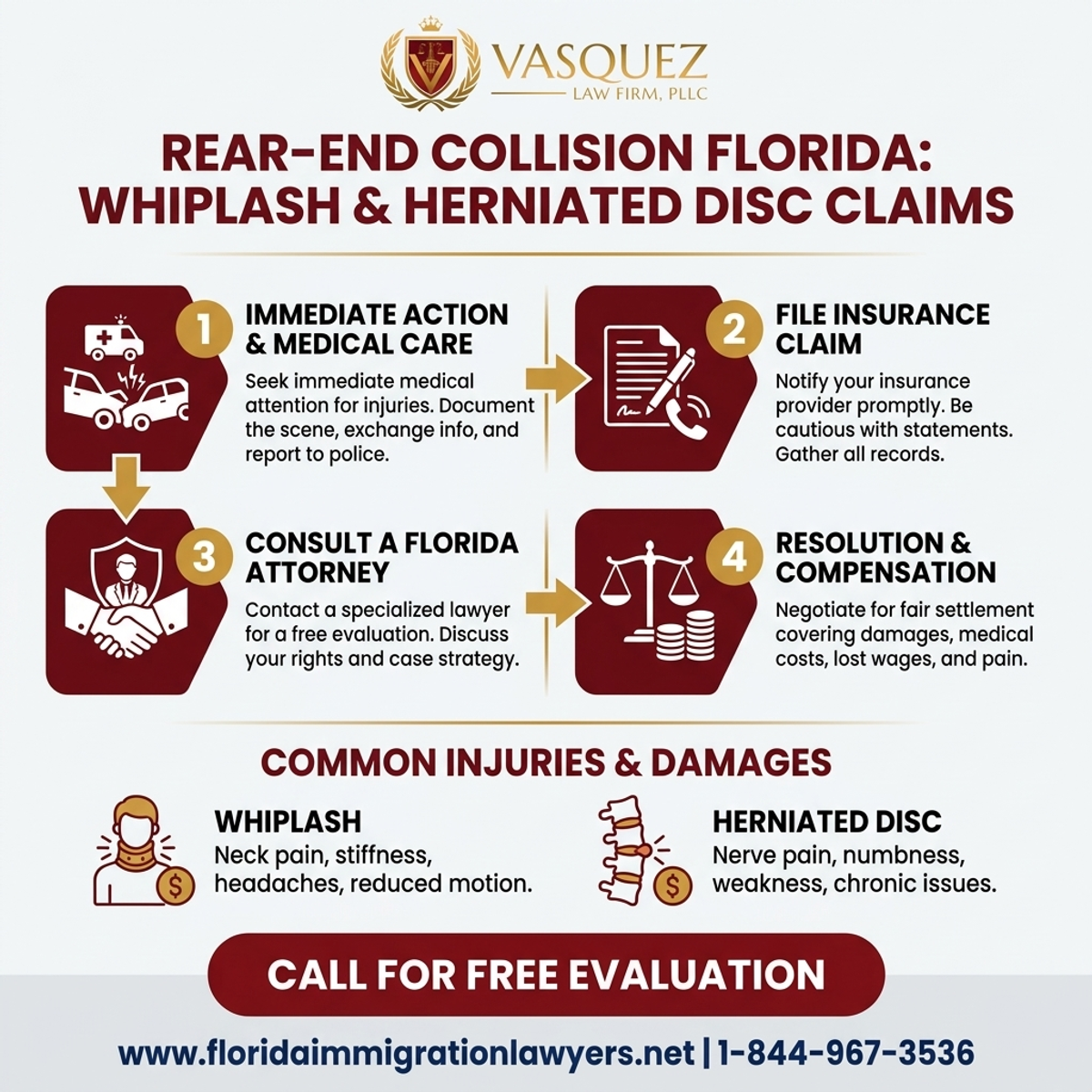
Step-by-Step Process — Rear-End Collision Florida: Whiplash, Herniated Disc Claims
Both whiplash and herniated discs can lead to long-term complications, including chronic pain, limited mobility, and nerve damage. Diagnosing these injuries often involves a combination of physical examinations, X-rays, MRIs, and CT scans. Treatment can range from physical therapy and pain management to injections and, in severe cases, surgery. The extensive medical costs and potential for lifelong disability underscore the importance of seeking appropriate compensation for these types of injuries after a car accident in Florida.
The Legal Process for a Rear-End Collision Claim in Florida
Navigating the legal aftermath of a rear-end collision in Florida can be daunting, but understanding the steps involved can empower you. The process typically begins with immediate post-accident actions and progresses through insurance claims, negotiations, and potentially litigation. It is essential to remember that Florida operates under a modified comparative negligence rule, codified in §768.81 of the Florida Statutes. This means your compensation can be reduced by your percentage of fault, and if you are found more than 50% at fault, you may be barred from recovery.
-
Seek Immediate Medical Attention and Document Injuries
Your health is the priority. Even if you don't feel immediate pain, see a doctor. Many serious injuries, especially whiplash and herniated discs, have delayed symptoms. Comprehensive medical records are crucial evidence for your claim. Remember, you must seek initial medical treatment within 14 days to qualify for PIP benefits under Florida law.
-
Report the Accident and Gather Initial Evidence
Call 911 to ensure law enforcement responds and creates a police report. Exchange information with all parties involved, including names, insurance details, and vehicle information. Take photos of the accident scene, vehicle damage, and any visible injuries. Collect contact information for any witnesses.
-
Notify Your Insurance Company
Report the accident to your own insurance company as soon as possible. However, be cautious when speaking with the at-fault driver's insurer. Provide only basic facts and avoid discussing fault or the extent of your injuries without legal counsel.
-
Consult a Florida Personal Injury Attorney
An attorney can explain your rights, help you understand Florida's complex laws, and handle all communications with insurance companies. They will work to gather all necessary evidence, including medical records, expert testimony, and accident reconstruction reports, to build a strong case on your behalf.
-
File a Personal Injury Lawsuit (If Necessary)
If negotiations with the insurance company fail to yield a fair settlement, your attorney may recommend filing a lawsuit. In Florida, personal injury lawsuits must generally be filed within two years from the date of the accident, as per §95.11(4)(a) of the Florida Statutes. This is a critical deadline, and missing it can permanently bar your claim. Cases in the Orlando and Kissimmee areas would typically be handled in the 9th Judicial Circuit Court of Florida.
-
Discovery, Mediation, and Trial
During the discovery phase, both sides exchange information and evidence. Many cases are resolved through mediation, a non-binding process where a neutral third party helps facilitate a settlement. If mediation is unsuccessful, the case proceeds to trial, where a judge or jury will determine liability and damages.
Throughout this intricate process, having a knowledgeable attorney by your side is invaluable. They can ensure all deadlines are met, evidence is properly presented, and your rights are vigorously protected. Furthermore, understanding your legal standing, including how your immigration status might interact with legal proceedings, can be important. Resources from agencies like U.S. Citizenship and Immigration Services (USCIS) provide general information on legal standing for individuals in the U.S., which can be a helpful starting point for understanding broader legal contexts.
Gathering Evidence and Building Your Whiplash or Herniated Disc Case
A successful personal injury claim for whiplash or a herniated disc hinges on strong, compelling evidence. The more thoroughly you document your injuries and the accident circumstances, the better your chances of securing fair compensation. This process begins immediately after the collision and continues throughout your medical treatment and legal proceedings.
Key pieces of evidence include the official police report, which details the accident's specifics and often assigns preliminary fault. Photos and videos of the accident scene, vehicle damage, road conditions, and your visible injuries are also incredibly valuable. Witness statements can corroborate your account of the events, providing an unbiased perspective on how the rear-end collision occurred. These immediate forms of evidence lay the groundwork for your claim.
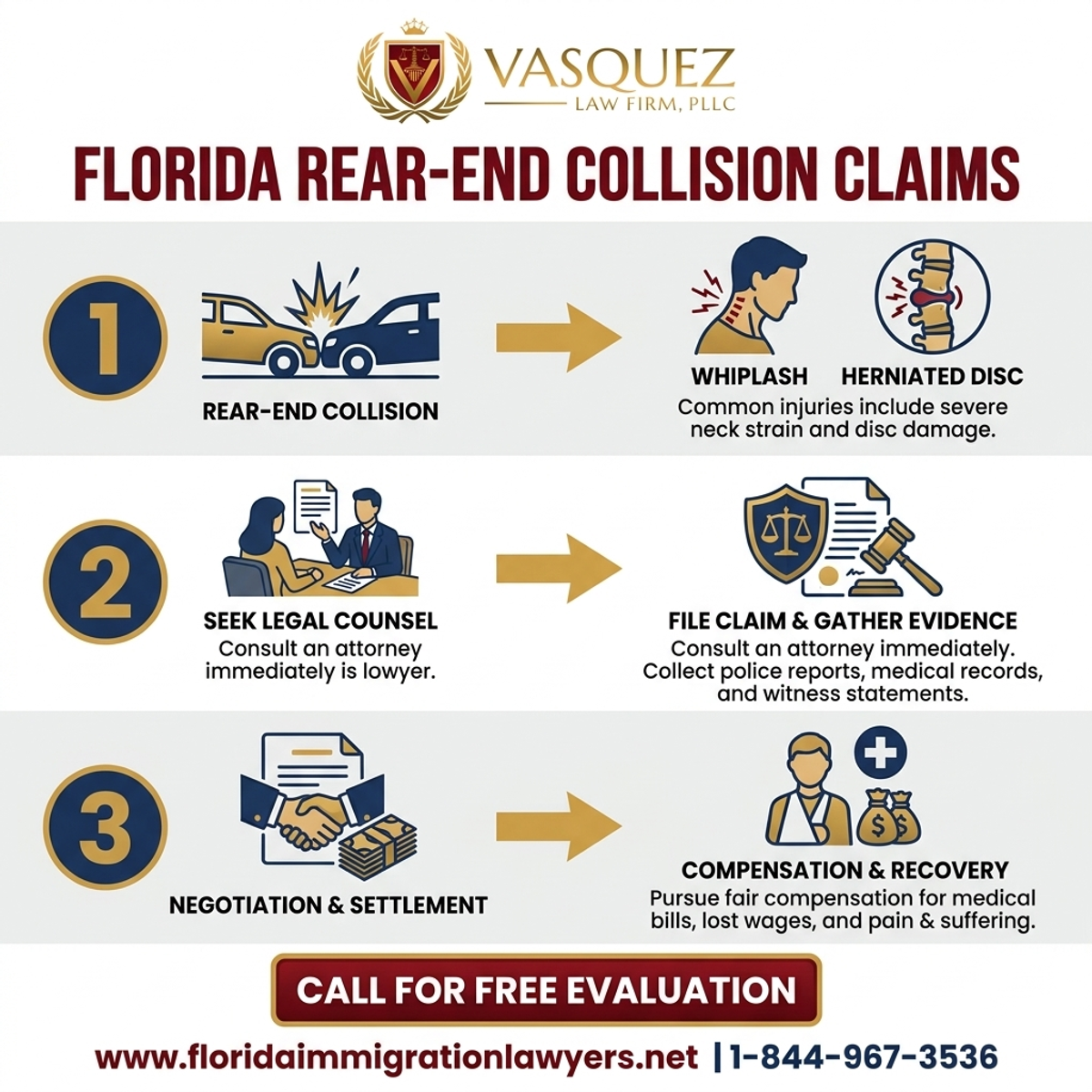
Key Statistics — Rear-End Collision Florida: Whiplash, Herniated Disc Claims
Medical records are arguably the most crucial evidence for whiplash and herniated disc claims. This includes emergency room reports, diagnostic imaging results (X-rays, MRIs, CT scans), doctor's notes, physical therapy records, and prescriptions. These documents objectively demonstrate the nature and extent of your injuries, the treatments you've received, and the impact on your daily life. It is vital to follow all medical advice and attend all appointments, as gaps in treatment can be used by insurance companies to dispute the severity of your injuries. Your attorney can also coordinate with medical experts who can provide testimony on the prognosis and long-term effects of your injuries. This comprehensive approach ensures that every aspect of your suffering and loss is meticulously documented and presented.
Cost Factors and Valuing Your Whiplash or Herniated Disc Claim
Understanding the potential value of your rear-end collision Florida claim for whiplash or a herniated disc involves assessing various damages, both economic and non-economic. Economic damages are quantifiable financial losses, while non-economic damages account for intangible suffering. The total value of your claim will depend on the severity of your injuries, the duration of your recovery, the impact on your life, and the specifics of Florida law, including the at-fault driver's insurance limits.
Economic damages typically include all medical expenses, from emergency room visits and ambulance rides to ongoing physical therapy, medications, and potential surgeries. It also covers lost wages due to time off work, as well as future lost earning capacity if your injuries prevent you from returning to your previous job or working at full capacity. Property damage to your vehicle also falls under economic losses. Keep meticulous records of all bills and receipts related to your accident and injuries.
Non-economic damages are designed to compensate you for the intangible aspects of your suffering. This includes pain and suffering, emotional distress, loss of enjoyment of life, and inconvenience. These damages are harder to quantify but are a significant component of many personal injury claims, especially for chronic conditions like severe whiplash or a debilitating herniated disc. An experienced personal injury attorney can help you accurately assess both your economic and non-economic damages to ensure you seek full and fair compensation. It is important to note that the ability to recover for pain and suffering generally requires proving a permanent injury, as defined by Florida law.
What to Expect: Timeline and Processing Expectations for Your Claim
The timeline for a rear-end collision Florida claim can vary significantly depending on several factors, including the complexity of your injuries, the responsiveness of insurance companies, and whether your case proceeds to litigation. It is important to have realistic expectations and understand that personal injury cases are rarely resolved quickly. Patience and persistence, coupled with strong legal representation, are key.
Initially, after the accident, the focus is on medical treatment and recovery. This phase can last for several months, particularly for severe injuries like herniated discs that require extensive therapy or surgery. During this time, your attorney will gather medical records, police reports, witness statements, and other evidence. Once your medical treatment is complete, or you reach Maximum Medical Improvement (MMI), your attorney will compile a comprehensive demand package to send to the at-fault driver's insurance company.
Negotiations with the insurance company can take weeks or months. Insurers often make a low initial offer, and your attorney will counter with a demand reflecting the true value of your damages. If a fair settlement cannot be reached through negotiation, the next step is often to file a lawsuit. Litigation adds considerable time, with the discovery phase, potential mediation, and court scheduling. A case that goes to trial in the 9th Judicial Circuit, for example, could take 1-3 years or even longer from the date of the accident. Throughout this process, your attorney will keep you informed and guide you through each stage, ensuring you understand your options and the potential outcomes. For insights into the broader U.S. legal system, including due process, resources from the Executive Office for Immigration Review (EOIR) can offer general information about legal proceedings, though specific to immigration courts, it highlights the importance of legal representation in any court system.
Do not navigate this complex process alone. Contact Florida Immigration Lawyers today for dedicated personal injury representation. We offer a no recovery, no fee approach, meaning you don't pay us unless we win your case.
Common Mistakes to Avoid After a Rear-End Collision in Florida
Making the wrong moves after a rear-end collision in Florida can severely jeopardize your claim for whiplash or a herniated disc. Being aware of these common pitfalls can help you protect your rights and ensure you receive the compensation you deserve.
-
Delaying Medical Attention: Waiting to see a doctor can make it difficult to link your injuries directly to the accident. Insurance companies often argue that if you weren't hurt immediately, your injuries must be from another cause.
-
Not Reporting the Accident: Failing to call the police and get an official report means there's no official record of the incident, which can weaken your claim significantly.
-
Admitting Fault: Never apologize or admit fault at the scene, even if you feel partially responsible. Let the investigation determine liability. Anything you say can be used against you.
-
Giving a Recorded Statement to the Other Driver's Insurer: The other driver's insurance company is not on your side. Providing a recorded statement without legal counsel can lead to you inadvertently harming your case.
-
Signing Releases Without Legal Review: Never sign any medical or financial releases from an insurance company without having your attorney review them. You could unknowingly waive important rights.
-
Failing to Follow Medical Advice: Gaps in treatment or not following your doctor's recommendations can suggest your injuries are not as severe as claimed, giving the insurance company grounds to deny or reduce your compensation.
-
Posting About Your Accident on Social Media: Insurance adjusters routinely check social media. Posts about your activities, even if seemingly innocuous, can be twisted to suggest your injuries are not limiting your life.
-
Not Documenting Everything: Failing to keep detailed records of medical appointments, expenses, lost wages, and pain symptoms can make it difficult to prove the full extent of your damages.
-
Accepting the First Settlement Offer: Initial offers from insurance companies are almost always low. An attorney can negotiate for a fair settlement that truly reflects the value of your claim.
-
Missing the Statute of Limitations: In Florida, you generally have two years from the date of the accident to file a personal injury lawsuit (Florida Statute §95.11(4)(a)). Missing this deadline means you lose your right to sue.
When to Call a Personal Injury Lawyer After a Florida Car Accident
While some minor fender-benders might be handled directly with insurance, a rear-end collision in Florida, especially one involving whiplash or a herniated disc, almost always warrants legal counsel. The complexities of Florida's no-fault system, combined with the tactics of insurance companies, can quickly overwhelm an injured individual.
You should contact a personal injury lawyer immediately if:
- You've suffered significant injuries like whiplash, a herniated disc, or any injury requiring ongoing medical treatment.
- The other driver's insurance company is contacting you for statements or settlement offers.
- There is a dispute about who was at fault for the accident.
- Your medical bills and lost wages exceed your PIP coverage.
- You are experiencing pain and suffering that significantly impacts your daily life.
- You are unsure about your rights or the legal process in Florida.
At Florida Immigration Lawyers, Harold Estrada-Rodriguez, Florida Bar No. 1041171, specializes in helping victims of personal injury accidents throughout Florida, including Tallahassee, Orlando, and Kissimmee. We understand the nuances of Florida law, including statutes like §768.81 on modified comparative negligence, and are prepared to fight for your rights. Our team can assess your case, handle all communications with insurance adjusters, gather critical evidence, and pursue the maximum compensation you deserve. Don't face the insurance companies alone. Your legal journey may also involve understanding broader legal protections; for instance, the U.S. Department of State provides resources relevant to U.S. citizens and foreign nationals, emphasizing the rule of law. While not directly related to your PI claim, it underscores the importance of legal frameworks.
About Florida Immigration Lawyers
Florida Immigration Lawyers is a dedicated Florida personal injury practice, proudly serving clients in Orlando, Kissimmee, and across the state. While our name reflects a broader commitment to legal services, our personal injury division is focused exclusively on advocating for accident victims. Harold Estrada-Rodriguez, Florida Bar No. 1041171, leads our personal injury efforts, bringing extensive experience and a compassionate approach to every case. We understand the challenges you face after an injury and are committed to providing aggressive, client-focused representation.
Our firm handles a wide range of personal injury matters, including car accidents, truck accidents, motorcycle accidents, pedestrian accidents, and slip and falls. We believe in providing accessible legal support, which is why we offer free consultations and operate on a contingency fee basis – meaning you pay no attorney fees unless we secure a recovery for you. We are available 24/7 to answer your questions and provide immediate assistance. When you choose Florida Immigration Lawyers, you choose a team dedicated to fighting for your rights and helping you rebuild your life after an accident.
Contact us today at 1-844-967-3536 or visit our website at https://www.floridaimmigrationlawyers.net to learn how we can help you.
Reviewed By
This article was reviewed for Florida legal accuracy by Harold Estrada-Rodriguez, Florida Bar No. 1041171, the attorney responsible for personal injury matters at Florida Immigration Lawyers. Personal injury representation in Florida only. No recovery, no fee.
Sources and References
- U.S. Citizenship and Immigration Services (USCIS)
- Executive Office for Immigration Review (EOIR)
- U.S. Department of State
- Florida Statute §95.11(4)(a) - Limitations, Actions Other Than for Recovery of Real Property
- Florida Statute §627.736 - Required Personal Injury Protection Benefits; Exclusions; Priority; Co-payments; Deductibles
- Florida Statute §768.81 - Comparative Fault
- Florida Rules of Civil Procedure - Rule 7.010 - Small Claims, Rule 9.030 - Appellate Jurisdiction
- 9th Judicial Circuit Court of Florida (Orange and Osceola Counties)
Related services: commercial truck accident claims, motorcycle accident representation.
This article provides general legal information and is not intended as legal advice. Every case is unique, and outcomes depend on specific facts and circumstances. Contact an attorney for advice about your particular situation.
Protect Your Rights After a Florida Rear-End Collision
If you've suffered whiplash or a herniated disc from a rear-end collision in Florida, time is of the essence. Don't let the complexities of the legal system prevent you from getting the compensation you deserve. Our experienced personal injury attorney, Harold Estrada-Rodriguez, Florida Bar No. 1041171, is ready to provide the dedicated legal representation you need.
Contact Florida Immigration Lawyers today for a free, no-obligation consultation. We are available 24/7 to discuss your case and explain how we can help you achieve a favorable outcome. Call us now at 1-844-967-3536. Se Habla Espanol - Estamos aqui para ayudarle.
If you need legal assistance, learn more about our Florida personal injury representation, or call us at 1-844-967-3536 for a free consultation.
Do Not Navigate This Process Alone
Our experienced immigration attorneys are ready to fight for you. Get a free, confidential consultation today.
Se Habla Español
Frequently Asked Questions
Florida Immigration Lawyers
Immigration Attorney | Founder, Vasquez Law Firm
U.S. Air Force veteran and immigration attorney with thousands of cases resolved. J.D., NCCU School of Law. AILA member. Admitted to the 4th, 5th, and 11th Circuit Courts.
Available 24/7 - Free Evaluations
Related Legal Services
Our Florida immigration attorneys can help you with slip-and-fall premises liability, Florida wrongful death claims and Florida personal injury attorney Harold Estrada-Rodriguez. Call today at 1-844-967-3536 for a free consultation.
Related Links
Related Topics
Free Legal Consultation
Discuss your case with our experienced attorneys. We're available 24/7.
Se Habla Español - Estamos aquí para ayudarle.
Related Articles
Florida Rear-End Collision: Whiplash and Herniated Disc Claims
Rear-end collisions in Florida can lead to serious injuries like whiplash and herniated discs. Learn how to navigate your claim and secure compensation. Call 1-844-967-3536 for a free consultation.
Motorcycle Accident: Left Turn Rider Injury Claim Florida
A Florida motorcycle accident, particularly one caused by a negligent left turn, can result in severe injuries and complex legal challenges for riders. This detailed guide explains how to establish fault, navigate Florida's comparative negligence laws, and pursue a comprehensive injury claim. Learn about immediate steps after a crash, the types of damages you can recover, and the critical legal process from investigation to resolution. Discover common mistakes to avoid and understand when it's essential to seek professional legal representation. Florida Immigration Lawyers, led by Harold Estrada-Rodriguez, Florida Bar No. 1041171, offers dedicated personal injury advocacy on a 'no recovery, no fee' basis. Protect your rights and ensure you receive the compensation you deserve.
Florida Wrongful Death Survivors: Understanding §§768.16-768.21
Explore how the Florida Wrongful Death Act, under §§768.16-768.21, impacts survivors in Fort Lauderdale. Learn about eligibility, damages, and legal processes. Call 1-844-967-3536 for a free consultation.
Florida Hit and Run: Understanding Uninsured Motorist Coverage
Florida hit and run accidents are distressingly common, making uninsured motorist (UM) coverage crucial. Learn about UM benefits and how Florida Immigration Lawyers can assist you.
