2026 Winter Olympics Ice Hockey: Immigration Paths for...
For athletes and support staff targeting the 2026 Winter Olympics ice hockey, understanding U.S. immigration laws is critical, especially if training or residing in Florida. This comprehensive guide from Florida Immigration Lawyers details the specialized visa categories, such as O-1 for extraordinary ability and P-1 for internationally recognized athletes, essential for entering the U.S. We provide a step-by-step application process, a crucial document checklist, and insights into timelines and costs. We also highlight common mistakes to avoid and explain when professional legal assistance is indispensable. Whether you are an athlete, coach, or essential personnel, our firm offers expert guidance to navigate the complexities of U.S. immigration, ensuring your focus remains on your Olympic aspirations. Contact us for a free consultation to secure your immigration path.

For athletes, coaches, and support staff involved in the 2026 Winter Olympics ice hockey, understanding U.S. immigration laws is crucial, especially if training or residing in Florida. Specialized visas like the O-1 for extraordinary ability or P-1 for internationally recognized athletes are typically required. The application process is complex, demanding meticulous documentation and adherence to strict deadlines. Consulting an experienced immigration lawyer is highly recommended to ensure a smooth journey.
- Athletes and support staff need specific visas (O-1, P-1, B-1) for U.S. entry.
- The application process involves USCIS petitions and consular interviews.
- Meticulous documentation and adherence to timelines are essential for success.
- Florida offers a strategic location for training and international sports connections.
- Professional legal guidance is vital to navigate immigration complexities successfully.
The excitement surrounding the 2026 Winter Olympics is building, especially for fans of ice hockey. While the games themselves will take place in Italy, the journey for many international athletes, coaches, and essential support personnel often involves extensive preparation, training, and travel. For those based in or planning to train in the United States, particularly here in sunny Florida, understanding the intricacies of U.S. immigration law becomes paramount.
Whether you are an Olympic-bound athlete, a renowned coach, or a critical support staff member, your ability to enter and reside in the U.S. legally is fundamental to your Olympic aspirations. This comprehensive guide will explore the various visa options available, outline the application process, highlight potential challenges, and explain how Florida Immigration Lawyers can provide invaluable assistance.
Do not let immigration hurdles dim your Olympic dream. For personalized guidance and expert legal support tailored to your unique situation, call Florida Immigration Lawyers at 1-844-967-3536 for a free consultation. We are here to help you navigate your path to the 2026 Winter Olympics and beyond.
Understanding Immigration for 2026 Winter Olympics Ice Hockey Participants
The global nature of the Olympic Games means that athletes and their teams come from every corner of the world. For those involved in 2026 Winter Olympics ice hockey, this often includes periods of training, exhibition games, or even long-term residence in the United States. Florida, with its excellent sports facilities, diverse population, and strategic location, serves as a significant hub for international athletes.
Navigating U.S. immigration for elite athletes and their support teams is a specialized area of law. It requires a deep understanding of specific nonimmigrant and immigrant visa categories designed for individuals with extraordinary abilities or international recognition. Our firm specializes in these complex cases, ensuring that your focus can remain on your athletic performance.
Florida's Role in International Sports and Immigration
Florida is not just a tourist destination; it is a premier location for professional sports training and events. From world-class ice hockey facilities to diverse training grounds, many international athletes choose Florida as their base. This makes the intersection of Florida immigration law and sports particularly relevant for 2026 Winter Olympics ice hockey participants.
Our state is home to a vibrant international community, and our legal system is well-versed in handling cases for individuals pursuing their professional careers here. Whether you are an athlete seeking a temporary stay or considering a more permanent move, our team understands the unique context of Florida's legal landscape.
Key Visa Categories for Olympic Ice Hockey Professionals in Florida
For athletes, coaches, and support personnel aiming for the 2026 Winter Olympics ice hockey team, several U.S. visa categories may be applicable. The choice of visa depends on the individual's specific role, level of recognition, and the duration of their stay in the United States. We will primarily focus on the O-1 and P-1 visas, which are most common for elite athletes.
The O-1 Visa for Individuals with Extraordinary Ability
The O-1 visa is designed for individuals who possess extraordinary ability in the sciences, arts, education, business, or athletics, or who have a demonstrated record of extraordinary achievement in the motion picture or television industry. For an ice hockey athlete or coach, this means demonstrating a level of expertise indicating that the individual is one of the small percentage who have risen to the very top of the field of endeavor.
To qualify, you must show sustained national or international acclaim. This can be evidenced by major awards, published material about you, high salary, or critical roles in distinguished organizations. An O-1 visa is initially granted for up to three years and can be extended, making it suitable for long-term training and competition cycles in Florida.
The P-1 Visa for Internationally Recognized Athletes
The P-1 visa category is specifically for internationally recognized athletes, individually or as part of a team, who are coming to the U.S. to participate in a specific athletic competition. This visa is highly relevant for 2026 Winter Olympics ice hockey players and their essential support personnel.
To qualify, you must be coming to the U.S. to participate in an athletic competition at an internationally recognized level of performance. The P-1 visa is generally valid for the period necessary to complete the event, competition, or performance, not to exceed 5 years for individuals and 1 year for teams. Extensions are possible. Essential support personnel accompanying P-1 athletes may also be eligible for P-1S visas.
B-1 Visitor Visa for Limited Activities
For very short-term visits, such as attending tryouts or engaging in brief, unpaid training activities where the primary purpose is not to compete for prize money, a B-1 business visitor visa might be appropriate. However, this visa has strict limitations and is generally not suitable for full-fledged Olympic preparation or competition. It is crucial to understand that receiving payment in the U.S. on a B-1 visa for athletic performance is typically prohibited.
Step-by-Step Guide to Securing Your U.S. Athlete Visa
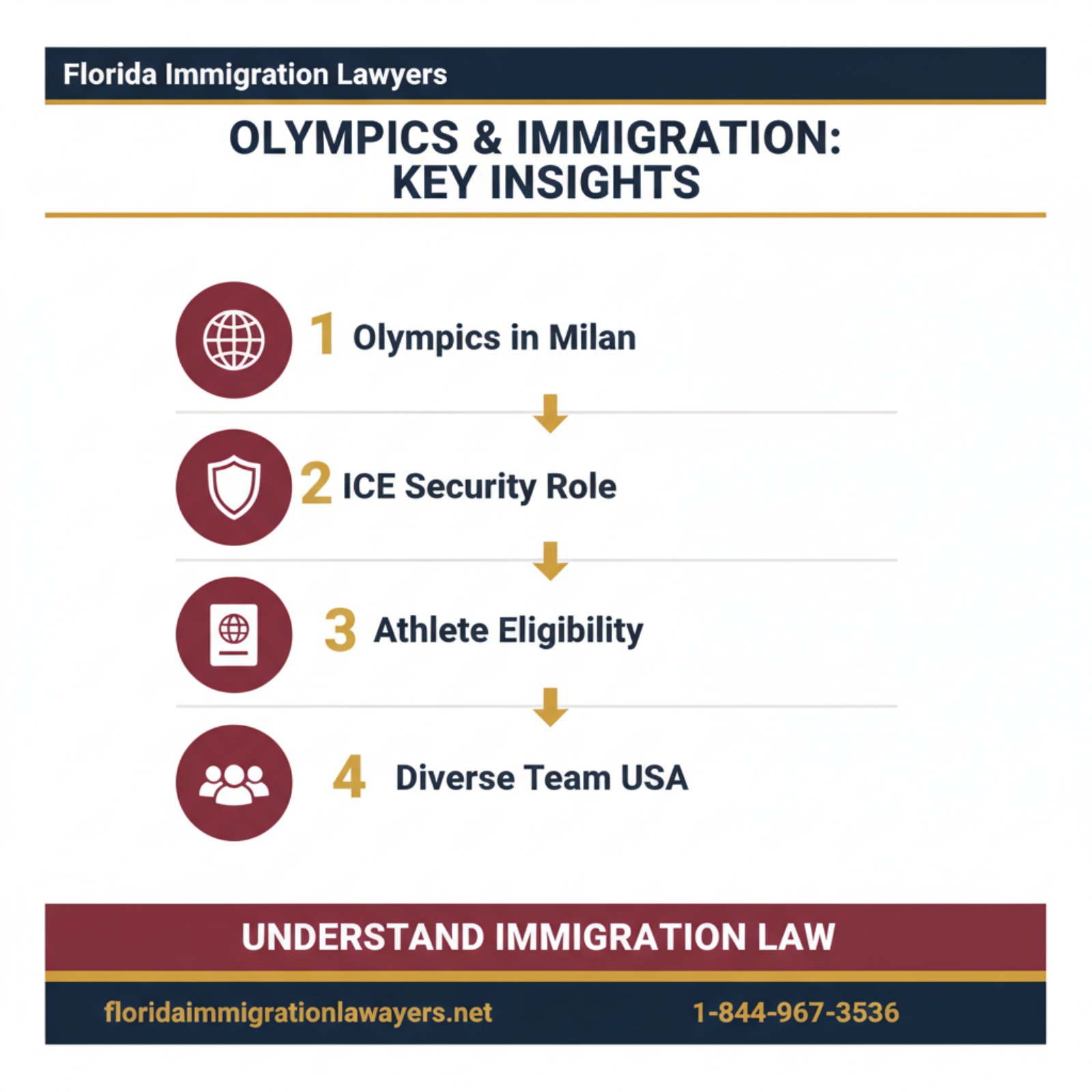
The process of obtaining an athlete visa for the United States, especially for an event as significant as the 2026 Winter Olympics ice hockey, involves several critical steps. Our firm, Florida Immigration Lawyers, can guide you through each stage, ensuring accuracy and compliance.
-
Determine Eligibility and Visa Category: The first step is to assess which visa type best suits your situation (e.g., O-1, P-1). This involves a detailed review of your athletic achievements, international recognition, and the specific purpose and duration of your stay in Florida. An experienced immigration lawyer can help you make this crucial determination.
-
Gather Required Documentation: Once the visa category is identified, you must compile an extensive portfolio of evidence. This includes proof of your extraordinary ability or international recognition, such as contracts, awards, media coverage, letters of recommendation from experts, and detailed itineraries. This step is often the most time-consuming and critical.
-
File Form I-129 Petition with USCIS: Your U.S. sponsor (e.g., a team, league, or agent) must file Form I-129, Petition for a Nonimmigrant Worker, with U.S. Citizenship and Immigration Services (USCIS). This petition must include all supporting documentation and a detailed explanation of why you qualify for the requested visa. USCIS field offices, such as those in Miami or Orlando, process many petitions for Florida-based individuals.
-
Respond to Requests for Evidence (RFE) or Notices of Intent to Deny (NOID): USCIS may issue an RFE if they need more information or a NOID if they intend to deny your petition. Responding comprehensively and promptly to these requests is vital. Our legal team is adept at formulating strong responses to such challenges.
Step-by-Step Process Guide -
Consular Processing or Adjustment of Status: If your I-129 petition is approved and you are outside the U.S., you will undergo consular processing at a U.S. Embassy or Consulate in your home country. If you are already in the U.S. and eligible, you might apply for an Adjustment of Status to change your immigration status. This is a complex decision that requires legal advice.
-
Attend Visa Interview: For consular processing, you will attend an interview at the U.S. Embassy or Consulate. An immigration officer will review your application and ask questions about your qualifications and intentions. Being well-prepared for this interview is essential.
-
Visa Issuance and Entry to U.S.: Upon successful completion of the interview, your visa will be stamped in your passport. You can then travel to the United States. At the port of entry, a Customs and Border Protection (CBP) officer will make the final decision on your admission and the duration of your authorized stay.
Essential Document Checklist for Athlete Visas
Preparing a thorough and accurate set of documents is paramount for any U.S. visa application, especially for an athlete visa related to the 2026 Winter Olympics ice hockey. Missing or incorrect documentation can lead to significant delays or even denial. Here is a general checklist of documents typically required:
- Valid passport from your home country.
- Birth certificate and marriage certificate (if applicable, for dependents).
- Copies of all U.S. visa stamps and I-94 records (if previously in the U.S.).
- Form I-129, Petition for a Nonimmigrant Worker, and all supporting forms.
- Employment contract or letter from your U.S. employer/sponsor detailing your role, salary, and terms of employment for the 2026 Winter Olympics or related activities.
- Detailed itinerary of your activities in the U.S., including training schedules, competition dates, and locations (e.g., training camps in West Palm Beach, Florida).
- Evidence of extraordinary ability or international recognition (for O-1 visa):
- Major internationally recognized awards (e.g., Olympic medals, World Championship titles).
- Documentation of less significant nationally or internationally recognized prizes or awards for excellence.
- Membership in associations requiring outstanding achievement.
- Published material in professional or major trade publications, or major media, about you.
- Evidence of your participation on a panel or as a judge of the work of others in the same or an allied field.
- Evidence of your original scientific, scholarly, or artistic contributions of major significance.
- Evidence of authorship of scholarly articles.
- Evidence that you have commanded a high salary or other remuneration for services.
- Evidence of international recognition (for P-1 visa):
- Participation in major international competitions (e.g., World Championships, Olympic Games).
- Proof of significant recognition by sports organizations.
- Media articles and press clippings highlighting your international achievements.
- Letters of recommendation or testimonials from recognized experts in the field of ice hockey.
- Any necessary labor consultation letters from appropriate unions.
- Proof of payment for all USCIS filing fees and other associated costs.
- Photographs meeting U.S. visa specifications.
Timeline and Processing Expectations for 2026 Winter Olympics Visas
Planning ahead is crucial when applying for U.S. visas, especially with the approaching 2026 Winter Olympics ice hockey events. USCIS processing times can vary significantly based on the service center, the type of petition, and current caseloads. It is never too early to start your immigration process.
Standard processing for Form I-129 can take several months, sometimes up to a year or more. Given the specific timing requirements for Olympic athletes, this timeline can be challenging. For an additional fee, USCIS offers premium processing, which guarantees a response (approval, denial, or Request for Evidence) within 15 calendar days. This option is often indispensable for athletes with tight schedules leading up to major events.
After USCIS approves the petition, consular processing at an embassy or consulate abroad also has its own timeline. This includes scheduling an interview, which can take weeks or months depending on the country. Factor in potential administrative processing delays post-interview. Our team helps you manage these timelines strategically to minimize stress and maximize your chances of timely approval.
Cost Factors and Fee Breakdown for Immigration Applications
Understanding the financial aspects of your immigration journey is an important part of the planning process for 2026 Winter Olympics ice hockey participants. While exact fees can change, it is helpful to be aware of the typical costs involved. These generally include government filing fees, premium processing fees, and legal fees.
USCIS filing fees for petitions like Form I-129 are set by the government and are subject to change. These fees must be paid at the time of filing. Premium processing, if chosen, involves a substantial additional fee, but it significantly accelerates the USCIS review period. Consular processing, including visa application fees and potential reciprocity fees, also adds to the overall cost.
Beyond government fees, you will incur legal fees for the services of an experienced immigration lawyer. These fees cover the comprehensive preparation of your petition, evidence gathering, communication with USCIS, and representation throughout the process. Other potential costs include translation services for foreign documents, travel expenses for interviews, and fees for obtaining official records. Investing in professional legal assistance from Florida Immigration Lawyers can save you time and prevent costly mistakes in the long run.
Common Mistakes to Avoid in Your Immigration Journey
Navigating the U.S. immigration system can be daunting, and even minor errors can lead to significant delays or outright denials. For those preparing for the 2026 Winter Olympics ice hockey, precision is key. Here are common mistakes to avoid:
-
Underestimating the Complexity: Many applicants underestimate the detailed requirements for O-1 or P-1 visas. These are not simple applications; they require extensive evidence and legal arguments. Assuming you can handle it alone often leads to critical omissions.
-
Incomplete or Inaccurate Documentation: Submitting an application with missing documents or incorrect information is a primary reason for Requests for Evidence (RFEs) or denials. Every piece of evidence must directly support your eligibility criteria.
-
Missing Deadlines: Immigration processes are time-sensitive. Failing to file applications or respond to USCIS requests by their deadlines can result in the abandonment or denial of your case, jeopardizing your participation in events like the 2026 Winter Olympics.
-
Misrepresenting Information: Providing false or misleading information, even unintentionally, can have severe consequences, including a permanent bar from entering the U.S. Always be truthful and accurate in all submissions.
-
Choosing the Wrong Visa Category: Applying for a visa that does not match your true purpose or qualifications wastes time and money. An athlete trying to train on a B-1 visa, for example, risks being found in violation of status.
-
Not Addressing Past Immigration Issues: Any prior visa overstays, denials, or other immigration violations must be disclosed and properly addressed. Hiding such issues will likely lead to problems later in the process.
-
Traveling Without Proper Authorization: Do not travel internationally or within the U.S. without understanding how it affects your pending immigration application. Certain travel can be considered abandonment of a petition.
-
Ignoring Legal Advice: While some information is available online, it cannot replace personalized legal advice. Ignoring recommendations from your immigration lawyer can lead to critical errors specific to your case.
-
Assuming Automatic Approval: Even highly qualified individuals are not guaranteed visa approval. Every application is reviewed on its merits, and a strong, well-prepared petition is essential for a favorable outcome.
-
Not Planning for Dependents: If family members (spouse, children) will accompany you, their visa applications must be managed simultaneously and correctly. Each dependent requires their own appropriate visa (e.g., O-3, P-4).
-
Failing to Update Address with USCIS: If you move within Florida or to another state while your application is pending, you must notify USCIS of your new address. Failure to do so can result in missed notifications and delays.
-
Waiting Too Long to Apply: Given the lengthy processing times, delaying your application can put your 2026 Winter Olympics participation at risk. Start the process as soon as you have a clear plan.
When to Call a Florida Immigration Lawyer
While some aspects of immigration law might seem straightforward, the path for athletes, especially those aiming for events like the 2026 Winter Olympics ice hockey, is often anything but. Partnering with an experienced immigration lawyer from Florida Immigration Lawyers can make all the difference. We serve clients across Florida, including West Palm Beach, Miami, and Orlando.
You should consider calling us if you:
- Are an international athlete, coach, or support staff member considering training or competing in Florida for the 2026 Winter Olympics.
- Are unsure which visa category is most appropriate for your unique situation.
- Have received a Request for Evidence (RFE) or a Notice of Intent to Deny (NOID) from USCIS.
- Have a complex immigration history, such as previous visa denials, overstays, or criminal records.
- Need to expedite your visa processing due to tight deadlines related to the 2026 Winter Olympics.
- Are seeking to bring family members to the U.S. with you.
- Require assistance with obtaining or extending your current visa status.
- Are a U.S. team or organization looking to sponsor international talent for the 2026 Winter Olympics.
- Simply want peace of mind knowing that your application is handled by experts.
Our team at Florida Immigration Lawyers understands the specific demands placed on athletes and their need for efficient, effective legal solutions. We are dedicated to providing clear, empathetic guidance through every stage of your immigration journey. Let us handle the legal complexities so you can focus on your athletic pursuits.
Frequently Asked Questions (FAQs) About 2026 Winter Olympics Ice Hockey Immigration
Here are answers to some common questions related to 2026 Winter Olympics ice hockey and immigration in Florida:
Where is the Winter Olympics 2026 ice hockey?
The 2026 Winter Olympics, officially known as Milano Cortina 2026, will be held in Milan and Cortina d'Ampezzo, Italy. While the games themselves are abroad, many athletes and support staff, including those based in Florida, will travel from the U.S. or conduct pre-Olympic training here, necessitating proper U.S. immigration status for their stay in Florida.
What teams will play in 2026 Olympic hockey?
The men's and women's ice hockey tournaments at the 2026 Winter Olympics will feature top national teams from around the world. Teams qualify through a combination of their world rankings by the International Ice Hockey Federation (IIHF) and through qualification tournaments. The National Hockey League (NHL) and the International Ice Hockey Federation (IIHF) have reached an agreement for NHL players to participate, meaning many familiar faces from teams like the Florida Panthers could represent their home countries.
Are the Florida Panthers going to the Olympics in 2026?
No specific NHL team, including the Florida Panthers, goes to the Olympics as a unit. Instead, individual players from the Florida Panthers and other NHL teams will be selected to represent their respective national teams (e.g., Team USA, Team Canada, Team Sweden). Given the Panthers' strong roster, it is highly anticipated that several players will be chosen for their national Olympic ice hockey teams.
Where do NHL teams play in Florida?
Florida is home to two NHL teams: the Florida Panthers, who play their home games at the FLA Live Arena in Sunrise (near Fort Lauderdale), and the Tampa Bay Lightning, who play at Amalie Arena in Tampa. These professional sports organizations, along with various training facilities across the state, contribute to Florida's appeal for international athletes, including those involved in 2026 Winter Olympics ice hockey preparation.
Can family members accompany Olympic athletes to the U.S.?
Yes, immediate family members (spouses and unmarried children under 21) of O-1 visa holders can apply for O-3 visas, and those of P-1 visa holders can apply for P-4 visas. These derivative visas allow family members to reside in the U.S. with the principal athlete but generally do not permit them to work. They can, however, attend school.
What if my visa is denied?
A visa denial can be disheartening, but it is not always the end of the road. Understanding the reason for the denial is the first step. Depending on the grounds, it may be possible to appeal the decision, reapply with additional evidence, or explore other visa options. An experienced immigration lawyer can analyze your denial and advise on the best course of action.
About Florida Immigration Lawyers
Florida Immigration Lawyers is a leading immigration law firm dedicated to serving individuals, families, and businesses across the entire state of Florida. Our team of highly skilled and compassionate attorneys brings extensive experience in all facets of U.S. immigration law, from complex visa applications to deportation defense.
We understand that immigration journeys are deeply personal and often challenging. Our mission is to provide clear, effective, and results-oriented legal representation, guiding our clients through every step of the process with integrity and professionalism. We pride ourselves on offering personalized attention and strategic solutions tailored to meet your specific needs.
Our comprehensive services include family-based immigration, employment visas (including O-1 and P-1 for athletes), green cards, citizenship and naturalization, asylum, and deportation defense. We are committed to protecting your rights and helping you achieve your American dream, whether you are an athlete preparing for the 2026 Winter Olympics ice hockey or a family seeking a new beginning in Florida.
Choose Florida Immigration Lawyers for unparalleled legal expertise and dedicated client service. We are available 24/7 to answer your questions and offer free consultations. Contact us today at 1-844-967-3536 or visit our website at www.floridaimmigrationlawyers.net to learn how we can assist you. Serving all of Florida, we are your trusted partners in immigration.
Sources and References
- U.S. Citizenship and Immigration Services (USCIS) - O-1 Visa
- U.S. Citizenship and Immigration Services (USCIS) - P-1 Visa
- U.S. Department of State - Visas for Athletes, Artists, and Entertainers
- Executive Office for Immigration Review (EOIR)
- 8 U.S.C. § 1101(a)(15)(O) - Immigration and Nationality Act (INA) Section 101(a)(15)(O)
- 8 U.S.C. § 1101(a)(15)(P) - Immigration and Nationality Act (INA) Section 101(a)(15)(P)
- 8 CFR § 214.2(o) - Regulations pertaining to O Nonimmigrants
- 8 CFR § 214.2(p) - Regulations pertaining to P Nonimmigrants
This article provides general legal information and is not intended as legal advice. Every case is unique, and outcomes depend on specific facts and circumstances. Contact an attorney for advice about your particular situation.
Embarking on an immigration journey, especially one tied to an international event like the 2026 Winter Olympics ice hockey, requires careful planning and expert legal support. Let Florida Immigration Lawyers be your trusted partner. Our dedicated team is ready to assist you with your visa needs, ensuring you can focus on your athletic goals.
Call us today at 1-844-967-3536 for a free, confidential consultation. Se Habla Español - Estamos aquí para ayudarle.
Do Not Navigate This Process Alone
Our experienced immigration attorneys are ready to fight for you. Get a free, confidential consultation today.
Se Habla Español
Frequently Asked Questions
Florida Immigration Lawyers
Immigration Attorney | Founder, Vasquez Law Firm
U.S. Air Force veteran and immigration attorney with thousands of cases resolved. J.D., NCCU School of Law. AILA member. Admitted to the 4th, 5th, and 11th Circuit Courts.
Available 24/7 - Free Evaluations
Related Legal Services
Our Florida immigration attorneys can help you with asylum protection, deportation defense and citizenship and naturalization. Call today at 1-844-967-3536 for a free consultation.
Related Links
Related Topics
Free Legal Consultation
Discuss your case with our experienced attorneys. We're available 24/7.
Se Habla Español - Estamos aquí para ayudarle.
Related Articles
I-601 Waiver Guide for Florida Immigrants | VLF Florida
The I-601 waiver is essential for immigrants in Coral Springs, Florida, facing inadmissibility. Learn about eligibility, documentation, and common mistakes to avoid. Contact Florida Immigration Lawyers for a free consultation.
Understanding U Visa Certification in Florida | VLF Florida
Explore the process of U visa certification in Florida, focusing on law enforcement's role and how it aids crime victims. Contact Florida Immigration Lawyers for guidance.
Immigration Services in Jacksonville, Florida | VLF Florida
Navigating immigration services in Jacksonville, Florida, requires understanding visa processes and legal guidance. Explore our comprehensive guide for expert insights.
Dual Citizenship in Florida: A Comprehensive Guide
Explore the advantages and process of obtaining dual citizenship in Florida. Learn about the naturalization process, common pitfalls to avoid, and when to seek legal assistance. Contact Florida Immigration Lawyers for expert guidance.