Naturalization Ceremony Locations and Schedule in Florida
Discover the naturalization ceremony locations and schedule in Florida for 2026, including key USCIS field offices in Miami, Orlando, and Tampa. This guide details the step-by-step naturalization process, eligibility requirements, and crucial documents needed for U.S. citizenship. Learn about typical processing times, potential costs, and how to avoid common mistakes that could delay your application. We provide insights into what to expect at your Oath of Allegiance ceremony and how to prepare for the English and civics tests. For residents of Hollywood and across Florida, this article serves as an essential resource for navigating the path to becoming a U.S. citizen. Florida Immigration Lawyers offers expert legal assistance for every stage of your journey.

Naturalization ceremony locations and schedules in Florida for 2026 are determined by USCIS field offices across the state, including major cities like Miami, Orlando, and Tampa. These ceremonies, often referred to as Oath of Allegiance ceremonies, are the final step in becoming a U.S. citizen. While specific dates and venues are assigned by USCIS after an applicant's N-400 application is approved, they typically occur regularly throughout the year at federal courthouses or USCIS facilities. Applicants receive an official notice (Form N-445) detailing their assigned ceremony date, time, and location, usually within a few weeks of their naturalization interview.
- USCIS field offices in Florida organize naturalization ceremonies.
- Locations include federal courthouses and USCIS facilities in cities like Miami, Orlando, and Tampa.
- Applicants receive Form N-445 with specific date, time, and location details.
- Ceremonies are the final step to becoming a U.S. citizen.
- Consult an attorney for personalized guidance on the process.
For many immigrants in Florida, the dream of becoming a U.S. citizen is a profound aspiration, representing stability, opportunity, and full participation in American society. The journey to naturalization culminates in a significant event: the Oath of Allegiance ceremony. This final step formalizes your commitment to the United States and grants you all the rights and responsibilities of citizenship. However, understanding the naturalization ceremony locations and schedule in Florida for 2026, as well as the preceding steps, can feel complex and overwhelming.
This comprehensive guide from Florida Immigration Lawyers aims to demystify the naturalization process, with a particular focus on what to expect regarding citizenship ceremonies across the Sunshine State in 2026. We will cover eligibility requirements, the application process, and provide crucial insights into how and where these pivotal ceremonies take place. Our goal is to equip you with the knowledge needed to navigate this important journey successfully. If you have questions or need assistance with your naturalization application, do not hesitate to call Florida Immigration Lawyers at 1-844-967-3536 for a free consultation.
What is U.S. Naturalization and Why is it Important?
U.S. naturalization is the process by which a foreign national voluntarily becomes a U.S. citizen. This process is governed by the Immigration and Nationality Act (INA), specifically INA § 316 and 8 U.S.C. § 1427, which outline the general requirements for eligibility. Achieving U.S. citizenship brings a host of benefits, including the right to vote in federal elections, eligibility for federal jobs, the ability to travel with a U.S. passport, and the opportunity to petition for certain family members to immigrate to the United States. It also provides a sense of permanent belonging and protection from deportation.
For residents of Florida, naturalization offers enhanced security and peace of mind. Florida is a diverse state with a large immigrant population, and becoming a citizen can significantly improve one's quality of life and opportunities within communities like Hollywood, Miami, Orlando, and Tampa. The process, while rigorous, is a testament to an individual's dedication to the United States and its values. Understanding the significance of naturalization can motivate applicants to meticulously prepare for each stage, from the initial application to the final oath ceremony. Our firm is dedicated to helping individuals in Florida achieve this important milestone, ensuring they understand every aspect of becoming a U.S. citizen.
Who is Eligible for U.S. Citizenship in Florida?
Eligibility for U.S. citizenship is based on several key criteria established by the Immigration and Nationality Act (INA). Generally, applicants must meet specific requirements related to age, residency, moral character, and English language proficiency. These criteria are applied uniformly across the United States, including for residents of Florida. Understanding these requirements is the first critical step in determining if you can apply for naturalization. Many individuals living in Florida may qualify, but it is important to review each point carefully to avoid delays or denials.
General Eligibility Requirements
As of 2026, the primary requirements for naturalization include:
- Age: You must be at least 18 years old at the time of filing your Form N-400, Application for Naturalization.
- Continuous Residence: You must have been a lawful permanent resident (green card holder) for at least 5 years. This period is reduced to 3 years if you are married to a U.S. citizen and meet other specific requirements, such as living in marital union with your spouse during this time.
- Physical Presence: You must have been physically present in the United States for at least half of your continuous residency period (e.g., 30 months for a 5-year requirement).
- Residency in State/USCIS District: You must have resided for at least 3 months in the state or USCIS district where you file your application. For Florida residents, this means living in Florida for at least three months.
- Good Moral Character: You must demonstrate good moral character for the statutory period (3 or 5 years) leading up to your application and until you take the Oath of Allegiance. This involves a review of your criminal record, if any, and adherence to U.S. laws.
- English Language and Civics Knowledge: You must be able to read, write, and speak basic English and have a fundamental understanding of U.S. history and government. There are some exceptions for age and length of permanent residency.
- Attachment to the Constitution: You must demonstrate an attachment to the principles and ideals of the U.S. Constitution.
Special Circumstances and Waivers
Certain individuals may have different eligibility pathways or be exempt from some requirements. For example, military personnel and their families may have expedited processing or different residency rules. Individuals with certain medical conditions may qualify for a waiver of the English language and civics requirements. It is crucial to consult with an experienced immigration attorney to understand how your specific circumstances might affect your eligibility and application process. Florida Immigration Lawyers can assess your unique situation and provide tailored advice.
What is the Step-by-Step Naturalization Process?
The naturalization process is a multi-stage journey that requires careful attention to detail and adherence to USCIS guidelines. As of 2026, the general steps remain consistent, though processing times can vary. Understanding each stage is crucial for a smooth application process. From preparing your initial application to attending your interview, each step builds upon the last, leading to the ultimate goal of U.S. citizenship. Our team at Florida Immigration Lawyers guides clients through every phase.
The Naturalization Process: A Step-by-Step Guide
- Determine Eligibility: Review the requirements for age, continuous residence, physical presence, state residency, good moral character, and English/civics knowledge. Ensure you meet all criteria before proceeding.
- Prepare and File Form N-400: Complete Form N-400, Application for Naturalization, accurately and thoroughly. Gather all required supporting documents. This form is the cornerstone of your application.
- Attend Biometrics Appointment: After filing, you will receive a notice for a biometrics appointment at a local Application Support Center (ASC). This involves fingerprinting, photographs, and a signature for background checks.
- Attend Naturalization Interview: USCIS will schedule an interview at a local field office (e.g., Miami, Orlando, Tampa). An immigration officer will review your application, ask questions about your eligibility, and administer the English and civics tests.
- Receive Decision and Notice of Oath Ceremony: If your application is approved, you will receive Form N-445, Notice of Naturalization Oath Ceremony, detailing the date, time, and location of your ceremony.
- Take the Oath of Allegiance: Attend the naturalization ceremony and take the Oath of Allegiance, officially becoming a U.S. citizen. You will then receive your Certificate of Naturalization.
Required Document Checklist
Preparing a complete document package is vital for your Form N-400 application. Missing or incorrect documents can lead to delays. Typically, you will need:
- Copy of your Permanent Resident Card (Green Card)
- Copy of your current and any expired passports
- Copies of marriage certificates, divorce decrees, or spouse's death certificate (if applicable)
- Evidence of continuous residence (e.g., tax returns, utility bills, leases)
- Documents supporting good moral character (e.g., police clearances, court dispositions if you have any arrests or convictions)
- Tax transcripts for the past 5 years (or 3 years if married to a U.S. citizen)
- Proof of selective service registration (for males 18-26)
- Certified translations for any foreign language documents
Naturalization Timeline and Processing Expectations (As of 2026)
Processing times can fluctuate based on the USCIS field office and national backlogs. While exact timelines are subject to change, here's a general expectation for 2026:
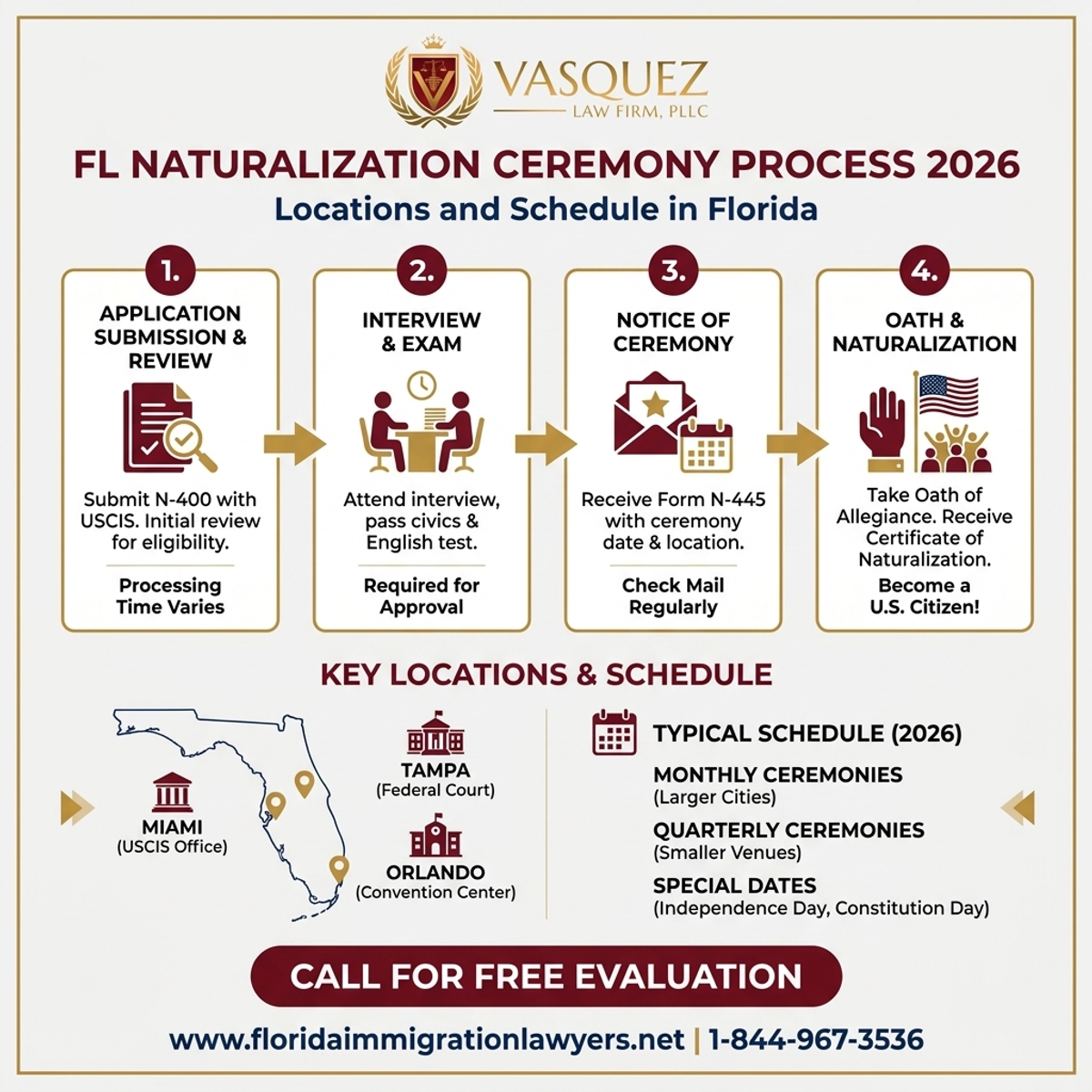
Step-by-Step Process — Naturalization Ceremony Locations and Schedule in Florida 2026
| Stage | Typical Timeframe | Notes |
|---|---|---|
| Form N-400 Filing to Biometrics | 1-3 months | Appointment notice sent after filing. |
| Biometrics to Interview Scheduling | 6-12 months | Can vary significantly by field office. |
| Interview to Oath Ceremony | 2 weeks - 4 months | Often same-day or within a few weeks if approved. |
| Total Processing Time | 8-18 months (average) | Check USCIS website for current processing times for your field office. |
These timelines are estimates, and individual cases may vary. For the most accurate and up-to-date information, regularly check the USCIS processing times page. Navigating these stages requires diligence, and the support of experienced immigration attorneys can make a significant difference in ensuring your application proceeds smoothly and efficiently.
Do not navigate this process alone. The journey to U.S. citizenship is too important to leave to chance. Contact Florida Immigration Lawyers today for expert guidance and support through every step. Our dedicated team is ready to help you achieve your dream of naturalization.
What are the Naturalization Ceremony Locations and Schedule in Florida for 2026?
Naturalization ceremony locations and schedules in Florida for 2026 are primarily managed by the U.S. Citizenship and Immigration Services (USCIS) field offices across the state. These offices are responsible for processing naturalization applications, conducting interviews, and ultimately scheduling the Oath of Allegiance ceremonies. While specific dates and venues are dynamic and assigned individually, ceremonies are consistently held throughout the year to accommodate the large number of approved applicants in Florida.
As of 2026, USCIS does not publish a public, fixed schedule of naturalization ceremonies far in advance. Instead, applicants receive a specific appointment notice (Form N-445) detailing their ceremony's date, time, and location once their N-400 application has been approved and all background checks are complete. These notices are typically mailed a few weeks after the naturalization interview. The locations generally include federal courthouses or USCIS facilities in major metropolitan areas, ensuring accessibility for residents across the state. For those residing in Hollywood and surrounding Broward County, ceremonies are often held at federal courthouses or USCIS offices in Miami or Oakland Park, depending on operational capacity.
Typical Ceremony Locations in Florida (2026)
Naturalization ceremonies in Florida are generally held at or coordinated by the following USCIS Field Offices:
- Miami Field Office: Serves South Florida, including Miami-Dade, Broward (Hollywood), and Palm Beach counties. Ceremonies frequently take place at the federal courthouse in Miami or the USCIS office in Oakland Park.
- Orlando Field Office: Serves Central Florida, including Orange, Seminole, and Volusia counties. Ceremonies are often held at federal courthouses in Orlando.
- Tampa Field Office: Serves West Central Florida, including Hillsborough, Pinellas, and Sarasota counties. Ceremonies typically occur at the federal courthouse in Tampa.
- Jacksonville Field Office: Serves Northeast Florida. Ceremonies are held at federal courthouses in Jacksonville.
Understanding Your Form N-445 (Notice of Naturalization Oath Ceremony)
Form N-445 is your official invitation to the naturalization ceremony. It contains critical information you need to attend. It is essential to read this document carefully and follow all instructions. The form will specify:
- The exact date and time you must report for your ceremony.
- The full address of the ceremony location.
- Instructions on what documents to bring (e.g., your Green Card, any travel documents).
- A questionnaire to ensure you still meet all eligibility requirements up to the date of the ceremony.
It is paramount that you do not travel outside the U.S. between your interview and the oath ceremony without consulting USCIS or an attorney, as this could impact your eligibility. If you cannot attend your scheduled ceremony, you must notify USCIS immediately using the instructions on Form N-445.
Estimated Ceremony Schedule Frequency (2026)
While specific dates are not public, the frequency of ceremonies is generally high in Florida's major USCIS districts due to the volume of applicants. Here's a general overview of typical frequency:
| USCIS Field Office Area | Estimated Ceremony Frequency (2026) | Notes |
|---|---|---|
| Miami (including Broward) | Multiple times per week | High volume of applicants, frequent ceremonies. |
| Orlando | Weekly or bi-weekly | Consistent schedule for Central Florida. |
| Tampa | Weekly or bi-weekly | Regular ceremonies for West Central Florida. |
| Jacksonville | Monthly or bi-monthly | Lower volume than major metro areas, but regular. |
The frequency and capacity of ceremonies can be influenced by USCIS staffing levels, facility availability, and the number of approved applications. It is always best to plan for flexibility and to wait for your official N-445 notice. For specific questions about your ceremony, contacting USCIS or your experienced immigration attorneys at Florida Immigration Lawyers is advisable.
How Much Does it Cost to Apply for U.S. Citizenship?
The cost of applying for U.S. citizenship, primarily through Form N-400, Application for Naturalization, involves several components, including government filing fees and potential legal fees. As of 2026, USCIS fees are subject to change, but they typically consist of the N-400 application fee and a separate biometrics services fee. These fees are non-refundable, regardless of the outcome of your application. Understanding these costs is an important part of financial planning for your naturalization journey. It's crucial to budget appropriately to avoid any financial hurdles during the process.
USCIS Filing Fees (As of 2026 - Subject to Change)
USCIS fees are standardized across the country. While we cannot provide exact figures due to potential changes, the typical structure for naturalization fees is as follows:
| Item | Typical Fee (Approximate) | Notes |
|---|---|---|
| Form N-400, Application for Naturalization | Varies (e.g., $640-$710) | Check the USCIS website for the most current fee. |
| Biometrics Services Fee | Varies (e.g., $85) | May be included in the N-400 fee or separate. |
| Total USCIS Fees | Varies (e.g., $725-$795) | Sum of N-400 and Biometrics fees. |
Always verify the current fees on the official USCIS website or by consulting with an immigration attorney before filing. USCIS fees can change, and using an outdated fee can result in your application being rejected.
Fee Waivers and Reductions
For individuals facing financial hardship, USCIS offers fee waivers or reduced fees for Form N-400. To be eligible for a fee waiver, you typically need to demonstrate that your household income is at or below 150% of the Federal Poverty Guidelines, or that you receive a means-tested benefit, or that you are experiencing financial hardship. For a reduced fee, your household income must be above 150% but not more than 200% of the Federal Poverty Guidelines. Applying for a fee waiver or reduction requires submitting Form I-912, Request for Fee Waiver, or Form I-942, Request for Reduced Fee, along with supporting documentation. Our firm can help you assess if you qualify and assist with the application.
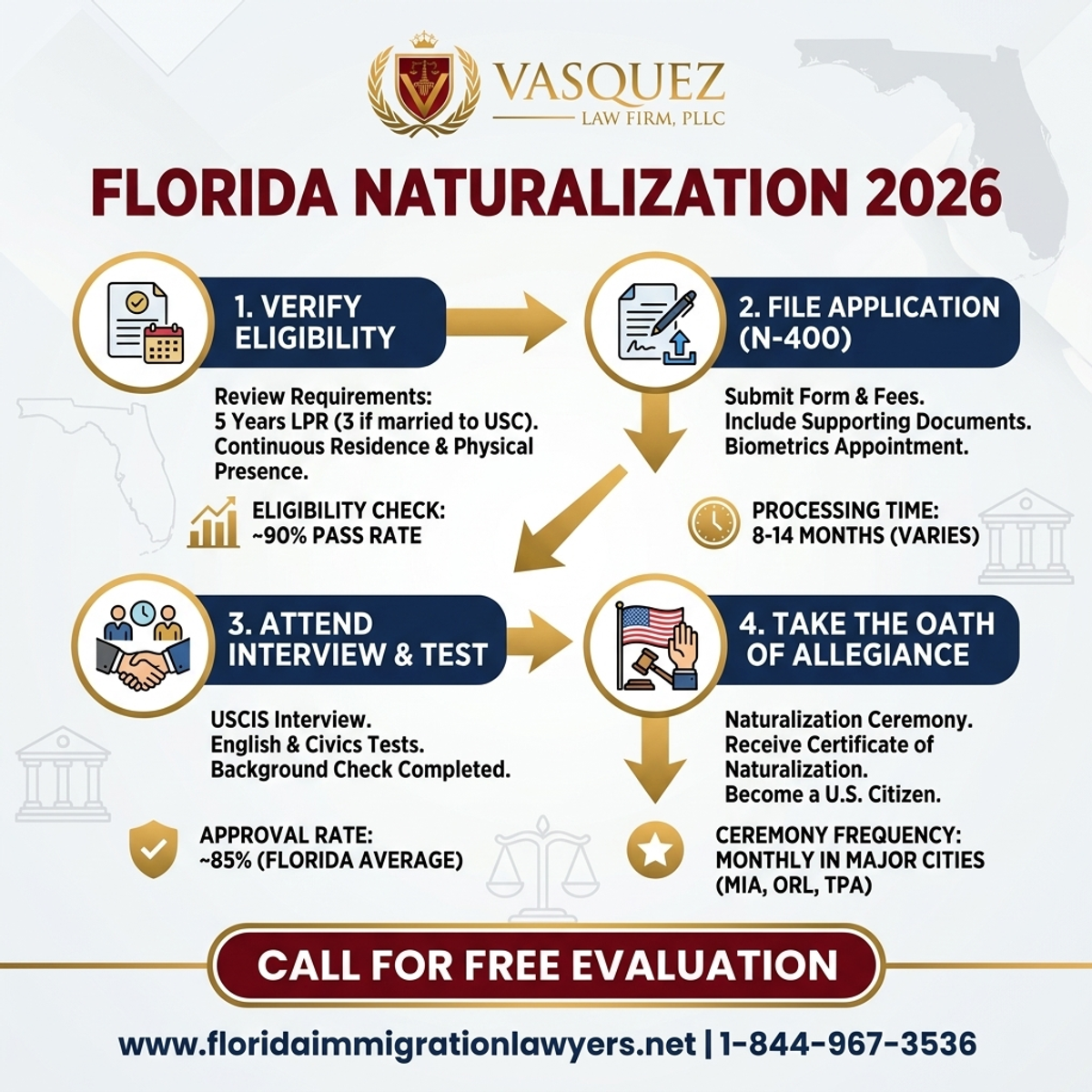
Key Statistics — Naturalization Ceremony Locations and Schedule in Florida 2026
Legal Fees and Other Potential Costs
While not mandatory, retaining an immigration attorney for your naturalization application can be a wise investment. Legal fees vary based on the complexity of your case and the services provided. An attorney can help with:
- Assessing eligibility and identifying potential issues.
- Preparing and reviewing your Form N-400 and supporting documents.
- Preparing you for the naturalization interview.
- Representing you at the interview, if permitted and necessary.
- Responding to Requests for Evidence (RFEs) or Notices of Intent to Deny (NOIDs).
Other potential costs might include obtaining certified copies of documents, translation services, or travel expenses for interviews and ceremonies. Florida Immigration Lawyers offers transparent fee structures and works with clients to make legal assistance accessible.
Common Mistakes to Avoid in the Naturalization Process
The naturalization process is detailed and unforgiving. Even minor errors can lead to significant delays or even denial of your application. Being aware of common pitfalls can help you avoid unnecessary stress and ensure a smoother path to U.S. citizenship. Many applicants, especially those in diverse communities like Hollywood, sometimes overlook crucial details or misunderstand legal requirements. Avoiding these mistakes is paramount for a successful outcome.
- Incomplete or Inaccurate Form N-400: Failing to answer all questions truthfully and completely, or making simple typos, can lead to Requests for Evidence (RFEs) or denial. Every section must be filled out with precision.
- Insufficient Supporting Documentation: Not providing all required documents, or submitting uncertified copies when originals are needed, will cause delays. Always refer to the USCIS instructions carefully.
- Failing to Meet Continuous Residence or Physical Presence: Miscalculating time spent outside the U.S. can invalidate your application. Extended trips abroad can break continuous residency.
- Lack of Good Moral Character: Failing to disclose arrests, citations, or convictions, even minor ones, is a serious offense. Any criminal history must be fully disclosed and properly documented. This includes traffic violations that might seem minor.
- Poor English Language Proficiency: Not being adequately prepared for the English reading, writing, and speaking tests during the interview can lead to failure, unless you qualify for an exemption.
- Inadequate Civics Knowledge: Failing the civics test demonstrates a lack of understanding of U.S. history and government, which is a core requirement for naturalization. Study materials are readily available from USCIS.
- Missing the Biometrics Appointment: Failing to attend your scheduled biometrics appointment without prior rescheduling can lead to your application being considered abandoned.
- Missing the Naturalization Interview: Not attending your interview is a critical error that can lead to denial. If you have an emergency, you must contact USCIS immediately to reschedule.
- Traveling Abroad After Interview (Before Oath): While generally permitted, significant travel outside the U.S. after your interview but before your oath ceremony can raise questions about your intent to reside in the U.S. and potentially impact your eligibility. Always consult an attorney first.
- Not Updating USCIS of Address Changes: Moving without notifying USCIS using Form AR-11 can result in missed notices, interviews, or ceremony invitations, which can lead to application abandonment or denial.
- Not Seeking Legal Counsel for Complex Cases: Attempting to navigate complex naturalization cases (e.g., criminal history, long absences, prior immigration issues) without an attorney often leads to avoidable mistakes and denials.
When to Call a Lawyer for Your Naturalization Application
While the naturalization process may seem straightforward for some, many applicants benefit immensely from legal counsel. There are specific scenarios where the expertise of an immigration attorney from Florida Immigration Lawyers becomes not just helpful, but crucial for the success of your application. Navigating complex legal requirements and potential pitfalls without professional guidance can be risky, especially given the significant investment of time and resources involved in seeking U.S. citizenship.
You should strongly consider calling an attorney if:
- You have any criminal history, even minor arrests or convictions, regardless of how long ago they occurred.
- You have previously been denied U.S. citizenship or had any immigration application denied.
- You have spent significant periods outside the United States during your continuous residency period.
- You have questions about your eligibility for a fee waiver or need assistance proving financial hardship.
- You have a medical condition that might qualify you for an exemption from the English or civics test.
- You have received a Request for Evidence (RFE) or a Notice of Intent to Deny (NOID) from USCIS.
- You are unsure about any part of the Form N-400 or the required supporting documentation.
- You have had issues with tax compliance or have outstanding tax obligations.
- You have been in deportation or removal proceedings, even if your case was closed or terminated.
- You are concerned about your ability to pass the English or civics test, or the interview itself.
Our firm specializes in citizenship services and can provide invaluable assistance, from initial eligibility assessment to preparing you for your interview and addressing any complications that may arise. We serve clients across Florida, including Hollywood, Miami, Orlando, and Tampa, offering dedicated and knowledgeable representation to make your path to citizenship as smooth as possible.
About Florida Immigration Lawyers
Florida Immigration Lawyers is a leading law firm dedicated to providing comprehensive and compassionate immigration legal services across the entire state of Florida. With years of experience and a deep understanding of U.S. immigration law, our team is committed to helping individuals and families achieve their immigration goals. We pride ourselves on offering personalized attention, strategic advice, and aggressive representation to every client.
Our services encompass a wide range of immigration matters, including family-based petitions, employment visas, deportation defense, asylum claims, and, critically, the naturalization process. We understand the complexities of immigration law and the profound impact it has on people's lives. Our attorneys are fluent in multiple languages, including Spanish, ensuring that we can effectively communicate with and serve Florida's diverse immigrant communities. We are available 24/7 to answer your questions and offer free consultations to discuss your unique situation. Choose Florida Immigration Lawyers for trusted legal support on your journey to U.S. citizenship. Call us at 1-844-967-3536 or visit www.floridaimmigrationlawyers.net.
Sources and References
- U.S. Citizenship and Immigration Services (USCIS)
- Form N-400, Application for Naturalization - USCIS
- USCIS Naturalization Test Information
- USCIS Filing Fees
- Executive Office for Immigration Review (EOIR)
- 8 U.S.C. Chapter 12 - Immigration and Nationality Act (INA)
- INA § 316 - Requirements for Naturalization
- 8 CFR Part 316 - General Requirements for Naturalization
Related services: immigration practice areas, family immigration services, asylum protection.
This article provides general legal information and is not intended as legal advice. Every case is unique, and outcomes depend on specific facts and circumstances. Contact an attorney for advice about your particular situation.
The path to U.S. citizenship is a significant undertaking, and understanding the naturalization ceremony locations and schedule in Florida for 2026 is just one piece of the puzzle. With the right legal guidance, you can navigate the complexities with confidence and achieve your American dream. Don't leave your future to chance. Contact Florida Immigration Lawyers today for a free, confidential consultation. Call us at 1-844-967-3536. Se Habla Espanol - Estamos aqui para ayudarle.
Do Not Navigate This Process Alone
Our experienced immigration attorneys are ready to fight for you. Get a free, confidential consultation today.
Se Habla Español
Or leave your details and we’ll call you:
Free Evaluation in 24 Hours
Or talk to us right now

AI voice assistant — available 24/7
FreeFrequently Asked Questions

William J. Vásquez
Founding Attorney · Vasquez Law Firm
U.S. Air Force veteran and immigration attorney with years of hands-on U.S. immigration experience. J.D., NCCU School of Law. AILA member. Admitted to the 4th, 5th, and 11th Circuit Courts.
Available 24/7 - Free Evaluations
Reviewed for legal accuracy by William J. Vásquez
Licensed in North Carolina; U.S. immigration is federal practice.
Related Legal Services
Our Florida immigration attorneys can help you with business immigration, asylum protection and deportation defense. Call today at 1-844-967-3536 for a free consultation.
Related Links
Related Topics
Free Legal Consultation
Discuss your case with our experienced attorneys. We're available 24/7.
Se Habla Español - Estamos aquí para ayudarle.
Related Articles
Immigration Lawyer Orlando Free Consultation 2026
Discover the cost of hiring an immigration lawyer in Orlando in 2026. Learn about various fees, free consultations, and how to choose the right legal representation for your immigration needs.
Farmers and H-2A in Florida: What You Need to Know
The H-2A visa is crucial for Florida farmers needing seasonal agricultural workers. This guide covers eligibility, application steps, and common pitfalls. Call Florida Immigration Lawyers for expert assistance.
Special Immigrant Juvenile Status in Florida: Your 2026
Special Immigrant Juvenile Status (SIJS) in Florida provides a vital immigration pathway for children who have suffered abuse, neglect, or abandonment. This detailed guide for 2026 explains the two-part process: obtaining a predicate order from a Florida state court and then filing with USCIS. We cover eligibility criteria, essential documentation, typical processing timelines, and associated costs. Navigating state juvenile courts and federal immigration procedures requires specific legal expertise. Learn how to protect vulnerable youth in Florida and avoid common mistakes that could jeopardize their Green Card application. Florida Immigration Lawyers offers expert guidance to ensure a secure future for these children.
Parole in Place for Military Families Miami 2026
Parole in place (PIP) offers critical relief to military families facing immigration challenges in Florida. Learn about the application process, eligibility, and how Florida Immigration Lawyers can assist you in keeping your family together.