Farmers and H-2A Agricultural Worker Program in Florida
The H-2A visa program is essential for Florida farmers seeking temporary agricultural workers. Learn how this program supports labor needs and ensures legal work status for foreign nationals. Discover the application process, requirements, and common mistakes to avoid. Contact Florida Immigration Lawyers for expert guidance.
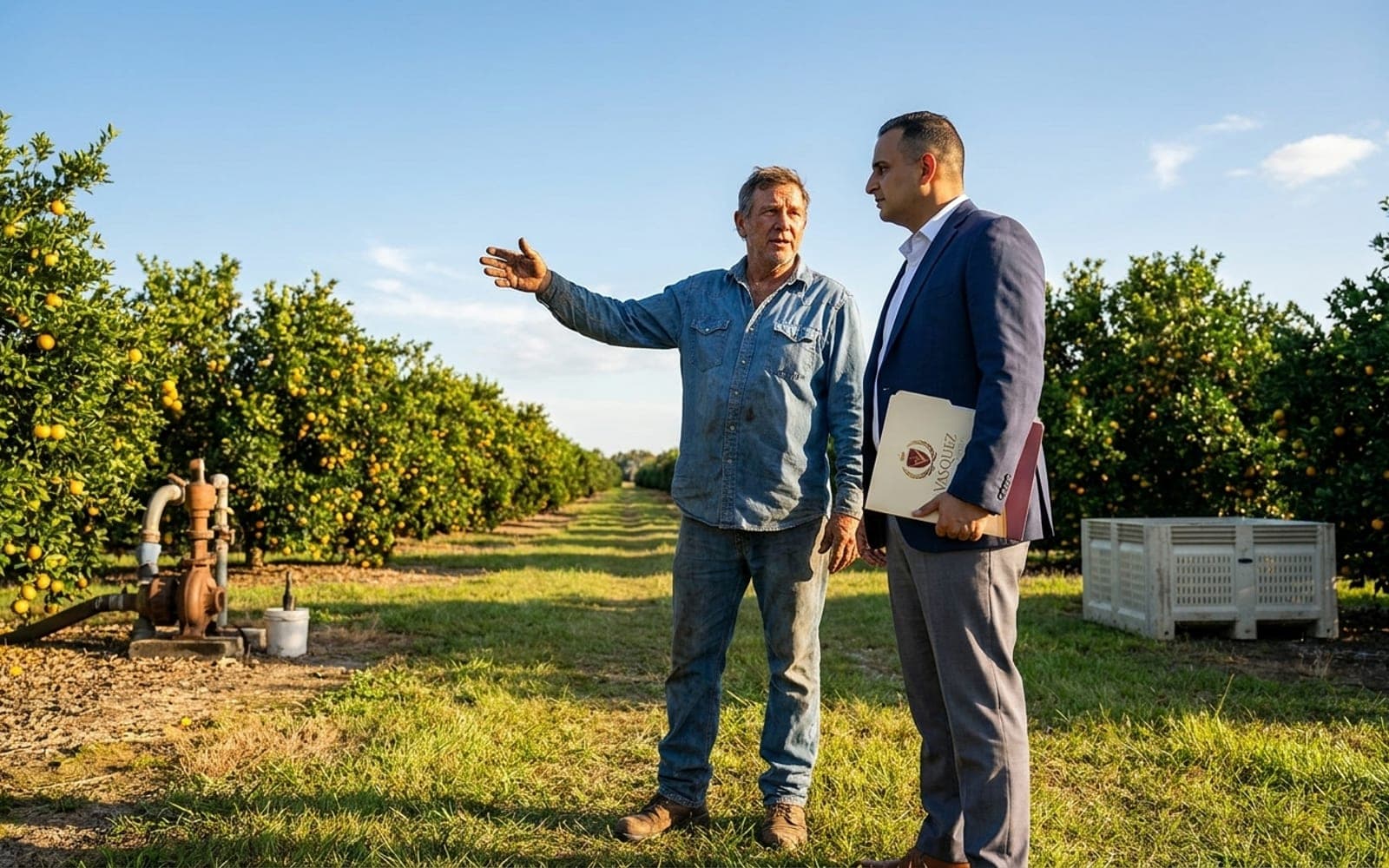
- Supports seasonal farm labor needs
- Ensures legal work status for foreign workers
- Helps maintain agricultural productivity
Farmers and H-2A Agricultural Worker Program in Florida
In the heart of Florida's agricultural landscape, the H-2A visa program serves as a vital lifeline for farmers seeking reliable and legal temporary labor. This program is particularly crucial in areas like Homestead, where the demand for farm labor peaks during harvest seasons. If you're a farmer in Florida, understanding the H-2A visa process can significantly impact your agricultural operations. Call Florida Immigration Lawyers at 1-844-YO-PELEO for a free consultation to explore your options.
What is the H-2A Visa Program?
The H-2A visa program allows U.S. farmers to bring foreign nationals to the country for seasonal agricultural work. As of 2026, this program remains a critical component for meeting the labor demands in Florida's agricultural sectors.
The primary purpose of the H-2A visa is to fill temporary agricultural jobs when U.S. workers are unavailable. This visa ensures that foreign workers can work legally in the U.S., providing a reliable workforce for farmers.
For Florida farmers, particularly those engaged in labor-intensive crops like tomatoes, citrus, and strawberries, the H-2A program provides a stable and predictable labor force. This stability is crucial for ensuring that crops are harvested efficiently and on schedule, preventing significant economic losses due to spoilage or missed market windows. It also helps farmers maintain competitive pricing by managing labor costs effectively, which directly impacts the viability of their operations.
Beyond just filling labor gaps, the H-2A program also ensures that foreign workers are afforded specific protections and fair wages, as mandated by federal regulations. This includes guaranteed minimum wage rates (Adverse Effect Wage Rate or AEWR), housing, and transportation, which contribute to a structured and compliant work environment. For farmers, adhering to these regulations is not just a legal requirement but also a commitment to ethical labor practices, safeguarding their reputation and avoiding potential legal challenges. Florida Immigration Lawyers can help ensure your compliance every step of the way.
How Do Florida Farmers Apply for H-2A Visas?
To apply for H-2A visas, Florida farmers must follow a detailed process to demonstrate the need for foreign labor. Here's a step-by-step guide:
- Job Order Submission: Submit a job order with the State Workforce Agency (SWA) in Florida. This initial step outlines the job duties, wages, and working conditions.
- ETA Form 9142: File ETA Form 9142, the Application for Temporary Employment Certification, with the Department of Labor (DOL). This form formalizes your request for H-2A workers and details your labor needs.
- Recruitment: Conduct recruitment efforts to hire U.S. workers. This crucial phase involves advertising the job through various channels to prove that qualified U.S. workers are not available for the positions.
- USCIS Petition: Once the DOL certifies your application, you must file Form I-129, Petition for a Nonimmigrant Worker, with USCIS for each worker or group of workers.
Each step requires careful documentation and adherence to regulations. For assistance, consider contacting Florida Immigration Lawyers at 1-844-YO-PELEO.
A common pitfall for farmers is underestimating the complexity of the recruitment phase. The DOL requires specific advertising methods, including newspaper ads, radio advertisements, and contact with former U.S. employees. For example, a farmer in Homestead seeking tomato pickers must demonstrate that despite extensive local recruitment efforts, they could not find enough qualified U.S. workers willing and able to perform the demanding work. Proper documentation of these efforts is paramount; any oversight can lead to significant delays or even denial of the application.
Furthermore, maintaining meticulous records throughout the entire application process is a practical tip that cannot be overstated. From the initial job order submission to the final USCIS petition, every piece of correspondence, advertisement, and recruitment outcome should be carefully logged. This record-keeping serves as critical evidence if your application faces scrutiny or an audit. Florida Immigration Lawyers can guide you through these intricate requirements, ensuring your application is robust and compliant.
What Documents are Required for H-2A Visa Applications?
Preparing a comprehensive application package is crucial. Farmers need the following documents:
- Completed ETA Form 9142, Application for Temporary Employment Certification, with all required addendums and attachments.
- Detailed proof of recruitment efforts, including copies of advertisements, recruitment reports, and records of U.S. worker applicants and their dispositions.
- A copy of the job order as it was submitted to and accepted by the State Workforce Agency (SWA), clearly outlining the terms and conditions of employment.
- Business registration documents, such as articles of incorporation, partnership agreements, or business licenses, to establish the legitimacy of the farming operation.
- Proof of financial ability to pay the wages and provide housing and transportation as required by the H-2A program, which may include bank statements, tax returns, or lines of credit.
- Copies of any necessary state or local licenses or permits required for the agricultural operation.
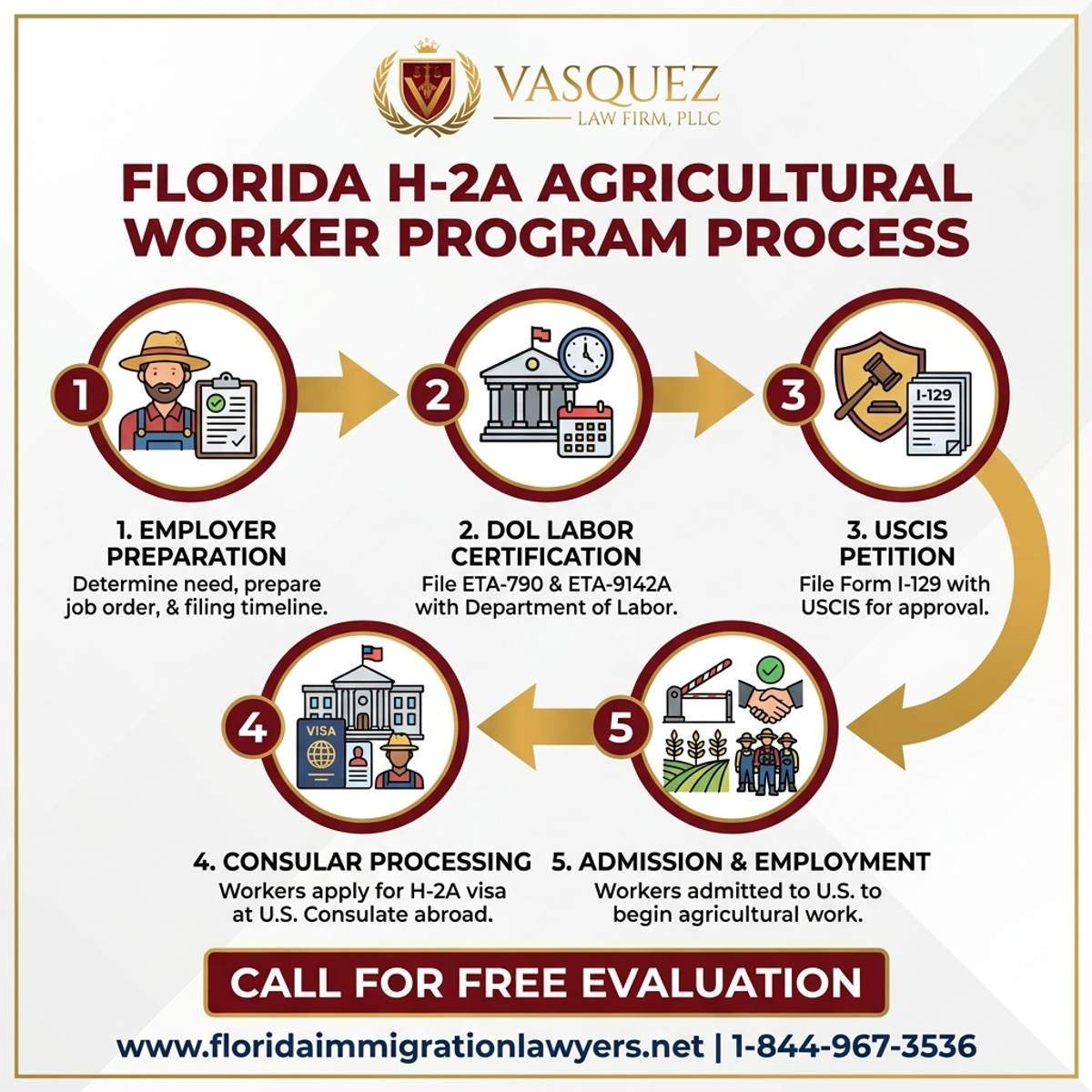
Step-by-Step Process — Farmers and H-2A Agricultural Worker Program in Florida
Missing any document can lead to delays or denials. Ensure all paperwork is accurate and complete.
A practical tip for farmers is to create a checklist and gather documents well in advance of the application deadlines. For instance, obtaining proper business registration or financial proofs can sometimes take longer than expected. Having these readily available can prevent last-minute rushes and potential errors. Furthermore, ensure consistency across all submitted documents; discrepancies in dates, names, or addresses can trigger scrutiny from DOL or USCIS. An immigration attorney from Florida Immigration Lawyers can help you organize and verify your documentation, minimizing the risk of issues.
Consider a scenario where a farmer, eager to secure workers for the strawberry season, submits an application with an outdated business license. This seemingly minor error could halt the entire process, requiring resubmission and pushing back the worker arrival date, potentially jeopardizing the harvest. Thorough review of each document for currency and accuracy is not just a recommendation but a necessity for a smooth H-2A application process. Preparing a robust application package is a significant investment of time and resources, but it pays off by ensuring timely access to the labor your farm needs.
Timeline and Processing Expectations for H-2A Visas
| Stage | Typical Timeframe | Notes |
|---|---|---|
| Job Order Submission | 60-75 days before work start date | Submit with SWA to allow for review and corrections. |
| DOL Processing | 30 days | Review and certify job order, including recruitment oversight. |
| Form I-129 Approval | 15-30 days (Standard) | Processed by USCIS. Premium processing is available for an additional fee, reducing this to 15 calendar days. |
| Visa Interview & Issuance | Variable (1-4 weeks) | Conducted at U.S. Embassies/Consulates abroad. |
Timely submissions are crucial to avoid delays. Start early to ensure your workers arrive on time.
It's important to understand that these timeframes are estimates and can fluctuate based on agency workload, the completeness of your application, and external factors like national holidays or unforeseen policy changes. For instance, during peak agricultural seasons, the volume of applications can significantly increase, potentially extending processing times. Farmers should ideally initiate the H-2A process up to 90 days before the anticipated start date of work to build in a buffer for any unforeseen delays. This proactive approach can make a critical difference in securing your workforce when you need them most.
For situations where time is of the essence, USCIS offers premium processing for Form I-129, guaranteeing a response within 15 calendar days for an additional fee. While this expedites the USCIS portion, it doesn't shorten the DOL certification or the visa interview stages. A practical tip is to evaluate if premium processing aligns with your harvest schedule and budget. Consulting with Florida Immigration Lawyers can help you strategize the optimal timeline for your specific needs, ensuring all stages are managed efficiently to get your workers to Florida on time.
Cost Factors and Fee Breakdown for H-2A Visas
| Item | Typical Fee | Notes |
|---|---|---|
| Form I-129 Filing Fee | Variable (e.g., $460-$510 per petition) | Check USCIS for current fees; covers a group of workers. |
| SWA Job Order Fee | Variable (often minimal or none) | State-specific charges for processing job orders. |
| DOL Application Fee | Currently none | No direct fee for ETA Form 9142. |
| Visa Application Fee (DS-160) | Variable (e.g., $190 per worker) | Paid by the worker, but reimbursed by the employer. |
| Recruitment Costs | Variable (hundreds to thousands) | Newspaper ads, radio, online job boards. |
| Transportation Costs | Variable (thousands per worker) | Round-trip travel from home country to worksite. |
| Housing Costs | Variable | Providing free, compliant housing or housing allowance. |
| Legal Fees | Variable | For attorney assistance with the complex application process. |
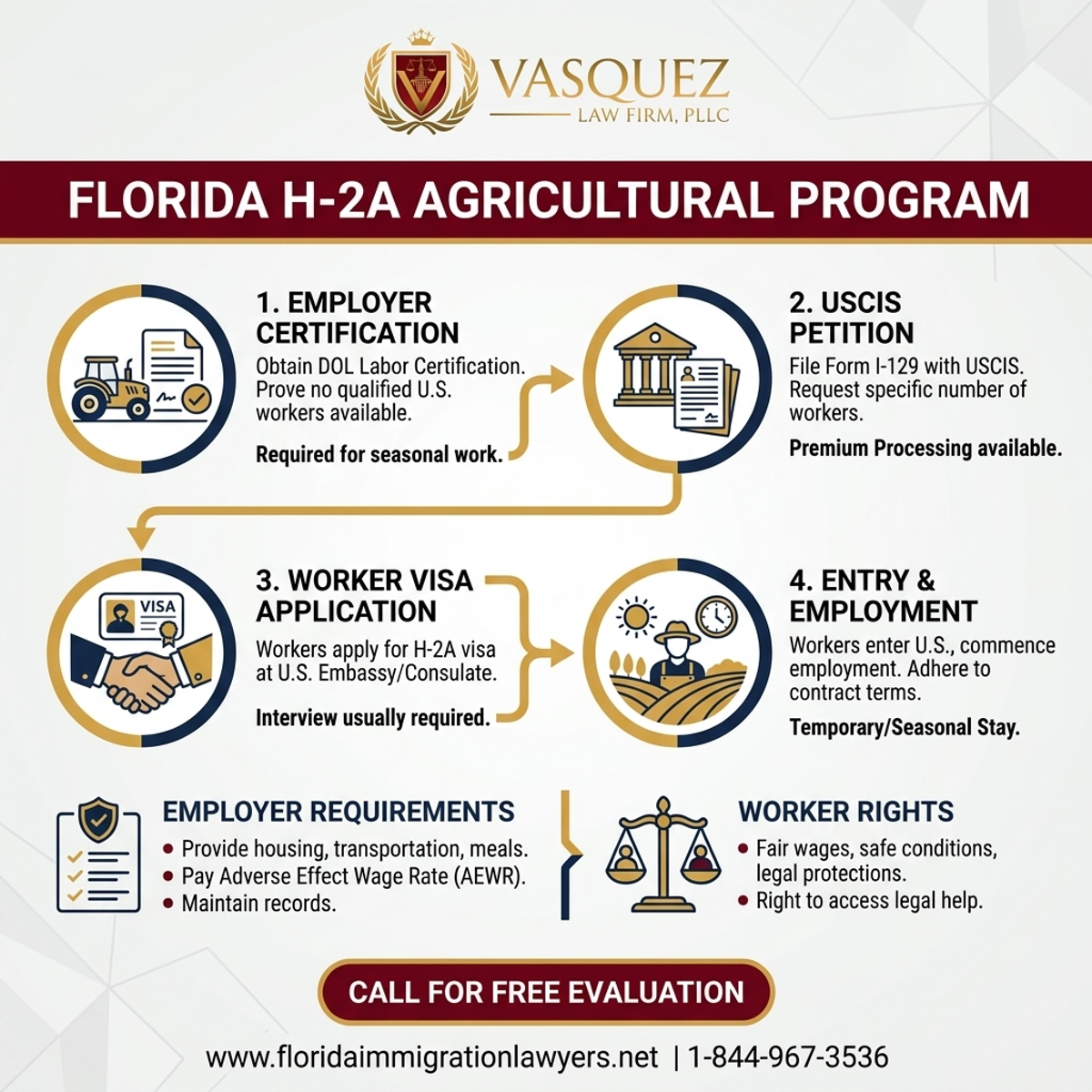
Key Statistics — Farmers and H-2A Agricultural Worker Program in Florida
Costs vary based on specific circumstances and the number of workers. Consult with a legal expert for precise estimates.
Beyond the direct filing fees, farmers must account for significant indirect costs associated with the H-2A program. This includes the Adverse Effect Wage Rate (AEWR), which is the minimum wage employers must pay H-2A workers, often higher than the state or federal minimum wage. For example, a Florida farmer hiring 20 workers for a six-month season will incur substantial wage costs, along with providing housing that meets federal and state safety standards, and covering inbound and outbound transportation expenses. These are not optional expenditures but mandatory requirements designed to protect foreign workers.
A practical tip for budgeting is to create a detailed financial projection that includes all potential H-2A related expenses, from initial application fees to ongoing payroll, housing, and transportation. Underestimating these costs is a common mistake that can lead to financial strain on the farm. Engaging with experienced legal counsel like Florida Immigration Lawyers can provide you with a clearer picture of the total financial commitment and help you avoid unexpected expenses, ensuring your farm's financial stability throughout the season. Call 1-844-YO-PELEO for a free consultation to discuss your specific cost factors.
Do not navigate this process alone. Contact Florida Immigration Lawyers today.
When to Call a Lawyer
If you're facing challenges with the H-2A visa process, it's essential to seek legal guidance. Situations like application denials, complex paperwork, or compliance issues require professional help. Florida Immigration Lawyers offer expertise in navigating these complexities and ensuring your applications are successful.
Proactive engagement with an immigration attorney can save farmers significant time, money, and stress. For instance, if you are a first-time H-2A applicant, the sheer volume of regulations and forms can be overwhelming. An attorney can help you understand eligibility requirements, prepare accurate documentation, and develop a robust recruitment strategy. Even experienced H-2A employers can benefit from legal review, especially when there are changes in immigration policy, labor laws, or if they plan to expand their workforce. Don't wait until a problem arises; early consultation can prevent issues before they occur.
Consider a scenario where a farmer receives a Notice of Deficiency from the Department of Labor, citing issues with their recruitment efforts. Without legal expertise, responding to such a notice effectively can be daunting, potentially leading to certification denial. An immigration lawyer can analyze the deficiency, formulate a strategic response, and help implement corrective actions to keep your application on track. Furthermore, if you face an audit or investigation regarding your H-2A program, legal representation is invaluable to protect your interests and ensure compliance. Contact Florida Immigration Lawyers at 1-844-YO-PELEO for expert assistance.
About Florida Immigration Lawyers
Florida Immigration Lawyers is dedicated to assisting clients in all immigration-related matters. With a team of experienced attorneys, we provide comprehensive services, including visa applications, deportation defense, and more. Our goal is to simplify the immigration process for you. Contact us at 1-844-YO-PELEO or visit our website at www.floridaimmigrationlawyers.net. We are available 24/7 and offer free consultations.
Our firm understands the unique challenges faced by Florida farmers in securing essential agricultural labor. We pride ourselves on offering tailored legal solutions that address the specific needs of your farm, whether you're a small family operation or a large agribusiness. Our attorneys stay abreast of the latest changes in H-2A regulations and policies, ensuring that our advice is always current and effective. We don't just process paperwork; we partner with you to develop long-term immigration strategies that support your operational goals and ensure workforce stability.
Choosing Florida Immigration Lawyers means gaining a dedicated advocate who will meticulously guide you through every stage of the H-2A application process, from initial compliance checks and recruitment oversight to petition filing and post-approval support. We are committed to providing transparent communication, proactive problem-solving, and unwavering support to help you navigate the complexities of immigration law successfully. Let us handle the legal intricacies so you can focus on what you do best: farming. Call us today for a free consultation and experience the difference expert legal guidance can make.
Sources and References
- U.S. Citizenship and Immigration Services (USCIS)
- Executive Office for Immigration Review (EOIR)
- 8 U.S.C. Chapter 12 - Immigration and
Do Not Navigate This Process Alone
Our experienced immigration attorneys are ready to fight for you. Get a free, confidential case review today.
Se Habla Español
Or leave your details and we’ll call you:
Free Evaluation in 24 Hours
Or talk to us right now

AI voice assistant — available 24/7
FreeFrequently Asked Questions

William J. Vásquez
Founding Attorney · Vasquez Law Firm
U.S. Air Force veteran and immigration attorney with years of hands-on U.S. immigration experience. J.D., NCCU School of Law. AILA member. Admitted to the 4th, 5th, and 11th Circuit Courts.
Available 24/7 - Free Evaluations
Reviewed for legal accuracy by William J. Vásquez
Licensed in North Carolina; U.S. immigration is federal practice.
Related Legal Services
Our Florida immigration attorneys can help you with business immigration, deportation defense and family immigration services. Call today at 1-844-YO-PELEO for a free case review.
Related Links
Related Topics
Free Legal Case Review
Discuss your case with our experienced attorneys. We're available 24/7.
Se Habla Español - Estamos aquí para ayudarle.
Related Articles
EAD Advance Parole Combo Card in Florida 2026
For individuals with a pending Form I-485, Application to Register Permanent Residence or Adjust Status, the EAD Advance Parole Combo Card is an essential document. This single card combines the authorization to work legally in the U.S. (Employment Authorization Document - EAD) with permission to travel internationally and re-enter without abandoning your green card application (Advance Parole). This guide from Florida Immigration Lawyers provides a comprehensive overview for applicants in Florida in 2026, covering eligibility, the step-by-step application process, required documents, expected processing times, and associated costs. We also highlight common mistakes to avoid and when to seek legal counsel to ensure a smooth and successful immigration journey. Understanding this vital card is key to maintaining stability while awaiting your permanent residency approval.
Immigration Lawyer Orlando Free Consultation in Florida
For individuals and families in Orlando, Florida, navigating the complexities of U.S. immigration law requires expert guidance. An immigration lawyer in Orlando offers crucial support for everything from visa applications and green card processes to naturalization and deportation defense. This comprehensive guide details what a free consultation covers, providing a step-by-step overview of immigration pathways, essential document checklists, and expected timelines in 2026. We also highlight common mistakes to avoid, discuss the critical role of legal counsel in deportation and asylum cases, and explain why choosing a local Orlando immigration attorney is beneficial. Florida Immigration Lawyers is dedicated to serving the diverse community of Orlando with compassionate, effective legal solutions, ensuring you receive personalized advice and robust representation for a successful immigration journey.
USCIS Oath Ceremony Schedule 2026: Your Guide to Citizenship
Achieving U.S. citizenship culminates in the naturalization oath ceremony, a pivotal moment for immigrants in Florida. This comprehensive guide from Florida Immigration Lawyers details the USCIS oath ceremony schedule for 2026, outlining what to expect from your Form N-445 notice to the final pledge of allegiance. We cover the entire naturalization process, including eligibility requirements, the step-by-step application (Form N-400), necessary documents, typical timelines for Florida field offices like Orlando, Miami, and Tampa, and associated costs. Learn how to prepare for your ceremony, avoid common mistakes that could delay your path, and understand when legal counsel becomes indispensable. Our firm is dedicated to providing expert guidance, ensuring a smooth and successful journey to becoming a U.S. citizen. Get a free case review from our bilingual team today.
Annual Asylum Fee: Preparation for Florida Interviews
As of 2026, there is no annual asylum fee in the U.S. Preparing for your asylum interview in Florida is crucial for success. Learn more about the process, necessary documentation, and common mistakes to avoid. Florida Immigration Lawyers are here to help.