N-600 Certificate of Citizenship Florida Children
For Florida families, obtaining an N-600 Certificate of Citizenship for children born abroad is essential for official proof of U.S. citizenship. This guide details eligibility under derived or acquired citizenship, the step-by-step application process, required documents, and processing timelines. Learn how to navigate USCIS requirements, avoid common mistakes, and understand the cost factors involved. Whether your child automatically became a citizen or needs an N-600K, understanding the nuances of INA 320 and INA 322 is critical. Florida Immigration Lawyers offers expert legal assistance, ensuring your child's status is properly documented for passports, federal benefits, and peace of mind. Contact us for a free consultation to secure your child's future.
Quick Answer: N-600 Certificate of Citizenship for Children
The N-600, Application for Certificate of Citizenship, is a vital document for children born outside the United States who have derived citizenship or acquired citizenship through a U.S. citizen parent. This certificate serves as official proof of their U.S. citizenship, enabling them to obtain a U.S. passport, vote, and access other federal benefits. For families in Florida, understanding the eligibility criteria, required documentation, and application process is crucial. While many children automatically become citizens, the N-600 provides undeniable legal evidence, preventing future complications. Consulting with experienced legal counsel, like Florida Immigration Lawyers, can streamline this process and ensure all requirements are met accurately for your child.
- An N-600 application proves a child's existing U.S. citizenship, not grants it.
- Eligibility typically requires a U.S. citizen parent, the child to be under 18, and lawful permanent resident status.
- The process involves submitting forms, supporting documents, and potentially an interview.
- A Certificate of Citizenship is essential for passports and other citizenship benefits.
- Legal guidance from Florida Immigration Lawyers can prevent common mistakes and delays.
N-600 Certificate of Citizenship for Florida Children: Your Guide to Derived Citizenship
Imagine your child, born outside the U.S., growing up in a vibrant Florida community like Naples, attending local schools, and embracing American life. You know they are a U.S. citizen because you are, but proving it can sometimes feel like navigating a maze. This is where the N-600, Application for Certificate of Citizenship, becomes incredibly important. For many families in Florida, securing this document for their children is a crucial step in formalizing their legal status and ensuring they have undeniable proof of their identity as U.S. citizens.
This comprehensive guide from Florida Immigration Lawyers will walk you through everything you need to know about the N-600 application process for derived citizenship. We will cover eligibility requirements, the step-by-step application process, essential documents, expected timelines, and associated costs. Our goal is to empower you with the knowledge needed to confidently pursue this important certificate for your child. Understanding the nuances of immigration law can be challenging, especially when dealing with federal agencies like USCIS. We are here to simplify it for you.
Do not let uncertainty delay your child's future. If you are a parent in Florida seeking to confirm your child's U.S. citizenship, we are ready to assist. Call Florida Immigration Lawyers at 1-844-967-3536 for a free consultation and let our experienced team guide you through every stage of the N-600 process.
Understanding the N-600 Certificate of Citizenship in Florida
The Form N-600 is not an application for naturalization; rather, it is a request for a document that officially recognizes a child's existing U.S. citizenship. Unlike naturalization (Form N-400), which grants citizenship, the N-600 is for individuals who have already become citizens automatically through their parents. This process is often referred to as derived citizenship or acquired citizenship, depending on the specific circumstances of birth and parentage. The Certificate of Citizenship issued by USCIS provides definitive proof of this status, which is invaluable for various aspects of life in Florida and beyond.
For children living in diverse communities across Florida, from the bustling streets of Miami to the family-friendly neighborhoods of Naples and Orlando, having a Certificate of Citizenship offers numerous benefits. It allows them to apply for a U.S. passport, register to vote upon turning 18, pursue federal employment, and establish their identity without question. Without this official certificate, a child might face bureaucratic hurdles when applying for a passport or proving their citizenship for educational or travel purposes. The legal foundation for derived and acquired citizenship can be found in the Immigration and Nationality Act (INA), specifically sections like INA 320 (8 U.S.C. § 1431) for children residing in the U.S. with a citizen parent, and INA 322 (8 U.S.C. § 1433) for children residing abroad whose citizen parent applies on their behalf.
At Florida Immigration Lawyers, we understand the importance of securing this document for your child. Our team helps families throughout Florida navigate these regulations, ensuring that their children's citizenship is properly documented. We can clarify the distinctions between derived and acquired citizenship, making sure you apply under the correct provisions of the law. This foundational understanding is the first step toward a successful N-600 application and a secure future for your child.
Eligibility Requirements for Children to Obtain Derived Citizenship
Determining eligibility is the most critical initial step for any N-600 certificate of citizenship application. The requirements vary slightly depending on whether the child is residing in the United States or abroad at the time of the application, as outlined by the Immigration and Nationality Act. Understanding these specific criteria is essential for families in Florida to ensure a successful application for their children.
Automatic Citizenship Under INA 320 (Children Residing in the U.S.)
Most Florida children who obtain derived citizenship fall under INA 320. For a child born outside the U.S. to automatically become a U.S. citizen, all of the following conditions must be met:
- At least one parent is a U.S. citizen by birth or naturalization.
- The child is under 18 years of age.
- The child is a lawful permanent resident (LPR), meaning they hold a Green Card.
- The child is residing in the United States in the legal and physical custody of the U.S. citizen parent.
For example, if a U.S. citizen parent living in Naples sponsored their child, born in Venezuela, for a Green Card, and the child entered the U.S. as an LPR before their 18th birthday, they would likely have automatically become a citizen on the date of their LPR admission. The N-600 would then simply provide official proof of this existing citizenship. This applies even if the U.S. citizen parent naturalized after the child's birth, as long as the child met the other criteria while under 18 and an LPR.
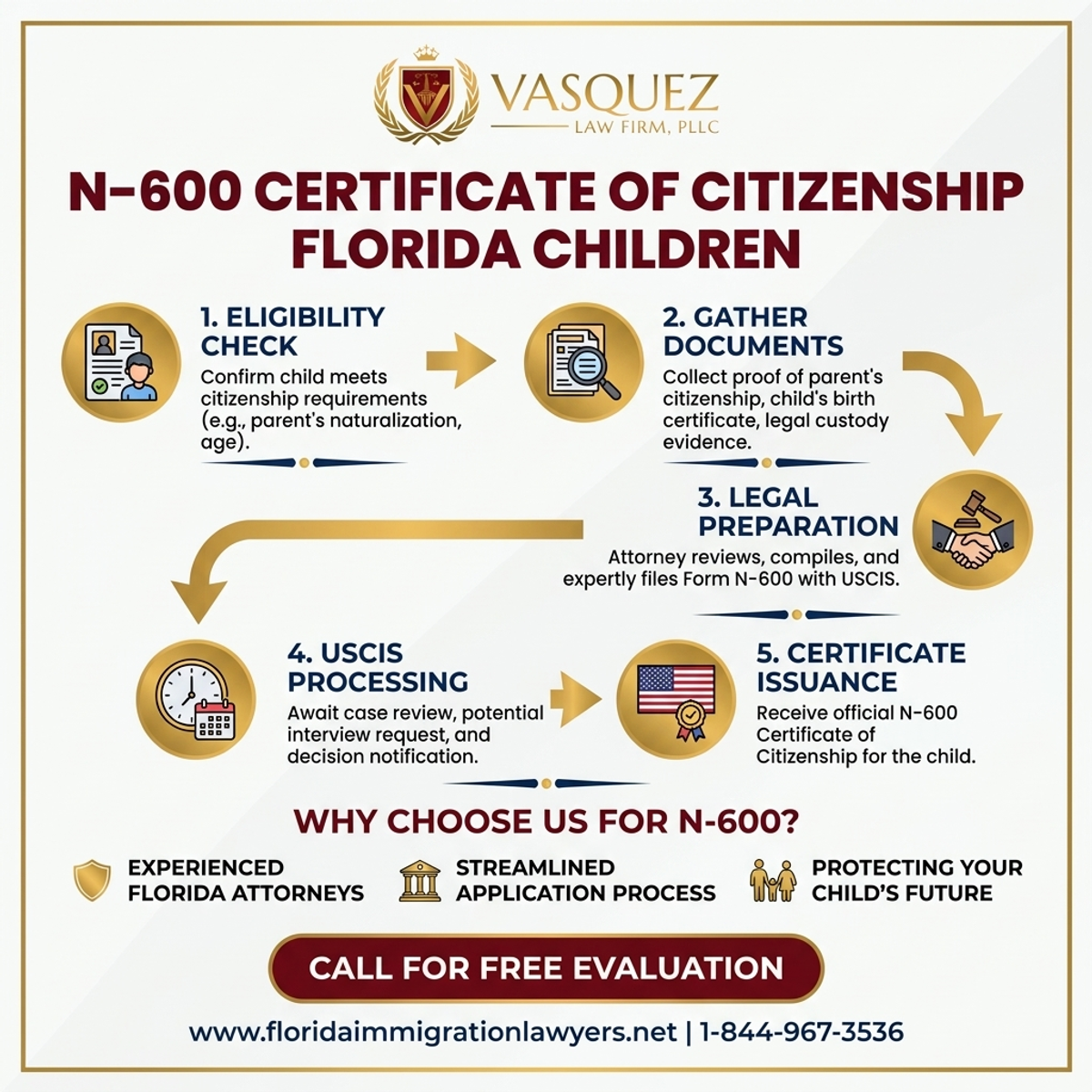
Step-by-Step Process — N-600 Certificate of Citizenship Florida Children
Acquired Citizenship Under INA 322 (Children Residing Abroad)
In some cases, a U.S. citizen parent may wish to obtain citizenship for a child born abroad who is not an LPR and resides outside the U.S. This typically involves applying for citizenship through INA 322. The requirements are:
- At least one parent is a U.S. citizen (by birth or naturalization).
- The child is under 18 years of age.
- The child is residing outside the U.S.
- The U.S. citizen parent (or grandparent if the parent is deceased) files the N-600K (a variant of the N-600) on the child's behalf.
- The child must be temporarily present in the U.S. for the interview and oath of allegiance (if required).
This process is more complex and typically requires careful planning, often involving a visa to enter the U.S. for the purpose of the interview. Adopted children also have specific requirements, often needing a final adoption decree before the age of 16 (with some exceptions) and meeting the same custody and residency rules as biological children. Our attorneys at Florida Immigration Lawyers can help clarify which section applies to your child's unique situation and guide you through the specific requirements.
Step-by-Step Guide to Filing Form N-600 for Florida Families
Filing the N-600, Application for Certificate of Citizenship, can seem daunting, but breaking it down into manageable steps makes the process clearer for Florida families. Accuracy and thoroughness are paramount to avoid delays or requests for additional evidence (RFEs) from USCIS. Here is a detailed step-by-step guide:
-
Determine Eligibility: Before anything else, meticulously review the eligibility criteria under INA 320 or INA 322, as discussed above. Ensure your child meets all conditions, including age, parent's citizenship status, and residency. If you have any doubts, consulting with an immigration attorney from Florida Immigration Lawyers can provide clarity and prevent wasted time or resources on an ineligible application. This initial assessment is crucial for a smooth process.
-
Gather Required Documents: This is often the most time-consuming step. Compile all necessary supporting evidence, such as birth certificates, marriage certificates, naturalization certificates, Green Cards, and custody documents. Organize everything clearly and make copies. We will provide a detailed checklist in the next section.
-
Complete Form N-600 (or N-600K): Fill out the application form entirely and accurately. Ensure all questions are answered, and no sections are left blank unless instructed. You can often fill out forms digitally, but always print and sign in blue ink. Any discrepancies or missing information can lead to significant delays. Pay close attention to dates and names to match all supporting documents precisely.
-
Pay the Filing Fees: Check the official USCIS website for Form N-600 for the current filing fee. Do not send cash. Typically, you can pay by money order, personal check, cashier's check, or by credit card using Form G-1450, Authorization for Credit Card Transactions. Be aware that fees can change, so always verify the amount closest to your filing date. Fee waivers (Form I-912) may be available for eligible applicants based on income or receipt of public benefits.
-
Submit the Application Package: Mail your completed Form N-600, all supporting documents, and the correct filing fee to the appropriate USCIS Lockbox facility. The mailing address depends on whether you are using the U.S. Postal Service or a private courier service (e.g., FedEx, UPS). Always use certified mail with a return receipt or a tracking service to confirm delivery. Keep a complete copy of your entire application package for your records.
-
Attend Biometrics Appointment: After USCIS accepts your application, you will receive a receipt notice (Form I-797C) and then a biometrics appointment notice. This appointment, usually held at an Application Support Center (ASC) in Florida (e.g., Miami, Orlando, Tampa), is for fingerprinting, photographs, and signature collection. It is mandatory for the child and often for the petitioning parent as well. Failing to attend will result in delays or even denial.
-
Attend Interview (if requested): USCIS may schedule an interview for the child and parent(s) at a local field office. This is more common in complex cases or if there are questions about the documentation. Prepare to answer questions about the child's birth, the parent's citizenship, and the family's residency. An attorney can help prepare you for this interview.
-
Receive Decision: USCIS will send a decision notice. If approved, your child will receive their Certificate of Citizenship. If denied, the notice will explain the reasons. You may have options to appeal or refile. Sometimes, a Request for Evidence (RFE) may be issued if USCIS needs more information; responding promptly and thoroughly is crucial.
Essential Document Checklist for N-600 Applications
A well-organized and complete set of supporting documents is critical for a smooth N-600 certificate of citizenship application. Missing or incorrect documents are among the most common reasons for delays or denials. For families in Florida applying for their children, preparing this checklist carefully can save significant time and stress. Always submit copies, not originals, unless specifically requested by USCIS, and ensure all foreign language documents are accompanied by certified English translations.
Required Documents for the Child:
- Child's Birth Certificate: A copy of the child's original birth certificate, showing the child's name, date of birth, and parents' names.
- Child's Green Card (Form I-551): If the child is a lawful permanent resident (LPR) and applying under INA 320.
- Child's Passport and Travel History: Copies of all pages of the child's current and previous passports, along with any relevant travel records (e.g., I-94 arrival/departure records) to prove U.S. residency.
- Two Passport-Style Photos: Current, color photographs taken within 30 days of filing, meeting USCIS specifications.
- Proof of Legal and Physical Custody: If parents are divorced or separated, court documents proving the U.S. citizen parent has legal and physical custody.
Required Documents for the U.S. Citizen Parent:
- Proof of U.S. Citizenship: Copy of the parent's U.S. birth certificate, Certificate of Naturalization, or Certificate of Citizenship.
- Parent's Marriage Certificate: If the parents are married.
- Divorce Decrees or Death Certificates: If applicable, for any previous marriages of the U.S. citizen parent or if a parent is deceased.
- Proof of Residency: Documents showing the U.S. citizen parent resided in the U.S. for a certain period, if required by the specific INA section (e.g., utility bills, tax returns, school records).
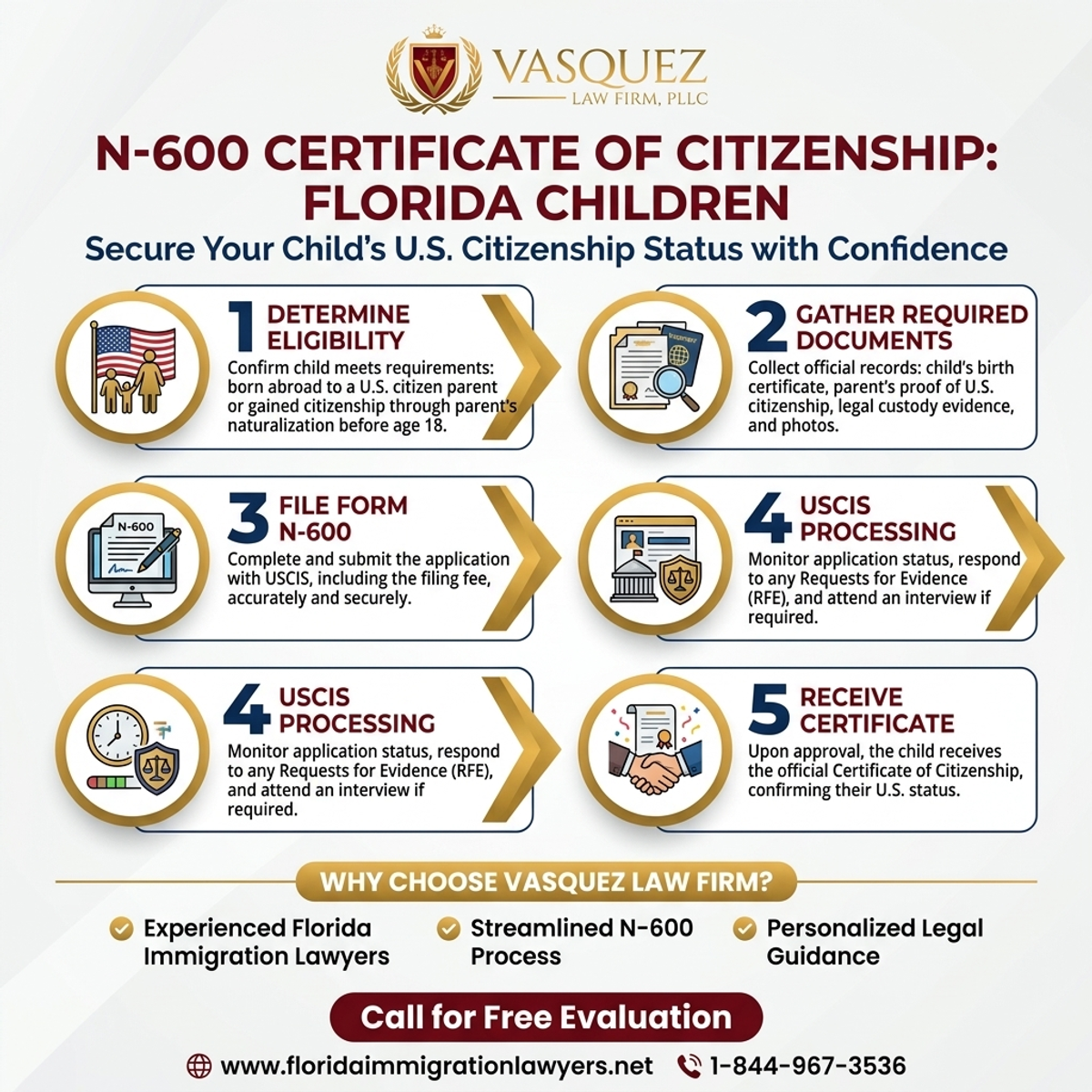
Key Statistics — N-600 Certificate of Citizenship Florida Children
Additional Documents (if applicable):
- Adoption Decree: If the child was adopted, a copy of the final adoption decree.
- Name Change Documents: If the child or parent has legally changed their name since birth.
- Form G-28, Notice of Entry of Appearance as Attorney or Accredited Representative: If you are represented by an attorney.
- Fee Waiver Application (Form I-912): If you are requesting a waiver of the filing fee.
Remember, all foreign language documents must be accompanied by a complete and accurate English translation, certified by the translator. Missing even a single document can lead to significant processing delays. Our team at Florida Immigration Lawyers can help you compile a comprehensive list tailored to your specific situation and review your entire package before submission.
N-600 Processing Timelines and Expectations for Florida Applicants
Understanding the processing timelines for the N-600 certificate of citizenship is crucial for families in Florida. While USCIS strives for efficiency, processing times can vary significantly based on several factors, including the volume of applications, the complexity of individual cases, and the specific USCIS field office involved. It is important to manage expectations and be prepared for potential delays. As of 2026, typical processing times can range from several months to over a year, sometimes longer.
What to Expect in the N-600 Timeline:
- Receipt Notice: Within 2-4 weeks after filing, you should receive a Form I-797C, Notice of Action, confirming that USCIS has received your application. This notice will contain your case receipt number, which you can use to track your case status online via the USCIS website.
- Biometrics Appointment: Typically, within 1-3 months of filing, you will receive an appointment notice for biometrics (fingerprints, photos, signature) at a local Application Support Center (ASC). For Florida residents, these are located in major cities like Miami, Orlando, Tampa, and Jacksonville. Naples residents will generally be directed to the Miami or Tampa ASC.
- Interview (if required): If an interview is deemed necessary, it could be scheduled anywhere from 6 months to over a year after filing. USCIS aims to schedule interviews at the field office closest to your residence. In Florida, this would likely be the Miami, Orlando, or Tampa field office. Preparing for this interview with a lawyer can be beneficial.
- Decision and Certificate Issuance: Once all steps are completed and USCIS reviews your case, a decision will be issued. If approved, the Certificate of Citizenship will be mailed to you. This final step can take several weeks to a few months after the interview or final review.
Factors Influencing Processing Times:
- USCIS Workload: High volumes of applications can naturally extend wait times.
- Completeness of Application: Incomplete forms or missing documents will lead to Requests for Evidence (RFEs), significantly delaying the process.
- Case Complexity: Cases involving complex legal histories, unusual family situations, or criminal records may require additional scrutiny and thus more time.
- Field Office Specifics: While processing times are generally national, some field offices might have slightly different backlogs. For example, the Miami Field Office, serving a large immigrant population in South Florida, might experience high volumes.
It is important to regularly check the USCIS website for updated processing times for Form N-600 at the relevant service center. If your case goes beyond the posted processing times, you may be able to submit an inquiry. Our team at Florida Immigration Lawyers monitors these trends and can provide up-to-date information and assistance if your application experiences unusual delays.
Cost Factors and Fee Breakdown for the N-600 Application
Understanding the financial aspects of applying for an N-600 certificate of citizenship is an important consideration for families in Florida. The total cost involves not only the government filing fees but also potential additional expenses. While specific fee amounts are subject to change by USCIS, we can outline the typical cost factors involved in securing this important document for your children.
USCIS Filing Fees:
- Form N-600 Application Fee: This is the primary fee for filing the application. It is crucial to check the most current fee on the USCIS website or by calling their customer service number before submitting your application. The fee is non-refundable, even if the application is denied.
- Biometrics Fee: In many cases, the biometrics fee is included within the N-600 application fee. However, it is always wise to confirm this on the USCIS website. This fee covers the cost of fingerprinting, photographs, and signature collection at an Application Support Center (ASC).
Potential Additional Costs:
- Attorney Fees: Engaging an experienced immigration attorney, such as those at Florida Immigration Lawyers, is an investment that can save you time, stress, and potential costly mistakes. Legal fees vary depending on the complexity of the case and the services provided, but typically cover comprehensive case review, document preparation, representation, and communication with USCIS. We offer a free initial consultation to discuss your specific needs.
- Document Acquisition Costs: You may incur costs to obtain certified copies of birth certificates, marriage certificates, divorce decrees, or other official records from government agencies in the U.S. or abroad.
- Translation Services: All documents not in English must be accompanied by a certified English translation. Professional translation services will have associated fees.
- Travel Expenses: There may be costs for travel to a USCIS Application Support Center for biometrics or to a USCIS field office for an interview. For families in remote parts of Florida, like the Everglades City area near Naples, this could involve significant travel to Miami or Tampa.
- Postage and Courier Services: Costs for sending your application package via certified mail with tracking or using a private courier service.
Fee Waivers:
USCIS offers fee waivers (Form I-912, Request for Fee Waiver) for certain applicants who meet specific income guidelines or receive means-tested public benefits. If you believe you might qualify for a fee waiver, you must submit Form I-912 along with your N-600 application. It is crucial to provide strong evidence of your inability to pay the fees, as improperly filed fee waiver requests can lead to delays or rejection of your entire application. Our attorneys can assess your eligibility for a fee waiver and help you prepare the necessary documentation.
Do not navigate this complex process alone. Contact Florida Immigration Lawyers today for dedicated support and peace of mind. We are committed to helping Florida families secure their children's future and can provide expert guidance on all aspects of the N-600 application. Visit our contact page to schedule your consultation.
Common Mistakes to Avoid When Applying for an N-600
Applying for an N-600 certificate of citizenship for your children in Florida requires meticulous attention to detail. Even minor errors can lead to significant delays, Requests for Evidence (RFEs), or even denial. Here are some common mistakes families make and their potential consequences:
-
Misunderstanding Eligibility Requirements: A frequent mistake is applying when the child does not actually meet all criteria for derived or acquired citizenship. This can happen if a parent's citizenship status changed too late, the child was not an LPR, or was over 18. Consequence: Automatic denial and loss of filing fees.
-
Incomplete or Inaccurate Forms: Failing to answer all questions, providing inconsistent information, or making typographical errors on Form N-600. Consequence: USCIS may reject the application, issue an RFE, or deny it, causing significant delays.
-
Insufficient Supporting Documentation: Not including all required documents, such as birth certificates, marriage certificates, or proof of custody. This is particularly common with complex family structures. Consequence: RFE, which prolongs processing, or outright denial if evidence is not provided promptly.
-
Failing to Provide Certified Translations: Submitting foreign language documents without a complete and certified English translation. USCIS cannot process documents they cannot read. Consequence: RFE or rejection of the application.
-
Submitting Incorrect Filing Fees: Sending an outdated fee amount or an incorrect payment method. USCIS strictly enforces fee requirements. Consequence: Application will be rejected and returned, requiring resubmission and further delays.
-
Missing Biometrics Appointments or Interviews: Failing to attend scheduled appointments without proper rescheduling. Consequence: USCIS may consider the application abandoned and deny it.
-
Lack of Proper Proof of Legal and Physical Custody: For children of divorced or separated parents, clear evidence of the U.S. citizen parent's legal and physical custody is essential. Consequence: RFE or denial due to insufficient proof of a critical eligibility factor.
-
Not Keeping Copies of Everything: Failing to maintain a complete copy of the submitted application package, including all forms and documents. Consequence: Inability to respond accurately to RFEs or discuss the case effectively with USCIS or an attorney.
-
Ignoring USCIS Communications: Not responding promptly to RFEs or other notices from USCIS. Consequence: Potential denial of the application without further consideration.
When to Call a Florida Immigration Lawyer for Your N-600 Application
While the goal of the N-600 certificate of citizenship process is to confirm an existing status, the application can be surprisingly intricate. Knowing when to seek professional legal assistance can make a significant difference in the outcome and efficiency of your child's application. For families in Florida, especially those in areas like Naples, Miami, or Orlando, navigating federal immigration law can be complex. Florida Immigration Lawyers are here to provide expert guidance.
You should strongly consider contacting an attorney for your child's N-600 application if any of the following scenarios apply:
- Complex Family Situations: If the child's parents are divorced, separated, or if the child was adopted, the documentation required to prove legal and physical custody can be extensive and confusing. Step-parent situations also add layers of complexity.
- Uncertain Eligibility: If you are unsure whether your child meets all the strict requirements for derived or acquired citizenship, an attorney can provide a thorough assessment based on the specific facts of your case. This is crucial for avoiding a denied application.
- Criminal History: If either the child or the U.S. citizen parent has any criminal record, even minor offenses, it can complicate the application. An attorney can advise on how to disclose this information and mitigate potential issues.
- Previous Immigration Issues: Past visa denials, deportation proceedings, or other immigration challenges for the child or parent can significantly impact the N-600 process.
- Received an RFE or Notice of Intent to Deny: If USCIS has sent a Request for Evidence or a Notice of Intent to Deny, it means they have concerns about your application. Responding correctly and comprehensively within the deadline is critical, and legal counsel is highly recommended.
- Language Barriers: If English is not your primary language, an attorney can help ensure all communication with USCIS is clear and accurate, and that all documents are properly translated.
- Peace of Mind: Even in seemingly straightforward cases, the peace of mind that comes from having an experienced legal professional review and manage your application is invaluable. Our attorneys are well-versed in citizenship and family immigration law.
Florida Immigration Lawyers has extensive experience assisting families throughout Florida with N-600 applications. We understand the nuances of the law and the specific requirements of USCIS. Our team can help you gather all necessary documents, prepare a robust application package, respond to any USCIS inquiries, and ensure your child's journey to officially recognized citizenship is as smooth as possible. We are dedicated to protecting the rights and futures of immigrant families in Florida.
About Florida Immigration Lawyers
Florida Immigration Lawyers is a leading immigration law firm dedicated to serving individuals and families across the entire state of Florida. With a deep understanding of U.S. immigration laws and a commitment to our clients, we provide compassionate, effective, and results-oriented legal representation. Our team of skilled attorneys specializes in a wide range of immigration matters, including N-600 certificate of citizenship applications, family-based petitions, naturalization, deportation defense, asylum, and business immigration.
We pride ourselves on our client-focused approach, ensuring that every individual receives personalized attention and strategic advice tailored to their unique circumstances. We understand the complexities and emotional challenges often associated with immigration processes, especially when it involves securing the future of your children. Our firm is committed to simplifying these processes for you, providing clear communication, and advocating fiercely on your behalf. We serve all of Florida, from the panhandle to the Keys, including major cities like Miami, Orlando, Tampa, and communities such as Naples.
At Florida Immigration Lawyers, we believe everyone deserves access to quality legal representation. We offer free consultations to discuss your case and are available 24/7 to answer your questions. Our bilingual staff ensures that language is never a barrier to receiving the legal help you need. Trust us to be your dedicated partners in navigating the U.S. immigration system. Visit floridaimmigrationlawyers.net or call us at 1-844-967-3536 to schedule your free consultation today.
Sources and References
- U.S. Citizenship and Immigration Services (USCIS)
- U.S. Department of State
- 8 U.S.C. § 1431 (Immigration and Nationality Act Section 320) - Children Born Outside the U.S. of Citizen Parent
- 8 U.S.C. § 1433 (Immigration and Nationality Act Section 322) - Children Born Outside the U.S.
- 20 CFR Part 404 - Federal Old-Age, Survivors, and Disability Insurance (regulations related to proof of citizenship for federal benefits)
- USCIS Policy Manual, Volume 12, Part H, Chapter 4 - Automatic Acquisition of Citizenship
Related services: naturalization process, citizenship test preparation, dual citizenship guidance, citizenship test resources.
This article provides general legal information and is not intended as legal advice. Every case is unique, and outcomes depend on specific facts and circumstances. Contact an attorney for advice about your particular situation. Immigration laws are subject to change by Congress and federal agencies.
Securing your child's future as a U.S. citizen is a profound responsibility, and the N-600 Certificate of Citizenship is a key step in that journey. Do not leave this critical process to chance. Our dedicated team at Florida Immigration Lawyers is ready to provide the expert legal guidance and support you need. Call us today at 1-844-967-3536 for a free, confidential consultation. Se Habla Español - Estamos aqui para ayudarle.
Do Not Navigate This Process Alone
Our experienced immigration attorneys are ready to fight for you. Get a free, confidential consultation today.
Se Habla Español
Or leave your details and we’ll call you:
Free Evaluation in 24 Hours
Or talk to us right now

AI voice assistant — available 24/7
FreeFrequently Asked Questions

William J. Vásquez
Founding Attorney · Vasquez Law Firm
U.S. Air Force veteran and immigration attorney with years of hands-on U.S. immigration experience. J.D., NCCU School of Law. AILA member. Admitted to the 4th, 5th, and 11th Circuit Courts.
Available 24/7 - Free Evaluations
Reviewed for legal accuracy by William J. Vásquez
Licensed in North Carolina; U.S. immigration is federal practice.
Related Legal Services
Our Florida immigration attorneys can help you with deportation defense, citizenship and naturalization and family immigration services. Call today at 1-844-967-3536 for a free consultation.
Related Links
Related Topics
Free Legal Consultation
Discuss your case with our experienced attorneys. We're available 24/7.
Se Habla Español - Estamos aquí para ayudarle.
Related Articles
Military Naturalization Expedited in Florida Bases
Explore military naturalization options for families at Florida bases, including parole in place benefits in Miami. Learn how to expedite your application with expert guidance from Florida Immigration Lawyers.
Immigration Lawyer Orlando Free Consultation 2026
Discover how to find an immigration lawyer in Orlando offering a free consultation. Understand the services available and why choosing Florida Immigration Lawyers can make a difference in your case.
Immigration Lawyer Orlando Free Consultation: 2026 Policy
As Florida anticipates significant immigration policy changes by 2026, understanding their potential impact is crucial for residents and businesses across the state, from Naples to Orlando. These reforms may include enhanced enforcement, adjustments to visa programs, and shifts in asylum processing. Navigating these new rules requires expert legal guidance to ensure compliance and protect your rights. Florida Immigration Lawyers offers free consultations to help you understand how these changes affect your specific case, whether you're applying for a visa, seeking adjustment of status, or facing a complex legal challenge. Our comprehensive guide covers anticipated timelines, document requirements, and common mistakes to avoid, emphasizing the importance of informed preparation. Don't let uncertainty jeopardize your future; learn how our experienced attorneys can advocate for you.
DUI Immigration Consequences in Florida: What to Know
A DUI conviction in Florida can have significant immigration consequences, including potential inadmissibility and deportation. Learn how to navigate these challenges and protect your rights with guidance from Florida Immigration Lawyers.