Motion to Reopen Immigration Case in Florida | VLF Florida
Learn how to file a motion to reopen your immigration case in Florida. Discover eligibility, steps, and common mistakes. Call us for a free consultation.

Motion to Reopen Immigration Case in Florida | VLF Florida
Facing a final order of deportation or removal can be a devastating experience. However, in many situations, the law provides a crucial avenue for relief: the motion to reopen an immigration case. For individuals and families in Florida, understanding this complex legal tool is paramount. At VLF Florida, we specialize in helping clients navigate the intricacies of immigration law, offering expert guidance on motions to reopen and other critical legal strategies.
What is a Motion to Reopen an Immigration Case?
A motion to reopen is a formal request filed with the Immigration Court (Executive Office for Immigration Review - EOIR) or the Board of Immigration Appeals (BIA) asking them to reconsider a previous decision in your immigration case. It is not an appeal of the decision itself, but rather a request to present new facts or evidence that were not available or discoverable at the time of the original hearing. The goal is to convince the court or BIA that, with this new information, the outcome of your case should be different.
This legal mechanism is particularly vital for those who have received an unfavorable decision, such as a denial of asylum, a deportation order, or a denial of an adjustment of status. It offers a lifeline, allowing individuals to present circumstances that may have changed or new evidence that could alter the court's perception of their eligibility for relief. Unlike an appeal, which challenges the legal correctness of the previous decision based on the existing record, a motion to reopen seeks to introduce new material that could lead to a different factual finding or legal conclusion.
Key Grounds for Filing a Motion to Reopen
Successfully filing a motion to reopen hinges on demonstrating specific, compelling grounds. The law outlines several primary reasons that may warrant a reopening of your case. Understanding these grounds is crucial for building a strong argument.
New Material Facts or Evidence
One of the most common grounds is the presentation of new material facts or evidence that was not available and could not have been discovered or presented at the time of the original hearing. This evidence must be truly 'new' and 'material,' meaning it is relevant to the issues in your case and could realistically change the outcome. Examples include new medical diagnoses, updated country conditions reports relevant to asylum claims, or newly obtained documents proving a relationship or status that was previously unverified.
Changed Country Conditions (for Asylum Cases)
For individuals seeking asylum, a motion to reopen can be based on changed country conditions. If conditions in your home country have significantly worsened or changed in a way that now makes you eligible for asylum or withholding of removal, and these changes occurred after your last hearing, you may be able to reopen your case. This ground is particularly important as geopolitical situations can evolve rapidly, creating new dangers for individuals previously denied protection.
Ineffective Assistance of Counsel
If you believe your previous attorney provided substandard legal representation that prejudiced your case, you might have grounds for a motion to reopen based on ineffective assistance of counsel. This is a complex claim that requires demonstrating that your attorney's performance fell below professional standards and that this deficiency directly led to an unfavorable outcome. This often involves filing a complaint against the previous attorney and providing detailed evidence of their errors or omissions.
Failure to Receive Notice (In Absentia Orders)
Many motions to reopen arise from in absentia orders, where an immigration judge ordered deportation because the individual failed to appear for a hearing. If you can prove that you did not receive proper notice of your hearing, or that your failure to appear was due to exceptional circumstances beyond your control (e.g., serious illness, death of a family member, severe weather), you may be able to reopen your case. This is a critical pathway for those who were unaware of their court dates and subsequently received a removal order.
Exceptional Circumstances
Beyond the specific grounds, the BIA and Immigration Courts may consider reopening a case based on 'exceptional circumstances.' While not a standalone ground, it often applies in conjunction with other reasons, such as a failure to appear due to unforeseen and severe events. This requires a compelling argument demonstrating that factors outside your control prevented you from presenting your case effectively or appearing in court.
The Strict Deadlines for Motions to Reopen
One of the most challenging aspects of motions to reopen is the strict time limits involved. Generally, a motion to reopen must be filed within 90 days of the final administrative decision (e.g., the immigration judge's order or the BIA's decision). This deadline is rigorously enforced, and missing it can severely jeopardize your ability to reopen your case.
However, there are crucial exceptions to this 90-day rule:
- Motions Based on Changed Country Conditions: For asylum cases, motions to reopen based on changed country conditions have no time limit, provided the evidence of changed conditions is material and was not available at the time of the previous hearing.
- Motions Based on In Absentia Orders: If you received an in absentia order, you generally have 180 days to file a motion to reopen if you can show exceptional circumstances for your failure to appear. If you can prove you never received notice of the hearing, there is no time limit.
- Joint Motions to Reopen: If both you and the Department of Homeland Security (DHS) counsel agree to reopen the case, a joint motion can be filed at any time, without regard to the 90-day limit. This often occurs when DHS acknowledges an error or new evidence merits reconsideration.
- Sua Sponte Reopening: The BIA or an Immigration Judge can, on their own initiative (sua sponte), reopen a case at any time. While rare, this discretionary power can be invoked in cases where there has been a fundamental miscarriage of justice.
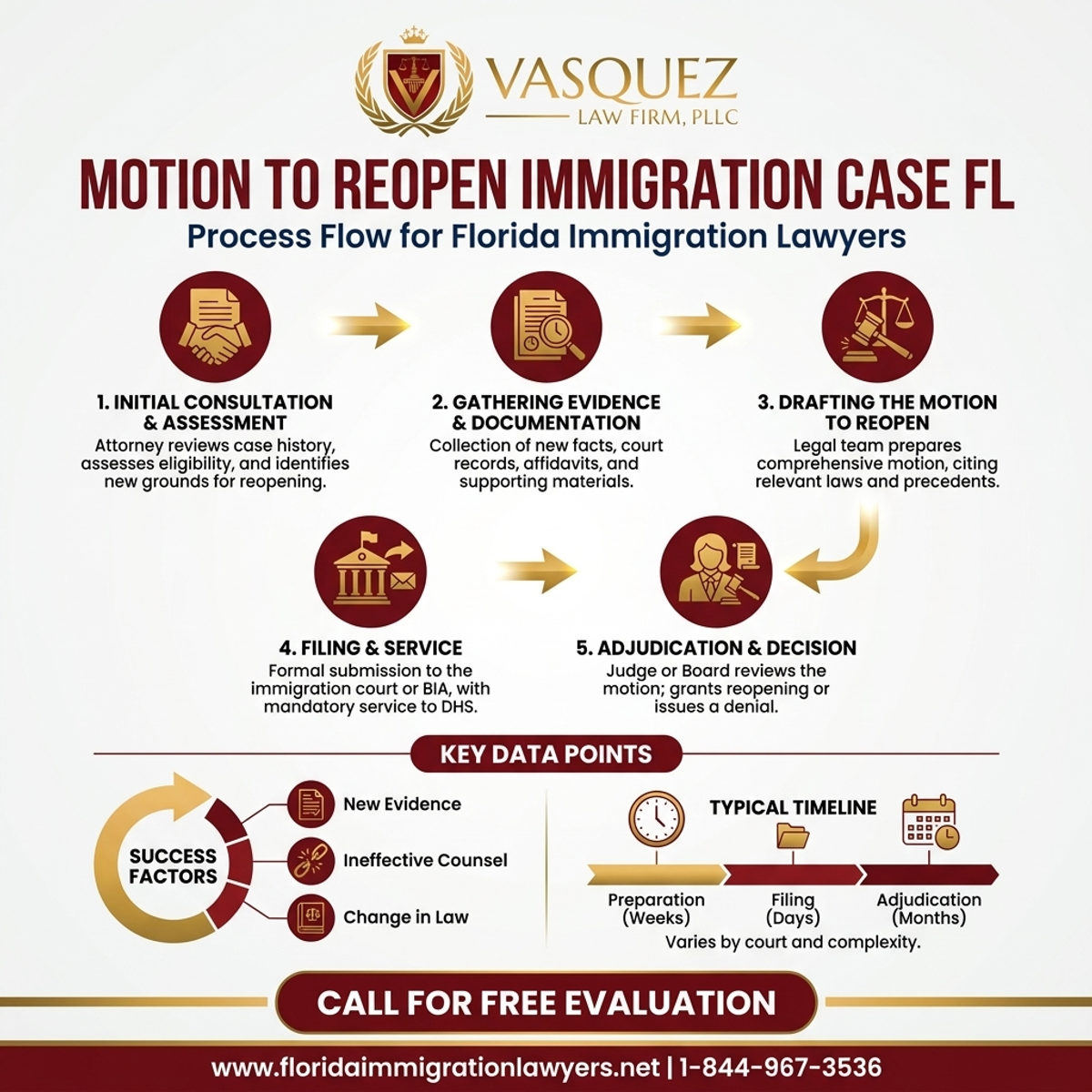
Step-by-Step Process — Motion to Reopen Immigration Case in Florida | VLF Florida
Given the complexity and strict deadlines, consulting with an experienced immigration attorney in Florida is not just advisable, but often essential to ensure your motion is timely and properly filed.
The Process of Filing a Motion to Reopen in Florida Immigration Courts
The process of filing a motion to reopen is meticulous and requires careful attention to detail. Any misstep can lead to denial, further complicating your immigration status.
Gathering Evidence
The first and most critical step is to gather all new material facts and evidence. This could include affidavits, expert opinions, medical records, country condition reports, police reports, or any other documentation that supports your claim for reopening. The evidence must be compelling and directly relevant to the grounds you are asserting.
Drafting the Motion
The motion itself is a legal brief that must clearly state the grounds for reopening, explain why the new evidence was not available previously, and demonstrate how this evidence would likely change the outcome of your case. It must be supported by a sworn affidavit from you, detailing the facts. Legal arguments must be precise, citing relevant statutes, regulations, and case law.
Filing with the Appropriate Authority
Depending on whether the last decision was made by an Immigration Judge or the Board of Immigration Appeals, the motion must be filed with the correct body. If the case is still with the Immigration Court, it's filed with the EOIR. If the BIA issued the last decision, it's filed with the BIA. Proper filing includes submitting the correct forms (e.g., Form EOIR-29 for the BIA), the motion brief, all supporting evidence, and the required filing fee or a fee waiver request.
Service on the Opposing Party
You must properly serve a copy of your motion and all supporting documents on the opposing party, which is typically the Office of Chief Counsel for the Department of Homeland Security (DHS). Proof of service must then be filed with the court or BIA.
Waiting for a Decision
Once filed, the court or BIA will review the motion. This process can take several months. They may issue a decision based solely on the written submissions, or they may request oral arguments. If the motion is granted, your case will be reopened, and you will be given a new hearing date to present your full case with the new evidence.
Navigating Complexities: Specific Scenarios and Challenges in Florida Immigration Cases
Florida, with its diverse population and significant immigrant communities, presents unique challenges and scenarios in immigration law. A motion to reopen in Florida often requires an understanding of local court procedures, specific ICE field office policies, and the nuances of state-specific issues that can impact federal immigration cases. This added layer of complexity underscores the need for specialized legal assistance.
One common challenge in Florida involves individuals who have received in absentia removal orders. Due to various factors, including language barriers, lack of understanding of the legal system, or simply outdated addresses, many individuals miss their court dates. Successfully reopening these cases requires meticulous documentation to prove lack of notice or exceptional circumstances. The Florida immigration courts, particularly in Miami and Orlando, handle a high volume of such cases, making a well-prepared motion even more critical.
Another significant hurdle can arise from the interplay between state criminal convictions and federal immigration law. Even minor offenses in Florida can have severe immigration consequences, potentially leading to deportation. If new evidence emerges regarding a criminal conviction (e.g., a vacated plea, a successful appeal, or a pardon), a motion to reopen can be a vital tool to revisit the immigration decision. Understanding how Florida's criminal justice system interacts with federal immigration statutes is key to crafting an effective motion in these situations.
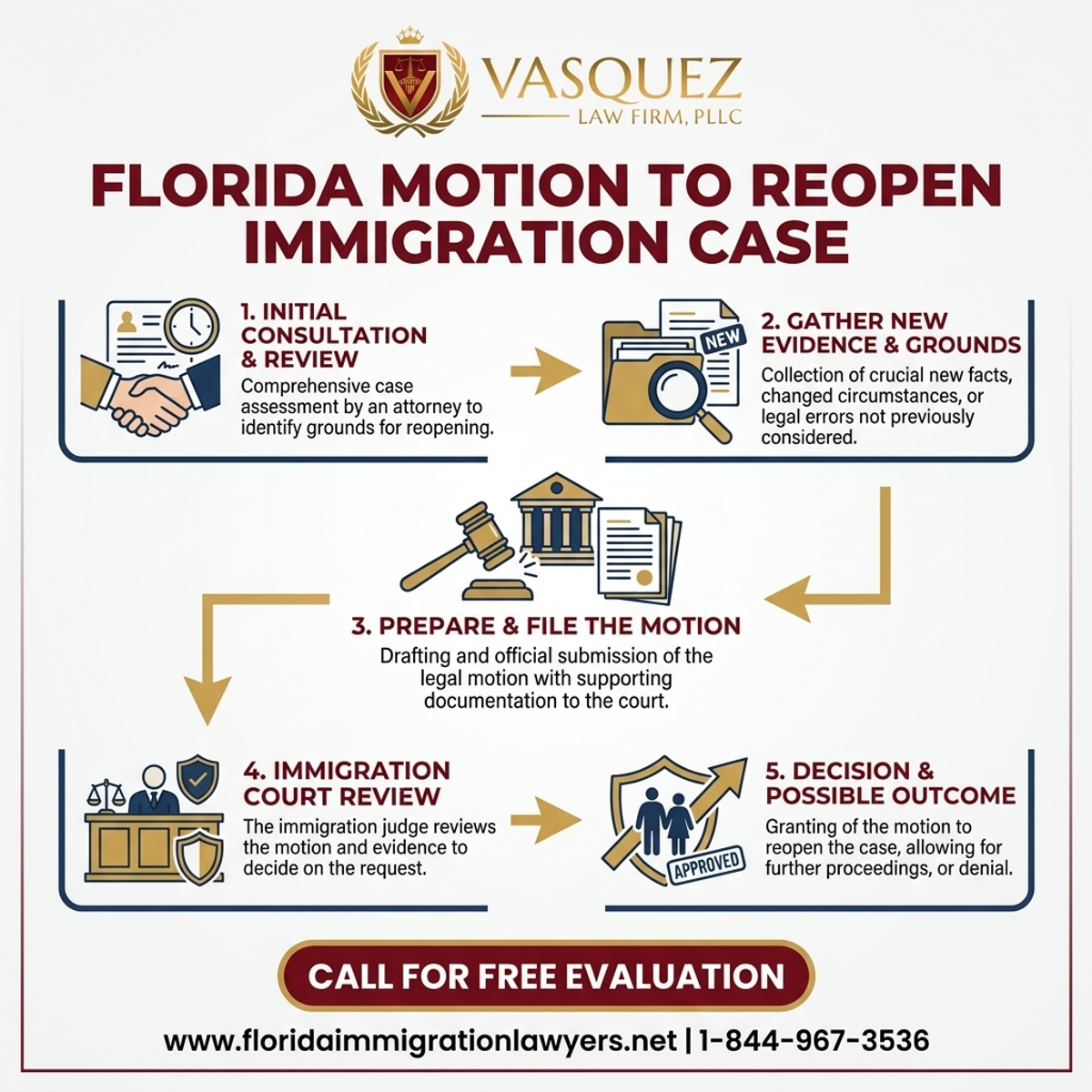
Key Statistics — Motion to Reopen Immigration Case in Florida | VLF Florida
Furthermore, the dynamic nature of prosecutorial discretion by DHS in Florida can impact motions to reopen. In certain circumstances, DHS counsel may agree to a joint motion to reopen, particularly if there are compelling humanitarian factors or if the case aligns with current enforcement priorities. An experienced attorney can engage with DHS counsel to explore these possibilities, which can significantly streamline the reopening process and increase the chances of a favorable outcome. This strategic engagement requires a deep understanding of current immigration policy and strong advocacy skills.
Finally, for asylum seekers in Florida, the evolving political and social conditions in their home countries can frequently provide new grounds for reopening. Keeping abreast of international developments and presenting this information effectively to the court is a specialized skill. The ability to connect new country conditions to an individual's specific fear of persecution is paramount. These complexities highlight why a generic approach to motions to reopen is insufficient, especially in a state like Florida where immigration issues are so prevalent and varied.
The Critical Role of an Experienced Immigration Attorney
Given the stringent deadlines, complex legal requirements, and high stakes involved, attempting to file a motion to reopen without legal representation is extremely risky. An experienced immigration attorney can provide invaluable assistance at every stage of the process.
Expertise in Immigration Law
Immigration law is incredibly intricate and constantly evolving. An attorney specializing in this field understands the nuances of motions to reopen, including the specific grounds, exceptions to deadlines, and the types of evidence that are most persuasive to the court or BIA. They can identify the strongest legal arguments and present them effectively.
Evidence Gathering and Presentation
Collecting and presenting compelling evidence is crucial. An attorney knows what types of documents and testimony are needed, how to obtain them, and how to present them in a clear, organized, and legally sound manner. They can help you draft detailed affidavits and gather expert opinions.
Meeting Deadlines
Missing a deadline, even by a single day, can lead to the outright denial of your motion. An attorney will ensure all documents are prepared, filed, and served correctly and on time, safeguarding your opportunity to reopen your case.
Appearing in Court
If your motion is granted and your case is reopened, you will likely need to appear before an Immigration Judge again. An attorney will prepare you for these hearings, represent you in court, and advocate tirelessly on your behalf.
Strategic Planning
Beyond the motion itself, an attorney can help you develop a comprehensive strategy for your entire immigration case. This includes exploring other potential avenues for relief, preparing for future hearings, and advising on the best course of action to achieve your immigration goals.
Frequently Asked Questions (FAQ)
What is the main difference between a motion to reopen and an appeal? A motion to reopen introduces new facts or evidence that were not available at the time of the original decision, asking the court to reconsider based on this new information. An appeal challenges the legal correctness of the original decision based on the existing record. How long does it typically take for a decision on a motion to reopen? The processing time can vary significantly, often taking several months to over a year, depending on the caseload of the Immigration Court or the Board of Immigration Appeals. Can a motion to reopen stop a deportation order? Filing a motion to reopen does not automatically stop a deportation order. You may need to file a separate request for a stay of removal along with your motion to prevent deportation while your motion is pending. What if I missed my immigration court hearing? If you missed your hearing and received an in absentia removal order, you may be able to file a motion to reopen within 180 days (or without time limit if you prove lack of notice) by demonstrating exceptional circumstances or that you did not receive proper notice. Are there any fees associated with filing a motion to reopen? Yes, there is typically a filing fee required by the EOIR or BIA. However, you may be eligible to request a fee waiver if you can demonstrate financial hardship. Can I file multiple motions to reopen? Generally, an individual is allowed to file only one motion to reopen. There are very limited exceptions, such as joint motions with DHS or motions based on changed country conditions for asylum seekers. What constitutes 'new material evidence'? 'New material evidence' refers to evidence that was not available and could not have been discovered or presented at the time of the original hearing, and which is relevant and could potentially change the outcome of your case. Why is legal counsel so important for a motion to reopen? Motions to reopen are highly complex, with strict deadlines and specific legal requirements. An experienced immigration attorney ensures proper documentation, adherence to deadlines, strong legal arguments, and effective representation, significantly increasing your chances of success.Conclusion
A motion to reopen an immigration case in Florida can be a powerful tool to reverse an unfavorable decision and secure your future in the United States. However, its success hinges on meticulous preparation, adherence to strict deadlines, and a deep understanding of complex immigration law. Whether you are dealing with an in absentia order, new evidence, or changed country conditions, navigating this process requires expert legal guidance.
Don't face the complexities of immigration court alone. If you believe you have grounds to reopen your immigration case, or if you have questions about deportation defense or asylum, contact VLF Florida today. Our dedicated team of immigration attorneys is ready to provide the compassionate and effective representation you need. Call us for a free consultation at (844) 967-3536 or visit our contact page to schedule an appointment. Let us help you fight for your right to remain in Florida and pursue your American dream.
Sources and References
- U.S. Citizenship and Immigration Services (USCIS)
- Executive Office for Immigration Review (EOIR)
- U.S. Department of State - Bureau of Consular Affairs
- Immigration and Nationality Act (INA), 8 U.S.C. Chapter 12
Do Not Navigate This Process Alone
Our experienced immigration attorneys are ready to fight for you. Get a free, confidential consultation today.
Se Habla Español
Frequently Asked Questions
Florida Immigration Lawyers
Immigration Attorney | Founder, Vasquez Law Firm
U.S. Air Force veteran and immigration attorney with thousands of cases resolved. J.D., NCCU School of Law. AILA member. Admitted to the 4th, 5th, and 11th Circuit Courts.
Available 24/7 - Free Evaluations
Related Legal Services
Our Florida immigration attorneys can help you with deportation defense, citizenship and naturalization and family immigration services. Call today at 1-844-967-3536 for a free consultation.
Related Links
Related Topics
Free Legal Consultation
Discuss your case with our experienced attorneys. We're available 24/7.
Se Habla Español - Estamos aquí para ayudarle.
Related Articles
Immigration Attorney in Gainesville: Your North Florida Guide
Finding an immigration attorney in Gainesville, North Florida, can be crucial for your immigration journey. Learn how experienced lawyers can guide you through complex processes and help you avoid common pitfalls. Call Florida Immigration Lawyers at 1-844-967-3536 for expert assistance.
E-2 Visa Guide for Investors in Florida | VLF Florida
Discover how to obtain an E-2 investor visa for your business in St. Petersburg, Florida. Learn the steps, requirements, and how Florida Immigration Lawyers can assist you.
Immigration Attorney Orlando Florida: Expert Visa Help
Facing immigration challenges in Orlando, Florida? Discover how an experienced immigration attorney can assist with visas, green cards, and deportation defense. Call Florida Immigration Lawyers at 1-844-967-3536 for a free consultation.
Green Card Renewal Process in Florida Explained | VLF Florida
Renew your green card in Naples, Florida, by understanding the essential steps and avoiding common mistakes. Learn more about the process and get professional assistance from Florida Immigration Lawyers.
