Immigration Lawyer Orlando Free Consultation: Bond Hearings
Understanding immigration bond hearings is crucial for individuals detained by ICE in Florida. This guide covers the process, required documents, timelines, and cost factors, with a specific focus on those seeking an immigration lawyer in Orlando. Learn how an Immigration Judge determines bond eligibility based on factors like community ties and criminal history. Discover the critical role of legal representation in navigating complex procedures and advocating for a fair bond amount. Florida Immigration Lawyers offers comprehensive assistance, including free consultations, to help families reunite and pursue their immigration cases effectively. Avoid common mistakes and understand when to seek professional legal help for the best possible outcome.

An immigration bond hearing in Florida is a legal proceeding where an Immigration Judge determines if a detained individual can be released from U.S. Immigration and Customs Enforcement (ICE) custody by posting a bond. These hearings are crucial for many non-citizens in Florida, including those held in facilities near Orlando, as they offer a chance for temporary release while their immigration case proceeds. Eligibility depends on factors like criminal history and flight risk. Securing an immigration lawyer Orlando free consultation can provide immediate guidance on eligibility and the process, significantly improving the chances of a favorable outcome. Legal representation helps navigate complex procedures and present compelling arguments for release.
- Immigration bond hearings determine release eligibility from ICE detention.
- An Immigration Judge sets bond amounts based on individual risk factors.
- Legal representation is vital for navigating the complex bond process.
- Eligibility is assessed based on criminal history, flight risk, and community ties.
- Many individuals in Florida, including those detained near Orlando, can seek bond.
Facing detention by U.S. Immigration and Customs Enforcement (ICE) can be an incredibly daunting and stressful experience, not just for the individual detained but also for their loved ones. The uncertainty of what comes next, especially regarding an immigration bond hearing, can feel overwhelming. Many families in Florida, particularly those in the Orlando area, find themselves searching for immediate answers and reliable legal assistance during these critical times. Understanding the bond hearing process is the first step towards reuniting with family and effectively pursuing your immigration case outside of detention.
This comprehensive guide from Florida Immigration Lawyers will walk you through everything you need to know about immigration bond hearings in Florida, focusing on the procedures, requirements, and crucial role of legal representation. We will cover how to request a hearing, the documents required, typical timelines, and factors influencing bond decisions. Whether you are seeking an immigration lawyer Orlando free consultation to understand your options or need urgent assistance for a detained family member, our firm is here to provide clarity and steadfast advocacy. Don't navigate this complex legal landscape alone. Call Florida Immigration Lawyers at 1-844-967-3536 for a free case review today.
What is an Immigration Bond Hearing in Florida?
An immigration bond hearing is a formal legal proceeding conducted by an Immigration Judge (IJ) to determine if a non-citizen detained by ICE can be released from custody upon posting a bond. The primary purpose of an immigration bond is to ensure that the individual will appear for all future immigration court hearings and will not pose a danger to the community. These hearings are distinct from criminal bail hearings and are governed by specific immigration laws and regulations.
In Florida, individuals are typically detained in facilities like the Baker County Detention Center or the Glades County Detention Center, often far from urban centers like Orlando. An Immigration Judge, usually from the Orlando Immigration Court or Miami Immigration Court, presides over these hearings. The judge considers various factors, including the individual's ties to the community, criminal history, and the likelihood of them appearing for future court dates. The legal framework for these bonds is primarily found in Section 236 of the Immigration and Nationality Act (INA), specifically INA 236(a), which grants the Attorney General the authority to release certain detained non-citizens on bond. Understanding this foundational aspect is critical for anyone facing detention.
How Do I Request an Immigration Bond Hearing in Orlando?
To request an immigration bond hearing in Orlando or for an individual detained in Florida, you generally don't initiate a formal 'request' in the same way you might file a motion in civil court. Instead, the opportunity for a bond hearing typically arises once an individual is taken into ICE custody and placed into removal proceedings. An Immigration Judge then has the authority to set a bond. However, an attorney can actively pursue a bond hearing or a bond redetermination.
-
Initial Detention and Notice to Appear (NTA): Once an individual is detained by ICE, they are typically served with a Notice to Appear (NTA), which formally initiates removal proceedings. The NTA will list the charges of removability and the date of the first hearing, often referred to as a Master Calendar Hearing. This document is crucial as it signifies the start of the legal process.
-
Automatic Bond Review (ICE Bond): In some cases, ICE may initially set a bond amount on its own, known as an ICE bond. If the detained individual or their family can pay this amount, the person can be released without an IJ hearing. However, ICE bonds are often higher or not offered at all, prompting the need for an Immigration Judge's review.
-
Requesting an Immigration Judge (IJ) Bond Hearing: If ICE does not set a bond, or if the ICE bond amount is too high, the detained individual has the right to request a bond hearing before an Immigration Judge. This request is usually made orally at the initial Master Calendar Hearing or through a written motion filed by an attorney. For individuals detained in Florida, these hearings are typically held at the Immigration Court with jurisdiction over their detention facility, such as the Orlando Immigration Court or the Miami Immigration Court.
-
Preparation and Presentation: Once a bond hearing is scheduled, thorough preparation is essential. This involves gathering evidence of community ties, financial stability, lack of flight risk, and good moral character. An experienced immigration lawyer in Orlando can compile these documents, prepare the client, and present a compelling argument to the Immigration Judge, highlighting why the individual should be released on bond. The goal is to demonstrate that the individual is not a flight risk and does not pose a danger to the community, thereby warranting release.
What Documents Are Needed for an Immigration Bond Hearing?
Gathering the right documents is paramount for a successful immigration bond hearing. These documents serve as evidence to convince the Immigration Judge that the detained individual is not a flight risk and does not pose a danger to the community. The more comprehensive and compelling the evidence, the stronger the case for a lower bond or even release without bond.
- Proof of Identity and Immigration Status: Passport, birth certificate, previous visas, I-94 arrival/departure record, or any other official identification. This establishes who the person is and their history of interactions with U.S. immigration authorities.
- Evidence of Family Ties in the U.S.: Marriage certificates, birth certificates of U.S. citizen children or lawful permanent resident relatives, letters from family members attesting to the individual's character and their dependence on them. This demonstrates strong connections to the community.
- Proof of Employment and Financial Stability: Pay stubs, employment verification letters, tax returns, bank statements, and letters from employers. These documents show financial responsibility and a stable life in the U.S., indicating less likelihood of absconding.
- Property Ownership: Deeds, mortgage statements, or rental agreements in the individual's name. Owning property or having a stable residence in Florida further illustrates deep roots in the community.
- Community Involvement: Letters from community leaders, religious figures, or volunteer organizations, proof of school enrollment for children, or membership in local clubs. These highlight positive contributions and ties to the local area, including Orlando.
- Medical Records: If the individual has significant health issues requiring ongoing treatment, these records can support arguments for release based on humanitarian grounds or the difficulty of receiving adequate care in detention.
- Affidavits of Support: Letters from U.S. citizens or lawful permanent residents willing to financially support the detained individual and ensure their appearance in court. These affidavits can be very persuasive.
- Criminal History Documentation: If there is any criminal history, obtaining certified court dispositions for all arrests and convictions is critical. This allows an attorney to address any concerns directly and show rehabilitation or minor nature of offenses.
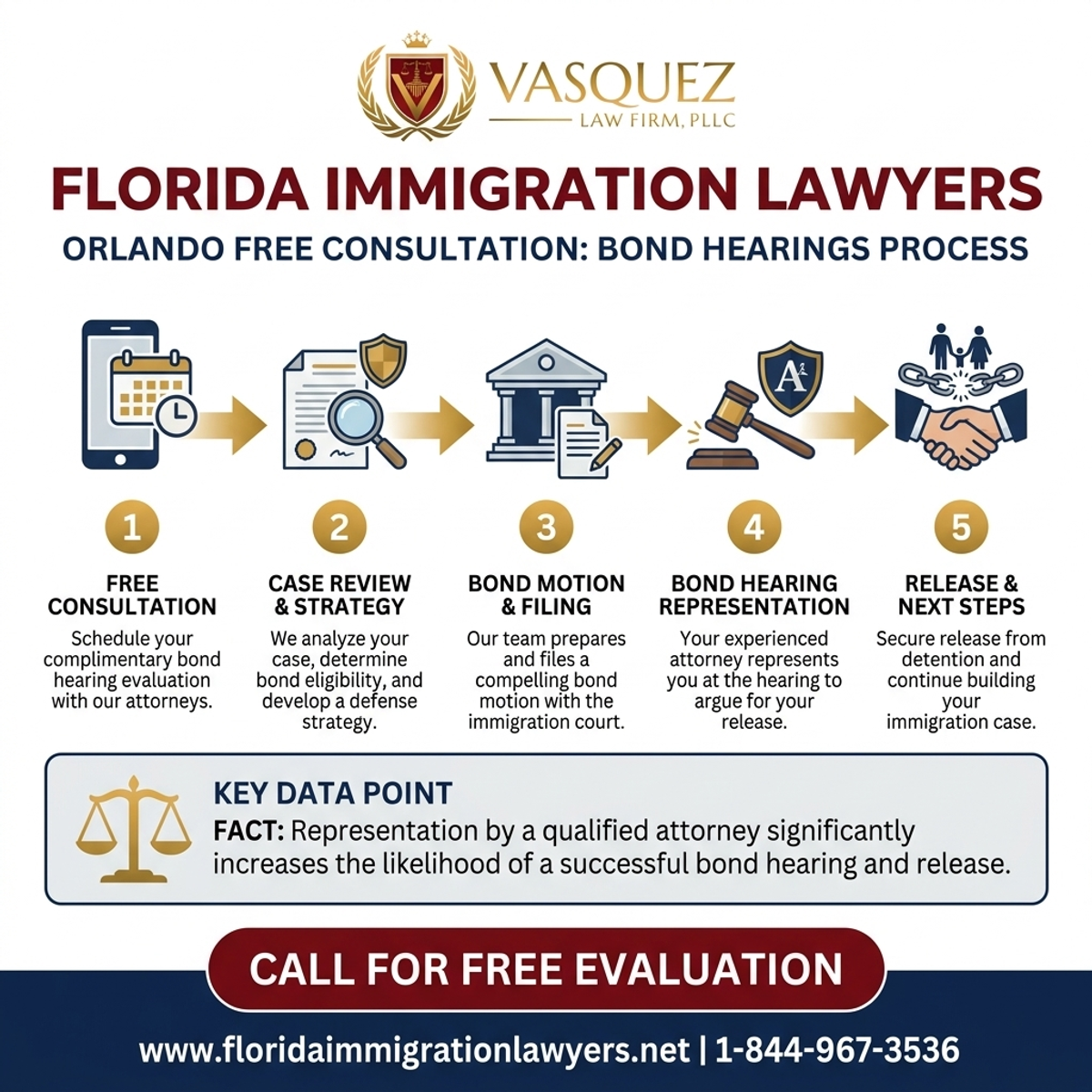
Step-by-Step Process — Immigration Lawyer Orlando Free Consultation: Bond Hearings
How Long Does an Immigration Bond Hearing Take in Florida?
The timeline for an immigration bond hearing in Florida can vary significantly based on several factors, including the specific detention facility, the caseload of the Immigration Court, and whether the individual has legal representation. However, understanding the typical stages can help manage expectations. As of 2026, the process generally follows a predictable sequence, though delays are possible due to court backlogs or administrative issues. An expedited hearing is usually preferable for the detained individual.
| Stage | Typical Timeframe | Notes |
|---|---|---|
| Initial Detention to NTA Issuance | 1-5 days | ICE issues a Notice to Appear (NTA) to initiate removal proceedings. |
| NTA Issuance to First Master Calendar Hearing | 2-6 weeks | The first opportunity for an Immigration Judge (IJ) to review the case. A bond hearing can be requested here. |
| Request for Bond Hearing to Actual Hearing | 1-4 weeks | Once requested, the IJ typically schedules the bond hearing relatively quickly. |
| Bond Hearing Duration | 30 minutes - 2 hours | The actual hearing is usually short, but preparation is extensive. |
| Decision and Bond Posting | Immediate decision, bond posting 1-3 days | IJ usually gives a decision on the spot. Posting bond then takes administrative time. |
It's important to note that while the hearing itself might be brief, the time from detention to release on bond can span several weeks. For instance, the Orlando Immigration Court, like others, faces varying caseloads. Having a skilled immigration lawyer in Orlando can often expedite the scheduling of a bond hearing and ensure all necessary documentation is prepared efficiently, reducing potential delays. Without legal counsel, individuals may face longer wait times and be unaware of their rights to a timely hearing.
How Much Does an Immigration Bond Cost in Florida in 2026?
The cost of an immigration bond in Florida, as in other states, is not a fixed amount. It varies significantly depending on the individual's specific circumstances, including their immigration history, criminal record, ties to the community, and the Immigration Judge's discretion. As of 2026, the minimum bond amount set by regulation is generally $1,500, but bonds can range much higher, often between $5,000 and $25,000, and sometimes even more in complex cases. The judge aims to set a bond that is high enough to ensure the individual's appearance in court but not so high as to be punitive or impossible to pay.
| Item | Typical Fee Range (2026) | Notes |
|---|---|---|
| Immigration Bond Amount | $1,500 - $25,000+ | Set by ICE or an Immigration Judge. Varies greatly based on individual risk factors. |
| Attorney Legal Fees | Varies widely | Depends on complexity of case, attorney's experience, and services required. Essential for effective representation. |
| Bond Posting Fees | Nominal or percentage | If using a bond agent, they charge a non-refundable percentage (e.g., 10-15%) of the total bond amount. |
| Travel Costs | Varies | For family members traveling to detention centers (often remote) or court hearings. |
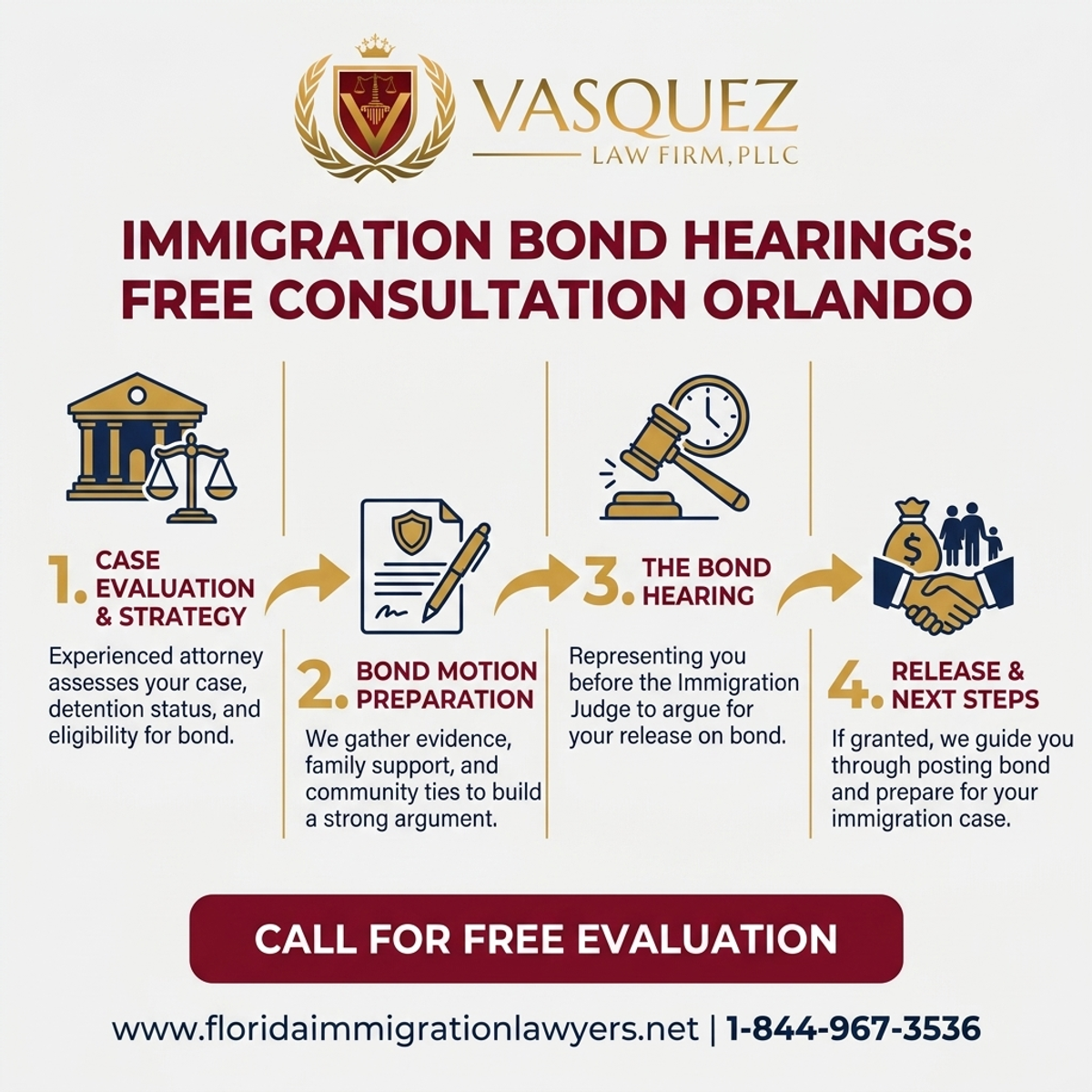
Key Statistics — Immigration Lawyer Orlando Free Consultation: Bond Hearings
Factors influencing the bond amount include the seriousness of any criminal history, prior immigration violations, family ties in the U.S., length of residence, employment history, and financial resources. An individual with a clean record, strong community ties in Florida, and a stable job is more likely to receive a lower bond than someone with a significant criminal history or a record of failing to appear in court. An experienced immigration lawyer in Orlando can present a persuasive case to the Immigration Judge, arguing for a lower bond amount based on the specific equities of the detained individual. This can save families thousands of dollars and facilitate a quicker release.
What Factors Influence an Immigration Judge's Bond Decision?
An Immigration Judge's decision regarding an immigration bond is not arbitrary; it is based on a careful assessment of specific factors to determine if the detained individual poses a flight risk or a danger to the community. These factors are considered under 8 CFR § 1236.1 and BIA precedent decisions. The judge's discretion is broad, making the presentation of a compelling case by a knowledgeable attorney even more critical.
Key factors that Immigration Judges typically evaluate include:
- Ties to the Community: This is a primary consideration. The judge will look at the individual's family ties in the U.S. (especially U.S. citizen or LPR relatives), property ownership in Florida, employment history, and community involvement (e.g., church, volunteer work). Strong ties suggest a lower flight risk.
- Criminal History: Any past arrests, convictions, or pending charges are thoroughly scrutinized. Serious criminal offenses, especially those involving violence, drugs, or moral turpitude, significantly reduce the likelihood of bond or result in a very high bond amount. Certain crimes can even make an individual ineligible for bond entirely under INA 236(c).
- Immigration History: The judge will consider prior immigration violations, such as previous deportations, voluntary departures, or failures to appear for court hearings. A history of non-compliance with immigration laws will negatively impact the bond decision.
- Length of Residency in the U.S.: How long the individual has lived in the United States, particularly if they have established deep roots over many years, can be a favorable factor. This is especially true for individuals who have lived in Florida for an extended period.
- Employment History and Financial Resources: Stable employment and financial stability demonstrate responsibility and provide a means of support, making the individual less likely to abscond. The ability to pay a bond is also considered, though it should not be the sole determining factor.
- Good Moral Character: Evidence of good moral character, such as letters of support from employers, community leaders, or family members, can be persuasive. This can also include participation in rehabilitation programs if there's a criminal history.
- Manner of Entry into the U.S.: While not always a decisive factor, how an individual entered the country (e.g., lawful entry versus entry without inspection) can sometimes play a role in the judge's assessment of flight risk.
An attorney from Florida Immigration Lawyers can effectively highlight positive factors and mitigate negative ones, constructing a strong argument tailored to the specific facts of the case before the Orlando Immigration Court. They understand how these elements are weighed and can present the most favorable light for the detained individual.
Do not navigate this process alone. Contact Florida Immigration Lawyers today at 1-844-967-3536 for a free case review.
Common Mistakes to Avoid in Immigration Bond Hearings
Navigating an immigration bond hearing without experienced legal counsel can lead to several critical errors that could result in continued detention or an unreasonably high bond amount. Avoiding these common mistakes is essential for a favorable outcome.
-
Failing to Seek Legal Representation: One of the biggest mistakes is attempting to represent oneself. Immigration law is incredibly complex, and an Immigration Judge is not obligated to explain all legal nuances or help present a case. Without a lawyer, individuals often miss crucial legal arguments, fail to present necessary evidence, and are unaware of their rights.
-
Not Presenting Sufficient Evidence: Many individuals fail to gather and present compelling evidence of their ties to the community, good moral character, or lack of flight risk. Vague statements or incomplete documentation are rarely persuasive to an Immigration Judge. A detailed, well-organized evidence packet is vital.
-
Misunderstanding Eligibility Criteria: Some individuals may mistakenly believe they are ineligible for bond due to a past minor offense, or conversely, believe they are guaranteed bond when they are not. Understanding the specific legal grounds for bond eligibility and non-eligibility (e.g., certain aggravated felonies under INA 236(c)) is crucial.
-
Providing Inconsistent Information: Any inconsistencies between statements made to ICE, CBP, or the Immigration Judge can severely damage credibility. It is vital to be truthful and consistent, and a lawyer can help prepare you for questioning.
-
Failing to Disclose Criminal History: Attempting to hide or downplay past criminal convictions is a grave error. Immigration Judges have access to criminal records. Full disclosure, along with certified court dispositions, allows an attorney to address these issues proactively and present them in the best possible light.
-
Missing Deadlines or Hearings: Immigration court operates on strict deadlines. Missing a scheduled bond hearing or failing to respond to court orders can lead to an order of removal in absentia, making it much harder to pursue future relief.
-
Appealing Without Counsel: If an Immigration Judge denies bond or sets an unreasonably high amount, there is a right to appeal to the Board of Immigration Appeals (BIA). This appellate process is highly technical, and attempting it without an experienced attorney is almost always futile.
-
Ignoring Bond Conditions: If released on bond, individuals must strictly adhere to all conditions, such as appearing at all scheduled court dates. Failure to do so will result in bond forfeiture and likely re-detention.
-
Not Understanding the Role of the Bond Obligor: The person who posts the bond (the obligor) has responsibilities. They must ensure the detained individual appears for all court dates. If the individual fails to appear, the obligor can lose the bond amount. Understanding these obligations is critical.
When to Call an Immigration Lawyer for a Bond Hearing
The decision to contact an immigration lawyer should ideally happen as soon as a loved one is detained by ICE. The complexities of immigration law, combined with the urgency of securing release, make legal representation not just beneficial, but often essential. Florida Immigration Lawyers are available 24/7 to assist families across Florida, including those seeking an immigration lawyer Orlando free consultation.
You should immediately call an attorney if:
- A family member has been detained by ICE: Time is of the essence. An attorney can quickly determine if a bond hearing is possible and begin preparing for it.
- ICE has set a bond amount that is too high: An attorney can file a motion for a bond redetermination with an Immigration Judge, arguing for a lower, more reasonable amount.
- The detained individual has a criminal record: Certain criminal convictions can make an individual ineligible for bond or increase the bond amount significantly. An attorney can assess the impact of the criminal history and present mitigating factors.
- There are prior immigration violations: Past deportations, voluntary departures, or failures to appear can complicate bond eligibility. An attorney can navigate these issues.
- You are unsure about the bond hearing process or what evidence to present: A lawyer provides expert guidance, ensuring all necessary documentation is gathered and presented effectively.
- The individual is being held at a remote detention center: Facilities like Glades County Detention Center can be difficult to access. An attorney can communicate with the detained individual and the court on your behalf.
Florida Immigration Lawyers specialize in deportation defense and bond hearings. Our attorneys are well-versed in the procedures of the Orlando Immigration Court and other Florida immigration courts. We offer a free case review to assess your situation, explain your options, and develop a strategic plan to fight for your loved one's release. Our empathetic approach ensures you and your family feel supported throughout this challenging process.
About Florida Immigration Lawyers
Florida Immigration Lawyers is a leading law firm dedicated to providing comprehensive and compassionate immigration legal services across the entire state of Florida. With a deep understanding of U.S. immigration laws and their impact on individuals and families, our firm stands as a beacon of hope for those navigating complex legal challenges. We are committed to protecting the rights and interests of immigrants, offering personalized strategies and unwavering advocacy.
Our team of experienced attorneys specializes in a wide range of immigration matters, including:
Immigration Law
Deportation Defense
Asylum
Citizenship
Family-Based Immigration
Business Immigration
We understand the unique needs of Florida's diverse immigrant communities, from Orlando to Miami, Tampa to Jacksonville. Our firm is available 24/7 to provide immediate assistance and offers free case reviews to help you understand your legal options without financial commitment. Choosing Florida Immigration Lawyers means choosing a team that is not only highly skilled but also deeply empathetic to your situation. We fight tirelessly for favorable outcomes, ensuring that every client receives the dedicated attention and expert guidance they deserve. For immediate assistance, please call us at 1-844-967-3536 or visit our website at www.floridaimmigrationlawyers.net.
Sources and References
- U.S. Citizenship and Immigration Services (USCIS)
- Executive Office for Immigration Review (EOIR)
- U.S. Department of State
- 8 U.S.C. § 1229a (Immigration and Nationality Act Section 240 - Removal Proceedings)
- 8 U.S.C. § 1226 (Immigration and Nationality Act Section 236 - Apprehension and Detention of Aliens)
- 8 C.F.R. § 236.1 (Apprehension, custody, detention, and parole)
- 8 C.F.R. § 1236.1 (Apprehension, custody, detention, and parole)
- Matter of Guerra, 24 I&N Dec. 37 (BIA 2006) (precedent decision on bond factors)
Related services: immigration waivers, humanitarian protection programs, DACA renewal and applications, temporary protected status (TPS).
This article provides general legal information and is not intended as legal advice. Every case is unique, and outcomes depend on specific facts and circumstances. Contact an attorney for advice about your particular situation.
If you or a loved one is facing an immigration bond hearing in Florida, immediate legal action is crucial. Don't let the fear and uncertainty of detention define your future. Florida Immigration Lawyers are here to provide the expert legal representation you need to fight for release and navigate your immigration case successfully. Call us today at 1-844-967-3536 for a free, confidential case review. Se Habla Español - Estamos aqui para ayudarle.
Do Not Navigate This Process Alone
Our experienced immigration attorneys are ready to fight for you. Get a free, confidential consultation today.
Se Habla Español
Or leave your details and we’ll call you:
Free Evaluation in 24 Hours
Or talk to us right now

AI voice assistant — available 24/7
FreeFrequently Asked Questions

William J. Vásquez
Founding Attorney · Vasquez Law Firm
U.S. Air Force veteran and immigration attorney with years of hands-on U.S. immigration experience. J.D., NCCU School of Law. AILA member. Admitted to the 4th, 5th, and 11th Circuit Courts.
Available 24/7 - Free Evaluations
Reviewed for legal accuracy by William J. Vásquez
Licensed in North Carolina; U.S. immigration is federal practice.
Related Legal Services
Our Florida immigration attorneys can help you with citizenship and naturalization, family immigration services and immigration practice areas. Call today at 1-844-967-3536 for a free consultation.
Related Links
Related Topics
Free Legal Consultation
Discuss your case with our experienced attorneys. We're available 24/7.
Se Habla Español - Estamos aquí para ayudarle.
Related Articles
Immigration Lawyer Orlando Free Consultation in Florida
For individuals and families in Orlando, Florida, navigating the complexities of U.S. immigration law requires expert guidance. An immigration lawyer in Orlando offers crucial support for everything from visa applications and green card processes to naturalization and deportation defense. This comprehensive guide details what a free consultation covers, providing a step-by-step overview of immigration pathways, essential document checklists, and expected timelines in 2026. We also highlight common mistakes to avoid, discuss the critical role of legal counsel in deportation and asylum cases, and explain why choosing a local Orlando immigration attorney is beneficial. Florida Immigration Lawyers is dedicated to serving the diverse community of Orlando with compassionate, effective legal solutions, ensuring you receive personalized advice and robust representation for a successful immigration journey.
Immigration Lawyer Orlando Free Consultation: Your Defense
Facing immigration challenges in Orlando or anywhere in Florida? Secure an immigration lawyer Orlando free consultation to understand your legal options, especially if you are in removal proceedings. This guide covers the complexities of deportation defense, including reasons for removal, the step-by-step process, crucial document checklists, and cost considerations for legal representation. Learn how an experienced removal proceedings defense lawyer in Florida can help you navigate the system, avoid common mistakes, and fight for your right to remain in the U.S. Discover when to call a lawyer and how Florida Immigration Lawyers provides compassionate and effective advocacy. Start protecting your future today with a free case review.
Green Card Holders Issued New Warning: Renewing in Florida
Green card holders in Florida are advised of new warnings emphasizing the critical importance of timely green card renewal. An expired green card, though not revoking your status, can lead to significant problems with employment, travel, and proving your lawful permanent residency. The renewal process primarily involves filing Form I-90, Application to Replace Permanent Resident Card, with USCIS. This guide provides a comprehensive overview of the steps, required documentation, timelines, and costs involved in renewing your green card in Florida for 2026. It also highlights common mistakes to avoid and when to seek legal counsel to ensure a smooth and compliant process. Florida Immigration Lawyers offers expert assistance to permanent residents throughout the state, helping them navigate complex immigration regulations and secure their future. Timely action is essential to avoid legal complications and maintain your rights.
Orlando Immigration Criminal Defense Attorney: Florida 2026
For immigrants in Orlando, Florida, a criminal charge or conviction can jeopardize their future in the U.S. An Orlando immigration criminal defense attorney specializes in navigating the complex intersection of criminal and immigration law, offering vital defense strategies and advocating for criminal waivers like Form I-601. This comprehensive guide from Florida Immigration Lawyers explores common grounds of inadmissibility, the I-601 application process, associated costs, and crucial mistakes to avoid. Learn how expert legal counsel can help protect your immigration status and provide a path forward, even in the face of challenging criminal issues in Florida. Secure your rights and future with dedicated legal support.