Immediate Relative Petition Tampa: What to Know in 2026
For U.S. citizens in Florida, sponsoring an immediate relative for a green card is a direct path to family reunification. This guide explains the immediate relative petition process in 2026, covering eligibility for spouses, children, and parents. Unlike other categories, immediate relatives are not subject to visa quotas, potentially speeding up processing times. We detail the steps for filing Form I-130, required documents for both the petitioner and beneficiary, and provide a comprehensive overview of typical timelines and costs. Learn about common challenges, such as proving bona fide relationships and addressing inadmissibility, and discover why legal assistance from Florida Immigration Lawyers is crucial for a successful outcome. We serve families across Florida, including Tampa and Jacksonville, offering expert guidance and support.

An immediate relative petition allows U.S. citizens to sponsor close family members—spouses, unmarried children under 21, and parents—for a green card. Unlike other family-based categories, there is no annual limit on the number of visas available for immediate relatives, meaning processing times can often be faster once the initial petition (Form I-130) is approved. The process typically involves filing Form I-130 with USCIS, followed by either Adjustment of Status if the relative is in the U.S. or Consular Processing if they are abroad. Seeking legal guidance, especially in areas like Tampa, Florida, is crucial to navigate the complexities and avoid common pitfalls.
- Immediate relatives include spouses, unmarried children under 21, and parents of U.S. citizens.
- There are no visa quotas, potentially leading to faster processing.
- The process starts with Form I-130, Petition for Alien Relative.
- Adjustment of Status or Consular Processing follows I-130 approval.
- Legal assistance from Florida Immigration Lawyers is highly recommended.
Navigating the U.S. immigration system can be a daunting and often emotional journey, especially when you are trying to reunite with your loved ones. For many U.S. citizens in Florida, sponsoring an immediate relative for a green card is the most direct path to family reunification. Whether you're in Tampa, Jacksonville, or anywhere across the Sunshine State, understanding the intricacies of an immediate relative petition Tampa or elsewhere in Florida is paramount. This process offers a unique advantage because, unlike other family-based immigration categories, immediate relatives are not subject to annual visa quotas, which can significantly expedite the path to a green card.
This comprehensive guide will walk you through everything you need to know about immediate relative petitions in 2026. We will cover eligibility criteria, the step-by-step application process, essential documents, typical timelines, and associated costs. Our goal is to provide clear, actionable information to help you and your family navigate this critical journey successfully. We understand the stakes involved in family immigration, and our experienced team is here to support you every step of the way. Do not embark on this complex process alone. Call Florida Immigration Lawyers at 1-844-967-3536 for a free consultation today.
What is an immediate relative petition, and who qualifies in Florida?
An immediate relative petition allows U.S. citizens to sponsor certain close family members for permanent residency, offering a direct path to a green card without the long waiting periods often associated with other family-based categories. This special designation is outlined in the Immigration and Nationality Act (INA) Section 201(b)(2)(A)(i), which specifies that immediate relatives include spouses of U.S. citizens, unmarried children under 21 years of age of U.S. citizens, and parents of U.S. citizens (if the U.S. citizen petitioner is at least 21 years old). As of 2026, these definitions remain consistent, providing a clear framework for family reunification.
The key benefit of being classified as an immediate relative is the exemption from numerical limitations. This means there is no annual cap on the number of visas available, allowing for faster processing once the initial petition is approved. For families in Florida, whether residing in Tampa, Orlando, or Miami, this distinction is incredibly important. It means your loved ones can potentially join you sooner, without waiting for a visa number to become available, which can take years or even decades for other preference categories. The process begins with filing Form I-130, Petition for Alien Relative, with U.S. Citizenship and Immigration Services (USCIS). This form establishes the qualifying relationship between the U.S. citizen petitioner and the immediate relative beneficiary.
Eligibility for an immediate relative petition Tampa or anywhere else in Florida hinges entirely on the relationship type and the petitioner's U.S. citizenship status. The U.S. citizen must be able to prove their citizenship (e.g., via a birth certificate, U.S. passport, or naturalization certificate) and demonstrate a legitimate familial relationship with the beneficiary. For spouses, this involves proving a bona fide marriage, not one entered into solely for immigration purposes. For children, it requires proof of parentage and that the child is unmarried and under 21. For parents, the U.S. citizen child must demonstrate parentage and be at least 21 years old. These requirements are strictly enforced by USCIS to prevent fraud and ensure the integrity of the immigration system. Understanding these foundational elements is the first step toward a successful application.
How do I file an I-130 petition for an immediate relative in Florida in 2026?
Filing an I-130 petition for an immediate relative in Florida in 2026 involves a series of structured steps designed to establish the qualifying family relationship with U.S. Citizenship and Immigration Services (USCIS). The process begins with the U.S. citizen petitioner accurately completing Form I-130, Petition for Alien Relative. This form is the cornerstone of your immediate relative petition, providing USCIS with the necessary details about both the petitioner and the beneficiary, as well as the nature of their relationship. Attention to detail is crucial, as any errors or omissions can lead to delays or even denial.
- Gather Essential Documents: Before filling out Form I-130, collect all required supporting documents. This includes proof of your U.S. citizenship (birth certificate, passport, naturalization certificate), proof of the qualifying relationship (marriage certificate for spouses, birth certificate for children/parents), and any evidence of name changes. For spouses, extensive evidence of a bona fide marriage, such as joint bank accounts, shared leases, photos, and affidavits from friends and family, is vital.
- Complete Form I-130: Fill out Form I-130 accurately and completely. Ensure all questions are answered, and no sections are left blank unless not applicable. You can find the latest version and instructions on the USCIS website.
- Prepare Supporting Evidence: Organize all your supporting documents. Make sure copies are clear and legible. If any documents are not in English, they must be accompanied by a certified English translation.
- Pay the Filing Fee: As of 2026, the filing fee for Form I-130 must be paid at the time of submission. Check the USCIS website for the most current fee schedule, as fees can change. Payment can be made by money order, personal check, cashier's check, or by credit card using Form G-1450, Authorization for Credit Card Transactions.
- Mail the Petition: Submit the completed Form I-130, all supporting documents, and the fee to the correct USCIS lockbox facility. The specific mailing address depends on where you live in Florida and the type of petition. Always refer to the "Where to File" section of the I-130 instructions on the USCIS website. For residents in Tampa, Jacksonville, or other Florida cities, the filing address will typically be a designated lockbox.
- Receive Receipt Notice: After USCIS receives your petition, they will send you a Form I-797C, Notice of Action, acknowledging receipt. This notice will include your case number, which you can use to track the status of your petition online.
- Attend Biometrics Appointment (if applicable): Depending on the subsequent steps (Adjustment of Status), the beneficiary may need to attend a biometrics appointment at a local Application Support Center (ASC) in Florida.
Following these steps meticulously is essential for a smooth process. Given the complexities, particularly with documentation and ensuring all legal requirements are met, many Florida residents choose to work with experienced immigration attorneys. This is especially true for those navigating an immediate relative petition Tampa, where local USCIS field offices may have specific procedures or common requests. An attorney can help ensure your petition is perfectly prepared and submitted.
What documents are needed for an immediate relative green card application?
A successful immediate relative green card application, whether pursued through Adjustment of Status in Florida or Consular Processing abroad, requires a comprehensive set of documents from both the U.S. citizen petitioner and the immediate relative beneficiary. Gathering these documents accurately and completely is critical to avoid delays and ensure a smooth review by USCIS or the Department of State. As of 2026, the fundamental document requirements remain consistent, emphasizing proof of identity, citizenship, and the bona fide nature of the qualifying relationship.
Required Documents for the U.S. Citizen Petitioner:
- Proof of U.S. Citizenship: U.S. birth certificate, U.S. passport, Certificate of Naturalization, or Certificate of Citizenship.
- Proof of Name Change (if applicable): Marriage certificate, divorce decree, or court order.
- Marriage Certificate (for spousal petitions).
- Birth Certificate (for parent-child petitions, showing petitioner's parentage).
- Proof of Domicile in the U.S. (especially for consular processing, demonstrating intent to reside in the U.S. with the beneficiary).
- Form I-864, Affidavit of Support (after I-130 approval, to demonstrate financial ability to support the immigrant).
- Tax transcripts and employment verification letters to support Form I-864.
Required Documents for the Immediate Relative Beneficiary:
- Birth Certificate.
- Passport (valid for at least six months beyond the intended date of entry to the U.S.).
- Marriage Certificate (if applicable, for spousal petitions).
- Divorce Decrees or Death Certificates (for any previous marriages, if applicable).
- Police Certificates from all countries resided in for more than six months since age 16.
- Medical Examination Report (from an authorized civil surgeon or panel physician).
- Photographs (passport-style).
- Form I-485, Application to Register Permanent Residence or Adjust Status (if adjusting status in the U.S.).
- Form DS-260, Immigrant Visa Application (if undergoing consular processing abroad).
- Form I-693, Report of Medical Examination and Vaccination Record.
- Form I-94 Arrival/Departure Record (if adjusting status in the U.S., showing legal entry).
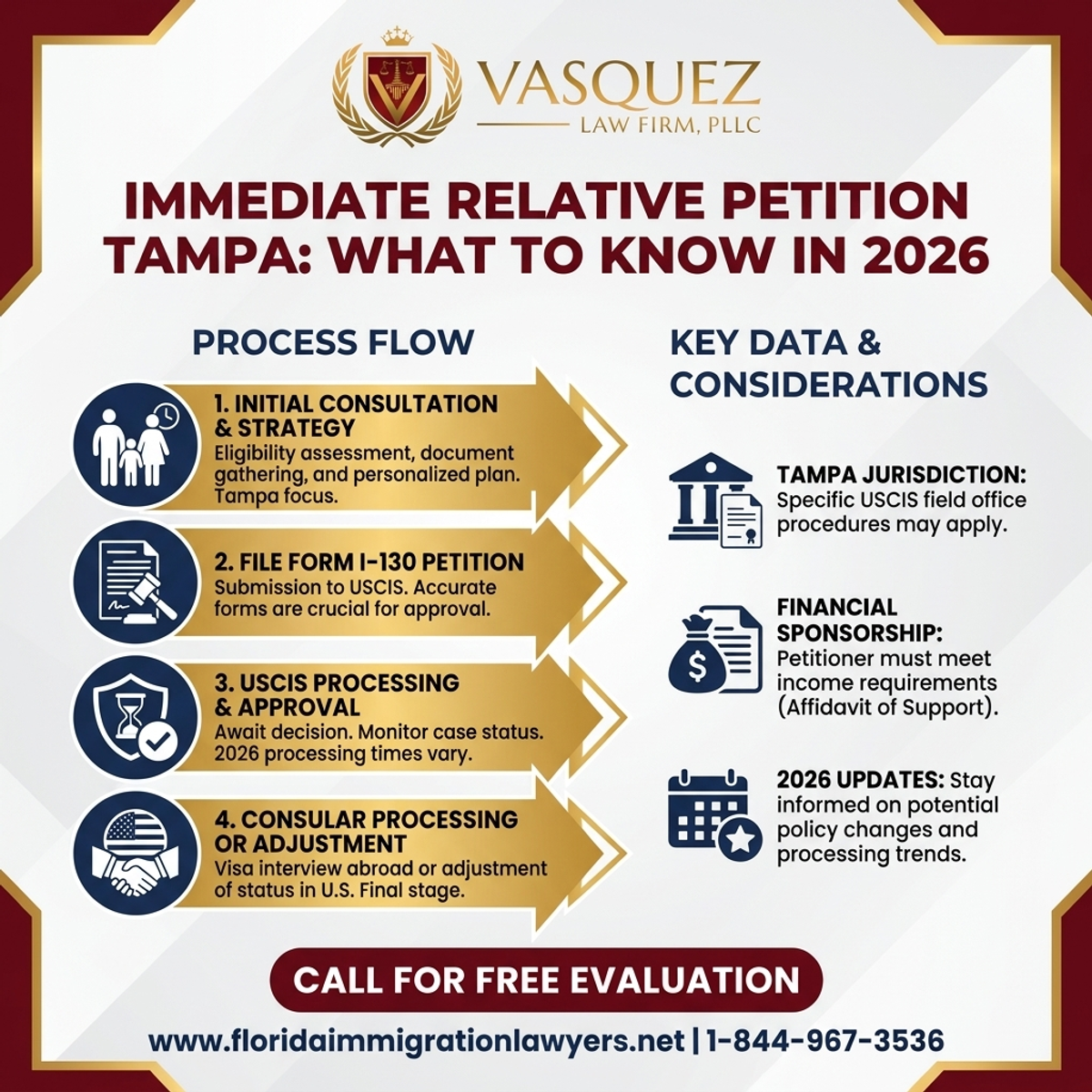
Step-by-Step Process — Immediate Relative Petition Tampa: What to Know in 2026
For spousal petitions, additional evidence of a bona fide marriage is crucial. This can include joint bank account statements, joint leases or mortgages, utility bills in both names, insurance policies, photographs together, and affidavits from individuals who can attest to the legitimacy of the marriage. USCIS field offices in Florida, such as those in Jacksonville or Orlando, are particularly vigilant in scrutinizing these documents. Ensuring every piece of evidence is complete and accurately presented can make a significant difference in the outcome of your family immigration Florida case.
What are the typical timelines and costs for an immediate relative petition in Florida?
The timeline and costs for an immediate relative petition in Florida can vary based on several factors, including the specific relationship, the volume of applications at USCIS, and whether the beneficiary is adjusting status in the U.S. or undergoing consular processing abroad. As of 2026, while immediate relatives are not subject to visa quotas, the administrative processing of petitions still takes time. Understanding these expectations can help families plan their immigration journey effectively.
Typical Timeline for Immediate Relative Petitions (as of 2026):
| Stage | Typical Timeframe | Notes |
|---|---|---|
| Form I-130 Processing | 10-18 months | Processing times can vary by USCIS service center. Check the USCIS website for current estimates. |
| Form I-485 (Adjustment of Status) | 12-24 months | Includes biometrics, interview, and decision. Can be filed concurrently with I-130 for spouses/children under 21 if legally present. |
| Consular Processing (NVC & Interview) | 6-12 months after I-130 approval | Involves National Visa Center (NVC) processing, document collection, and interview at a U.S. embassy/consulate abroad. |
| Work Permit (EAD) & Travel Permit (Advance Parole) (if filed concurrently with I-485) | 6-12 months | These can be applied for using Forms I-765 and I-131 while the I-485 is pending. |
Cost Factors for Immediate Relative Petitions (as of 2026):
| Item | Typical Fee | Notes |
|---|---|---|
| Form I-130 Filing Fee | Varies (check USCIS website) | Mandatory fee for filing the Petition for Alien Relative. |
| Form I-485 Filing Fee (Adjustment of Status) | Varies (check USCIS website) | Includes biometrics fee. Required for beneficiaries adjusting status in the U.S. |
| Form I-765 Filing Fee (Work Permit) | Varies (check USCIS website) | Often combined with I-485 fee, or separate if filed later. |
| Form I-131 Filing Fee (Travel Permit) | Varies (check USCIS website) | Often combined with I-485 fee, or separate if filed later. |
| Medical Examination | $200 - $500 | Paid to authorized civil surgeon or panel physician. Not paid to USCIS. |
| Consular Processing Immigrant Visa Application Fee (DS-260) | Varies (check State Dept. website) | Required for beneficiaries undergoing consular processing abroad. |
| Attorney Fees | Varies widely | Highly recommended for expert guidance, document preparation, and representation. |
| Miscellaneous Costs | $100 - $300+ | Includes translations, postage, photocopying, travel for appointments. |
It's important to note that USCIS fees are subject to change, so always verify the current amounts on the official USCIS website. The total cost of an I-130 green card application can be substantial, and these fees do not include legal representation. While the timeline for immediate relatives is generally more favorable than for other family categories, patience and thorough preparation are still essential for success in Florida's immigration landscape.
What are common challenges and solutions for family immigration in Florida?
Family immigration cases in Florida, including those involving an immediate relative petition Tampa, often encounter specific challenges that can complicate the process. Understanding these hurdles and knowing how to address them is crucial for a successful outcome. From proving bona fide relationships to navigating complex legal requirements, many factors can impact your application. Florida's diverse population means many cases involve beneficiaries from various countries, each with unique document requirements and consular processing nuances.
Common Challenges:
- Proving Bona Fide Marriage: For spousal petitions, USCIS rigorously scrutinizes the authenticity of the marriage. Insufficient evidence of a shared life or a perception that the marriage was entered into solely for immigration benefits can lead to denials.
- Inadmissibility Issues: Beneficiaries may have inadmissibility grounds due to past immigration violations, criminal history, certain health conditions, or misrepresentations. These issues require waivers, which are complex to obtain.
- Documentation Problems: Missing birth certificates, marriage licenses, or other vital records, especially from countries with less robust record-keeping, can cause significant delays. Translations must also be certified and accurate.
- Financial Sponsorship (Affidavit of Support): The U.S. citizen petitioner must demonstrate sufficient income to support the immigrant. If their income is below the poverty guidelines, a joint sponsor may be needed, adding another layer of complexity.
- Changes in Law or Policy: Immigration laws and policies can shift, impacting processing times, forms, or requirements. Staying updated is challenging for laypersons.
- USCIS Interview Challenges: Interviews at local USCIS field offices (e.g., Orlando, Miami, Jacksonville) can be intimidating. Inconsistent answers or perceived evasiveness can jeopardize the case.
Effective Solutions:
- Thorough Documentation: Compile an extensive portfolio of evidence for bona fide marriages, including shared financial documents, property, photos, and affidavits. The more evidence, the stronger the case.
- Legal Consultations for Inadmissibility: If inadmissibility is a concern, consult an experienced immigration attorney immediately. They can assess eligibility for waivers and prepare a strong waiver application.
- Alternative Document Acquisition: Work with an attorney or explore options for obtaining alternative evidence if original documents are unavailable, such as secondary evidence or affidavits.
- Secure Joint Sponsor: If the primary petitioner's income is insufficient, identify a reliable joint sponsor early in the process and ensure they meet the financial requirements.
- Stay Informed or Get Representation: Regularly check official USCIS and Department of State websites for updates. Better yet, retain an attorney who stays abreast of all legal changes.
- Interview Preparation: Practice common interview questions and ensure both petitioner and beneficiary understand the facts of their case thoroughly and consistently.
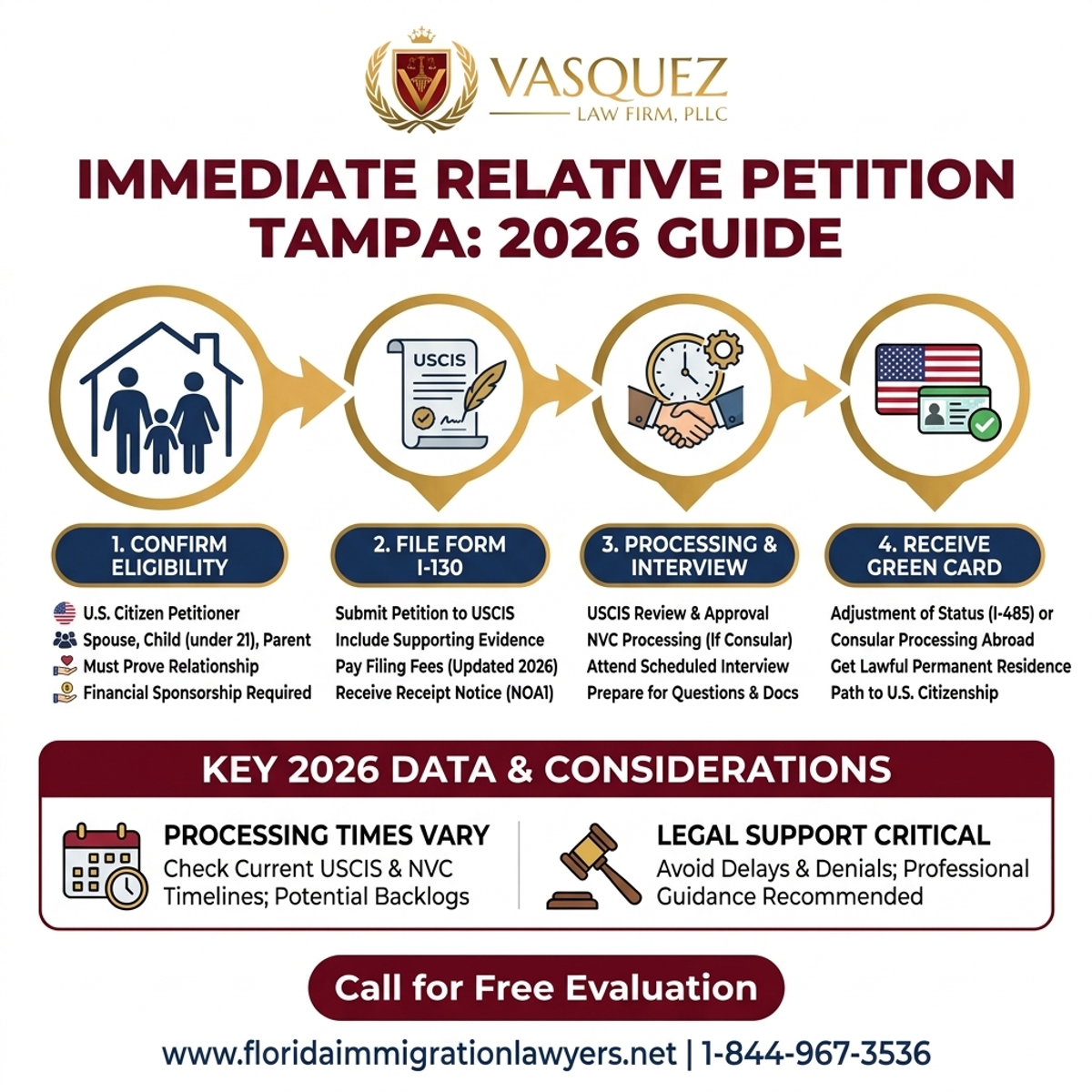
Key Statistics — Immediate Relative Petition Tampa: What to Know in 2026
Navigating these challenges requires meticulous preparation and a deep understanding of immigration law. For individuals and families in Florida, particularly those dealing with the nuances of an immediate relative petition Tampa, having seasoned legal counsel can be the difference between success and prolonged frustration. Florida Immigration Lawyers are adept at handling such complexities, offering strategic advice and robust representation.
Do not navigate this process alone. Contact Florida Immigration Lawyers today to ensure your family's future is secure. Call us at 1-844-967-3536 for a free consultation.
Common Mistakes to Avoid in Immediate Relative Petitions
The immediate relative petition process, while seemingly straightforward, is riddled with potential pitfalls that can lead to significant delays or even denial. Avoiding these common mistakes is crucial for a successful outcome, especially for families in Florida. Here are some key errors to watch out for:
- Incomplete or Inaccurate Forms: Submitting forms with blank fields, incorrect information, or outdated versions is a frequent cause of rejection or Request for Evidence (RFE). Always double-check every entry and use the latest forms from the USCIS website.
- Insufficient Evidence of Bona Fide Relationship: For spousal petitions, failing to provide substantial evidence that the marriage is genuine and not solely for immigration purposes can be fatal. Relying only on a marriage certificate is rarely enough; include joint financial documents, shared property, photos, and affidavits.
- Failure to Disclose All Prior Marriages: Both the petitioner and beneficiary must disclose all previous marriages and provide proof of termination (divorce decrees, death certificates). Omission can be considered misrepresentation.
- Not Meeting Financial Sponsorship Requirements: The U.S. citizen petitioner must file Form I-864, Affidavit of Support, demonstrating income at or above 125% of the poverty guidelines. Not meeting this or failing to secure a qualified joint sponsor will lead to denial.
- Missing or Incorrect Translations: Any document not in English must be accompanied by a complete and certified English translation. Translations must be accurate and include the translator's certification.
- Ignoring Inadmissibility Grounds: Not addressing potential grounds of inadmissibility (e.g., criminal history, past immigration violations, unlawful presence) can lead to outright denial. These often require complex waivers.
- Filing Adjustment of Status without Legal Entry: An individual cannot adjust status to permanent resident in the U.S. if they did not enter the country legally (e.g., without inspection). This usually requires consular processing abroad.
- Lack of Domicile for Petitioner: For consular processing, the U.S. citizen petitioner must demonstrate they are domiciled in the U.S. or intend to re-establish domicile by the time the beneficiary immigrates.
- Failing to Respond to RFEs or NOIDs: USCIS often issues Requests for Evidence (RFEs) or Notices of Intent to Deny (NOIDs). Failing to respond adequately and on time will result in denial.
- Not Preparing for the Interview: Attending the USCIS interview unprepared can lead to inconsistent answers or a poor impression, especially in spousal cases. Both parties should be thoroughly familiar with their own history and shared life.
- Submitting Expired Documents: Ensure all passports, identity documents, and medical examinations are current and valid at the time of submission and interview.
- Attempting to Handle Complex Cases Alone: While some simple cases might be managed independently, any complexity (e.g., prior arrests, overstays, previous denials) warrants professional legal assistance to avoid irreversible mistakes.
By being aware of these common pitfalls, families in Florida can significantly improve their chances of a successful family immigration process. Consulting with experienced attorneys from Florida Immigration Lawyers can help you proactively avoid these errors.
When to Call a Florida Immigration Lawyer for Your Immediate Relative Petition
While the immediate relative petition process is designed to be straightforward for eligible families, its underlying complexities can quickly become overwhelming. Knowing when to seek professional legal assistance is crucial to prevent delays, costly mistakes, and even denial. For residents across Florida, including Jacksonville and Tampa, an experienced immigration lawyer from Florida Immigration Lawyers can provide invaluable guidance and representation, especially in the following scenarios:
- Complex Family Situations: If you have previous marriages, step-children, or adoption circumstances, these can add layers of complexity to your petition. A lawyer can help properly document these relationships.
- Criminal History or Prior Immigration Violations: Any criminal record for either the petitioner or beneficiary, or past immigration issues such as overstays, unauthorized employment, or prior deportations, can trigger grounds of inadmissibility. Navigating waivers for these issues requires expert legal knowledge.
- Previous Denials or Difficulties: If a past petition was denied, or you've faced challenges with USCIS before, an attorney can help identify the root cause, address previous issues, and strengthen your current application.
- Difficulty Obtaining Documents: If you struggle to obtain vital records from abroad, or if documents are damaged or incomplete, a lawyer can advise on acceptable secondary evidence or alternative procedures.
- Suspicion of Fraud or Sham Marriage: If USCIS raises concerns about the legitimacy of your marriage or relationship, legal counsel is essential to present compelling evidence and protect your rights during an interview.
- Language Barriers: If either the petitioner or beneficiary is not fluent in English, an attorney can ensure all forms are correctly understood and completed, and can assist with communication during interviews.
- Overwhelmed by the Process: The sheer volume of forms, documents, and instructions can be intimidating. A lawyer can simplify the process, manage deadlines, and ensure everything is filed correctly and on time.
- Need for Concurrent Filing: For beneficiaries present in the U.S., determining eligibility for concurrent filing of Form I-130 and I-485 is critical. An attorney can assess your specific situation and advise on the best strategy.
Florida Immigration Lawyers serves clients throughout the state, from Jacksonville to Miami, offering comprehensive legal support for all aspects of immediate relative and family immigration cases. Our dedicated team is committed to providing personalized attention and strategic solutions to help your family achieve its immigration goals. Do not take chances with your family's future; let our experienced attorneys guide you.
About Florida Immigration Lawyers
Florida Immigration Lawyers is a premier law firm dedicated to serving individuals and families throughout the state of Florida with their diverse immigration needs. With a deep understanding of U.S. immigration law and a compassionate approach, our experienced attorneys are committed to providing exceptional legal representation. We pride ourselves on offering personalized service, ensuring that each client's unique circumstances are thoroughly understood and addressed. From complex deportation defense cases to straightforward family petitions, our firm stands ready to advocate tirelessly on your behalf.
Our comprehensive practice areas include family immigration, business immigration, asylum, naturalization, and deportation defense. Whether you are seeking an I-130 green card, navigating the complexities of an immediate relative petition, or require assistance with any other immigration matter, our team possesses the knowledge and expertise to guide you. We understand the emotional and financial investment involved in immigration processes and strive to make your journey as smooth and stress-free as possible. Our firm is available 24/7, offering free consultations to discuss your case and outline your best legal options.
Choosing Florida Immigration Lawyers means choosing a partner who will stand by you every step of the way. We serve all of Florida, including major cities like Jacksonville, Tampa, Orlando, and Miami, providing accessible and effective legal solutions. Our commitment to our clients is unwavering, and our track record of success speaks for itself. For trusted legal counsel and dedicated support in your immigration journey, contact Florida Immigration Lawyers at 1-844-967-3536 or visit www.floridaimmigrationlawyers.net.
Sources and References
- U.S. Citizenship and Immigration Services (USCIS) - Immediate Relative and Family-Sponsored Immigrant Process
- Executive Office for Immigration Review (EOIR)
- U.S. Department of State - Family-Sponsored Visas
- Immigration and Nationality Act (INA) Section 201(b)(2)(A)(i) - Immediate Relatives
- 8 U.S.C. § 1151(b)(2)(A)(i) - Numerical limitations on immigrant visas
- 8 CFR Part 204 - Petitions for Immigrant Relatives, Widows, and Special Immigrants
- USCIS Policy Manual
Related services: family petition process, family-based green cards, fiancé visa (K-1).
This article provides general legal information and is not intended as legal advice. Every case is unique, and outcomes depend on specific facts and circumstances. Contact an attorney for advice about your particular situation.
Reuniting with your immediate family is a fundamental right and a cornerstone of U.S. immigration policy. While the journey to a green card can be complex, you do not have to navigate it alone. Florida Immigration Lawyers is here to provide the expert legal guidance and compassionate support you need to achieve your family immigration goals. Take the first step towards a brighter future for your loved ones. Call us today for a free consultation. Se Habla Espanol - Estamos aqui para ayudarle. Contact Florida Immigration Lawyers at 1-844-967-3536.
If you need legal assistance, learn more about how our family immigration attorneys can help, or call us at 1-844-967-3536 for a free consultation.
Do Not Navigate This Process Alone
Our experienced immigration attorneys are ready to fight for you. Get a free, confidential consultation today.
Se Habla Español
Or leave your details and we’ll call you:
Free Evaluation in 24 Hours
Or talk to us right now

AI voice assistant — available 24/7
FreeFrequently Asked Questions

William J. Vásquez
Founding Attorney · Vasquez Law Firm
U.S. Air Force veteran and immigration attorney with years of hands-on U.S. immigration experience. J.D., NCCU School of Law. AILA member. Admitted to the 4th, 5th, and 11th Circuit Courts.
Available 24/7 - Free Evaluations
Reviewed for legal accuracy by William J. Vásquez
Licensed in North Carolina; U.S. immigration is federal practice.
Related Legal Services
Our Florida immigration attorneys can help you with immigration practice areas, free immigration consultation and experienced immigration attorneys. Call today at 1-844-967-3536 for a free consultation.
Related Links
Related Topics
Free Legal Consultation
Discuss your case with our experienced attorneys. We're available 24/7.
Se Habla Español - Estamos aquí para ayudarle.
Related Articles
Immigration Lawyer Orlando Free Consultation 2026
Discover how to find an immigration lawyer in Orlando offering a free consultation. Understand the services available and why choosing Florida Immigration Lawyers can make a difference in your case.
Military Naturalization Expedited in Florida Bases
Explore military naturalization options for families at Florida bases, including parole in place benefits in Miami. Learn how to expedite your application with expert guidance from Florida Immigration Lawyers.
K-3 Visa Timeline in Florida: What to Expect
Learn the K-3 visa timeline process in Florida, including steps, costs, and documentation. Understand your options in 2026 with guidance from Florida Immigration Lawyers.
T Visa for Trafficking Victims in Florida: 2026 Guide
The T visa provides legal status to trafficking victims in Florida, offering a path to safety and a chance for a new life. Learn about eligibility, application steps, and crucial tips for success in this comprehensive guide. Contact Florida Immigration Lawyers for expert legal assistance.