Immediate Relative Petitions Florida: Your Guide to...
For U.S. citizens in Florida, an immediate relative petition offers a streamlined path to a green card for spouses, minor children, and parents. This comprehensive guide from Florida Immigration Lawyers details the step-by-step process, from filing Form I-130 to interview and approval. Learn about eligibility, required documents, processing timelines, and common pitfalls to avoid. We emphasize the importance of accurate documentation and professional legal assistance to navigate the complexities of USCIS procedures. Whether your relative is in Hollywood or abroad, understanding this process is crucial for successful family reunification. Contact us for expert guidance and a free consultation.

An immediate relative petition in Florida allows U.S. citizens to sponsor close family members-spouses, unmarried children under 21, and parents-for a U.S. green card without facing lengthy visa backlogs. This process, primarily initiated by filing Form I-130, offers a direct path to permanent residency, distinguishing it from other family-based categories with extensive waiting lists. Understanding eligibility and meticulous document preparation are crucial for success.
- Immediate relatives include spouses, minor children, and parents of U.S. citizens.
- No visa bulletin wait times apply to immediate relatives.
- The process typically involves filing Form I-130 and then either Adjustment of Status or Consular Processing.
- Accurate documentation and adherence to USCIS guidelines are essential.
- Legal assistance can significantly streamline the complex petition process.
Are you a U.S. citizen in Hollywood, Florida, dreaming of reuniting with your loved ones? Do you wish to bring your spouse, child, or parent to live permanently in the United States? The path to family reunification through an immediate relative petition can seem daunting, filled with complex forms, strict deadlines, and specific legal requirements.
Many Florida families face similar challenges when navigating the U.S. immigration system. Understanding the intricacies of immediate relative petitions is the first step toward achieving your family's immigration goals. This comprehensive guide from Florida Immigration Lawyers will walk you through every stage of the process, ensuring you are well-informed and prepared.
We will cover everything from eligibility criteria and required documents to processing timelines and potential costs. Our aim is to demystify the journey, providing clear, actionable information tailored for Florida residents. If you're ready to take the next step or have specific questions, do not hesitate. Call Florida Immigration Lawyers at 1-844-967-3536 for a free consultation.
Understanding Immediate Relative Petitions for Florida Families
The U.S. immigration system prioritizes certain close family relationships, categorizing them as "immediate relatives." This designation is incredibly significant because it means these family members are not subject to the annual numerical limitations and extensive waiting lists that apply to other family-based visa categories. For families across Florida, from Miami to Jacksonville, this distinction offers a quicker, more direct route to a green card.
Who Qualifies as an Immediate Relative?
According to U.S. immigration law, specifically INA 201(b)(2)(A)(i) (8 U.S.C. § 1151(b)(2)(A)(i)), an immediate relative is defined as:
- The spouse of a U.S. citizen.
- The unmarried child under 21 years of age of a U.S. citizen.
- The parent of a U.S. citizen, provided the U.S. citizen is at least 21 years of age.
It is crucial to note that only U.S. citizens can file immediate relative petitions. Lawful Permanent Residents (green card holders) can petition for certain family members, but those categories are subject to visa bulletin backlogs, meaning immediate relative status is exclusive to U.S. citizens.
The Significance of "Immediate Relative" Status
The primary benefit of immediate relative status is the availability of an immigrant visa immediately upon approval of the underlying petition. Unlike preference categories, where family members often wait many years for a visa number to become current, immediate relatives can proceed with their green card application as soon as their Form I-130, Petition for Alien Relative, is approved by USCIS. This expedited process is a cornerstone of family immigration policy.
For families in diverse communities like Hollywood, Florida, this means less time separated from loved ones. Whether you are sponsoring a spouse, a minor child, or a parent, understanding this classification is vital. It sets the stage for a more predictable and often faster immigration journey compared to other family-based routes.
The Immediate Relative Green Card Process: A Step-by-Step Guide
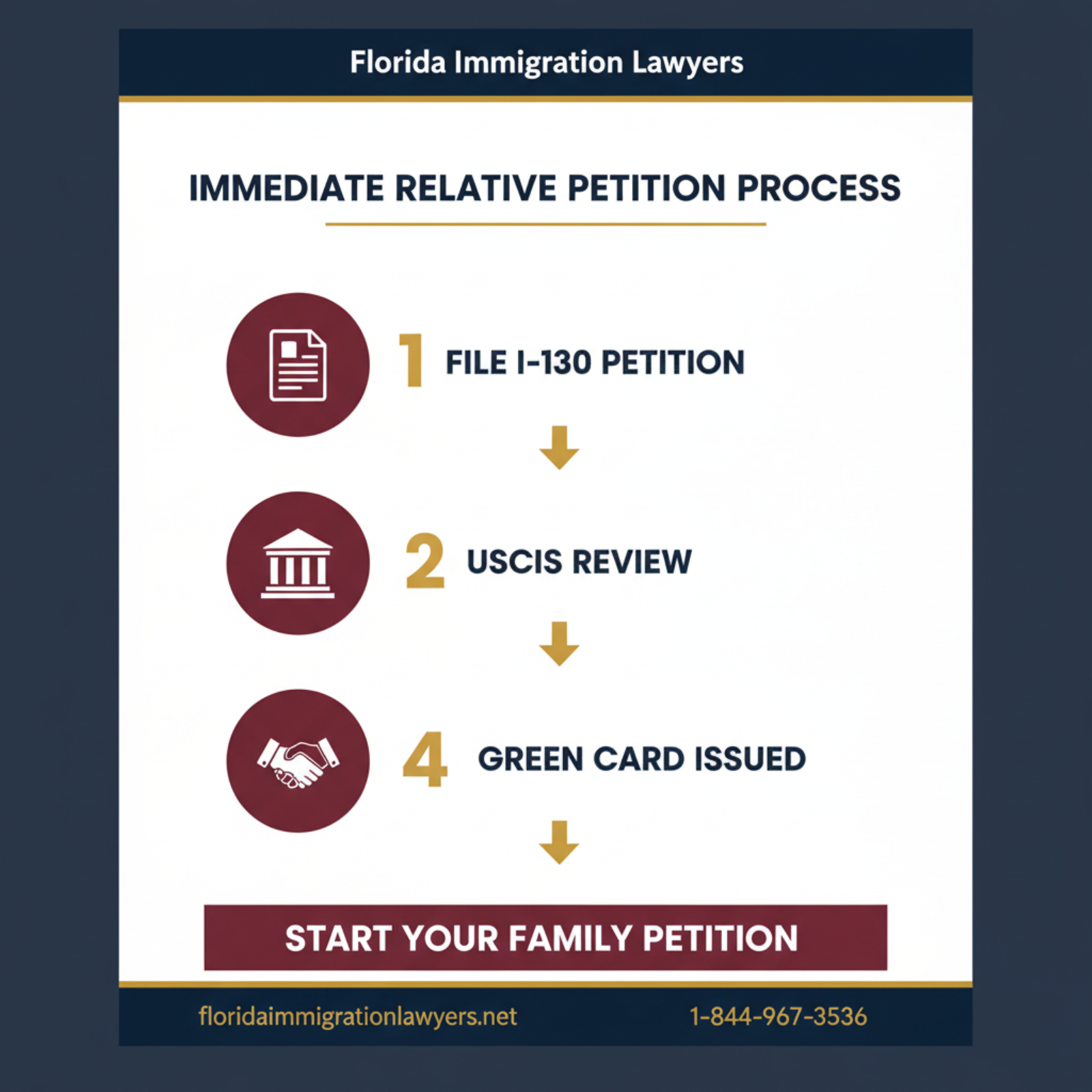
Bringing an immediate relative to the U.S. involves a structured process with several key stages. While the overall goal is consistent, the specific steps can vary slightly depending on whether your relative is already in the United States or resides abroad. Here's a general overview of the steps involved in an immediate relative green card application:
-
Step 1: Determine Eligibility and Gather Initial Information
Before filing, confirm that your relationship meets the definition of an immediate relative. You must be a U.S. citizen, and your relative must be your spouse, unmarried child under 21, or parent (if you are 21 or older). Collect basic information about both the petitioner (U.S. citizen) and the beneficiary (your relative).
This includes names, birth dates, addresses, and details about your relationship. Ensuring your eligibility from the outset prevents unnecessary delays and potential denials later in the process.
-
Step 2: File Form I-130, Petition for Alien Relative
The first official step is for the U.S. citizen petitioner to file Form I-130, Petition for Alien Relative, with U.S. Citizenship and Immigration Services (USCIS). This form establishes the qualifying family relationship between you and your immediate relative. It must be accompanied by supporting documentation proving the relationship, such as marriage certificates, birth certificates, and proof of your U.S. citizenship.
The filing fee must also be submitted at this stage. Accurate and complete filing of Form I-130 is paramount, as errors can lead to Requests for Evidence (RFEs) or even denials, prolonging the entire process. USCIS generally sends a receipt notice (Form I-797C) acknowledging receipt of your petition.
-
Step 3: USCIS Processing and Approval
Once USCIS receives your Form I-130, they will process it. This involves reviewing your petition and supporting documents to verify the authenticity of your relationship. Processing times can vary by service center, but you can check current estimates on the USCIS website. If USCIS requires more information, they will send an RFE. Responding promptly and thoroughly to an RFE is critical.
Upon approval, USCIS will send an I-797 approval notice. If your relative is already in the U.S. and eligible to adjust status, the approved I-130 is a prerequisite for their Form I-485 application. If your relative is abroad, the approved petition is forwarded to the National Visa Center (NVC).
-
Step 4: Adjustment of Status (for relatives in the U.S.) OR National Visa Center (NVC) Processing (for relatives abroad)
Adjustment of Status (AOS)
If your immediate relative is lawfully present in the U.S. and meets certain eligibility criteria, they can apply for Adjustment of Status to a lawful permanent resident using Form I-485. This allows them to obtain their green card without leaving the country. Form I-485 can often be filed concurrently with Form I-130 or after the I-130 is approved.
Along with Form I-485, the beneficiary will typically file for employment authorization (Form I-765) and advance parole (Form I-131) to allow them to work and travel while their green card application is pending. They will also attend a biometrics appointment and may be scheduled for an interview at a local USCIS field office, such as the one in Miami or Orlando.
Consular Processing
If your immediate relative lives outside the U.S., their case will proceed through consular processing. After the I-130 is approved, USCIS sends the petition to the National Visa Center (NVC). The NVC collects all necessary documents, including the Affidavit of Support (Form I-864) and civil documents, and ensures all fees are paid. The NVC will then schedule an interview at the U.S. Embassy or Consulate in the beneficiary's home country.
The NVC plays a vital role in preparing the case for interview. They provide detailed instructions on submitting documents electronically and paying fees. Following these instructions meticulously helps avoid delays.
-
Step 5: Biometrics Appointment and Interview
For both Adjustment of Status and Consular Processing, the beneficiary will undergo a biometrics appointment where their fingerprints and photographs are taken. This is used for background and security checks. Subsequently, an interview will be scheduled.
For AOS, interviews are typically held at a local USCIS office. For consular processing, the interview takes place at the U.S. Embassy or Consulate. During the interview, an immigration officer will verify the information provided in the application and confirm the authenticity of the relationship. Preparing thoroughly for this interview is essential.
-
Step 6: Green Card Approval
If the interview is successful and all requirements are met, the immediate relative's green card application will be approved. For AOS cases, the green card is mailed directly to the beneficiary. For consular processing, the immigrant visa is stamped in the beneficiary's passport, allowing them to enter the U.S. as a lawful permanent resident. The physical green card will then be mailed to their U.S. address within several weeks of entry.
Essential Documents for Your I-130 Immediate Relative Petition
One of the most critical aspects of any family immigration petition is providing comprehensive and accurate documentation. Proving immediate family relationships requires specific evidence, and any missing or incorrect documents can significantly delay your case. Here's a general checklist of documents typically required:
For the U.S. Citizen Petitioner:
- Proof of U.S. Citizenship: Copy of U.S. birth certificate, naturalization certificate, or valid U.S. passport.
- Copy of Form I-130, Petition for Alien Relative.
- Passport-style photos.
- If applicable, copy of marriage certificate (for spouse petitions).
- If applicable, copies of divorce decrees or death certificates for any prior marriages of both petitioner and beneficiary to prove termination.
For the Beneficiary (Immediate Relative):
- Copy of birth certificate.
- Copy of passport biographical page.
- Passport-style photos.
- If applicable, copy of marriage certificate (for spouse petitions).
- If applicable, copies of divorce decrees or death certificates for any prior marriages.
- Form I-94, Arrival/Departure Record (if in the U.S.).
Proof of Relationship (How do you prove immediate family?):
- For Spouses: Marriage certificate, joint bank accounts, joint leases/mortgages, utility bills in both names, birth certificates of children born to the marriage, photos together, affidavits from friends/family attesting to the bona fide marriage.
- For Children: Child's birth certificate listing the U.S. citizen as a parent. If the child was born out of wedlock and is petitioning for a U.S. citizen father, proof of a bona fide parent-child relationship may be required.
- For Parents: U.S. citizen's birth certificate listing the parent as a parent. If the parent is the mother, this is generally straightforward. If the parent is the father, and the U.S. citizen was born out of wedlock, proof of a bona fide parent-child relationship may be needed.
Financial Support Documents (Affidavit of Support):
- Form I-864, Affidavit of Support, from the petitioner.
- Proof of income (tax returns, W-2s, employment letters, pay stubs).
- Bank statements, if necessary, to show sufficient assets.
- If the petitioner's income is insufficient, a joint sponsor may be required to file Form I-864.
All documents not in English must be accompanied by a certified English translation. This meticulous preparation is vital for a smooth immediate relative USCIS process. Our attorneys at Florida Immigration Lawyers regularly assist clients in Hollywood and across Florida in compiling robust evidence packages.
Immediate Relative Petition Timelines: What Florida Applicants Can Expect
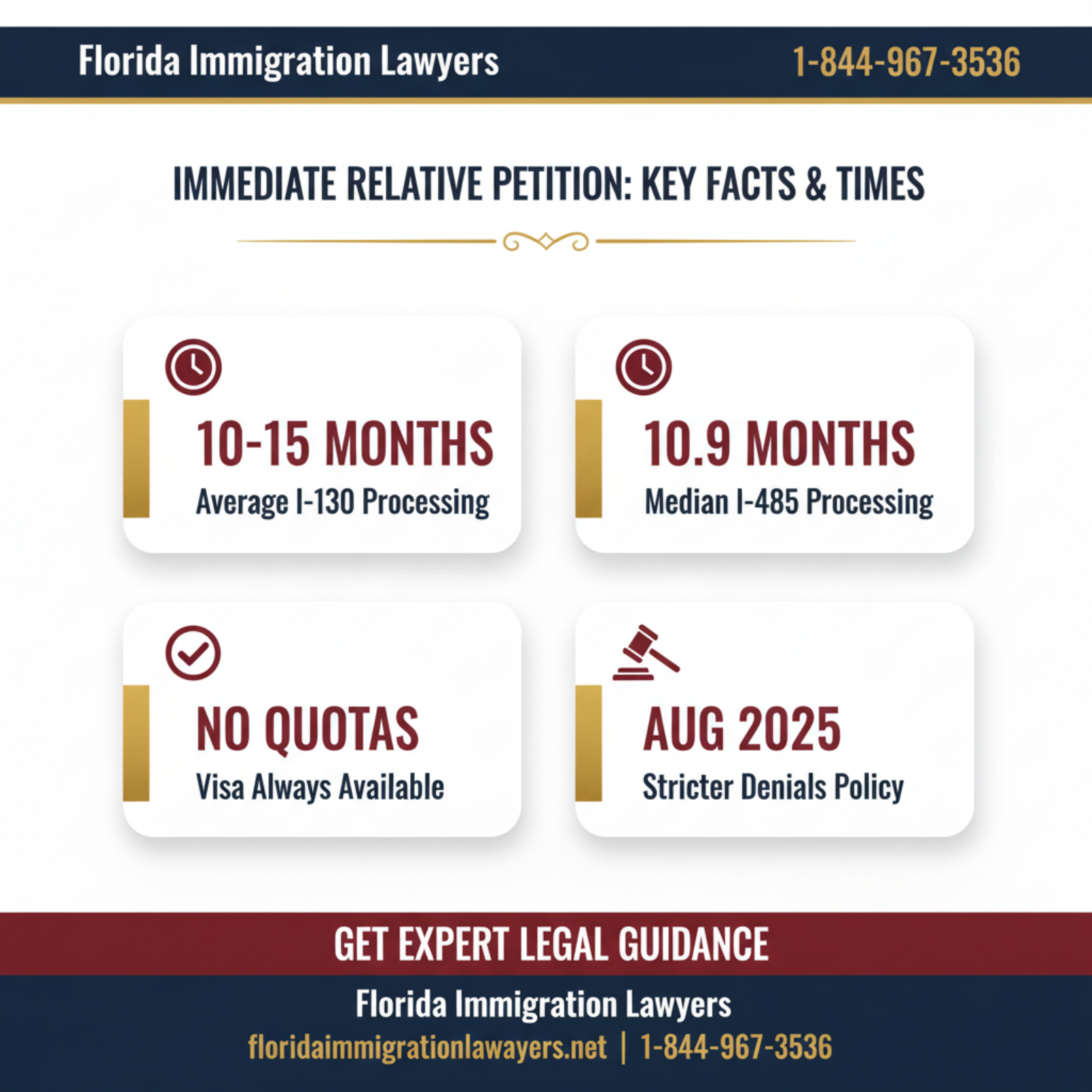
One of the most frequently asked questions is, "What is the processing time for immediate relatives?" While immediate relatives do not face visa backlogs, the entire process still takes time due to USCIS and NVC processing. It's important to have realistic expectations. Processing times can fluctuate based on the specific USCIS service center handling your case, the complexity of your situation, and current caseloads.
General Timeline Breakdown (2026 Estimates):
- Form I-130 Processing: Typically, USCIS takes 6 to 18 months to process Form I-130. Some cases may be faster, others slower. You can check the current processing times on the USCIS website by selecting Form I-130 and your relevant service center (e.g., California, Nebraska, Texas, Vermont).
- Adjustment of Status (AOS) Processing (after I-130 approval): If your relative is in the U.S. and files Form I-485, the processing time can range from 8 to 24 months or more, including biometrics, potential RFEs, and the interview. This is often processed at local field offices in Florida, such as the Miami Field Office or Orlando Field Office.
- Consular Processing (after I-130 approval): Once the I-130 is approved and sent to the NVC, it can take 3 to 6 months for NVC processing (fee payments, document collection) and then another 1 to 3 months for the interview to be scheduled at a U.S. Embassy or Consulate abroad.
It is important to remember these are estimates. Factors such as the accuracy of your application, timely responses to RFEs, and the volume of applications at a specific USCIS office or consulate can all impact the actual timeline. For example, a U.S. citizen petition for parents how long does it take can vary, but generally falls within these ranges. While processing times for immediate relative visas are not guaranteed, they are considerably shorter than for preference categories.
Understanding the Costs of an Immediate Relative Green Card
Pursuing an immediate relative green card involves various fees that applicants must consider. These costs are subject to change, so it's always best to verify the most current amounts on the official USCIS website. We do not provide specific fee amounts here to ensure accuracy, as they can be updated by the government.
Key Cost Factors and Fee Breakdown:
- USCIS Filing Fees:
- Form I-130, Petition for Alien Relative: This is the initial filing fee for establishing the family relationship.
- Form I-485, Application to Register Permanent Residence or Adjust Status: Required for beneficiaries adjusting status in the U.S. This fee often includes biometrics.
- Form I-864, Affidavit of Support: While there isn't a separate USCIS fee for filing this form, it's a critical part of the financial aspect.
- Biometrics Services Fee: If not included in the I-485 fee, a separate fee may be required for fingerprinting and background checks.
- Medical Examination Fee: All green card applicants, whether adjusting status or undergoing consular processing, must undergo a medical examination by a USCIS-approved civil surgeon or panel physician. The cost for this exam varies by doctor and location and is paid directly to the physician.
- Translation Fees: If any required documents are not in English, they must be translated by a certified translator. These costs vary based on the length and complexity of the documents.
- Attorney Fees: While not mandatory, hiring an experienced immigration attorney can significantly improve the efficiency and success rate of your application. Legal fees vary depending on the complexity of the case and the services provided. Florida Immigration Lawyers offers transparent fee structures for our comprehensive services.
- Travel Costs (for Consular Processing): Beneficiaries undergoing consular processing will need to factor in travel expenses to attend their interview at the U.S. Embassy or Consulate in their home country.
Planning for these costs is an important part of the immediate relative visa USA process. Our team can help you understand the current fee structure and plan accordingly.
Do not navigate this process alone. Contact Florida Immigration Lawyers today.
Avoiding Common Pitfalls in Your Immediate Relative Petition
The immediate relative petition process, while offering a direct path, is not without its complexities. Many applicants encounter delays or even denials due to common mistakes. Being aware of these pitfalls can help you avoid them and ensure a smoother journey for your family in Florida.
-
Incomplete or Inaccurate Forms
Consequence: USCIS will issue a Request for Evidence (RFE) or, worse, reject or deny your application. This leads to significant delays and potentially restarting the process. Every field on every form must be accurately completed, even if it seems minor.
-
Insufficient Proof of Relationship
Consequence: The core of an immediate relative petition is proving a bona fide relationship. If you fail to provide enough compelling evidence (e.g., joint documents, photos, affidavits), USCIS may doubt the legitimacy of your relationship, leading to an RFE, interview scrutiny, or denial. This is particularly crucial for spouse petitions.
-
Failure to Meet Financial Requirements (Affidavit of Support)
Consequence: The petitioner must demonstrate the ability to financially support the beneficiary to prevent them from becoming a public charge. If your income or assets are insufficient, and you don't secure a qualified joint sponsor, your application will be denied. Form I-864 is a legally binding contract.
-
Not Disclosing Previous Immigration Violations or Criminal History
Consequence: Attempting to conceal past issues can lead to accusations of misrepresentation, which carries severe penalties, including permanent bars from the U.S. It's always best to disclose everything and seek legal advice on potential waivers or remedies.
-
Missing Deadlines for RFEs or Appointments
Consequence: USCIS provides strict deadlines for responding to RFEs or attending biometrics and interviews. Missing these deadlines without a valid reason will almost certainly result in the denial of your application, requiring you to refile and incur new costs.
-
Improperly Filing Applications
Consequence: Sending your forms to the wrong USCIS service center or failing to include the correct fees can lead to rejection and significant delays. Always double-check the filing instructions on the USCIS website for the correct mailing address and fee amounts.
-
Leaving the U.S. Without Advance Parole (for AOS applicants)
Consequence: If you are applying for Adjustment of Status and leave the U.S. without an approved Advance Parole document, your I-485 application will be considered abandoned, and you may not be allowed to re-enter. This is a common and serious mistake.
-
Not Preparing for the Interview
Consequence: A poorly prepared interview can raise red flags for the immigration officer. You should be familiar with all information in your application and be able to answer questions consistently and confidently about your relationship and personal history. Mismatched answers can lead to further investigation or denial.
-
Ignoring Small Details or Inconsistencies
Consequence: Even minor discrepancies in dates, names, or addresses across different documents can raise suspicion. Ensure all information is consistent and accurate. Explain any legitimate inconsistencies clearly in an accompanying cover letter.
-
Failing to Keep Copies of All Submitted Documents
Consequence: You should always retain a complete copy of every form and supporting document submitted to USCIS. This is invaluable if USCIS loses a document, issues an RFE, or if you need to appeal a decision.
When to Seek Expert Legal Help for Your Immediate Relative Case
While the goal of an immediate relative green card is straightforward, the path is often anything but. Even seemingly simple cases can benefit from professional guidance, and complex situations absolutely demand it. Florida Immigration Lawyers are here to help you navigate these waters, providing peace of mind and increasing your chances of success.
Specific Scenarios Requiring Legal Help:
- Complex Relationship Dynamics: If there have been previous marriages, divorces, or children from prior relationships, proving the bona fides of your current immediate relative relationship can be challenging.
- Criminal History: Any criminal record for either the petitioner or beneficiary can make a case significantly more complicated, potentially requiring waivers of inadmissibility.
- Previous Immigration Violations: Overstays, unlawful presence, prior deportations, or other immigration infractions for the beneficiary will almost certainly require legal expertise to resolve.
- Receiving a Request for Evidence (RFE) or Notice of Intent to Deny (NOID): These notices indicate that USCIS has concerns about your application. A skilled attorney can help you formulate a comprehensive and persuasive response.
- Adjustment of Status Eligibility Issues: Not all individuals in the U.S. are eligible to adjust status. An attorney can assess your specific circumstances to determine the best path forward, especially if you entered without inspection or have a history of visa overstays.
- Fraud Allegations: If USCIS suspects marriage fraud or any other form of misrepresentation, legal representation is critical to defend your case and present compelling evidence.
- Lack of Sufficient Financial Support: If the U.S. citizen petitioner does not meet the income requirements for the Affidavit of Support, an attorney can help identify a qualified joint sponsor or explore other options.
Don't wait for a problem to arise. Proactive engagement with an experienced immigration attorney can prevent costly mistakes and unnecessary delays. Florida Immigration Lawyers specializes in family immigration and immediate relative petitions for clients throughout Florida, including Hollywood, Fort Lauderdale, and Miami. We understand the specific nuances of Florida's diverse communities and the local USCIS field offices.
Our team is dedicated to providing personalized and empathetic legal counsel. We will meticulously review your case, prepare all necessary documentation, and represent you throughout the process. Let us handle the complexities so you can focus on reuniting with your family.
About Florida Immigration Lawyers
Florida Immigration Lawyers is a leading immigration law firm dedicated to serving individuals and families across the entire state of Florida. With years of specialized experience, our attorneys are committed to providing exceptional legal representation and guidance through the complexities of U.S. immigration law.
We understand the profound impact immigration matters have on our clients' lives. Our firm offers a comprehensive range of immigration services, including family-based petitions, asylum applications, deportation defense, citizenship and naturalization, and business immigration. We pride ourselves on our client-focused approach, ensuring that each case receives the attention and expertise it deserves.
Why choose Florida Immigration Lawyers? Our firm is known for its unwavering dedication, in-depth legal knowledge, and a proven track record of helping clients achieve their immigration goals. We offer free consultations, are available 24/7 to address your urgent needs, and provide bilingual services to ensure clear communication. Our commitment extends to every corner of Florida, ensuring that top-tier immigration assistance is always within reach.
For trusted advice and zealous advocacy in your immigration journey, contact us today. Our dedicated team is ready to assist you. Phone: 1-844-967-3536 | Website: https://www.floridaimmigrationlawyers.net
Sources and References
- U.S. Citizenship and Immigration Services (USCIS)
- Form I-130, Petition for Alien Relative (USCIS)
- Form I-485, Application to Register Permanent Residence or Adjust Status (USCIS)
- The Immigrant Visa Process (U.S. Department of State)
- 8 U.S.C. Chapter 12 - Immigration and Nationality Act (INA)
- INA Section 201(b)(2)(A)(i) - Immediate Relatives Defined
- 8 CFR Part 204 - Petitions to Classify Alien Relatives for Issuance of Immigrant Visas
This article provides general legal information and is not intended as legal advice. Every case is unique, and outcomes depend on specific facts and circumstances. Contact an attorney for advice about your particular situation. Immigration laws are subject to change.
Navigating the immediate relative petition process in Florida can be complex, but you don't have to face it alone. Our dedicated team at Florida Immigration Lawyers is here to provide the expert guidance and support you need to reunite with your family. We are committed to helping you achieve your immigration goals with compassion and professionalism.
Don't let uncertainty delay your family's future. Take the first step today towards securing a green card for your loved ones. We offer free, confidential consultations to discuss your specific case and outline a clear path forward. Call Florida Immigration Lawyers now at 1-844-967-3536 to schedule your free consultation. Se Habla Español - Estamos aquí para ayudarle.
Do Not Navigate This Process Alone
Our experienced immigration attorneys are ready to fight for you. Get a free, confidential consultation today.
Se Habla Español
Frequently Asked Questions
Florida Immigration Lawyers
Immigration Attorney | Founder, Vasquez Law Firm
U.S. Air Force veteran and immigration attorney with thousands of cases resolved. J.D., NCCU School of Law. AILA member. Admitted to the 4th, 5th, and 11th Circuit Courts.
Available 24/7 - Free Evaluations
Related Legal Services
Our Florida immigration attorneys can help you with business immigration, asylum protection and deportation defense. Call today at 1-844-967-3536 for a free consultation.
Related Links
Related Topics
Free Legal Consultation
Discuss your case with our experienced attorneys. We're available 24/7.
Se Habla Español - Estamos aquí para ayudarle.
Related Articles
How to Choose an Immigration Lawyer in Florida | VLF Florida
Choosing the right immigration lawyer in Hialeah, Florida is vital for navigating complex immigration processes. Learn how to make an informed decision with our detailed guide. Call 1-844-967-3536 for a free consultation.
U Visa for Crime Victims in Florida: Key Insights | VLF Florida
Discover the potential of the U visa for crime victims in Florida. Gain insights into eligibility, the application process, and how Florida Immigration Lawyers can assist you. Call us today for a free consultation.
Green Card Through Marriage in Florida | VLF Florida
Considering a green card through marriage in Florida? Discover the steps, common mistakes, and when to consult a lawyer. Call 1-844-967-3536 today!
Understanding Stokes Interview for Marriage Fraud in Florida
If you're facing a Stokes interview in Hialeah, Florida, understanding the process is crucial. This interview assesses the authenticity of your marriage to prevent fraud in I-130 petitions. Learn more about preparation and common pitfalls. Call Florida Immigration Lawyers for expert guidance.