H-1B Visa Fee Increase: What Florida Employers Need to Know in 2026
The H-1B visa program has undergone significant changes in 2026, most notably a substantial H-1B visa fee increase that impacts employers and skilled foreign workers across Florida, including Kissimmee. Understanding these new costs, updated application requirements, and potential processing delays is crucial for successful petition filing. This comprehensive guide from Florida Immigration Lawyers details the step-by-step process, essential documentation, and common mistakes to avoid. We emphasize the importance of legal counsel to navigate the complexities, ensure compliance with the latest regulations, and maximize your chances of approval. Learn how these changes affect your ability to secure or sponsor an H-1B visa in Florida.
The H-1B visa fee increase in 2026 significantly impacts employers and skilled foreign workers in Florida. New fees, including a substantial increase for certain categories, necessitate careful planning and budgeting. Understanding these changes is crucial for successful petition filing. Consulting an experienced Florida immigration lawyer can help you navigate the complexities and ensure compliance.
- New H-1B visa fees are in effect for 2026, impacting all applicants.
- Employers bear the primary responsibility for most H-1B related fees.
- Careful preparation and adherence to deadlines are more critical than ever.
- Legal guidance is essential to avoid common mistakes and navigate complex requirements.
Are you an employer in Kissimmee, or anywhere across Florida, considering sponsoring a highly skilled foreign worker? Perhaps you are a professional seeking to secure your future in the Sunshine State. The landscape of U.S. immigration, particularly concerning the H-1B visa program, is constantly evolving. As of 2026, significant changes, including a notable H-1B visa fee increase, have reshaped the application process.
These new regulations present both challenges and opportunities. Understanding the updated fee structure, application requirements, and potential pitfalls is paramount for a successful outcome. This comprehensive guide from Florida Immigration Lawyers will walk you through everything you need to know about the H-1B visa fee increase and its implications for Florida. Call Florida Immigration Lawyers at 1-844-967-3536 for a free consultation to discuss your specific H-1B visa needs today.
Understanding the H-1B Visa Fee Increase for Florida in 2026
The H-1B visa program is a vital pathway for U.S. employers to temporarily employ foreign workers in specialty occupations. These occupations generally require a bachelor's degree or higher in a specific field. From technology and healthcare to education, Florida industries heavily rely on H-1B visa holders to fill critical skill gaps.
However, 2026 brings substantial updates to the financial commitments associated with this visa. The U.S. Citizenship and Immigration Services (USCIS) has implemented a series of fee adjustments, including a significant H-1B visa fee increase that impacts various aspects of the petition process. These changes aim to recover operational costs and fund specific immigration programs, but they place a greater financial burden on sponsoring employers.
What is an H-1B Visa?
An H-1B visa permits U.S. employers to temporarily hire foreign workers in specialty occupations. These roles typically demand theoretical and practical application of a body of highly specialized knowledge and a bachelor's degree or higher in the specific specialty, or its equivalent. Common H-1B occupations include roles in IT, engineering, medicine, and higher education across Florida.
The H-1B program is subject to an annual cap of 85,000 visas, with 20,000 reserved for those with a U.S. master's degree or higher. Due to high demand, the H-1B cap is often met shortly after the filing period opens, necessitating a lottery selection process. Navigating this competitive landscape, especially with the new fees, requires expert guidance.
Key Changes in H-1B Fees for 2026
The most notable change involves a substantial increase in the base filing fee for the Form I-129, Petition for a Nonimmigrant Worker. Beyond this, other fees like the H-1B Fraud Prevention and Detection Fee and the American Competitiveness and Workforce Improvement Act (ACWIA) fee have also seen adjustments. For certain large employers, there may also be additional public law fees.
While specific amounts are subject to change and should always be verified with the official USCIS fee schedule, the overall financial outlay for an H-1B petition has risen considerably. This H-1B visa fee increase requires employers to re-evaluate their budgeting and strategic planning for hiring international talent. Companies in Kissimmee and other Florida hubs must be prepared for these elevated costs.
Navigating the H-1B Application Process Amidst New Fees
The H-1B application process is intricate, involving multiple stages and strict deadlines. The recent H-1B visa fee increase adds another layer of complexity, making meticulous preparation more critical than ever. Here is a step-by-step guide to help you understand the journey:
-
Employer Registration and Lottery (if applicable): For cap-subject H-1B petitions, employers must first register electronically with USCIS during a designated period, typically in March. This involves providing basic information about the employer and the prospective employee. If more registrations are received than available visas, USCIS conducts a lottery to select eligible registrations. Only selected registrations can proceed to the next step.
It is crucial to understand that even if selected, a petition must still be filed and approved. This initial registration fee has also seen an adjustment, contributing to the overall H-1B visa fee increase.
-
Labor Condition Application (LCA) Filing: Before filing the H-1B petition, the employer must file a Labor Condition Application (Form ETA-9035) with the U.S. Department of Labor (DOL). This document attests that the employer will pay the H-1B worker at least the prevailing wage for the occupation in the area of intended employment, or the actual wage paid to other employees with similar experience and qualifications, whichever is higher. It also confirms that working conditions will not adversely affect other employees.
The LCA process ensures fair labor practices and is a prerequisite for the H-1B petition. Any errors or misrepresentations on the LCA can lead to significant delays or even denial.
-
Form I-129 Petition Filing: Once the LCA is certified by the DOL and, if applicable, the H-1B registration is selected, the employer can file Form I-129, Petition for a Nonimmigrant Worker, with USCIS. This is the core of the H-1B application. It includes extensive documentation about the employer, the beneficiary, the specialty occupation, and how the beneficiary meets the requirements for that occupation.
This is where the bulk of the H-1B visa fee increase will be felt, as the I-129 base filing fee has been significantly adjusted. All required fees must be submitted correctly with the petition.
-
Fee Payments: Along with the Form I-129, several fees must be submitted. These typically include the base filing fee, the ACWIA fee, the Fraud Prevention and Detection Fee, and potentially a Public Law 114-113 fee for certain employers. If premium processing is requested, an additional fee is required for expedited adjudication. Understanding the correct fee amounts and payment methods is vital to avoid rejection.
The new fee schedule for 2026 makes it imperative to consult the latest USCIS guidelines or an immigration attorney to ensure accurate payment. Incorrect fees are a common reason for petition rejection.
-
Consular Processing or Change of Status: If the beneficiary is outside the U.S., they will undergo consular processing at a U.S. embassy or consulate abroad after the I-129 petition is approved. This involves an interview and biometric collection. If the beneficiary is already in the U.S. on a different nonimmigrant visa, they may be eligible for a Change of Status (COS) to H-1B, which is requested directly within the I-129 petition.
Consular processing can involve additional fees charged by the Department of State. While not part of the USCIS H-1B visa fee increase, these are important considerations for the overall cost.
-
Responding to Requests for Evidence (RFEs): USCIS may issue a Request for Evidence (RFE) if they require additional information or clarification to make a decision on the petition. An RFE can significantly delay the process. Timely and comprehensive responses are critical to avoid denial. Florida Immigration Lawyers can assist in preparing robust responses to RFEs.
Who Pays the H-1B Visa Fees?
Generally, the employer is responsible for paying most of the H-1B visa fees. This includes the ACWIA fee, the Fraud Prevention and Detection Fee, and any Public Law 114-113 fee. The employer is also legally obligated to pay the prevailing wage. While the base filing fee for Form I-129 is typically paid by the employer, some exceptions or arrangements might exist for certain parts, though this is rare.
The beneficiary may pay the premium processing fee, if requested for their benefit, and certain consular processing fees. However, the substantial H-1B visa fee increase largely falls on the sponsoring employer. It is illegal for employers to make H-1B workers pay for fees that are legally the employer's responsibility.
Essential Documents for Your H-1B Visa Application
A successful H-1B petition hinges on submitting a complete and accurate set of documents. With the H-1B visa fee increase and increased scrutiny, ensuring every piece of documentation is perfect is more important than ever. Here is a general checklist of essential documents:
- Employer-Specific Documents:
- Federal Employer Identification Number (FEIN).
- Business license and registration documents.
- Financial statements, tax returns, and annual reports to demonstrate financial viability.
- Organizational charts and company brochures.
- Detailed job description outlining specialty occupation duties and requirements.
- Client letters or contracts (for third-party placement cases) to establish a valid employer-employee relationship.
- Beneficiary-Specific Documents:
- Copy of valid passport (all pages).
- Academic degrees, diplomas, and official transcripts.
- Foreign degree evaluations (if applicable) to demonstrate U.S. equivalency.
- Detailed resume/CV highlighting relevant work experience.
- Professional licenses or certifications (if required for the occupation).
- Previous visa copies, I-94 records, and U.S. entry/exit stamps.
- Any prior H-1B approval notices (Form I-797) or other immigration documents.
- Petition-Specific Documents:
- Certified Labor Condition Application (Form ETA-9035).
- Completed Form I-129, Petition for a Nonimmigrant Worker.
- Letter of Support from the petitioning employer, detailing the job offer, salary, and why the beneficiary's skills are essential.
- Evidence of prevailing wage determination.
- Any other supporting evidence demonstrating the specialty occupation nature of the position and the beneficiary's qualifications.
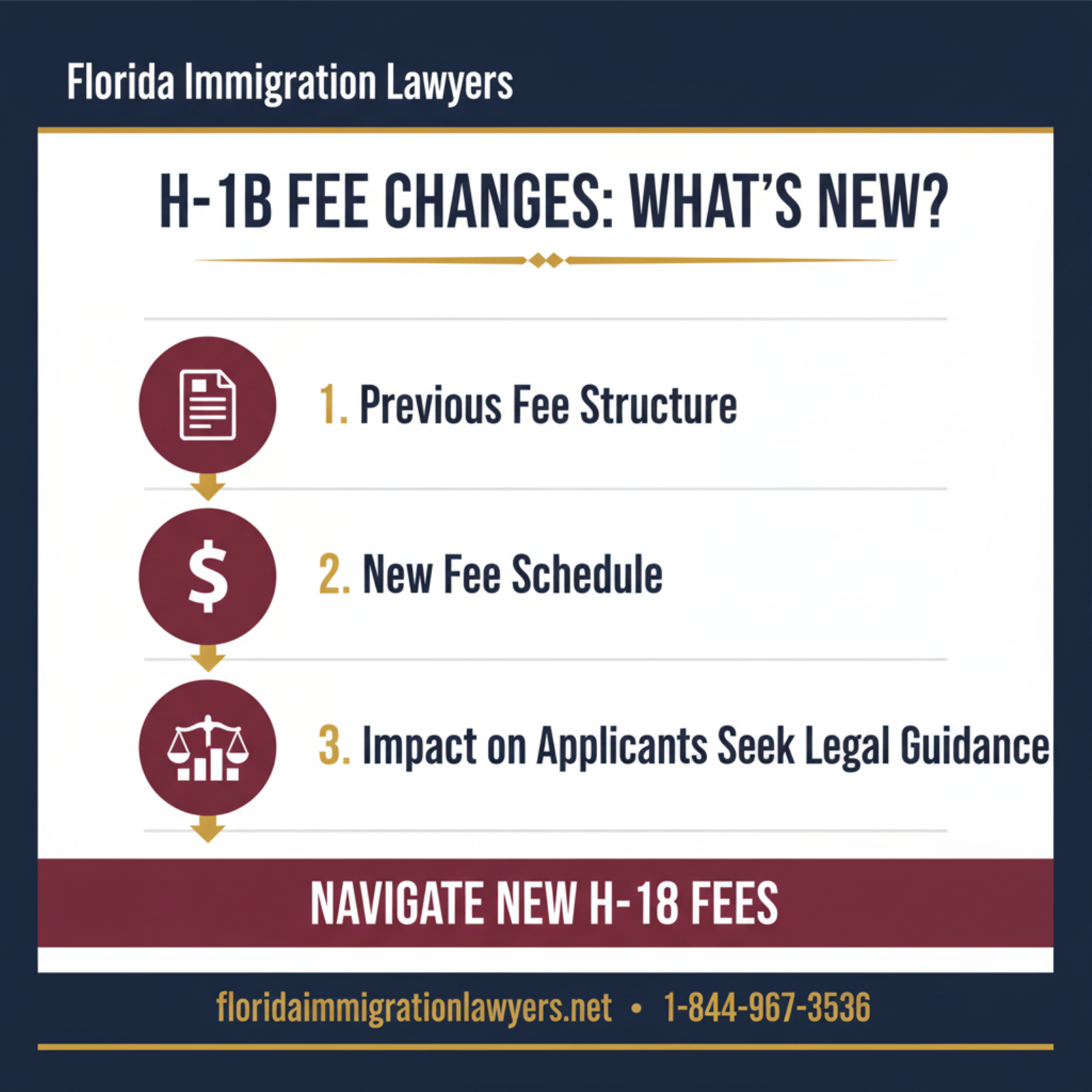
Step-by-Step Process Guide
H-1B Salary Requirements in Florida
The H-1B program mandates that employers pay their H-1B workers at least the prevailing wage for their occupation in the specific geographic area of employment, or the actual wage paid to other similarly qualified employees, whichever is higher. This is a critical component of the LCA. The prevailing wage rates are determined by the Department of Labor and vary significantly based on occupation, skill level, and location within Florida.
For example, a software developer in Miami will have a different prevailing wage than one in Kissimmee. Employers must ensure they meet these requirements to avoid compliance issues. The increase in overall H-1B costs emphasizes the importance of budgeting for both fees and competitive salaries.
H-1B Visa Timeline and Processing Expectations in 2026
The H-1B visa process can be lengthy and unpredictable, a factor further complicated by the recent fee changes. Understanding the typical timeline and processing expectations is crucial for both employers and beneficiaries in Florida. USCIS processing times can fluctuate significantly based on various factors, including the volume of petitions received and the specific service center handling the case.
For cap-subject H-1B petitions, the annual cycle typically begins with electronic registration in March. The lottery results are usually announced by late March. Petitions for selected registrations can then be filed starting April 1st for an October 1st start date. If you're applying for an H-1B visa, be prepared for potential delays at service centers like the California Service Center or Vermont Service Center, which process many H-1B cases.
What to Expect After H-1B Approval
Once your H-1B petition is approved, you will receive an Approval Notice (Form I-797). If you are already in the U.S. and filed for a Change of Status, your I-94 will be updated to reflect your H-1B status. You can then begin working for the petitioning employer on the effective start date. If you are outside the U.S., you will need to schedule an interview at a U.S. embassy or consulate in your home country to obtain the physical H-1B visa stamp in your passport. This stamp allows you to enter the U.S. in H-1B status. Remember, the H-1B visa fee increase does not impact post-approval processes directly, but ensures your initial approval was secured.
Cost Factors and Breakdown of H-1B Visa Fees
The H-1B visa fee increase for 2026 demands a clear understanding of the various costs involved. These fees are subject to change by USCIS, so always refer to the latest official fee schedule. However, here's a breakdown of the typical fees an employer can expect:
- Base Filing Fee (Form I-129): This is the primary fee for filing the petition itself. The 2026 increase has significantly raised this cost.
- American Competitiveness and Workforce Improvement Act (ACWIA) Fee: This fee is used to fund U.S. worker training and education programs. It varies based on the employer's size. Small employers (25 or fewer full-time equivalent employees) pay a lower amount than larger employers.
- Fraud Prevention and Detection Fee: Imposed to combat fraud in the H-1B program, this fee applies to all initial H-1B petitions and petitions for a new employer.
- Public Law 114-113 Fee: Also known as the "50/50 Rule" fee, this applies to employers who have 50 or more employees and where more than 50% of those employees are in H-1B or L-1 nonimmigrant status. This fee is substantial.
- H-1B Registration Fee: A smaller fee paid during the electronic registration process for cap-subject petitions. This fee has also seen an adjustment.
- Premium Processing Fee: An optional fee paid to USCIS to guarantee adjudication of the petition within 15 calendar days. While this expedites processing, it does not guarantee approval.
Are There Exemptions to the H-1B Fee Increase?
Certain organizations may be exempt from some of the H-1B fees, specifically the ACWIA fee and the Public Law 114-113 fee. These exemptions generally apply to non-profit research organizations, government research organizations, and institutions of higher education. For instance, many Florida universities, such as the University of Central Florida near Kissimmee, may qualify for these exemptions, potentially mitigating the impact of the overall H-1B visa fee increase for their H-1B employees.
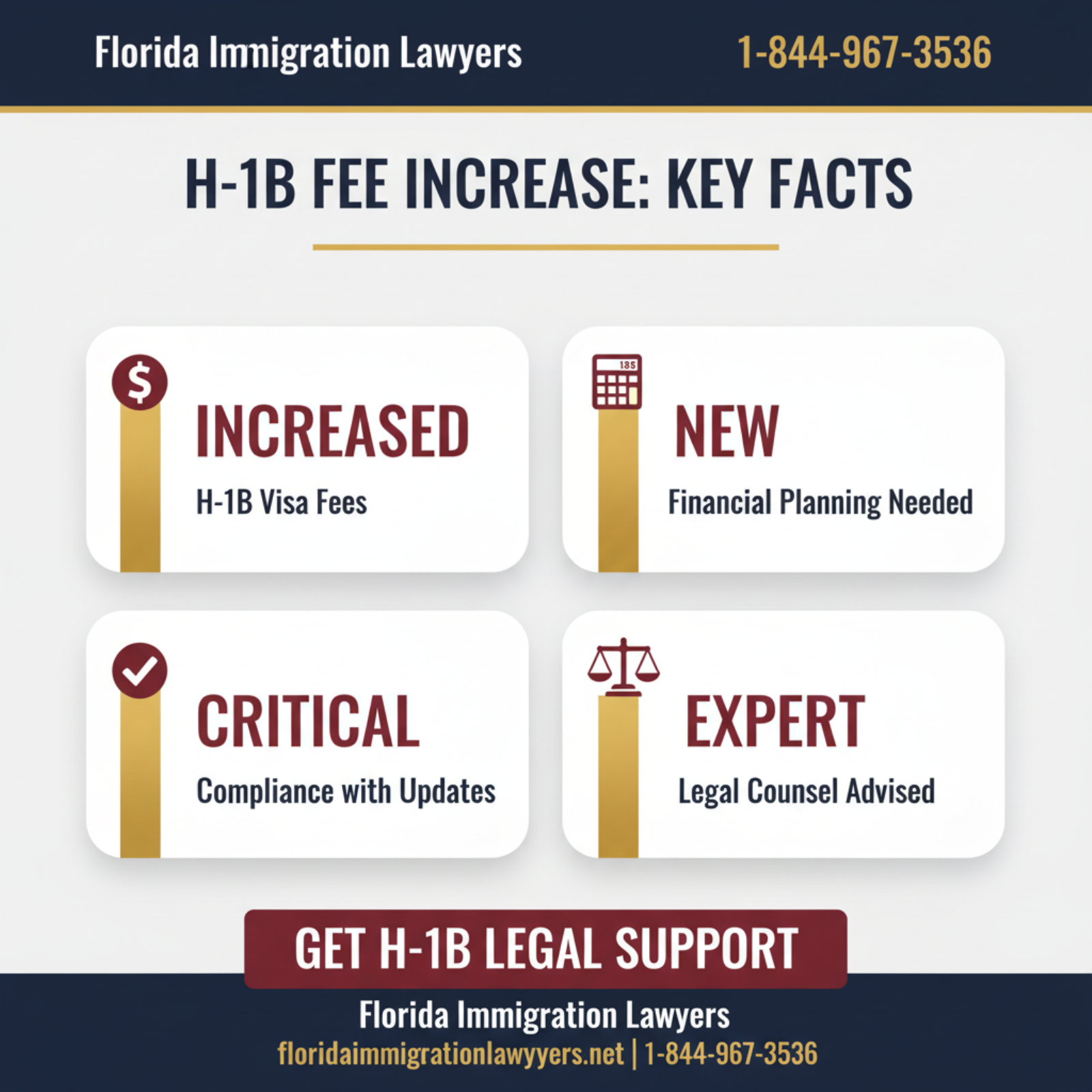
It is crucial to verify eligibility for any exemptions as they can significantly reduce the overall cost of an H-1B petition. An experienced immigration attorney can help determine if your organization qualifies.
Do not navigate this process alone. The complexities of the H-1B visa fee increase and the application process demand expert attention. Contact Florida Immigration Lawyers today for comprehensive legal support tailored to your unique situation.
Common Mistakes to Avoid During Your H-1B Application
Applying for an H-1B visa, especially with the new H-1B visa fee increase, is fraught with potential pitfalls. Avoiding common mistakes can save you significant time, money, and stress. Here are some of the most frequent errors and their consequences:
-
Incorrect Fee Payments: Submitting an incorrect fee amount or using an outdated fee schedule is a primary reason for rejection. USCIS will return your entire petition, causing critical delays, especially for cap-subject cases where deadlines are strict. Always verify the latest fee schedule directly from USCIS.
-
Incomplete Documentation: Failing to include all required forms and supporting documents can lead to RFEs or outright denial. This includes missing passport copies, academic transcripts, or a certified LCA. Each missing piece can derail your application.
-
Missing Deadlines: The H-1B process has strict deadlines, from registration to petition filing. Missing these can result in your application not being considered for the current fiscal year. This is particularly critical for cap-subject petitions.
-
Misrepresentation of Job Duties or Qualifications: Providing inaccurate information about the specialty occupation or the beneficiary's qualifications can lead to denials and even allegations of fraud. Ensure all details are truthful and consistent with supporting evidence.
-
Failure to Respond to RFEs Promptly: If USCIS issues an RFE, you have a limited time to respond. Failing to submit a comprehensive and timely response will almost certainly lead to a denial. Preparing a strong RFE response often requires legal expertise.
-
Not Understanding Prevailing Wage Requirements: Paying below the prevailing wage or failing to document compliance with wage requirements can lead to DOL investigations and penalties. This is a serious compliance issue for employers.
-
Lack of a Valid Employer-Employee Relationship: For third-party placement models, USCIS scrutinizes the employer-employee relationship. If the petitioning employer does not have direct control over the H-1B worker, the petition may be denied. Clear contracts and statements of work are essential.
-
Traveling During Processing: If you are in the U.S. and have applied for a Change of Status to H-1B, traveling outside the U.S. while your petition is pending can be considered abandonment of your COS application. Always consult an attorney before making travel plans.
-
Ignoring Cap-Exempt Eligibility: Many employers, especially those affiliated with higher education or non-profit research, are cap-exempt. Incorrectly filing under the cap when an exemption applies can lead to unnecessary lottery participation and delays.
-
Failure to Plan for the H-1B Visa Fee Increase: Not budgeting for the significantly higher fees can lead to financial strain or last-minute scrambling, potentially impacting the timely submission of your petition. Planning ahead is vital.
When to Call Florida Immigration Lawyers for H-1B Assistance
The complexities surrounding the H-1B visa fee increase and the application process make professional legal guidance invaluable. While some may attempt to navigate the process independently, the risks of errors, delays, or even denials are high. Florida Immigration Lawyers are here to offer expert assistance for all your H-1B needs.
You should consider contacting our experienced attorneys if:
- You are an employer in Florida contemplating sponsoring H-1B workers for the first time or need assistance with the new fee structure.
- You have received a Request for Evidence (RFE) from USCIS and need help crafting a comprehensive and compelling response.
- Your H-1B petition has been denied, and you wish to explore options for appeal or refiling.
- You are a beneficiary with a complex immigration history or unique educational qualifications that require expert interpretation.
- You have questions about H-1B cap exemptions or the prevailing wage determination for your specific role in Florida.
- You are a current H-1B holder needing to transfer your visa to a new employer or extend your stay.
Our team at Florida Immigration Lawyers understands the unique challenges faced by individuals and businesses in Kissimmee and across Florida. We stay abreast of the latest immigration policies and fee changes to provide you with the most accurate and effective legal strategies. Let us help you confidently navigate the H-1B process, ensuring compliance and maximizing your chances of success.
About Florida Immigration Lawyers
Florida Immigration Lawyers is a leading immigration law firm dedicated to serving individuals and businesses throughout Florida. With a deep understanding of U.S. immigration law and a commitment to our clients, we provide compassionate and effective legal representation. Our attorneys are passionate about helping you achieve your immigration goals, whether it's securing an H-1B visa, obtaining a green card, or defending against deportation.
We offer a wide range of immigration services, including general immigration assistance, asylum claims, deportation defense, citizenship applications, family-based petitions, and business immigration solutions. We pride ourselves on clear communication, strategic planning, and aggressive advocacy on behalf of our clients.
Choosing Florida Immigration Lawyers means choosing a partner who will stand by you every step of the way. We offer free consultations and are available 24/7 to address your urgent legal needs. Serving all of Florida, we are your trusted advocates in the complex world of immigration. Visit our website at https://www.floridaimmigrationlawyers.net or call us at 1-844-967-3536 to speak with an attorney today.
Sources and References
- U.S. Citizenship and Immigration Services (USCIS)
- U.S. Department of State - Bureau of Consular Affairs
- Executive Office for Immigration Review (EOIR)
- 8 U.S.C. § 1101 et seq. - Immigration and Nationality Act (INA)
- 8 CFR Part 214 - Nonimmigrant Classes
- USCIS Policy Manual - Volume 2, Part H, Chapter 9 - H-1B Specialty Occupation
This article provides general legal information and is not intended as legal advice. Every case is unique, and outcomes depend on specific facts and circumstances. Contact an attorney for advice about your particular situation.
The recent H-1B visa fee increase marks a significant shift in the immigration landscape for Florida employers and professionals. Navigating these changes requires not only a thorough understanding of the law but also strategic planning and precise execution. Do not let the complexities overwhelm you. Florida Immigration Lawyers is here to provide the expert guidance and support you need to achieve your immigration goals. Call us today at 1-844-967-3536 for your free consultation. Se Habla Español - Estamos aquí para ayudarle.
Frequently Asked Questions
Florida Immigration Lawyers
Legal Team
Our experienced attorneys at Florida Immigration Lawyers have been serving clients across Florida for over 20 years. We specialize in immigration, personal injury, criminal defense, workers compensation, and family law.