Asylum Application Florida: Your 2026 Guide to I-589 Success
Navigating the asylum application process in Florida is a challenging journey for many seeking safety. This comprehensive guide for 2026 details the affirmative asylum process, focusing on Form I-589, eligibility requirements, necessary documentation, and expected timelines. We also cover potential costs and crucial mistakes to avoid. Whether you're in Orlando or elsewhere in Florida, understanding these steps is vital. Florida Immigration Lawyers offers legal assistance, ensuring you're well-prepared for your asylum claim. Learn how to secure your future in the U.S. with professional guidance.
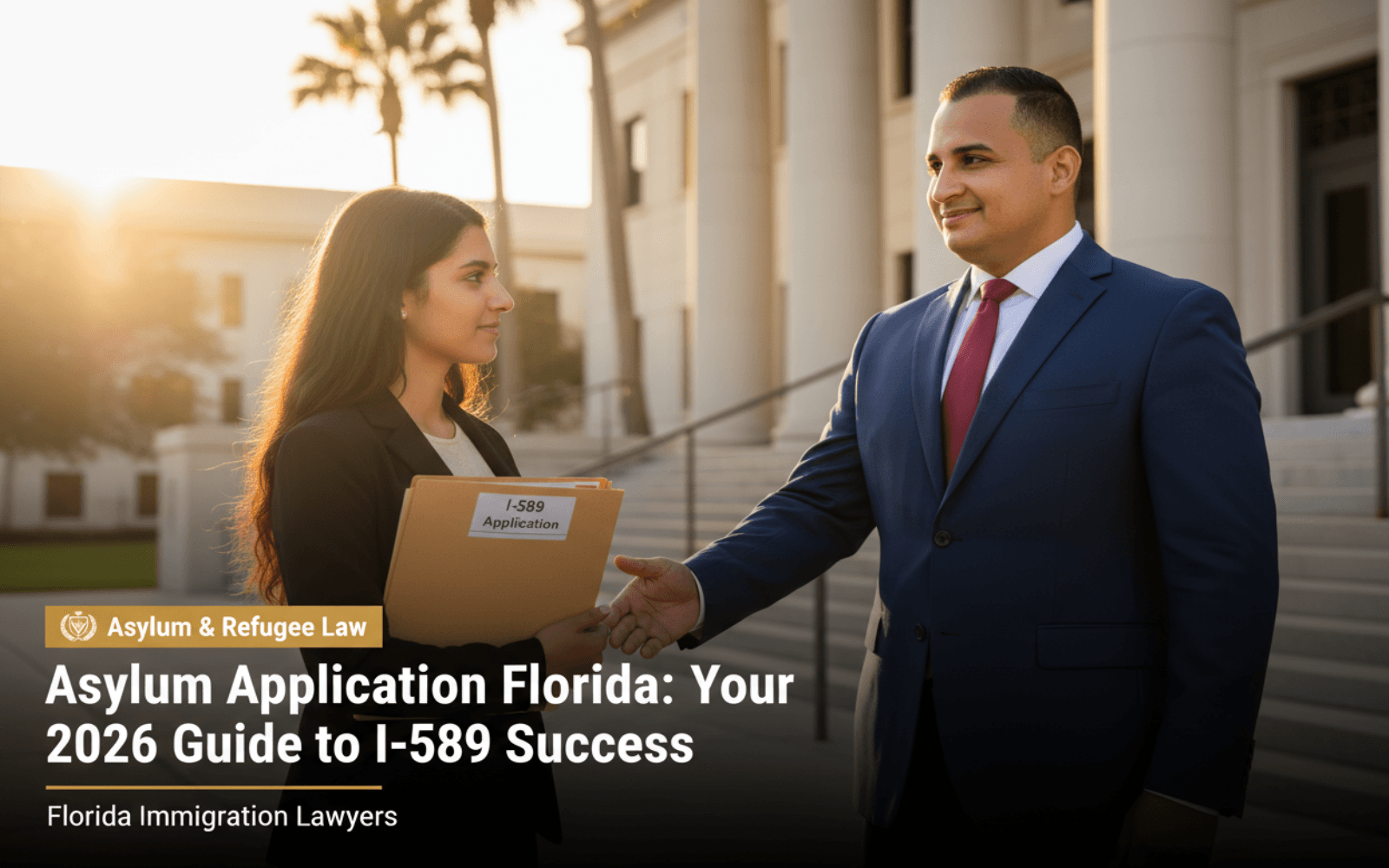
Applying for asylum in Florida involves filing Form I-589, Application for Asylum and for Withholding of Removal, with USCIS. You must demonstrate a well-founded fear of persecution in your home country based on race, religion, nationality, political opinion, or membership in a particular social group. The process typically includes an interview and can be complex, often requiring legal assistance.
- File Form I-589 within one year of arrival.
- Provide detailed evidence of persecution.
- Attend an asylum interview at a USCIS office.
- Seek legal counsel for best outcomes.
- Understand the difference between affirmative and defensive asylum.
Are you seeking safety and protection in the United States, fearing persecution in your home country? The thought of starting a new life in Florida, away from danger, can be a beacon of hope. However, the asylum application Florida process is intricate and demanding, requiring precise adherence to legal guidelines. Many individuals arriving in Orlando and other Florida cities face this challenging journey.
Understanding the complexities of filing Form I-589 and navigating the U.S. immigration system is crucial for your success. This comprehensive guide will walk you through the affirmative asylum process, detailing eligibility, required documents, timelines, and potential costs. Our goal is to empower you with the knowledge needed to pursue your claim for protection.
Do not navigate this critical process alone. Call Florida Immigration Lawyers at 1-844-YO-PELEO for a free consultation to discuss your specific situation and how we can help you secure your future in Florida.
Understanding Asylum in Florida: An Overview
Asylum provides protection to individuals already in the United States who meet the definition of a refugee. A refugee is someone who is unable or unwilling to return to their country of origin due to a well-founded fear of persecution. This fear must be based on one of five protected grounds: race, religion, nationality, membership in a particular social group, or political opinion. The U.S. government grants asylum to individuals who demonstrate this fear, allowing them to live and work legally in the U.S. and eventually apply for a Green Card.
Florida, with its diverse population and international connections, is often a destination for individuals seeking refuge. The asylum application Florida process is primarily handled by U.S. Citizenship and Immigration Services (USCIS) for affirmative asylum claims. For those already in removal proceedings, the Executive Office for Immigration Review (EOIR) immigration courts handle defensive asylum claims. Understanding which path applies to your situation is the first vital step.
Eligibility for Asylum: Who Qualifies?
To qualify for asylum, you must meet specific criteria outlined in the Immigration and Nationality Act (INA) Section 208, 8 U.S.C. § 1158. The most fundamental requirement is demonstrating a well-founded fear of persecution. This means you must show a reasonable possibility that you will be persecuted if you return to your home country. Persecution is generally defined as harm or suffering inflicted upon an individual.
The five protected grounds for asylum are:
- Race: Fear of harm due to your racial background.
- Religion: Fear of harm due to your religious beliefs or practices.
- Nationality: Fear of harm due to your country of origin or ethnic group.
- Membership in a Particular Social Group: Fear of harm due to belonging to a group with common immutable characteristics, such as family, sexual orientation, or shared past experience.
- Political Opinion: Fear of harm due to your political beliefs or activities, or those imputed to you by your persecutors.
You must also file your Form I-589, Application for Asylum and for Withholding of Removal, within one year of your last arrival in the United States. There are limited exceptions to this one-year filing deadline, such as changed country conditions or extraordinary circumstances. Consulting with an experienced immigration attorney is essential to determine if an exception applies to your case.
The Affirmative Asylum Application Process (I-589): A Step-by-Step Guide
Navigating the asylum application Florida process can feel overwhelming, but breaking it down into manageable steps can help. This guide focuses on affirmative asylum, where you proactively apply to USCIS, not as a defense against deportation.
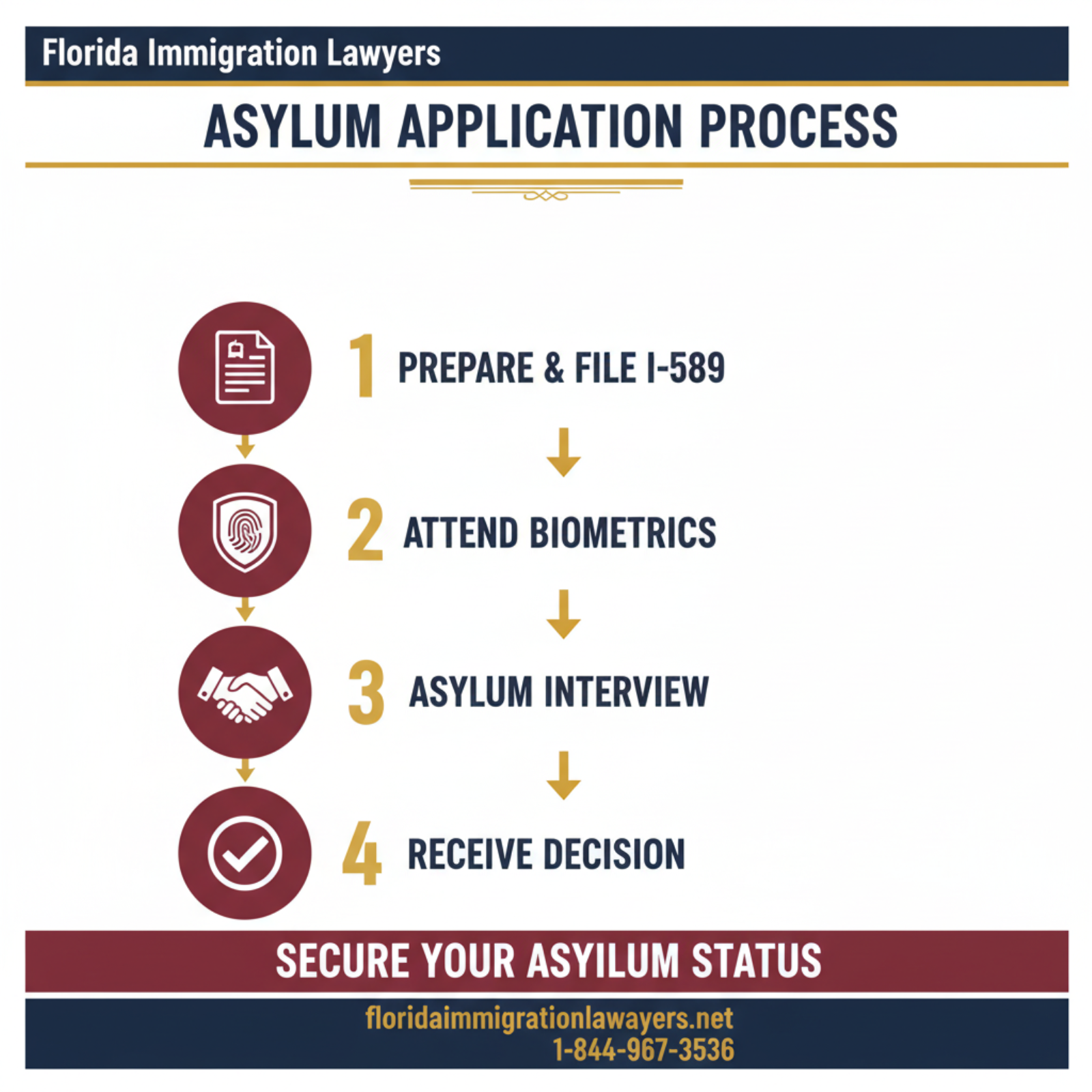
- Step 1: Prepare and File Form I-589.
Your journey begins with completing Form I-589, Application for Asylum and for Withholding of Removal. This form is critical and requires detailed information about your identity, family, travel history, and, most importantly, a comprehensive narrative explaining your fear of persecution. Be truthful and thorough; any inconsistencies can harm your case. You must include all dependents you wish to include in your application. - Step 2: Gather Supporting Documentation.
After filing Form I-589, you must compile and submit all available evidence supporting your claim. This includes personal statements, affidavits from witnesses, medical records, police reports, news articles, country condition reports, and any other documents that corroborate your story of persecution. The more compelling and well-documented your evidence, the stronger your case will be. Organize these documents clearly. - Step 3: Attend Biometrics Appointment.
USCIS will send you a notice to attend a biometrics appointment at an Application Support Center (ASC). At this appointment, your fingerprints, photograph, and signature will be collected. This information is used for background and security checks. It is a mandatory step in the asylum process. - Step 4: Prepare for Your Asylum Interview.
Once your background checks are complete, you will typically receive a notice for an asylum interview at a USCIS Asylum Office. In Florida, the relevant office is often the Orlando Asylum Office. This interview is a crucial part of the process where an Asylum Officer will ask detailed questions about your Form I-589 and your claim of persecution. Preparing thoroughly, often with legal counsel, is vital. - Step 5: Receive a Decision or Referral.
After your interview, the Asylum Officer will review your case and make a decision. If your case is approved, you and your eligible family members will be granted asylum. If the officer does not grant asylum, and you are not in lawful immigration status, your case will generally be referred to an immigration judge at an EOIR court for defensive asylum proceedings. If you are in lawful status, your case will be denied, and you may not appeal the decision to an immigration judge. - Step 6: Apply for a Green Card (Adjustment of Status).
If you are granted asylum, you become eligible to apply for a Green Card (lawful permanent residence) one year after the date your asylum was granted. You will need to file Form I-485, Application to Register Permanent Residence or Adjust Status. This is a separate application with its own set of requirements and fees.
Required Documents for Your Asylum Claim
A well-prepared asylum application Florida depends heavily on comprehensive documentation. Having the right documents can significantly strengthen your case.
- Completed Form I-589, Application for Asylum and for Withholding of Removal.
- Two passport-style photographs for each applicant.
- Copy of your passport, birth certificate, and any other identity documents.
- Copy of your I-94, Arrival/Departure Record, or other proof of legal entry.
- Detailed personal declaration or affidavit explaining your fear of persecution.
- Affidavits or witness statements from others who can corroborate your story.
- Medical records, if you suffered physical or psychological harm.
- Police reports, court documents, or other official records related to persecution incidents.
- News articles, human rights reports, or country condition reports from credible sources (e.g., U.S. Department of State, Amnesty International, Human Rights Watch) specific to your country and claim.
- Any other evidence proving your membership in a protected group or political opinion.
- Marriage certificate and birth certificates for any dependents included in your application.
It is crucial to provide certified English translations for any documents not originally in English. Always keep copies of everything you submit to USCIS.
Do not navigate this process alone. Contact Florida Immigration Lawyers today for legal guidance on your asylum claim. Our team is ready to assist you.
Timeline and Processing Expectations for Asylum Seekers
The asylum application Florida timeline can vary significantly based on several factors, including the volume of applications, staffing levels at USCIS, and the complexity of individual cases. While some cases are processed relatively quickly, others can take several years.
- Initial Filing and Receipt: After filing Form I-589, you typically receive a receipt notice within a few weeks.
- Biometrics Appointment: This usually occurs within 1-2 months after filing.
- Asylum Interview Wait Time: This is often the longest waiting period. Due to a "last-in, first-out" interview scheduling policy implemented by USCIS, newer affirmative asylum applications may be scheduled for an interview more quickly than older ones. However, backlogs still exist. Wait times for an interview can range from several months to several years, especially for older cases.
- Interview and Decision: The interview itself can last several hours. A decision is typically mailed within two weeks to several months after the interview. In some complex cases, it may take longer.
- Work Authorization: You may apply for work authorization (Form I-765, Employment Authorization Document) 150 days after your asylum application is filed and while it is pending, provided your application has not been denied by an Asylum Officer or referred to an Immigration Judge. The EAD is typically granted after 180 days of filing.
Key Factors Influencing Processing Times:
- USCIS Backlogs: High volumes of applications can lead to delays.
- Country Conditions: Changes in global events or country conditions can affect processing priorities.
- Case Complexity: Cases with extensive documentation or complex legal issues may take longer.
- USCIS Office Location: While the Orlando Asylum Office handles Florida cases, national backlogs impact local processing.
- Defensive Asylum: If your case is referred to an immigration court, the timeline will depend on the court's schedule, which also has significant backlogs.
Costs Associated with an Asylum Application
One significant advantage of seeking asylum in Florida is that there is no filing fee for Form I-589 itself. This policy ensures that individuals fleeing persecution are not financially barred from seeking protection.
However, while the asylum application is free, you should anticipate other associated costs:
- Legal Fees: Hiring an experienced immigration attorney, like those at Florida Immigration Lawyers, is highly recommended. Legal fees cover assistance with preparing your application, gathering evidence, preparing you for the interview, and representing you during the process. Costs vary depending on the complexity of your case and the attorney's experience.
- Translation Fees: If any of your supporting documents are not in English, you will need to pay for certified translations.
- Document Retrieval Fees: You might incur fees to obtain official documents from your home country or other sources.
- Travel Expenses: You will need to cover travel costs to your biometrics appointment and your asylum interview, which for Florida residents is often at the Orlando Asylum Office.
- Employment Authorization Document (EAD) Fee: If you apply for work authorization while your asylum case is pending, there is typically a filing fee for Form I-765. However, fee waivers may be available for eligible applicants.
- Green Card Application Fee: If granted asylum, applying for a Green Card (Form I-485) will involve a separate filing fee and potentially a biometrics fee. Fee waivers are also available for this application for asylees.
It is important to budget for these potential expenses. A free consultation with Florida Immigration Lawyers can help you understand the potential costs involved in your specific situation.
Common Mistakes to Avoid in Your Asylum Application
Applying for asylum in Florida is a high-stakes process where even small errors can have significant consequences. Avoiding these common mistakes can greatly improve your chances of success.
- Missing the One-Year Filing Deadline: Failing to file Form I-589 within one year of your last arrival to the U.S. without a valid exception is a common reason for denial. This rule is strictly enforced, and exceptions are rare and difficult to prove.
- Inconsistent or False Information: Providing inconsistent statements or false information, whether intentionally or unintentionally, can severely damage your credibility. USCIS carefully scrutinizes all details.
- Lack of Sufficient Evidence: A strong narrative is not enough; you must provide corroborating evidence. Failing to submit enough documentation to support your claim of persecution weakens your case considerably.
- Poorly Prepared Personal Statement: Your personal statement is your chance to tell your story. If it is vague, lacks detail, or doesn't clearly connect your fear to one of the five protected grounds, it may not be persuasive.
- Not Preparing for the Asylum Interview: The interview is a critical stage. Many applicants underestimate its importance and fail to practice explaining their story clearly and consistently. This can lead to misinterpretations or doubts about your credibility.
- Failing to Disclose All Family Members: Not including all eligible family members (spouse and unmarried children under 21) in your initial application can complicate their ability to obtain derivative asylum status later.
- Ignoring Country Conditions: While your personal story is paramount, showing awareness of and providing evidence of general country conditions that support your claim can strengthen your case.
- Not Updating USCIS of Address Changes: If you move, failing to inform USCIS of your new address can result in missed notices, interview appointments, or even a denial if you do not respond to requests for information.
- Assuming the Process is Simple: The asylum process is legally complex. Believing you can navigate it effectively without legal counsel often leads to avoidable errors and a higher risk of denial.
- Waiting Too Long to Seek Legal Help: Delaying consultation with an immigration attorney can mean missed deadlines, improperly filed paperwork, or insufficient evidence gathering. Early legal intervention is always beneficial.
When to Call a Lawyer for Your Asylum Case
The journey to secure asylum in Florida is fraught with legal complexities and high stakes. While some individuals attempt to navigate the process alone, the risks of errors and denial are significantly reduced with professional legal assistance. You should consider calling an attorney from Florida Immigration Lawyers in several key scenarios.
- Before Filing Form I-589: An attorney can help you determine your eligibility, gather the necessary documentation, and accurately complete the complex Form I-589. This initial guidance is crucial for a strong start.
- If You Missed the One-Year Filing Deadline: If you filed your asylum application more than one year after arriving in the U.S., you will need to prove an exception. An attorney can assess if you qualify and help you present the necessary evidence.
- Preparing for Your Asylum Interview: An experienced lawyer will prepare you for the types of questions you might face, help you articulate your story clearly, and ensure consistency with your written application. They can also accompany you to the interview.
- If Your Case is Referred to Immigration Court: If USCIS does not grant your affirmative asylum claim and refers your case to an immigration judge, you will enter defensive asylum proceedings. This is a court process, and legal representation is almost essential to protect your rights and present your case effectively. We are experienced in deportation defense.
- If You Have a Criminal Record: Any past criminal history, no matter how minor, can complicate your asylum claim and potentially make you inadmissible. An attorney can assess the impact and advise on the best course of action.
- If You Have Previous Immigration Violations: Prior immigration violations can also affect your eligibility. A lawyer can help clarify your situation and strategize to mitigate any negative impacts.
- When Facing Complex Legal Issues: If your case involves complex legal questions, such as issues of particular social group definitions, internal relocation, or past persecutor bars, an attorney's expertise is invaluable.
- For Assistance with Work Authorization and Green Card Applications: After asylum is granted, an attorney can assist you with applying for an Employment Authorization Document (EAD) and, eventually, your Green Card, ensuring these subsequent applications are filed correctly. Our firm also handles citizenship applications.
Florida Immigration Lawyers focuses on asylum and general immigration law, serving clients throughout Florida, including Orlando, Miami, and Tampa. We understand the unique challenges faced by those seeking safety. Our attorneys are dedicated to providing compassionate and effective legal representation.
About Florida Immigration Lawyers
Florida Immigration Lawyers is an immigration law firm dedicated to serving individuals and families across the entire state of Florida. With a deep understanding of U.S. immigration law, our experienced attorneys provide comprehensive legal services to help our clients achieve their immigration goals. We are committed to offering compassionate and effective representation, ensuring that every client receives personalized attention and strategic advice.
Our firm handles a wide range of immigration matters, including asylum applications, deportation defense, family-based immigration, business immigration, and citizenship. We pride ourselves on our client-focused approach, guiding you through every step of the complex immigration process. We understand the profound impact immigration decisions have on your life and your family's future.
Why choose Florida Immigration Lawyers?
- Experience: Our attorneys possess extensive knowledge of immigration law and stay updated on the latest policy changes, including those impacting asylum in Florida.
- Compassion: We approach every case with empathy and understanding, recognizing the unique circumstances of each client.
- Accessibility: We are available 24/7 to address your urgent questions and concerns.
- Free Consultations: We offer free initial consultations to discuss your case and outline your legal options.
- Bilingual Services: Se Habla Español – our team is equipped to serve both English and Spanish-speaking clients effectively.
Your journey to a safer future in Florida starts with the right legal partner. Trust Florida Immigration Lawyers to be your advocate.
Phone: 1-844-YO-PELEO
Website: Vasquez Law Firm
Sources and References
- U.S. Citizenship and Immigration Services (USCIS) - Asylum
- Executive Office for Immigration Review (EOIR) - Immigration Courts
- USCIS Form I-589, Application for Asylum and for Withholding of Removal
- 8 U.S.C. Chapter 12 - Immigration and Nationality Act (INA) Sections 208 and 241
- 8 CFR Part 208 - Asylum and Withholding of Removal
- USCIS Policy Manual, Volume 7 - Asylum
This article provides general legal information and is not intended as legal advice. Every case is unique, and outcomes depend on specific facts and circumstances. Contact an attorney for advice about your particular situation. Immigration laws are subject to change.
Securing asylum in Florida is a pathway to safety and a new beginning. While the process is complex, you do not have to face it alone. Florida Immigration Lawyers is here to provide the legal support you need every step of the way. We are dedicated to protecting your rights and helping you achieve a secure future.
Take the first courageous step towards protection. Call Florida Immigration Lawyers today at 1-844-YO-PELEO for a free, confidential consultation. Se Habla Español - Estamos aquí para ayudarle.
Do Not Navigate This Process Alone
Our experienced immigration attorneys are ready to fight for you. Get a free, confidential case review today.
Se Habla Español
Or leave your details and we’ll call you:
Free Evaluation in 24 Hours
Or talk to us right now
AI voice assistant — available 24/7
FreeFrequently Asked Questions

William J. Vásquez
Founding Attorney · Vasquez Law Firm
U.S. Air Force veteran and immigration attorney with years of hands-on U.S. immigration experience. J.D., NCCU School of Law. AILA member. Admitted to the 4th, 5th, and 11th Circuit Courts.
Available 24/7 - Free Evaluations
Reviewed for legal accuracy by William J. Vásquez
Licensed in North Carolina; U.S. immigration is federal practice.
Related Legal Services
Our Florida immigration attorneys can help you with free immigration consultation, business immigration and deportation defense. Call today at 1-844-YO-PELEO for a free case review.
Related Links
Related Topics
Free Legal Case Review
Discuss your case with our experienced attorneys. We're available 24/7.
Se Habla Español - Estamos aquí para ayudarle.
Related Articles
Certificate of Eligibility for Expungement in Florida 2026
For non-U.S. citizens in Florida, understanding how a state expungement impacts immigration status is critical. A certificate of eligibility for expungement in Florida allows a criminal record to be sealed or expunged under state law. However, federal immigration agencies often disregard such state-level relief, still considering the original criminal offense as a conviction for immigration purposes. This can have severe implications for visa applications, green card eligibility, naturalization, and even lead to deportation. This guide clarifies the Florida expungement process, its limited effect on federal immigration law, and key steps to protect your status in 2026. Learn about common mistakes, required documents, timelines, and when to seek expert legal counsel from Florida Immigration Lawyers to navigate these complex issues effectively.
Immigration Lawyer Orlando Free Consultation in Florida
For individuals and families in Orlando, Florida, navigating the complexities of U.S. immigration law requires expert guidance. An immigration lawyer in Orlando offers crucial support for everything from visa applications and green card processes to naturalization and deportation defense. This comprehensive guide details what a free consultation covers, providing a step-by-step overview of immigration pathways, essential document checklists, and expected timelines in 2026. We also highlight common mistakes to avoid, discuss the critical role of legal counsel in deportation and asylum cases, and explain why choosing a local Orlando immigration attorney is beneficial. Florida Immigration Lawyers is dedicated to serving the diverse community of Orlando with compassionate, effective legal solutions, ensuring you receive personalized advice and robust representation for a successful immigration journey.
Work Permit EAD Application Process in Florida 2026
Applying for a work permit, or Employment Authorization Document (EAD), in Florida is a crucial step for many non-citizens seeking to work legally in the U.S. This comprehensive guide from Florida Immigration Lawyers details the 2026 application process, including eligibility criteria, necessary documentation for Form I-765, typical processing times, and associated costs. We highlight the importance of accurate submission and offer insights into common pitfalls to avoid. Our firm, based in Orlando, Florida, provides expert legal assistance for asylum seekers, adjustment of status applicants, and other eligible individuals. Learn how to prepare for your EAD application and understand when professional legal counsel can make a significant difference in achieving a successful outcome. Secure your right to work with knowledgeable support.
Change of Status B-2 to F-1 in Florida: Key Steps
Changing your status from a B-2 tourist visa to an F-1 student visa in Florida involves several crucial steps. This guide provides a comprehensive overview, including the 2026 I-539 processing times, document requirements, and common pitfalls to avoid. Learn how to navigate the process effectively with help from Florida Immigration Lawyers.