F-1 Visa for Florida Universities: Your 2026 Guide to Study
Planning to study in Florida on an F-1 visa in 2026? This guide from Florida Immigration Lawyers covers every essential step, from university admission and SEVIS fee payment to the visa interview and maintaining your student status. Learn about eligibility requirements, necessary documents, typical timelines, and financial considerations for international students. We also highlight common mistakes to avoid and when legal assistance can be invaluable. Ensure a smooth application process for your academic journey in the Sunshine State. Contact us for expert guidance and a free consultation.

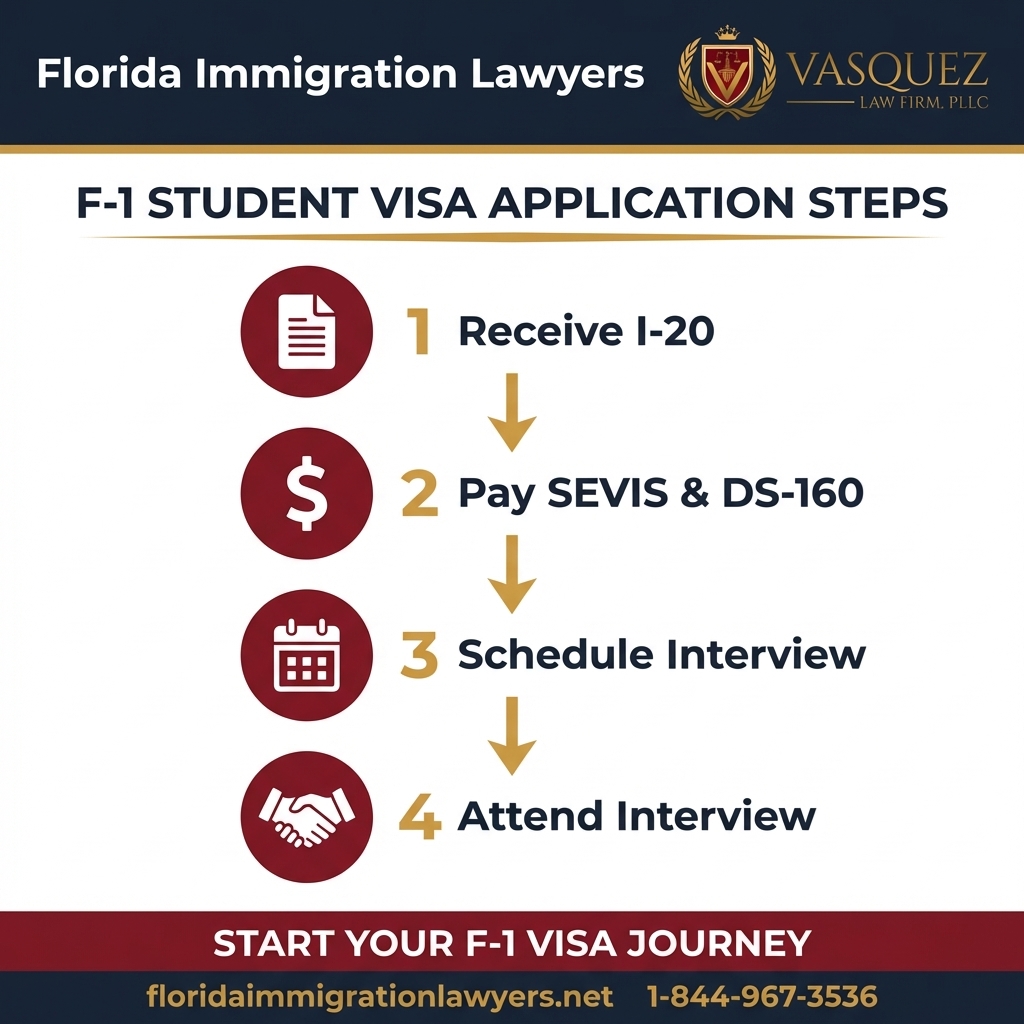
The F-1 visa allows international students to pursue academic studies at U.S. institutions, including many reputable Florida universities. Obtaining an F-1 visa involves securing admission to an SEVP-approved school, receiving Form I-20, paying SEVIS fees, and attending a visa interview. This process requires careful preparation and adherence to specific regulations to ensure a successful application for your 2026 studies.
- Secure admission to a Student and Exchange Visitor Program (SEVP) approved Florida university.
- Obtain Form I-20, Certificate of Eligibility for Nonimmigrant Student Status.
- Pay the I-901 SEVIS fee and complete the DS-160 visa application.
- Attend a visa interview at a U.S. Embassy or Consulate in your home country.
- Maintain full-time enrollment and comply with F-1 visa regulations while in the U.S.
Dreaming of pursuing your higher education amidst the vibrant culture and beautiful weather of Florida? Many international students aspire to study at world-class Florida universities, from Jacksonville to Miami, making the Sunshine State a popular destination. To turn this dream into a reality for 2026, understanding the F-1 visa process is your essential first step.
The F-1 student visa is specifically designed for individuals who wish to engage in full-time academic or language training programs. Navigating the requirements and application steps can seem complex, but with the right guidance, it is entirely manageable. This comprehensive guide will walk you through everything you need to know about securing your F-1 visa for studies in Florida, covering everything from initial applications to maintaining your status.
Do not let the complexities deter you from your educational goals. For personalized assistance and expert legal guidance throughout your F-1 visa application, call Florida Immigration Lawyers at 1-844-967-3536 for a free consultation. Our experienced team is here to help you every step of the way.
Understanding the F-1 Visa for Florida Universities
The F-1 visa is a nonimmigrant visa that allows foreign nationals to enter the United States as full-time students at accredited academic institutions. These institutions must be approved by the Student and Exchange Visitor Program (SEVP) to issue the necessary Form I-20, Certificate of Eligibility for Nonimmigrant Student Status. Florida boasts numerous such institutions, ranging from large public universities to specialized private colleges.
As an international student in Florida, your F-1 status permits you to reside in the U.S. for the duration of your academic program, plus a grace period. It is crucial to maintain your student status by adhering to specific regulations, including full-time enrollment and limited employment options. Understanding these foundational aspects is key to a successful educational journey in the U.S.
What is an F-1 Visa?
An F-1 visa is specifically for academic and language students. It is distinct from other nonimmigrant visas, such as the J-1 visa for exchange visitors or the M-1 visa for vocational students. The primary purpose of an F-1 visa holder's stay in the U.S. must be to pursue education, not to immigrate or work.
The Immigration and Nationality Act (INA) defines the F-1 nonimmigrant classification under INA § 101(a)(15)(F)(i). This section outlines the requirements for foreign students to be admitted to the U.S. solely for the purpose of pursuing a full course of study at an established institution of learning.
Eligibility Requirements for an F-1 Visa
To be eligible for an F-1 visa, you must first meet several criteria. You must be accepted by an SEVP-approved school in the U.S. for a full course of study. You also need to demonstrate sufficient funds to cover your tuition, living expenses, and other costs for your entire period of study.
Furthermore, you must have strong ties to your home country and intend to depart the U.S. upon completion of your program. This "nonimmigrant intent" is a critical aspect of the F-1 visa application. You must convince the consular officer that you do not plan to stay in the U.S. permanently.
Step-by-Step Guide to Obtaining Your F-1 Visa for Florida
The journey to obtaining your F-1 visa for a Florida university involves several distinct stages. Each step requires meticulous attention to detail and timely action. Here is a comprehensive guide to help you navigate the process for 2026.
-
Gain Admission to an SEVP-Approved Florida University
Your first step is to apply and be accepted by an academic institution in Florida that is certified by the Student and Exchange Visitor Program (SEVP). Universities such as the University of North Florida in Jacksonville, Florida International University in Miami, or the University of Central Florida in Orlando are popular choices for international students. Once accepted, the school will issue you a Form I-20, Certificate of Eligibility for Nonimmigrant Student Status.
-
Pay the SEVIS I-901 Fee
After receiving your Form I-20, you must pay the SEVIS I-901 fee. This fee supports the Student and Exchange Visitor Information System (SEVIS), which tracks F-1 students and exchange visitors. You can pay this fee online through the official SEVIS website. Keep your payment receipt, as you will need it for your visa interview.
For more detailed information on SEVIS, you can visit the official U.S. Immigration and Customs Enforcement (ICE) SEVIS website.
-
Complete the DS-160 Online Nonimmigrant Visa Application
The DS-160 is the online application form for nonimmigrant visas, including the F-1 visa. You will need to accurately fill out all sections, upload a compliant photo, and electronically sign the application. Make sure all information matches your passport and Form I-20.
-
Schedule and Attend Your Visa Interview
After completing the DS-160, you will schedule an interview at a U.S. Embassy or Consulate in your home country. It is advisable to schedule this interview as early as possible, as wait times can vary. During the interview, a consular officer will review your application, ask questions about your academic plans, financial resources, and your intent to return home after your studies. Be prepared to present all required documents.
You can find information about visa appointment wait times and application procedures on the U.S. Department of State website.
-
Prepare for Your Arrival in the U.S.
Once your F-1 visa is approved, you can make arrangements to travel to the United States. You are generally permitted to enter the U.S. up to 30 days before the program start date listed on your Form I-20. Ensure you carry all your essential documents, including your passport, visa, Form I-20, SEVIS fee receipt, and financial evidence, in your hand luggage.
-
Report to Your Designated School Official (DSO)
Upon arrival in Florida and at your university, you must report to your Designated School Official (DSO). Your DSO will register your arrival in SEVIS, confirming your enrollment and activating your F-1 student status. Failing to report to your DSO can jeopardize your visa status.
Essential Document Checklist for Your F-1 Visa Application
Gathering the correct documentation is paramount for a smooth F-1 visa application. Missing or incorrect documents can lead to delays or even denial. Ensure you have all these items ready for your interview and travel.
- Valid passport (must be valid for at least six months beyond your intended period of stay in the U.S.).
- Nonimmigrant Visa Application, Form DS-160 confirmation page.
- DS-160 payment receipt.
- One 2x2 inch color photograph, taken within the last six months, meeting U.S. visa photo requirements.
- Form I-20, Certificate of Eligibility for Nonimmigrant Student Status, issued by your SEVP-approved Florida university.
- SEVIS I-901 fee payment receipt.
- Academic transcripts, diplomas, degrees, or certificates from institutions you have attended.
- Standardized test scores required by your U.S. school (e.g., TOEFL, IELTS, SAT, GRE, GMAT).
- Evidence of your intent to depart the U.S. upon completion of your studies (e.g., property deeds, family ties, job offers in your home country).
- Financial evidence proving you have sufficient funds to cover your tuition, living expenses, and other costs for your entire period of study. This may include:
- Bank statements.
- Scholarship letters.
- Sponsor letters and their bank statements (if applicable).
F-1 visa - Step-by-Step Process
F-1 Visa Timeline and Processing Expectations for 2026
Understanding the typical timeline for an F-1 visa application is crucial for planning your studies in Florida. The process can vary significantly based on your home country, the specific U.S. Embassy or Consulate, and the time of year. It is always best to apply well in advance of your program start date.
Application Processing Times
Generally, you should begin your university application process at least 12-18 months before your desired start date, especially for competitive Florida universities. Once accepted and with your I-20 in hand, you can pay the SEVIS fee and complete the DS-160.
Visa interview wait times can range from a few days to several weeks or even months, depending on the embassy or consulate. After your interview, visa processing typically takes a few days to a few weeks. Some cases may require additional administrative processing, which can extend the timeline further. Always check the specific wait times for your country on the U.S. Department of State's website.
Remember that you cannot apply for your F-1 visa more than 120 days before your program start date. You also cannot enter the U.S. more than 30 days before your program start date.
Maintaining Your F-1 Status
Once in Florida, maintaining your F-1 status is vital. This includes enrolling in a full course of study, making normal progress towards completing your degree, and notifying your DSO of any changes to your address or program. Failure to comply with these regulations can lead to serious immigration consequences, including potential deportation defense issues.
For specific regulations governing F-1 students, refer to 8 CFR 214.2(f), which outlines the requirements for nonimmigrant students. This includes rules regarding course load, employment, and transfers.
Cost Factors and Fee Breakdown for International Students
Studying in Florida as an international student involves several significant costs beyond just tuition. It is essential to budget carefully to ensure you have sufficient funds throughout your academic journey. These costs typically include university fees, SEVIS fees, visa application fees, and living expenses.
University Tuition and Fees
Tuition fees for Florida universities vary widely. Public universities generally have lower tuition for in-state residents, but international students typically pay out-of-state tuition rates. Private universities often have higher, but sometimes more consistent, tuition rates for all students. Jacksonville-area institutions like the University of North Florida or Jacksonville University will have their own distinct fee structures.
Beyond tuition, universities often charge additional fees for health insurance, student activities, technology, and other services. These can add several thousand dollars to your annual costs. Always review the detailed fee breakdown provided by your chosen university.
Government Application Fees
- SEVIS I-901 Fee: This is a mandatory fee for all F-1 visa applicants, paid directly to the U.S. government.
- DS-160 Visa Application Fee: This fee is paid to the U.S. Embassy or Consulate where you apply for your visa.
Please note that these fees are subject to change and are non-refundable. You should always check the official U.S. government websites for the most current fee amounts.
Living Expenses in Florida
Living costs in Florida can vary depending on the city and your lifestyle. Major cities like Miami or Orlando tend to be more expensive than smaller towns. Jacksonville, for example, offers a relatively affordable cost of living compared to some other major U.S. cities, but you must still budget for accommodation, food, transportation, books, and personal expenses.
Many Florida universities provide estimates for living expenses on their international student services websites. These estimates are crucial for demonstrating your financial capability during the F-1 visa application process. Remember, the F-1 visa generally restricts your ability to work off-campus, so you must prove you can support yourself without relying on unauthorized employment.
The F-1 visa process, while structured, can present unexpected challenges. Do not navigate this process alone. Contact Florida Immigration Lawyers today to ensure your application is strong and compliant. Our team is ready to assist you.
Common Mistakes to Avoid During Your F-1 Visa Application
Applying for an F-1 visa requires precision. Even minor errors can lead to delays or denials. Be aware of these common pitfalls to safeguard your application.
-
Submitting an Incomplete or Inaccurate DS-160 Form
The DS-160 form is the cornerstone of your application. Any missing information, inconsistencies with your passport or I-20, or factual errors can raise red flags. Consequences: Delays, requests for more information, or outright visa denial.
-
Failing to Demonstrate Sufficient Nonimmigrant Intent
Consular officers need to be convinced you intend to return to your home country after your studies. Lack of strong ties (family, property, job prospects) can lead to suspicion. Consequences: Visa denial based on presumed immigrant intent.
-
Insufficient Proof of Funds
You must clearly show you have adequate financial resources for your tuition and living expenses for your entire program. Vague bank statements or unverified sponsorship can be problematic. Consequences: Visa denial due to concerns about financial stability.
-
Not Paying the SEVIS Fee
The SEVIS I-901 fee is mandatory and must be paid before your visa interview. Forgetting this step means your application cannot proceed. Consequences: Inability to schedule or attend the visa interview, or immediate denial.
-
Applying Too Late or Too Early
There are specific windows for applying for your F-1 visa and entering the U.S. Applying outside these windows can invalidate your application or entry. Consequences: Visa denial or denial of entry at the port of entry.
-
Providing Dishonest Information
Any misrepresentation or fraudulent information on your application or during your interview can have severe and long-lasting consequences. Consequences: Permanent visa ineligibility under INA § 212(a)(6)(C)(i), affecting all future U.S. visa attempts.
-
Not Understanding Your Program of Study
During the interview, you should be able to articulate why you chose your specific program and university in Florida. Lack of clarity can suggest a lack of genuine academic intent. Consequences: Consular officer may doubt your purpose of visit, leading to denial.
-
Improper Interview Demeanor
Being nervous is normal, but appearing evasive, disrespectful, or unprepared can negatively impact the interview. Consequences: Unfavorable impression, potentially leading to denial.
-
Failing to Maintain F-1 Status in the U.S.
Once in Florida, not enrolling full-time, working without authorization, or failing to report changes to your DSO can violate your status. Consequences: Status termination, leading to potential deportation proceedings and future bars to entry.
-
Overstaying Your Grace Period
After completing your program or Optional Practical Training (OPT), you have a 60-day grace period to depart the U.S. or change your status. Overstaying this period is a serious violation. Consequences: Accrual of unlawful presence, which can lead to re-entry bars.
When to Call a Lawyer for Your F-1 Visa Journey
While many F-1 visa applications proceed smoothly, certain situations warrant the expert guidance of an immigration attorney. Understanding when to seek legal help can significantly improve your chances of success and prevent costly errors.
You should consider contacting Florida Immigration Lawyers if you encounter any of the following scenarios:
- Previous Visa Denials: If you have had a U.S. visa denied in the past, understanding the reasons and addressing them effectively is crucial.
- Complex Financial Situations: If your financial support comes from multiple sources, or if your sponsor is not a direct relative, an attorney can help present your case clearly.
- Criminal History: Even minor offenses can impact your eligibility. A lawyer can assess your situation and advise on waivers or strategies.
- Prior Immigration Violations: Any history of overstaying a previous visa, unauthorized employment, or other violations requires professional legal advice.
- Unclear Nonimmigrant Intent: If you have significant ties to the U.S. (e.g., close relatives who are U.S. citizens or permanent residents), demonstrating nonimmigrant intent can be challenging.
- Administrative Processing Delays: If your F-1 visa application is stuck in administrative processing for an extended period, an attorney can inquire on your behalf.
- Changes in Status: If you are already in the U.S. on a different visa and wish to change to F-1 status, this process has its own complexities.
- Maintaining Status Issues: If you are struggling to maintain full-time enrollment, need to transfer schools, or have questions about Optional Practical Training (OPT), your DSO can help, but an attorney offers an independent legal perspective.
Our firm, Florida Immigration Lawyers, is dedicated to assisting international students achieve their academic dreams in Florida. We can help you prepare your application, gather necessary documentation, and even prepare you for your visa interview. Do not leave your future to chance; seek professional legal counsel.
Frequently Asked Questions (FAQs) About F-1 Visas in Florida
Here are answers to some common questions international students have about F-1 visas and studying in Florida.
Will F-1 students have to pay $100,000 for H1B?
No, F-1 students do not directly pay $100,000 for an H-1B visa. The H-1B visa is a separate nonimmigrant visa for specialty occupations, often sought by F-1 students after completing their studies and Optional Practical Training (OPT). The fees associated with an H-1B visa are typically paid by the sponsoring employer, and while they can be substantial, they do not generally reach $100,000 for government filing fees. The cost for an employer can vary based on attorney fees, premium processing, and specific employer size, but these are employer costs, not direct student payments.
Will you hold an F-1 visa at the USF?
The F-1 visa is a federal nonimmigrant visa status, not something "held" by a specific university. If you are admitted to the University of South Florida (USF) or any other SEVP-approved institution in Florida, and you meet all the F-1 visa requirements, you will be issued an F-1 visa by a U.S. Embassy or Consulate. USF, like other universities, would issue you the Form I-20 necessary for your F-1 application, but your visa status is granted by the U.S. government.
What is the cheapest university in Florida for international students?
Identifying the absolute "cheapest" university in Florida for international students is challenging, as costs fluctuate and depend on many factors. Generally, public universities may offer more competitive tuition rates compared to private institutions, though international students almost always pay out-of-state tuition. Factors like scholarships, assistantships, and the cost of living in the university's city (e.g., Jacksonville vs. Miami) also heavily influence overall expenses. We recommend researching specific university websites and contacting their international student offices for the most accurate and up-to-date cost estimates for 2026.
What is the 5 year rule for F-1 visa?
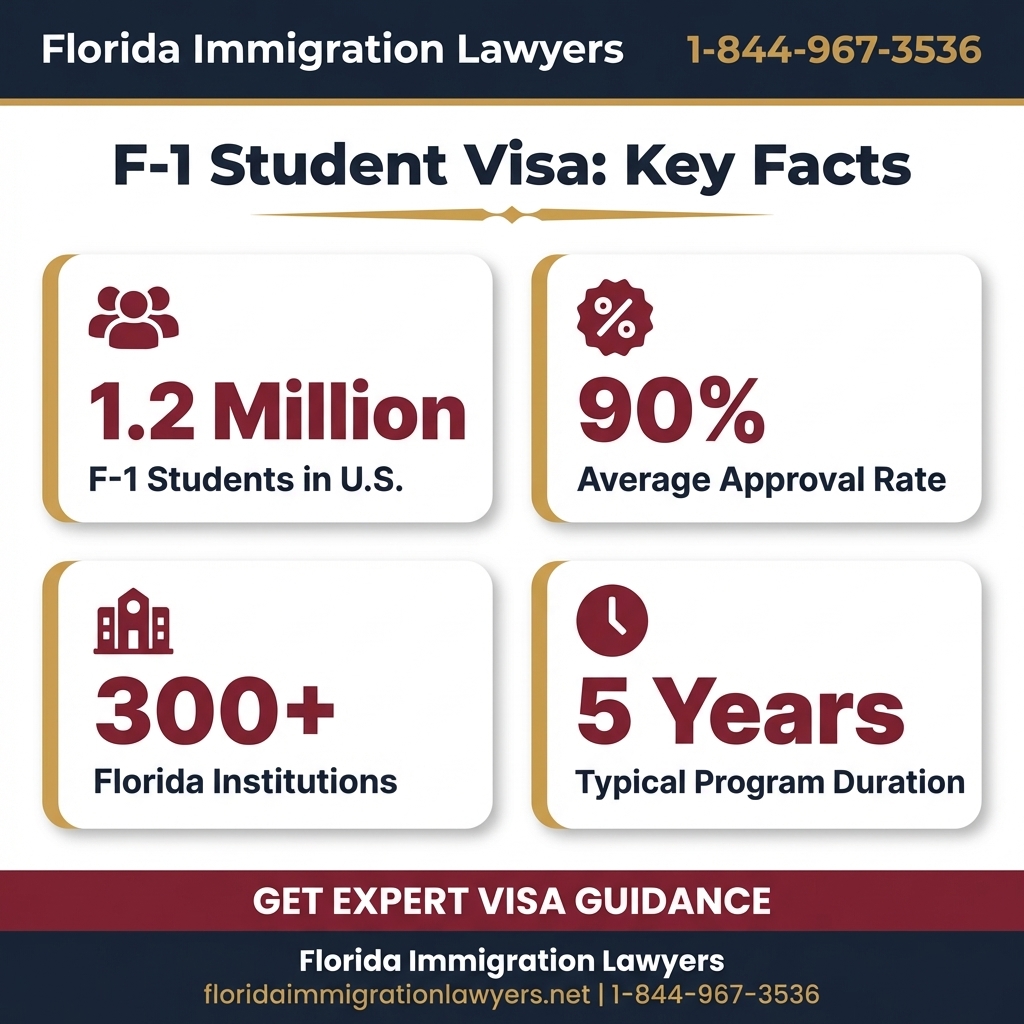
There isn't a strict "5-year rule" for F-1 visas that universally limits all F-1 students to five years of study. However, there are regulations regarding the duration of your F-1 status. For students pursuing a bachelor's degree, F-1 status is typically granted for the duration of the program plus Optional Practical Training (OPT) and a 60-day grace period. For specific programs, such as English language training, there might be limitations on how long you can remain in F-1 status. Students pursuing multiple degrees or higher education (Master's, PhD) can often extend their F-1 status for the duration of these programs. It is crucial to always maintain full-time enrollment and complete your program within the expected timeframe to avoid violating your status. Consult your DSO or an immigration attorney if you have concerns about your duration of status.
About Florida Immigration Lawyers
At Florida Immigration Lawyers, we understand the aspirations and challenges faced by international students seeking to study in the U.S. Our firm is a leading immigration law practice serving individuals and families across all of Florida, including Jacksonville, Orlando, Tampa, and Miami. We are dedicated to providing compassionate, knowledgeable, and effective legal representation for a wide range of immigration matters.
Our experienced attorneys specialize in various immigration services, including F-1 student visas, family-based petitions, employment visas, asylum claims, and deportation defense. We pride ourselves on offering personalized attention and strategic advice tailored to your unique situation. We are committed to helping you navigate the complex U.S. immigration system successfully.
Why Choose Florida Immigration Lawyers?
- Expertise: Deep knowledge of U.S. immigration law and Florida-specific contexts.
- Client-Centered Approach: Your goals are our priority, with clear communication and empathetic support.
- Comprehensive Services: From initial visa applications to complex appeals and defense.
- Accessibility: Available 24/7 to address your urgent needs.
- Bilingual Support: Se Habla Español – our team is fluent in both English and Spanish to serve you better.
If you are considering applying for an F-1 visa, or need assistance with any other immigration issue in Florida, do not hesitate to reach out. Call us at 1-844-967-3536 or visit our website at https://www.floridaimmigrationlawyers.net for a free consultation. Let us be your trusted legal partner in achieving your American dream.
Sources and References
- U.S. Citizenship and Immigration Services (USCIS) - Students and Exchange Visitors
- U.S. Department of State - Student Visas
- U.S. Immigration and Customs Enforcement (ICE) - Student and Exchange Visitor Program (SEVP)
- 8 U.S.C. § 1101(a)(15)(F)(i) - Immigration and Nationality Act (INA) defining F-1 status
- 8 CFR Part 214.2(f) - Code of Federal Regulations pertaining to F-1 students
This article provides general legal information and is not intended as legal advice. Every case is unique, and outcomes depend on specific facts and circumstances. Contact an attorney for advice about your particular situation.
Embarking on your F-1 visa journey to a Florida university requires expert guidance. Do not navigate this complex process alone. Contact Florida Immigration Lawyers today for a free, confidential consultation. Our dedicated team is ready to help you achieve your academic goals. Call us at 1-844-967-3536. Se Habla Español - Estamos aquí para ayudarle.
Do Not Navigate This Process Alone
Our experienced immigration attorneys are ready to fight for you. Get a free, confidential consultation today.
Se Habla Español
Frequently Asked Questions
Florida Immigration Lawyers
Immigration Attorney | Founder, Vasquez Law Firm
U.S. Air Force veteran and immigration attorney with thousands of cases resolved. J.D., NCCU School of Law. AILA member. Admitted to the 4th, 5th, and 11th Circuit Courts.
Available 24/7 - Free Evaluations
Related Legal Services
Our Florida immigration attorneys can help you with business immigration, asylum protection and deportation defense. Call today at 1-844-967-3536 for a free consultation.
Related Links
Related Topics
Free Legal Consultation
Discuss your case with our experienced attorneys. We're available 24/7.
Se Habla Español - Estamos aquí para ayudarle.
Related Articles
Understanding Citizenship Application Delays in Florida
Facing delays in your citizenship application in Florida? Learn about the causes, how to manage them, and when to seek legal help. Our guide provides insights into the N-400 process and offers practical advice for applicants in Tallahassee. Contact us for a free consultation.
VAWA Self-Petition for Abused Spouse in Florida | VLF Florida
Learn how to file a VAWA self-petition in Florida as an abused spouse. Discover eligibility requirements, process steps, and when to seek legal help. Call Florida Immigration Lawyers for a free consultation.
Navigating the Unlawful Presence Waiver in Florida
Learn about the I-601A provisional waiver for unlawful presence in Florida. This guide covers eligibility, application steps, common mistakes, and why consulting an attorney is crucial. Contact Florida Immigration Lawyers for a free consultation.
Protecting Against Immigration Scams in Florida | VLF Florida
Learn how to protect yourself from immigration scams in Florida, including notario fraud. Discover actionable steps and legal resources. Call Florida Immigration Lawyers at 1-844-967-3536.