Derived Citizenship Florida: Guide for Children Born Abroad
For Florida families, understanding derived citizenship is key to ensuring children born abroad gain U.S. citizenship. This guide from Florida Immigration Lawyers explains eligibility under the Child Citizenship Act, the N-600 application process, required documents, and critical differences from acquired citizenship. We cover common mistakes and when to seek legal help to navigate this complex journey, especially for residents of Hollywood and surrounding areas. Learn how your child can automatically become a U.S. citizen through a parent's naturalization. Contact us for a free consultation to clarify your child's path to citizenship.
Quick Answer: Derived Citizenship in Florida
Derived citizenship in Florida allows certain children born outside the U.S. to automatically become U.S. citizens when one of their parents naturalizes or becomes a citizen. This process typically applies to children under 18 who are lawful permanent residents and are residing in the U.S. in the legal and physical custody of their U.S. citizen parent. It is distinct from acquired citizenship, which applies at the moment of birth. Understanding the specific requirements of the Child Citizenship Act of 2000 is crucial for families in Hollywood and across Florida. Consulting with an experienced immigration attorney can clarify your child's eligibility and streamline the application process for the Certificate of Citizenship (Form N-600).
- Derived citizenship is automatic for eligible children under 18.
- Requires the child to be a lawful permanent resident (Green Card holder).
- One parent must be a U.S. citizen (either by birth or naturalization).
- The child must be in the legal and physical custody of the U.S. citizen parent.
- Form N-600, Application for Certificate of Citizenship, is used to document this status.
Navigating the complexities of immigration law can feel overwhelming, especially when your family's future hangs in the balance. For parents in Florida, particularly those in areas like Hollywood, understanding how a child can gain derived citizenship is incredibly important. This pathway to U.S. citizenship is a significant benefit for many families, allowing children born abroad to automatically become citizens when their parent naturalizes.
At Florida Immigration Lawyers, we frequently assist families throughout the state in understanding and securing their children's citizenship. This comprehensive guide will explain what derived citizenship means, who is eligible, the steps involved in the process, and what challenges you might encounter. We aim to empower you with the knowledge to navigate this critical journey.
Do not let uncertainty prevent your child from realizing their full potential as a U.S. citizen. If you believe your child may be eligible for derived citizenship, or if you have questions about any aspect of the process, we are here to help. Call Florida Immigration Lawyers at 1-844-YO-PELEO for a free consultation and let our experienced team guide you through every step.
Understanding Derived Citizenship in Florida
Derived citizenship, often confused with acquired citizenship or naturalization, is a specific legal pathway for children. It is governed primarily by Section 320 of the Immigration and Nationality Act (INA), codified at 8 U.S.C. § 1431. This law states that a child born outside the United States automatically becomes a U.S. citizen when certain conditions are met, usually upon a parent's naturalization.
Unlike naturalization, which requires an application and an oath of allegiance, derived citizenship is automatic. There is no need for the child to file an N-400 application or take an oath. The child simply becomes a citizen by operation of law once all statutory requirements are fulfilled. The Form N-600, Application for Certificate of Citizenship, is then filed to obtain official documentation of this status, not to confer it.
For families residing in Florida, whether in bustling cities like Miami or Tampa, or communities such as Hollywood, understanding this distinction is vital. It means that if your child meets the criteria, they are already a U.S. citizen, even if they do not yet have a Certificate of Citizenship. This can have profound implications for their rights, benefits, and future opportunities in the United States.
The Child Citizenship Act of 2000 (CCA) clarified and streamlined many aspects of derived citizenship, making it easier for eligible children to claim their rightful place as U.S. citizens. Our firm stays current with all such legislative changes to provide accurate and timely advice to Florida families.
Eligibility Requirements for Derived Citizenship in Florida
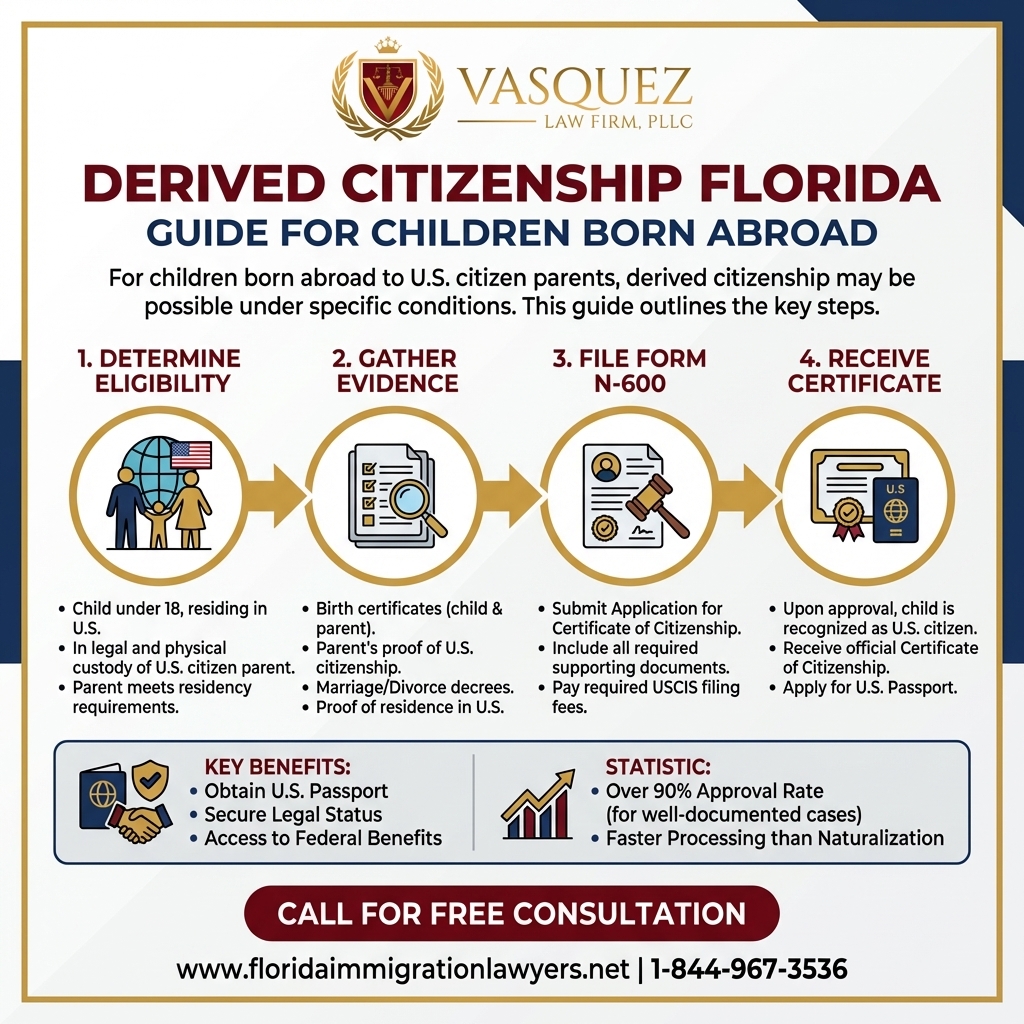
To qualify for derived citizenship under INA Section 320 (8 U.S.C. § 1431), a child must meet all the following conditions on or after February 27, 2001, when the Child Citizenship Act became effective:
- At Least One Parent is a U.S. Citizen: This parent must be a U.S. citizen by birth or through naturalization. If the parent naturalizes, the child's citizenship derives from that event.
- Child is Under 18 Years of Age: All conditions must be met before the child's 18th birthday. If the child turns 18 even one day before all conditions are met, they are not eligible for derived citizenship under this section.
- Child is a Lawful Permanent Resident (LPR): The child must have a Green Card and be lawfully admitted for permanent residence in the United States. This means they have gone through the immigration process to become a permanent resident.
- Child is Residing in the U.S. in Legal and Physical Custody of the U.S. Citizen Parent: The child must live with the U.S. citizen parent. Legal custody refers to the parent's right to make decisions for the child, typically granted by a court or through marriage. Physical custody means the child actually lives with the parent.
It is important to note that if the child is adopted, the adoption must be full and final before the child's 16th birthday. Stepchildren generally do not qualify for derived citizenship unless legally adopted by the U.S. citizen stepparent. Our attorneys can help you determine if your specific family situation in Hollywood or elsewhere in Florida meets these strict criteria.
Special Considerations for Children Born Abroad
For children born abroad, the path to derived citizenship often begins with their immigration to the U.S. as a lawful permanent resident. This typically involves a family-based visa petition filed by the U.S. citizen parent. Once the child enters the U.S. with their immigrant visa and becomes an LPR, the clock starts for meeting the other derived citizenship conditions. Understanding these nuances is crucial for families in Florida.
The Application Process: Steps to Claim Derived Citizenship
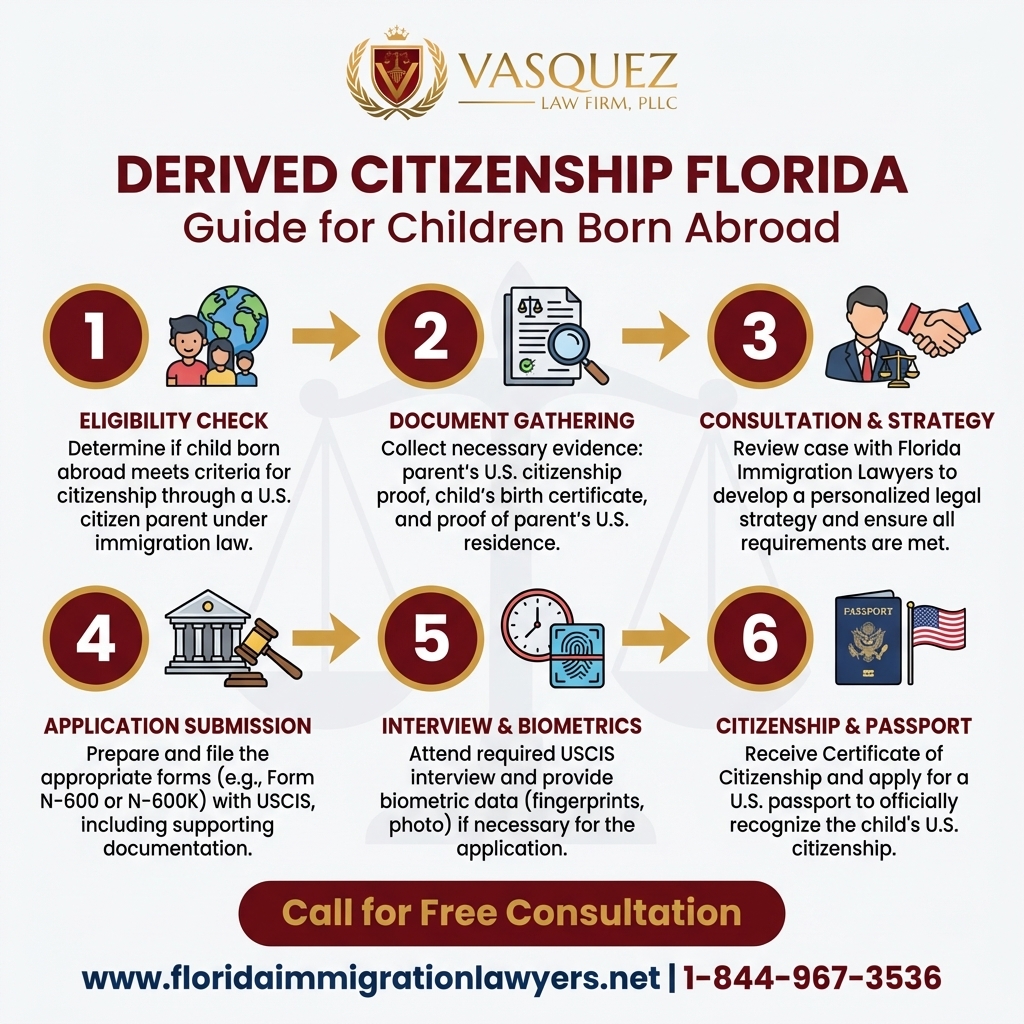
While derived citizenship is automatic, obtaining official proof of citizenship is highly recommended. This typically involves filing Form N-600, Application for Certificate of Citizenship, with U.S. Citizenship and Immigration Services (USCIS). This document serves as definitive proof of your child's U.S. citizenship, similar to a birth certificate for those born in the U.S.
- Confirm Eligibility: Before filing, ensure your child meets all the criteria outlined above. This includes verifying the parent's citizenship, the child's age, LPR status, and custody arrangements. Gather all relevant documents to support each condition.
- Complete Form N-600: Accurately fill out Form N-600. Pay close attention to all sections, ensuring consistency with supporting documents. Any discrepancies can lead to delays or requests for additional evidence.
- Gather Supporting Documentation: Collect all necessary documents, such as birth certificates, marriage certificates, naturalization certificates, Green Cards, and custody orders. Make sure copies are clear and legible.
- Pay Filing Fees: Submit the required filing fee with your application. USCIS fees can change, so always check the latest fee schedule on the USCIS website before filing. Fee waivers may be available for eligible applicants.
- Submit the Application: Mail the completed Form N-600, supporting documents, and fee to the appropriate USCIS Lockbox facility. The address depends on your location and the courier service you use.
- Attend Biometrics Appointment (if required): USCIS may require the child (if of a certain age) and/or the parent to attend a biometrics appointment to collect fingerprints, photos, and signatures. This typically occurs at a local Application Support Center (ASC) in Florida.
- Attend Interview (if required): In some cases, USCIS may schedule an interview at a local field office, such as the Miami, Orlando, or Tampa USCIS office. Both the child and the U.S. citizen parent would typically attend. The purpose is to verify information and clarify any issues.
- Receive Decision and Certificate of Citizenship: If approved, USCIS will mail the Certificate of Citizenship. This document is proof of U.S. citizenship and can be used to apply for a U.S. passport.
The process can be intricate, and errors can be costly in terms of time and stress. Our firm routinely assists families in Hollywood and across Florida with every step of the N-600 application, ensuring accuracy and thoroughness.
Required Documents Checklist for N-600 Application
A complete and accurate application package is key to a smooth process. Here is a general checklist of documents typically required when filing Form N-600. Remember to submit copies, not originals, unless specifically requested by USCIS.
- Form N-600, Application for Certificate of Citizenship.
- Two passport-style photos of the child.
- Child's birth certificate (with certified English translation if applicable).
- Evidence of child's lawful permanent resident status (e.g., Green Card, I-551 stamp in passport).
- Parent's birth certificate (if U.S. citizen by birth).
- Parent's naturalization certificate (if U.S. citizen by naturalization).
- Parents' marriage certificate (if applicable, with certified English translation).
- Divorce decrees or death certificates for any previous marriages of either parent (if applicable, with certified English translation).
- Evidence of legal and physical custody (e.g., court orders, divorce decrees, sworn statements).
- Evidence of name change (if applicable, e.g., court order, marriage certificate).
- If applicable, evidence of adoption (e.g., final adoption decree).
- Payment for the filing fee or Form I-912, Request for Fee Waiver.
Gathering these documents can be time-consuming, and ensuring they meet USCIS requirements is crucial. For families in Florida, particularly those with complex family histories or international documents, working with an experienced immigration attorney can prevent common pitfalls.
Timelines, Processing, and Cost Factors for Derived Citizenship
Understanding the expected timelines and costs associated with obtaining a Certificate of Citizenship is important for planning. While derived citizenship itself is automatic, the administrative process of documenting it through Form N-600 does take time and incurs fees.
Processing Timelines
USCIS processing times for Form N-600 can vary significantly based on the service center's workload, the complexity of the case, and the completeness of the application. Generally, applicants can expect processing times ranging from several months to over a year. You can check current processing times on the USCIS website by selecting Form N-600 and the relevant field office or service center. For Florida residents, this would typically involve the USCIS field offices in Miami, Orlando, or Tampa, depending on your address.
Factors that can influence processing times include:
- Missing documents or incomplete information.
- Requests for Evidence (RFEs) from USCIS.
- The need for an interview.
- Background check processing.
Cost Factors and Fee Breakdown
The primary cost associated with documenting derived citizenship is the USCIS filing fee for Form N-600. It is crucial to check the most current fee schedule on the USCIS website, as fees are subject to change. Typically, the fee is a flat rate per application. Additionally, there may be costs for:
- Gathering supporting documents, such as obtaining certified copies of birth certificates or marriage licenses.
- Translation services for foreign-language documents.
- Passport-style photographs.
- Attorney fees for legal assistance and representation.
While the legal fees for an attorney are an additional expense, the value of professional guidance in avoiding errors, preparing a strong application, and responding to USCIS inquiries can be invaluable. This investment can save you significant time, stress, and potential delays or denials. Our firm offers transparent fee structures and will discuss all anticipated costs during your free consultation.
Acquired vs. Derived Citizenship: Key Differences for Florida Families
It is common for families to confuse acquired and derived citizenship, but they are distinct legal concepts with different requirements. Understanding these differences is crucial for determining your child's eligibility, especially for those born abroad to U.S. citizen parents in Florida.
Acquired Citizenship
Acquired citizenship refers to citizenship that is conferred at birth to a child born outside the United States. This occurs when a child is born to at least one U.S. citizen parent who has met certain physical presence requirements in the U.S. before the child's birth. The child is a U.S. citizen from the moment of birth, typically documented by filing Form FS-240, Consular Report of Birth Abroad (CRBA), through a U.S. embassy or consulate. This is governed by INA Section 301 (8 U.S.C. § 1401) and Section 309 (8 U.S.C. § 1409).
Key characteristics of acquired citizenship:
- Citizenship at birth.
- Parent must meet specific physical presence requirements in the U.S. prior to the child's birth.
- Child does not need to be a lawful permanent resident.
- Often applies to children born to U.S. military personnel or government employees stationed abroad.
Derived Citizenship
As discussed, derived citizenship applies to a child who was not a U.S. citizen at birth but automatically becomes one later when their U.S. citizen parent naturalizes or meets other specific criteria. The child must be under 18, a lawful permanent resident, and in the legal and physical custody of the U.S. citizen parent. This is governed by INA Section 320 (8 U.S.C. § 1431) and Section 322 (8 U.S.C. § 1433).
Key characteristics of derived citizenship:
- Citizenship after birth, by operation of law.
- Child must be a lawful permanent resident.
- Parent does not need to meet specific physical presence requirements prior to the child's birth, only that they are a U.S. citizen when the conditions are met.
- Child must be under 18 and in the legal and physical custody of the U.S. citizen parent.
For Florida families, especially those who have immigrated to the U.S. and later naturalized, derived citizenship is the more common pathway for their children. If you are unsure which category applies to your child, consulting with an immigration attorney is crucial to ensure the correct application process is followed.
Common Mistakes to Avoid in Derived Citizenship Cases
Even though derived citizenship is automatic by law, mistakes in documenting it can lead to significant delays, denials, or complications. Avoid these common pitfalls:
- Missing the 18th Birthday Deadline: All conditions for derived citizenship must be met before the child's 18th birthday. If a parent naturalizes even one day after the child turns 18, the child is no longer eligible under INA 320. This is a strict deadline with no exceptions.
- Lack of Lawful Permanent Resident Status: The child must be a Green Card holder. If the child is in the U.S. on a visa (e.g., student, tourist) or is undocumented, they do not qualify for derived citizenship. They must first obtain LPR status.
- Insufficient Proof of Parent's U.S. Citizenship: Failing to provide clear evidence that at least one parent is a U.S. citizen (e.g., birth certificate, naturalization certificate) will halt the process.
- Failure to Prove Legal and Physical Custody: USCIS requires clear evidence that the child is residing with and under the legal and physical custody of the U.S. citizen parent. This can be complex in cases of divorce, separation, or guardianship.
- Incomplete or Inaccurate Form N-600: Errors or omissions on the application form are a leading cause of RFEs and processing delays. Double-check every field for accuracy and completeness.
- Submitting Expired or Unclear Documents: Ensure all supporting documents are current, legible, and properly translated if in a foreign language. Expired passports or blurry copies can cause issues.
- Incorrect Filing Fees: USCIS fees change periodically. Always verify the current fee for Form N-600 on the official USCIS website before mailing your application. Incorrect fees will result in the application being rejected.
- Not Responding to Requests for Evidence (RFEs): If USCIS sends an RFE, it is critical to respond fully and on time. Failing to do so can lead to a denial of the application.
- Confusing Derived with Acquired Citizenship: Applying for a Certificate of Citizenship under the wrong section of law or misunderstanding the eligibility criteria for each can lead to denials and wasted time and money.
- Attempting to Apply for Naturalization (N-400) for an Eligible Child: If your child already qualifies for derived citizenship, they are already a citizen. Filing an N-400 is unnecessary and incorrect, as the N-400 is for adults seeking to naturalize, not for children who automatically become citizens.
- Not Seeking Legal Counsel for Complex Cases: While some cases are straightforward, complex family situations (e.g., adoptions, children born out of wedlock, divorce, prior immigration issues) significantly benefit from attorney guidance.
When to Call a Florida Immigration Lawyer
While the concept of derived citizenship might seem straightforward, the application process for proving it through Form N-600 can be complex. Many families in Florida, from Hollywood to Jacksonville, benefit immensely from professional legal assistance. You should consider contacting Florida Immigration Lawyers if:
- You are unsure if your child meets all the eligibility requirements for derived citizenship.
- Your family situation is complex, involving divorce, adoption, step-parents, or children born out of wedlock.
- You have difficulty gathering or translating the required documentation, especially foreign-language documents.
- USCIS has sent you a Request for Evidence (RFE) or a Notice of Intent to Deny (NOID).
- Your child has a criminal record or any past immigration violations that might complicate their case.
- You need assistance preparing for a USCIS interview or responding to questions about your application.
- You want to ensure the application is filed correctly and efficiently to avoid delays or denials.
- You are a U.S. citizen parent living abroad and need to understand the process for your child.
Our dedicated team at Florida Immigration Lawyers has extensive experience in citizenship and family immigration cases. We understand the nuances of the Child Citizenship Act and the specific requirements of USCIS. We can help you navigate the process, prepare a robust application, and represent your interests. Your child's future as a U.S. citizen is paramount, and our firm is here to provide the guidance you need.
About Florida Immigration Lawyers
Florida Immigration Lawyers is an immigration law firm dedicated to serving individuals and families across the entire state of Florida. With a deep understanding of U.S. immigration laws and a passion for helping our clients achieve their dreams, we offer comprehensive legal services tailored to your unique needs. Our team of experienced attorneys provides compassionate, effective, and results-driven representation in all areas of immigration law, including derived citizenship, family immigration, asylum, deportation defense, and naturalization.
We pride ourselves on our client-focused approach, ensuring that every individual receives personalized attention and clear communication throughout their legal journey. Our firm is committed to upholding the highest standards of legal ethics and professionalism. We understand the profound impact immigration matters have on lives, and we are here to be your trusted advocates.
Available 24/7, we offer free consultations to discuss your case and provide an honest assessment of your options. We serve all of Florida, including Orlando and beyond. Let us put our knowledge and dedication to work for you. Visit our website at www.floridaimmigrationlawyers.net or call us directly at 1-844-YO-PELEO.
Sources and References
- U.S. Citizenship and Immigration Services (USCIS) Policy Manual: Volume 12, Part H, Chapter 4 - Automatic Acquisition of Citizenship (INA 320)
- U.S. Citizenship and Immigration Services (USCIS): Form N-600, Application for Certificate of Citizenship
- Executive Office for Immigration Review (EOIR)
- 8 U.S.C. § 1431 (INA Section 320) - Children born outside the United States and residing permanently in the United States; conditions for automatic citizenship.
- 8 U.S.C. § 1433 (INA Section 322) - Children born outside the United States; application for certificate of citizenship requirements.
- 8 U.S.C. § 1401 (INA Section 301) - Nationals and citizens of United States at birth.
- 8 CFR Part 320 - Children of Citizen Parents.
Related services: naturalization process, citizenship test preparation, dual citizenship guidance, citizenship test resources.
This article provides general legal information and is not intended as legal advice. Every case is unique, and outcomes depend on specific facts and circumstances. Contact an attorney for advice about your particular situation. Immigration laws are subject to change, and it is crucial to consult with a qualified legal professional for the most current and accurate information.
Securing your child's future as a U.S. citizen is a profound step, and Florida Immigration Lawyers is here to ensure that journey is as smooth and successful as possible. Our commitment to Florida families is unwavering.
Do not delay in seeking legal advice. Your child may already be a U.S. citizen, and we can help you obtain the official documentation they need. Contact us today for a free consultation at 1-844-YO-PELEO. Se Habla Espanol - Estamos aqui para ayudarle.
Do Not Navigate This Process Alone
Our experienced immigration attorneys are ready to fight for you. Get a free, confidential case review today.
Se Habla Español
Or leave your details and we’ll call you:
Free Evaluation in 24 Hours
Or talk to us right now
AI voice assistant — available 24/7
FreeFrequently Asked Questions

William J. Vásquez
Founding Attorney · Vasquez Law Firm
U.S. Air Force veteran and immigration attorney with years of hands-on U.S. immigration experience. J.D., NCCU School of Law. AILA member. Admitted to the 4th, 5th, and 11th Circuit Courts.
Available 24/7 - Free Evaluations
Reviewed for legal accuracy by William J. Vásquez
Licensed in North Carolina; U.S. immigration is federal practice.
Related Legal Services
Our Florida immigration attorneys can help you with family immigration services, immigration lawyer cost in Florida and experienced immigration attorneys. Call today at 1-844-YO-PELEO for a free case review.
Related Links
Related Topics
Free Legal Case Review
Discuss your case with our experienced attorneys. We're available 24/7.
Se Habla Español - Estamos aquí para ayudarle.
Related Articles
DUI Immigration Consequences in Florida 2026
A DUI conviction in Florida can have severe immigration consequences, potentially leading to inadmissibility, deportation, or denial of immigration benefits. For non-citizens, a DUI is not just a traffic offense but a serious criminal matter that federal immigration law scrutinizes closely. Factors like multiple offenses, injury, or property damage can escalate a simple DUI to a Crime Involving Moral Turpitude (CIMT) or even an aggravated felony, triggering mandatory detention and removal proceedings. Understanding the specific nature of your Florida conviction and its interpretation under the Immigration and Nationality Act (INA) is crucial. This article outlines how DUIs impact immigration status, the grounds for inadmissibility and deportation, a step-by-step guide to navigating the process, essential documentation, and expected timelines for 2026. We also highlight common mistakes to avoid and when to seek legal counsel from an experienced immigration attorney. Florida Immigration Lawyers offers comprehensive support for individuals facing these challenging situations, providing expert guidance through complex legal landscapes.
Immigration Lawyer Orlando Free Consultation in Florida
For individuals and families in Orlando, Florida, navigating the complexities of U.S. immigration law requires expert guidance. An immigration lawyer in Orlando offers crucial support for everything from visa applications and green card processes to naturalization and deportation defense. This comprehensive guide details what a free consultation covers, providing a step-by-step overview of immigration pathways, essential document checklists, and expected timelines in 2026. We also highlight common mistakes to avoid, discuss the critical role of legal counsel in deportation and asylum cases, and explain why choosing a local Orlando immigration attorney is beneficial. Florida Immigration Lawyers is dedicated to serving the diverse community of Orlando with compassionate, effective legal solutions, ensuring you receive personalized advice and robust representation for a successful immigration journey.
EAD Advance Parole Combo Card in Florida: What You Need
An EAD advance parole combo card allows individuals with pending adjustment applications to both work and travel abroad without jeopardizing their green card application. Learn how to apply in Florida, what documents you need, and common mistakes to avoid.
Dual Citizenship Lawyer in Florida: What You Need to Know
For Florida residents, the concept of dual citizenship, or holding two passports, offers a compelling blend of opportunities and challenges. While the U.S. generally permits dual nationality, the path to achieving this status requires a meticulous understanding of both U.S. immigration laws and the citizenship policies of your country of origin. This guide explores the definition of dual citizenship, the detailed step-by-step process for U.S. naturalization, and the significant benefits and potential pitfalls involved. We cover essential documentation, typical timelines, and cost considerations for 2026, providing crucial insights for anyone in Orlando, Miami, or across Florida considering this important legal step. Learn about common mistakes to avoid and understand when to seek professional legal counsel to navigate this complex process successfully. Florida Immigration Lawyers is here to provide expert, bilingual support for your dual citizenship journey.