DACA News 2026 Florida: Navigating Dreamer Rights & Renewals
Stay updated on DACA news 2026 in Florida, a critical year for Dreamers. This comprehensive guide from Florida Immigration Lawyers covers renewal processes, legal challenges, and state-specific enforcement impacts. Learn about eligibility, required documents, and processing timelines. We address concerns about safety and DACA's status in Florida, emphasizing the importance of legal counsel amidst ongoing policy shifts. Understand how to avoid common application mistakes and when to seek professional help to protect your DACA status and explore other immigration pathways. Your future matters, and expert legal guidance is essential.
In 2026, DACA continues to face legal challenges, yet renewals are still being processed for eligible individuals. While DACA does not offer a path to permanent residency, it provides crucial temporary protection from deportation and work authorization. Florida Dreamers must stay informed about evolving policies and state-specific enforcement actions. Consulting an experienced immigration lawyer is vital for navigating the complexities and ensuring your application or renewal is robust.
- DACA renewals are still available for current recipients in 2026.
- Legal challenges continue to impact DACA's long-term future.
- Florida's specific enforcement policies require heightened awareness.
- Expert legal guidance is crucial for successful applications and renewals.
The landscape of immigration law is constantly shifting, and for Deferred Action for Childhood Arrivals (DACA) recipients in Florida, 2026 brings both continuity and uncertainty. Many Dreamers, individuals who arrived in the U.S. as children, are understandably anxious about their future. You might be wondering how recent court decisions, state policies, and federal actions will impact your status or that of your loved ones.
Understanding the latest DACA news 2026 is not just about staying informed; it's about protecting your future. This comprehensive guide will walk you through the current status of DACA, renewal processes, potential challenges specific to Florida, and how expert legal assistance can make a critical difference. Do not navigate these complex waters alone. Call Florida Immigration Lawyers at 1-844-967-3536 for a free consultation today.
Understanding DACA in 2026: A Florida Perspective
Deferred Action for Childhood Arrivals (DACA) was established in 2012, offering temporary relief from deportation and work authorization to eligible young immigrants. While it has provided a lifeline for hundreds of thousands, DACA has never been a permanent solution or a pathway to citizenship. Its future remains subject to ongoing legal battles and political discourse.
As of 2026, DACA continues to operate under a cloud of uncertainty due to various court rulings. While new applications are generally not being accepted by USCIS, renewals are still being processed for individuals who previously held DACA status. This distinction is critical for current recipients in Florida.
DACA's Legal Status and Future Outlook
The program's legality is still being contested in federal courts. Decisions from the Fifth Circuit Court of Appeals and subsequent reviews have placed restrictions on DACA, primarily halting the acceptance of initial applications. This means that if you have never received DACA before, you are generally unable to apply at this time. For current DACA recipients, however, the ability to renew remains intact, for now.
The legal challenges stem from arguments that DACA was not properly implemented through formal rulemaking procedures. This ongoing litigation creates an unpredictable environment, leaving many Dreamers in Florida anxious about potential changes. Our firm closely monitors all legal developments to provide the most current advice.
Are DACA Recipients Safe in Florida? Addressing State-Specific Concerns
The question, "Are DACA recipients safe in Florida?" is a valid and pressing concern for many. Florida has implemented several state-level immigration policies that can create a challenging environment for undocumented immigrants and even those with DACA status. These policies, such as increased state involvement in immigration enforcement, often lead to heightened anxiety.
Recent news, including Florida law enforcement leading with ICE 287(g) partnerships and "Operation Tidal Wave" resulting in thousands of arrests, highlights the state's aggressive stance on immigration enforcement. While DACA provides protection from deportation, these state-level actions can still create indirect risks and a climate of fear. It is crucial for DACA recipients in Florida to understand their rights and the limits of state authority.
Despite these challenges, DACA is still allowed in Florida. DACA recipients have legal authorization to live and work in the U.S., and this status is recognized by federal agencies. However, the state's enforcement policies mean that interactions with local law enforcement, particularly in areas like Tallahassee and surrounding regions, require careful navigation. Always carry proof of your DACA status and consult an attorney if you face any immigration-related detention or questioning.
DACA Demographics in Florida
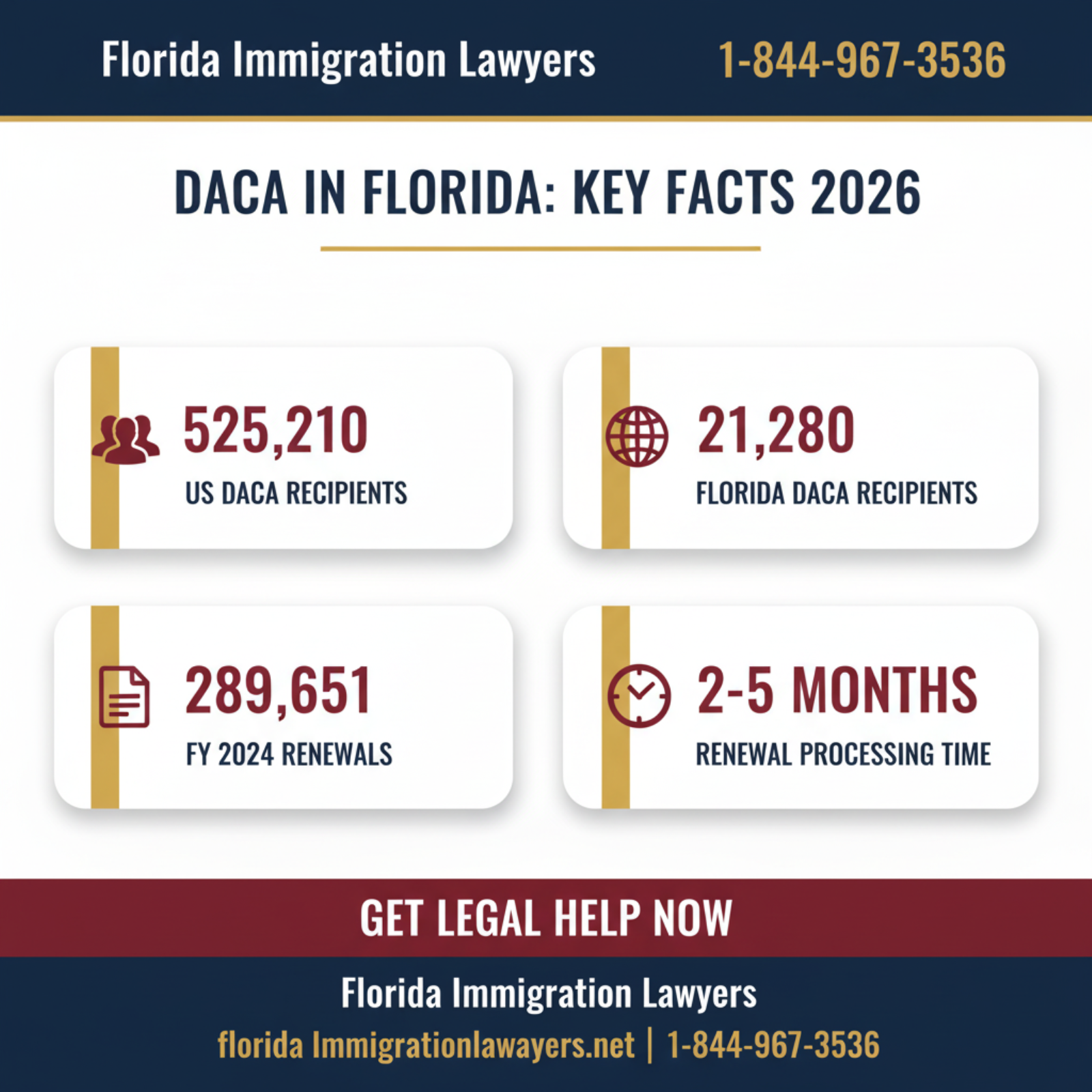
Florida is home to a significant population of DACA recipients, making the impact of any policy changes particularly profound here. Estimates suggest tens of thousands of DACA recipients reside in the Sunshine State, contributing significantly to its economy and culture. These individuals often arrived in the U.S. as young children, have grown up in Florida communities, and consider it their home.
The presence of such a large Dreamer community underscores the importance of staying updated on DACA news 2026 Florida. Our firm is committed to serving this vital part of our community, offering dedicated legal support to help protect your future.
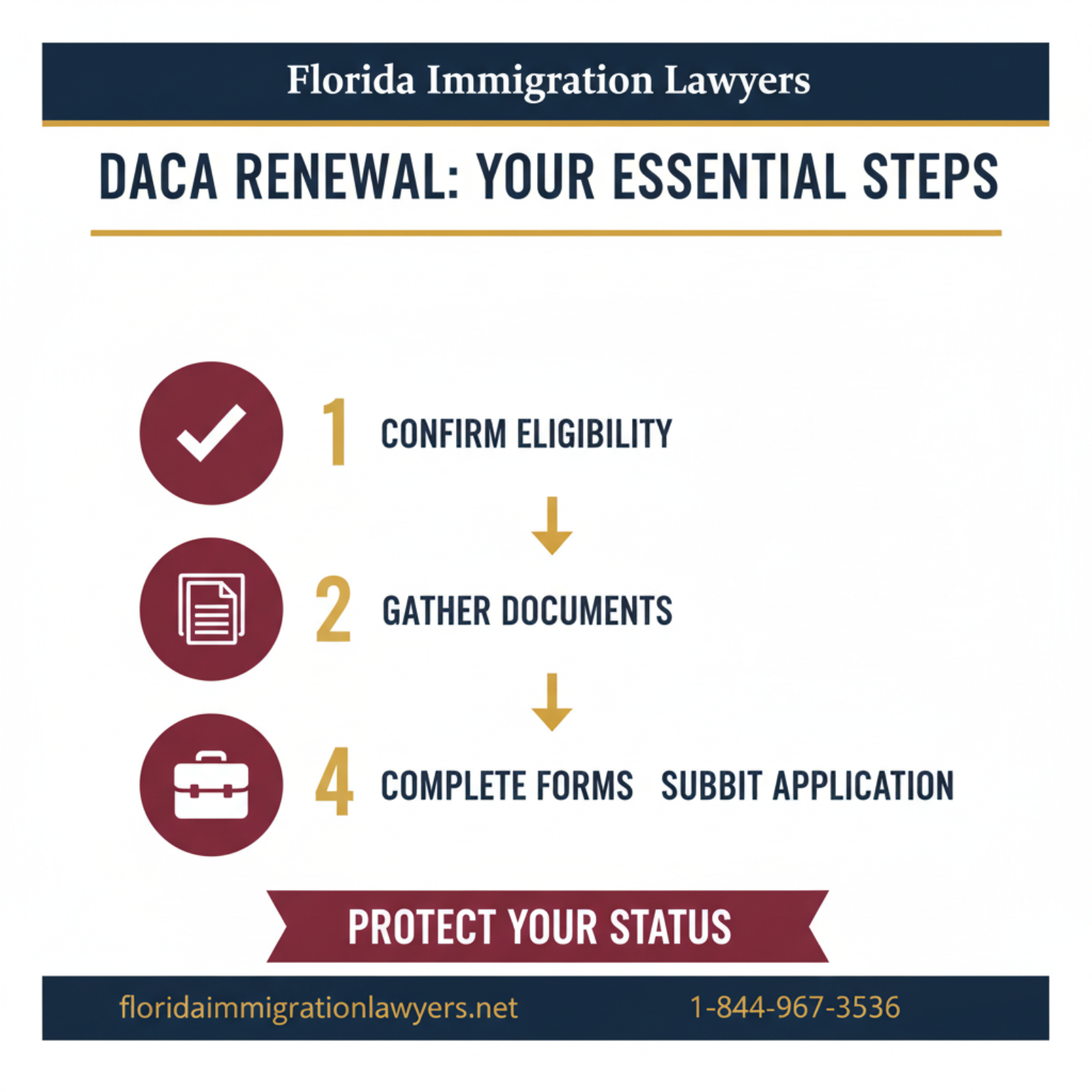
DACA Renewal Process: A Step-by-Step Guide for Florida Dreamers
For current DACA recipients, the renewal process is your pathway to maintaining temporary protection and work authorization. It is essential to understand and follow each step meticulously to avoid delays or denials. USCIS encourages individuals to apply for renewal approximately 120 to 150 days before their current DACA and Employment Authorization Document (EAD) expire.
-
Gather Necessary Documents
Before you begin filling out forms, compile all required documentation. This includes previous DACA approval notices, your current EAD card, and any documents demonstrating your continuous presence in the U.S. since your last DACA approval. Ensure all documents are current and accurately reflect your information.
-
Complete Forms I-821D and I-765
You must accurately complete Form I-821D, Consideration of Deferred Action for Childhood Arrivals, and Form I-765, Application for Employment Authorization. Pay close attention to every question, ensuring consistency with previous applications. Any discrepancies could lead to requests for evidence or even denial. You will also need to complete Form I-765 Worksheet, which is submitted with Form I-765.
-
Prepare Supporting Evidence
While USCIS generally does not require extensive new evidence of continuous presence for renewals unless there has been a significant break in your DACA status, it is always wise to include proof of your presence in the U.S. since your last approval. This might include school transcripts, employment records, or utility bills. For more information on what constitutes acceptable evidence, you can visit the USCIS website.
-
Pay the Required Fees
The DACA renewal process involves filing fees for both Form I-821D and Form I-765. These fees are subject to change, so always check the most current amounts on the USCIS website. Fee waivers are generally not available for DACA applications, but in some limited circumstances, you may qualify for an exemption. It's important to never submit an incorrect fee amount.
-
Submit Your Application Package
Once all forms are completed, signed, and all supporting documents and fees are ready, mail your application package to the appropriate USCIS Lockbox facility. The correct Lockbox address depends on your state of residence. For Florida residents, you typically send your application to the USCIS Chicago Lockbox. Double-check the address on the USCIS website before mailing to ensure your application reaches the correct location.
-
Attend Biometrics Appointment
After USCIS accepts your application, you will receive a notice to attend a biometrics appointment at an Application Support Center (ASC). This appointment is mandatory. You will have your fingerprints, photograph, and signature taken. This data is used for background checks. Missing this appointment without rescheduling can lead to a denial.
-
Receive Decision
Finally, you will receive a decision from USCIS by mail. If approved, you will receive a new DACA approval notice and your Employment Authorization Document (EAD). If your application is denied, it is crucial to immediately consult with an immigration lawyer to understand the reasons for denial and explore any potential remedies or appeals.
Essential Documents for Your DACA Application or Renewal
Having all your documents organized and ready is a cornerstone of a successful DACA application or renewal. Missing or incorrect documents can lead to delays or even denial of your case. Here is a general checklist of documents you should prepare:
- Copies of all previous DACA approval notices and EAD cards.
- Your current Employment Authorization Document (EAD).
- Your birth certificate (with certified translation if not in English).
- Passport or other government-issued identification from your home country.
- Any U.S. government-issued identification (e.g., state ID or driver's license).
- Proof of continuous residence in the U.S. since your last DACA approval (e.g., school records, medical records, employment records, utility bills, tax returns).
- Proof of your entry into the U.S. before age 16 (e.g., passport with entry stamp, I-94 arrival/departure record).
- Proof of education or enrollment (e.g., high school diploma, GED certificate, college transcripts, current school enrollment records).
- Records of any criminal history, including dispositions (if applicable).
- Two passport-style photos (taken within 30 days of filing).
- Copy of your Social Security card.
DACA Processing Times and Expectations in 2026
Processing times for DACA applications and renewals can vary significantly based on several factors, including the volume of applications USCIS receives, staffing levels, and the complexity of individual cases. While USCIS aims to process renewals efficiently, delays are not uncommon.
Typically, DACA renewal processing can take anywhere from 3 to 6 months, or sometimes longer. It is critical to apply well in advance of your EAD expiration date, ideally 120-150 days prior, to minimize any gaps in your work authorization. You can check the current average processing times for your specific application type and service center on the USCIS website.
For DACA recipients in Florida, applications are generally processed through USCIS Lockbox facilities and then by service centers like the Nebraska Service Center or the California Service Center. While there are USCIS Field Offices in Florida (e.g., Miami, Orlando, Tampa), these primarily handle interviews and biometrics appointments, not the initial processing of DACA applications.
Understanding DACA Application Costs and Fees
The cost associated with DACA applications and renewals is a significant consideration for many applicants. As of 2026, the total fee for a DACA renewal application generally includes the Form I-765 fee and the biometrics services fee. These fees are subject to change by USCIS and should always be verified on their official website before filing.
It is important to understand that fee waivers for DACA applications are extremely rare and only granted in very specific, limited circumstances. Most applicants will need to pay the full fee. If you are struggling to afford the fees, explore options like community assistance programs or legal aid organizations that may offer support. However, it is crucial to ensure any assistance is legitimate and does not involve fraudulent practices.
Do not navigate this process alone. Contact Florida Immigration Lawyers today to ensure your DACA renewal is handled correctly. Call us at 1-844-967-3536 for expert guidance.
Common Mistakes to Avoid in Your DACA Application or Renewal
Even a small error in your DACA application can lead to significant delays or even denial. Being aware of common pitfalls can help you submit a strong and successful application. Avoid these mistakes to protect your DACA status:
-
Filing too late or too early: Submitting your renewal application too close to your expiration date risks a lapse in your work authorization. Filing too early (more than 150 days) can result in rejection. Aim for the recommended 120-150 day window.
-
Incomplete or incorrect forms: Failing to answer all questions, providing inconsistent information, or leaving sections blank can prompt a Request for Evidence (RFE) or outright denial. Double-check every field.
-
Incorrect fees: USCIS fees can change. Submitting an outdated or incorrect fee amount will cause your application to be rejected. Always verify the current fees on the USCIS website.
-
Missing signature: Forgetting to sign your forms (I-821D, I-765) is a common, yet critical, error that will lead to rejection. Ensure all required signatures are present.
-
Insufficient supporting documentation: While renewals may require less evidence than initial applications, you still need to prove continuous presence since your last approval and meet all eligibility criteria. Not including necessary documents can cause delays.
-
Not disclosing criminal history: Any arrests, charges, or convictions, even minor ones, must be fully disclosed. Failure to do so can be considered misrepresentation and lead to denial or even severe immigration consequences, including referral to ICE for deportation proceedings.
-
Using outdated forms: USCIS updates its forms periodically. Always download the latest version from the USCIS website to ensure compliance.
-
Poor quality photocopies: Ensure all photocopies of supporting documents are clear and legible. Illegible documents will not be considered.
-
Not keeping copies: Always make and keep a complete copy of your entire application package before mailing it to USCIS. This is crucial for your records and if USCIS requests further information.
-
Ignoring USCIS notices: Promptly respond to any notices from USCIS, such as Requests for Evidence (RFEs) or appointment notices. Failing to respond within the given timeframe can result in denial.
When to Call an Immigration Lawyer in Florida
While the DACA renewal process can seem straightforward for many, certain situations absolutely warrant the expertise of an immigration lawyer. Navigating the complex federal and state immigration landscape, especially in Florida with its unique enforcement policies, is best done with professional legal guidance.
You should consider contacting Florida Immigration Lawyers if any of the following scenarios apply to you:
- You have any criminal history, even minor infractions or arrests that did not lead to conviction. Certain offenses can make you ineligible for DACA.
- You have had a significant break in your continuous residence in the U.S. since your last DACA approval.
- You have received a Request for Evidence (RFE) or Notice of Intent to Deny (NOID) from USCIS regarding your DACA application.
- You are unsure about your eligibility for DACA or if you meet all the criteria for renewal.
- You have questions about other potential immigration pathways, such as family immigration, business immigration, or even asylum, which might offer more permanent relief.
- You are a DACA recipient who has been detained by state or federal authorities, particularly given Florida's increased enforcement activities. An attorney can help with deportation defense.
- You are exploring options for citizenship or lawful permanent residency.
Florida Immigration Lawyers specializes in all aspects of immigration law. Our attorneys are well-versed in the nuances of DACA and the specific challenges faced by Dreamers in Florida. We can help you understand your options, prepare a robust application, and represent you in complex situations. Don't leave your future to chance; seek professional legal counsel.
About Florida Immigration Lawyers
Florida Immigration Lawyers is a premier law firm dedicated to providing exceptional immigration legal services across the entire state of Florida. Our experienced attorneys understand the profound impact immigration matters have on individuals and families. We are committed to offering compassionate, effective, and results-driven representation.
We handle a wide range of immigration cases, including DACA renewals, family-based petitions, employment visas, deportation defense, asylum claims, and naturalization. Our team stays current with the latest legal developments, including DACA news 2026, to ensure our clients receive the most accurate and up-to-date advice.
Choosing Florida Immigration Lawyers means choosing a team that genuinely cares about your future. We offer free consultations, are available 24/7, and provide bilingual services (Se Habla Español) to ensure clear communication. Let us be your trusted partner in navigating the complexities of U.S. immigration law. Visit our website or call us at 1-844-967-3536 to schedule your free consultation.
Sources and References
- U.S. Citizenship and Immigration Services (USCIS) - DACA Information
- U.S. Citizenship and Immigration Services (USCIS) - Check Processing Times
- U.S. Immigration and Customs Enforcement (ICE)
- 8 U.S.C. § 1101 et seq. - Immigration and Nationality Act (INA)
- 8 CFR Part 274a - Control of Employment of Aliens
- 8 CFR Part 103 - Adjudication of Applications and Petitions
This article provides general legal information and is not intended as legal advice. Every case is unique, and outcomes depend on specific facts and circumstances. Contact an attorney for advice about your particular situation.
The journey through the U.S. immigration system can be daunting, but you do not have to face it alone. Especially with the evolving DACA news 2026 Florida, having a knowledgeable and compassionate legal team by your side is invaluable. Florida Immigration Lawyers is here to provide the support and representation you need.
Take the first step towards securing your future. Call Florida Immigration Lawyers today at 1-844-967-3536 for a free, confidential consultation. Se Habla Español - Estamos aquí para ayudarle.
Frequently Asked Questions
Florida Immigration Lawyers
Legal Team
Our experienced attorneys at Florida Immigration Lawyers have been serving clients across Florida for over 20 years. We specialize in immigration, personal injury, criminal defense, workers compensation, and family law.