UK Immigration Reform Denmark Model: What Florida Residents Must Know
The UK's consideration of Denmark's strict immigration model highlights a global trend towards more restrictive asylum policies. For Florida residents, it is crucial to understand that the U.S. immigration system operates under its own distinct laws and regulations, governed by agencies like USCIS. While foreign models do not directly apply to U.S. law, awareness of global discussions can provide context. Navigating U.S. immigration requires expert legal counsel to ensure compliance and protect your rights. Florida Immigration Lawyers offers comprehensive support for all immigration matters, from asylum to family visas, ensuring you receive accurate and empathetic guidance.
The UK immigration reform Denmark model refers to the United Kingdom's consideration of stricter asylum and migration policies, drawing inspiration from Denmark's highly restrictive approach. This model emphasizes external processing of asylum claims and temporary protection over integration. While these discussions occur abroad, they highlight global trends in immigration policy. For Florida residents, understanding the distinct U.S. immigration system and seeking legal counsel is crucial, as foreign models do not directly apply to U.S. law.
- The Denmark model focuses on externalizing asylum processing and temporary residency.
- The UK is exploring similar reforms to control irregular migration.
- These models are distinct from the U.S. immigration system, which has its own complex laws.
- Florida residents must navigate U.S. immigration law, which is not influenced by foreign models.
- Expert legal guidance is essential for any immigration process in Florida.
Global immigration policies are constantly evolving, with countries frequently examining different approaches to managing migration. In recent years, discussions around the UK immigration reform Denmark model have gained significant attention. This refers to the United Kingdom's interest in adopting elements of Denmark's stringent immigration framework, particularly concerning asylum seekers.
For individuals and families in Florida, these international discussions might seem distant. However, understanding global trends can provide context, even if the U.S. immigration system operates under its own unique laws and regulations. It is vital to remember that the Danish model, or any proposed UK reform, does not directly dictate U.S. immigration policy.
Navigating the complexities of U.S. immigration law requires specialized knowledge and experience. Whether you are seeking asylum, pursuing a family visa, or facing deportation, the legal landscape is intricate. For personalized guidance on your immigration journey in Florida, do not hesitate to call Florida Immigration Lawyers at 1-844-967-3536 for a free consultation. We are here to help you understand your rights and options.
Understanding the UK Immigration Reform and the Denmark Model
The Danish immigration model has become a focal point in international discussions due to its exceptionally restrictive approach to immigration and asylum. Denmark, a Nordic nation, has progressively tightened its immigration laws over the past two decades. This model is characterized by a strong emphasis on temporary protection, external processing of asylum claims, and a stated goal of zero asylum seekers.
The United Kingdom's government has expressed interest in exploring aspects of this model as part of its own comprehensive UK immigration reform Denmark model efforts. This comes amid pressures to control irregular migration and to reform its asylum system. The proposed reforms aim to deter illegal crossings and ensure that those seeking protection do so through safe and legal routes, often outside the UK's borders.
Key tenets of the Danish approach include policies that limit the rights of refugees to reunite with family, make it difficult to obtain permanent residency, and actively promote repatriation when conditions in their home countries are deemed safe. These policies represent a significant departure from traditional international norms surrounding refugee integration.
It is important for those in Florida to recognize that the U.S. immigration system, governed by the Immigration and Nationality Act (INA), operates under different legal and humanitarian principles. While policy debates are constant, the core framework of U.S. law, including provisions for asylum under 8 U.S.C. § 1158, remains distinct from the Denmark model's philosophy.
The Evolution of Danish Immigration Policy
Denmark's shift towards more restrictive policies began in the early 2000s and has been consistently reinforced by successive governments, regardless of political affiliation. This sustained effort has resulted in some of the strictest immigration laws in Europe. The goal has been to reduce the number of asylum applications and to ensure that those granted protection receive temporary status.
This approach often involves placing a high burden of proof on applicants and limiting access to social benefits and integration programs. The long-term implications for individuals seeking protection under such a system are significant, impacting their ability to build a new life or establish permanent roots.
Key Components of the Danish Immigration Model: A Step-by-Step Overview
While not directly applicable to Florida or the U.S. immigration system, understanding the components of the Danish model provides insight into the type of reforms being discussed internationally. The following outlines its general operational principles:
- Strict Border Control and Deterrence: Denmark employs robust measures to prevent unauthorized entry, often using public campaigns to discourage individuals from seeking asylum in the country. This is the first line of defense in their policy.
- External Processing of Asylum Claims: A central, and highly controversial, feature of the model is the aspiration to process asylum claims outside Denmark's borders, potentially in third countries. This aims to prevent asylum seekers from entering Danish territory while their applications are pending.
- Temporary Protection Status: For those who are granted protection, the Danish model typically offers temporary residency rather than immediate permanent status. This status is regularly reviewed, and extensions are contingent on ongoing needs and conditions in their home country.
- Focus on Repatriation: A core objective is to facilitate the return of refugees and asylum seekers to their countries of origin once conditions are deemed safe. Denmark invests in repatriation programs and support for voluntary returns.
- Limited Integration Initiatives: Compared to many other European nations, Denmark's model offers fewer resources and pathways for long-term integration into Danish society. The emphasis is often on maintaining cultural ties to the country of origin rather than full assimilation.
- Reduced Family Reunification Rights: The model includes stringent rules regarding family reunification, making it challenging for those with temporary protection to bring family members to Denmark. This can lead to prolonged separation for many families.
These steps illustrate a system designed for minimal intake and temporary stay, a stark contrast to the U.S. system's various pathways to permanent residency and citizenship, such as those available through family-based immigration or employment-based visas. The U.S. also has specific provisions for asylum seekers and refugees that differ significantly.
Essential Documentation for U.S. Immigration: A Contrast to the Denmark Model's Approach
Unlike the Danish model, which emphasizes temporary status and repatriation, the U.S. immigration system often requires extensive documentation to establish eligibility for long-term residency or protection. For individuals in Miami and across Florida, preparing a thorough application package is paramount. This robust documentation is critical for proving eligibility under various sections of the INA.
When applying for immigration benefits in the U.S., whether through USCIS or in immigration court, you will typically need to provide a wide array of supporting documents. These documents serve to verify your identity, demonstrate your relationship to U.S. citizens or lawful permanent residents, prove your qualifications for a specific visa category, or substantiate a claim for protection like asylum.
Here are examples of the types of documents commonly required in U.S. immigration processes, which highlight the U.S. system's focus on substantiation and eligibility for a more permanent future:
- Identity and Civil Documents: Birth certificates, marriage certificates, passports, national identity cards, and divorce decrees. These establish fundamental biographical information.
- Proof of Relationship: For family-based petitions, extensive evidence like marriage certificates, birth certificates of children, photos, joint bank accounts, and affidavits from third parties are crucial to prove bona fide relationships.
- Financial Documentation: Tax returns, employment letters, bank statements, and affidavits of support (Form I-864) are often required to demonstrate financial stability and prevent an applicant from becoming a public charge.
- Educational and Professional Credentials: For employment-based visas or certain waivers, diplomas, transcripts, professional licenses, and letters of recommendation are essential.
- Evidence for Asylum Claims: This includes detailed personal statements, country condition reports, news articles, medical records, police reports, and witness affidavits that corroborate the fear of persecution.
- Criminal Records and Background Checks: Police clearance certificates from all countries resided in, court disposition documents, and FBI background checks are standard requirements to assess admissibility.
- Medical Examinations: A medical examination conducted by a USCIS-approved civil surgeon is required for most green card applicants to ensure public health safety.
This extensive requirement for documentation underscores the U.S. system's detailed approach to determining eligibility for various statuses, many of which lead to permanent residency and eventually U.S. citizenship. This contrasts sharply with a model focused on temporary stays and minimal integration, where such comprehensive documentation for long-term settlement might not be a primary concern.
Navigating Immigration in Florida: Timelines and Processing Expectations
For individuals residing in Florida, understanding the timelines and processing expectations for various immigration applications is crucial. The U.S. immigration system, managed primarily by U.S. Citizenship and Immigration Services (USCIS) and the Executive Office for Immigration Review (EOIR), involves procedures that can vary significantly in duration. These processes are distinct from the rapid, temporary decisions often seen in the Danish immigration model.
USCIS operates several field offices across Florida, including major hubs in Miami, Orlando, and Tampa. These offices handle interviews for green cards, naturalization, and other benefits, while service centers process initial applications. Processing times are publicly available on the USCIS website and can fluctuate based on application type, service center workload, and current policy priorities.
For instance, an asylum application filed with USCIS in Florida may take several months or even years to be scheduled for an interview, especially if it is not categorized as an urgent case. If an asylum case is referred to an immigration court, the process can extend for years due to court backlogs. Florida hosts several immigration courts, including those in Miami and Orlando, which manage deportation defense and other complex cases.
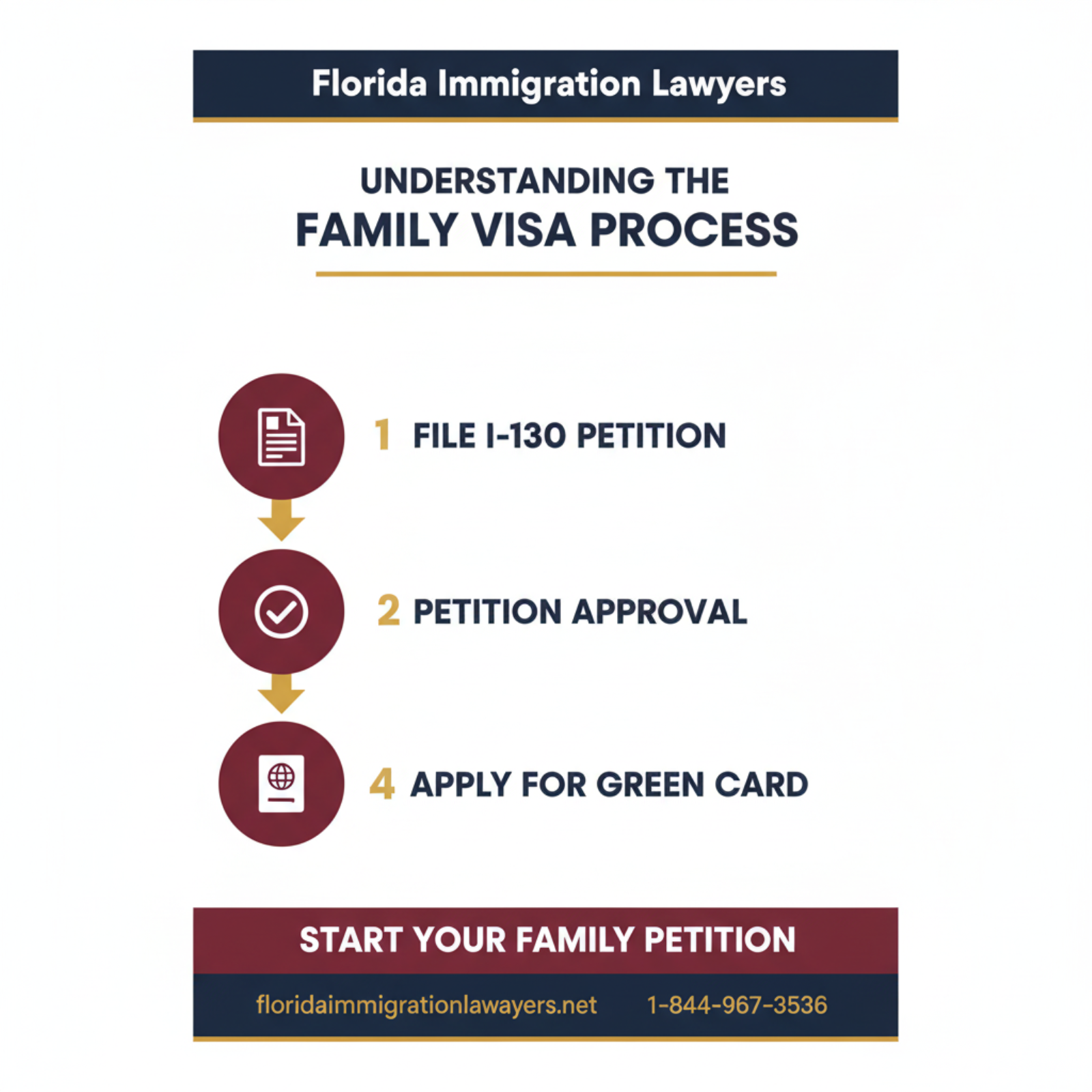
Family-based petitions, such as those for spouses or children of U.S. citizens, also have varying timelines. An immediate relative petition (Form I-130) may be processed relatively quickly, but the subsequent adjustment of status or consular processing can add many months. Other family preference categories can involve waiting periods of several years due to visa bulletin availability, as outlined by the Department of State's Visa Bulletin.
Naturalization applications (Form N-400) typically involve a processing period of several months to over a year, including biometrics, interview, and oath ceremony. The specific time often depends on the workload of the local USCIS field office serving your Florida location.
It is important to prepare for potential delays and to respond promptly to any requests for evidence (RFEs) from USCIS. Maintaining accurate contact information with USCIS and your legal counsel is also vital to avoid missing crucial notices. While the U.S. system aims for efficiency, the sheer volume of applications and the detailed review process mean that patience and careful planning are essential for all Florida immigration matters.
Cost Factors and Legal Fees for Florida Immigration Matters
Understanding the financial aspects of immigration is a critical part of the process for anyone in Florida. The costs associated with immigration cases typically fall into two main categories: government filing fees and legal fees for attorney services. These costs are distinct from any potential expenses related to the UK immigration reform Denmark model, which is a foreign policy discussion.
Government filing fees are imposed by USCIS and other agencies for processing various applications and petitions. These fees can vary significantly depending on the type of application, such as an I-485 for adjustment of status, an I-130 for a family petition, or an N-400 for naturalization. While specific amounts change, it is important to budget for these non-refundable fees. USCIS does offer fee waivers for certain eligible applicants who can demonstrate financial hardship, which can provide significant relief.
Beyond government fees, legal fees for immigration attorney services constitute another major cost factor. Hiring an experienced immigration lawyer in Florida, such as those at Florida Immigration Lawyers, is an investment in professional guidance and expertise. Legal fees typically cover:
- Initial consultations and case evaluations.
- Preparation and submission of all required forms and supporting documentation.
- Representation during interviews with USCIS or appearances in immigration court.
- Communication with government agencies on your behalf.
- Legal research and strategy development for complex cases.
The total legal fees can vary based on the complexity of your case, the type of immigration benefit sought, and the amount of attorney time required. For instance, a straightforward family petition might incur different fees than a complex deportation defense case or an asylum application. Many firms, including Florida Immigration Lawyers, offer payment plans to help manage these costs.
It is always advisable to discuss all potential costs, including both government fees and attorney fees, during your initial consultation. Transparency regarding fees is a hallmark of ethical legal practice. Investing in qualified legal representation can help prevent costly mistakes, streamline the process, and significantly improve the likelihood of a successful outcome in your Florida immigration journey.
Do not navigate this process alone. The complexities of immigration law, especially with ongoing global discussions like the UK immigration reform Denmark model, underscore the need for expert guidance tailored to U.S. law. Contact Florida Immigration Lawyers today to ensure your case is handled with precision and care.
Common Mistakes to Avoid in U.S. Immigration Cases
Navigating the U.S. immigration system can be fraught with challenges. Even minor errors can lead to significant delays, denials, or even more severe consequences. Avoiding these common mistakes is crucial for anyone pursuing immigration benefits in Florida:
- Submitting Incomplete or Inaccurate Applications: Providing missing information or errors on forms can lead to Requests for Evidence (RFEs) or outright denials. Consequences: Delays, re-filing fees, and prolonged uncertainty.
- Missing Deadlines: Failing to respond to USCIS requests or appear for court hearings by the specified dates can result in automatic denials, deportation orders, or loss of appeal rights. Consequences: Loss of legal status, deportation, or bars to future immigration.
- Misrepresenting Facts or Providing False Information: Any attempt to deceive immigration authorities, even inadvertently, can lead to charges of fraud, permanent bars from the U.S., and criminal penalties. Consequences: Inadmissibility, deportation, criminal charges, and permanent separation from family.
- Failing to Update Your Address with USCIS: Moving without notifying USCIS using Form AR-11 can cause you to miss crucial notices, interview appointments, or decisions. Consequences: Missed appointments leading to denials, or even removal orders issued in absentia.
- Entering the U.S. Illegally or Overstaying a Visa: These actions can trigger severe penalties, including bars to re-entry, inadmissibility, and immediate placement in removal proceedings. Consequences: Deportation, inability to adjust status, and long-term separation from family.
- Not Seeking Legal Counsel for Complex Cases: Attempting to handle complicated immigration matters, such as asylum claims or deportation defense, without an attorney significantly increases the risk of negative outcomes. Consequences: Denial of benefits, deportation, and failure to present a strong legal argument.
- Ignoring Minor Criminal Offenses: Even seemingly minor arrests or convictions can have significant immigration consequences, potentially leading to inadmissibility or deportability. Consequences: Denial of green card or visa, and initiation of removal proceedings.
When to Call a Florida Immigration Lawyer
The U.S. immigration system is notoriously complex, and attempting to navigate it alone can be overwhelming and risky. While the UK immigration reform Denmark model might highlight global policy debates, your focus should be on the specific laws and procedures governing immigration in Florida. Knowing when to seek professional legal assistance from Florida Immigration Lawyers can make all the difference in your case.
You should consider calling a lawyer if you are facing any of the following scenarios:
- Facing Deportation or Removal Proceedings: If you receive a Notice to Appear (NTA) in immigration court, immediate legal counsel is essential. Our firm specializes in deportation defense and can help protect your rights.
- Applying for Asylum or Refugee Status: These cases require compelling evidence and skilled advocacy. An attorney can help gather documentation and present a strong case for asylum.
- Have a Criminal Record: Even minor offenses can impact your immigration status. A lawyer can assess the consequences and explore waivers or other forms of relief.
- Received a Request for Evidence (RFE) or Notice of Intent to Deny (NOID): These notices indicate that USCIS requires more information or intends to deny your application. Prompt and accurate legal response is critical.
- Applying for a Complex Visa or Green Card: Certain visa categories, such as employment-based visas or specific family petitions, involve intricate requirements that benefit from expert guidance. We assist with family immigration and business immigration cases.
- Experienced Previous Denials: If you have had an application denied, a lawyer can review your case, identify issues, and help you pursue appeals or new applications.
- Seeking U.S. Citizenship: While seemingly straightforward, naturalization applications can face delays or denials due to eligibility issues. An attorney can ensure a smooth path to citizenship.
Florida Immigration Lawyers stands ready to provide the compassionate and effective legal representation you need. Our team of experienced attorneys understands the nuances of U.S. immigration law and is dedicated to achieving the best possible outcome for our clients across Florida. Don't wait for a red flag; proactive legal advice is often the most effective strategy.
About Florida Immigration Lawyers
Florida Immigration Lawyers is a premier immigration law firm dedicated to serving individuals and families across the entire state of Florida. With a deep understanding of U.S. immigration law and its constant changes, our firm provides comprehensive legal services designed to meet the diverse needs of our clients.
Our experienced attorneys offer a wide range of immigration services, including family-based petitions, employment visas, asylum claims, deportation defense, and naturalization applications. We pride ourselves on offering personalized attention, strategic advice, and vigorous representation for every case we undertake.
Why choose Florida Immigration Lawyers? We are committed to providing empathetic and effective legal solutions. Our team is available 24/7 to address your concerns and offer free, confidential consultations. We understand the stakes involved in immigration matters and work tirelessly to protect your rights and help you achieve your American dream.
Contact us today for a free consultation:
- Phone: 1-844-967-3536
- Website: https://www.floridaimmigrationlawyers.net
- Availability: 24/7
- Consultations: Free
- Service Area: All of Florida
Sources and References
- U.S. Citizenship and Immigration Services (USCIS)
- Executive Office for Immigration Review (EOIR)
- U.S. Department of State
- 8 U.S.C. Chapter 12 - Immigration and Nationality Act (INA)
- 8 U.S.C. § 1158 - Asylum
- 8 CFR Part 208 - Asylum and Withholding of Removal
This article provides general legal information and is not intended as legal advice. Every case is unique, and outcomes depend on specific facts and circumstances. Contact an attorney for advice about your particular situation.
The global conversation around immigration, including discussions about the UK immigration reform Denmark model, underscores the ever-changing nature of immigration law worldwide. For those in Florida, navigating the specific requirements of the U.S. system demands expert legal guidance.
Do not face your immigration challenges alone. Florida Immigration Lawyers is here to provide the support and representation you need. We offer free consultations to discuss your case and outline your best path forward.
Call us today at 1-844-967-3536 for your free consultation.
Se Habla Español - Estamos aquí para ayudarle.
Frequently Asked Questions
Florida Immigration Lawyers
Legal Team
Our experienced attorneys at Florida Immigration Lawyers have been serving clients across Florida for over 20 years. We specialize in immigration, personal injury, criminal defense, workers compensation, and family law.