H-1B Visa Florida Employers Guide 2026: Sponsoring Talent
For Florida employers, navigating the H-1B visa process in 2026 is crucial for securing specialized talent. This guide from Florida Immigration Lawyers provides a detailed overview of the H-1B program, including eligibility for both employers and employees, the annual cap and lottery system, and a comprehensive step-by-step sponsorship guide. Learn about essential documentation, processing timelines, and associated costs. We also highlight common mistakes to avoid and when to seek legal counsel to ensure compliance with USCIS and DOL regulations. Our firm is dedicated to helping businesses in Hollywood and across Florida successfully sponsor H-1B workers, offering expert guidance for a smooth and efficient process.
The H-1B visa allows U.S. employers, including those in Florida, to temporarily employ foreign workers in specialty occupations. This guide outlines the 2026 process, including the lottery, eligibility, and documentation, ensuring compliance for sponsoring skilled talent. Employers must meet specific requirements and navigate a competitive annual cap.
- H-1B visas are for specialty occupations requiring a bachelor's degree or higher.
- The annual H-1B cap and lottery system are key considerations for employers.
- Compliance with Department of Labor and USCIS regulations is crucial.
- The process involves multiple steps, from LCA filing to petition approval.
- Legal guidance is highly recommended for successful sponsorship.
As a Florida employer, are you struggling to find the specialized talent your business needs to thrive in a competitive global market? Many businesses across the state, from the vibrant tech hubs of Miami to the growing healthcare sector in Hollywood, face this challenge. The H-1B visa program offers a vital pathway to bring highly skilled foreign professionals to your team, helping to fill critical skill gaps and drive innovation.
Navigating the complex landscape of U.S. immigration law, particularly the H-1B visa process, can be daunting. This comprehensive guide is designed to equip Florida employers with the knowledge and tools necessary to understand the H-1B visa requirements for 2026. We will cover everything from eligibility criteria and the annual lottery to the step-by-step application process and associated costs.
Securing an H-1B visa for a prospective employee requires careful planning, meticulous documentation, and strict adherence to deadlines. Florida Immigration Lawyers is here to simplify this journey for you. Call Florida Immigration Lawyers at 1-844-967-3536 for a free consultation today and let our experienced team help your business secure the talent it deserves.
Understanding the H-1B Visa for Florida Employers in 2026
The H-1B nonimmigrant visa program enables U.S. employers to temporarily employ foreign workers in specialty occupations. These occupations generally require a bachelor's degree or higher in a specific field. This program is critical for Florida businesses looking to attract and retain top global talent in sectors like technology, healthcare, finance, and engineering.
What is a Specialty Occupation?
A specialty occupation is defined by law as an occupation that requires theoretical and practical application of a body of highly specialized knowledge, and a bachelor's or higher degree in the specific specialty (or its equivalent) as a minimum for entry into the occupation in the United States. This includes a wide range of professions vital to Florida's economy.
For example, a software engineer in Hollywood, a biomedical researcher in Gainesville, or a financial analyst in Miami could all qualify for an H-1B visa if their position meets these stringent requirements. The U.S. Department of Labor (DOL) and U.S. Citizenship and Immigration Services (USCIS) scrutinize these definitions closely.
H-1B Cap and Lottery System for 2026
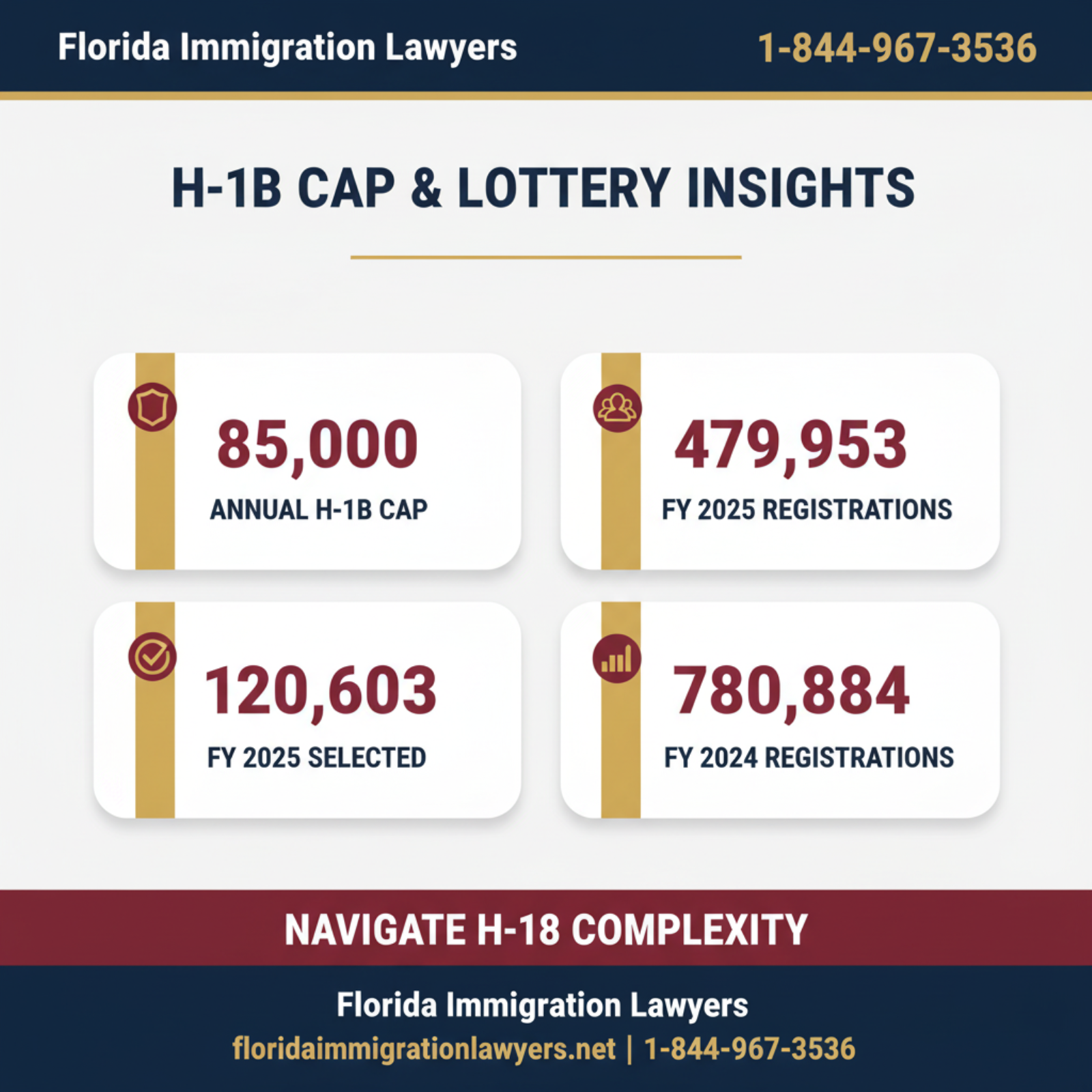
Each fiscal year, Congress sets a numerical cap on the number of H-1B visas issued. The current annual cap is 65,000 visas, with an additional 20,000 visas reserved for those holding a U.S. master's degree or higher. This cap often leads to a lottery system, as demand typically far exceeds availability, especially for the H-1B visa Florida employers seek.
The H-1B cap registration period usually occurs in March, with the lottery results announced shortly thereafter. Employers must register prospective employees electronically with USCIS during this designated period. Failure to register within this window means missing the opportunity for that fiscal year.
Employer and Employee Eligibility Criteria
To sponsor an H-1B visa, Florida employers must meet specific criteria. The employer must demonstrate a legitimate need for a specialty occupation worker and have the financial ability to pay the prevailing wage. The job offered must genuinely qualify as a specialty occupation.
The prospective H-1B employee must hold at least a bachelor's degree or its equivalent, or possess a license in a specialty occupation field, or have work experience equivalent to a bachelor's degree. They must also meet any specific state licensing requirements for their profession in Florida. For detailed eligibility, refer to 8 U.S.C. § 1101(a)(15)(H)(i)(b) and 8 CFR § 214.2(h).
Step-by-Step Guide: Sponsoring an H-1B Visa in Florida
Sponsoring an H-1B visa for your Florida business involves several critical stages. Each step requires precision and adherence to strict timelines. Our firm, Florida Immigration Lawyers, specializes in guiding businesses through this intricate process. We understand the nuances of business immigration and can assist you at every turn.
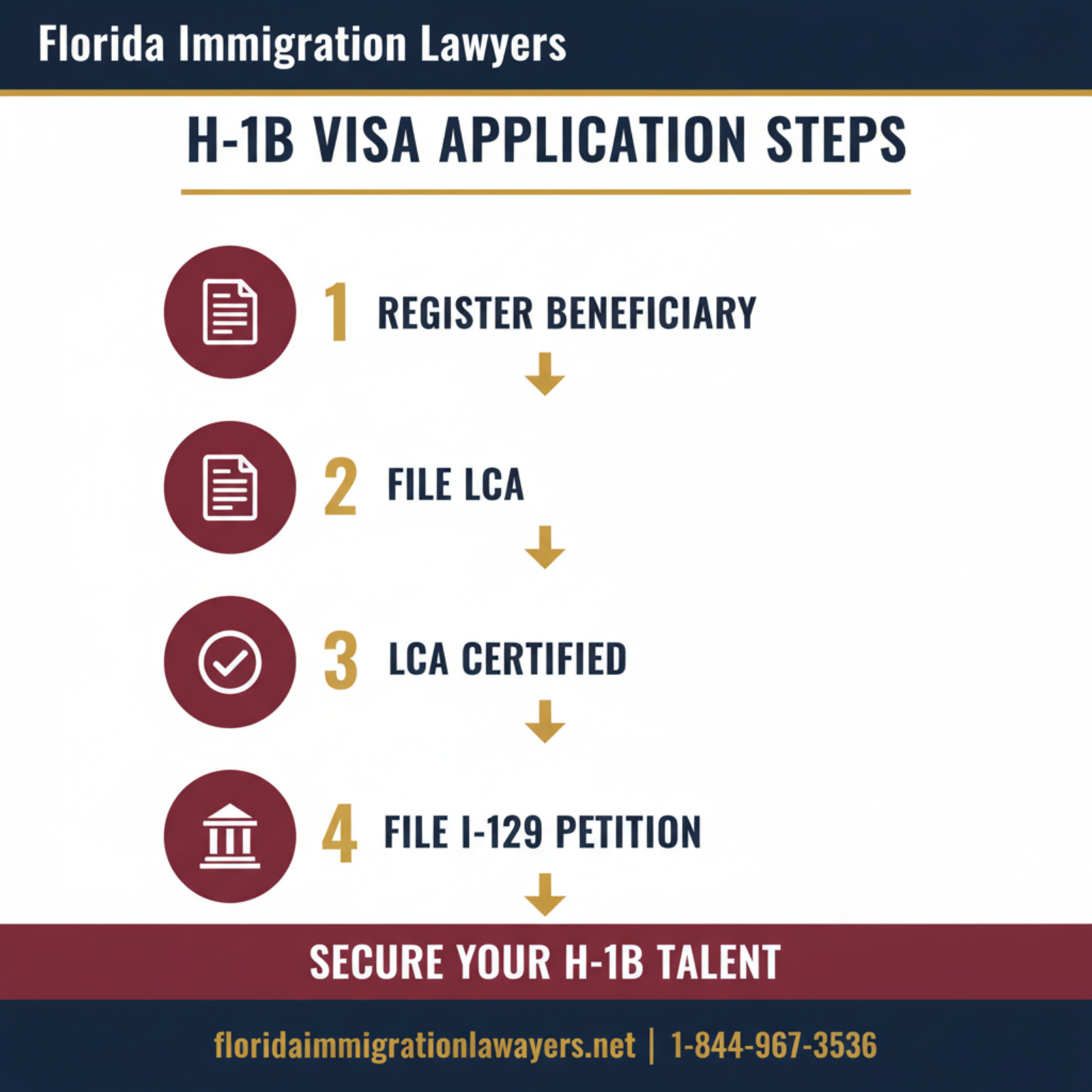
- Determine Eligibility and Prevailing Wage: First, confirm that the position qualifies as a specialty occupation and that the prospective employee meets the educational requirements. Research the prevailing wage for the position in the specific geographic area within Florida (e.g., Hollywood, Orlando, Tampa) using the Department of Labor's Foreign Labor Certification Data Center. Employers must pay at least the prevailing wage or the actual wage paid to other employees with similar experience and qualifications, whichever is higher.
- File a Labor Condition Application (LCA) with DOL: Before filing the H-1B petition, the employer must submit Form ETA-9035, a Labor Condition Application, to the U.S. Department of Labor. This application attests that the employer will pay the H-1B worker at least the prevailing wage and provide working conditions that will not adversely affect other workers. The DOL typically certifies LCAs within 7 business days.
- H-1B Cap Registration (If Applicable): If the H-1B cap is expected to be met, employers must register electronically with USCIS during the designated registration period (typically in March). Each registration costs a small, non-refundable fee. Only selected registrations proceed to the petition filing stage. USCIS then notifies selected registrants.
- File Form I-129, Petition for a Nonimmigrant Worker: For selected registrants, or for cap-exempt employers, the next step is to prepare and file Form I-129, Petition for a Nonimmigrant Worker, with USCIS. This extensive petition includes the certified LCA, educational documents, employment contracts, and detailed information about the employer and the job. It must be filed within the specified filing window.
- Respond to Requests for Evidence (RFEs): USCIS may issue a Request for Evidence (RFE) if they require additional documentation or clarification for your petition. Prompt and thorough responses are crucial to avoid delays or denials. Our attorneys are adept at preparing robust RFE responses.
- Petition Approval: Upon approval of the I-129 petition, USCIS sends an I-797 Approval Notice. If the beneficiary is already in the U.S. and changing status, the approval notice will reflect the change. If the beneficiary is abroad, they will need to attend a visa interview at a U.S. consulate or embassy in their home country.
- Visa Interview and Entry to the U.S.: For beneficiaries outside the U.S., they must schedule an interview at a U.S. embassy or consulate. They will present their approval notice and supporting documents. If approved, the H-1B visa stamp is placed in their passport, allowing them to enter the U.S. as an H-1B worker. Upon arrival in Florida, they can commence employment.
Essential Document Checklist for H-1B Petitions
A complete and accurate submission of documents is vital for a successful H-1B petition. Missing or incorrect documentation is a common cause for RFEs and denials. Ensure you have all necessary paperwork compiled before initiating the process.
Employer Documents:
- Federal Employer Identification Number (FEIN)
- Business license and registration documents for your Florida entity
- Company overview, including size, structure, and services
- Financial statements, tax returns, or annual reports to demonstrate financial viability
- Copies of previous H-1B petitions filed by the company (if applicable)
- Job offer letter detailing the position, salary, and duties
- Evidence of a legitimate employer-employee relationship
Employee Documents:
- Copy of passport biographical page and any previous U.S. visas
- Copies of all academic degrees, diplomas, and transcripts (translated if not in English)
- Foreign degree evaluations (if applicable) to demonstrate U.S. equivalency
- Professional licenses or certifications relevant to the specialty occupation
- Detailed resume or CV outlining work experience and skills
- Letters of experience from previous employers
- Wage statements or pay stubs from current/previous U.S. employment (if applicable)
- I-94 arrival/departure record (if currently in the U.S.)
H-1B Visa Timeline and Processing Expectations for Florida Businesses
The H-1B visa process operates on a strict timeline, particularly due to the annual cap. Understanding these dates is crucial for effective planning for your Florida business.
Key Dates for Fiscal Year 2026:
- March (typically early March) 2025: H-1B cap electronic registration period opens for Fiscal Year 2026. Employers must register during this time.
- March (typically late March) 2025: USCIS conducts the lottery (if needed) and notifies selected registrants.
- April 1, 2025: The earliest date that selected H-1B cap-subject petitions for Fiscal Year 2026 can be filed with USCIS.
- October 1, 2025: The earliest date H-1B cap-subject petitions can be approved and the H-1B employment can begin for Fiscal Year 2026.
Processing times for H-1B petitions can vary significantly based on the service center and caseload. Regular processing can take several months, sometimes extending beyond six months. You can check current processing times on the USCIS website. The California Service Center and Vermont Service Center are primary processing hubs.
Premium Processing Option
For an additional fee, employers can opt for premium processing for Form I-129. This guarantees USCIS will take action on the petition (approval, denial, RFE, or notice of intent to deny) within 15 calendar days. This option is highly beneficial for businesses needing to expedite the employment of critical talent.
Cost Factors and Fee Breakdown for H-1B Sponsorship
Sponsoring an H-1B visa involves various fees that employers must typically cover. It is important to budget for these expenses, which can fluctuate. Please note that USCIS fees are subject to change, so always refer to the official USCIS website for the most current fee schedule.
Typical H-1B Visa Fees Include:
- USCIS Filing Fee for Form I-129: This is the base fee for filing the petition.
- American Competitiveness and Workforce Improvement Act (ACWIA) Fee: This fee varies based on the employer's size (number of full-time equivalent employees).
- Fraud Prevention and Detection Fee: A mandatory fee for all initial H-1B petitions and petitions for a new employer.
- Public Law 114-113 Fee: An additional fee for certain employers with 50 or more employees, where more than 50% are in H-1B or L-1 nonimmigrant status.
- H-1B Registration Fee: A small, non-refundable fee per registration for the annual lottery.
- Premium Processing Fee (Optional): If you choose to expedite the processing of your petition.
Beyond government filing fees, employers should also account for legal fees charged by an immigration attorney. While not government fees, these are a crucial investment to ensure proper preparation and submission of the petition, maximizing the chances of approval. Our legal team at Florida Immigration Lawyers provides transparent fee structures. Contact us for a detailed discussion of your specific case costs.
Navigating H-1B Visa Requirements in Hollywood, Florida
Hollywood, Florida, with its diverse economy and growing industries, presents unique opportunities and considerations for H-1B visa employers. From the healthcare sector to the burgeoning tech and tourism industries, businesses in Hollywood often seek specialized talent that the H-1B program can provide.
Understanding the local labor market and prevailing wage requirements specific to Hollywood and Broward County is paramount. The Department of Labor's data centers provide region-specific wage information, ensuring compliance with federal regulations. Our firm is deeply familiar with the economic landscape and immigration needs of businesses throughout South Florida, including Hollywood.
Florida is home to a significant immigrant population and robust industries that benefit from H-1B workers. According to recent data, Florida ranks among the top states for H-1B visa approvals, reflecting its dynamic economy. This makes the H-1B visa Florida employers seek a critical tool for growth.
Do not navigate this process alone. The complexities of H-1B sponsorship, especially with the annual lottery and strict regulatory framework, demand expert guidance. Contact Florida Immigration Lawyers today to ensure your business is fully compliant and positioned for success in securing H-1B talent.
Common Mistakes to Avoid in the H-1B Visa Process
The H-1B visa process is unforgiving of errors. Even minor mistakes can lead to significant delays, Requests for Evidence (RFEs), or outright denials. Avoiding these common pitfalls is essential for a successful outcome.
- Incorrect Prevailing Wage Determination: Failing to accurately determine and commit to paying the prevailing wage for the specific occupation and geographic area in Florida can lead to LCA denials or serious compliance issues. The DOL scrutinizes this closely.
- Missing H-1B Cap Registration Deadlines: The electronic registration period for the H-1B lottery is short and strictly enforced. Missing this window means you cannot file an H-1B petition for that fiscal year, potentially delaying your talent acquisition by a full year.
- Incomplete or Inaccurate Documentation: Submitting a petition with missing forms, unsigned documents, or inconsistencies between different pieces of evidence is a primary cause of RFEs. This prolongs the process and increases legal costs.
- Failure to Prove Specialty Occupation: The job duties and the required qualifications must clearly demonstrate that the position is a specialty occupation. Vague job descriptions or roles that don't explicitly require a bachelor's degree can lead to denials.
- Lack of Employer-Employee Relationship: For third-party placement or consulting arrangements, USCIS often scrutinizes whether a valid employer-employee relationship exists between the petitioner and the H-1B worker. Insufficient evidence can be a major hurdle.
- Not Responding Adequately to RFEs: If USCIS issues an RFE, failing to provide a comprehensive, well-supported response within the given deadline will almost certainly result in a denial. RFEs require a strategic and detailed approach.
- Assuming Automatic Lottery Selection: Many employers mistakenly believe that registration guarantees selection. The H-1B lottery is highly competitive, and selection is not guaranteed. Plan for alternative strategies if your registration is not selected.
When to Call a Lawyer for Your H-1B Visa Needs
While this guide provides a comprehensive overview, the H-1B visa process is filled with complexities that often require professional legal assistance. Engaging an experienced immigration attorney from Florida Immigration Lawyers early in the process can significantly increase your chances of success and minimize potential pitfalls.
You should consider contacting our firm in the following scenarios:
- Before Starting the Process: To ensure your business and the prospective employee meet all eligibility requirements and to strategize for the H-1B cap and lottery. Our immigration team can provide invaluable initial guidance.
- If You Receive a Request for Evidence (RFE): RFEs often signal a specific concern from USCIS. Our attorneys have extensive experience in analyzing RFEs and crafting compelling, evidence-based responses to address USCIS's concerns effectively.
- If Your Petition is Denied: A denial is not necessarily the end of the road. We can help you understand the reasons for denial and explore options for appeal or refiling, depending on the circumstances.
- For Complex Cases: This includes situations involving cap-exempt organizations, changes of employer, concurrent H-1B employment, or beneficiaries with unusual educational or work experience backgrounds.
- When Sponsoring Dependents: H-4 visas for spouses and children involve additional forms and considerations, which our team can manage seamlessly.
- To Ensure Ongoing Compliance: Immigration regulations are dynamic. We can advise you on maintaining compliance throughout the H-1B worker's employment period, including amendments for changes in job duties or location.
Don't leave your H-1B visa sponsorship to chance. The legal team at Florida Immigration Lawyers is dedicated to providing strategic and effective representation for employers across Florida. We are here to simplify the process and help you secure the talent your business needs.
About Florida Immigration Lawyers
Florida Immigration Lawyers is a premier immigration law firm dedicated to serving individuals and businesses throughout Florida. With a deep understanding of U.S. immigration law and a commitment to client success, we provide comprehensive legal services tailored to your unique needs.
Our experienced attorneys assist clients with a wide range of immigration matters, including business immigration, family-based petitions, asylum claims, deportation defense, and citizenship applications. We pride ourselves on offering compassionate, client-focused representation and achieving favorable outcomes for those we serve.
Why choose Florida Immigration Lawyers? We offer personalized attention, strategic legal advice, and unwavering support through every stage of the immigration process. Our team is available 24/7 to address your concerns and provide clear, actionable guidance. We offer free consultations to discuss your case and outline the best path forward.
Contact us today to experience the difference expert legal representation can make. Call Florida Immigration Lawyers at 1-844-967-3536 or visit our website at https://www.floridaimmigrationlawyers.net. We are here to help you achieve your immigration goals, serving all of Florida.
Sources and References
- U.S. Citizenship and Immigration Services (USCIS)
- U.S. Department of Labor (DOL) - Foreign Labor Certification Data Center
- U.S. Department of State - H-1B Specialty Occupations
- 8 U.S.C. Chapter 12 - Immigration and Nationality Act (INA)
- INA §101(a)(15)(H)(i)(b) - Definition of H-1B nonimmigrant
- INA §214(g) - Numerical limitations on H-1B visas
- 8 CFR §214.2(h) - Regulations pertaining to H nonimmigrants
This article provides general legal information and is not intended as legal advice. Every case is unique, and outcomes depend on specific facts and circumstances. Contact an attorney for advice about your particular situation.
The journey to securing an H-1B visa for your valuable talent can be complex, but you don't have to navigate it alone. Florida Immigration Lawyers is committed to assisting Florida employers in successfully bringing skilled professionals to their teams. Our dedicated attorneys are ready to provide the expert guidance and support you need.
Take the first step towards expanding your workforce and achieving your business objectives. Contact Florida Immigration Lawyers today at 1-844-967-3536 for your free consultation. Se Habla Español - Estamos aquí para ayudarle.
Frequently Asked Questions
Florida Immigration Lawyers
Legal Team
Our experienced attorneys at Florida Immigration Lawyers have been serving clients across Florida for over 20 years. We specialize in immigration, personal injury, criminal defense, workers compensation, and family law.