Conditional Green Card Removal in Florida
Learn how to remove conditions from your green card in Florida, ensuring you maintain your residency without issues. Call us today for a free consultation!

Conditional Green Card Removal in Florida | VLF Florida
Obtaining a green card is a monumental step towards building a life in the United States. However, for many individuals, the initial green card granted through marriage is conditional, valid for only two years. This conditional status is designed to prevent marriage fraud and requires a subsequent step: the removal of conditions. Navigating the complexities of this process, particularly Form I-751, Petition to Remove Conditions on Residence, can be daunting. In Florida, understanding the specific requirements and potential pitfalls is crucial for securing permanent residency. VLF Florida is here to guide you through every step, ensuring your petition is strong and complete.
What is a Conditional Green Card?
A conditional green card is issued to foreign nationals who obtain lawful permanent resident status based on a marriage to a U.S. citizen or lawful permanent resident, and the marriage was less than two years old on the day they were granted permanent residence. This two-year period serves as a probationary phase, allowing U.S. Citizenship and Immigration Services (USCIS) to verify the legitimacy of the marriage. The intent is to ensure that the marriage was entered into in good faith, not solely for immigration benefits. During these two years, the conditional resident has most of the same rights and responsibilities as a permanent resident, but their status is temporary. Failure to remove these conditions can lead to the loss of your green card and even deportation proceedings. It is a critical period that demands careful attention to USCIS regulations and deadlines.
Understanding Form I-751: Petition to Remove Conditions on Residence
Form I-751 is the official application filed with USCIS to request the removal of conditions on your permanent resident status. This petition must be filed by both spouses jointly, typically within the 90-day period immediately preceding the second anniversary of the date you were granted conditional permanent residence. The purpose of the I-751 is to demonstrate to USCIS that the marriage upon which your green card was based was, and continues to be, a bona fide (real) marriage, not one entered into solely for immigration purposes. The petition requires extensive documentation to prove the authenticity of your marital union. This includes evidence of shared financial responsibilities, cohabitation, joint ownership of property, and the commingling of your lives. A well-prepared I-751 petition is key to a smooth transition from conditional to permanent resident status.
Eligibility Criteria for I-751 Filing
To be eligible to file Form I-751, you must generally meet specific criteria. The primary requirement is that you are still married to the U.S. citizen or lawful permanent resident spouse through whom you obtained your conditional green card. The petition must be filed jointly by both spouses. Crucially, the filing window is narrow: you must submit Form I-751 within the 90-day period before your conditional green card expires. Filing too early or too late can lead to significant complications, including rejection of your petition and potential loss of status. There are, however, exceptions to the joint filing requirement, known as waivers, which allow an individual to petition alone under specific circumstances, such as divorce, abuse, or the death of the petitioning spouse. Understanding these eligibility nuances is vital for a successful application.
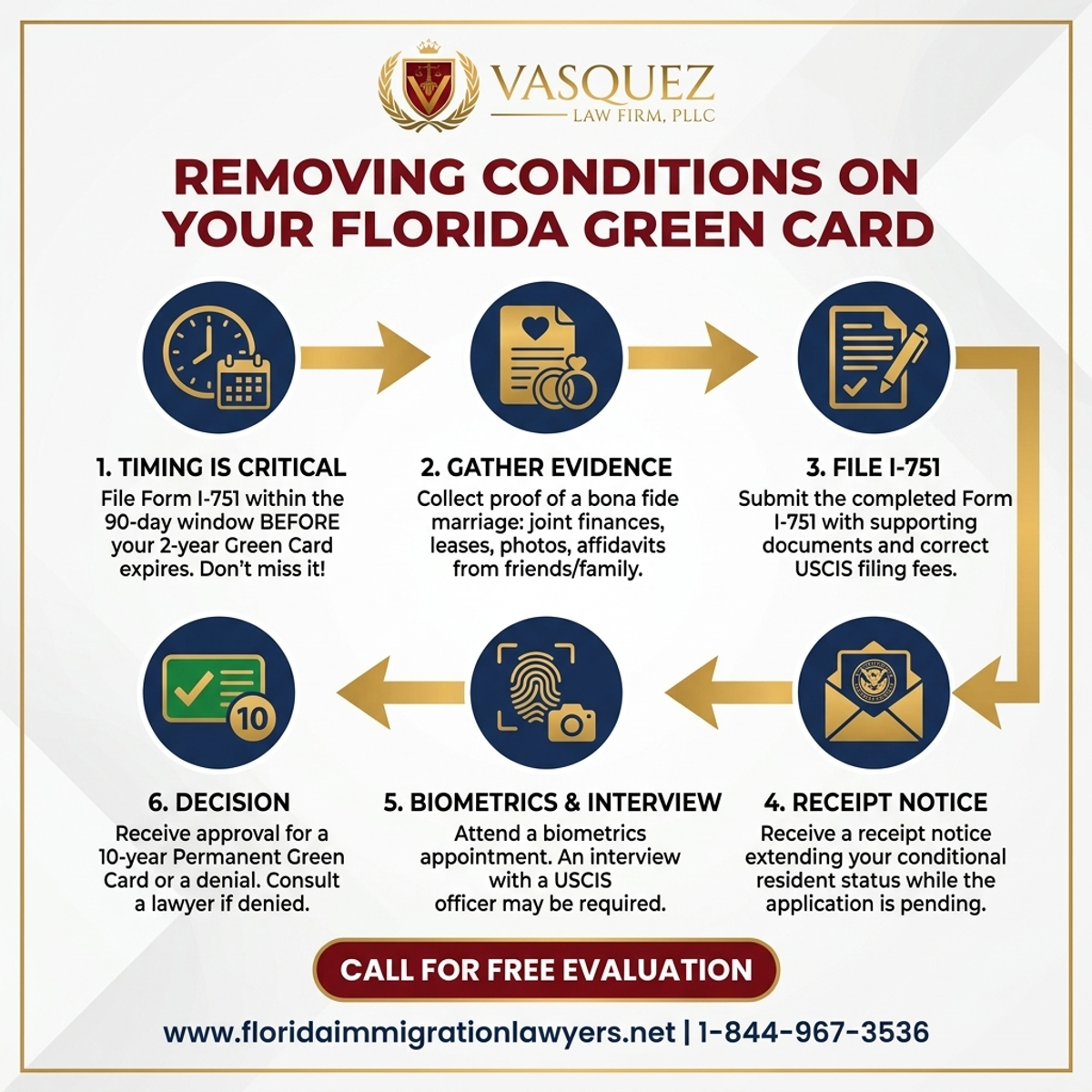
Step-by-Step Process — Conditional Green Card Removal in Florida | VLF Florida
The Joint Filing Requirement
The standard procedure for removing conditions on a green card requires a joint petition, meaning both the conditional resident and the petitioning spouse (the U.S. citizen or lawful permanent resident) must sign and file Form I-751 together. This joint filing serves as a reaffirmation of the marriage and provides USCIS with updated evidence that the marital union is ongoing and legitimate. The expectation is that both spouses will cooperate in providing documentation and, if necessary, attending an interview to demonstrate the bona fide nature of their relationship. This requirement underscores USCIS's emphasis on verifying the authenticity of the marriage throughout the conditional period. However, life circumstances can change, making joint filing impossible or unsafe, which is where waivers become essential.
Waivers for the Joint Filing Requirement
While joint filing is the norm, USCIS recognizes that not all marriages endure or remain safe. Several waivers allow a conditional resident to file Form I-751 without the petitioning spouse. These waivers are critical safety nets for individuals facing difficult circumstances and require robust evidence to support the claim.
Divorce or Annulment
If your marriage ends in divorce or annulment before the conditions are removed, you may still file Form I-751 on your own. You must demonstrate that the marriage was entered into in good faith and was not a sham to obtain immigration benefits. This requires submitting evidence that proves the marriage was legitimate at its inception, even if it later dissolved. You will need to provide a certified copy of the final divorce decree or annulment order along with all the evidence of your bona fide marriage that you would typically submit for a joint filing. The key is to show that despite the divorce, your original intent was genuine.
Spousal Abuse or Child Abuse
Victims of spousal abuse or child abuse by the petitioning spouse can file for a waiver. This provision is designed to protect individuals in abusive relationships, ensuring they are not forced to remain with an abuser to maintain their immigration status. You must demonstrate that you or your child were subjected to battery or extreme cruelty by your U.S. citizen or lawful permanent resident spouse. Evidence can include police reports, medical records, court orders, affidavits from therapists or social workers, and personal statements. USCIS handles these cases with sensitivity, and it is highly recommended to seek legal counsel from an experienced immigration attorney when applying under this waiver.
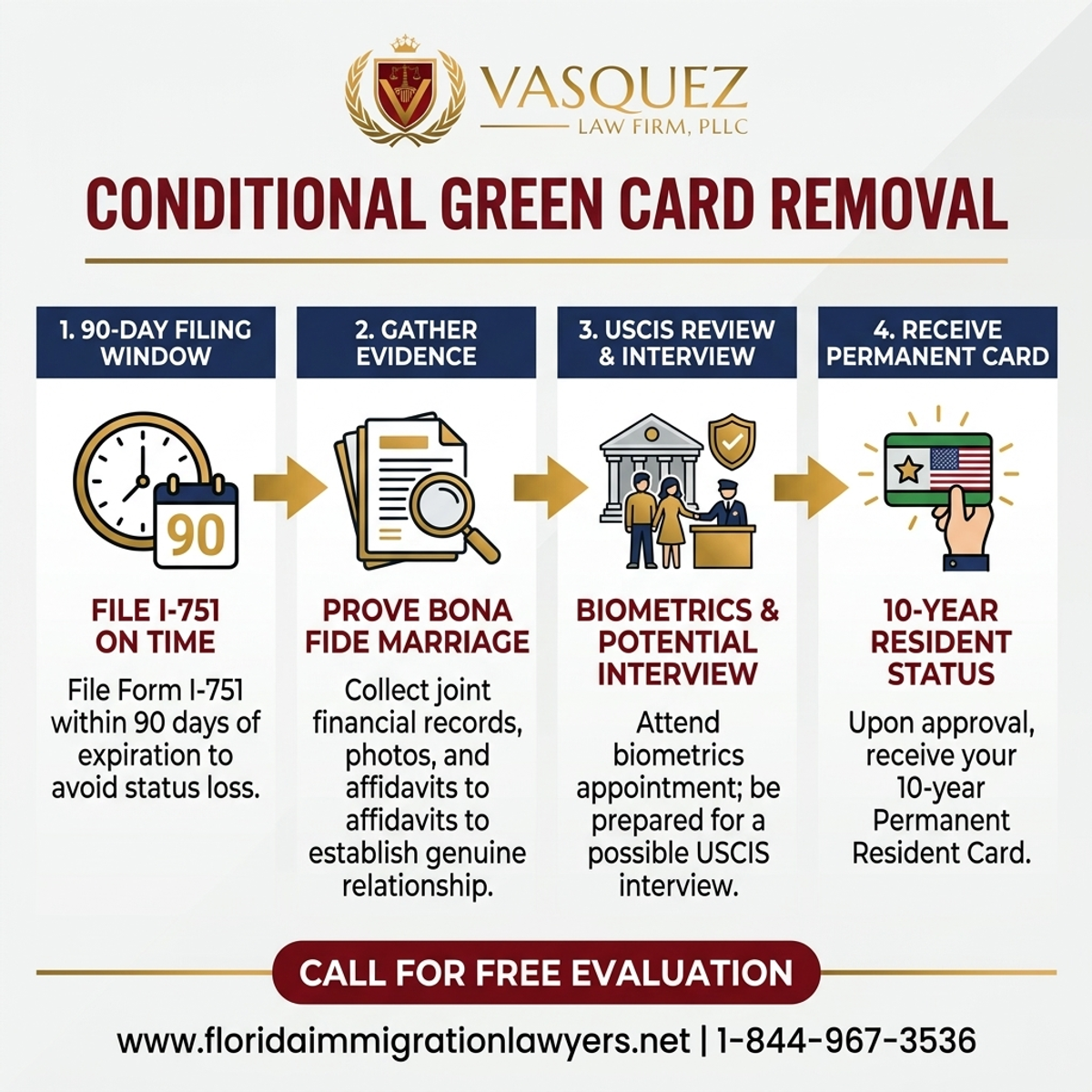
Key Statistics — Conditional Green Card Removal in Florida | VLF Florida
Death of the Petitioning Spouse
If your petitioning spouse dies before the conditions on your green card are removed, you can file Form I-751 on your own. You must submit a certified copy of the death certificate along with evidence that your marriage was bona fide. In this tragic circumstance, USCIS understands that joint filing is impossible. The focus remains on proving the legitimacy of the marriage up until the time of your spouse's passing. This waiver allows surviving spouses to continue their path to permanent residency without additional hardship.
Extreme Hardship
You may also qualify for a waiver if the termination of your status and removal from the United States would result in extreme hardship. This is a high bar to meet and typically requires demonstrating that your removal would cause severe hardship to you, a U.S. citizen child, or a lawful permanent resident child. The hardship must be beyond what is ordinarily expected from deportation. This could involve medical conditions, significant financial loss, or other compelling circumstances that would make returning to your home country exceptionally difficult. This waiver is often complex and requires substantial documentation and a compelling argument.
Required Documentation for I-751
Regardless of whether you are filing jointly or seeking a waiver, providing comprehensive documentation is paramount. USCIS scrutinizes these petitions to ensure the marriage is legitimate. Key evidence includes:
- Proof of Joint Residence: Lease agreements, mortgage statements, property deeds showing both names.
- Financial Commingling: Joint bank accounts, credit card statements, tax returns filed jointly, utility bills in both names.
- Shared Assets and Liabilities: Joint car titles, insurance policies (health, life, auto) listing both spouses, joint loans.
- Children: Birth certificates of children born to the marriage.
- Affidavits: Sworn statements from friends, family, or employers attesting to the bona fide nature of your marriage.
- Photographs: Pictures together from various times, including wedding photos, family events, and vacations.
- Other Evidence: Travel itineraries, greeting cards, letters, and any other documents that demonstrate an ongoing, shared life.
The more compelling and varied the evidence, the stronger your petition will be. Organize your documents clearly and provide copies, not originals, unless specifically requested.
The I-751 Filing Process Step-by-Step
The process of filing Form I-751 involves several critical steps that must be followed precisely to avoid delays or rejections:
- Gather Comprehensive Documentation: As detailed above, collect all evidence proving your bona fide marriage. This is the most time-consuming but crucial step.
- Complete Form I-751: Fill out the form accurately and completely. Ensure all sections are addressed, and signatures are in the correct places. Mistakes can lead to Requests for Evidence (RFEs) or denials.
- Prepare the Filing Fee: Include the correct filing fee and biometrics fee, payable to the U.S. Department of Homeland Security. Check the USCIS website for the most current fees.
- Assemble the Petition Package: Organize your documents logically, often with a cover letter and a table of contents. Place the form, fee, and supporting evidence in a secure package.
- Mail the Petition: Send the complete package to the correct USCIS Lockbox facility, as specified in the I-751 instructions. Use a trackable mailing service.
- Receive Receipt Notice (I-797C): Within a few weeks, you should receive a Form I-797C, Notice of Action, acknowledging receipt of your petition. This notice also typically extends your conditional permanent resident status for 18-24 months, allowing you to continue working and traveling while your petition is pending.
- Biometrics Appointment: USCIS will send you an appointment notice for a biometrics (fingerprints, photos, signature) collection at an Application Support Center (ASC).
- Potential Interview: While not all I-751 petitioners are interviewed, USCIS may schedule one, especially if there are questions about the evidence or if a waiver is requested.
- Decision: USCIS will issue a decision. If approved, you will receive a new 10-year green card. If denied, you may be placed in deportation proceedings.
The USCIS Interview for I-751: What to Expect
While many I-751 petitions are approved without an interview, USCIS reserves the right to call petitioners for an interview, especially in cases where the evidence is insufficient, inconsistent, or if a waiver of the joint filing requirement has been requested. The interview serves as an opportunity for USCIS officers to ask questions and clarify any doubts they may have regarding the bona fide nature of your marriage. If you are filing jointly, both spouses are expected to attend the interview. The officer will typically ask questions about your daily life, how you met, your wedding, your living arrangements, shared activities, and future plans. They may also ask individual questions to each spouse separately to check for consistency in your answers. It is crucial to be honest, consistent, and prepared to provide additional documentation if requested. For those filing with a waiver, the interview will focus on the circumstances that led to the waiver request, such as the details of abuse, the circumstances of a divorce, or the extreme hardship you face. Bringing an experienced immigration attorney to the interview can provide significant peace of mind and ensure your rights are protected. Your attorney can help prepare you for potential questions, organize your documents, and represent your interests during the proceedings, making the process less stressful and more effective. This is particularly important in complex cases or when language barriers exist. Knowing what to expect and having professional support can significantly improve your chances of a positive outcome.
Potential Challenges and Denials
Despite careful preparation, challenges can arise during the I-751 process. Common reasons for Requests for Evidence (RFEs) or denials include insufficient documentation, inconsistencies in provided information, or a failure to convince USCIS that the marriage was bona fide. If your petition is denied, it can have severe consequences, including the termination of your conditional permanent resident status and the initiation of deportation proceedings. In such cases, you typically have the right to appeal the decision or have the case reviewed by an Immigration Judge. Seeking immediate legal counsel from a qualified immigration attorney is critical if your I-751 petition faces an RFE or denial.
Consequences of Failing to File I-751
Failing to file Form I-751 within the designated 90-day window before your conditional green card expires can have severe and immediate repercussions. Your conditional permanent resident status will automatically terminate, and you will lose your lawful immigration status in the United States. This means you will no longer be authorized to live, work, or travel in the U.S. More critically, USCIS will likely initiate deportation proceedings against you. While there are limited circumstances under which USCIS may accept a late filing (e.g., due to extraordinary circumstances beyond your control), these are rare and require compelling evidence. It is imperative to adhere strictly to the filing deadlines to avoid jeopardizing your future in the U.S.
The Role of an Immigration Attorney in Florida
Navigating the I-751 process, especially when facing complex situations like waivers or potential interviews, can be overwhelming. An experienced immigration attorney in Florida can provide invaluable assistance. Our attorneys at VLF Florida can help you:
- Assess your eligibility for joint filing or a waiver.
- Identify and organize all necessary documentation.
- Prepare a compelling petition with a strong legal argument.
- Respond to Requests for Evidence (RFEs).
- Prepare you for a USCIS interview.
- Represent you during the interview, if necessary.
- Address any issues that arise, including denials or deportation defense.
Having legal representation ensures that your petition is complete, accurate, and presented in the best possible light, significantly increasing your chances of success. Beyond conditional green card removal, our firm also assists with a wide range of immigration matters, including asylum applications and deportation defense.
Why Choose VLF Florida for Your I-751 Petition?
At VLF Florida, we understand the profound importance of securing your permanent residency. Our dedicated immigration team has extensive experience with I-751 petitions, including complex waiver cases. We pride ourselves on providing personalized, compassionate, and effective legal representation. We stay abreast of the latest immigration laws and policies to offer you the most current and accurate advice. Our goal is to alleviate your stress and guide you seamlessly through the process, helping you achieve your American dream. We are committed to protecting your rights and ensuring your journey to permanent residency is successful.
Frequently Asked Questions (FAQs)
Here are some common questions about conditional green card removal:
- How long does the I-751 process take?
- Can I travel outside the U.S. while my I-751 is pending?
- What if my conditional green card expires while my I-751 is pending?
- Do I need an attorney to file Form I-751?
- What happens if my I-751 is denied?
- Can I file I-751 if I am separated but not yet divorced?
- What kind of evidence is most important for I-751?
- Will I definitely have an interview for my I-751?
Contact VLF Florida Today
Don't leave your future to chance. The process of removing conditions on your green card is a critical step, and having knowledgeable legal support can make all the difference. If you are a conditional green card holder in Florida and need assistance with your I-751 petition, contact VLF Florida today. Our team is ready to provide you with expert guidance and dedicated representation. Call us for a free consultation at (844) 967-3536 or visit our contact page to schedule an appointment. Let us help you secure your permanent residency in the United States.
Sources and References
- U.S. Citizenship and Immigration Services (USCIS)
- Executive Office for Immigration Review (EOIR)
- U.S. Department of State - Bureau of Consular Affairs
- Immigration and Nationality Act (INA), 8 U.S.C. Chapter 12
Do Not Navigate This Process Alone
Our experienced immigration attorneys are ready to fight for you. Get a free, confidential consultation today.
Se Habla Español
Or leave your details and we’ll call you:
Free Evaluation in 24 Hours
Or talk to us right now

AI voice assistant — available 24/7
FreeFrequently Asked Questions

William J. Vásquez
Founding Attorney · Vasquez Law Firm
U.S. Air Force veteran and immigration attorney with years of hands-on U.S. immigration experience. J.D., NCCU School of Law. AILA member. Admitted to the 4th, 5th, and 11th Circuit Courts.
Available 24/7 - Free Evaluations
Reviewed for legal accuracy by William J. Vásquez
Licensed in North Carolina; U.S. immigration is federal practice.
Related Legal Services
Our Florida immigration attorneys can help you with immigration practice areas, free immigration consultation and experienced immigration attorneys. Call today at 1-844-967-3536 for a free consultation.
Related Links
Related Topics
Free Legal Consultation
Discuss your case with our experienced attorneys. We're available 24/7.
Se Habla Español - Estamos aquí para ayudarle.
Related Articles
Military Naturalization Expedited in Florida Bases
Explore military naturalization options for families at Florida bases, including parole in place benefits in Miami. Learn how to expedite your application with expert guidance from Florida Immigration Lawyers.
Immigration Lawyer Orlando Free Consultation 2026
Discover how to find an immigration lawyer in Orlando offering a free consultation. Understand the services available and why choosing Florida Immigration Lawyers can make a difference in your case.
DUI Immigration Consequences in Florida: What to Know
A DUI conviction in Florida can have significant immigration consequences, including potential inadmissibility and deportation. Learn how to navigate these challenges and protect your rights with guidance from Florida Immigration Lawyers.
Immediate Relative Petition Tampa: What You Need to Know
Discover the process of filing an immediate relative petition in Tampa, Florida. Learn about eligibility, timelines, and common mistakes. Call Florida Immigration Lawyers for guidance.