Conditional Green Card Removal Florida: Your I-751 Guide 2026
For conditional permanent residents in Florida, removing conditions from your green card is a vital step. This guide for 2026 explains the I-751 petition process, including requirements, essential documents, and what to expect regarding processing times. Learn about common mistakes to avoid and when it's crucial to seek legal counsel from Florida Immigration Lawyers. We simplify the complexities of demonstrating a bona fide marriage to USCIS, helping you transition to permanent residency. Contact us for a free consultation and personalized support.
Removing conditions from your conditional green card is a critical step to obtaining permanent residency in Florida. You must file Form I-751, Petition to Remove Conditions on Residence, with USCIS within the 90-day window before your marriage green card expires. This process demonstrates your marriage was entered in good faith. Failure to file on time or properly can lead to loss of status and potential deportation.
- File Form I-751 within 90 days of your conditional green card expiration.
- Provide strong evidence of a bona fide marriage.
- Seek legal guidance, especially in complex cases like divorce or abuse.
- Prepare for potential interviews and requests for additional evidence.
Are you a conditional permanent resident in Florida, perhaps living in Pembroke Pines or a surrounding community, approaching the expiration of your 2 year Green Card? The process of removing conditions from your conditional green card is a pivotal moment in your immigration journey. Many individuals, after receiving a marriage-based green card, are initially granted conditional resident status for two years.
This status requires you to demonstrate to U.S. Citizenship and Immigration Services (USCIS) that your marriage was legitimate and not solely for immigration purposes. Our comprehensive guide for 2026 will walk you through the essential steps, requirements, and potential challenges of filing Form I-751, Petition to Remove Conditions on Residence. We understand the anxieties involved, and our goal is to provide clear, actionable information to help you navigate this complex process successfully.
For personalized assistance with your conditional green card removal Florida case, do not hesitate. Call Florida Immigration Lawyers at 1-844-967-3536 for a free consultation today.
Understanding Your Conditional Green Card and the I-751 Process
A conditional green card is issued to individuals who obtain permanent residency based on a marriage to a U.S. citizen or lawful permanent resident, and that marriage is less than two years old at the time of green card approval. This conditional status is a safeguard against marriage fraud. It ensures that the marriage is authentic and ongoing for at least two years after the initial green card approval.
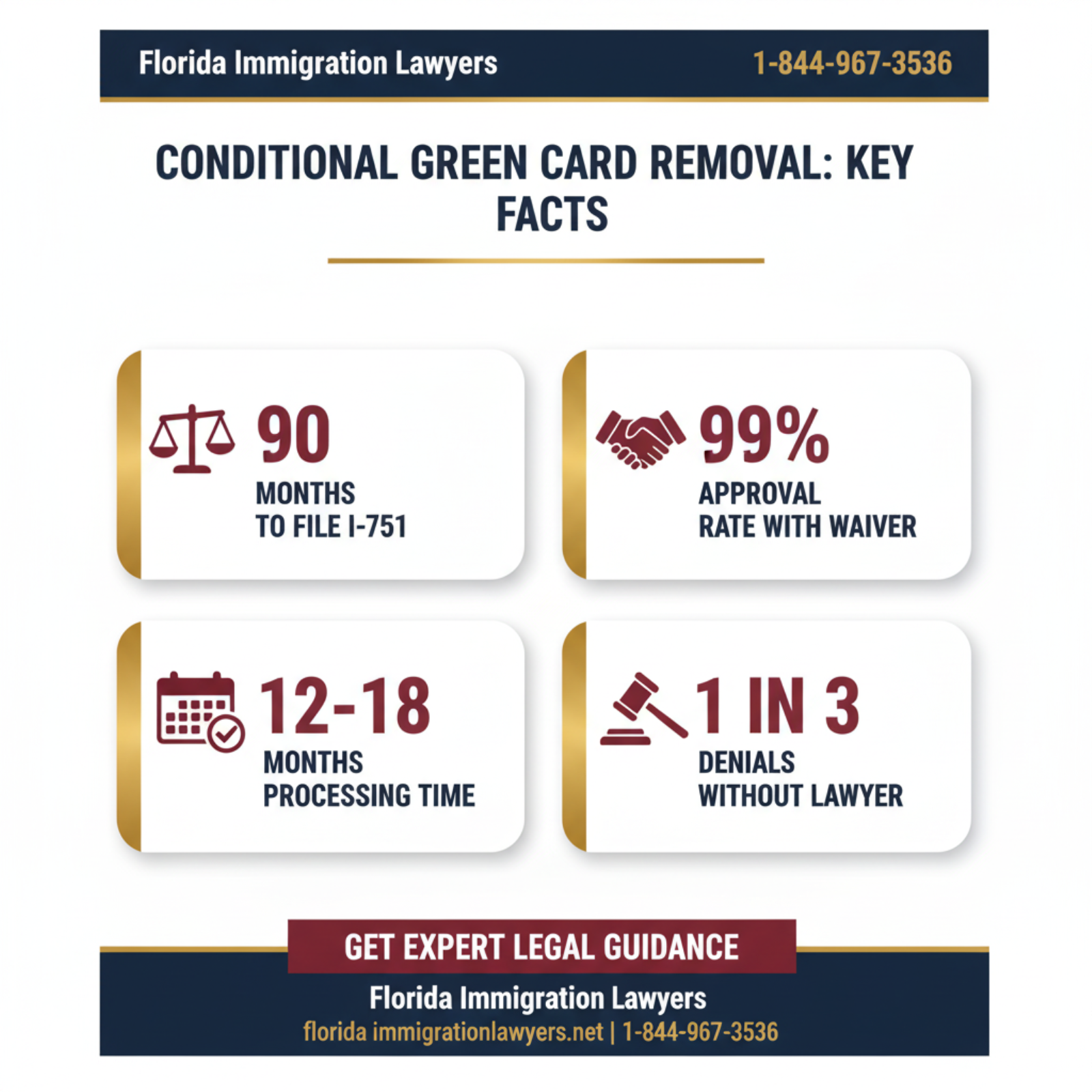
To transition from a conditional resident to a permanent resident with a 10-year green card, you must file Form I-751, Petition to Remove Conditions on Residence. This petition is typically filed jointly by both spouses. It must be submitted to USCIS within the 90-day period immediately preceding the expiration date printed on your conditional green card. Missing this crucial deadline can have severe consequences for your immigration status.
The purpose of the I-751 petition is to provide further evidence that your marriage was entered into in good faith. You must prove that it was a real, loving relationship, not just a way to obtain immigration benefits. This section will delve into the specifics of this requirement.
Step-by-Step Guide to Filing Your I-751 Petition in Florida
Navigating the conditional green card removal Florida process requires careful attention to detail. Here is a step-by-step guide to help you prepare and submit your Form I-751 petition to USCIS.
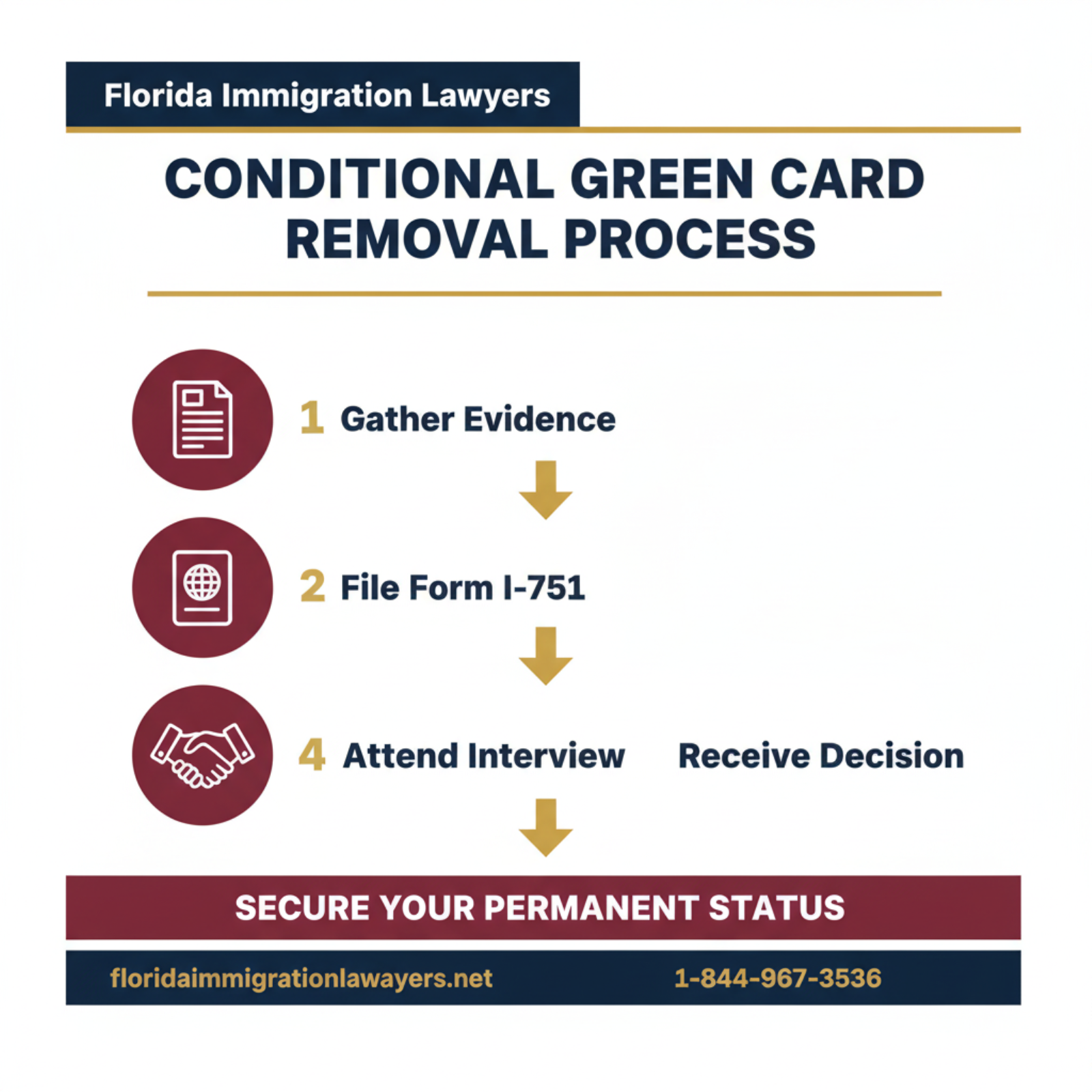
- Determine Your Filing Category: Most applicants file jointly with their spouse. However, if your marriage ended in divorce, annulment, or if you or your child were subjected to abuse, you may be eligible to file a waiver. Understanding your specific situation is the first critical step.
- Gather Comprehensive Evidence: This is perhaps the most crucial part of your application. You need to provide clear and convincing evidence that your marriage is bona fide. This includes joint financial documents, shared property, birth certificates of children born of the marriage, and affidavits from friends and family.
- Complete Form I-751 Accurately: Fill out every section of the Petition to Remove Conditions on Residence thoroughly and accurately. Any omissions or errors can lead to delays or even a denial. Be honest and consistent with all information provided.
- Prepare Supporting Documents: Assemble all your evidence, ensuring copies are clear and legible. Do not send original documents unless specifically requested by USCIS. Organize your documents logically with cover sheets and tabs.
- Pay the Correct Filing Fees: The removal of conditions green card fee must be paid at the time of filing. Be sure to check the most current fees on the USCIS website, as they are subject to change. Include the biometrics fee as well.
- Mail Your Petition to USCIS: Send your completed Form I-751 package to the appropriate USCIS Lockbox facility. The correct address depends on your mailing service (USPS vs. private courier) and your location in Florida. Always use a service that provides tracking.
- Attend Biometrics Appointment: After filing, USCIS will send you a receipt notice (Form I-797C) and later a notice for a biometrics appointment at an Application Support Center (ASC). This appointment is mandatory for fingerprinting and photographs.
- Respond to Requests for Evidence (RFE) or Interview Notices: USCIS may send an RFE if they need more information or an interview notice. It is vital to respond promptly and completely to RFEs. An interview may be waived if your evidence is strong, but be prepared to attend one if requested, possibly at a Florida field office like the one in Kendall or Orlando.
- Receive a Decision: Once USCIS has reviewed your petition and any additional evidence or interview results, they will issue a decision. If approved, you will receive a new 10-year green card.
What is the strongest evidence for I-751?
When filing your I-751 petition, the strongest evidence demonstrates the commingling of your lives and finances. This includes joint bank accounts, joint credit cards, joint leases or mortgages, and joint utility bills. Evidence of shared responsibilities and activities is crucial for the conditional green card removal Florida process.
Furthermore, birth certificates of children born to the marriage are considered very strong evidence. Affidavits from friends and family, photographs from various stages of your relationship, and joint tax returns also significantly bolster your case. The goal is to paint a comprehensive picture of a genuine marital union.
Essential Document Checklist for I-751 Filers
A well-organized and complete package of supporting documents is key to a successful conditional green card removal. Here is a general checklist of items you should consider including with your Form I-751 petition. Remember, the more comprehensive and convincing your evidence, the better your chances of approval.
- Copy of your conditional permanent resident card (front and back).
- Copy of your spouse's U.S. birth certificate, naturalization certificate, or green card (front and back).
- Copy of your marriage certificate.
- Birth certificates of any children born to the marriage.
- Joint bank account statements (checking, savings, investment accounts).
- Joint credit card statements.
- Joint leases or mortgages, property deeds, or titles (showing joint ownership).
- Utility bills in both names (electricity, water, gas, internet).
- Auto insurance policies, health insurance policies, or life insurance policies listing each other as beneficiaries.
- Joint tax returns (federal and state).
- Correspondence addressed to both spouses at the same address.
- Photographs of the couple together over time (wedding, vacations, family events, holidays).
- Affidavits from third parties (friends, family, employers, religious leaders) attesting to the bona fides of the marriage. These should include the affiant's full name, address, date and place of birth, relationship to the couple, and an explanation of how they know the marriage is genuine.
- Any other relevant documents proving a bona fide marriage (e.g., joint memberships, travel itineraries, wills).
- If filing a waiver (e.g., due to conditional green card divorce or abuse), include supporting legal documents like divorce decrees, police reports, medical records, or court orders.
Timeline and Processing Expectations for Conditional Green Card Removal Florida
The green card conditional removal processing time can vary significantly. USCIS processing times are subject to change based on caseloads, policy updates, and the specific service center handling your petition. It is crucial to check the official USCIS website for the most current processing timelines for Form I-751.
Generally, after filing your I-751 petition, you will receive a Form I-797C, Notice of Action, within a few weeks. This notice extends your conditional resident status for a specified period, typically 24 months, allowing you to continue working and traveling. This is a critical document, so keep it safe.
Following this, you will receive a biometrics appointment notice. The interview waiver rate has increased for well-documented cases, but an interview can still be requested, especially if USCIS has questions or concerns. The entire process, from filing to receiving your 10-year green card, can take anywhere from 12 to 24 months, or sometimes even longer. Patience is key during this period.
How long does it take to get I-751 approved?
While there's no single definitive answer, the approval process for an I-751 petition typically ranges from 12 to 24 months. Some cases may be resolved quicker, while others, particularly those requiring an interview or additional evidence, can extend beyond two years. The efficiency of the USCIS service center and the completeness of your initial application significantly influence the green card conditional removal processing time. It is vital to file a strong and comprehensive petition from the outset.
Cost Factors and Fee Breakdown for I-751 Filings
Understanding the financial aspects of your conditional green card removal Florida is essential. The primary costs associated with filing Form I-751 include the USCIS filing fee and the biometrics services fee. These fees are subject to change, so always verify the most current amounts directly on the official USCIS website before submitting your petition.
As of early 2026, the combined fees for Form I-751 typically include a base filing fee and a biometrics fee per applicant. If you are filing jointly with your spouse and including dependent children on the same petition, separate biometrics fees may be required for each included individual. It's important to bundle these payments correctly to avoid delays.
Beyond the government fees, you should also consider potential legal fees if you choose to hire an experienced immigration attorney. While not mandatory, legal representation can be invaluable, especially for complex cases, waivers, or if you anticipate an interview. An attorney can help ensure your petition is perfectly prepared and submitted, potentially saving you time and stress. Other costs might include document translation services or postage for sending your application.
The journey to remove conditions from your marriage green card can be intricate. Do not navigate this process alone. Contact Florida Immigration Lawyers today at 1-844-967-3536 for expert legal guidance and support in Florida.
Common Mistakes to Avoid During I-751 Conditional Green Card Removal
Successfully removing the conditions on your conditional green card requires precision. Avoiding common pitfalls can significantly improve your chances of approval. Be aware of these frequent mistakes:
- Missing the Filing Deadline: Failing to file Form I-751 within the 90-day window before your conditional green card expires is a critical error. This can lead to loss of your lawful permanent resident status and initiation of removal (deportation) proceedings.
- Insufficient Evidence of Bona Fide Marriage: Submitting a petition with weak or minimal evidence that your marriage is genuine is a common mistake. USCIS requires comprehensive proof of a shared life.
- Sending Original Documents: Unless specifically requested, never send original documents. USCIS advises submitting copies. Sending originals can result in their loss and difficulty in replacement.
- Incomplete or Inaccurate Form I-751: Any missing information, unanswered questions, or inconsistencies on the form can cause delays, RFEs, or even a denial. Double-check everything.
- Failure to Update Address with USCIS: Moving without notifying USCIS can cause you to miss crucial notices, including biometrics appointments or interview requests. This can lead to your case being abandoned.
- Not Attending the Biometrics Appointment: Missing your scheduled biometrics appointment without rescheduling can lead to the denial of your petition. It is a mandatory step.
- Ignoring Requests for Evidence (RFEs): If USCIS sends an RFE, failing to respond fully and within the specified timeframe will almost certainly lead to a denial.
- Filing a Joint Petition After Divorce Without a Waiver: If your marriage has ended, you cannot file a joint petition. You must file a waiver based on divorce or other qualifying circumstances.
- Not Seeking Legal Advice for Complex Cases: Cases involving divorce, abuse, or criminal history are highly complex. Attempting to navigate these without an attorney significantly increases the risk of denial.
- Believing the Process is "Easy": While many cases are approved, the process is not always straightforward. Underestimating its complexity can lead to inadequate preparation and negative outcomes.
While some straightforward cases for conditional green card removal Florida may be manageable without legal representation, there are many scenarios where the expertise of an immigration attorney is invaluable. Florida Immigration Lawyers can provide the support you need, whether you are in Pembroke Pines, Miami, Orlando, or anywhere else in the state.
You should strongly consider contacting an attorney if any of the following apply to your I-751 petition:
- Your marriage has ended in conditional green card divorce or annulment.
- You are a victim of spousal abuse or extreme cruelty.
- Your spouse refuses to sign the joint petition.
- You have a criminal record or any adverse immigration history.
- USCIS has issued a Request for Evidence (RFE) or an Intent to Deny notice.
- You have concerns about the strength of your evidence.
- You have missed the 90-day filing window.
- You are facing removal (deportation) proceedings. Our deportation defense attorneys can assist.
Our experienced team at Florida Immigration Lawyers specializes in complex immigration matters. We can help you gather compelling evidence, prepare a strong legal argument, and represent you throughout the entire conditional green card removal process, including interviews at USCIS field offices in Florida. We are here to protect your rights and help you achieve your goal of permanent residency.
Florida Immigration Lawyers is a leading law firm dedicated to providing exceptional immigration legal services across the entire state of Florida. With a deep understanding of U.S. immigration law and a commitment to our clients, we strive to make complex legal processes as clear and stress-free as possible. Our firm serves individuals and families from all walks of life, from Pembroke Pines to Jacksonville, Tampa to Miami.
We offer a comprehensive range of immigration services, including family-based petitions, employment-based visas, asylum claims, deportation defense, citizenship applications, and assistance with conditional green card removal, including Form I-751 petitions. Our attorneys are passionate advocates, known for their meticulous preparation and compassionate client care.
Choosing Florida Immigration Lawyers means partnering with a team that puts your needs first. We are available 24/7 to answer your urgent questions and offer free consultations to discuss your unique situation. Our bilingual staff ensures that language is never a barrier to quality legal representation. Let us be your trusted guide in navigating the intricacies of immigration law.
Contact us today: 1-844-967-3536 | Visit our website: https://www.floridaimmigrationlawyers.net
Sources and References
- U.S. Citizenship and Immigration Services (USCIS) - Form I-751
- USCIS Policy Manual - Volume 6, Part G, Chapter 2 (Conditional Permanent Resident Status)
- Executive Office for Immigration Review (EOIR)
- 8 U.S.C. § 1186a - Conditional permanent resident status for certain alien spouses and sons and daughters
- 8 CFR Part 216 - Conditional Basis of Lawful Permanent Residence Status
- Immigration and Nationality Act (INA) Section 216
This article provides general legal information and is not intended as legal advice. Every case is unique, and outcomes depend on specific facts and circumstances. Immigration laws are subject to change. Contact an attorney for advice about your particular situation and to confirm current regulations and fees.
Securing your permanent residency is a significant milestone. Do not leave your conditional green card removal Florida process to chance. The experienced immigration attorneys at Florida Immigration Lawyers are ready to provide the dedicated and knowledgeable representation you deserve. Call us now for a free, confidential consultation.
Call Florida Immigration Lawyers at 1-844-967-3536 today! Se Habla Español - Estamos aquí para ayudarle.
Frequently Asked Questions
Florida Immigration Lawyers
Legal Team
Our experienced attorneys at Florida Immigration Lawyers have been serving clients across Florida for over 20 years. We specialize in immigration, personal injury, criminal defense, workers compensation, and family law.