SIJS Florida: Navigating Special Immigrant Juvenile Status in 2026
Special Immigrant Juvenile Status (SIJS) in Florida offers a vital path to legal residency for eligible minors who have suffered abuse, neglect, or abandonment. This complex process involves securing a specific order from a Florida state court, followed by filing petitions with USCIS. Our comprehensive guide for 2026 details the step-by-step application, essential documents, expected timelines, and cost factors. Learn how this status provides protection and a potential green card for vulnerable children. Florida Immigration Lawyers is dedicated to assisting minors and their guardians throughout Florida, including Kissimmee, ensuring a thorough and compassionate approach to every SIJS case. Contact us for a free consultation.
Special Immigrant Juvenile Status (SIJS) in Florida offers a path to legal residency for certain undocumented children who have been abused, neglected, or abandoned by one or both parents. This process involves obtaining a specific order from a Florida state court and then applying to USCIS. It provides crucial protection and a potential green card for vulnerable minors in Florida.
- SIJS protects vulnerable children from deportation.
- Requires a state court order before federal immigration petition.
- Can lead to a U.S. green card for eligible minors.
- Age limits and specific dependency findings are crucial.
- Professional legal guidance is highly recommended.
SIJS Florida: Navigating Special Immigrant Juvenile Status in 2026
For many young individuals in Florida, the journey to a stable future in the United States is filled with challenges. If you are a minor in Florida who has experienced abuse, neglect, or abandonment, you may be eligible for a unique form of immigration relief known as Special Immigrant Juvenile Status (SIJS). This status provides a critical pathway to protection and permanent residency.
Navigating the complex legal landscape of SIJS in Florida requires a deep understanding of both state family law and federal immigration regulations. This comprehensive guide will walk you through the essential steps, requirements, and considerations for obtaining SIJS in 2026. Our goal is to empower you with the knowledge needed to pursue this vital immigration benefit.
Do not face this intricate process alone. The experienced team at Florida Immigration Lawyers is here to help. For personalized guidance and to discuss your unique situation, call Florida Immigration Lawyers at 1-844-967-3536 for a free consultation. We serve clients across all of Florida, including Kissimmee and surrounding areas.
Understanding Special Immigrant Juvenile Status (SIJS) in Florida
Special Immigrant Juvenile Status (SIJS) is a provision under U.S. immigration law designed to protect undocumented immigrant children who have been subjected to abuse, neglect, or abandonment by a parent. This humanitarian relief offers a pathway to lawful permanent residency, commonly known as a green card, for eligible minors. It is a vital tool for safeguarding children who cannot be reunited with their parents due to these tragic circumstances.
Eligibility Criteria for SIJS
To qualify for SIJS, a minor must meet specific federal immigration requirements. These criteria are established by Congress and detailed by U.S. Citizenship and Immigration Services (USCIS). Understanding these requirements is the first critical step in determining if SIJS is the right path for you or a child you are assisting.
- Age: You must be under 21 years old at the time USCIS receives your Form I-360, Petition for Amerasian, Widow(er), or Special Immigrant. Importantly, state court jurisdiction usually ends at age 18, making timely action crucial.
- Unmarried: You must be unmarried at the time you file your SIJS petition and remain unmarried until you receive your green card. Marriage will disqualify you from SIJS eligibility.
- Dependency or Custody Order: A state juvenile court must have issued an order declaring you dependent on the court or placing you in the custody of a state agency, an individual, or an entity. This order is foundational to the SIJS process.
- Abuse, Neglect, or Abandonment Finding: The state court order must also find that reunification with one or both parents is not possible due to abuse, neglect, or abandonment. This finding must be explicit within the court order.
- Best Interest Determination: The state court must determine that it is not in your best interest to return to your or your parents' country of nationality or last habitual residence. This is a critical protective measure by the court.
These strict criteria ensure that SIJS is granted only to those children who genuinely require this special protection. The process involves close coordination between state family courts and federal immigration authorities. Our firm, Florida Immigration Lawyers, regularly assists families navigating these complex eligibility questions, particularly concerning family immigration matters.
The Role of Florida State Courts in SIJS
The state court order is the cornerstone of any SIJS petition. In Florida, this typically involves a juvenile court, often in circuits like the Ninth Judicial Circuit (serving Orange and Osceola counties, including Kissimmee) or the Eleventh Judicial Circuit (Miami-Dade). The state court does not grant immigration status directly; rather, it makes the factual findings necessary for USCIS to grant SIJS.
The state court must establish jurisdiction over the minor. This usually happens through dependency proceedings, guardianship proceedings, or dissolution of marriage cases where the minor is involved. The court then issues an order containing the specific findings required for SIJS. These findings include the child's dependency or placement, and the determination that reunification with one or both parents is not viable due to abuse, neglect, or abandonment, and that it is not in the child's best interest to return to their home country.
Working with an attorney who understands both Florida family law and federal immigration law is crucial. They can help ensure the state court order contains all the necessary language to satisfy USCIS requirements. Without a properly worded state court order, your SIJS petition will likely be denied.
The Step-by-Step SIJS Application Process for Minors in Florida
The path to obtaining Special Immigrant Juvenile Status and eventually a green card is a multi-stage process. Each step requires meticulous attention to detail and adherence to strict legal requirements. Here is a numbered guide to help you understand the journey:
-
Obtain a State Court Order: The first and most critical step is to secure a qualifying order from a Florida state court. This typically involves filing a petition in a Florida juvenile or family court. The court must declare the minor dependent on the court or place them in the custody of an individual or entity. Crucially, the order must state that reunification with one or both parents is not possible due to abuse, neglect, or abandonment, and that it is not in the minor's best interest to return to their country of origin. This step often requires the assistance of a Florida family law attorney or an immigration attorney experienced in SIJS cases who can coordinate with a family law practitioner.
-
File Form I-360 Petition with USCIS: Once you have the state court order, the next step is to file Form I-360, Petition for Amerasian, Widow(er), or Special Immigrant, with USCIS. This petition formally requests Special Immigrant Juvenile Status. You will need to submit the original or certified copy of the state court order, proof of your age (e.g., birth certificate), and any other supporting documentation that demonstrates your eligibility. Filing this form promptly is important, especially if you are nearing the age limit for SIJS.
-
Receive USCIS Approval for Form I-360: USCIS will review your I-360 petition and all submitted evidence. If they determine that you meet all SIJS eligibility criteria, they will approve your petition. This approval grants you Special Immigrant Juvenile Status. Please note that an approved I-360 does not automatically grant you a green card; it is a prerequisite for the next step, which is adjustment of status to lawful permanent resident. The processing time for this step can vary, impacting the overall SIJS processing time.
-
Apply for Adjustment of Status (Form I-485): After your I-360 petition is approved, and if an immigrant visa is immediately available, you can apply for adjustment of status to become a lawful permanent resident. This involves filing Form I-485, Application to Register Permanent Residence or Adjust Status. Along with Form I-485, you will typically need to submit Form I-765 for employment authorization (EAD) and Form I-131 for advance parole (travel document). You will also undergo a biometrics appointment and a medical examination.
-
Attend an Interview (if required): In many cases, USCIS will schedule an interview for your adjustment of status application. This interview will typically take place at a local USCIS field office, such as the one in Orlando for individuals in Kissimmee. During the interview, an immigration officer will review your application and documents and ask questions to confirm your eligibility for a SIJS green card. Having an attorney accompany you to this interview can be highly beneficial.
-
Receive Your Green Card: If your adjustment of status application is approved after the interview (or without an interview, in some cases), you will officially become a lawful permanent resident of the United States. Your green card will be mailed to you, marking the successful completion of your SIJS journey. This status provides stability and numerous opportunities for your future.
Each of these steps can be intricate, and a misstep at any stage can lead to delays or even denial. This is why seeking professional legal counsel from an experienced immigration law firm like Florida Immigration Lawyers is essential. We can help you navigate each phase, from preparing your state court petition to representing you at your USCIS interview.
Essential Documents for Your SIJS Petition
Gathering the correct documentation is paramount for a successful SIJS application. Incomplete or incorrect submissions are common reasons for delays or denials. Here is a checklist of the documents typically required for both the state court process and the federal immigration petition:
- Certified Copy of State Court Order: This is the most critical document. It must contain all the specific findings required by federal law for SIJS eligibility.
- Proof of Age: Your birth certificate is the primary document. If unavailable, other forms of identification like a passport, national identity document, or even an affidavit from a credible witness may be accepted.
- Proof of Identity: A government-issued photo ID, such as a passport or a national identity card.
- Proof of Entry into the U.S.: I-94 arrival/departure record, if available.
- Form I-360, Petition for Amerasian, Widow(er), or Special Immigrant: Completed and signed.
- Form I-485, Application to Register Permanent Residence or Adjust Status: Completed and signed (filed after I-360 approval, if visa is available).
- Form I-765, Application for Employment Authorization: If you wish to work while your I-485 is pending.
- Form I-131, Application for Travel Document: If you wish to travel internationally while your I-485 is pending.
- Form I-693, Report of Medical Examination and Vaccination Record: Completed by a USCIS-approved civil surgeon.
- Photos: Passport-style photographs meeting USCIS specifications.
- Affidavits/Declarations: Statements from you or others detailing the abuse, neglect, or abandonment, if relevant and helpful to supplement the court order.
- Translations: Any documents not in English must be accompanied by a certified English translation.
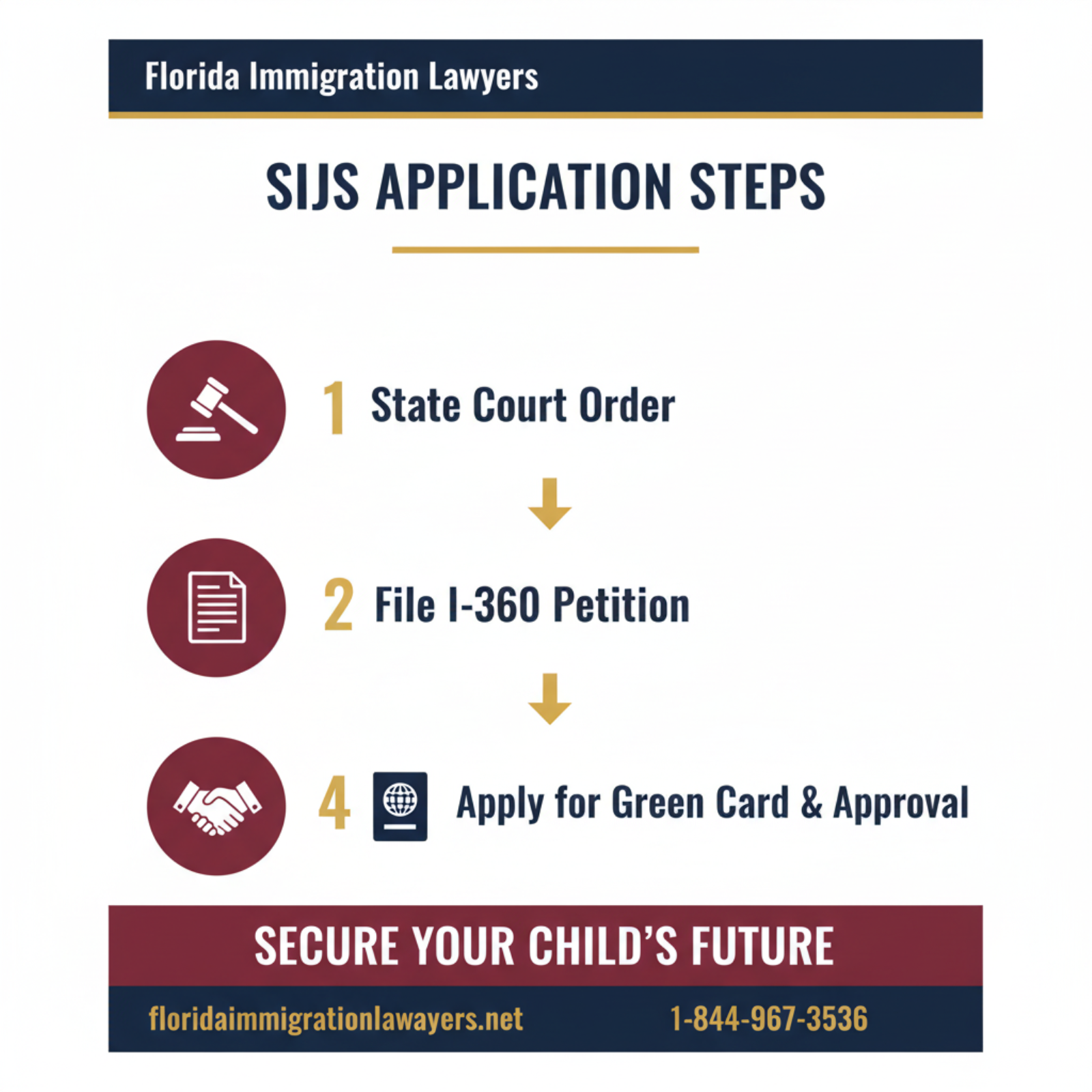
Organizing these documents can be overwhelming. Florida Immigration Lawyers can assist you in compiling a thorough and accurate application package, reducing the risk of errors that could jeopardize your immigration case. We understand the specific requirements for SIJS in Florida.
SIJS Timeline and Processing Expectations in 2026
The total time it takes to obtain Special Immigrant Juvenile Status and eventually a green card can vary significantly. Several factors influence the SIJS processing time, including the efficiency of the state court system, USCIS caseloads, and the availability of immigrant visas.
State Court Process Timeline
The initial state court proceedings can take anywhere from a few months to over a year, depending on the complexity of the case and the specific judicial circuit in Florida. For instance, dependency cases in larger counties like Miami-Dade or Orange County might have different timelines than those in smaller jurisdictions. Securing the necessary findings from a Florida state court is often the longest initial phase.
USCIS I-360 Processing
After the state court order is obtained, the Form I-360 petition is filed with USCIS. Processing times for I-360 petitions can fluctuate. You can check the USCIS website for current processing times by form type and service center. Generally, this stage can take several months to over a year. The USCIS office that serves Florida applicants for I-360 is typically the Nebraska Service Center or Texas Service Center.
Visa Bulletin and Green Card Availability
Unlike some other immigration categories, SIJS applicants, after I-360 approval, are generally considered under the Employment-Based Fourth Preference (EB-4) visa category for green card purposes. Due to high demand, there can be a backlog for EB-4 visas, particularly for individuals from certain countries. This means that even after your I-360 is approved, you may have to wait for an immigrant visa to become available before you can file your Form I-485 to adjust status to a SIJS green card. This wait is determined by the Department of State's Visa Bulletin, which is updated monthly. This can significantly extend the overall timeline.
The total journey from initiating state court proceedings to receiving a green card can range from 2 to 5 years, or even longer in cases with visa backlogs. Patience and continuous legal support are crucial during this extended period.
Cost Factors for Special Immigrant Juvenile Status Petitions
Understanding the potential costs involved in an SIJS case is important for planning. These costs generally fall into two main categories: government filing fees and legal fees. Please note that government filing fees are subject to change by USCIS and should always be verified on the official USCIS website.
Government Filing Fees
For SIJS petitions, USCIS often waives the filing fee for Form I-360. However, fees typically apply for the adjustment of status application (Form I-485), the biometrics appointment, and the medical examination (Form I-693) conducted by a civil surgeon. Fee waivers may be available for certain low-income applicants for Form I-485, but eligibility is strict. It's crucial to check the latest fee schedule on USCIS.gov.
Legal Fees
Legal fees constitute a significant portion of the overall cost, but they represent an invaluable investment in the success of your case. An experienced immigration attorney will charge for their expertise in:
- Guiding you through the state court process to obtain the necessary order.
- Preparing and filing Form I-360 and supporting documentation.
- Preparing and filing Form I-485, I-765, and I-131.
- Responding to Requests for Evidence (RFEs) from USCIS.
- Preparing you for and representing you at your USCIS interview.
- Monitoring the Visa Bulletin for green card availability.
The complexity of SIJS cases, particularly those involving coordination between state and federal law, makes legal representation highly advisable. While fees vary, many firms offer payment plans. Investing in legal counsel helps ensure that your application is correctly prepared, minimizing delays and increasing the likelihood of approval. Florida Immigration Lawyers offers transparent fee structures and free consultations to discuss your options.
Common Mistakes to Avoid in SIJS Cases
Navigating the Special Immigrant Juvenile Status process in Florida is intricate, and even small errors can lead to significant delays or outright denials. Being aware of common pitfalls can help you avoid them.
-
Failing to Obtain a Proper State Court Order: This is the most frequent mistake. The state court order must contain all the specific findings required by federal immigration law (e.g., dependency, reunification not viable due to abuse/neglect/abandonment, not in best interest to return). An order that omits any of these elements will result in a denial of the I-360 petition. Ensure your Florida state court order is meticulously reviewed for all necessary language.
-
Missing Age-Out Deadlines: The SIJS age limit is strict. While the federal limit is under 21 for I-360 filing, most state courts lose jurisdiction when a child turns 18. Delaying the state court process can lead to an 'age-out' situation, rendering the minor ineligible for SIJS. Timely action is paramount.
-
Marriage Before Green Card Approval: SIJS applicants must remain unmarried until they receive their green card. Marriage at any point during the SIJS process, even after I-360 approval, will lead to disqualification. This is a critical rule that must be strictly followed.
-
Incomplete or Incorrect Forms: Submitting forms with missing information, incorrect answers, or without proper signatures is a common reason for USCIS to issue a Request for Evidence (RFE) or deny the application. Double-check all forms thoroughly before submission.
-
Lack of Supporting Documentation: Failing to provide all required supporting documents, such as birth certificates, identity proofs, or certified translations, can cause significant delays. Each piece of evidence must be accurate and properly presented.
-
Not Responding to RFEs in Time: If USCIS sends a Request for Evidence, you must respond within the specified timeframe. Failing to do so, or providing an inadequate response, will likely result in a denial of your petition.
-
Undocumented Travel After Filing: Leaving the U.S. without an approved advance parole document while an adjustment of status application is pending can lead to the abandonment of your application. Always consult with an attorney before any international travel.
-
Misrepresenting Facts: Any false statements or misrepresentations on your application can have severe consequences, including denial of your SIJS petition and potential findings of inadmissibility in the future. Honesty and accuracy are crucial.
-
Attempting to Navigate the Process Alone: While possible, the complexities of SIJS-combining state family law with federal immigration law-make it extremely challenging for non-attorneys. Without legal guidance, you are at a higher risk of making critical errors. Seeking help from experienced attorneys is highly recommended.
-
Ignoring Visa Bulletin Backlogs: For many SIJS applicants, especially those from certain countries, there can be a wait for an immigrant visa to become available after I-360 approval. Not understanding or monitoring the Visa Bulletin can lead to confusion about processing times and expectations for the SIJS green card.
When to Call a Lawyer for Your SIJS Case
The Special Immigrant Juvenile Status process is one of the most complex areas of immigration law, requiring specialized knowledge in both state family law and federal immigration statutes. While this guide provides general information, your specific circumstances will always dictate the best course of action. It is highly advisable to seek legal counsel from an experienced immigration attorney in Florida if you encounter any of the following scenarios:
- You are considering SIJS: An initial consultation can help determine if you or the minor you are assisting meets the basic eligibility requirements and assess the viability of your case.
- You need to initiate state court proceedings: Obtaining the specific findings required for SIJS from a Florida state court is a nuanced process. An attorney can guide you through dependency, guardianship, or family court proceedings to secure the proper order.
- You are nearing the age limit: If you are approaching 18 or 21, time is of the essence. An attorney can help expedite the process where possible to avoid 'aging out' of eligibility.
- You have a complicated family situation: Cases involving complex family dynamics, missing parents, or previous interactions with child protective services require expert navigation.
- You received a Request for Evidence (RFE) or Notice of Intent to Deny (NOID): These notices from USCIS indicate that there are issues with your application. A lawyer can help you formulate a comprehensive and timely response to address USCIS concerns.
- You have a criminal record: Even minor legal infractions can impact immigration eligibility. An attorney can assess potential inadmissibility issues and advise on waivers if available. This is especially important for minors who may have had brushes with the law.
- You are in deportation proceedings: SIJS can be a powerful defense against removal. If you or a minor are in immigration court, an attorney can help explore SIJS as a form of relief.
- You need help with the adjustment of status interview: An attorney can prepare you for the interview, accompany you, and advocate on your behalf, ensuring your rights are protected.
At Florida Immigration Lawyers, we specialize in helping vulnerable individuals navigate the complexities of asylum, SIJS, and other protective immigration pathways. Our team is dedicated to providing compassionate and effective legal representation to minors in Kissimmee, Orlando, and throughout Florida. We understand the unique challenges faced by immigrant children and are committed to securing their futures.
About Florida Immigration Lawyers
Florida Immigration Lawyers is a leading immigration law firm dedicated to serving individuals and families across the entire state of Florida. With a deep commitment to justice and a comprehensive understanding of U.S. immigration law, our firm provides expert legal guidance and representation for a wide range of immigration matters.
We understand that immigration journeys are deeply personal and often challenging. Our mission is to offer compassionate, client-focused services, ensuring that you receive the best possible legal support. From family-based petitions to complex deportation defense cases, our experienced attorneys are here to advocate for your rights and help you achieve your immigration goals.
Our services include, but are not limited to, Special Immigrant Juvenile Status (SIJS), family immigration, business immigration, asylum claims, deportation defense, citizenship applications, and visa applications. We pride ourselves on our proactive approach, meticulous attention to detail, and unwavering dedication to our clients.
Why choose Florida Immigration Lawyers?
- Experienced Attorneys: Our team possesses extensive knowledge of immigration law and a proven track record of success.
- Client-Centered Approach: We prioritize your needs, offering personalized strategies and clear communication every step of the way.
- Serving All of Florida: No matter where you are in Florida, our firm is equipped to provide legal assistance.
- Bilingual Services: We offer services in English and Spanish to ensure effective communication.
- Free Consultations: We provide free initial consultations to discuss your case and explore your options.
- Available 24/7: We understand that legal needs can arise at any time, and we are here to support you around the clock.
Your immigration journey is important. Let Florida Immigration Lawyers be your trusted partner. For a free consultation, call us today at 1-844-967-3536 or visit our website at https://www.floridaimmigrationlawyers.net.
Sources and References
- U.S. Citizenship and Immigration Services (USCIS) - Special Immigrant Juveniles
- U.S. Department of State - Visa Bulletin
- Executive Office for Immigration Review (EOIR)
- Immigration and Nationality Act (INA) § 101(a)(27)(J) - 8 U.S.C. § 1101(a)(27)(J)
- 8 CFR § 204.11 - Special Immigrant Juveniles
- Florida Statutes Chapter 39 - Proceedings Relating to Children
This article provides general legal information and is not intended as legal advice. Every case is unique, and outcomes depend on specific facts and circumstances. Contact an attorney for advice about your particular situation.
The journey to Special Immigrant Juvenile Status can be life-changing for vulnerable minors in Florida. By understanding the process and avoiding common mistakes, you can significantly improve your chances of success. Remember, you do not have to face this journey alone.
Florida Immigration Lawyers is here to provide the expert legal support you need. Schedule your free consultation today by calling 1-844-967-3536. Se Habla Español - Estamos aquí para ayudarle.
Frequently Asked Questions
Florida Immigration Lawyers
Legal Team
Our experienced attorneys at Florida Immigration Lawyers have been serving clients across Florida for over 20 years. We specialize in immigration, personal injury, criminal defense, workers compensation, and family law.