Naturalization Ceremony ICE Concerns in Florida: Your Rights
For many aspiring citizens in Florida, the naturalization ceremony is a highly anticipated event. However, concerns about ICE presence can create anxiety. This guide from Florida Immigration Lawyers addresses naturalization ceremony ICE concerns, clarifying your rights and the realities of enforcement. We detail the step-by-step naturalization process, essential documents, expected timelines, and cost factors. Learn about common mistakes to avoid and when to seek expert legal assistance to ensure a smooth journey to U.S. citizenship. Understand your rights and find peace of mind with our dedicated legal support.
While U.S. Citizenship and Immigration Services (USCIS) naturalization ceremonies are generally safe, concerns about Immigration and Customs Enforcement (ICE) presence can arise. It is rare for ICE to target individuals at these ceremonies unless there are specific, serious legal issues, such as undisclosed criminal history or fraud. Knowing your rights and having legal counsel is crucial for peace of mind.
- ICE presence at naturalization ceremonies is uncommon for lawful applicants.
- Your rights include remaining silent and requesting an attorney if questioned.
- Undisclosed criminal history or fraud are primary reasons for ICE intervention.
- Consulting an immigration lawyer can alleviate concerns and prepare you.
- Florida Immigration Lawyers can provide guidance for your ceremony in Fort Lauderdale and across Florida.
Naturalization Ceremony ICE Concerns in Florida: Your Rights
The journey to U.S. citizenship is a momentous occasion, filled with hope and excitement. For many aspiring citizens in Florida, the naturalization ceremony marks the culmination of years of dedication and perseverance. However, a common underlying concern for some involves the potential presence of U.S. Immigration and Customs Enforcement (ICE) at these ceremonies.
This apprehension is understandable, especially given the dynamic landscape of immigration enforcement in Florida. Our goal at Florida Immigration Lawyers is to provide clear, reliable information to ease your worries. We want you to understand your rights and the realities of ICE involvement during this significant milestone.
This comprehensive guide will address your questions about naturalization ceremony ICE concerns in Florida. We will cover the naturalization process, common pitfalls, and, most importantly, when and how to protect your rights. If you have specific concerns or need personalized legal advice, do not hesitate. Call Florida Immigration Lawyers at 1-844-967-3536 for a free consultation.
Understanding Naturalization Ceremony ICE Concerns in Florida
For many years, naturalization ceremonies have been considered safe havens, places where new citizens could celebrate without fear. Generally, this remains true. USCIS, the agency that conducts these ceremonies, focuses on welcoming new citizens, not on immigration enforcement.
However, the public perception of ICE's role has sometimes created anxiety. It is important to distinguish between general immigration enforcement and specific actions at a naturalization ceremony. ICE's primary mission is to enforce immigration laws, but their presence at a USCIS naturalization ceremony is typically reserved for very specific circumstances.
In Florida, the landscape of immigration enforcement has seen various initiatives, including 287(g) partnerships and operations like “Operation Tidal Wave.” These programs often focus on arrests away from sensitive locations. While these operations can heighten general community fears, they rarely target individuals at their naturalization oath ceremonies unless there is a pre-existing warrant or specific intelligence related to fraud or serious criminality.
It is crucial to understand that becoming a naturalized U.S. citizen grants you the full protections of citizenship. This includes protection from deportation, except in rare cases where citizenship was obtained through fraud or misrepresentation. For lawful permanent residents who have successfully navigated the naturalization process, the ceremony is a final step, not an enforcement opportunity.
The Immigration and Nationality Act (INA) outlines the requirements for naturalization. Once you meet these, you are generally on solid ground. Any concerns about ICE should stem from specific, unaddressed legal issues in your past, not from the act of becoming a citizen itself. Understanding this distinction is the first step in addressing your naturalization ceremony ICE concerns.
The Naturalization Process: A Step-by-Step Guide for Florida Residents
Becoming a U.S. citizen is a detailed process requiring careful attention to every step. For residents in Fort Lauderdale and throughout Florida, the process typically follows these stages:
-
Determine Your Eligibility: Before applying, ensure you meet all USCIS eligibility requirements. This usually includes age, continuous residency, physical presence, good moral character, English language proficiency, and knowledge of U.S. history and government. Most applicants qualify based on five years as a lawful permanent resident, or three years if married to a U.S. citizen.
-
Prepare and File Form N-400: The Application for Naturalization, Form N-400, is the cornerstone of your application. This form requires comprehensive personal, residential, employment, and immigration history. Accuracy is paramount, as any discrepancies can lead to delays or issues. Our team at Florida Immigration Lawyers can help you prepare a thorough and accurate N-400.
-
Attend Biometrics Appointment: After filing, USCIS will send you an appointment notice for a biometrics collection. This involves fingerprinting, photographs, and a signature to conduct background checks. This step is a standard part of the process for all applicants.
-
Complete the Naturalization Interview: This is a critical stage where a USCIS officer will review your N-400 application with you. They will ask questions to verify your eligibility, assess your good moral character, and test your English and civics knowledge. Being well-prepared for this interview is essential for success. We regularly assist clients with interview preparation in Florida.
-
Receive a Decision: Following your interview, the USCIS officer will generally issue a decision. This could be an approval, a continuance (if more information is needed), or a denial. If approved, you will typically receive a notice for your oath ceremony.
-
Attend the Oath of Allegiance Ceremony: This is the final step where you take the Oath of Allegiance to the United States. During this ceremony, you will surrender your Permanent Resident Card (Green Card) and receive your Certificate of Naturalization. This document is proof of your U.S. citizenship. This is the ceremony where naturalization ceremony ICE concerns sometimes arise, though, as discussed, rarely for legitimate applicants.
For more detailed information on navigating the path to citizenship, please visit our Citizenship practice area page. We are here to guide you through every stage, ensuring a smooth and successful journey.
Essential Documents for Your Naturalization Journey
A successful naturalization application hinges on providing accurate and complete documentation. Gathering these materials early can prevent delays. Here is a general checklist of documents you will typically need:
- Your Permanent Resident Card (Green Card).
- Your state-issued identification (e.g., Florida driver's license or ID card).
- All passports, current and expired.
- Birth certificate.
- Marriage certificate (if applicable).
- Divorce decrees or death certificates for previous marriages (if applicable).
- Evidence of termination of prior marriages (if applicable).
- Tax returns for the past five years (or three years if married to a U.S. citizen).
- Proof of selective service registration (for males aged 18-26).
- Certified court dispositions for any arrests, citations, or convictions, even if expunged.
- Proof of payment of child support or alimony (if applicable).
- Documentation for any trips outside the U.S., including dates and destinations.
- Proof of employment and income.
- Any USCIS correspondence regarding your immigration history.
This list is not exhaustive, and specific cases may require additional documentation. We strongly advise working with an experienced attorney who can help you compile a complete and accurate application package. This proactive approach significantly reduces the likelihood of issues arising during your process, including any naturalization ceremony ICE concerns.
Naturalization Timeline and Processing Expectations in Florida
The processing time for naturalization applications can vary significantly. Several factors influence how long it takes to become a U.S. citizen, including the specific USCIS field office processing your case, the complexity of your application, and current agency workloads. For applicants in Florida, processing times can differ between offices like Miami, Orlando, or Tampa.
Generally, applicants can expect the process to take anywhere from 8 to 18 months, or sometimes longer. This includes the time from filing Form N-400 to attending the Oath of Allegiance ceremony. You can check current processing times for your specific USCIS field office on the USCIS website.
Factors that can cause delays include:
- Incomplete or inaccurate applications.
- A criminal record or complex immigration history.
- Requests for additional evidence (RFE) from USCIS.
- Changes in your personal circumstances during the process.
- Security checks taking longer than usual.
While you cannot control all these factors, submitting a complete and well-prepared application is the best way to ensure a timely process. Our firm helps clients in Fort Lauderdale and across Florida streamline their naturalization applications. We work diligently to avoid common pitfalls that lead to delays, helping you reach your naturalization ceremony sooner.
Cost Factors and Fee Breakdown for Naturalization Applicants
Understanding the costs associated with naturalization is an important part of planning your journey to citizenship. There are typically two main categories of costs: government filing fees and legal fees.
Government Filing Fees:
- The primary fee is for filing Form N-400, the Application for Naturalization.
- There is also a separate fee for biometrics services.
- These fees are set by USCIS and are subject to change. It is essential to check the most current fee schedule on the USCIS website before filing.
- Some applicants may be eligible for a fee waiver (Form I-912, Request for Fee Waiver) if they meet certain income or public benefits criteria. This can significantly reduce the financial burden.
Legal Fees:
- Hiring an immigration attorney involves legal fees for their services. These fees cover expert guidance, help with preparing your application, document review, interview preparation, and representation if necessary.
- While not mandatory, legal representation can be invaluable, especially for complex cases or if you have naturalization ceremony ICE concerns. An attorney can help identify potential issues before they arise, ensuring your application is as strong as possible.
Investing in legal assistance can often save you time, stress, and potential complications in the long run. We offer transparent fee structures and discuss all costs upfront during your initial consultation. Our goal is to make quality legal representation accessible for aspiring citizens throughout Florida.
Do not navigate this process alone. Contact Florida Immigration Lawyers today. Our experienced team is ready to provide the support and guidance you need to achieve your citizenship goals.
Common Mistakes to Avoid During Your Naturalization Process
The naturalization process is complex, and even minor errors can lead to significant delays or even denial. Avoiding these common mistakes is crucial for a smooth journey:
-
Misrepresenting Facts or Lying on Your Application: Any false statements or omissions on Form N-400, or during your interview, constitute fraud. This can lead to denial, deportation, and even criminal charges. Always be truthful and provide accurate information, even if it highlights a past issue.
-
Failing to Disclose All Arrests or Criminal History: Even minor arrests, citations, or expunged records must be disclosed. USCIS conducts thorough background checks. Failure to disclose can be seen as a lack of good moral character, leading to denial and potential naturalization ceremony ICE concerns.
-
Not Meeting Continuous Residency or Physical Presence Requirements: Spending too much time outside the U.S. can break your continuous residency. Long trips can also impact your physical presence calculation. Carefully track your travel dates and consult an attorney if you have spent significant time abroad.
-
Failing to Pay Taxes or Child Support: Demonstrating good moral character includes fulfilling your financial obligations. Unpaid taxes or child support can be grounds for denial. Address these issues before filing your N-400.
-
Not Updating Your Address with USCIS: If you move while your application is pending, you must notify USCIS within 10 days using Form AR-11. Failure to do so can result in missed notices, appointments, or even a denial due to abandonment.
-
Lack of English or Civics Knowledge: You must demonstrate proficiency in English (reading, writing, speaking) and pass a civics test. While exceptions exist for age and length of residency, most applicants must meet these requirements. Inadequate preparation can lead to a failed interview.
-
Attending the Interview Unprepared: Knowing your application inside and out, understanding the civics questions, and being ready to discuss your history clearly are vital. An unprepared interview can raise red flags and necessitate a second interview or even a denial.
An experienced immigration lawyer can review your case for these and other potential pitfalls. This proactive approach significantly strengthens your application and minimizes the risk of issues.
When to Call a Florida Immigration Lawyer
While many naturalization cases are straightforward, certain situations warrant the immediate assistance of a skilled immigration attorney. Florida Immigration Lawyers are here to help you navigate complex scenarios, protecting your rights every step of the way.
You should consider calling us if any of the following apply to your situation:
- You have a criminal record: Any arrest, charge, or conviction, even if minor or expunged, can significantly complicate your naturalization application and raise naturalization ceremony ICE concerns. An attorney can assess the impact and advise on the best course of action. For more information, please see our Deportation Defense practice area.
- You have prior immigration violations: If you have ever been placed in removal proceedings, ordered deported, or had other immigration issues, legal guidance is essential.
- You have spent significant time outside the U.S.: Extended absences can affect your continuous residency and physical presence requirements. An attorney can help calculate your eligibility and address any potential breaks in residency.
- You have been denied naturalization in the past: Understanding the reasons for a previous denial is crucial for a successful reapplication.
- You are concerned about good moral character issues: If you have issues like unpaid taxes, child support arrears, or other conduct that might question your moral character, legal advice is vital.
- You have naturalization ceremony ICE concerns: If you have any specific reason to fear ICE intervention, even if you believe your case is strong, consulting an attorney can provide peace of mind and strategic advice.
- You received a Request for Evidence (RFE) or Notice of Intent to Deny (NOID): These notices indicate that USCIS requires more information or intends to deny your application. Responding correctly within the deadline is critical.
Our attorneys at Florida Immigration Lawyers serve clients in Fort Lauderdale, Miami, Orlando, Tampa, and across the entire state. We offer personalized attention and strategic legal solutions for all your immigration needs. Do not wait for a problem to arise. Contact us today for proactive assistance.
Your Rights at a Naturalization Ceremony
Understanding your rights is paramount, especially if you have naturalization ceremony ICE concerns. While the ceremony is celebratory, knowing what to do if an unexpected situation arises is empowering.
What to Do if ICE is Present
It is important to reiterate that direct ICE enforcement at naturalization ceremonies is rare for individuals who have successfully passed all USCIS checks. However, if you observe ICE agents, or if you are approached, remember these key points.
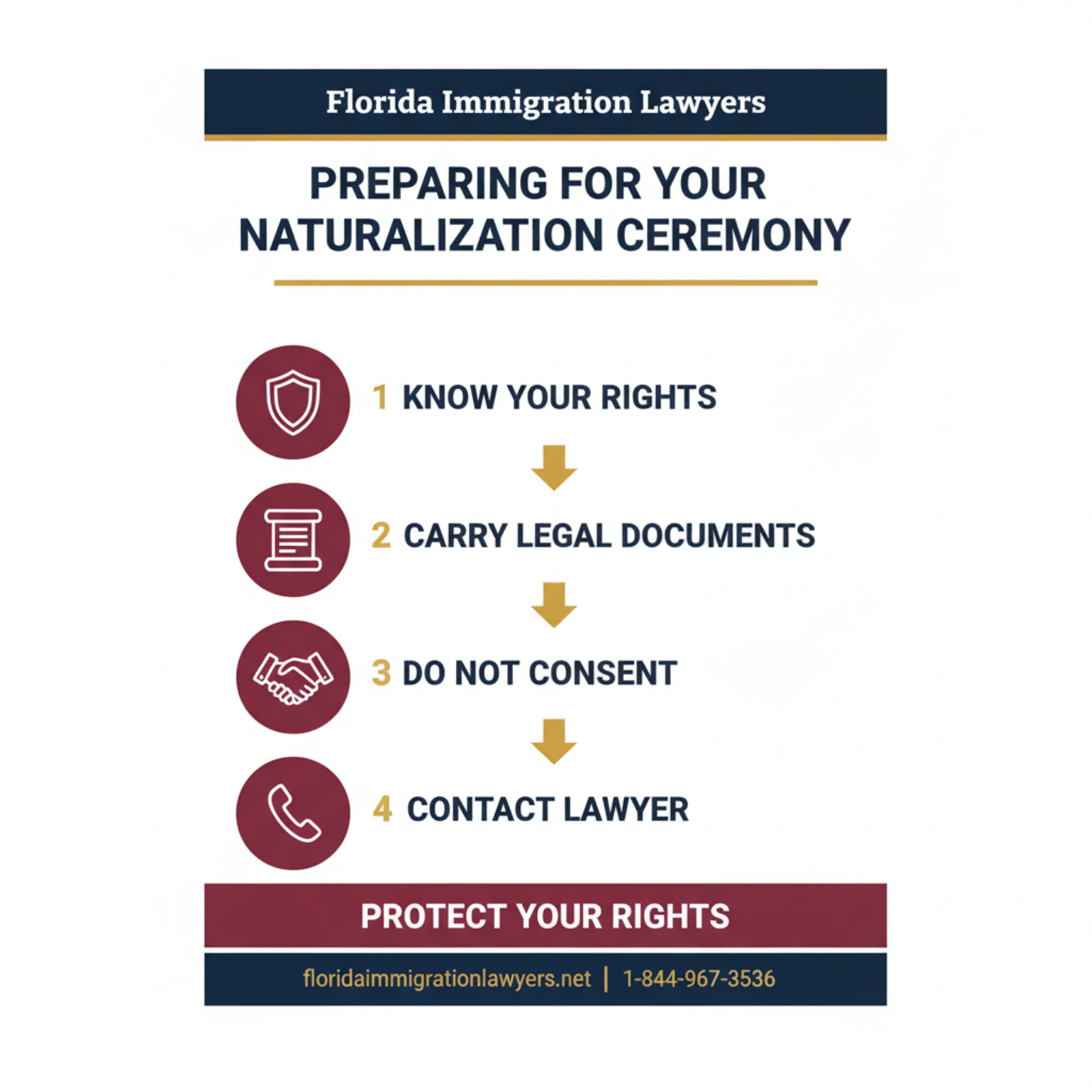
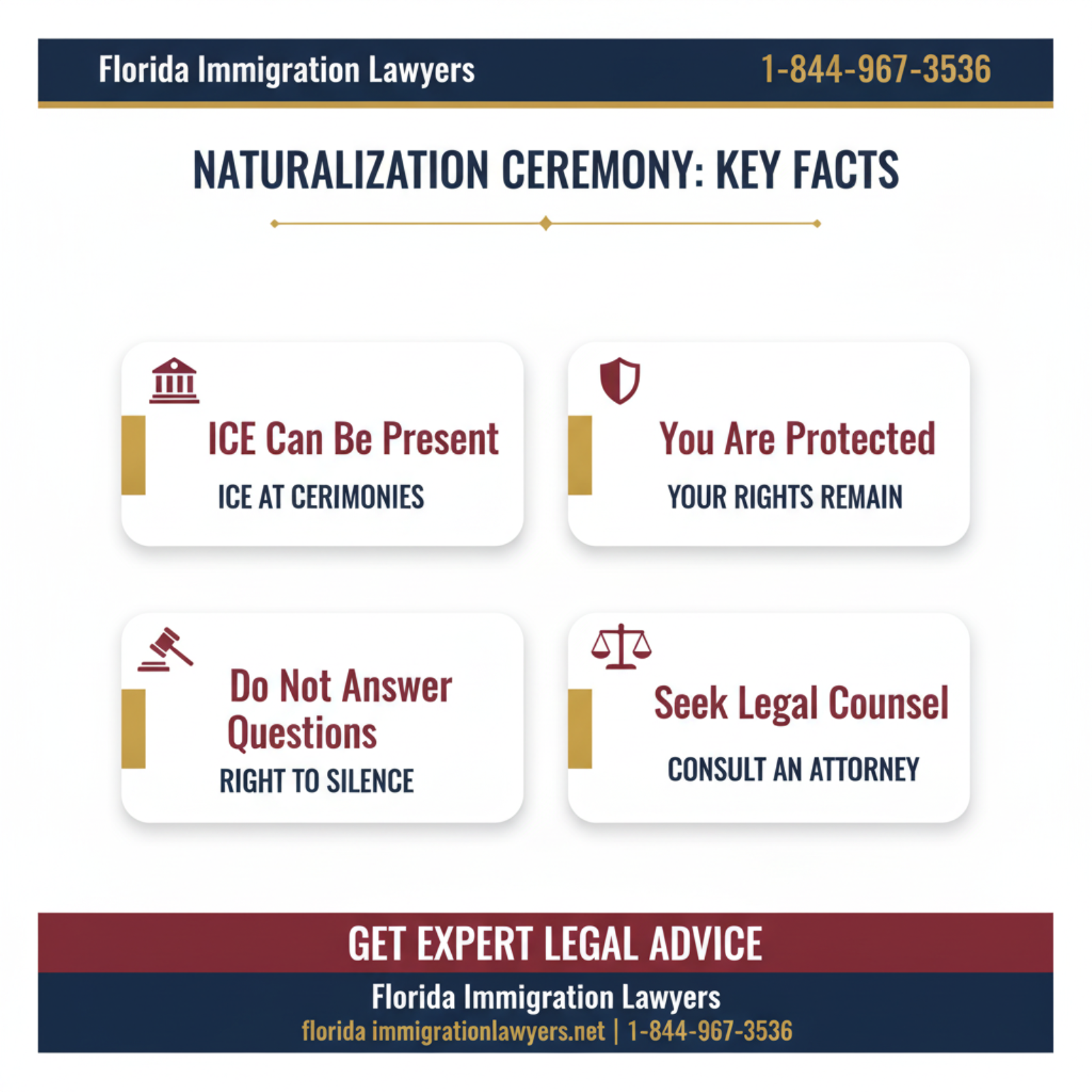
You have the right to remain silent. You are not required to answer questions about your immigration status, birthplace, or how you entered the U.S. if you are approached by an ICE agent. Politely state, “I wish to remain silent and I want to speak with my attorney.”
Knowing Your Rights
As an applicant for naturalization, and especially once you become a U.S. citizen, you have constitutional rights. If an ICE agent attempts to question you or detain you, ask if you are free to leave. If they say no, you are being detained. Do not resist physically. Do not sign anything without consulting an attorney.
Remember that ICE agents generally need a warrant signed by a judge to enter your home without your permission. At a public ceremony, their authority is limited by your rights. Always ask to see a warrant and verify it is signed by a judge. A warrant for arrest (Form I-200) or a warrant for removal (Form I-205) is different from a search warrant.
Seeking Legal Counsel Immediately
If you or a loved one are questioned or detained by ICE at any point, including at a naturalization ceremony, the most critical step is to immediately request to speak with an attorney. Do not provide any information beyond your name until you have legal representation. Our attorneys are available to provide urgent assistance in such scenarios.
Frequently Asked Questions (FAQs) about Naturalization and ICE
Is ICE arresting naturalized citizens?
Generally, no. Once you are a naturalized U.S. citizen, you have the same rights and protections as any other U.S. citizen. ICE does not typically arrest naturalized citizens unless there is strong evidence that citizenship was obtained fraudulently or through misrepresentation, which can lead to denaturalization proceedings. This is a very rare and complex process.
Can I sue ICE for detaining me as a citizen?
Yes, if you are a U.S. citizen and are unlawfully detained by ICE, you may have grounds to sue for wrongful detention. Such cases are serious and require immediate legal action. It is vital to contact an attorney experienced in civil rights and immigration law if this occurs.
Can ICE ask for your citizenship status?
Yes, ICE agents can ask about your citizenship status. However, you have the right to remain silent and do not have to answer their questions. If you are a U.S. citizen, you are not required to carry proof of citizenship, but having your Certificate of Naturalization or U.S. passport can help clarify your status quickly.
Can ICE deport a naturalized citizen without revoking their citizenship?
No, generally not. A naturalized U.S. citizen cannot be deported unless their citizenship is first formally revoked through a process called denaturalization. This process is initiated by the U.S. government, usually due to fraud or misrepresentation during the naturalization application. Without denaturalization, a naturalized citizen is protected from deportation.
About Florida Immigration Lawyers
Florida Immigration Lawyers is a leading law firm dedicated to providing exceptional legal representation to immigrants and their families throughout Florida. With years of experience and a deep understanding of complex immigration laws, our attorneys are committed to achieving positive outcomes for our clients. We understand the unique challenges faced by the immigrant community in Fort Lauderdale, Miami, Orlando, Tampa, and across the state.
Our comprehensive range of services includes general immigration matters, asylum applications, deportation defense, citizenship and naturalization, family-based immigration, and business immigration solutions. We pride ourselves on offering personalized, compassionate, and effective legal strategies tailored to each client's unique needs.
Why choose Florida Immigration Lawyers? Our firm stands out due to our unwavering dedication, proven track record, and client-centered approach. We are available 24/7 to address your urgent concerns and offer free consultations to help you understand your options without financial commitment. Our bilingual team ensures that language is never a barrier to quality legal assistance. Visit our attorneys page to learn more about our dedicated legal professionals.
For trusted legal guidance and a partner who truly cares about your immigration journey, contact Florida Immigration Lawyers. Call us today at 1-844-967-3536 or visit our website at https://www.floridaimmigrationlawyers.net. We are here to help you secure your future in Florida.
Sources and References
- U.S. Citizenship and Immigration Services (USCIS)
- Executive Office for Immigration Review (EOIR)
- U.S. Immigration and Customs Enforcement (ICE)
- 8 U.S.C. Chapter 12 - Immigration and Nationality Act (INA)
- 8 U.S.C. § 1427 - Requirements for naturalization
- 8 CFR § 316.2 - General requirements for naturalization
- USCIS Policy Manual
This article provides general legal information and is not intended as legal advice. Every case is unique, and outcomes depend on specific facts and circumstances. Contact an attorney for advice about your particular situation.
Achieving U.S. citizenship is a monumental achievement, and you deserve to celebrate it without undue fear. While naturalization ceremony ICE concerns are understandable, proactive legal guidance can empower you to navigate the process confidently. Our team at Florida Immigration Lawyers is dedicated to ensuring your path to citizenship is as smooth and secure as possible.
Do not let anxieties overshadow your significant accomplishment. For expert advice and unwavering support in Fort Lauderdale and throughout Florida, reach out to us today. Call Florida Immigration Lawyers at 1-844-967-3536 for your free consultation. Se Habla Español - Estamos aquí para ayudarle.
Frequently Asked Questions
Florida Immigration Lawyers
Legal Team
Our experienced attorneys at Florida Immigration Lawyers have been serving clients across Florida for over 20 years. We specialize in immigration, personal injury, criminal defense, workers compensation, and family law.