Citizenship Test Preparation Florida: Your 2026 Naturalization Guide
This comprehensive guide provides everything Florida residents need to know for the 2026 U.S. citizenship test. Learn about naturalization eligibility, the N-400 application process, and essential preparation for the English and civics tests. We cover step-by-step instructions, document checklists, timelines, and cost factors. Discover common mistakes to avoid and understand when to seek professional legal assistance. Florida Immigration Lawyers is dedicated to helping you achieve U.S. citizenship, offering expert guidance and support throughout your journey. Prepare confidently for your naturalization interview with our detailed insights and resources.
To prepare for the U.S. citizenship test in Florida for 2026, you must study English and U.S. civics. The process involves submitting Form N-400, attending an interview, and passing both the English reading, writing, and speaking test, and the civics test. Understanding the requirements and preparing thoroughly is crucial for a successful naturalization application.
- Study the 100 civics questions and answers provided by USCIS.
- Practice English reading, writing, and speaking skills.
- Ensure your Form N-400 is complete and accurate.
- Gather all necessary supporting documents meticulously.
- Consider legal guidance for complex cases or specific concerns.
Dreaming of becoming a U.S. citizen in Florida? The path to naturalization culminates in the U.S. citizenship test, a crucial step for many aspiring citizens across our diverse state, including communities like Hialeah. Preparing for this significant milestone can feel overwhelming, but with the right guidance, you can approach your interview with confidence. This comprehensive guide will walk you through everything you need to know about the 2026 citizenship test preparation in Florida.
From understanding the requirements to mastering the civics questions and navigating the N-400 application, we are here to simplify the process for you. Our goal is to empower you with the knowledge and resources necessary for a successful naturalization journey. Call Florida Immigration Lawyers at 1-844-967-3536 for a free consultation to discuss your specific situation and get personalized legal support.
Navigating the U.S. Citizenship Test in Florida for 2026
Becoming a U.S. citizen is a profound achievement, granting you full rights and responsibilities within American society. Naturalization is the process by which a foreign citizen or national can voluntarily become a U.S. citizen. In Florida, a state with a vibrant immigrant population, understanding this process is essential for thousands of residents.
The U.S. citizenship test is a key component of the naturalization interview. It assesses your knowledge of English and U.S. history and government (civics). These requirements are outlined in the Immigration and Nationality Act (INA), specifically INA Section 312 (8 U.S.C. 1423). For many residents in Florida, from Miami to Orlando, successfully passing this test is the final hurdle before taking the Oath of Allegiance.
Who Needs to Take the Citizenship Test?
Generally, applicants for naturalization must demonstrate an ability to read, write, and speak English and possess knowledge of U.S. history and government. There are certain exceptions, such as for older applicants or those with specific medical conditions. These exceptions are typically based on age and length of U.S. permanent residency or documented medical inability.
The Importance of Preparation in Florida
Florida is home to several USCIS field offices, including those in Miami, Orlando, and Tampa. These offices conduct thousands of naturalization interviews annually. Proper preparation for your citizenship test can significantly reduce anxiety and increase your chances of a positive outcome. Many Floridians, particularly in areas with large immigrant communities like Hialeah, find community resources helpful, but legal guidance offers an unparalleled advantage.
Step-by-Step Guide to Naturalization and the Citizenship Test
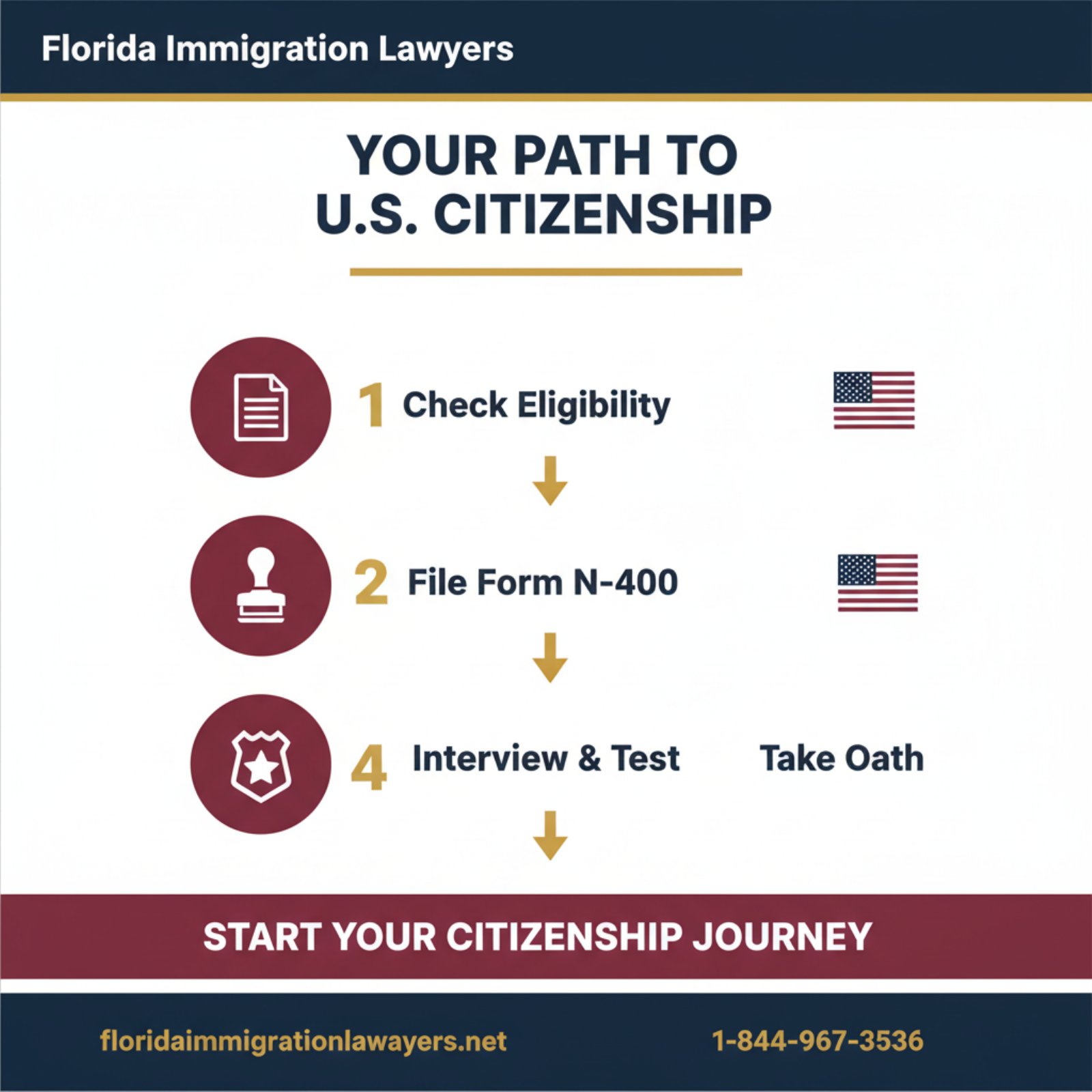
The naturalization process, leading up to the U.S. citizenship test, involves several critical stages. Each step requires careful attention to detail and adherence to USCIS guidelines. Here is a detailed breakdown of what you can expect on your journey to U.S. citizenship in 2026.
-
Determine Your Eligibility: Before applying, ensure you meet all naturalization requirements. Generally, you must be 18 years old, a lawful permanent resident (Green Card holder) for at least 5 years (or 3 years if married to a U.S. citizen), have continuous residence and physical presence in the U.S., demonstrate good moral character, and be willing to take the Oath of Allegiance. You can learn more about eligibility on our citizenship practice area page.
-
Prepare and File Form N-400, Application for Naturalization: This is the official application form for U.S. citizenship. It requires extensive personal information, including your residency history, employment, travel, and any interactions with law enforcement. Accuracy is paramount; any errors or omissions could delay your application or lead to issues. We encourage you to seek assistance when completing this complex form.
-
Attend Your Biometrics Appointment: After filing Form N-400, USCIS will send you an appointment notice for biometrics. This typically involves submitting your fingerprints, photograph, and signature. These are used for background checks and to verify your identity. Missing this appointment without rescheduling can severely impact your application.
-
Attend the Naturalization Interview: This is a critical stage where a USCIS officer will review your N-400 application and ask questions about your eligibility. They will verify your identity, confirm the information on your application, and assess your English language abilities. This interview usually takes place at a USCIS field office in Florida, such as the one serving the Hialeah area.
-
The English Test: During the interview, the officer will test your ability to read, write, and speak basic English. You will be asked to read one out of three sentences correctly to demonstrate reading ability. For writing, you will write one out of three sentences accurately. Speaking ability is assessed throughout the interview as you answer questions about your N-400 form and personal history.
-
The Civics Test: This is an oral test of your knowledge of U.S. history and government. The officer will ask you up to 10 questions from a list of 100 civics questions. You must answer 6 out of 10 questions correctly to pass. The questions cover topics like American government, history, and integrated civics. USCIS provides study materials, which are crucial for this part of the test. You can find these resources on the USCIS website.
-
-
Receive a Decision: After your interview, the USCIS officer will inform you whether your application is recommended for approval, continued, or denied. If approved, you will typically receive a notice for your Oath of Allegiance ceremony. If continued, you may need to provide additional documents or retake a portion of the test.
-
Take the Oath of Allegiance: This is the final step to becoming a U.S. citizen. During the ceremony, you will pledge your allegiance to the United States. Once you take the oath, you will receive your Certificate of Naturalization, officially making you a U.S. citizen. This is a moment of great pride for many new citizens across Florida.
Essential Document Checklist for Your N-400 Application
A well-organized application package is critical for a smooth naturalization process. Missing or incorrect documents can lead to delays or even denial. Here is a general checklist of documents you should prepare when filing your Form N-400 and for your interview. Always check the specific instructions for Form N-400 on the USCIS website for the most current requirements.
- A copy of your Green Card (both front and back).
- Your current and any expired passports, especially those used for travel outside the U.S.
- Marriage certificate, if applicable, and divorce decrees for all prior marriages of you or your spouse.
- Birth certificates for your children, if applicable.
- Proof of selective service registration, if you are a male applicant between ages 18 and 26.
- Tax returns for the past 5 years (or 3 years if applying based on marriage to a U.S. citizen).
- Certified court dispositions for any arrests or citations, even if charges were dropped or expunged.
- Proof of payment of child support or alimony, if applicable.
- Documents supporting any claimed disability or medical waiver.
- Proof of your current income and assets, if applying for a fee waiver.
- Two passport-style photos, if required by current N-400 instructions (check USCIS website).
- Any USCIS correspondence related to your immigration history.
Organizing these documents thoroughly will help you navigate the process more effectively. For complex family situations or specific document needs, consulting with an attorney can be invaluable. Visit our family immigration page for more information on related matters.
Understanding the Citizenship Test Timeline and Processing Expectations
The time it takes to become a U.S. citizen can vary significantly. Several factors influence the naturalization processing timeline, from the initial filing of Form N-400 to the Oath of Allegiance ceremony. Understanding these factors can help manage your expectations throughout the process.
Factors Affecting Processing Times
Processing times for naturalization applications can depend on the specific USCIS field office handling your case. For applicants in Florida, offices in Miami, Orlando, and Tampa each have their own caseloads and processing efficiencies. The volume of applications, staffing levels, and the complexity of individual cases also play a role. Your personal history, such as extensive travel or minor legal issues, might require additional review, extending your timeline.
Current Processing Timeframes for Florida Applicants
While exact times fluctuate, applicants in Florida typically experience processing times ranging from several months to over a year. You can check the approximate processing times for your specific USCIS field office using the USCIS Processing Times tool online. It is crucial to monitor your case status regularly and respond promptly to any requests for evidence (RFE) from USCIS. Delays can often be minimized by submitting a complete and accurate application from the start. If you have concerns about your case status, our team can help you understand your options. Contact us for assistance.
Cost Factors and Fee Breakdown for Naturalization
The naturalization process involves certain fees that applicants must pay to USCIS. These fees are subject to change, so it is always important to verify the current amounts on the official USCIS website before filing. Understanding the potential costs can help you plan financially for your journey to citizenship.
USCIS Filing Fees
The primary cost is the filing fee for Form N-400, Application for Naturalization. Additionally, there is a biometrics services fee. These fees are typically paid together when you submit your application. USCIS periodically updates its fee schedule, so always refer to USCIS Form G-1055, Fee Schedule, or the N-400 instructions for the most current amounts. It is important to note that these fees are generally non-refundable, regardless of the outcome of your application.
Fee Waivers and Reduced Fees
USCIS offers fee waivers for certain applicants who demonstrate an inability to pay. Eligibility for a fee waiver is typically based on income level, receipt of means-tested benefits, or financial hardship. If you believe you qualify, you must submit Form I-912, Request for Fee Waiver, along with your N-400 application and supporting documentation. Some applicants may also be eligible for reduced fees. Discussing your financial situation with an immigration attorney can help determine if you qualify for these options.
Do not navigate this process alone. Contact Florida Immigration Lawyers today to ensure your application is handled correctly and efficiently.
Common Mistakes to Avoid During Your Citizenship Journey
The path to U.S. citizenship can be complex, and even minor errors can lead to significant delays or denials. Being aware of common pitfalls can help you avoid them. Here are 7 critical mistakes to steer clear of during your naturalization process.
-
Submitting an Incomplete or Inaccurate Form N-400: Filling out the N-400 form incorrectly or omitting crucial information is a frequent mistake. This can lead to Requests for Evidence (RFEs), delays, or even a denial. Ensure every question is answered truthfully and completely, even if it seems irrelevant. For instance, not disclosing all past addresses or employers can be problematic.
-
Failing to Meet Continuous Residence Requirements: Naturalization requires continuous residence in the U.S. for a specific period (usually 5 or 3 years). Extended trips outside the U.S. can break this continuity. Absences of six months to a year or more can be particularly detrimental unless properly documented and explained. Understand how travel affects your eligibility.
-
Lack of Preparation for the English and Civics Tests: Many applicants underestimate the importance of thorough preparation. Failing either the English reading, writing, or speaking test, or getting fewer than 6 out of 10 civics questions correct, will result in a re-test. Multiple failures can lead to denial, requiring you to start the application process again.
-
Not Disclosing All Criminal History (Even Minor Incidents): Even seemingly minor arrests, citations, or expunged records must be disclosed on your N-400 and provided at your interview. USCIS conducts thorough background checks. Failure to disclose any interaction with law enforcement, regardless of the outcome, can be viewed as a lack of good moral character and lead to a denial for misrepresentation.
-
Failing to Update USCIS on Changes: If your address, marital status, or employment changes after you file your N-400, you must inform USCIS promptly. Failure to do so can result in missed appointments or critical correspondence, causing significant delays or issues with your application. Always keep your contact information current.
-
Assuming Automatic Eligibility for Exceptions: While there are exceptions for the English and civics tests based on age, length of residency, or medical conditions, you must formally apply and provide supporting documentation. Do not assume you automatically qualify without proper submission of forms like N-648, Medical Certification for Disability Exceptions, if applicable. Incorrectly claiming an exception can cause problems.
-
Lying or Misrepresenting Information: Any false statements or misrepresentations on your N-400 application or during your interview can have severe consequences, including denial of your naturalization application and potential deportation proceedings. Always be truthful and provide accurate information to USCIS.
When to Call a Florida Immigration Lawyer for Naturalization
While many individuals successfully navigate the naturalization process on their own, certain situations warrant the expertise of an experienced immigration attorney. Florida Immigration Lawyers is here to provide the guidance you need, especially when your case presents complexities. Knowing when to seek legal help can save you time, stress, and potential setbacks.
Specific Scenarios Requiring Legal Help
You should consider contacting an attorney if you encounter any of the following:
- Criminal History: Any arrests, charges, or convictions, even minor ones, can impact your good moral character requirement. An attorney can assess your record and advise on the best approach.
- Previous Application Denials: If your naturalization application has been denied in the past, understanding the reasons for denial and addressing them properly is crucial for reapplication.
- Complex Residency Issues: Extended absences from the U.S., issues with continuous residence, or doubts about your physical presence can be tricky. An attorney can help calculate your eligibility and present your case effectively.
- Medical Waivers: If you are seeking an exception to the English or civics test due to a medical condition, proper documentation and submission of Form N-648 are essential. An attorney can guide you through this process.
- Marital Issues: If you are applying based on marriage to a U.S. citizen and have issues with your marriage, divorce, or previous marriages, legal counsel can help strengthen your case.
- National Security Concerns: If you have any past associations or activities that might raise national security concerns, an attorney can help you prepare for intense scrutiny.
Warning Signs and Red Flags
Beyond specific scenarios, watch for these warning signs:
- You receive a Request for Evidence (RFE) from USCIS that you don't fully understand.
- Your case processing time significantly exceeds the published USCIS averages.
- You have concerns about your ability to pass the English or civics test due to language barriers or learning disabilities.
- You are unsure about how to answer specific questions on Form N-400 or during your interview.
Florida Immigration Lawyers offers comprehensive services for naturalization, including N-400 preparation, interview coaching, and representation. Our attorneys are dedicated to assisting individuals throughout Florida, from Hialeah to Jacksonville, in achieving their dream of U.S. citizenship. We understand the nuances of immigration law and are committed to protecting your rights. Visit our attorneys page to learn more about our experienced legal team.
About Florida Immigration Lawyers
Florida Immigration Lawyers is a leading law firm dedicated to providing exceptional legal services to immigrants across the entire state of Florida. With a deep understanding of U.S. immigration law and a compassionate approach, we strive to make a difference in the lives of our clients.
Our firm offers a wide range of immigration services, including assistance with naturalization and citizenship, asylum applications, deportation defense, family-based immigration, business immigration, and more. We are committed to achieving the best possible outcomes for our clients, guiding them through every step of their immigration journey.
Choose Florida Immigration Lawyers for our unwavering dedication, extensive experience, and personalized client care. We understand the challenges you face and are here to provide clear, effective legal strategies. We are available 24/7 for your convenience and offer free consultations to discuss your case. Call us today at 1-844-967-3536 or visit our website at https://www.floridaimmigrationlawyers.net to learn how we can help you achieve your immigration goals.
Sources and References
- U.S. Citizenship and Immigration Services (USCIS)
- USCIS Policy Manual, Volume 12, Part D, Chapter 2 - English and Civics Requirements
- USCIS - Apply for Citizenship
- USCIS - Forms and Fees
- USCIS - Check Case Processing Times
- Executive Office for Immigration Review (EOIR)
- 8 U.S.C. Chapter 12 - Immigration and Nationality Act (INA)
- INA Section 312 (8 U.S.C. 1423) - English and Civics Requirements
- INA Section 316 (8 U.S.C. 1427) - General Requirements for Naturalization
- 8 CFR Part 312 - English and Civics Tests
This article provides general legal information and is not intended as legal advice. Every case is unique, and outcomes depend on specific facts and circumstances. Contact an attorney for advice about your particular situation.
Don't let the complexities of the citizenship test deter you from achieving your American dream. With proper preparation and the right legal support, your path to naturalization in Florida can be smooth and successful. Contact Florida Immigration Lawyers today for a free consultation. Call us at 1-844-967-3536. Se Habla Español - Estamos aquí para ayudarle.
Need help with Immigration?
Our Florida immigration attorneys offer free consultations. Call today or schedule online.
Frequently Asked Questions
Florida Immigration Lawyers
Legal Team
Our experienced attorneys at Florida Immigration Lawyers have been serving clients across Florida for over 20 years. We specialize in immigration, personal injury, criminal defense, workers compensation, and family law.