VAWA Immigration Relief Florida: Protecting Abuse Victims
For abuse victims in Florida, VAWA (Violence Against Women Act) immigration relief offers a confidential pathway to a green card without the abuser's involvement. This guide by Florida Immigration Lawyers explains eligibility, the self-petition process, required documents, and critical steps to secure your safety and legal status. Learn how to navigate this complex journey with expert legal support. If you've been abused by a U.S. citizen or LPR spouse, parent, or child, you may be eligible. Contact us for a free consultation to understand your options.
VAWA (Violence Against Women Act) immigration relief in Florida allows certain abuse victims to self-petition for lawful permanent residency without the abuser's involvement. This path is available to individuals abused by a U.S. citizen or Legal Permanent Resident spouse, parent, or sometimes child. It offers a confidential and empowering way to seek safety and stability.
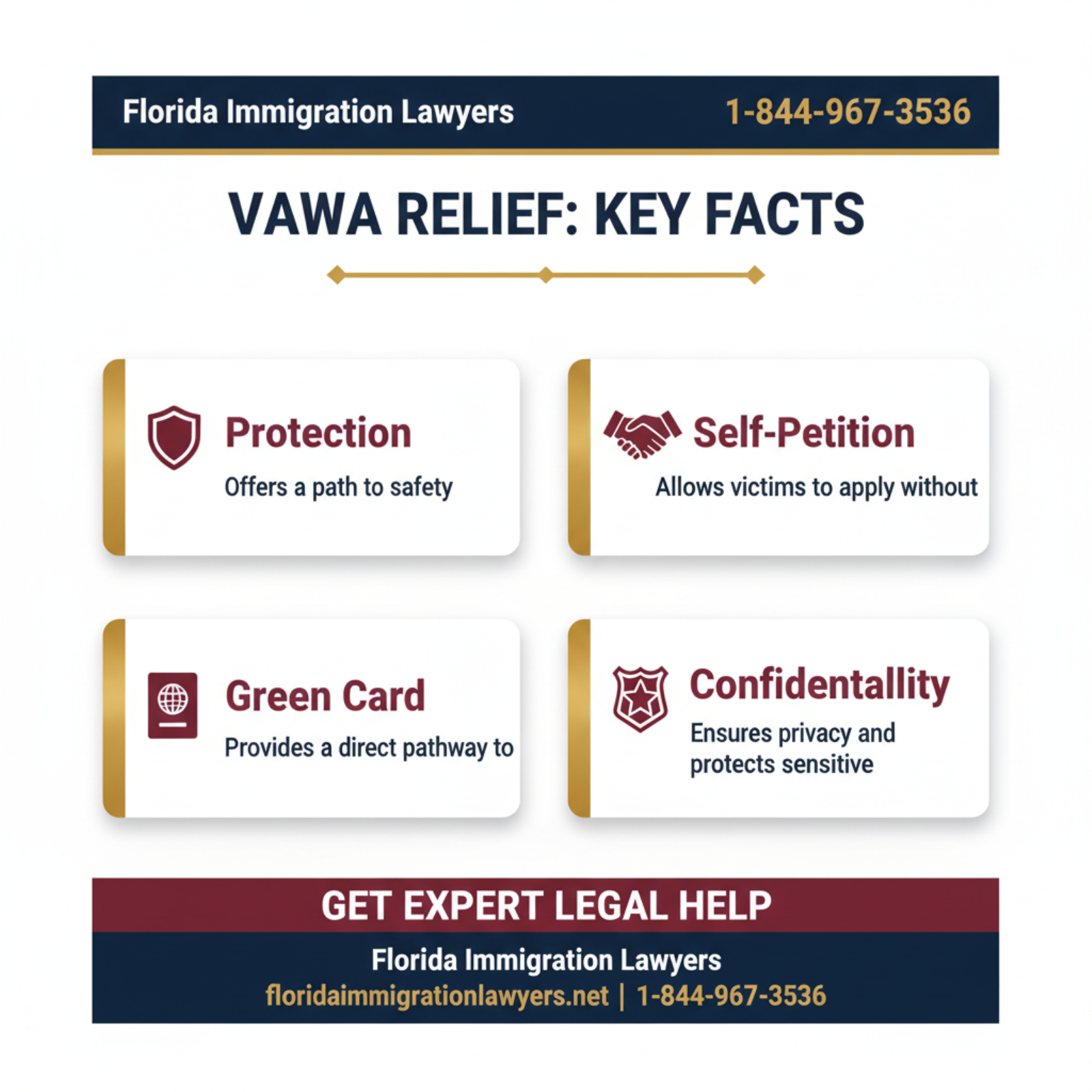
- Self-petition for a green card without the abuser.
- Protects victims of domestic violence, extreme cruelty.
- Confidential process, vital for safety.
- Available in Florida for eligible individuals.
- Consult a Florida immigration lawyer for guidance.
Imagine living in fear, trapped in an abusive relationship, and believing your immigration status ties you to your abuser. For many individuals in Florida, this is a painful reality. The Violence Against Women Act (VAWA) offers a beacon of hope, providing a pathway to VAWA immigration relief Florida that can help you escape this cycle of abuse and secure your future in the United States. This comprehensive guide will explain everything you need to know about this vital protection, empowering you with the knowledge to take control of your life.
We understand the courage it takes to seek help, and our dedicated team at Florida Immigration Lawyers is here to support you every step of the way. Your safety and well-being are our priority. Call Florida Immigration Lawyers at 1-844-967-3536 for a free consultation and begin your journey to safety and independence.
Understanding VAWA Immigration Relief in Florida
The Violence Against Women Act (VAWA), enacted in 1994, provides protections for victims of domestic violence, sexual assault, and stalking. Within immigration law, VAWA allows certain non-citizens who have been abused by a U.S. citizen or Lawful Permanent Resident (LPR) spouse, parent, or adult child to "self-petition" for a green card. This means you can apply for immigration benefits without the abuser's knowledge or cooperation, a critical safeguard for your safety.
VAWA immigration relief Florida is particularly relevant in a state with a diverse immigrant population. Many individuals here face unique challenges when attempting to leave abusive situations, often due to language barriers, cultural isolation, or fear of deportation. VAWA offers a confidential and secure pathway forward.
Who is Eligible for VAWA Self-Petition?
Eligibility for VAWA immigration relief Florida is specific and depends on your relationship to the abuser and the nature of the abuse. Generally, you may be eligible if you are:
- Battered Spouse: You are or were married to a U.S. citizen or LPR, and you or your child have been subjected to battery or extreme cruelty. This includes former spouses if the marriage ended due to abuse within the last two years.
- Battered Child: You are an unmarried child under 21 (or sometimes 25) who has been battered or subjected to extreme cruelty by a U.S. citizen or LPR parent.
- Battered Parent: You are a parent of a U.S. citizen son or daughter who is at least 21 years old and has subjected you to battery or extreme cruelty.
It is important to note that VAWA protects undocumented immigrants and those with various immigration statuses. The focus is on the abuse and your relationship to the abuser, not your current legal status. You do not need to be legally married to the abuser at the time of filing if the marriage ended due to the abuse.
Types of Abuse Covered by VAWA
VAWA covers "battery" or "extreme cruelty." These terms are interpreted broadly by USCIS. Battery includes physical abuse, while extreme cruelty encompasses a wide range of psychological, emotional, financial, and sexual abuse. It is not limited to physical violence.
- Physical Abuse: Any unwanted physical contact, threats of harm, or actual physical harm.
- Emotional/Psychological Abuse: Constant threats, intimidation, manipulation, isolation, degradation, or control over your movements and communications.
- Financial Abuse: Preventing you from working, controlling all money, withholding funds, or creating financial dependency.
- Sexual Abuse: Any non-consensual sexual act or exploitation.
The key is to demonstrate a pattern of abuse that rises to the level of battery or extreme cruelty. This evidence is crucial for your VAWA self-petition, and a Florida immigration lawyer can help you gather and present it effectively.
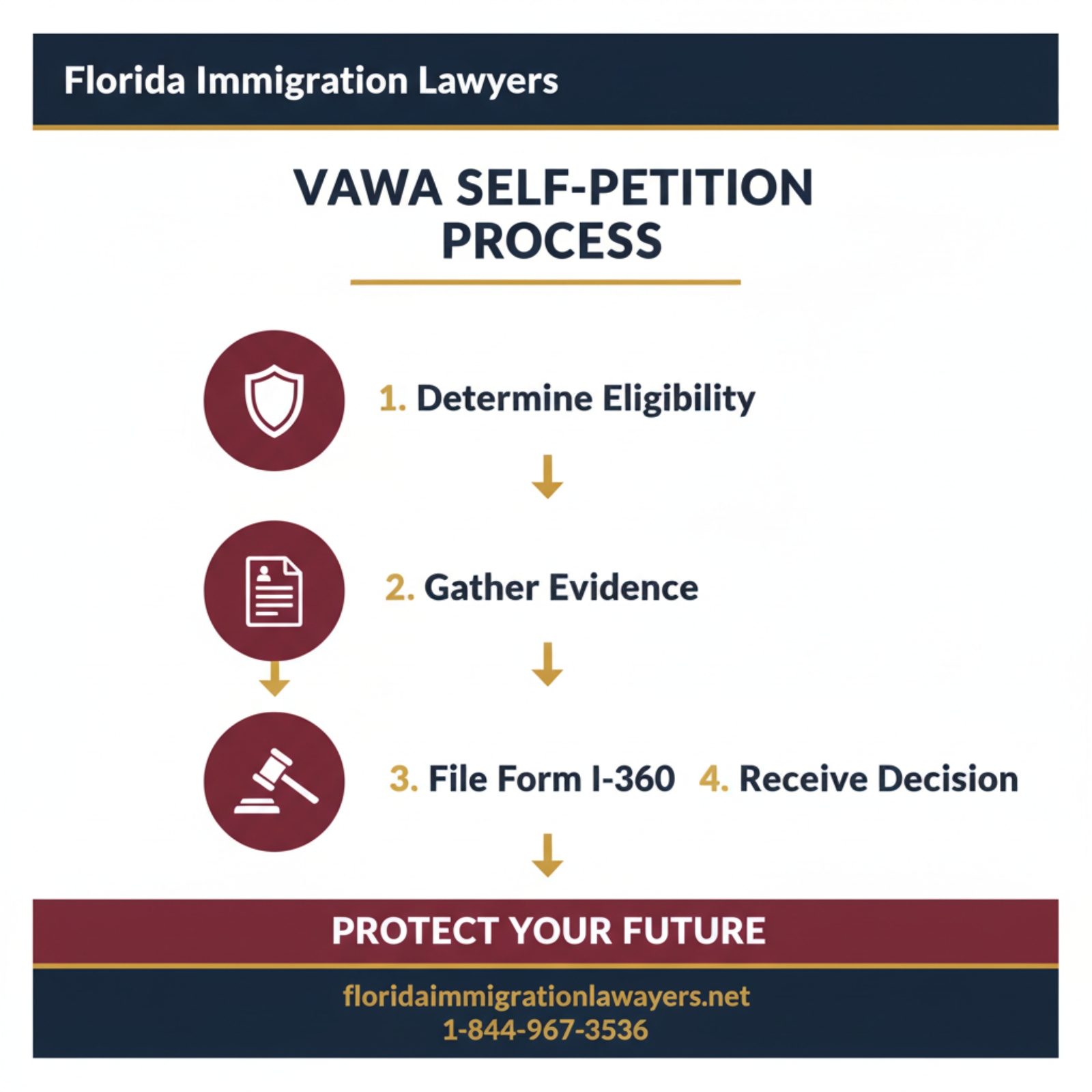
The VAWA Self-Petition Process: A Step-by-Step Guide for Florida Residents
Navigating the VAWA self-petition process can feel daunting, especially while coping with past trauma. However, understanding the steps involved can empower you. This guide outlines the typical process for individuals seeking VAWA immigration relief Florida.
-
Step 1: Gather Evidence and Prepare Your Declaration
The foundation of your VAWA petition is a compelling declaration describing the abuse you suffered. This statement should be detailed, chronological, and heartfelt. Alongside your declaration, you must gather supporting evidence. This includes police reports, medical records, affidavits from friends or family, counseling records, photos, emails, text messages, and any other documentation that substantiates the abuse and your relationship to the abuser. Proving your good moral character is also essential. -
Step 2: File Form I-360, Petition for Amerasian, Widow(er), or Special Immigrant
This is the primary form for your VAWA self-petition. You will submit Form I-360, along with all supporting documentation and the required USCIS filing fees (or a fee waiver request). USCIS typically processes these petitions at a centralized location, such as the Vermont Service Center, regardless of your location in Florida. Accuracy and completeness are paramount in this step. -
Step 3: Biometrics Appointment
After filing your I-360, USCIS will send you a notice to attend a biometrics appointment at a local Application Support Center (ASC) in Florida, such as those in Tampa, Orlando, or Miami. At this appointment, your fingerprints, photograph, and signature will be collected for background and security checks. This is a standard part of most immigration applications. -
Step 4: Prima Facie Determination and Potential Interview
USCIS will review your I-360 petition to determine if you have established a "prima facie" case, meaning there is enough evidence to suggest you are eligible for VAWA. If so, you will receive a prima facie determination notice, which can grant certain public benefits eligibility. While most VAWA self-petitioners are not required to attend an interview for their I-360, USCIS reserves the right to request one if they need additional information or clarification. If an interview is requested, it will typically be at a local USCIS field office in Florida. -
Step 5: I-360 Approval and Adjustment of Status (Form I-485)
If your I-360 is approved, you will receive an approval notice. This establishes your eligibility for VAWA and allows you to apply for lawful permanent resident status (a green card). You will then file Form I-485, Application to Register Permanent Residence or Adjust Status, along with additional supporting documents, medical examination results, and applicable fees. In many cases, you can file your I-485 concurrently with your I-360 or while it is pending, which can expedite the process. This adjustment of status process will typically involve another biometrics appointment and potentially an interview at a local USCIS office in Florida.
Essential Documents for Your VAWA Self-Petition
A successful VAWA immigration relief Florida petition hinges on providing comprehensive and credible evidence. Gathering these documents can be challenging, but they are vital to prove your eligibility. Here's a checklist of key documents you will generally need:
- Proof of Relationship: Marriage certificates, birth certificates, divorce decrees (if applicable), joint bank accounts, leases, utility bills, photos, and affidavits from people who can attest to your relationship with the abuser.
- Proof of Abuser's U.S. Citizen or LPR Status: Copies of their birth certificate, passport, naturalization certificate, or green card. If you do not have these, you may provide secondary evidence or explain why it's unavailable.
- Evidence of Abuse or Extreme Cruelty: Your detailed personal declaration, police reports, medical records, hospital visits, psychological evaluations or counseling records, affidavits from witnesses (e.g., friends, family, clergy, social workers), photos of injuries or property damage, restraining orders, court documents, emails, text messages, or voicemails from the abuser.
- Evidence of Residence in the U.S.: Documentation showing you resided with the abuser in the U.S. (e.g., utility bills, leases, mail addressed to both of you).
- Evidence of Good Moral Character: Police clearance certificates from all places you have lived, court records for any arrests or convictions, and affidavits from people who can attest to your good moral character.
- Proof of Your Identity and Nationality: Your birth certificate, passport, national identity card, or other official identification documents.
- Financial Documents: Evidence of your financial means or a request for a fee waiver, if applicable.
Organizing these documents can be overwhelming, but a knowledgeable attorney can help you identify what is needed and present it effectively to USCIS.
VAWA Petition Timeline and Processing Expectations
The processing time for VAWA immigration relief Florida petitions can vary significantly based on several factors, including the volume of applications, the complexity of your case, and the specific USCIS service center handling your petition. It's important to have realistic expectations and patience throughout the process.
- Initial I-360 Review: After you submit your Form I-360, USCIS will send a receipt notice. The initial review for a prima facie determination can take several months.
- I-360 Approval: The full adjudication of the I-360 petition can take anywhere from 12 to 24 months, or sometimes longer. USCIS posts average processing times on its website, which can give you a general idea.
- Adjustment of Status (I-485): If you are eligible to file your I-485 concurrently or once your I-360 is approved, the adjustment of status process can add another 6 to 18 months, depending on the local USCIS field office in Florida (e.g., Tampa, Miami, Orlando) and current backlogs.
- Work Authorization and Travel Document: While your I-485 is pending, you may be eligible to apply for an Employment Authorization Document (EAD) and Advance Parole (travel document), which can typically be processed within a few months.
Factors that can affect your timeline include requests for additional evidence (RFEs), interview requirements, and the thoroughness of your initial submission. Working with an experienced immigration lawyer can help minimize delays and ensure your application is as strong as possible.
Understanding VAWA Application Costs and Fees
Pursuing VAWA immigration relief Florida involves various costs, and it's important to understand these financial aspects upfront. While the process itself is designed to be accessible to abuse victims, certain fees are generally unavoidable.
- USCIS Filing Fees: While there are typically no filing fees for the I-360 VAWA self-petition itself, there are fees associated with the subsequent Form I-485, Application to Register Permanent Residence or Adjust Status, and other related applications like the Employment Authorization Document (EAD) and Advance Parole. However, VAWA self-petitioners are often eligible for fee waivers for these forms if they can demonstrate financial hardship.
- Medical Examination Fees: All applicants for adjustment of status must undergo a medical examination by a USCIS-approved civil surgeon. The cost of this exam is paid directly to the doctor and can vary significantly.
- Legal Fees: Hiring an experienced immigration attorney is an investment that can significantly increase your chances of success. Legal fees cover the attorney's time, expertise, and assistance in preparing your petition, gathering evidence, and representing you.
- Ancillary Costs: These can include fees for obtaining certified copies of documents, translation services for non-English documents, postage, and travel expenses for biometrics appointments or interviews.
Florida Immigration Lawyers understands the financial strain many abuse victims face. We offer free consultations to discuss your case and provide clear information about potential costs and fee waiver eligibility. We believe that financial barriers should not prevent you from seeking critical protection.
Do not navigate this complex process alone. The emotional and legal challenges of pursuing VAWA immigration relief in Florida can be overwhelming. Contact Florida Immigration Lawyers today to ensure your case is handled with the sensitivity, expertise, and dedication you deserve.
Common Mistakes to Avoid in Your VAWA Petition
Applying for VAWA immigration relief Florida requires meticulous attention to detail and a thorough understanding of immigration law. Even small errors can lead to significant delays or even denial. Here are common mistakes to avoid:
-
Insufficient Evidence of Abuse: One of the most common pitfalls is not providing enough credible evidence to prove battery or extreme cruelty. USCIS requires more than just your word; a lack of corroborating documents can weaken your case significantly.
-
Incomplete or Inaccurate Forms: Failing to fill out all sections of Form I-360 and other required forms completely and accurately can lead to Requests for Evidence (RFEs) or outright rejection. Ensure all questions are answered truthfully and thoroughly.
-
Failing to Prove Good Moral Character: VAWA applicants must demonstrate good moral character. Undisclosed criminal history, even minor infractions, can jeopardize your petition. Always be transparent and provide all relevant documentation.
-
Missing Deadlines: Immigration processes are time-sensitive. Missing deadlines for RFEs, biometrics appointments, or other submissions can result in the denial of your application. Keep track of all notices from USCIS.
-
Lack of Legal Counsel: Attempting to navigate the complex VAWA process without an experienced immigration attorney is a significant risk. A lawyer can help you gather evidence, prepare your declaration, and avoid common pitfalls.
-
Contacting the Abuser for Information: While you might need information about your abuser's immigration status, directly contacting them can be dangerous and could be misconstrued by USCIS. An attorney can advise on safe ways to obtain necessary information without jeopardizing your safety or case.
-
Not Disclosing Past Immigration Issues: Any prior visa overstays, illegal entries, or other immigration violations must be fully disclosed. While some of these may be waived for VAWA self-petitioners, failure to disclose them can lead to a finding of misrepresentation.
-
Misunderstanding Eligibility Requirements: Incorrectly assuming you meet the criteria for VAWA, such as the relationship to the abuser or the nature of the abuse, can lead to a wasted effort and a denied petition. Thoroughly review all eligibility criteria.
-
Failing to Demonstrate Residence with Abuser: You generally need to prove that you resided with the abuser in the United States. If this cohabitation was brief or sporadic, it requires careful explanation and supporting evidence.
-
Not Preparing for a Potential Interview: While not all VAWA petitioners are interviewed, if you are called for one, being unprepared can be detrimental. Practicing how to articulate your story and answer questions truthfully is crucial.
-
Withdrawing the Petition Prematurely: Under immense stress, some individuals consider withdrawing their petition. Before making such a critical decision, always consult with your attorney to understand the consequences and explore all available options.
When to Seek Legal Help for Your VAWA Case
While the information provided here is comprehensive, the decision to pursue VAWA immigration relief Florida is deeply personal and often fraught with emotional challenges. The legal process itself is complex, and having an experienced immigration attorney by your side can make a significant difference in the outcome of your case. Florida Immigration Lawyers specializes in protecting abuse victims and navigating these sensitive cases.
You should strongly consider contacting an attorney if:
- Your Abuse Situation is Complex: If the abuse involved multiple forms, was prolonged, or if gathering evidence is particularly difficult, a lawyer can help you build a strong case.
- You Have Past Immigration Violations: Overstays, illegal entries, or other issues in your immigration history can complicate your VAWA petition. An attorney can assess potential waivers and strategies.
- You are in Removal (Deportation) Proceedings: If you are already facing deportation, a VAWA self-petition can be a powerful defense against removal. Time is of the essence in these situations.
- The Abuser is Uncooperative or Threatening: While VAWA doesn't require the abuser's cooperation, they may still pose a threat. An attorney can help ensure your safety and protect your legal interests.
- You Need Strict Confidentiality: An attorney-client relationship ensures confidentiality, which is paramount in abuse cases. We understand the need for discretion and privacy.
- You are Unsure About Eligibility: An attorney can thoroughly evaluate your circumstances and determine if you meet all VAWA eligibility requirements.
- You Need Help Gathering Evidence: Identifying and collecting the right evidence, especially for "extreme cruelty," can be challenging. We can guide you through this critical step.
At Florida Immigration Lawyers, we offer compassionate and confidential legal services for individuals seeking VAWA immigration relief Florida. We are dedicated to helping abuse victims in Tampa and across Florida find safety and stability. Our legal team understands the nuances of VAWA law and is committed to advocating for your rights.
About Florida Immigration Lawyers
Florida Immigration Lawyers is a leading immigration law firm dedicated to serving individuals and families across the entire state of Florida. With a deep understanding of the complexities of U.S. immigration law, our experienced attorneys provide compassionate, effective, and results-driven legal representation.
We specialize in a wide range of immigration services, including family-based immigration, business immigration, asylum claims, deportation defense, citizenship applications, and critical relief options like VAWA. Our firm is built on the principles of integrity, client-focused service, and unwavering advocacy for our clients' rights and futures.
Why choose Florida Immigration Lawyers? We offer personalized attention, strategic legal advice tailored to your unique situation, and a commitment to keeping you informed every step of the way. We understand the emotional toll immigration processes can take, especially for vulnerable individuals seeking protection. Our team is fluent in both English and Spanish, ensuring clear communication and culturally sensitive support.
We are available 24/7 to address your urgent concerns and offer free, confidential consultations to help you understand your options without financial burden. Whether you are in Tampa, Miami, Orlando, Jacksonville, or anywhere else in Florida, we are your trusted partners in navigating the complexities of immigration law. Call us today at 1-844-967-3536 or visit https://www.floridaimmigrationlawyers.net to learn how we can help you achieve your immigration goals.
Sources and References
- U.S. Citizenship and Immigration Services (USCIS) - Battered Spouse, Child, or Parent Form I-360 VAWA Self-Petition
- Executive Office for Immigration Review (EOIR) - U.S. Department of Justice
- 8 U.S.C. Chapter 12 - Immigration and Nationality Act (INA)
- INA Section 204(a)(1)(A)(iii)-(iv) - Spouses and Children of U.S. Citizens
- 8 CFR 204.2(c)(1) - Petitions for Spouses, Children, and Parents of Citizens
- 8 CFR 204.2(e) - Petitions by Battered Spouses, Children, and Parents
This article provides general legal information and is not intended as legal advice. Every case is unique, and outcomes depend on specific facts and circumstances. Contact an attorney for advice about your particular situation.
If you are an abuse victim seeking VAWA immigration relief in Florida, remember you are not alone. Our compassionate and experienced attorneys at Florida Immigration Lawyers are ready to provide the dedicated legal support you need. Take the first courageous step towards a safer, more independent future. Call us for a free, confidential consultation at 1-844-967-3536. Se Habla Español - Estamos aquí para ayudarle.
Need help with Immigration?
Our Florida immigration attorneys offer free consultations. Call today or schedule online.
Frequently Asked Questions
Florida Immigration Lawyers
Legal Team
Our experienced attorneys at Florida Immigration Lawyers have been serving clients across Florida for over 20 years. We specialize in immigration, personal injury, criminal defense, workers compensation, and family law.