Visa Bulletin October 2025: Florida Immigration Updates & Analysis
The October 2025 Visa Bulletin is a critical resource for immigrants in Florida, signaling the availability of new visa numbers for the federal fiscal year. This comprehensive guide from Florida Immigration Lawyers breaks down the Final Action Dates and Dates for Filing Applications for family-sponsored and employment-based categories. Learn how to interpret the bulletin, what documents you need, and the typical processing timelines for applicants in Kissimmee, Orlando, and across Florida. We also highlight common mistakes to avoid and explain when professional legal assistance is essential. Contact our expert team for a free consultation to navigate your immigration journey with confidence.
The Visa Bulletin October 2025 is crucial for immigrants in Florida, signaling the start of a new fiscal year for visa availability. It details "Final Action Dates" and "Dates for Filing Applications," which determine when you can move forward with your green card application, whether through adjustment of status or consular processing. Understanding these dates is vital for planning your immigration journey.
- The October 2025 Visa Bulletin sets new dates for immigrant visa availability.
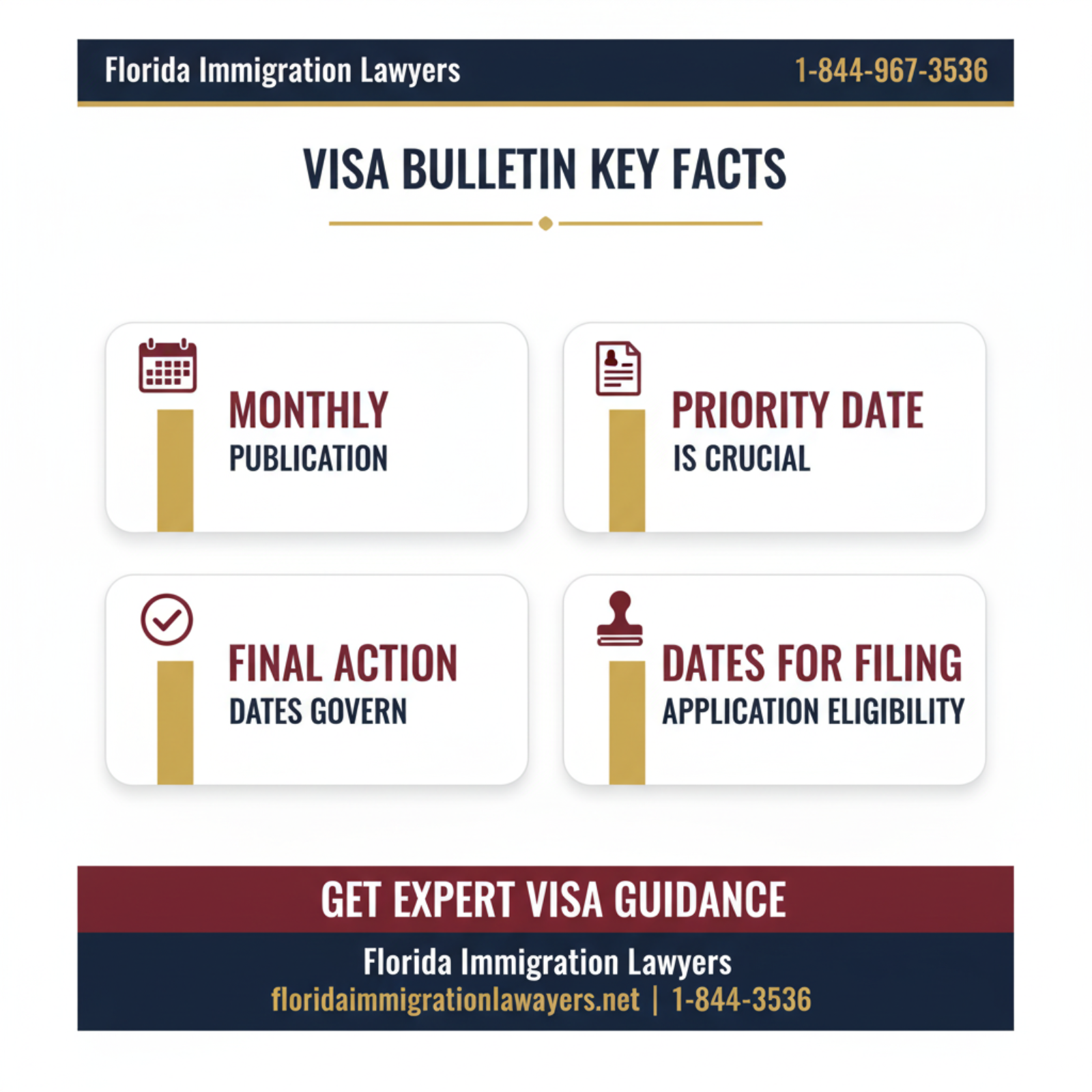
- It distinguishes between Final Action Dates and Dates for Filing, impacting when you can apply.
- Family-sponsored and employment-based categories are updated monthly.
- Your priority date must be current for your category and country of chargeability.
- Consulting an experienced Florida immigration lawyer is highly recommended for interpretation.
Visa Bulletin October 2025: Florida Immigration Updates & Analysis
Are you an immigrant in Florida, perhaps in Kissimmee, Orlando, or Miami, eagerly awaiting your turn for a green card? The monthly U.S. Department of State (DOS) Visa Bulletin is a document you simply cannot afford to ignore. It serves as your roadmap, indicating when immigrant visas become available for various categories and countries.
For many, the Visa Bulletin October 2025 marks the beginning of a new fiscal year. This means a fresh allocation of immigrant visa numbers, often bringing significant movement in certain categories. Understanding its intricacies is crucial for planning your next steps in Florida.
This comprehensive guide will break down the October 2025 Visa Bulletin, explain its impact on Florida residents, and provide actionable insights. We will cover everything from interpreting the dates to navigating the application process. Don't let confusion delay your American dream. Call Florida Immigration Lawyers at 1-844-967-3536 for a free consultation and let our experienced team help you understand your unique situation.
Understanding the Visa Bulletin October 2025 for Florida Immigrants
The Visa Bulletin is a monthly publication from the U.S. Department of State. It outlines the availability of immigrant visas for both family-sponsored and employment-based categories. These visas are subject to annual numerical limits set by Congress, as detailed in the Immigration and Nationality Act (INA), specifically INA Section 201-203 (8 U.S.C. §§ 1151-1153).
The bulletin is particularly significant for individuals from high-demand countries or those in backlogged categories. For Florida's diverse immigrant population, including many from Latin American and Caribbean nations, these updates can directly affect their ability to adjust status or obtain an immigrant visa abroad. The October bulletin is especially important as it reflects the start of a new fiscal year, often bringing new hope for movement.
What is the Visa Bulletin and Why Does it Matter?
The Visa Bulletin provides two key charts for family-sponsored and employment-based preference categories: "Final Action Dates" and "Dates for Filing Applications." These dates dictate when applicants can proceed with the final stages of their green card process. Your ability to move forward depends on your "priority date" becoming "current" according to these charts.
For Florida residents, understanding these dates is paramount. Whether you are applying through the Orlando USCIS Field Office, the Miami Field Office, or pursuing consular processing abroad, the Visa Bulletin is your definitive source for visa availability. Ignoring these updates can lead to missed opportunities or unnecessary delays in your immigration journey.
Final Action Dates vs. Dates for Filing Applications
It is crucial to differentiate between the two date charts presented in the Visa Bulletin. The Final Action Dates chart indicates when an immigrant visa can actually be issued, or when a green card can be approved by USCIS. Your priority date must be earlier than the listed date in this chart for your visa to be finalized.
The Dates for Filing Applications chart, on the other hand, allows certain applicants to submit their adjustment of status application (Form I-485) to USCIS earlier. This is permitted if USCIS determines there are more immigrant visas available than there are applicants for them. USCIS publishes monthly on its website which chart (Final Action Dates or Dates for Filing) should be used for adjustment of status applications. Always check the USCIS Visa Bulletin web page for this crucial information.
The Impact of a New Fiscal Year on Visa Availability
The federal fiscal year begins on October 1st. This date often brings a new allocation of immigrant visa numbers. For the Visa Bulletin October 2025, this means a fresh start for many categories. While there are numerical limits each year, unused visas from the previous fiscal year can sometimes "roll over" into other categories, leading to unexpected forward movement.
This new allocation is particularly impactful for heavily backlogged categories and countries. Many Florida immigrants, especially those from countries like Mexico, the Philippines, India, and China, often face long waits. The October bulletin can offer a glimmer of hope or a clear indication of continued backlogs, guiding their long-term immigration planning.
Navigating Your Immigrant Visa Category: Family-Based and Employment-Based
The Visa Bulletin is divided into two primary sections: family-sponsored and employment-based preferences. Each section has multiple categories, and your eligibility depends on the specific relationship to your petitioner or the nature of your employment.
Understanding which category you fall into is the first step in interpreting the bulletin. Our firm, Florida Immigration Lawyers, specializes in both family-based immigration and business immigration, assisting clients across Florida with their unique needs.
Family-Sponsored Preference Categories
Family-sponsored visas are subject to annual numerical limits and are allocated based on the relationship between the petitioner (U.S. citizen or green card holder) and the beneficiary. The categories are:
- F1: Unmarried Sons and Daughters of U.S. Citizens (23,400 plus unused 4th preference).
- F2A: Spouses and Children of Permanent Residents (77% of total F2, with 75% exempt from per-country limit).
- F2B: Unmarried Sons and Daughters (21 years of age or older) of Permanent Residents (23% of total F2).
- F3: Married Sons and Daughters of U.S. Citizens (23,400 plus unused 1st and 2nd preferences).
- F4: Brothers and Sisters of U.S. Citizens (65,000 plus unused 1st, 2nd, and 3rd preferences).
Immediate relatives of U.S. citizens (spouses, unmarried children under 21, and parents) are not subject to numerical limits and do not appear on the Visa Bulletin. However, other family members must wait for a visa number to become available.
Employment-Based Preference Categories
Employment-based visas are also subject to annual numerical limits and are categorized by the type of employment and the skills required. These categories are vital for skilled workers, professionals, and investors looking to contribute to Florida's economy.
- EB-1: Priority Workers (Persons of extraordinary ability, outstanding professors/researchers, multinational executives/managers).
- EB-2: Professionals Holding Advanced Degrees & Persons of Exceptional Ability (Requires a job offer and PERM labor certification, unless eligible for a National Interest Waiver).
- EB-3: Skilled Workers, Professionals, and Other Workers (Requires a job offer and PERM labor certification; "Other Workers" often faces significant backlogs).
- EB-4: Certain Special Immigrants (Religious workers, broadcasters, Iraqi/Afghan translators, etc.).
- EB-5: Immigrant Investors (For those investing significant capital in U.S. businesses).
The October 2025 Visa Bulletin will provide the latest movement for these categories, which can vary significantly by country. Many professionals in Florida, particularly in tech, healthcare, and hospitality, rely on these visa categories for their permanent residency.
Step-by-Step Guide to Interpreting the October 2025 Visa Bulletin
Interpreting the Visa Bulletin can seem daunting at first, but with a structured approach, you can understand what it means for your case. Follow these steps carefully:
-
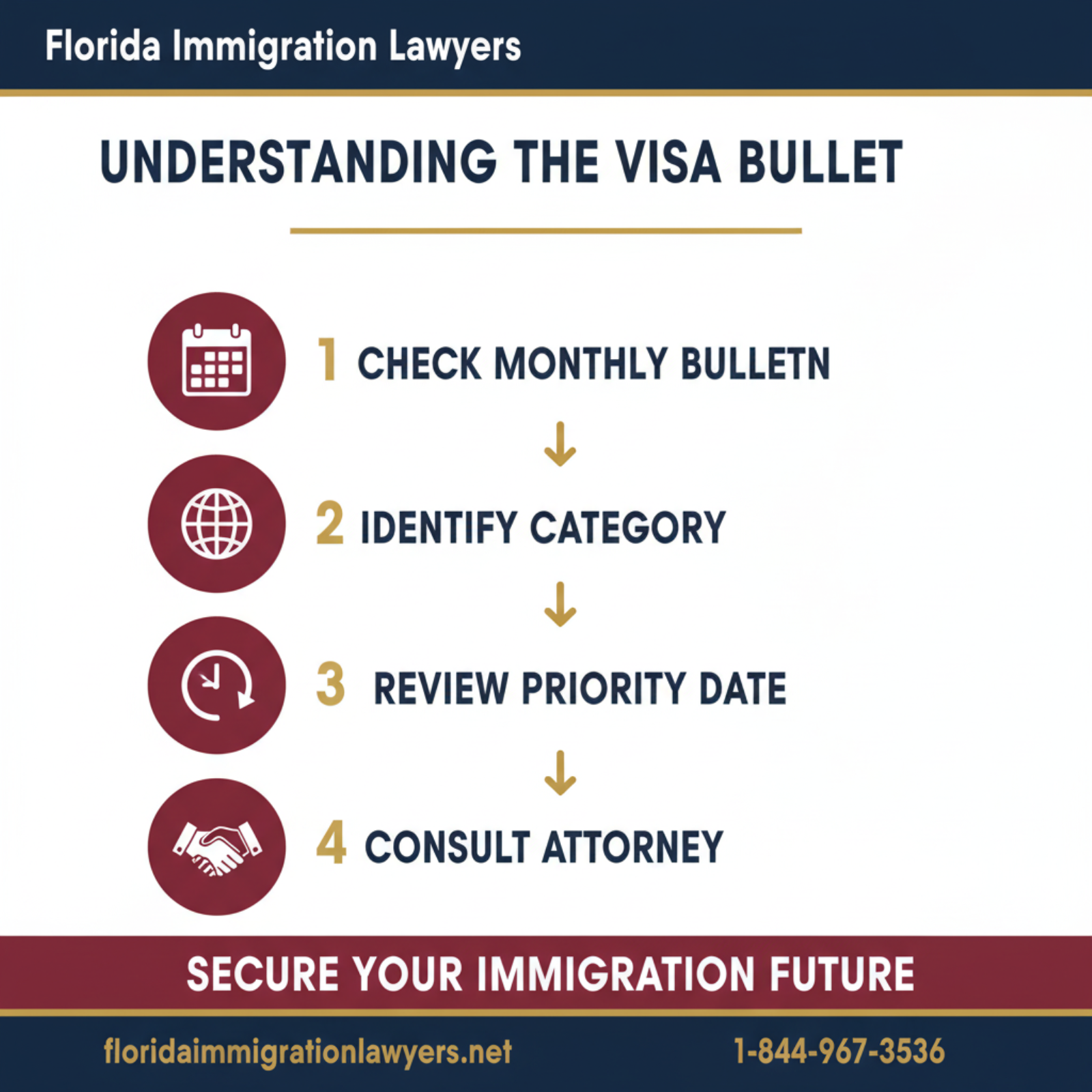
Locate Your Visa Category: First, identify whether your application is family-sponsored (F1, F2A, F2B, F3, F4) or employment-based (EB-1, EB-2, EB-3, EB-4, EB-5). This will direct you to the correct section of the bulletin.
-
Find Your Country of Chargeability: Your country of chargeability is generally your country of birth, not your country of citizenship. Find your specific country within your visa category on the bulletin's charts. Some countries, like China, India, Mexico, and the Philippines, often have separate, more backlogged columns.
-
Identify Your Priority Date: Your priority date is established when your petition (Form I-130 for family, Form I-140 for employment, or Form I-526 for EB-5) was properly filed with USCIS. This date is crucial for determining your place in the visa queue.
-
Compare Your Priority Date to the "Final Action Dates" Chart: Look at the "Final Action Dates" chart for your category and country. If your priority date is earlier than the date listed, an immigrant visa number is immediately available for you. This means your case can proceed to final adjudication, whether through adjustment of status in Florida or consular processing abroad.
Step-by-Step Process Guide -
Compare Your Priority Date to the "Dates for Filing Applications" Chart: Next, check the "Dates for Filing Applications" chart. If USCIS has indicated that this chart should be used for adjustment of status filings in October 2025, and your priority date is earlier than the date listed, you may be eligible to file your Form I-485 (Application to Register Permanent Residence or Adjust Status) with USCIS.
-
Understand the Implications: If your priority date is current under the Final Action Dates, you are very close to receiving your green card. If it is current under Dates for Filing, you can submit your I-485, allowing you to obtain work authorization and travel parole while awaiting final visa availability. If neither applies, you must continue to wait.
-
Seek Professional Guidance: The Visa Bulletin can be complex. Consulting with an experienced immigration attorney from Florida Immigration Lawyers can help ensure you correctly interpret the dates and take the appropriate next steps for your situation.
Essential Documents for Your Visa Application in Florida
Regardless of your visa category, a successful application requires meticulous preparation of supporting documents. Incomplete or incorrect documentation is a common reason for delays or denials. While specific documents vary by case, here is a general checklist of items typically required:
- Valid passport from your country of nationality.
- Birth certificate for yourself and any accompanying family members.
- Marriage certificate (if applicable) and divorce decrees for any previous marriages.
- Police certificates from all countries where you have lived for specified periods.
- Medical examination results from a USCIS-approved civil surgeon in Florida.
- Affidavit of Support (Form I-864) from your petitioner or joint sponsor, along with their tax returns and financial documents.
- Proof of your relationship to the petitioner (e.g., photos, correspondence, joint financial documents).
- Educational and professional credentials (for employment-based visas).
- Job offer letter and PERM labor certification (for most employment-based visas).
- Form I-485 (Application to Register Permanent Residence or Adjust Status) if applying within the U.S.
- Form DS-260 (Immigrant Visa Electronic Application) if applying through consular processing abroad.
- Photos meeting specific USCIS requirements.
- Any other documents requested by USCIS or the National Visa Center (NVC).
All foreign language documents must be accompanied by a certified English translation. Ensuring all documents are accurate and complete is paramount for a smooth process. Our team can help you compile and review your documentation.
Visa Bulletin October 2025: Timeline and Processing Expectations for Florida Applicants
Once your priority date becomes current according to the Visa Bulletin October 2025, the next phase of your immigration journey begins. The timeline for receiving your green card can still vary significantly. Several factors influence how quickly your application is processed, including the volume of applications, the efficiency of the specific USCIS field office (like Orlando or Miami), and the complexity of your individual case.
It is important to manage expectations, as no attorney can guarantee specific processing times. However, understanding the general stages involved can help you prepare.
USCIS and National Visa Center (NVC) Processing Stages
If you are adjusting status within the U.S., your Form I-485 will be processed by USCIS. This typically involves:
- Receipt and initial review of your application.
- Biometrics appointment (fingerprints, photos).
- Potential Request for Evidence (RFE) if more information is needed.
- Interview at a local USCIS field office (e.g., Orlando, Tampa, Miami), if required.
- Final decision.
For those undergoing consular processing abroad, your approved petition moves to the National Visa Center (NVC), part of the U.S. Department of State. The NVC collects all necessary documents and fees before scheduling an interview at a U.S. Embassy or Consulate in your home country. This stage can also involve significant wait times.
Factors Affecting Processing Times in Florida
Several elements can impact how long your immigration application takes in Florida:
- USCIS Workload: High volumes of applications at specific field offices can lead to longer waits.
- Case Complexity: Cases involving criminal history, previous immigration violations, or extensive documentation may require more scrutiny.
- Requests for Evidence (RFEs): If USCIS issues an RFE, it will pause your case until you provide the requested information, adding weeks or months to the process.
- Interview Backlogs: Both USCIS and U.S. Embassies/Consulates can experience backlogs in scheduling interviews.
- Policy Changes: Immigration policies can shift, potentially affecting processing priorities and timelines.
Staying informed and responding promptly to all communications from USCIS or the NVC is crucial. An experienced immigration lawyer can help you track your case and respond effectively to any challenges.
Cost Factors and Fee Breakdown for Immigration Applications
Pursuing an immigrant visa or adjustment of status involves various fees. These costs are an important consideration for applicants in Florida. It is crucial to remember that government filing fees are subject to change, so always check the official USCIS website for the most current amounts. Our firm does not charge specific government fees, but rather helps clients understand and prepare for them.
The primary costs generally include government filing fees, medical examination fees, and attorney fees.
Understanding USCIS Filing Fees and Other Expenses
The U.S. Citizenship and Immigration Services (USCIS) charges fees for most forms. For an adjustment of status application (Form I-485), this fee typically includes the application itself, biometrics services, and fees for related applications like employment authorization (Form I-765) and travel parole (Form I-131). The petition that precedes the I-485 (e.g., Form I-130 or I-140) also carries a separate filing fee.
Other expenses include:
- Medical Examination Fees: You must undergo a medical exam by a USCIS-approved civil surgeon. These fees are paid directly to the doctor and vary.
- Translation Fees: If any of your supporting documents are not in English, you will need certified translations, which incur additional costs.
- Travel Expenses: For interviews at USCIS field offices in Florida or for consular processing abroad, travel costs can be significant.
Some applicants with low incomes may be eligible for fee waivers for certain USCIS forms. Discussing this possibility with your attorney can help determine if you qualify.
The Value of Legal Representation
While attorney fees are an additional cost, the value of experienced legal representation is often immeasurable. An immigration lawyer ensures your application is correctly prepared, all necessary documents are included, and deadlines are met. This minimizes the risk of delays, RFEs, or even denials, which can be far more costly in the long run.
At Florida Immigration Lawyers, we offer transparent fee structures and provide comprehensive support throughout your entire immigration process. Investing in legal expertise can provide peace of mind and significantly improve your chances of a successful outcome.
Common Mistakes to Avoid in Your Visa Application
Navigating the immigration system can be complex, and even minor errors can lead to significant delays or denials. Being aware of common pitfalls can help you avoid them.
-
Misinterpreting the Visa Bulletin Dates: Many applicants confuse "Final Action Dates" with "Dates for Filing." Filing an I-485 when you are only current under Final Action Dates, or vice versa, can lead to rejection or denial. Always verify which chart USCIS authorizes for adjustment of status filings.
-
Missing Deadlines: The immigration process is time-sensitive. Failing to respond to RFEs, interview notices, or submit required documents by their deadlines can result in your application being denied or abandoned.
-
Incomplete or Inaccurate Documentation: Submitting an application without all required forms, supporting evidence, or with incorrect information is a primary cause of delays and RFEs. Every detail matters, from correct spellings to certified translations.
-
Not Disclosing All Relevant Information: Attempting to hide past immigration violations, criminal history, or other potentially adverse information can lead to severe consequences, including findings of misrepresentation and permanent bars from the U.S. Honesty and full disclosure are critical.
-
Failing the Medical Examination: Not addressing health issues that could deem you inadmissible, or failing to complete required vaccinations, can halt your application. Ensure you understand the health-related grounds of inadmissibility.
-
Not Updating Your Address: If you move within Florida or to another state, you must inform USCIS within 10 days using Form AR-11. Failure to do so can result in missed notices, interviews, or even deportation proceedings if you miss court dates.
-
Traveling Internationally Without Parole: If you have a pending I-485 application, leaving the U.S. without an approved Advance Parole document (Form I-131) can be considered an abandonment of your application. Always consult an attorney before making travel plans.
-
Assuming Your Case is Identical to Others: Every immigration case is unique. What worked for a friend or family member may not apply to your specific circumstances. Relying on anecdotal advice instead of professional legal counsel can be detrimental.
-
Not Preparing for Interviews: Underestimating the importance of your USCIS or consular interview can lead to poor performance. Being unprepared to answer questions about your application, relationship, or employment can raise red flags.
-
Ignoring Legal Grounds of Inadmissibility: There are many reasons an applicant might be deemed inadmissible to the U.S., such as certain criminal convictions, health issues, or previous immigration violations. Failing to address these, potentially through waivers, can lead to denial. Our team can also assist with deportation defense if inadmissibility issues arise.
When to Call a Lawyer for Your Visa Bulletin October 2025 Questions
While the Visa Bulletin October 2025 provides critical information, its interpretation and application to your specific case can be complex. There are many scenarios where the expertise of an immigration lawyer becomes invaluable. Florida Immigration Lawyers are dedicated to providing comprehensive legal support to individuals throughout Florida, including Kissimmee, Orlando, and Miami.
You should consider contacting an attorney if:
- Your Priority Date is Approaching: As your priority date nears the current dates on the bulletin, it is time to prepare your final application documents. An attorney ensures everything is in order.
- You Have a Complex Case: If you have a criminal record, previous immigration violations, or an unusual family situation, navigating the process alone can be risky.
- You Received a Request for Evidence (RFE): RFEs indicate USCIS needs more information. Responding correctly and comprehensively is vital, and a lawyer can help craft a strong response.
- You Are Considering Adjustment of Status vs. Consular Processing: Deciding whether to adjust status in the U.S. or go through consular processing abroad has significant implications. An attorney can advise on the best path for you.
- You Are Unsure About Your Visa Category or Priority Date: Correctly identifying your category and priority date is fundamental. If you have any doubts, seek professional clarification.
- You Have Been Denied Before: A previous denial does not necessarily mean the end of your immigration journey. An attorney can review your case, identify issues, and strategize next steps. Our firm also handles asylum and citizenship cases, offering a broad range of services.
- You Need Assistance with Internal Links to USCIS or NVC: Even simple administrative tasks can become complicated. Lawyers can help facilitate communication and ensure proper procedures are followed.
Don't wait for a problem to arise. Proactive legal counsel can prevent many common issues. Our team of experienced attorneys at Florida Immigration Lawyers is ready to provide the guidance you need.
Frequently Asked Questions About the Visa Bulletin and Immigration in Florida
The Visa Bulletin often generates many questions, especially for those navigating the immigration system in Florida. Here we address some common concerns:
Which employment-based green card is fastest?
Generally, the fastest employment-based green cards are those in the EB-1 category (Priority Workers) because they often do not experience significant backlogs, particularly for individuals not from highly backlogged countries like India or China. Extraordinary ability petitions (EB-1A) also do not require a job offer or PERM labor certification, potentially speeding up the initial stages. However, "fastest" is relative and depends on individual qualifications and country of chargeability. EB-2 with a National Interest Waiver (NIW) can also be quicker for highly qualified individuals as it bypasses the PERM process.
Is USCIS moving faster in 2025?
USCIS processing times fluctuate based on workload, staffing, and policy changes. While USCIS continually works to improve efficiency, it's difficult to make a blanket statement that they are "moving faster" across all categories and field offices in 2025. Some categories may see improvements, while others might still experience delays. We always recommend checking the official USCIS processing times page for the most up-to-date information specific to your form and field office, such as those serving Kissimmee, Orlando, or Miami.
What is the October Visa Bulletin?
The October Visa Bulletin is the first Visa Bulletin of the new federal fiscal year, which begins on October 1st. It is highly anticipated because it reflects the new annual allocation of immigrant visa numbers. This often leads to significant forward movement in certain visa categories, as a fresh supply of visas becomes available. It sets the tone for visa availability for the upcoming year.
Which date is the Visa Bulletin released every month?
The U.S. Department of State (DOS) typically releases the Visa Bulletin around the middle of the preceding month. For example, the Visa Bulletin October 2025 would generally be released around mid-September 2025. While there isn't a fixed release date, it is usually published between the 8th and the 15th of the month.
About Florida Immigration Lawyers
Florida Immigration Lawyers is a leading immigration law firm dedicated to serving individuals and families across the entire state of Florida. With a deep understanding of U.S. immigration law and a commitment to client success, we provide compassionate and effective legal representation for a wide range of immigration matters.
Our experienced attorneys offer personalized legal strategies tailored to your unique circumstances. We believe in clear communication, transparent processes, and unwavering advocacy for our clients. From visa applications and green cards to deportation defense and citizenship, we are your trusted partners in navigating the complexities of the immigration system.
Why Choose Florida Immigration Lawyers?
- Experienced Advocates: Our team possesses extensive knowledge of immigration law and a proven track record of success.
- Client-Centered Approach: We prioritize your needs and goals, providing empathetic and responsive legal support.
- Comprehensive Services: We handle all aspects of immigration law, ensuring you have expert guidance at every stage.
- Local Insight: With a focus on Florida, we understand the specific challenges and opportunities for immigrants in our state.
- Bilingual Support: Our team offers services in both English and Spanish to ensure effective communication.
We are available 24/7 to address your urgent concerns and offer free consultations to help you understand your options. Visit our website at https://www.floridaimmigrationlawyers.net or call us directly at 1-844-967-3536 to schedule your consultation. Let us help you achieve your immigration goals in Florida.
Sources and References
- U.S. Citizenship and Immigration Services (USCIS)
- U.S. Department of State - Visa Bulletin
- Executive Office for Immigration Review (EOIR)
- 8 U.S.C. Chapter 12 - Immigration and Nationality Act (INA Sections 201-203)
- 8 CFR Part 245 - Adjustment of Status
- USCIS Policy Manual
This article provides general legal information and is not intended as legal advice. Every case is unique, and outcomes depend on specific facts and circumstances. Contact an attorney for advice about your particular situation.
Navigating the ever-changing landscape of immigration law requires expert guidance. The Visa Bulletin October 2025 is just one piece of a larger puzzle. For personalized advice and dedicated representation in Florida, trust the experienced team at Florida Immigration Lawyers. We are committed to helping you achieve your immigration dreams.
Don't delay your future. Call Florida Immigration Lawyers today at 1-844-967-3536 for a free consultation. Se Habla Español - Estamos aquí para ayudarle.
Need help with Immigration?
Our Florida immigration attorneys offer free consultations. Call today or schedule online.
Frequently Asked Questions
Florida Immigration Lawyers
Legal Team
Our experienced attorneys at Florida Immigration Lawyers have been serving clients across Florida for over 20 years. We specialize in immigration, personal injury, criminal defense, workers compensation, and family law.