Change of Status Student Florida: Your F-1 Visa Guide for
Considering a change of status to an F-1 student visa in Florida? This guide from Florida Immigration Lawyers provides essential information for 2026, covering eligibility, the step-by-step application process, required documents, and critical timelines. Learn how to navigate USCIS procedures, understand cost factors, and avoid common mistakes that could jeopardize your academic future in Florida. We address frequently asked questions, including the 90-day rule and residency status for F-1 students. Our firm offers expert legal assistance for international students in Miami and across Florida. Contact us for a free consultation to ensure a smooth transition to your F-1 student status.

Changing your immigration status to an F-1 student visa in Florida allows you to pursue academic studies within the U.S. This process typically involves demonstrating eligibility, securing admission to a SEVP-approved school, obtaining an I-20, and filing Form I-539 with USCIS. Careful preparation and adherence to regulations are crucial for a successful outcome.
- Secure admission to a SEVP-approved school and obtain Form I-20.
- File Form I-539, Application to Extend/Change Nonimmigrant Status.
- Provide comprehensive financial documentation and academic records.
- Maintain your current nonimmigrant status throughout the application process.
- Consult with an experienced immigration attorney for guidance and support.
Change of Status Student Florida: Your F-1 Visa Guide for 2026
Are you currently in Florida on a nonimmigrant visa and dreaming of pursuing higher education at one of our state's renowned universities or colleges? Perhaps you're visiting as a tourist, working on a temporary visa, or hold another non-academic status, but your true passion lies in studying here. Navigating the immigration system to achieve your academic goals can seem daunting, especially when considering a change of status student Florida.
Understanding the intricacies of changing your immigration status to an F-1 student visa is paramount. This comprehensive guide from Florida Immigration Lawyers will walk you through the process, requirements, and crucial considerations for international students in Florida in 2026. We aim to equip you with the knowledge needed to make informed decisions about your future.
Before you embark on this significant journey, remember that immigration law is complex and constantly evolving. For personalized advice tailored to your specific situation, do not hesitate to reach out. Call Florida Immigration Lawyers at 1-844-967-3536 for a free consultation and let our experienced team assist you.
Understanding Change of Status to F-1 Student Visa in Florida
What is a Change of Status?
A change of status allows you to switch from one nonimmigrant visa category to another while remaining in the United States. For many individuals in Florida, this means transitioning from a tourist (B-2), business (B-1), or other temporary visa to an F-1 student visa. This process avoids the need to leave the U.S. and apply for a new visa at a U.S. embassy or consulate abroad.
It is distinct from applying for a new visa. When you apply for a change of status, you are asking U.S. Citizenship and Immigration Services (USCIS) to change your immigration classification. This allows you to legally engage in activities permitted by the new status, such as full-time study for an F-1 visa holder.
Who is Eligible for an F-1 Student Visa?
To be eligible for an F-1 student visa, you must generally meet several criteria. You must be accepted by a U.S. institution approved by the Student and Exchange Visitor Program (SEVP), such as the University of Miami, Florida International University, or the University of Central Florida. Your primary purpose for coming to the U.S. must be to study.
Furthermore, you must demonstrate sufficient financial resources to cover your tuition, living expenses, and other costs for the duration of your study. You must also prove an intent to depart the U.S. upon completion of your studies, showing no intent to abandon your foreign residence. This is a critical aspect of nonimmigrant intent.
The Importance of Maintaining Legal Status
Maintaining your current nonimmigrant status is absolutely critical throughout the entire change of status application process. If your current visa expires or you fall out of status before your F-1 change of status is approved, you could face severe immigration consequences. This includes potential denial of your application and even removal proceedings.
It is advisable to file your application well in advance of your current status expiration date. Overstaying your authorized period of admission can lead to bars from re-entry to the U.S. in the future. Always consult your I-94 record for your authorized period of stay, which can be accessed on the U.S. Customs and Border Protection (CBP) website.
Step-by-Step Guide to Applying for Change of Status to F-1 in Florida
The process for a change of status student Florida to an F-1 visa involves several key stages. Following these steps carefully will help ensure a smoother application experience. Our firm, Florida Immigration Lawyers, regularly assists clients in Miami and across the state with these applications.
-
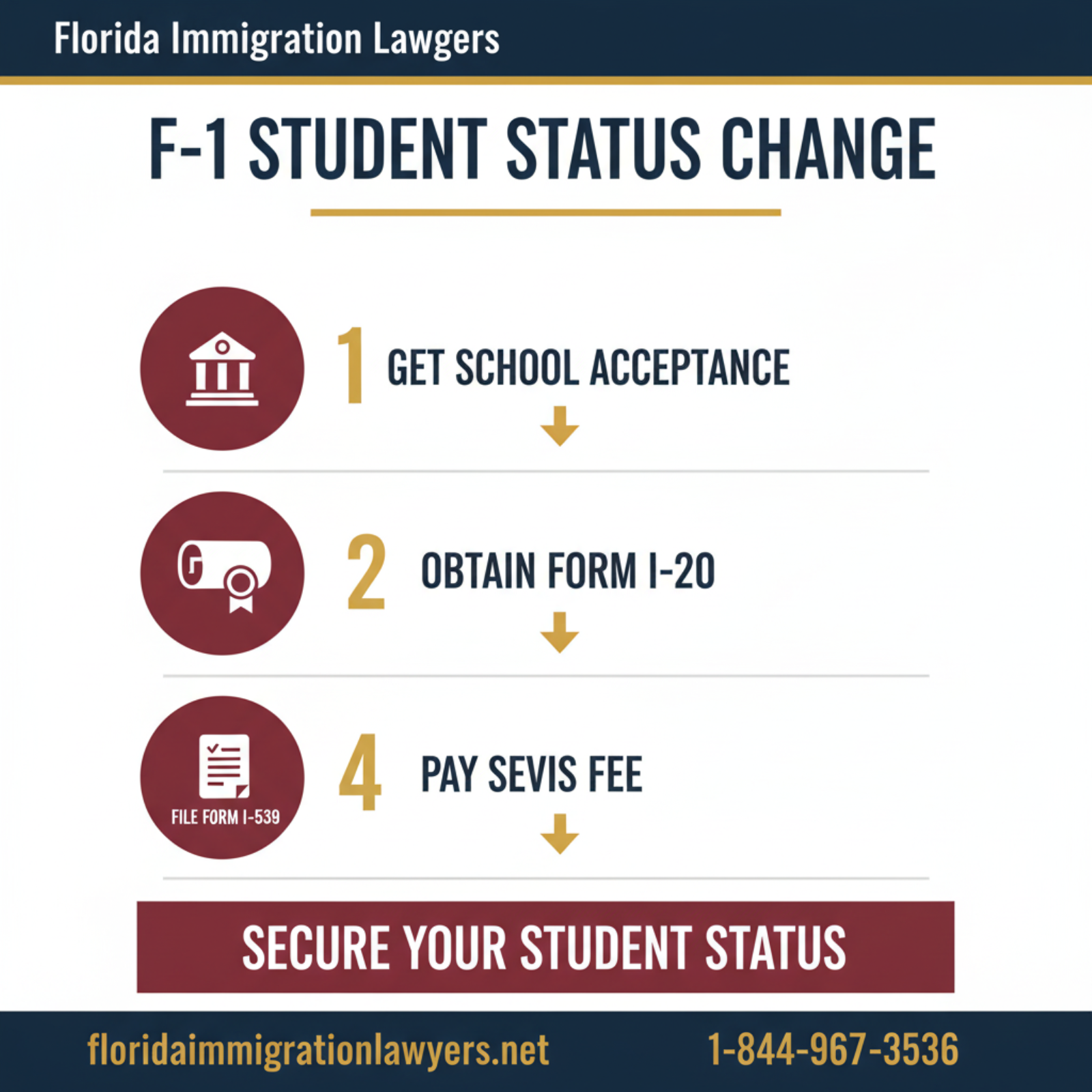
Gain Admission to a SEVP-Approved School and Obtain Form I-20: Your first step is to apply and be accepted by an academic institution in the U.S. that is certified by the Student and Exchange Visitor Program (SEVP). Once accepted, the school will issue you a Form I-20, Certificate of Eligibility for Nonimmigrant Student Status. This document is essential for your application.
The I-20 serves as proof of your acceptance and outlines the details of your program of study, estimated costs, and the school's SEVIS ID. Ensure all information on your I-20 is accurate before proceeding.
-
Pay the SEVIS I-901 Fee: Before filing your I-539 application, you must pay the I-901 SEVIS fee. This fee supports the Student and Exchange Visitor Information System (SEVIS), which tracks F-1 students. Keep your receipt of payment, as you will need to include it with your application.
This fee must be paid online through the FMJFee website. Without this payment, your change of status application will be considered incomplete and likely denied.
-
Complete and File Form I-539, Application to Extend/Change Nonimmigrant Status: This is the primary form for requesting a change of status. Fill out Form I-539 accurately and completely, providing all requested personal and immigration history information. It is crucial to be truthful and consistent with previous applications.
You will need to indicate your desired new status (F-1) and the reason for your request. Include the filing fee for Form I-539, which can change, so always check the latest USCIS fee schedule on www.uscis.gov/fees.
-
Gather Supporting Documentation: Compile all required supporting documents. This includes copies of your passport, current visa, I-94 record, Form I-20, proof of SEVIS fee payment, and extensive financial documentation. You will also need academic transcripts, diplomas, and a personal statement explaining your reasons for wanting to study in the U.S. and your academic goals.
Proof of financial support is paramount, demonstrating that you have sufficient funds to cover your tuition and living expenses without needing unauthorized employment. Bank statements, scholarship letters, or affidavits of support from sponsors are commonly accepted.
-
Attend Biometrics Appointment (if required): After filing, USCIS may send you an appointment notice for biometrics. This involves having your fingerprints and photograph taken at an Application Support Center (ASC). It is a mandatory step for most applicants and is used for background checks.
Failure to attend your biometrics appointment can lead to the denial of your application. Ensure your mailing address with USCIS is current to receive all notices.
-
Maintain Status While Awaiting Decision: During the processing of your I-539 application, you must continue to maintain your current nonimmigrant status. This means adhering to the restrictions of your current visa category. For example, if you are on a B-2 tourist visa, you cannot enroll in classes until your F-1 status is approved.
If your current status expires while your change of status application is pending, you are generally considered to be in a period of authorized stay. However, you cannot begin F-1 activities until the approval. Exiting the U.S. while your application is pending typically abandons it.
-
Receive Decision from USCIS: USCIS will send you a written decision. If approved, you will receive an I-797 Approval Notice indicating your new F-1 status and a new I-94 card. If denied, the notice will explain the reasons. A denial can have serious implications, and it is crucial to understand your options.
Upon approval, provide a copy of your I-797 Approval Notice and new I-94 to your designated school official (DSO) at your SEVP-approved school. Your DSO will update your SEVIS record to reflect your new F-1 status.
Essential Document Checklist for Your F-1 Change of Status Application
Preparing a thorough and accurate set of documents is vital for a successful change of status student Florida application. Missing or incorrect documents can lead to delays or even denial. Use this checklist to ensure you have everything ready for your F-1 visa change of status.
- Form I-539: Completed and signed Application to Extend/Change Nonimmigrant Status.
- Form I-539 Filing Fee: Check the current fee on the USCIS website.
- Form I-20: Original Certificate of Eligibility for Nonimmigrant Student Status from a SEVP-approved school.
- SEVIS I-901 Fee Receipt: Proof of payment for the Student and Exchange Visitor Information System fee.
- Passport: Copy of your passport biographical page, valid for at least six months beyond your intended period of stay.
- Current Visa: Copy of your current nonimmigrant visa stamp (if applicable).
- Form I-94: Copy of your most recent Arrival/Departure Record, obtainable from the CBP website.
- Financial Documentation: Evidence of sufficient funds to cover tuition, living expenses, and other costs. This may include bank statements, scholarship letters, or affidavits of support (Form I-134) with sponsor's financial proof.
- Academic Transcripts and Diplomas: Official copies of your academic records from previous institutions, translated if not in English.
- Personal Statement/Letter of Intent: A letter explaining your reasons for wanting to study in the U.S., your academic goals, and how the program aligns with your future plans.
- Photographs: Two passport-style photographs meeting USCIS specifications.
- Proof of Nonimmigrant Intent: Documents demonstrating ties to your home country, such as property deeds, job offers, or family commitments, showing you intend to return after studies.
- Marriage Certificate/Birth Certificates: If applying with dependents (spouse/children for F-2 status).
Timeline and Processing Expectations for F-1 Change of Status in Florida
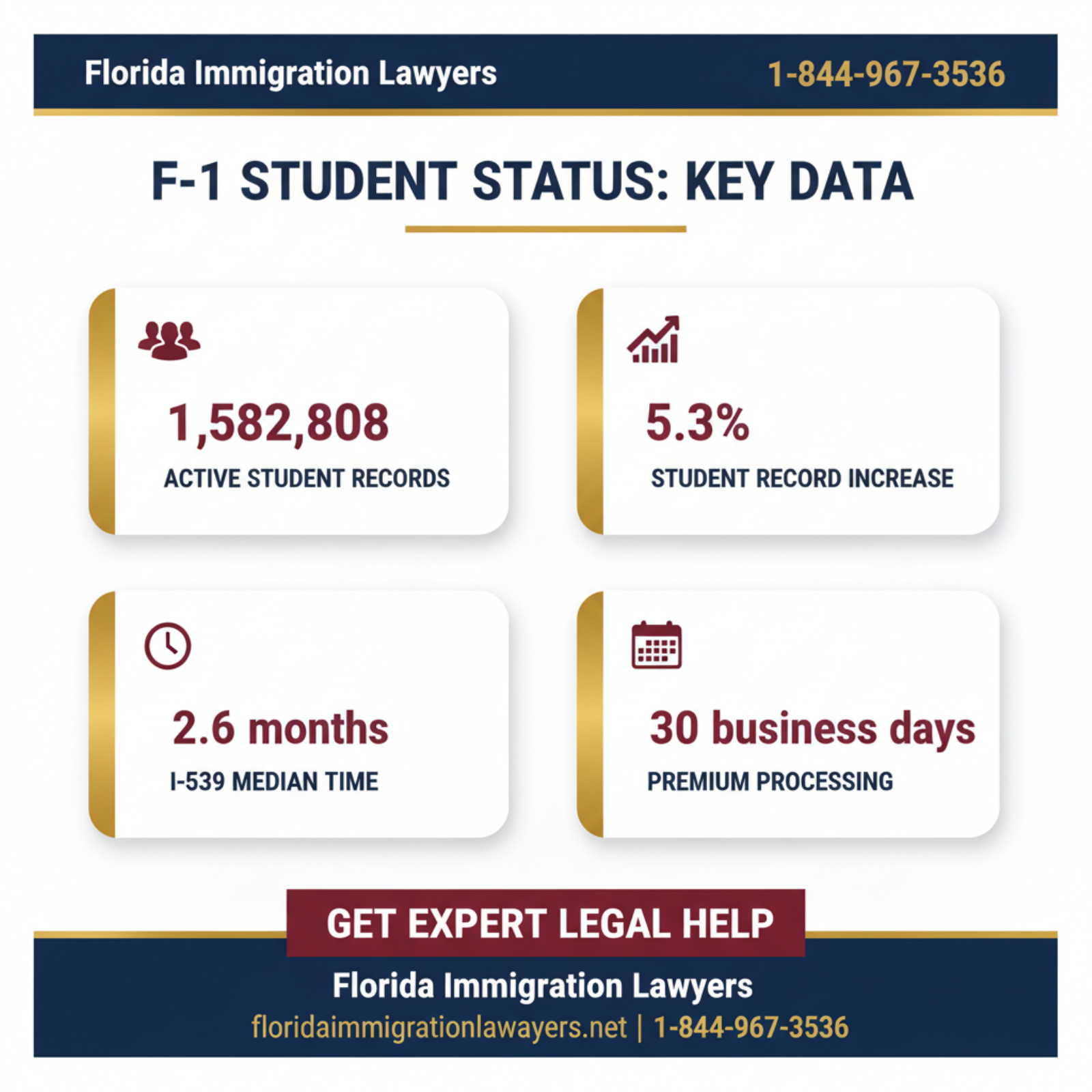
The processing times for a change of status student Florida application can vary significantly. USCIS processing times are subject to various factors, including the specific service center handling your application, current caseloads, and the completeness of your submission. It is essential to manage your expectations and plan accordingly.
Typically, F-1 change of status applications can take several months, ranging from 6 to 12 months, or even longer in some cases. You can check current processing times on the USCIS website for Form I-539 at the specific service center that has jurisdiction over your case. For Florida residents, this is often the Vermont Service Center or the California Service Center, depending on your current status.
Expedited processing is rarely granted for change of status applications unless there is an urgent humanitarian reason. Therefore, filing your application as early as possible is always recommended. This proactive approach helps to avoid issues related to your current status expiring while your application is still pending.
Throughout the waiting period, you must continue to comply with the terms of your current nonimmigrant status. Engaging in F-1 student activities, such as enrolling in a full course of study, before your change of status is approved is a violation of your nonimmigrant status and can lead to denial. Maintaining your status is paramount.
Cost Factors and Fee Breakdown for Your Student Visa Change of Status
Understanding the financial commitment involved in a change of status student Florida application is crucial for proper planning. There are several fees associated with the process, which can fluctuate. It is always best to verify the most current fees directly on the official USCIS website before filing.
The primary costs include the USCIS filing fee for Form I-539. This fee must be paid at the time of submission and is non-refundable, regardless of the application outcome. Additionally, the SEVIS I-901 fee is a mandatory payment that supports the Student and Exchange Visitor Program. This fee is also subject to change and should be verified.
Beyond government fees, you should budget for other potential expenses. These may include costs for obtaining official academic transcripts, translation services for foreign documents, and passport-style photographs. If you choose to seek legal assistance, attorney fees will also be a significant factor.
While hiring an attorney adds to the overall cost, the expertise and guidance provided by Florida Immigration Lawyers can be invaluable. Our team can help you prepare a strong application, avoid common pitfalls, and navigate complex legal issues, potentially saving you time and stress in the long run. We offer transparent fee structures for our services.
Do not navigate this process alone. Contact Florida Immigration Lawyers today to discuss your case and understand the full scope of requirements and potential costs. Our dedicated team is ready to assist you.
Common Questions About Changing Student Status in Florida
Many individuals in Florida have questions about the change of status process to an F-1 student visa. Here, we address some of the most frequently asked questions to provide clarity and guidance.
How do I change my student status?
To change your status to an F-1 student, you must first be accepted by a SEVP-approved school and receive a Form I-20. Then, you will pay the SEVIS I-901 fee and file Form I-539, Application to Extend/Change Nonimmigrant Status, with USCIS. This application must include all required supporting documents, such as financial proof and academic records. It is crucial to maintain your current legal status throughout the entire process until your F-1 status is approved.
What is the 90 day rule for status change?
The 90-day rule is a guideline used by immigration officers to determine if an applicant misrepresented their intentions when entering the U.S. If you enter the U.S. on a nonimmigrant visa (e.g., B-2 tourist) and then apply for a change of status to F-1 within 90 days of entry, USCIS may presume you had an intent to change status at the time of entry, which could be considered misrepresentation. While not a strict law, it can lead to increased scrutiny and potential denial. It is generally safer to wait at least 90 days after entry before filing a change of status application, if feasible.
Are F-1 students considered residents after 5 years?
No, F-1 students are generally considered non-resident aliens for tax purposes for their first five calendar years in the U.S. This is under the substantial presence test rules. However, for immigration purposes, an F-1 visa holder remains a nonimmigrant, meaning they do not have permanent resident status (a green card). The F-1 visa is a temporary visa, and it does not automatically lead to residency, regardless of how long you hold it. Achieving permanent residency requires a separate application process.
Who qualifies for change of status?
Generally, individuals who entered the U.S. legally on a nonimmigrant visa and have maintained their status may qualify for a change of status. You must meet the eligibility requirements for the new visa category (e.g., F-1 student) and not be subject to any bars to adjustment, such as certain immigration violations. Individuals who entered under the Visa Waiver Program (VWP) are typically not eligible to change status within the U.S. Always consult with an immigration attorney to determine your specific eligibility.
Common Mistakes to Avoid During Your Change of Status Student Florida Application
Applying for a change of status student Florida to an F-1 visa can be complex. Even minor errors can lead to significant delays or denial. Be aware of these common pitfalls to increase your chances of a successful outcome.
-
Falling Out of Status Before Filing: This is perhaps the most critical mistake. If your current visa expires before USCIS receives your I-539 application, you will be out of status. This typically makes you ineligible for a change of status and can lead to serious immigration consequences, including potential deportation.
Always file your application well in advance of your I-94 expiration date.
-
Applying Too Late: While you must file before your current status expires, filing too close to the expiration date leaves little room for error or responding to requests for evidence. Aim to file several months before your current status ends to provide a buffer.
Early submission is a strategic advantage in most immigration processes.
-
Insufficient Financial Documentation: One of the main reasons for denial is failing to prove you have sufficient funds to cover your tuition and living expenses. USCIS requires clear, verifiable evidence of financial support for your entire program of study.
Ensure your bank statements are recent and reflect the required amount, or that sponsor affidavits are comprehensive.
-
Incomplete or Inaccurate Documentation: Submitting an application with missing forms, unsigned documents, or incorrect information will almost certainly result in a Request for Evidence (RFE) or outright denial. Double-check every form and attachment.
Attention to detail is paramount in all immigration filings.
-
Working Without Authorization: While your change of status is pending, you are still bound by the restrictions of your current visa. If you are on a B-2 tourist visa, you are not authorized to work. Engaging in unauthorized employment can lead to denial and future immigration issues.
Wait for your F-1 status approval before considering any on-campus employment options.
-
Misunderstanding the 90-Day Rule: As discussed, applying for a change of status too soon after entering the U.S. (within 90 days) can raise red flags with USCIS regarding your original intent. While not an absolute bar, it can lead to enhanced scrutiny.
Plan your entry and application timing carefully to avoid this presumption of misrepresentation.
-
Ignoring Requests for Evidence (RFEs): If USCIS sends an RFE, it means they need more information or clarification. Failing to respond by the deadline, or providing an inadequate response, will result in denial. Treat RFEs with extreme seriousness.
Respond comprehensively and accurately to all RFEs.
-
Not Updating Your Address with USCIS: If you move while your application is pending, you must update your address with USCIS within 10 days. Failing to do so could mean missing crucial notices, including RFEs or approval notices, leading to adverse outcomes.
Use the USCIS online change of address tool or Form AR-11.
-
Assuming Approval: Do not make irreversible plans, such as enrolling in classes or quitting a job, based on the assumption that your change of status will be approved. Only begin F-1 activities once you have received your I-797 Approval Notice.
Always await official USCIS approval before changing your activities.
-
Lack of Nonimmigrant Intent Proof: For F-1 visas, you must convince USCIS that you intend to return to your home country after completing your studies. Failing to provide adequate proof of ties abroad can lead to denial.
Gather evidence like property ownership, family ties, or job prospects in your home country.
-
Not Consulting an Attorney: Attempting to navigate the complex change of status process without legal guidance can be a costly mistake. An experienced immigration attorney can identify potential issues, ensure all documents are correct, and represent your best interests.
Legal counsel provides peace of mind and significantly improves your chances of success.
When to Call a Lawyer for Your Change of Status Student Florida Application
While some individuals attempt to file a change of status student Florida application independently, the complexities of immigration law often warrant professional legal assistance. Knowing when to seek the help of an experienced attorney can save you time, stress, and potential heartache. Florida Immigration Lawyers are here to provide the support you need.
You should strongly consider contacting an immigration attorney if your case involves any complexities. This includes having a previous visa denial, a history of overstaying a previous visa, or any criminal record. If you are unsure about your eligibility or if your current nonimmigrant status has specific restrictions that might complicate a change of status, legal counsel is invaluable.
Furthermore, if you receive a Request for Evidence (RFE) from USCIS, a Notice of Intent to Deny (NOID), or if your application is denied, it is crucial to consult with a lawyer immediately. These situations require a precise and timely response. Our attorneys at Florida Immigration Lawyers can help you understand the reasons for these notices and formulate the strongest possible response.
Even if your case seems straightforward, an attorney can offer peace of mind by ensuring all documents are correctly prepared and submitted. We can help you gather the necessary evidence, draft compelling personal statements, and represent you throughout the entire process. Our firm offers comprehensive services for F-1 visa applications and change of status cases across Florida, including Miami, Orlando, and Tampa.
About Florida Immigration Lawyers
Florida Immigration Lawyers is a leading immigration law firm dedicated to serving individuals and families across the entire state of Florida. With a deep understanding of U.S. immigration law and a commitment to our clients, we provide compassionate, effective, and results-driven legal representation. Our team of skilled attorneys is passionate about helping immigrants achieve their American dreams.
We offer a wide range of immigration services, including family-based immigration, employment visas, asylum claims, deportation defense, naturalization and citizenship, and various nonimmigrant visas, including F-1 student visas and change of status applications. Whether you are in Miami, Orlando, Jacksonville, or anywhere else in Florida, our firm is equipped to handle your case with the utmost professionalism and care.
Choosing Florida Immigration Lawyers means partnering with a firm that prioritizes your success. We are known for our meticulous attention to detail, clear communication, and personalized legal strategies. We understand the challenges you face and are dedicated to providing accessible and high-quality legal services. Your immigration journey is our priority.
We are available 24/7 to answer your questions and provide support. We offer free consultations to discuss your case and explore your legal options without any obligation. Visit our website at https://www.floridaimmigrationlawyers.net or call us directly at 1-844-967-3536 to schedule your free consultation today. Let us be your trusted guide in the complex world of immigration law.
Sources and References
- U.S. Citizenship and Immigration Services (USCIS)
- U.S. Department of State (travel.state.gov)
- Student and Exchange Visitor Program (SEVP) - U.S. Immigration and Customs Enforcement (ICE)
- 8 U.S.C. § 1101 et seq. - Immigration and Nationality Act (INA)
- 8 CFR § 214.2(f) - Regulations pertaining to F-1 students
- USCIS Policy Manual, Volume 7, Part B, Chapter 5 - Change of Status
This article provides general legal information and is not intended as legal advice. Every case is unique, and outcomes depend on specific facts and circumstances. Contact an attorney for advice about your particular situation.
Embarking on a change of status student Florida journey requires careful planning and expert guidance. Do not leave your academic future to chance. Our dedicated team at Florida Immigration Lawyers is here to support you every step of the way, offering comprehensive legal assistance and peace of mind. Your dream of studying in Florida is within reach.
Schedule your free consultation with Florida Immigration Lawyers today by calling 1-844-967-3536. Se Habla Español - Estamos aquí para ayudarle.
Do Not Navigate This Process Alone
Our experienced immigration attorneys are ready to fight for you. Get a free, confidential consultation today.
Se Habla Español
Frequently Asked Questions
Florida Immigration Lawyers
Immigration Attorney | Founder, Vasquez Law Firm
U.S. Air Force veteran and immigration attorney with thousands of cases resolved. J.D., NCCU School of Law. AILA member. Admitted to the 4th, 5th, and 11th Circuit Courts.
Available 24/7 - Free Evaluations
Related Legal Services
Our Florida immigration attorneys can help you with free immigration consultation, experienced immigration attorneys and business immigration. Call today at 1-844-967-3536 for a free consultation.
Related Links
Related Topics
Free Legal Consultation
Discuss your case with our experienced attorneys. We're available 24/7.
Se Habla Español - Estamos aquí para ayudarle.
Related Articles
VAWA Self-Petition for Abused Spouse in Florida | VLF Florida
Learn how to file a VAWA self-petition in Florida as an abused spouse. Discover eligibility requirements, process steps, and when to seek legal help. Call Florida Immigration Lawyers for a free consultation.
Navigating the Unlawful Presence Waiver in Florida
Learn about the I-601A provisional waiver for unlawful presence in Florida. This guide covers eligibility, application steps, common mistakes, and why consulting an attorney is crucial. Contact Florida Immigration Lawyers for a free consultation.
Protecting Against Immigration Scams in Florida | VLF Florida
Learn how to protect yourself from immigration scams in Florida, including notario fraud. Discover actionable steps and legal resources. Call Florida Immigration Lawyers at 1-844-967-3536.
L-1 Visa Transfer for Florida Companies | VLF Florida
Learn about L-1 visa intracompany transfers for Florida companies. Ensure a smooth transition for your employees to Tampa. Call 1-844-967-3536 for expert advice.