Asylum Application Florida Process: Your 2026 Guide to
Navigating the asylum application Florida process requires careful attention to detail and a deep understanding of U.S. immigration law. This comprehensive guide from Florida Immigration Lawyers provides a step-by-step overview of seeking asylum in Florida, covering eligibility, the Form I-589, biometrics, interviews, and potential court proceedings. We detail essential documents, processing timelines, and cost factors, emphasizing that the application itself has no filing fee. Learn about common mistakes to avoid, such as missing the one-year deadline or submitting inconsistent information. Discover when professional legal assistance is crucial, especially for complex cases or those in removal proceedings. Our firm offers dedicated support for asylum seekers across Florida, including Tampa, ensuring you receive empathetic and effective representation. Contact us for a free consultation to start your journey towards safety and stability.

Quick Answer: Asylum Application Florida Process
The asylum application Florida process allows individuals fleeing persecution in their home country to seek protection in the U.S. It involves filing Form I-589 with USCIS or an immigration court, attending interviews, and potentially court hearings. Eligibility requires demonstrating a well-founded fear of persecution based on race, religion, nationality, political opinion, or membership in a particular social group. Legal guidance is vital for navigating this complex system.
- Identify if you qualify for asylum based on specific persecution grounds.
- File Form I-589, Application for Asylum and for Withholding of Removal, within one year of U.S. entry.
- Attend biometrics appointments and a detailed asylum interview.
- Understand the difference between affirmative and defensive asylum processes.
- Seek experienced legal counsel from Florida Immigration Lawyers to improve your chances.
Introduction: Seeking Safety in Florida
Imagine a life where returning home means facing unimaginable dangers. Many individuals arrive in Florida each year seeking refuge, carrying stories of persecution, fear, and a desperate hope for safety. If you are one of these individuals, understanding the asylum application Florida process is your first critical step towards building a new life.
The journey to obtain asylum in the United States, particularly within Florida's diverse communities like Tampa, can be challenging and complex. This comprehensive guide will walk you through the essential steps, eligibility requirements, and potential pitfalls of the asylum application Florida process in 2026. Our goal is to empower you with the knowledge you need to pursue protection successfully.
You do not have to navigate this path alone. For immediate assistance and to discuss your unique situation, we encourage you to **Call Florida Immigration Lawyers at 1-844-967-3536 for a free consultation** today. Our dedicated team is here to help.
Understanding Asylum in Florida: An Overview
Asylum is a form of protection granted to individuals who have fled their home country and are unable or unwilling to return because of a well-founded fear of persecution. This fear must be based on one of five protected grounds: race, religion, nationality, political opinion, or membership in a particular social group. The Immigration and Nationality Act (INA) Section 208, codified at 8 U.S.C. § 1158, establishes the legal framework for asylum in the United States.
Florida, as a major port of entry and a state with significant immigrant populations, sees a high volume of asylum cases. Understanding who qualifies for asylum in the United States is paramount. You must demonstrate that you have suffered persecution in the past or have a reasonable fear of future persecution if you return to your home country. This is a crucial distinction and requires compelling evidence.
Affirmative vs. Defensive Asylum: Knowing Your Path
There are two primary ways to seek asylum in the U.S., each with distinct procedures:
-
Affirmative Asylum: This is when you proactively file an asylum application with U.S. Citizenship and Immigration Services (USCIS) because you are not currently in removal (deportation) proceedings. Most applicants who enter the U.S. legally or without inspection and are not apprehended immediately typically pursue affirmative asylum. You will have an interview with an Asylum Officer.
-
Defensive Asylum: This occurs when you apply for asylum as a defense against deportation in immigration court. If you are apprehended by immigration authorities, placed in removal proceedings, or if your affirmative asylum application is not granted by USCIS, your case may be referred to an immigration judge for a defensive asylum hearing. This process involves a judge, a prosecutor, and often multiple court appearances.
Both pathways ultimately aim to secure protection, but the procedural nuances are significant. For those in removal proceedings, understanding the defensive asylum process is critical. Florida is home to several immigration courts, including the one in Orlando and the Krome Service Processing Center in Miami, where many defensive asylum cases are heard.
The Asylum Application Florida Process: A Step-by-Step Guide
Navigating the asylum application Florida process requires meticulous attention to detail and adherence to strict deadlines. Here is a general step-by-step guide:
-
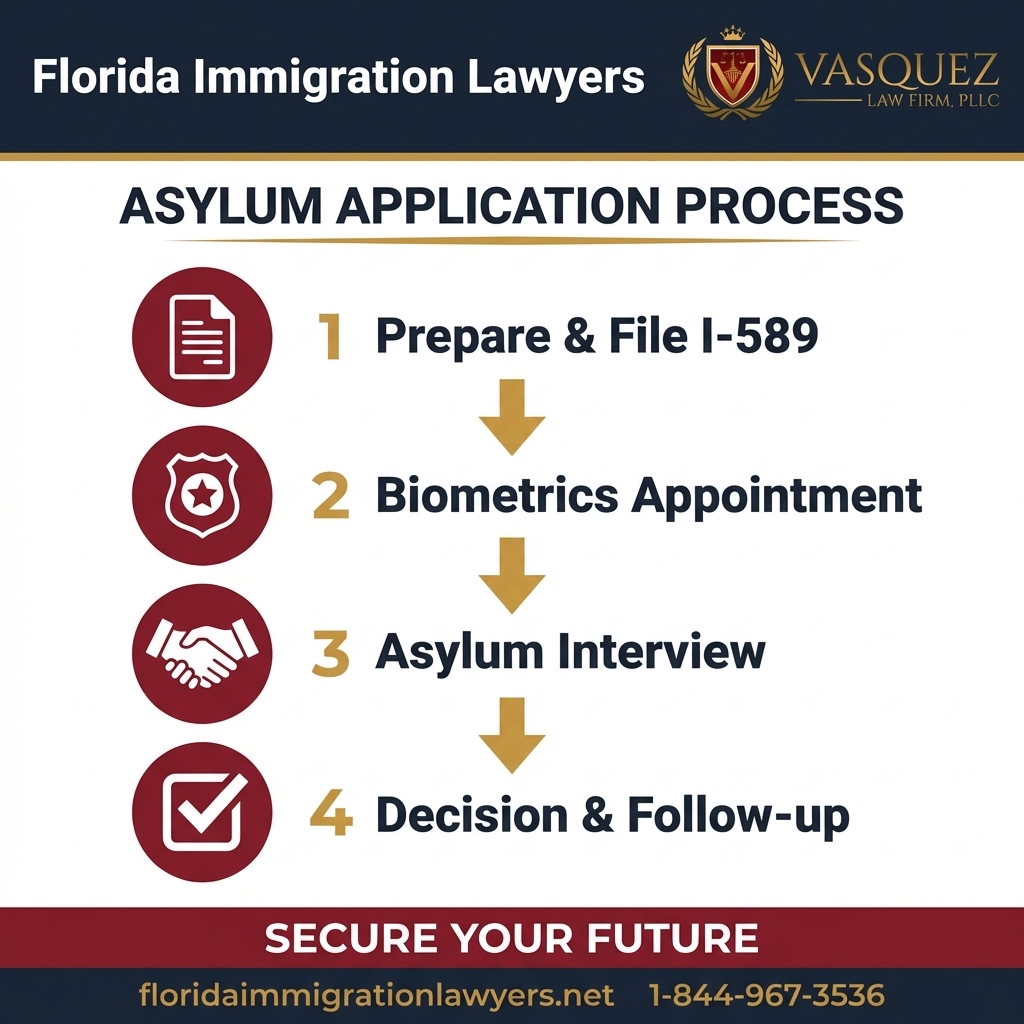
Step 1: Arriving in the U.S. and the One-Year Filing Deadline. Generally, you must file your Form I-589, Application for Asylum and for Withholding of Removal, within one year of your last arrival in the United States. There are limited exceptions to this one-year deadline, such as changed country conditions or extraordinary circumstances, as outlined in INA 208(a)(2)(D). Missing this deadline without a valid exception can lead to denial. It is crucial to act swiftly once you are in Florida and considering asylum.
-
Step 2: Preparing and Filing Form I-589. This is the core of your asylum application. The Form I-589 requires detailed information about your identity, family, travel history, and, most importantly, a comprehensive narrative explaining your fear of persecution. You must clearly articulate the basis of your fear and how it relates to one of the five protected grounds. Accuracy and consistency are vital. You can find the form and instructions on the official USCIS website.
-
Step 3: Biometrics Appointment. After USCIS receives your I-589, you will receive a notice for a biometrics appointment at an Application Support Center (ASC). At this appointment, your fingerprints, photograph, and signature will be collected for background and security checks. This is a mandatory step in the asylum application Florida process.
-
Step 4: The Asylum Interview. If you filed affirmatively, you will be scheduled for an interview with a USCIS Asylum Officer. This interview is a critical part of your case. You will be questioned about the information in your I-589, your fear of persecution, and your personal history. You have the right to have an attorney present at this interview. For those in Tampa, Florida, your interview might take place at the USCIS Asylum Office in Orlando, which serves much of Central Florida.
asylum application florida process - Step-by-Step Process -
Step 5: Decision or Referral to Immigration Court. After your interview, the Asylum Officer will make a decision. If your case is granted, you will receive asylum status. If the Asylum Officer does not grant your asylum claim, and you are not in legal immigration status, your case will typically be referred to an immigration judge for defensive asylum proceedings. This means you will be placed in removal proceedings.
-
Step 6: Immigration Court Proceedings (if referred). If your case is referred, you will receive a Notice to Appear (NTA) in immigration court. Here, an immigration judge will hear your asylum claim. This process involves multiple hearings, presenting evidence, and potentially testifying. An immigration prosecutor will represent the government. This is where the defensive asylum process formally begins, and having an attorney is highly recommended.
For more detailed information on asylum, visit our Asylum practice area page.
Essential Documents for Your Asylum Application
A strong asylum application relies heavily on compelling evidence. Gathering and organizing your documents is a crucial part of the asylum application Florida process. Here is a checklist of common documents:
- Form I-589, Application for Asylum and for Withholding of Removal: The main application form, completed accurately and thoroughly.
- Supporting Affidavit/Declaration: Your detailed personal statement describing your persecution and fear, expanding on the narrative in Form I-589.
- Identification Documents: Copies of your passport, birth certificate, national ID, and any U.S. immigration documents (e.g., I-94 arrival record).
- Country Condition Reports: Official reports from reputable sources (e.g., U.S. Department of State, Amnesty International, Human Rights Watch) detailing human rights abuses or persecution in your home country. These demonstrate general conditions that support your individual claim. You can find relevant information on travel.state.gov.
- Evidence of Persecution: Police reports, medical records, psychological evaluations, photographs, news articles, letters, or witness statements that corroborate your story of past persecution or fear of future persecution.
- Witness Statements: Affidavits from individuals who witnessed your persecution or can attest to your credibility and the conditions in your home country.
- Marriage Certificates, Birth Certificates: For any family members you wish to include in your application.
- Any Other Supporting Evidence: Any document that helps prove your identity, your story, or the conditions in your country.
Remember to submit copies of all documents, never originals, unless specifically requested. All documents not in English must be accompanied by a certified English translation.
Asylum Application Timeline and Processing Expectations in 2026
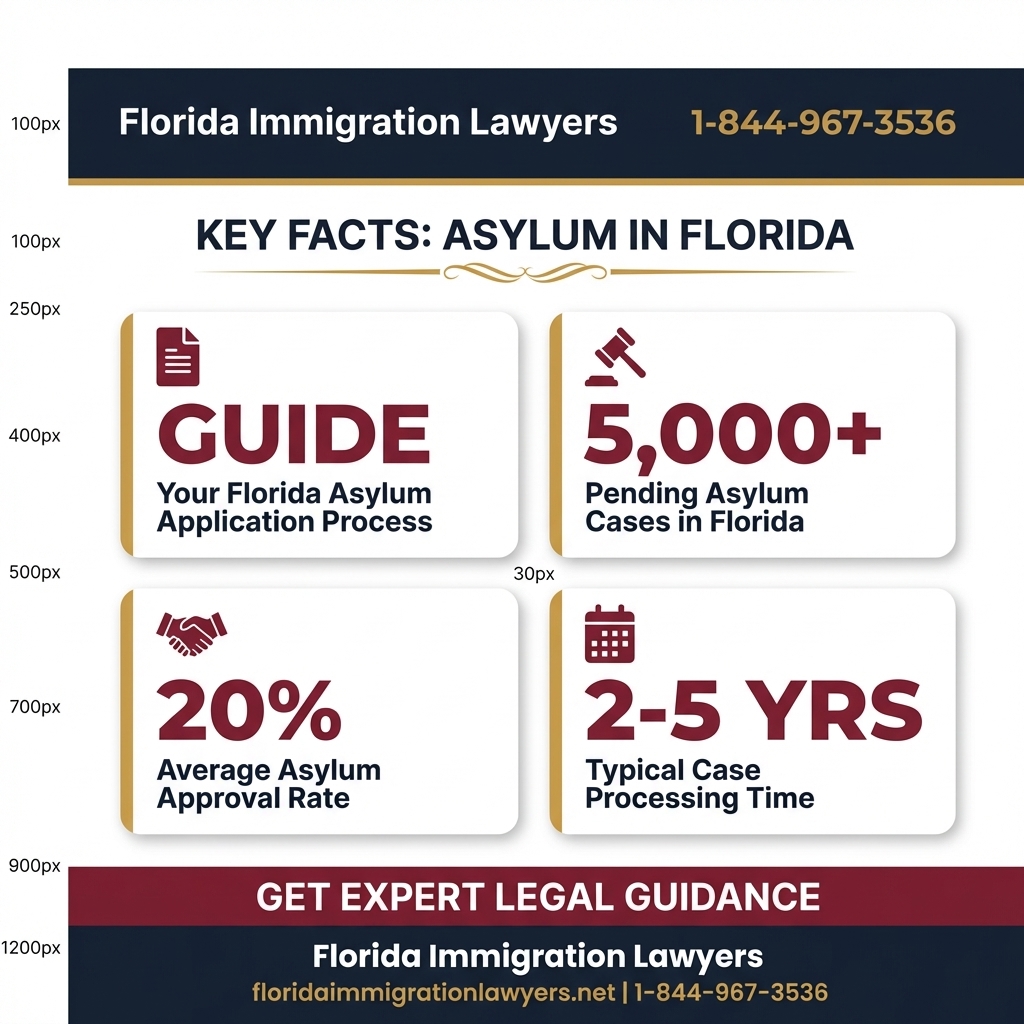
The timeline for the asylum application Florida process can vary significantly, often extending over several years due to backlogs. Here's what you can generally expect:
-
Filing Form I-589: Must be within one year of arrival, unless exceptions apply.
-
Receipt Notice: You typically receive a receipt notice from USCIS within a few weeks of filing.
-
Biometrics Appointment: Usually scheduled 3-8 weeks after filing.
-
Asylum Interview Scheduling: This is where the longest delays often occur. While USCIS aims to schedule interviews quickly, significant backlogs mean it can take months or even years after filing before you receive an interview notice. The Orlando Asylum Office, serving Tampa and Central Florida, faces these same challenges.
asylum application florida process - Key Statistics -
Interview Decision: An Asylum Officer typically issues a decision within two weeks of the interview, though this can sometimes take longer.
-
Immigration Court Proceedings (if referred): If your case goes to court, the process can span several years, involving multiple master calendar hearings and individual merits hearings. The Executive Office for Immigration Review (EOIR) oversees these courts. You can find more information about immigration court at justice.gov/eoir.
It is important to remain patient and ensure all your contact information is up to date with USCIS and, if applicable, with the immigration court. Delays do not mean your case is forgotten; they are often a reflection of the system's capacity.
Cost Factors and Fee Breakdown for Asylum Seekers
One critical piece of information regarding the asylum application Florida process is that **there is no filing fee for Form I-589, Application for Asylum and for Withholding of Removal.** USCIS explicitly states that asylum seekers are not required to pay a fee to apply for asylum.
However, while the application itself is free, you may encounter other associated costs:
-
Biometrics Fee: While the I-589 has no filing fee, there might be a fee for biometrics services in some instances, though typically it is waived for asylum applications. You will be notified if any fee is required.
-
Translation Fees: If any of your supporting documents are not in English, you will incur costs for certified translations. These fees can vary depending on the length and complexity of the documents.
-
Document Collection Fees: You might pay for obtaining official records, such as police reports or medical records from your home country or elsewhere.
-
Medical Examination Fees: If you are granted asylum, you will eventually need to apply for adjustment of status (a Green Card). This application typically requires a medical examination by a USCIS-approved civil surgeon, which incurs a separate fee.
-
Legal Fees: This is often the most significant cost, but also the most valuable investment. While you can file an asylum application without an attorney, legal representation significantly increases your chances of success. An experienced immigration lawyer can help you prepare your application, gather evidence, prepare you for your interview or court hearings, and represent you throughout the entire asylum application Florida process. Florida Immigration Lawyers offers free consultations to discuss your case and potential fees.
Do not navigate this process alone. The complexities of immigration law require expert guidance. **Contact Florida Immigration Lawyers today** for a free consultation to discuss your asylum application and how we can assist you.
Common Mistakes to Avoid in Your Asylum Application
The asylum application Florida process is unforgiving of errors. Avoiding these common mistakes can significantly improve your chances of success:
-
Missing the One-Year Filing Deadline: This is perhaps the most critical mistake. Failing to file Form I-589 within one year of your last arrival in the U.S. without a valid exception can lead to an automatic denial of your asylum claim. Always prioritize this deadline.
-
Incomplete or Inconsistent Form I-589: Providing vague, incomplete, or contradictory information on your application can raise credibility issues. Ensure every section is filled out accurately and consistently with your personal statement and evidence.
-
Lack of Compelling Evidence: Asylum claims require robust evidence. Merely stating a fear is not enough; you must provide documents, affidavits, and country condition reports that corroborate your story and demonstrate a well-founded fear of persecution.
-
Not Preparing for the Asylum Interview: The interview is your chance to explain your story in detail. Many applicants underestimate its importance. Lack of preparation can lead to inconsistent answers, omissions, or a failure to adequately convey your fear.
-
Failing to Disclose All Relevant Information: Hiding information, even if you believe it is minor or embarrassing, can severely damage your credibility. Be truthful and disclose all facts relevant to your case, including any past arrests or immigration violations.
-
Traveling Outside the U.S. Without Authorization: If you apply for asylum and then travel internationally without first obtaining advance parole, your asylum application may be considered abandoned, leading to denial.
-
Not Understanding the Legal Grounds for Asylum: Your fear of persecution must be based on one of the five protected grounds (race, religion, nationality, political opinion, or membership in a particular social group). Many applicants mistakenly base their claims on general violence or economic hardship, which are typically not grounds for asylum.
-
Providing False Information: Any misrepresentation or fraudulent claim on your application or during your interview will lead to a denial of your asylum claim and could result in severe immigration consequences, including a permanent bar from future immigration benefits.
-
Not Seeking Legal Representation: While not mandatory, navigating the complex asylum application Florida process without an attorney is a significant risk. Lawyers provide expertise, help avoid common pitfalls, and advocate on your behalf.
-
Ignoring Changes in Country Conditions: Your case may be strengthened or weakened by evolving conditions in your home country. Staying informed and updating your application with new, relevant country reports is important.
-
Missing Court Dates or Deadlines: If your case is in immigration court, failing to appear for hearings or missing court-ordered deadlines can lead to a removal order being issued against you in absentia.
-
Not Updating Contact Information: Moving without updating your address with USCIS or the immigration court means you could miss crucial notices, interview appointments, or court hearing dates, which can be detrimental to your case.
When to Call a Lawyer for Your Asylum Case
While the decision to hire an attorney is personal, certain situations strongly indicate the need for professional legal assistance, especially when dealing with the asylum application Florida process. Florida Immigration Lawyers are here to help you understand your options and provide robust representation.
-
Complex Persecution Claims: If your case involves intricate legal arguments, multiple forms of persecution, or a less straightforward connection to a protected ground, an attorney can help articulate your claim effectively.
-
Past Criminal History or Immigration Violations: Any prior arrests, convictions, or immigration infractions can complicate your asylum case and potentially make you inadmissible or ineligible. An attorney can assess the impact and help you navigate these issues.
-
You Missed the One-Year Filing Deadline: If you are past the one-year mark, proving an exception requires strong legal arguments and evidence. An attorney can help determine if you qualify for an exception and prepare the necessary documentation.
-
You Are in Removal Proceedings: If you have received a Notice to Appear (NTA) and are facing deportation, you are in a defensive asylum scenario. This is an adversarial legal process in immigration court, and legal representation is almost always essential for a fair chance.
-
Fear of Returning to Your Home Country: If your fear is genuine and profound, but you are unsure how to articulate it legally or gather the necessary evidence, an attorney can provide invaluable guidance and support.
-
Language Barriers or Difficulty Understanding the Process: If English is not your first language, or if the legal jargon is overwhelming, an attorney can ensure you understand every step and that your story is accurately conveyed.
Our experienced attorneys at Florida Immigration Lawyers regularly handle complex asylum cases for individuals across Florida, including Tampa. We understand the unique challenges faced by asylum seekers and are committed to fighting for your right to safety. Visit our contact page to reach out.
About Florida Immigration Lawyers
Florida Immigration Lawyers is a leading immigration law firm dedicated to serving individuals and families across the entire state of Florida. With a deep understanding of U.S. immigration laws and a passion for helping our clients achieve their dreams, we provide compassionate, effective, and results-oriented legal representation.
Our firm specializes in a wide array of immigration services, including asylum applications, deportation defense, family-based immigration, business immigration, and citizenship. We pride ourselves on offering personalized attention to each case, ensuring that your unique story and circumstances are heard and advocated for vigorously.
Why choose Florida Immigration Lawyers? We are available 24/7 to address your urgent needs, offer free initial consultations, and are committed to transparent communication throughout your legal journey. Our experienced team is proficient in handling complex immigration challenges, from initial applications to appeals. Your future in Florida is our priority.
Phone: 1-844-967-3536
Website: https://www.floridaimmigrationlawyers.net
Sources and References
- U.S. Citizenship and Immigration Services (USCIS) - Form I-589, Application for Asylum and for Withholding of Removal
- Executive Office for Immigration Review (EOIR)
- U.S. Department of State - Country Information
- 8 U.S.C. § 1158 (Immigration and Nationality Act Section 208 - Asylum)
- 8 U.S.C. § 1231 (Immigration and Nationality Act Section 241 - Withholding of Removal)
- 8 CFR Part 208 (Code of Federal Regulations - Asylum and Withholding of Removal)
This article provides general legal information and is not intended as legal advice. Every case is unique, and outcomes depend on specific facts and circumstances. Contact an attorney for advice about your particular situation. Immigration laws are subject to change.
Take the First Step Towards Safety in Florida
The decision to seek asylum is profound, and the asylum application Florida process can seem daunting. However, with the right legal guidance, you can navigate these challenges effectively and pursue the safety and stability you deserve. Florida Immigration Lawyers are here to offer the support, expertise, and advocacy you need.
Do not delay in protecting your future. **Call Florida Immigration Lawyers at 1-844-967-3536 for a free consultation.** We are available 24/7 to answer your questions and begin building your strong asylum case. **Se Habla Español - Estamos aquí para ayudarle.**
Do Not Navigate This Process Alone
Our experienced immigration attorneys are ready to fight for you. Get a free, confidential consultation today.
Se Habla Español
Frequently Asked Questions
Florida Immigration Lawyers
Immigration Attorney | Founder, Vasquez Law Firm
U.S. Air Force veteran and immigration attorney with thousands of cases resolved. J.D., NCCU School of Law. AILA member. Admitted to the 4th, 5th, and 11th Circuit Courts.
Available 24/7 - Free Evaluations
Related Legal Services
Our Florida immigration attorneys can help you with citizenship and naturalization, family immigration services and immigration practice areas. Call today at 1-844-967-3536 for a free consultation.
Related Links
Related Topics
Free Legal Consultation
Discuss your case with our experienced attorneys. We're available 24/7.
Se Habla Español - Estamos aquí para ayudarle.
Related Articles
Understanding Citizenship Application Delays in Florida
Facing delays in your citizenship application in Florida? Learn about the causes, how to manage them, and when to seek legal help. Our guide provides insights into the N-400 process and offers practical advice for applicants in Tallahassee. Contact us for a free consultation.
VAWA Self-Petition for Abused Spouse in Florida | VLF Florida
Learn how to file a VAWA self-petition in Florida as an abused spouse. Discover eligibility requirements, process steps, and when to seek legal help. Call Florida Immigration Lawyers for a free consultation.
Navigating the Unlawful Presence Waiver in Florida
Learn about the I-601A provisional waiver for unlawful presence in Florida. This guide covers eligibility, application steps, common mistakes, and why consulting an attorney is crucial. Contact Florida Immigration Lawyers for a free consultation.
Protecting Against Immigration Scams in Florida | VLF Florida
Learn how to protect yourself from immigration scams in Florida, including notario fraud. Discover actionable steps and legal resources. Call Florida Immigration Lawyers at 1-844-967-3536.