Adjustment of Status Florida Guide: Your Path to a Green...
This comprehensive guide from Florida Immigration Lawyers details the adjustment of status process for those seeking a green card while residing in Florida. Learn about eligibility requirements, the step-by-step application process including Form I-485, critical documents needed, and expected timelines. We also highlight common mistakes to avoid and the financial considerations involved. Whether you are in West Palm Beach or elsewhere in Florida, understanding these crucial steps is vital for a successful application. Our firm provides expert legal guidance to help you navigate the complexities of immigration law, ensuring your path to permanent residency is clear and supported. Contact us for a free consultation.

Adjustment of status, also known as filing Form I-485, allows eligible individuals already in the United States to apply for lawful permanent resident status (a green card) without leaving the country. This process is crucial for many immigrants in Florida seeking to formalize their status. Eligibility often depends on having an approved immigrant petition and a visa immediately available.
- Apply for a green card from within the U.S.
- Requires an approved immigrant petition.
- Involves Form I-485, biometrics, and an interview.
- Processing times vary by USCIS field office.
- Legal guidance is highly recommended to avoid delays.
Adjustment of Status Florida Guide: Your Path to a Green Card
Imagine building a life in West Palm Beach, contributing to your community, and establishing roots in Florida, but facing uncertainty about your immigration status. The dream of obtaining a green card, which grants lawful permanent residency, is a crucial step for many individuals and families across our vibrant state. Fortunately, for those already present in the U.S., the adjustment of status process offers a pathway to achieve this without having to return to their home country.
This comprehensive guide from Florida Immigration Lawyers is designed to illuminate the complexities of adjusting your status, particularly for those living in Florida. We understand the unique challenges and opportunities within our state's diverse immigrant communities. Our goal is to provide clear, actionable information to help you understand if you qualify, what steps are involved, and how to successfully navigate the Form I-485 application.
The journey to a green card Florida can be intricate, with specific requirements and potential pitfalls. Whether you are adjusting status through a family petition, employment sponsorship, or asylum, understanding the nuances is vital. We will break down each stage, from eligibility criteria to the final interview, ensuring you are well-prepared. Remember, securing your future in the U.S. is a significant undertaking.
Do not navigate this complex process alone. For personalized advice and dedicated legal support regarding your adjustment of status case in Florida, we are here to help. Call Florida Immigration Lawyers at 1-844-967-3536 for a free consultation today.
Understanding Adjustment of Status (AOS) in Florida
Adjustment of status, as defined under Section 245 of the Immigration and Nationality Act (INA), is the process that allows certain eligible foreign nationals physically present in the United States to apply for lawful permanent resident status. This means you can obtain your green card without leaving the U.S., provided you meet specific statutory and regulatory requirements. This is a critical distinction from consular processing, where applicants must travel to a U.S. embassy or consulate abroad.
For individuals residing in Florida, understanding the local context is important. Florida is home to a vast and diverse immigrant population, and USCIS field offices in cities like Miami, Orlando, and Tampa process a significant number of these applications. The process for adjustment of status typically involves demonstrating that you are admissible to the United States and that an immigrant visa is immediately available to you at the time of filing.
Who is Eligible for Adjustment of Status?
Eligibility for adjustment of status is not universal. Generally, you must meet several key criteria. Most commonly, eligibility stems from an approved immigrant petition, such as an I-130 Petition for Alien Relative (for family-based immigration) or an I-140 Immigrant Petition for Alien Worker (for employment-based immigration). Asylum seekers who have been granted asylum for at least one year may also be eligible to adjust their status.
Furthermore, you must have been lawfully admitted or paroled into the U.S. (with some exceptions) and not have committed certain immigration violations or crimes. The availability of an immigrant visa is checked through the Department of State's Visa Bulletin, which is particularly relevant for family-sponsored and employment-based categories. It is crucial to determine your eligibility accurately before proceeding.
Step-by-Step Guide to the Adjustment of Status Process
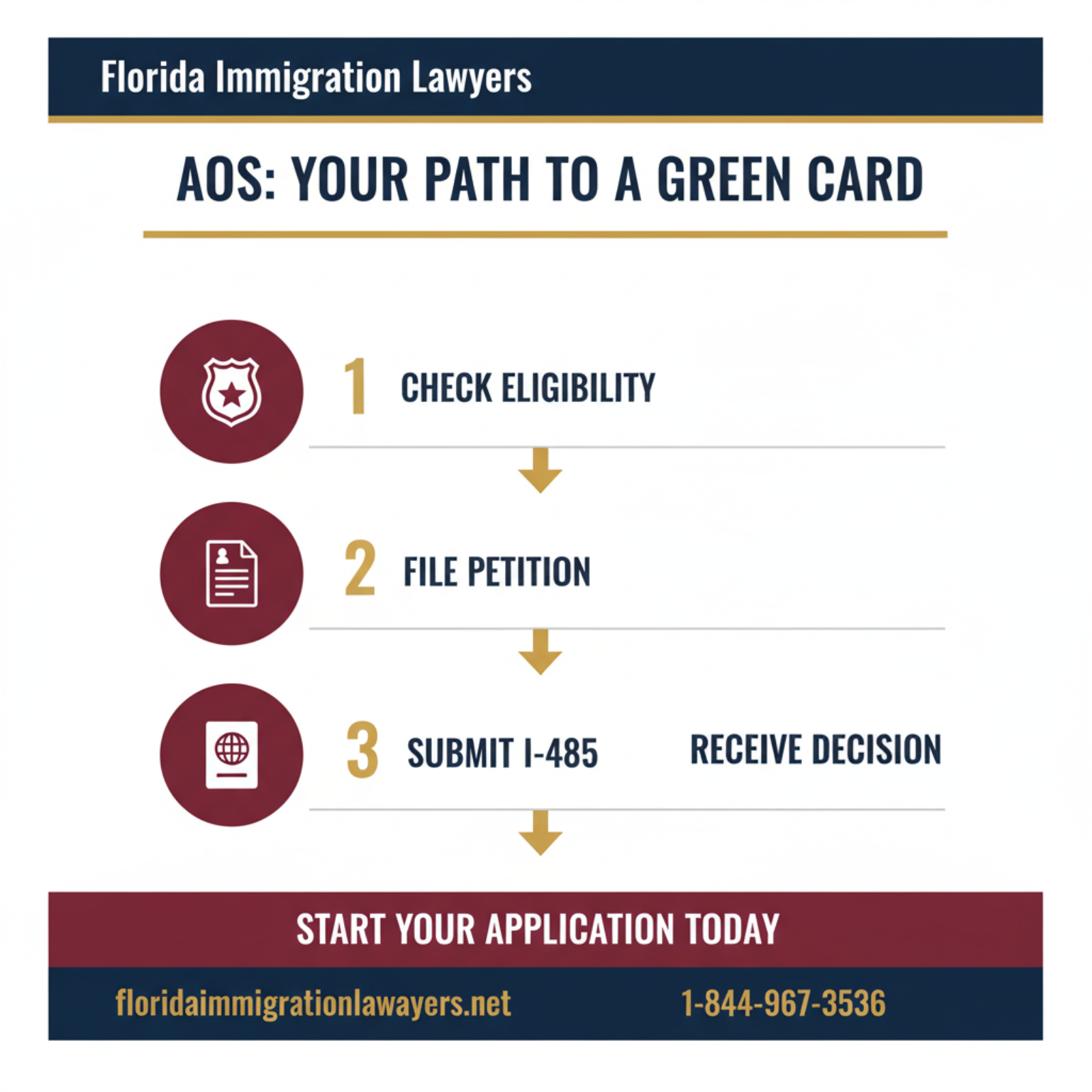
The adjustment of status process can seem daunting, but breaking it down into manageable steps can make it clearer. Here is a typical sequence of events you can expect when applying for your green card Florida.
-
Determine Your Eligibility: Before anything else, you must confirm you are eligible to adjust your status. This involves identifying a qualifying immigrant category (e.g., immediate relative of a U.S. citizen, employment-based, asylum) and ensuring you meet all statutory requirements under INA 245. Factors like your entry into the U.S., any prior immigration violations, and criminal history will be reviewed.
Understanding the specific requirements for your situation is paramount. Consulting with an experienced immigration attorney in West Palm Beach can help you assess your eligibility accurately and avoid potential issues.
-
File an Immigrant Petition (if applicable): For most family-based and employment-based categories, a sponsor (a U.S. citizen or lawful permanent resident family member, or an employer) must first file an immigrant petition on your behalf. This is typically Form I-130, Petition for Alien Relative, or Form I-140, Immigrant Petition for Alien Worker.
The petition must be approved by USCIS before you can proceed with your I-485 application. For immediate relatives of U.S. citizens, the petition and the adjustment application can often be filed concurrently, streamlining the process.
-
File Form I-485, Application to Register Permanent Residence or Adjust Status: Once an immigrant visa is available (or concurrently filed), you will submit Form I-485 along with all required supporting documentation. This is the core application for adjustment of status.
You will also typically file Form I-765 for Employment Authorization Document (EAD) and Form I-131 for Advance Parole, allowing you to work and travel internationally while your I-485 is pending. These applications are often filed together with your I-485 packet.
-
Attend Biometrics Appointment: After filing your I-485, USCIS will send you an appointment notice for biometrics collection. This appointment typically takes place at an Application Support Center (ASC) in Florida, such as those near West Palm Beach.
At this appointment, your fingerprints, photograph, and signature will be collected. These biometrics are used for background checks and identity verification. It is essential to attend this appointment as scheduled.
-
Attend the Interview (if required): Most adjustment of status applicants, especially those based on family petitions, will be scheduled for an interview at a local USCIS field office in Florida. This interview is conducted by an immigration officer who will review your application, ask questions about your eligibility, and verify the information provided.
For family-based petitions, the interviewing officer will assess the bona fides of the relationship. Both the applicant and the petitioner typically attend this interview. Being well-prepared and honest is critical during this stage.
-
Receive a Decision: Following the interview (or if an interview is waived), USCIS will make a decision on your I-485 application. If approved, you will receive a welcome notice and your physical green card will be mailed to you. If denied, USCIS will provide a written explanation for the denial.
In case of a denial, it is crucial to consult with an immigration attorney immediately to understand your options, which may include filing a motion to reopen or reconsider, or appealing the decision.
Essential Document Checklist for Your I-485 Application
Submitting a complete and accurate application packet is paramount for a smooth adjustment of status process. Missing or incorrect documents can lead to delays or even denials. Here is a general checklist of documents commonly required for Form I-485:
- Form I-485, Application to Register Permanent Residence or Adjust Status
- Form I-765, Application for Employment Authorization (optional, but recommended)
- Form I-131, Application for Travel Document (optional, but recommended for advance parole)
- Form I-864, Affidavit of Support (for family-based and some employment-based cases)
- Form I-693, Report of Medical Examination and Vaccination Record (must be completed by a USCIS-approved civil surgeon)
- Copy of your birth certificate
- Copy of your passport biographical page
- Copies of all visa pages and admission stamps in your passport
- Copies of your Form I-94, Arrival/Departure Record
- Two passport-style photos
- Copy of the approved immigrant petition (e.g., Form I-130, I-140, or asylum approval notice)
- Proof of continuous lawful presence in the U.S. (e.g., previous I-797 approval notices, EADs)
- Marriage certificate (if applying through marriage to a U.S. citizen)
- Divorce decrees for any previous marriages (for both applicant and petitioner, if applicable)
- Police clearances from countries where you lived (if applicable)
- Certified copies of any court records relating to criminal charges, arrests, or convictions (if applicable)
Always refer to the specific USCIS instructions for Form I-485 and the type of immigrant petition you are using, as requirements can vary. Our Florida Immigration Lawyers team can help you compile a robust application packet.
Timeline and Processing Expectations for Adjustment of Status
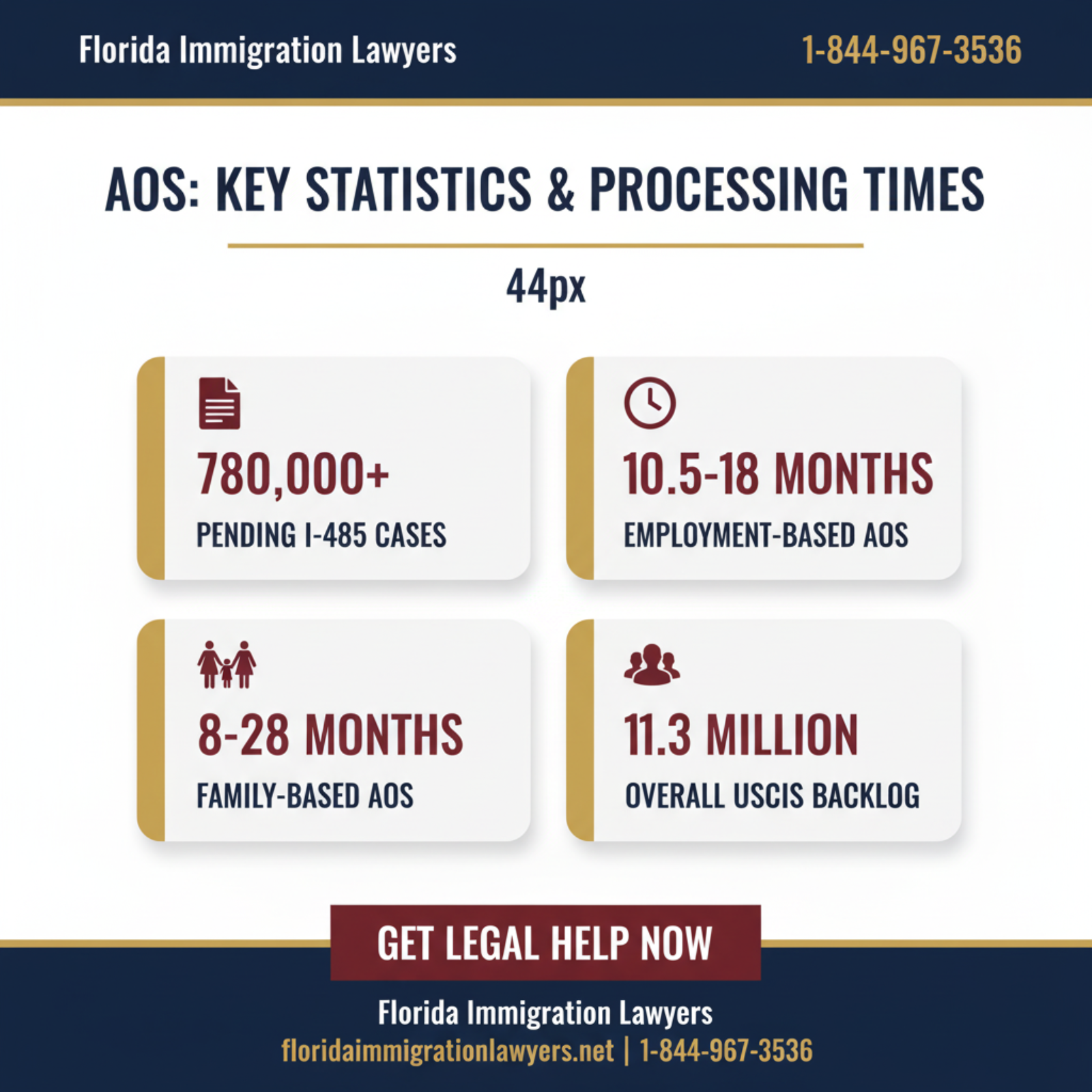
The processing time for an adjustment of status application can vary significantly depending on several factors. These include the USCIS field office processing your case (e.g., Miami, Orlando, Tampa), the specific immigrant category you are applying under, the current USCIS workload, and the completeness of your application.
Immediate relatives of U.S. citizens (spouses, unmarried children under 21, and parents) generally experience faster processing times because an immigrant visa is always immediately available. Other categories, such as family-sponsored preferences or some employment-based categories, are subject to visa bulletin availability, which can add years to the wait time.
Typical Processing Stages:
- Receipt Notice: Within a few weeks of filing, you will receive a Form I-797C Notice of Action confirming receipt of your application.
- Biometrics Appointment: Typically scheduled 3-8 weeks after filing.
- Employment Authorization (EAD) & Advance Parole: If filed concurrently, these documents often arrive within 6-12 months, allowing you to work and travel while your I-485 is pending.
- Interview Scheduling: Varies greatly. Some cases are processed within 8-14 months, while others can take 24 months or longer, especially in high-volume Florida offices.
- Final Decision: Usually follows the interview within a few weeks to several months.
You can check estimated processing times on the USCIS website for the specific service center or field office handling your case. Keep in mind these are estimates and can change without notice. The availability of a visa number for your category is also critical and can be monitored via the Department of State's monthly Visa Bulletin (travel.state.gov).
Cost Factors and Fee Breakdown for I-485
Applying for adjustment of status involves several fees that applicants should be aware of. These fees are set by USCIS and are subject to change, so it is crucial to always check the most current fee schedule on the official USCIS website before filing. Do not send specific fee amounts as they are subject to change. The fees generally include:
- Form I-485 Filing Fee: This is the primary fee for the adjustment of status application itself.
- Biometrics Services Fee: A separate fee for the collection of your fingerprints and photograph.
- Form I-130 or I-140 Filing Fee: If an immigrant petition is filed on your behalf, there will be a separate fee for that petition.
- Medical Examination Fee: This fee is paid directly to the USCIS-approved civil surgeon who conducts your medical exam. This cost varies by provider and is not paid to USCIS.
- Legal Fees: While not mandatory, retaining an experienced immigration attorney from Florida Immigration Lawyers can be an invaluable investment. Our fees cover case assessment, document preparation, legal advice, representation at interviews, and communication with USCIS.
It is important to budget for all these components to ensure your application is processed without delays due to insufficient payment. USCIS does offer fee waivers for certain low-income applicants for some forms, but eligibility is strict and not available for all applications. Always verify the current fees and fee waiver eligibility directly on the USCIS website (uscis.gov).
The financial aspect of the immigration process can be a concern for many families in West Palm Beach and across Florida. Understanding these costs upfront helps in planning effectively. We encourage you to discuss all potential costs, including legal fees, during your free consultation with our firm.
Do not navigate this process alone. The complexities of the adjustment of status can be overwhelming, and even minor errors can lead to significant delays or denials. Contact Florida Immigration Lawyers today to ensure your application is handled with precision and care.
Common Mistakes to Avoid During Adjustment of Status
The I-485 application is highly detailed, and even small errors can have significant consequences. Avoiding these common pitfalls is crucial for a successful green card Florida application:
-
Filing Without Proper Eligibility: Many applicants mistakenly believe they are eligible when they are not, often due to unlawful entry, certain criminal convictions, or previous immigration violations. Filing without eligibility will lead to denial and may create further immigration complications.
-
Incomplete or Inaccurate Forms: Failing to answer all questions truthfully and completely, or missing signatures, are common errors. USCIS will reject or deny applications that are incomplete or contain inconsistent information, causing significant delays.
-
Missing or Incorrect Supporting Documents: Not including all required evidence, such as birth certificates, marriage certificates, or financial documents, is a frequent issue. This often results in a Request for Evidence (RFE), prolonging the processing time.
-
Failing the Medical Examination or Submitting an Expired One: The Form I-693 medical exam must be completed by a USCIS-approved civil surgeon and submitted in a sealed envelope. An incomplete or expired medical exam will lead to an RFE or denial.
-
Traveling Internationally Without Advance Parole: If you leave the U.S. while your I-485 is pending without first obtaining an Advance Parole document (Form I-131), your adjustment of status application may be considered abandoned, leading to denial.
-
Misunderstanding the 90-Day Rule: This informal rule suggests that if you apply for a green card within 90 days of entering the U.S. on a non-immigrant visa, USCIS may presume you misrepresented your intent to enter. While not a formal law, it can trigger scrutiny and accusations of visa fraud.
-
Not Disclosing All Relevant Information: Hiding or omitting information, particularly about past arrests, immigration violations, or previous marriages, can be considered misrepresentation or fraud. This can lead to permanent bars from the U.S. and severe penalties.
When to Call a Florida Immigration Lawyer
While some straightforward adjustment of status cases might seem manageable, the truth is that the U.S. immigration process is incredibly complex and constantly evolving. This is especially true in Florida, where recent state-level immigration policies and increased federal enforcement activities (like those highlighted by Operation Tidal Wave or 287(g) partnerships) can add layers of concern for immigrants. Knowing when to seek legal counsel is crucial for protecting your rights and ensuring a successful outcome.
You should consider contacting Florida Immigration Lawyers if any of the following scenarios apply to your situation:
- Complex Eligibility Issues: If your entry to the U.S. was not entirely lawful, you have had previous deportations, or you are unsure about your eligibility under INA 245.
- Criminal History: Any past arrests, charges, or convictions, even minor ones, can complicate your I-485 application and may require waivers of inadmissibility.
- Previous Denials or Immigration Violations: If you have had prior visa denials, deportation orders, or overstayed a previous visa.
- Misrepresentation or Fraud Concerns: If you are worried about the 90-day rule or any past actions that could be interpreted as misrepresentation.
- Difficult Family Relationships: Cases involving domestic violence, child abuse, or complex marital histories require sensitive and expert handling.
- Expedited Processing Needs: If you have an urgent need for your green card or work authorization due to humanitarian reasons.
- You Received a Request for Evidence (RFE) or Notice of Intent to Deny (NOID): These notices indicate that USCIS has concerns about your application, and a swift, expert response is necessary.
- You are in Immigration Court Proceedings: If you are currently in deportation defense proceedings but may be eligible to adjust status.
Our experienced team at Florida Immigration Lawyers is dedicated to serving clients throughout Florida, including West Palm Beach, Miami, Orlando, and Tampa. We specialize in immigration law, family immigration, business immigration, asylum, and citizenship. We are here to provide the peace of mind that comes with professional legal representation.
About Florida Immigration Lawyers
Florida Immigration Lawyers is a premier immigration law firm dedicated to serving individuals and businesses across the entire state of Florida. With a deep understanding of U.S. immigration laws and the unique needs of our diverse communities, we are committed to providing compassionate, effective, and results-driven legal representation.
Our team of highly skilled attorneys specializes in a wide range of immigration services, including family-based petitions, employment visas, deportation defense, asylum claims, citizenship applications, and, of course, adjustment of status. We pride ourselves on our client-focused approach, ensuring that every individual receives personalized attention and strategic advice tailored to their specific situation.
Why Choose Florida Immigration Lawyers?
- Experienced Advocates: Our attorneys possess extensive experience in navigating complex immigration cases.
- Statewide Reach: We serve clients in all Florida cities, from West Palm Beach to Jacksonville, Miami to Pensacola.
- Bilingual Services: Our team is fluent in English and Spanish, ensuring clear communication and cultural understanding.
- 24/7 Availability: We understand that immigration issues do not adhere to business hours, which is why we are available around the clock.
- Free Consultations: We offer a free initial consultation to discuss your case and outline your best legal options.
Your journey to a secure future in the U.S. is our priority. Let us be your trusted guide through the immigration process. Visit our website at https://www.floridaimmigrationlawyers.net or call us directly at 1-844-967-3536 to schedule your free consultation.
Sources and References
- U.S. Citizenship and Immigration Services (USCIS)
- USCIS Filing Fees
- U.S. Department of State Visa Bulletin
- Executive Office for Immigration Review (EOIR)
- 8 U.S.C. § 1255 - Adjustment of Status of Nonimmigrant to That of Person Admitted for Permanent Residence (Immigration and Nationality Act Section 245)
- 8 CFR Part 245 - Adjustment of Status to That of Person Admitted for Permanent Residence
- USCIS Policy Manual, Volume 7 - Adjustment of Status
This article provides general legal information and is not intended as legal advice. Every case is unique, and outcomes depend on specific facts and circumstances. Contact an attorney for advice about your particular situation.
Embarking on the adjustment of status journey in Florida can be life-changing. Do not let the complexities deter you. With the right legal partner, you can navigate this path confidently and efficiently. We are committed to helping you achieve your American dream.
For dedicated legal assistance with your adjustment of status or any other immigration matter in Florida, call Florida Immigration Lawyers at 1-844-967-3536 for a free consultation. Se Habla Español - Estamos aquí para ayudarle.
Do Not Navigate This Process Alone
Our experienced immigration attorneys are ready to fight for you. Get a free, confidential consultation today.
Se Habla Español
Frequently Asked Questions
Florida Immigration Lawyers
Immigration Attorney | Founder, Vasquez Law Firm
U.S. Air Force veteran and immigration attorney with thousands of cases resolved. J.D., NCCU School of Law. AILA member. Admitted to the 4th, 5th, and 11th Circuit Courts.
Available 24/7 - Free Evaluations
Related Legal Services
Our Florida immigration attorneys can help you with experienced immigration attorneys, business immigration and asylum protection. Call today at 1-844-967-3536 for a free consultation.
Related Links
Related Topics
Free Legal Consultation
Discuss your case with our experienced attorneys. We're available 24/7.
Se Habla Español - Estamos aquí para ayudarle.
Related Articles
Family Petition Immigration Lawyer Miami: Your Florida Guide
For families in Miami, Kissimmee, and across Florida, securing a family petition is often the first step towards reuniting with loved ones in the U.S. This process, which typically begins with filing Form I-130, Petition for Alien Relative, requires meticulous attention to detail and a thorough understanding of U.S. immigration law. From proving a legitimate family relationship to navigating extensive documentation and often lengthy processing times, the journey can be complex. An experienced family petition immigration lawyer can provide invaluable guidance, helping to avoid common pitfalls, respond to USCIS requests, and ensure a smooth application process. Florida Immigration Lawyers offers dedicated legal support to families statewide, helping them achieve their dreams of reunification.
Immigration Interview Preparation Florida: Your Guide
Preparing for your immigration interview in Florida is a pivotal step towards securing your future. This comprehensive guide provides essential tips, a detailed step-by-step preparation plan, and a crucial document checklist to ensure you are fully ready for your USCIS interview. Learn about common mistakes to avoid, understand processing timelines, and identify when legal assistance from experienced Florida immigration lawyers is vital. Whether you are in Hialeah, Miami, or Orlando, navigating your green card, naturalization, or asylum interview requires meticulous attention to detail and professional guidance. Florida Immigration Lawyers offers free consultations to help you prepare effectively and confidently.
DACA Renewal Florida 2026 Guide for Dreamers | VLF Florida
For DACA recipients in Florida, understanding the DACA renewal process for 2026 is vital. This comprehensive guide details eligibility, step-by-step procedures, essential documents, timelines, and costs. Learn how to file your Form I-821D and I-765, avoid common mistakes, and ensure continuous residence. We cover specific considerations for Dreamers in St. Petersburg and across Florida, emphasizing the importance of timely and accurate submissions to USCIS. Discover when legal assistance from Florida Immigration Lawyers can be crucial, especially for complex cases involving criminal history or travel outside the U.S. Get expert advice to protect your deferred action status and employment authorization.
DACA Renewal Florida 2026 Guide for Dreamers | VLF Florida
Learn how to renew your DACA in Florida for 2026. This guide provides essential steps, common pitfalls, and resources available to Dreamers in Hialeah and beyond. Call Florida Immigration Lawyers at 1-844-967-3536 for a free consultation.