Work Permit Florida Application: Get Your EAD in 2026
For many non-citizens in Florida, obtaining a work permit (EAD) is essential to work legally. This comprehensive guide from Florida Immigration Lawyers covers the step-by-step application process for Form I-765, eligibility criteria, required documents, and what to expect regarding processing times and costs in 2026. We highlight critical mistakes to avoid and explain when seeking legal counsel is vital, especially for residents in Naples and across the state. Our expert team is dedicated to helping you navigate the complexities of immigration law to secure your employment authorization. Learn how to prepare a strong application and avoid common pitfalls, ensuring a smoother journey towards your career goals in Florida. Contact us for a free consultation to discuss your EAD application.

Obtaining a work permit, officially known as an Employment Authorization Document (EAD), is crucial for many non-citizens in Florida who wish to work legally. The application process, primarily through USCIS Form I-765, involves proving eligibility under specific immigration categories, submitting comprehensive documentation, and navigating processing times. While generally straightforward for eligible applicants, common pitfalls can lead to delays or denials. Consulting with experienced legal counsel from Florida Immigration Lawyers can significantly enhance your chances of a successful application in 2026, ensuring all requirements are met and potential issues are addressed proactively.
- An EAD allows non-citizens to legally work in the U.S.
- Eligibility varies based on your specific immigration status.
- The primary application is USCIS Form I-765.
- Accurate documentation and timely submission are critical.
- Legal assistance can simplify the complex process.
Dreaming of building a career and contributing to Florida's vibrant economy? For many non-citizens residing in the Sunshine State, securing a work permit is the essential first step toward achieving that dream. This Employment Authorization Document (EAD), also known as Form I-765, allows you to legally accept employment in the United States. The application process can seem daunting, filled with specific requirements and potential pitfalls that might delay your journey toward employment.
This comprehensive guide from Florida Immigration Lawyers is designed to demystify the EAD application process for individuals across Florida, from Naples to Jacksonville. We will walk you through eligibility criteria, detailed steps, required documents, and what to expect regarding timelines and costs in 2026. Our goal is to provide you with the knowledge needed to navigate this crucial immigration step with confidence. Do not hesitate to call Florida Immigration Lawyers at 1-844-967-3536 for a free consultation to discuss your specific situation.
Understanding Your Florida Work Permit (EAD): What You Need to Know
An Employment Authorization Document (EAD) is a permit issued by the U.S. Citizenship and Immigration Services (USCIS) that grants non-citizens legal permission to work in the United States. For individuals living in Florida, whether in bustling cities like Miami or quieter communities like Naples, obtaining an EAD is fundamental for legal employment. Without it, engaging in unauthorized employment can lead to severe immigration consequences, including potential deportation, as outlined in 8 U.S.C. § 1324a.
Eligibility for a work permit is tied to various immigration statuses and categories. Common categories include individuals with pending asylum applications, those applying for adjustment of status to lawful permanent resident, beneficiaries of Temporary Protected Status (TPS), certain students with Optional Practical Training (OPT), and spouses of certain visa holders. Each category has distinct requirements and documentation needs, making it crucial to understand your specific eligibility before applying. This document is not a visa or a green card, but rather proof that you are authorized to work while your underlying immigration status is being processed or maintained.
The EAD is vital for integrating into the Florida workforce, enabling you to secure jobs, pay taxes, and support yourself and your family. It provides stability and peace of mind, knowing that your employment is legal and protected. For example, an asylum applicant in Florida who has waited more than 180 days after filing their Form I-589 application may be eligible for an EAD. Similarly, individuals in Florida who have filed Form I-485 for adjustment of status often apply for an EAD concurrently to bridge the gap until their green card is approved. Understanding your specific pathway is the first critical step.
Florida Immigration Lawyers has extensive experience assisting clients throughout the state, including those seeking asylum or pursuing family-based immigration. We understand the unique challenges faced by immigrants in Florida and are committed to guiding you through the EAD application process. The EAD is a temporary document, usually valid for one or two years, and often requires renewal. Planning for renewal is just as important as the initial application to avoid any lapse in employment authorization.
The Step-by-Step Process for Your EAD Application in Florida
Applying for a work permit in Florida involves a series of detailed steps. Following these steps carefully is essential to avoid common mistakes and ensure a smooth process. Remember, accuracy and completeness are paramount when dealing with USCIS. This guide outlines the typical journey for most applicants in 2026.
Step 1: Determine Your Eligibility Category
Before you begin, you must confirm that you fall into an eligible category for an EAD. USCIS lists numerous categories, such as refugees, asylum seekers, individuals with pending adjustment of status applications, and certain non-immigrants. For example, an individual who has filed for asylum with the Miami Asylum Office may be eligible to apply for an EAD 180 days after their asylum application is received. Spouses of L-1 or E visa holders in Florida may also be eligible. Thoroughly review the instructions for Form I-765 and 8 CFR 274a.12 to identify your specific category.
Step 2: Complete Form I-765, Application for Employment Authorization
This is the core of your EAD application. Fill out Form I-765 meticulously, providing accurate and consistent information. Any discrepancies with previous immigration filings could lead to delays or Requests for Evidence (RFEs). Ensure you select the correct eligibility category code on the form. For example, if you are an asylum applicant, you would typically use category (c)(8). If you are applying for adjustment of status, you would use category (c)(9).
Step 3: Gather All Required Supporting Documents
Each eligibility category has specific documentation requirements. Generally, you will need proof of identity, nationality, immigration status, and evidence supporting your eligibility category. This might include copies of your passport, I-94 arrival/departure record, previous EADs, marriage certificates, birth certificates, or receipts for other pending immigration applications. Refer to the detailed checklist in the next section for a comprehensive list.
Step 4: Pay the Filing Fee or Request a Fee Waiver
As of 2026, USCIS requires a filing fee for most EAD applications, though the exact amount can change. You can pay by money order, personal check, cashier's check, or credit card using Form G-1450. Certain applicants may be eligible for a fee waiver if they can demonstrate an inability to pay. This typically involves submitting Form I-912, Request for Fee Waiver, along with supporting financial documentation. Consult the USCIS website for the most current fee information.
Step 5: Assemble and Mail Your Application Package
Once you have completed the form, gathered all documents, and prepared the fee, assemble your application package in the order specified by USCIS. Ensure all copies are clear and legible. Send your package to the correct USCIS Lockbox facility based on your eligibility category and mailing address. For Florida residents, this often means sending to a lockbox in Texas or Arizona. Some categories now allow for online filing, which can sometimes expedite processing.
Step 6: Attend Your Biometrics Appointment
After USCIS accepts your application, you will typically receive an appointment notice (Form I-797C) for a biometrics services appointment at an Application Support Center (ASC). In Florida, ASCs are located in cities like Miami, Orlando, Tampa, and Jacksonville. At this appointment, your fingerprints, photograph, and signature will be taken. This data is used for background checks and identity verification. Missing this appointment without rescheduling can lead to denial of your application.
Step 7: Respond to Requests for Evidence (RFEs)
During processing, USCIS may issue an RFE if they need additional information or clarification to make a decision on your application. It is crucial to respond to an RFE promptly and thoroughly by the specified deadline. Failure to do so will likely result in a denial. An RFE does not necessarily mean your case is in trouble, but it indicates that more information is needed to establish your eligibility.
Step 8: Receive a Decision
Eventually, you will receive a decision notice from USCIS. If approved, your EAD card will be mailed to you. If denied, the notice will explain the reasons for the denial. An approval means you are authorized to work legally in the U.S. for the specified validity period. A denial can often be challenged or the application refiled, especially with legal guidance. Keep your EAD card safe, as it is a vital document for employment and identification.
Essential Document Checklist for Your Florida Work Permit Application
A complete and accurate submission of documents is paramount for a successful work permit application in Florida. Missing or incorrect documents are among the most common reasons for delays or denials. Use this checklist as a general guide, but always refer to the specific instructions for Form I-765 and your particular eligibility category on the USCIS website for the most up-to-date requirements. Organize your documents clearly before mailing.
- Form I-765, Application for Employment Authorization: The original, signed form. Ensure all sections are filled out completely and accurately, including your eligibility category code.
- Two Passport-Style Photos: Recent (taken within 30 days of filing), unmounted, full-face, passport-style color photographs. Write your name and A-Number (if applicable) lightly in pencil on the back of each photo.
- Copy of Form I-94, Arrival/Departure Record: If you entered the U.S. legally. You can retrieve this electronically from the CBP website.
- Copy of Your Last EAD Card (if applicable): If you are applying for a renewal or replacement of a previously issued EAD. Both front and back copies are needed.
- Copy of Government-Issued Photo Identification: Such as your passport identity page, driver's license (even if expired), or state ID.
- Proof of Identity and Nationality: Copy of your birth certificate with a certified English translation if not in English, or a copy of your passport.
- Evidence of Your Eligibility Category: This is highly specific. Examples include:
- Asylum Applicants: Copy of Form I-589, Application for Asylum and for Withholding of Removal, and the USCIS receipt notice (Form I-797C) showing your asylum application was filed and pending for 180 days or more.
- Adjustment of Status Applicants: Copy of Form I-485, Application to Register Permanent Residence or Adjust Status, and the USCIS receipt notice.
- TPS Beneficiaries: Copy of your Form I-821 approval notice or a copy of your most recent EAD under TPS.
- F-1 OPT Students: Copy of your Form I-20, Certificate of Eligibility for Nonimmigrant Student Status, endorsed for OPT, and academic transcripts.
- Spouses of E or L Visa Holders: Copy of your spouse's Form I-797 approval notice for their E or L status, your marriage certificate, and your spouse's E or L visa stamp.
- Filing Fee or Fee Waiver Request (Form I-912): Include the check, money order, or Form G-1450.
- Any Previous Immigration Documents: Copies of any notices, approvals, or denials from USCIS related to your current status.
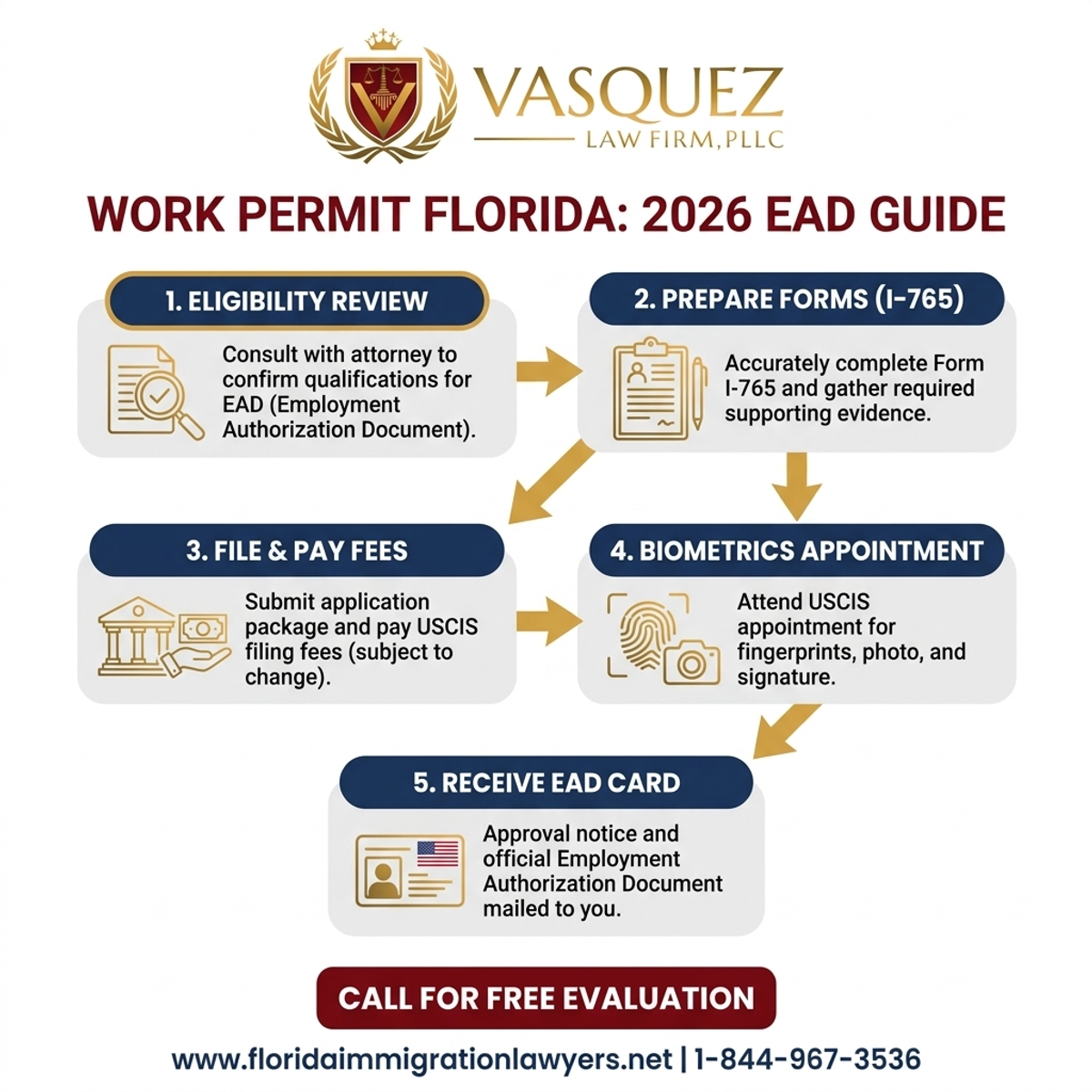
Step-by-Step Process — Work Permit Florida Application: Get Your EAD in 2026
Always make copies of your entire application package before mailing it. This will serve as your personal record and can be invaluable if USCIS requests further information or if your original package is lost.
Work Permit EAD Processing Times and Expectations in Florida for 2026
Understanding the processing times for your work permit application is crucial for planning your future employment in Florida. USCIS processing times can vary significantly based on the specific EAD eligibility category, the volume of applications, and the particular service center handling your case. While there are general estimates, it is important to remember that these are not guarantees. As of 2026, applicants typically experience processing times ranging from 6 to 12 months, though some cases may be resolved faster or take considerably longer.
Factors that can influence your EAD processing time include the completeness and accuracy of your initial submission. Applications with missing documents or errors often face delays due to Requests for Evidence (RFEs), which can add several months to the process. The specific USCIS service center (e.g., Nebraska Service Center, Texas Service Center) that processes your application also impacts the timeline, as each center has its own workload and backlogs. You can check current processing times on the USCIS website by selecting Form I-765 and your specific eligibility category.
For Florida residents, certain categories might experience unique fluctuations. For instance, asylum-based EADs might be influenced by the heavy caseloads at immigration courts in Miami and Orlando, which are under the jurisdiction of the Executive Office for Immigration Review (EOIR). Applicants for adjustment of status in Florida may also see their EAD processing tied to the overall progress of their green card application. Renewing your EAD requires foresight; it is generally recommended to file your renewal application at least 120-180 days before your current EAD expires to prevent any lapse in employment authorization.
In limited circumstances, you may be eligible to request expedited processing for your EAD. USCIS considers requests for expedited processing on a case-by-case basis under specific criteria, such as severe financial hardship, urgent humanitarian reasons, or national interest. Providing compelling evidence for your expedite request is essential, and even then, approval is not guaranteed. Florida Immigration Lawyers can help you assess if your situation meets the criteria for an expedite request and assist in preparing a strong submission. Proactive communication and meticulous preparation are key to managing expectations and minimizing delays.
Cost Factors and Fee Breakdown for a Florida Work Permit Application
Understanding the financial aspects of applying for a work permit in Florida is a crucial part of the process. The total cost can vary depending on your eligibility category, whether you qualify for a fee waiver, and if you choose to hire legal representation. It is important to budget for these expenses to avoid any unexpected financial burdens that could delay your application.
The primary cost associated with an EAD application is the USCIS filing fee for Form I-765. This fee is subject to change, so always refer to the official USCIS website or consult with an attorney for the most current amount. Certain categories of applicants, such as asylum seekers who have had their application pending for over 150 days, are often exempt from this fee. Additionally, some applicants may need to pay a biometrics services fee, which covers the cost of fingerprinting and background checks. This fee is typically combined with the filing fee, or may be waived if you qualify for a fee waiver.
Beyond the government fees, you should consider other potential costs. These include expenses for obtaining necessary supporting documents, such as birth certificates, marriage certificates, or academic transcripts. If any of your documents are not in English, you will incur translation fees for certified English translations. Passport-style photographs also come with a small cost. These seemingly minor expenses can add up, so it is wise to account for them in your financial planning.
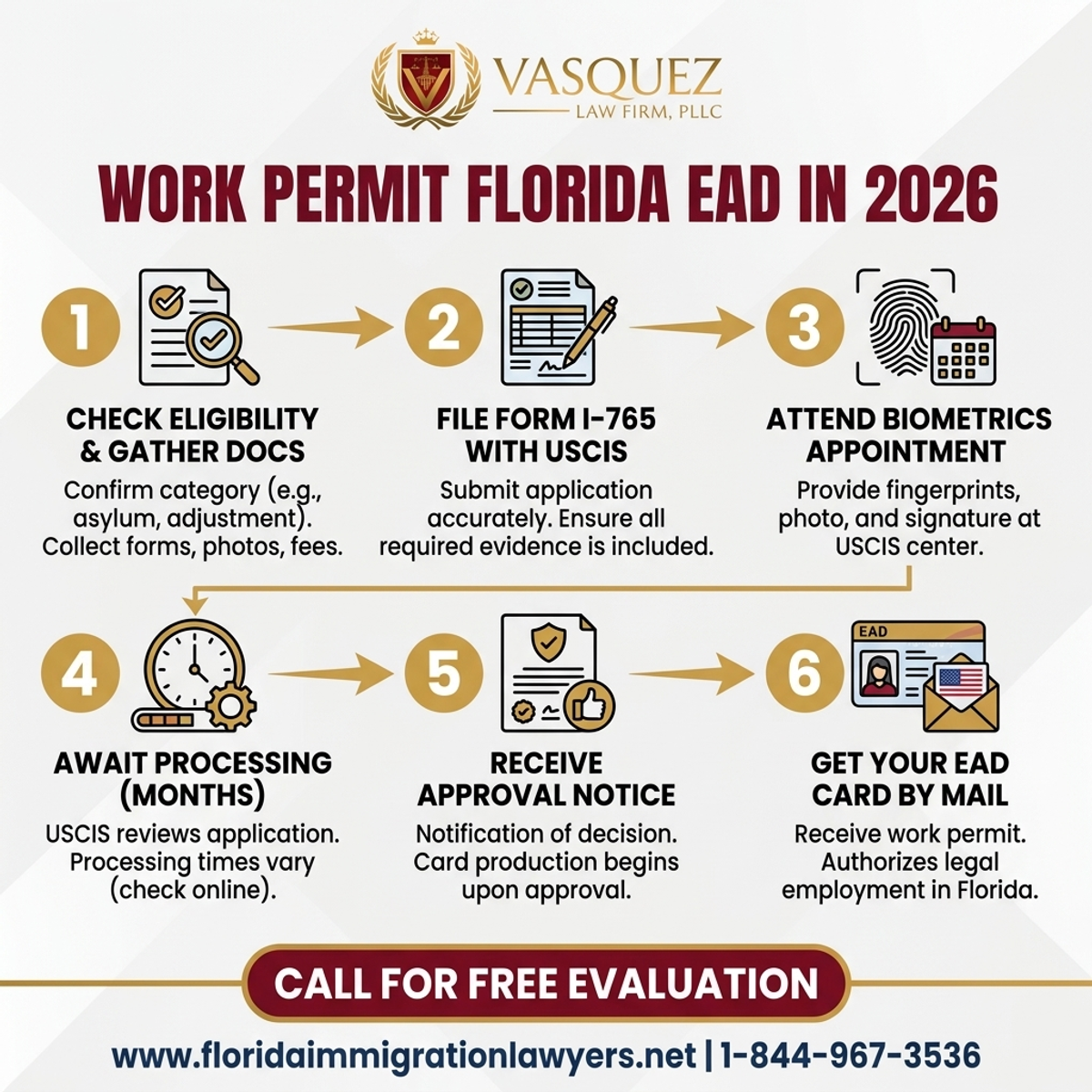
Key Statistics — Work Permit Florida Application: Get Your EAD in 2026
Engaging an experienced immigration attorney, like those at Florida Immigration Lawyers, is an investment that can significantly increase the likelihood of a successful and timely EAD approval. Attorney fees vary based on the complexity of your case and the services provided. While not mandatory, legal representation ensures that your application is prepared correctly, all documents are included, and any potential issues are identified and addressed proactively. This can save you time, stress, and potentially costly delays or denials in the long run. We offer free consultations to discuss your case and provide transparent information about our legal fees.
Common Mistakes to Avoid When Applying for Your Work Permit in Florida
Applying for a work permit in Florida can be a straightforward process for many, but even minor errors can lead to significant delays or outright denials. Avoiding these common mistakes is crucial for a smooth and successful application journey. Be diligent and meticulous in every step of the process.
- Submitting an Incomplete or Inaccurate Form I-765: This is perhaps the most frequent error. Missing signatures, unanswered questions, or inconsistent information (e.g., different birth dates than on previous filings) will almost certainly lead to an RFE or denial. Always double-check every field.
- Failing to Include All Required Supporting Documents: Each eligibility category has specific documentary proof. Omitting a copy of your I-94, previous EAD, or crucial evidence of your underlying immigration status will result in an RFE, delaying your application by months.
- Sending the Incorrect Filing Fee or Forgetting It Entirely: USCIS fees change periodically. Sending an outdated fee amount, an incorrect payment method, or forgetting the fee altogether will cause your application to be rejected and returned. Always verify the current fee on the USCIS website.
- Applying Under the Wrong Eligibility Category: Misidentifying your EAD eligibility category can lead to an immediate denial. For example, an individual seeking adjustment of status must use (c)(9), while an asylum applicant typically uses (c)(8). Ensure your category code aligns with your actual immigration status.
- Not Responding Promptly or Adequately to a Request for Evidence (RFE): If USCIS sends an RFE, it means they need more information. Failing to respond by the deadline or providing insufficient evidence will almost always result in a denial. Treat RFEs as urgent and critical.
- Filing a Renewal Application Too Late: Forgetting to renew your EAD in a timely manner can result in a lapse in your employment authorization, meaning you cannot legally work until your new EAD is approved. File your renewal at least 120-180 days before expiration.
- Providing Inconsistent Information Across Applications: Any discrepancies between your EAD application and other immigration forms (e.g., asylum application, green card application) can raise red flags for USCIS and lead to intense scrutiny, RFEs, or even fraud allegations.
- Engaging in Unauthorized Employment While Waiting: Working without a valid EAD is a serious violation of immigration law, as per 8 U.S.C. § 1324a. This can jeopardize your current and future immigration benefits, including your EAD application itself.
- Not Keeping Copies of Everything Submitted: Always make and retain a complete copy of your entire application package, including the form, all supporting documents, and proof of mailing. This is vital for your records and if USCIS loses your file.
- Assuming Automatic Approval or Ignoring Processing Times: An EAD application is never guaranteed. Assuming approval can lead to poor planning. Be realistic about processing times and prepare for potential delays, especially in Florida with its high volume of immigration cases.
When to Call a Florida Immigration Lawyer for Your EAD Application
While some work permit applications may appear straightforward, certain circumstances warrant the expertise of a qualified Florida immigration attorney. Navigating the complexities of immigration law can be challenging, and a lawyer can provide invaluable guidance, ensuring your application is meticulously prepared and submitted. Knowing when to seek legal assistance can save you time, stress, and prevent costly mistakes.
You should consider contacting Florida Immigration Lawyers if your eligibility for an EAD is not clear-cut. This includes situations where your immigration status is complex, you have a criminal history, or you have previously been denied an immigration benefit. These factors can significantly complicate your application and require a nuanced understanding of immigration law to address effectively. An attorney can analyze your unique situation and advise on the best course of action.
Furthermore, if you are facing deportation or removal proceedings, or if your EAD application is tied to a pending asylum case, legal representation is highly recommended. Our firm specializes in deportation defense and asylum applications, understanding how these cases intersect with EAD eligibility. An attorney can help coordinate your EAD application with your broader immigration strategy, ensuring consistency and maximizing your chances of success.
Other scenarios where legal help is beneficial include receiving a Request for Evidence (RFE) from USCIS, needing to file an expedite request, or experiencing unusually long processing delays. An attorney can help you craft a comprehensive response to an RFE, present a compelling case for expediting, or inquire with USCIS about delays. For residents of Naples, Miami, Orlando, or anywhere in Florida, our team is equipped to provide personalized support. We can help you understand your options, prepare a strong application, and advocate on your behalf, providing peace of mind throughout the process. Contact our experienced attorneys for a free consultation.
About Florida Immigration Lawyers
Florida Immigration Lawyers is a leading immigration law firm dedicated to serving individuals and families across the entire state of Florida. With a deep understanding of U.S. immigration laws and a commitment to our clients, we provide comprehensive legal services to guide you through every step of your immigration journey. Our team of experienced attorneys is passionate about helping immigrants achieve their dreams of living and working legally in the United States.
We specialize in a wide range of immigration matters, including family-based immigration, business immigration, asylum claims, deportation defense, citizenship applications, and, of course, employment authorization documents (EADs). We pride ourselves on offering personalized attention, clear communication, and strategic legal advice tailored to your unique circumstances. Our firm is known for its empathetic approach and aggressive advocacy on behalf of our clients.
Choosing Florida Immigration Lawyers means choosing a partner who will stand by you. We understand the anxieties and complexities associated with immigration processes and strive to make your experience as smooth as possible. We offer free, confidential consultations and are available 24/7 to address your concerns. Se Habla Español. Contact us today at 1-844-967-3536 or visit www.floridaimmigrationlawyers.net to learn how we can assist you in achieving your immigration goals in Florida.
Sources and References
- U.S. Citizenship and Immigration Services (USCIS)
- Executive Office for Immigration Review (EOIR)
- U.S. Customs and Border Protection (CBP) I-94 Website
- 8 U.S.C. Chapter 12 - Immigration and Nationality Act (INA)
- 8 U.S.C. § 1324a - Unlawful Employment of Aliens
- 8 CFR 274a.12 - Classes of aliens authorized to accept employment
- USCIS Policy Manual
Related services: H-1B specialty occupation visas, L-1 intracompany transfer visas, work visas for professionals, investment and entrepreneur visas.
This article provides general legal information and is not intended as legal advice. Every case is unique, and outcomes depend on specific facts and circumstances. Contact an attorney for advice about your particular situation.
Navigating the path to a work permit in Florida can be complex, but you don't have to face it alone. Our dedicated team at Florida Immigration Lawyers is ready to provide the expert guidance you need for a successful EAD application. Don't delay your opportunity to work legally and build your future in Florida. Call us for a free consultation today at 1-844-967-3536. Se Habla Espanol - Estamos aqui para ayudarle.
If you need legal assistance, learn more about learn about business immigration options, or call us at 1-844-967-3536 for a free consultation.
Do Not Navigate This Process Alone
Our experienced immigration attorneys are ready to fight for you. Get a free, confidential consultation today.
Se Habla Español
Or leave your details and we’ll call you:
Free Evaluation in 24 Hours
Or talk to us right now

AI voice assistant — available 24/7
FreeFrequently Asked Questions

William J. Vásquez
Founding Attorney · Vasquez Law Firm
U.S. Air Force veteran and immigration attorney with years of hands-on U.S. immigration experience. J.D., NCCU School of Law. AILA member. Admitted to the 4th, 5th, and 11th Circuit Courts.
Available 24/7 - Free Evaluations
Reviewed for legal accuracy by William J. Vásquez
Licensed in North Carolina; U.S. immigration is federal practice.
Related Legal Services
Our Florida immigration attorneys can help you with family immigration services, immigration practice areas and free immigration consultation. Call today at 1-844-967-3536 for a free consultation.
Related Links
Related Topics
Free Legal Consultation
Discuss your case with our experienced attorneys. We're available 24/7.
Se Habla Español - Estamos aquí para ayudarle.
Related Articles
Military Naturalization Expedited in Florida Bases
Explore military naturalization options for families at Florida bases, including parole in place benefits in Miami. Learn how to expedite your application with expert guidance from Florida Immigration Lawyers.
Immigration Lawyer Orlando Free Consultation 2026
Explore the cost of an immigration lawyer in Orlando in 2026. Understand attorney fees, what to expect during a consultation, and how to make the best choice for your immigration needs.
Ice Locator: Understanding ICE Check-Ins in Florida 2026
For non-citizens in Florida, understanding ICE check-ins is paramount. These mandatory appointments, often part of the Intensive Supervision Appearance Program (ISAP), are crucial for individuals released from detention or awaiting immigration court. This guide explains what to expect at an ICE check-in, the documents required, typical timelines, and the vital role of attorney representation. We cover common mistakes to avoid and when to seek legal counsel, emphasizing Florida-specific contexts for Miami and other areas. With strict compliance and expert legal support, you can navigate these complex requirements. Florida Immigration Lawyers offers comprehensive assistance, ensuring your rights are protected throughout the process. Learn how to manage your ICE supervision effectively and secure your future in the U.S.
Schedule A Nurse Immigration Process in Florida 2026
Explore the Schedule A nurse immigration process in Florida for 2026. Learn about naturalization ceremonies and opportunities for healthcare professionals in Gainesville.