Visa Bulletin October 2025: Florida Immigration Insights & Updates
The Visa Bulletin October 2025 is critical for Florida immigrants seeking Green Cards. Learn about Final Action Dates, Dates for Filing, and how to navigate the Adjustment of Status process. This comprehensive guide covers essential documents, timelines, costs, and common mistakes to avoid. Discover when to call an attorney and how Florida Immigration Lawyers can assist you with family-based immigration, employment visas, and more. Stay informed about processing times and ensure your application is accurate. Contact us for a free consultation.
The Visa Bulletin October 2025 outlines the availability of immigrant visas for the start of the new fiscal year. It determines when individuals, particularly those in Florida, can file their Adjustment of Status applications or receive final interviews. Understanding these dates is crucial for family-sponsored and employment-based immigration categories to avoid delays and ensure timely processing.
- The October 2025 Visa Bulletin marks the start of the new fiscal year.
- It details "Final Action Dates" and "Dates for Filing" for various visa categories.
- Visa availability dictates when Green Card applications can proceed.
- Categories like family-sponsored and employment-based visas are affected.
- Consulting an immigration lawyer is vital for interpreting the bulletin.
Are you an aspiring immigrant in Florida, eagerly awaiting your chance to live and work legally in the United States? The Visa Bulletin October 2025 is a pivotal document that could significantly impact your immigration journey. Each month, the U.S. Department of State (DOS) releases this bulletin, providing crucial updates on immigrant visa availability.
For many individuals and families across Florida, from Jacksonville to Miami, these dates determine the next steps in their pursuit of a Green Card. We understand the anticipation and complexity involved in navigating U.S. immigration law. This comprehensive guide will break down the October 2025 Visa Bulletin, explain its implications, and help you understand what it means for your application here in Florida.
We will cover key dates, categories, potential processing times, and crucial advice to help you proceed with confidence. Don't navigate this complex landscape alone; Call Florida Immigration Lawyers at 1-844-967-3536 for a free consultation to discuss your specific situation and how the latest Visa Bulletin affects you.
Understanding the Visa Bulletin October 2025: A Florida Perspective
The Visa Bulletin October 2025 is more than just a list of dates; it is a critical tool for anyone pursuing permanent residency in the United States. This bulletin, issued by the U.S. Department of State, provides a monthly summary of immigrant visa availability. It is especially important for individuals in Florida because it dictates when certain applications can move forward.
For many, it's the gateway to realizing their American dream. The October bulletin is particularly significant as it marks the beginning of the new fiscal year for immigration. This period often brings changes in visa number allocations, which can lead to advancements or retrogressions in various preference categories. Understanding these shifts is essential for planning your next steps, whether you are in Jacksonville, Orlando, Tampa, or elsewhere in the Sunshine State. Our firm, Florida Immigration Lawyers, closely monitors these updates to provide timely and accurate advice.
What are "Final Action Dates" and "Dates for Filing"?
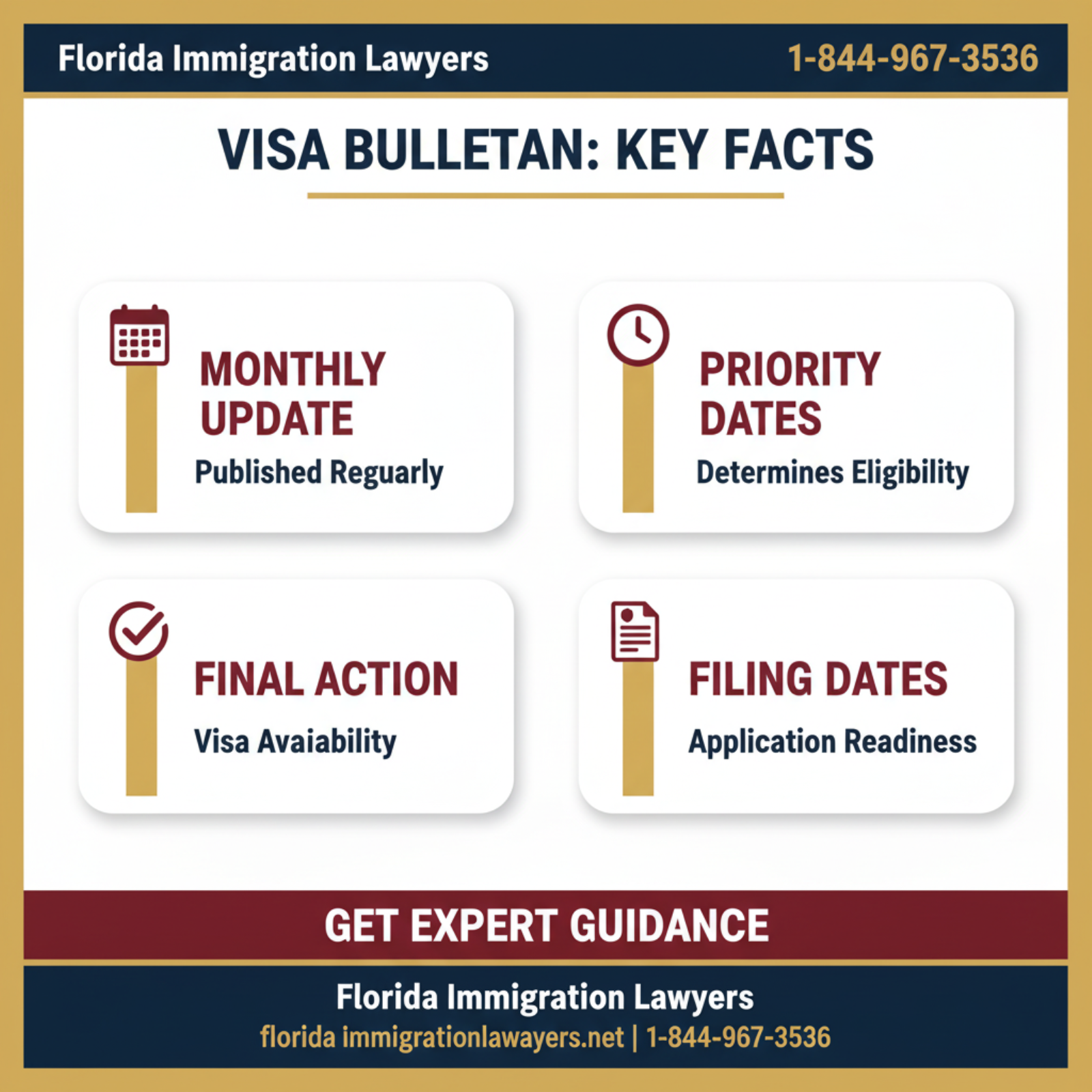
The Visa Bulletin primarily features two charts for each preference category and country of chargeability: "Final Action Dates" and "Dates for Filing Applications." These charts serve distinct purposes in the immigration process.
The Final Action Dates chart indicates when an immigrant visa is actually available for a given applicant. If your priority date is earlier than the date listed in this chart, your Green Card application can be approved, or you can be scheduled for an interview at a U.S. embassy or consulate abroad. This is the ultimate benchmark for visa issuance, as outlined in the Immigration and Nationality Act (INA).
The Dates for Filing Applications chart, on the other hand, determines when applicants may submit their Adjustment of Status (Form I-485) application to USCIS. USCIS, in its discretion, may permit the use of these "Dates for Filing" for a particular month. This allows certain individuals to file their applications sooner, even if a final visa is not yet available. Always check the USCIS website for their specific guidance on which chart to use each month.
Navigating Your Green Card Journey: A Step-by-Step Guide for Florida Residents
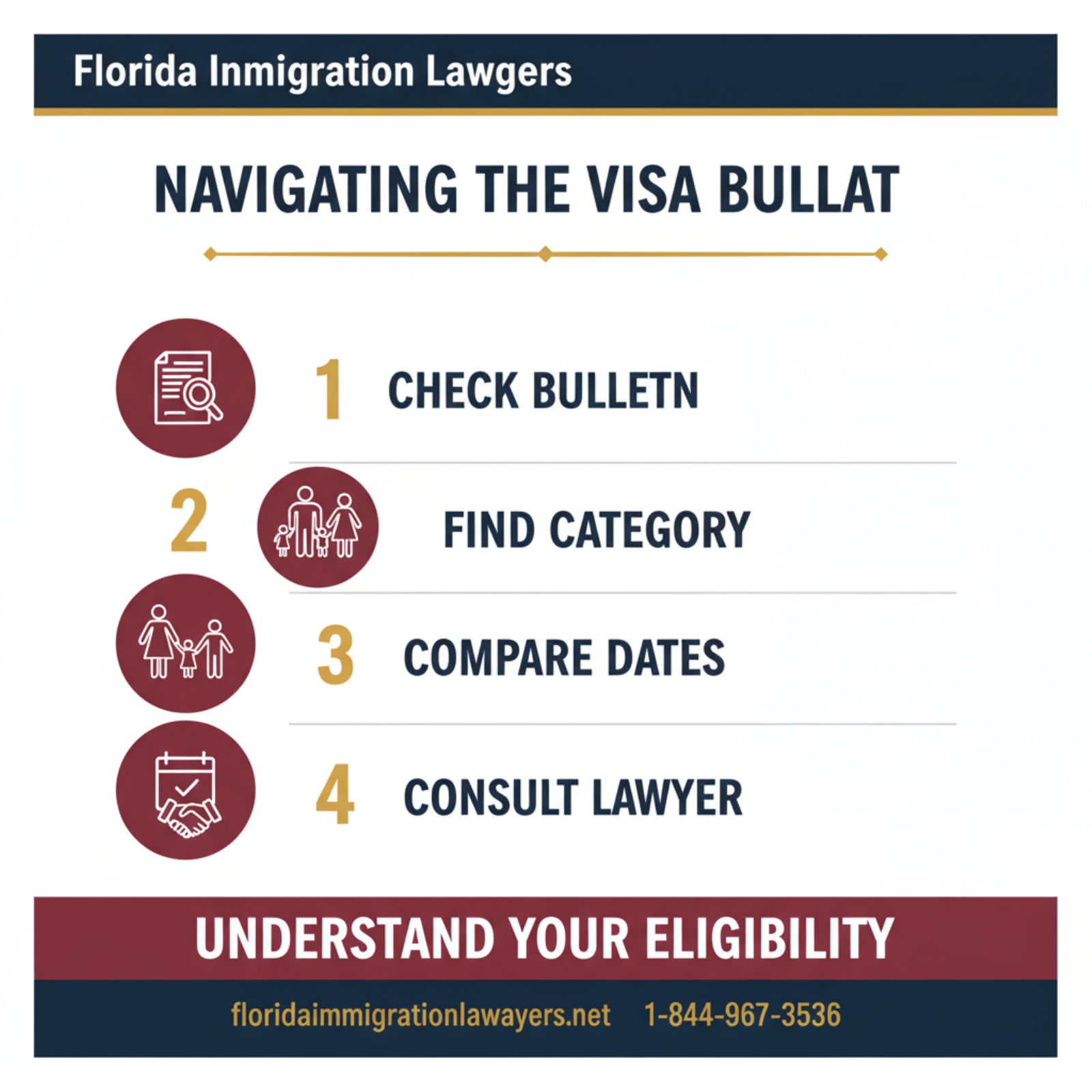
Understanding the Visa Bulletin October 2025 is a crucial part of your immigration process. Here is a general step-by-step guide on how to proceed, particularly if you are residing in Florida and your priority date is becoming current.
- Determine Your Visa Category and Priority Date: First, identify your specific visa preference category. This could be family-sponsored (e.g., F1, F2A, F2B, F3, F4) or employment-based (e.g., EB-1, EB-2, EB-3). Your priority date is established when your petition (Form I-130 or Form I-140) was properly filed with USCIS. This date is key to tracking your place in line for a Green Card in Florida.
- Review the Visa Bulletin October 2025: Carefully examine the "Final Action Dates" and "Dates for Filing Applications" charts in the latest Visa Bulletin. Locate your preference category and country of chargeability. Compare your priority date with the dates listed in both charts.
- Check USCIS Website for Filing Chart Guidance: Each month, USCIS determines which chart- "Final Action Dates" or "Dates for Filing Applications"- should be used for Adjustment of Status applications. Visit the USCIS website to confirm which chart applies to you for October 2025. This is a critical step for Florida residents planning to file Form I-485.
- Prepare Your Adjustment of Status Application (Form I-485): If your priority date is current under the "Dates for Filing" chart (and USCIS allows its use), you may be eligible to submit your Form I-485, Application to Register Permanent Residence or Adjust Status. Gather all necessary supporting documents, including birth certificates, marriage certificates, medical examination results, and affidavits of support.
- Attend Biometrics Appointment: After filing Form I-485, you will typically receive an appointment notice for biometrics collection at a local USCIS Application Support Center (ASC) in Florida. This involves fingerprinting and photographing for background checks.
- Prepare for Your Interview (if required): Most Adjustment of Status applicants are required to attend an interview at a USCIS field office, such as the one in Jacksonville, Orlando, or Miami. An immigration officer will review your application and ask questions about your eligibility. Preparing thoroughly with your attorney is highly recommended.
- Receive Your Green Card: If your application is approved and a visa number is available under the "Final Action Dates" chart, you will receive your Green Card. This signifies your status as a lawful permanent resident in the United States.
Key Considerations for Florida Applicants
Florida's diverse population means a wide range of immigration cases are processed here. The USCIS field offices in Florida handle a significant volume of Adjustment of Status interviews. Being prepared and understanding the local processing nuances can make a difference. Always ensure your legal representation is familiar with Florida-specific procedures and deadlines. This can greatly impact your Green Card processing times.
Essential Document Checklist for Your Adjustment of Status Application
When preparing your Adjustment of Status application (Form I-485) based on the Visa Bulletin October 2025, having a complete set of documents is paramount. Missing even a single required item can lead to delays or a Request for Evidence (RFE), prolonging your wait for a Green Card in Florida. This checklist provides a general overview; your specific situation may require additional documentation.
- Form I-485, Application to Register Permanent Residence or Adjust Status
- Form I-130 (for family-based) or Form I-140 (for employment-based) petition approval notice (Form I-797)
- Two passport-style photos
- Copy of government-issued photo identification (e.g., passport, driver's license)
- Copy of birth certificate
- Copy of marriage certificate (if applicable)
- Copies of all previous I-94 Arrival/Departure Records
- Copies of all U.S. visa pages and entry stamps in your passport
- Copies of all previous employment authorization documents (EADs) and advance paroles (APs) (if applicable)
- Form I-693, Report of Medical Examination and Vaccination Record (in a sealed envelope from a USCIS-approved civil surgeon)
- Form I-864, Affidavit of Support (for family-based petitions, along with sponsor's financial documents)
- Form I-765, Application for Employment Authorization (optional, but highly recommended for work permit)
- Form I-131, Application for Travel Document (optional, but highly recommended for advance parole)
- Certified copies of court and police records (if you have any arrests or convictions)
- Proof of continuous lawful presence in the U.S. (e.g., school records, utility bills, tax returns)
Important Note: Always review the latest USCIS instructions for Form I-485 and its supplements, as requirements can change. An experienced immigration lawyer from Florida Immigration Lawyers can help you compile an accurate and complete package, especially concerning family-based immigration Florida requirements.
Visa Bulletin October 2025: Timeline and Processing Expectations
Understanding the potential timeline for your immigration case after checking the Visa Bulletin October 2025 is vital for planning your future in Florida. Processing times can vary significantly based on several factors, including your visa category, country of chargeability, the specific USCIS field office handling your case (e.g., Jacksonville, Orlando, Miami), and the overall caseload of the agency.
The U.S. government operates on a fiscal year that begins on October 1st. The October Visa Bulletin typically marks the release of new visa numbers for the fiscal year, which can sometimes lead to favorable advancements in priority dates. However, this is not a guarantee. Some categories may see slow movement or even retrogression if demand outstrips supply, impacting Green Card processing times.
Factors Influencing Processing Times
Several elements can influence how long your Green Card application takes. These include:
- Visa Category: Family-sponsored categories generally have longer wait times than employment-based categories due to annual numerical limits set by 8 U.S.C. § 1151.
- Country of Chargeability: Applicants from high-demand countries like China, India, Mexico, and the Philippines often face much longer waits due to per-country caps.
- USCIS Caseload: The volume of applications received by USCIS directly impacts how quickly cases are processed.
- Requests for Evidence (RFEs): If your application is incomplete or raises questions, USCIS may issue an RFE, which adds significant time to the process.
- Interview Backlogs: Scheduling interviews at USCIS field offices in Florida can sometimes face delays.
While the Visa Bulletin October 2025 provides a snapshot of visa availability, it does not predict future movements with certainty. Priority dates can fluctuate month-to-month. It's crucial to regularly check subsequent bulletins, including the Visa Bulletin November 2025, and the USCIS processing times tool on their website for the most up-to-date information relevant to your location in Florida.
Cost Factors and Fee Breakdown for Your Immigration Journey
Pursuing a Green Card based on the Visa Bulletin October 2025 involves various costs beyond just legal fees. Understanding these expenses is crucial for budgeting and financial planning for your immigration journey in Florida. It's important to remember that USCIS filing fees are subject to change, so always verify the most current amounts on the official USCIS website.
Typical Fees Associated with Adjustment of Status
The primary costs you will encounter typically include:
- Form I-485 Filing Fee: This is the main fee for the Adjustment of Status application itself.
- Biometrics Fee: A separate fee for fingerprinting and background checks is usually incorporated into the I-485 fee.
- Medical Examination Fee: This fee is paid directly to a USCIS-approved civil surgeon in Florida for your Form I-693. This cost varies by provider.
- Form I-765 (Employment Authorization Document) and Form I-131 (Advance Parole) Fees: These are often included with the I-485 filing fee for primary applicants, but always confirm current policies.
- Form I-130 or I-140 Petition Fee: The initial petition filed by your sponsor or employer also has a separate filing fee.
Other Potential Costs
Beyond the mandatory government fees, you might incur other expenses:
- Attorney Fees: Legal representation from a qualified immigration lawyer like those at Florida Immigration Lawyers is highly recommended. Our fees cover preparing your application, responding to RFEs, and preparing you for interviews.
- Document Translation Costs: If any of your supporting documents are not in English, they must be translated by a certified translator.
- Postage and Courier Fees: Costs associated with mailing your application and documents securely.
- Travel Expenses: If you need to travel for your biometrics appointment or interview at a USCIS office in Florida.
While the costs can accumulate, investing in proper legal guidance can often save you time, stress, and potential costly mistakes in the long run. We offer transparent fee structures and free consultations to help you understand your financial obligations upfront for your Adjustment of Status Florida case.
Do not navigate this complex process alone. The nuances of the Visa Bulletin October 2025 and the subsequent application procedures require expert guidance. Contact Florida Immigration Lawyers today to ensure your application is accurate, complete, and submitted correctly. Our team is ready to assist you.
Common Mistakes to Avoid When Using the Visa Bulletin
Navigating the immigration system, especially with the Visa Bulletin October 2025, can be fraught with potential pitfalls. Making a mistake can lead to significant delays, denials, or even more serious immigration consequences. Here are common mistakes that individuals in Florida should strive to avoid:
- Misinterpreting Your Priority Date: Many applicants confuse their filing date with their priority date. Your priority date is established when the underlying petition (I-130 or I-140) is properly filed. Incorrectly identifying this date can lead to premature or delayed application submissions.
- Using the Wrong Chart: Each month, USCIS specifies whether applicants should use the "Final Action Dates" chart or the "Dates for Filing Applications" chart for Adjustment of Status. Failing to check the USCIS website for this critical guidance can result in your I-485 being rejected.
- Submitting an Incomplete Application: Missing required forms, signatures, or supporting documents is a frequent cause of RFEs or outright rejections. This prolongs your case and adds stress, impacting Green Card processing times.
- Failing to Disclose All Immigration History: Any past immigration violations, arrests, or encounters with law enforcement, even minor ones, must be fully disclosed. Hiding information can lead to accusations of misrepresentation and a permanent bar from the U.S.
- Ignoring Medical Examination Requirements: The Form I-693, Report of Medical Examination, must be completed by a USCIS-approved civil surgeon and submitted in a sealed envelope. Submitting an expired or improperly completed medical exam will cause delays.
- Not Notifying USCIS of Address Changes: Moving without informing USCIS can result in missed notices, interview appointments, or RFEs. This can lead to your application being denied without your knowledge.
- Traveling Internationally Without Advance Parole: If you have a pending Adjustment of Status application and travel outside the U.S. without an approved Advance Parole document (Form I-131), your I-485 application may be considered abandoned.
- Assuming All Dates Will Advance: The Visa Bulletin is dynamic. Dates can retrogress (move backward) if demand for visas exceeds the annual statutory limits. Assuming consistent forward movement can lead to missed opportunities or disappointment.
- Not Seeking Legal Counsel: Attempting to navigate the complex immigration system, especially with the nuances of the Visa Bulletin, without an attorney can lead to costly errors. An experienced lawyer can prevent common mistakes and advocate for your best interests.
- Submitting Outdated Forms or Fees: USCIS regularly updates its forms and filing fees. Using an old form or submitting an incorrect fee will result in your application being rejected and returned.
When to Call a Lawyer: Expert Guidance for Your Florida Immigration Case
The Visa Bulletin October 2025 provides essential information, but interpreting its impact on your unique situation can be challenging. While this guide offers general information, immigration law is incredibly complex and constantly evolving. This is precisely why having an experienced immigration lawyer from Florida Immigration Lawyers by your side is not just helpful, but often critical for a successful outcome.
You should consider calling an attorney immediately if:
- Your Priority Date is Approaching or Current: If your priority date is listed as current in the Visa Bulletin, you need to act quickly and accurately. An attorney can help you prepare and file your Adjustment of Status Florida application without delay.
- You Have a Complex Immigration History: Previous visa denials, deportations, criminal records, or unlawful presence can significantly complicate your case. An attorney can assess your eligibility for waivers or other relief, especially in areas like deportation defense.
- You Receive a Request for Evidence (RFE) or Notice of Intent to Deny (NOID): These notices indicate an issue with your application. A lawyer can help you understand the request and prepare a comprehensive, timely response.
- You Are Unsure Which Visa Category Applies to You: Determining the correct family-sponsored or employment-based category is crucial. An attorney can help you identify the most appropriate path, whether it's family-based immigration or business immigration.
- You Need Help Understanding the Visa Bulletin: The nuances of "Final Action Dates" versus "Dates for Filing" and per-country limits can be confusing. We simplify these complexities for our clients.
- You Are Concerned About Potential Delays or Retrogression: An attorney can advise you on strategies to mitigate risks and keep your case moving forward, impacting your Green Card processing times.
- You Reside in Florida and Need Local Expertise: Our firm has extensive experience with USCIS field offices and immigration courts throughout Florida, including Jacksonville, Orlando, and Miami. We understand the local procedures and requirements for general immigration law.
Florida Immigration Lawyers offers comprehensive legal services for individuals and families throughout the state. We specialize in areas such as general immigration law, family-based immigration, business immigration, deportation defense, and citizenship applications. Our dedicated team is committed to providing compassionate and effective representation. Don't leave your future to chance; schedule a free consultation with us today. Visit our attorney profiles to learn more about our experienced team.
Frequently Asked Questions About the Visa Bulletin and USCIS Processing
Navigating the complexities of immigration can lead to many questions, especially concerning the Visa Bulletin October 2025 and USCIS processing times. Here, we address some common inquiries that individuals in Florida often have.
Is USCIS moving faster in 2025?
USCIS processing times are dynamic and can fluctuate based on various factors, including the volume of applications, staffing levels, and policy changes. While there may be efforts to improve efficiency, it's not guaranteed that USCIS will be universally "faster" in 2025 across all case types. Some categories or offices might see improvements, while others may experience continued backlogs. Always check the official USCIS processing times tool for the most current data relevant to your specific application type and service center.
Is the Visa Bulletin changed in November 2025?
Yes, the Visa Bulletin is a monthly publication. The U.S. Department of State releases a new bulletin each month, typically around the middle of the preceding month. Therefore, a Visa Bulletin November 2025 will be issued, outlining visa availability for that month. The dates within the bulletin can change monthly, reflecting shifts in demand and the allocation of visa numbers. It's crucial to check the bulletin every month if your priority date is close to becoming current.
Is the U.S. suspending immigrant visas?
The U.S. government has, at various times, implemented temporary suspensions or restrictions on certain types of immigrant and non-immigrant visas, often in response to public health crises or economic conditions. However, a blanket suspension of all immigrant visas is not a common or permanent policy. Any such suspensions are typically announced by presidential proclamation or executive order and are subject to legal challenges and expiration dates. It is essential to stay informed through official government sources like travel.state.gov and uscis.gov for the most accurate and up-to-date information regarding any visa suspensions.
Why is the Visa Bulletin not moving?
The Visa Bulletin may appear to "not move" or even retrogress (move backward) for several reasons. The primary reason is that there are annual numerical limits on the number of immigrant visas that can be issued in certain categories, as well as per-country limits. If the demand for visas in a particular category or from a specific country exceeds the available supply, the priority dates will either remain stagnant or retrogress. This ensures that the annual caps are not exceeded. Factors like increased petition filings, policy changes, or administrative backlogs can also contribute to slow movement.
ABOUT Florida Immigration Lawyers SECTION
Florida Immigration Lawyers is a leading law firm dedicated to providing exceptional immigration legal services across the entire state of Florida. With offices strategically located to serve communities from Jacksonville to Miami, we are committed to helping individuals and families achieve their immigration goals. Our team of experienced attorneys understands the intricate and often challenging landscape of U.S. immigration law. We pride ourselves on offering personalized, compassionate, and results-driven representation.
Our Services: We offer a wide range of immigration services, including assistance with Green Card applications, family-based petitions, employment visas, Adjustment of Status, naturalization and citizenship, deportation defense, asylum claims, and more. Whether you are seeking to unite with family, pursue professional opportunities, or protect your right to stay in the U.S., we are here to guide you.
Why Choose Us:
- Florida Expertise: Deep understanding of local USCIS offices and immigration courts.
- Client-Centered Approach: We prioritize your needs and provide clear communication.
- Proven Track Record: A history of successful outcomes for our diverse clientele.
- Bilingual Services: Our team offers full services in English and Spanish to better serve the community.
Contact Us Today:
- Phone: 1-844-967-3536
- Website: https://www.floridaimmigrationlawyers.net
- Availability: We are available 24/7 to address your urgent immigration concerns.
- Free Consultations: We offer free consultations to discuss your case and outline your options.
- Serving All Florida: From Pensacola to Key West, we are your trusted immigration partners. You can also visit our contact page for more ways to reach us.
Sources and References
- U.S. Citizenship and Immigration Services (USCIS)
- U.S. Department of State - Visa Bulletin
- Executive Office for Immigration Review (EOIR)
- Immigration and Nationality Act (INA) - 8 U.S.C. Chapter 12
- 8 CFR (Code of Federal Regulations) - Aliens and Nationality
- USCIS Policy Manual
This article provides general legal information and is not intended as legal advice. Every case is unique, and outcomes depend on specific facts and circumstances. Contact an attorney for advice about your particular situation. Immigration laws are subject to frequent change.
Understanding the Visa Bulletin October 2025 is just the first step. For personalized legal guidance tailored to your specific immigration needs in Florida, trust the experienced team at Florida Immigration Lawyers. We are here to simplify the process and advocate for your best interests. Call us today at 1-844-967-3536 for a free consultation. Se Habla Español - Estamos aquí para ayudarle.
Frequently Asked Questions
Florida Immigration Lawyers
Legal Team
Our experienced attorneys at Florida Immigration Lawyers have been serving clients across Florida for over 20 years. We specialize in immigration, personal injury, criminal defense, workers compensation, and family law.