Visa Bulletin Predictions 2026 for Florida
Discover the visa bulletin predictions for 2026 in Florida. Learn about priority dates, wait times, and how these affect your immigration process. For personalized guidance, call Florida Immigration Lawyers today.

Understanding the visa bulletin predictions for 2026 is crucial for immigrants in Florida waiting for their priority dates. The visa bulletin provides monthly updates on which green card applications are eligible for processing based on priority dates. Key takeaways include:
- The visa bulletin affects eligibility for adjustment of status in the U.S.
- 2026 predictions suggest varying wait times for different categories.
- Consulting with an immigration lawyer can help navigate these updates effectively.
Introduction
Navigating the immigration process can be complex, especially when it comes to understanding visa bulletin predictions. For those in Pembroke Pines, Florida, and surrounding areas, knowing what to expect in 2026 can help you plan your immigration journey. This article will cover what the visa bulletin is, how it affects you, and what predictions are in store for 2026. Call Florida Immigration Lawyers at 1-844-967-3536 for a free consultation.
The visa bulletin serves as a vital compass for individuals and families aspiring for permanent residency in the United States. Its monthly release dictates the pace of green card processing, making proactive understanding and strategic planning absolutely essential. For Florida residents, particularly in diverse communities like Pembroke Pines, these predictions are not just numbers; they represent the future of families and careers.
Given the dynamic nature of immigration policies and the annual fluctuations in demand for visas, staying informed is paramount. This guide aims to demystify the visa bulletin, offering insights into its mechanics, its impact on different immigration categories, and what specific trends might emerge in 2026. With the right information and professional guidance from Florida Immigration Lawyers, you can approach your immigration journey with greater clarity and confidence.
Understanding the Visa Bulletin
The visa bulletin is a critical tool issued monthly by the U.S. Department of State. It determines when a foreign national can apply for a green card based on their priority date. A priority date is generally the date when the petition was filed. Understanding these dates is essential for anyone looking to adjust their status in the U.S.
For immigrants in Florida, particularly in Pembroke Pines, understanding these dates can help you estimate when your green card application might be processed. The visa bulletin categorizes applicants based on employment-based and family-sponsored preferences, each with its own set of wait times.
The bulletin actually features two distinct charts: 'Final Action Dates' and 'Dates for Filing'. The Final Action Dates chart indicates when visas may actually be issued, while the Dates for Filing chart allows certain applicants to submit their adjustment of status applications to USCIS earlier. Knowing which chart to use, as directed by USCIS each month, is crucial for timely application submission.
The allocation of green cards is subject to annual numerical limitations set by Congress, with further per-country limits. When the demand for visas in a particular category or country exceeds the available supply, a backlog forms, leading to longer wait times. This is why priority dates are so critical – they establish your place in the queue for an immigrant visa, and the visa bulletin reflects how quickly that queue is moving.
2026 Predictions for Visa Bulletin
As we look toward 2026, several factors could influence visa bulletin predictions, including policy changes by the USCIS and current immigration trends. With recent announcements by USCIS to adopt a stricter approach to adjustment of status, predicting exact wait times can be challenging. However, general trends suggest that applicants in Florida may experience shifts in priority dates, particularly in family-sponsored categories.
Florida's diverse immigrant population means that local trends can significantly impact how visa bulletins affect you. It's advisable to keep abreast of monthly updates and consult with immigration experts to understand how these changes may impact your specific case.
One significant factor influencing 2026 predictions will be the ongoing recovery from processing backlogs exacerbated by global events and administrative changes. While some categories might see modest advancements, others, especially those with historically high demand from countries like India, China, Mexico, and the Philippines, are likely to continue experiencing substantial wait times. For instance, family-sponsored preference categories (F1, F2A, F2B, F3, F4) are often subject to longer backlogs due to high demand and limited visa numbers.
Employment-based categories (EB-1, EB-2, EB-3, EB-4, EB-5) may see more movement, particularly for those not subject to per-country limits or in categories with lower demand. However, even within these, the EB-2 and EB-3 categories for Indian and Chinese nationals are expected to remain backlogged. Any potential legislative changes or shifts in USCIS processing priorities could also significantly alter these predictions, emphasizing the need for continuous monitoring and professional advice from Florida Immigration Lawyers.
For example, a U.S. citizen sponsoring their married child (F3 category) from Mexico might see a slow but steady advancement in their priority date, whereas a skilled worker from India in the EB-2 category could face a much longer and less predictable wait. Understanding these nuances is where expert legal guidance becomes indispensable. Our team at Florida Immigration Lawyers stays updated on these complex trends to provide you with the most accurate and actionable advice.
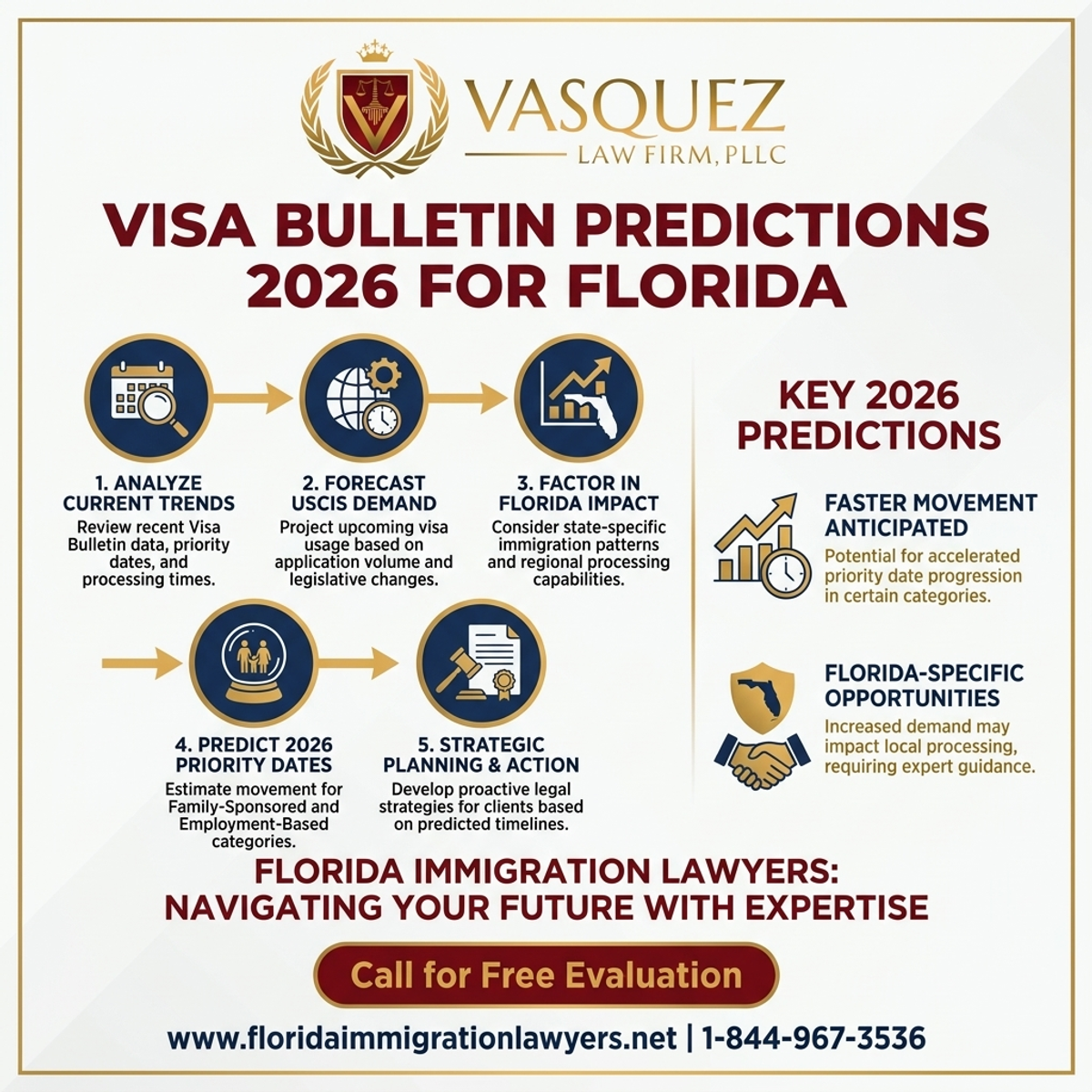
Step-by-Step Process — Visa Bulletin Predictions 2026 for Florida
Step-by-Step Guide to Understanding Priority Dates
Effectively tracking your immigration journey requires a clear understanding of your priority date and how to interpret the monthly visa bulletin. Following these steps diligently can help you stay informed and prepared for the next stage of your green card application.
- Identify Your Priority Date: This is the date your petition was filed and is crucial in determining when you can apply for a green card. For family-sponsored petitions (Form I-130) or employment-based petitions (Form I-140), this date is typically found on the I-797, Notice of Action, issued by USCIS.
- Consult the Monthly Visa Bulletin: Each month, check the State Department's release for updates on current priority dates. Pay close attention to whether USCIS directs applicants to use the 'Final Action Dates' or 'Dates for Filing' chart for adjustment of status applications.
- Understand Your Category: Different categories have different wait times. Make sure you know whether you're in a family-based (e.g., F1, F2A, F2B, F3, F4) or employment-based category (e.g., EB-1, EB-2, EB-3, EB-4, EB-5) and your country of chargeability. This will dictate which row and column to follow on the bulletin.
- Seek Legal Advice: Given the complexities, consulting with a lawyer can help you understand the implications of the bulletin on your case. An experienced immigration attorney from Florida Immigration Lawyers can analyze your specific situation, interpret the bulletin's impact, and advise on the best course of action.
Staying organized and proactive with these steps will significantly streamline your immigration process. Don't hesitate to reach out to Florida Immigration Lawyers if you have any questions about your priority date or visa category.
Document Checklist for Visa Bulletin Updates
When your priority date becomes current, you'll need to act quickly to submit your adjustment of status application or proceed with consular processing. Having all necessary documents prepared in advance can prevent costly delays and ensure a smooth application process.
- Copy of I-130 or I-140 petition: This is the foundational petition that established your priority date. Ensure you have the approved copy, typically Form I-797, Approval Notice.
- Notice of Action (Form I-797): This form confirms the filing and approval of your petition and clearly states your priority date. It's essential for verifying your eligibility.
- Current passport: A valid passport is required for identification and travel purposes. Ensure it has sufficient validity remaining, typically at least six months beyond your intended period of stay or adjustment.
- Proof of relationship (for family-sponsored categories): This includes birth certificates, marriage certificates, adoption decrees, or other official documents that establish the bona fide relationship between the petitioner and beneficiary.
- Employment verification letters (for employment-based categories): These letters from your employer confirm your job offer, salary, and job duties, demonstrating that you meet the requirements of your employment-based visa category.
Gathering these documents proactively can significantly reduce stress and expedite your application when your priority date becomes current. It's always a good idea to create digital and physical copies of all important records.
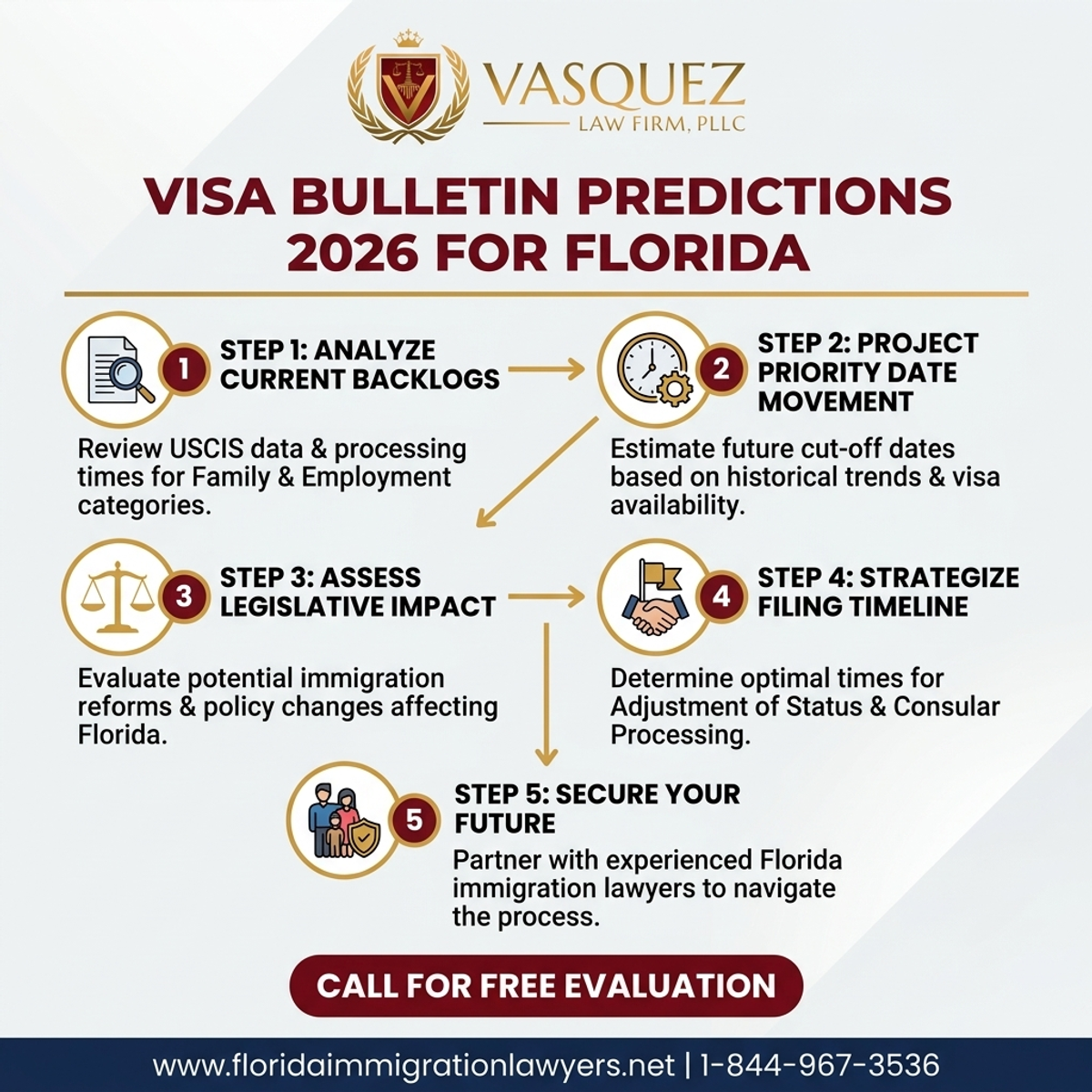
Key Statistics — Visa Bulletin Predictions 2026 for Florida
Timeline and Processing Expectations
Visa bulletin timelines can vary greatly depending on your category and country of chargeability. For instance, family-sponsored visas can have significantly longer wait times compared to employment-based visas. In 2026, these timelines may shift due to policy changes and global events.
Typically, once your priority date becomes current, you can expect the adjustment of status process to take several months. However, due to the recent stricter policies by USCIS, processing times could be longer. Staying informed and prepared is essential.
The actual processing time for an adjustment of status application (Form I-485) can range from several months to over a year, depending on the USCIS service center, the complexity of your case, and whether you receive a Request for Evidence (RFE). Factors like interview scheduling, background checks, and the volume of applications can all impact how quickly your case moves forward. It's important to remember that consular processing, where you apply for your green card at a U.S. embassy or consulate abroad, follows a different set of timelines and procedures.
To get a general idea of current processing times, you can check the USCIS website's processing times tool. However, these are estimates and can change frequently. Maintaining open communication with your immigration attorney from Florida Immigration Lawyers can help you manage expectations and prepare for each stage, including potential interviews or additional document requests.
Cost Factors and Fee Breakdown
While specific fees can change, generally, costs associated with visa applications include filing fees for the I-485 adjustment of status, biometric services, and potential legal fees. It is recommended to budget for these expenses in advance and consult with an attorney for specific advice on current fees and potential additional costs.
Do not navigate this process alone. Contact Florida Immigration Lawyers today.
Beyond the primary filing fee for Form I-485 (Application to Register Permanent Residence or Adjust Status), you should also account for the biometric services fee, which covers fingerprinting and background checks. If you are applying for work authorization (I-765) or advance parole (I-131) concurrently with your I-485, these forms may have separate fees, though they are often waived when filed with the adjustment application. Additionally, a mandatory medical examination by a USCIS-approved civil surgeon will incur its own costs, which vary by provider.
Legal fees for professional assistance from Florida Immigration Lawyers are a crucial investment. Our attorneys can help prepare your application, gather documentation, respond to RFEs, and represent you during interviews, significantly increasing your chances of success and reducing potential delays. While these fees are separate from government filing fees, they provide invaluable peace of mind and expertise. Always discuss a detailed fee structure with your attorney upfront to avoid surprises.
Common Mistakes to Avoid
- Ignoring Priority Date Changes: Failing to keep track of your priority date can delay your application process. If your date becomes current and you miss the window to file, you might have to wait for it to become current again, potentially adding months or even years to your wait.
- Submitting Incomplete Applications: Incomplete forms can lead to rejections or delays. USCIS will issue an RFE or even deny your application if essential information or signatures are missing, forcing you to restart or appeal.
- Overlooking Required Documents: Always refer to the checklist to ensure all documents are included. Missing a single supporting document, such as a birth certificate or an affidavit of support, can halt your application's progress.
- Missing Deadlines: Submit applications promptly to avoid missing critical deadlines. Whether it's responding to an RFE or filing your I-485 when your priority date is current, adherence to deadlines is non-negotiable.
- Not Seeking Legal Help: Navigating immigration laws alone can be challenging. Legal advice is crucial. Attempting to manage complex immigration processes without expert guidance often leads to errors and increased stress.
- Assuming All Categories Are the Same: Different categories have different requirements and wait times. Misunderstanding the specifics of your family-based or employment-based category can lead to incorrect filings or unrealistic expectations.
- Disregarding Policy Changes: Stay informed about new USCIS policies that may affect your case. Immigration laws and procedures are dynamic, and ignoring updates can result in your application being out of compliance.
- Misunderstanding USCIS Notices: Always clarify any notices received from USCIS with your lawyer. A misinterpretation of an RFE or a Notice of Intent to Deny can have severe consequences for your immigration status.
Avoiding these common pitfalls is critical for a successful immigration journey. By being diligent and seeking professional help from Florida Immigration Lawyers, you can mitigate risks and ensure your application proceeds as smoothly as possible.
When to Call a Lawyer
Immigrants in Florida should consider contacting a lawyer if they are unsure about their priority date or recent visa bulletin updates. Legal assistance is also recommended if there are changes in USCIS policies that might affect your application, or if you encounter any issues with your current immigration status. Our team at Florida Immigration Lawyers is here to guide you through these processes.
You should also reach out to an immigration attorney if you have a complex family situation, a prior immigration violation, or any criminal history, as these factors can significantly complicate your case. Receiving a Request for Evidence (RFE) or a Notice of Intent to Deny (NOID) from USCIS is a clear signal to seek immediate legal counsel, as these often require detailed and timely responses.
Even if your case seems straightforward, consulting with Florida Immigration Lawyers can provide peace of mind and ensure every step is handled correctly. Proactive legal advice can prevent common mistakes, save you time and money, and ultimately help you achieve your immigration goals more efficiently. Don't hesitate to call 1-844-967-3536 for a free consultation.
About Florida Immigration Lawyers
Florida Immigration Lawyers is dedicated to serving the immigrant community throughout Florida, including Pembroke Pines. Our experienced attorneys specialize in various immigration services, from family immigration to business visas. We offer free consultations and are available 24/7 to assist you with your immigration needs. Call us at 1-844-967-3536 or visit our website at floridaimmigrationlawyers.net.
Sources and References
- U.S. Citizenship and Immigration Services (USCIS)
- Executive Office for Immigration Review (EOIR)
- Visa Bulletin - U.S. Department of State
- 8 U.S.C. Chapter 12 - Immigration and Nationality Act
Related services: immigration practice areas, family immigration services, citizenship and naturalization, deportation defense.
This article provides general legal information and is not intended as legal advice. Every case is unique, and outcomes depend on specific facts and circumstances. Contact an attorney for advice about your particular situation.
Final Thoughts
Understanding the visa bulletin and its predictions for 2026 is crucial for immigrants in Florida. Stay informed and consult with legal experts to navigate the complexities of immigration law. Call Florida Immigration Lawyers at 1-844-967-3536 for a free consultation. Se Habla Español - Estamos aquí para ayudarle.
The immigration landscape is constantly evolving, and being prepared for future changes, especially those indicated by the visa bulletin, can significantly impact your journey to permanent residency. Proactive planning, meticulous document preparation, and timely consultation with experienced legal professionals are your best allies. Trust Florida Immigration Lawyers to provide the expert guidance you need every step of the way.
If you need legal assistance, learn more about our immigration legal services, or call us at 1-844-967-3536 for a free consultation.
Do Not Navigate This Process Alone
Our experienced immigration attorneys are ready to fight for you. Get a free, confidential consultation today.
Se Habla Español
Frequently Asked Questions

William J. Vásquez
Founding Attorney · Vasquez Law Firm
U.S. Air Force veteran and immigration attorney with thousands of cases resolved. J.D., NCCU School of Law. AILA member. Admitted to the 4th, 5th, and 11th Circuit Courts.
Available 24/7 - Free Evaluations
Related Legal Services
Our Florida immigration attorneys can help you with asylum protection, deportation defense and citizenship and naturalization. Call today at 1-844-967-3536 for a free consultation.
Related Links
Related Topics
Free Legal Consultation
Discuss your case with our experienced attorneys. We're available 24/7.
Se Habla Español - Estamos aquí para ayudarle.
Related Articles
Biometrics Appointment in Florida: What to Expect in 2026
Navigating a biometrics appointment in Florida is crucial for your USCIS process. Learn what to expect, how to prepare, and common pitfalls to avoid. Florida Immigration Lawyers are here to help with personalized guidance and support.
Withholding of Removal Explained: Florida Defense in 2026
For those in Florida facing deportation and fearing persecution or torture in their home country, understanding withholding of removal is critical. This form of protection prevents removal to a dangerous country, though it differs significantly from asylum in its eligibility criteria and benefits. It requires proving a "more likely than not" chance of persecution based on protected grounds or torture, a higher standard than asylum's "well-founded fear." While withholding of removal does not lead to a Green Card, it offers mandatory protection if the stringent criteria are met, even for some individuals barred from asylum. The process involves complex legal proceedings before an immigration judge, often in Miami or Orlando immigration courts. A comprehensive application, detailed testimony, and robust supporting evidence, including country conditions reports and affidavits, are essential. Given the high stakes and intricate legal requirements, securing the expertise of a Florida immigration lawyer is paramount to building a strong defense and navigating the path to safety.
US Visa Policy Changes July 2026: What Students in Florida
As of July 2026, international students in Florida seeking a change of status to an F-1 student visa must prepare for potential adjustments to U.S. visa policies. This comprehensive guide from Florida Immigration Lawyers explores the anticipated policy changes, detailing their potential impact on application requirements, processing times, and eligibility criteria. We provide a step-by-step overview of the change of status process, including a document checklist, expected timelines, and cost considerations. Understanding these complexities and avoiding common mistakes is crucial for a successful application. With potential changes approaching, proactive planning and expert legal guidance are more important than ever. Our firm is dedicated to helping students in Tampa and across Florida navigate these challenges, offering tailored advice and robust representation. Learn how to protect your academic future and ensure a smooth transition to F-1 student status.
Dual Citizenship Lawyer: Your 2026 Guide to Naturalization
Achieving U.S. citizenship is a profound milestone, but the path to naturalization, especially with dual citizenship in mind, is fraught with legal intricacies and a critical interview process. This comprehensive guide from Florida Immigration Lawyers demystifies the journey, offering essential citizenship interview tips and highlighting the invaluable role of a dual citizenship lawyer. We cover eligibility, document preparation, timelines, and common pitfalls, all tailored for Florida residents in areas like Pembroke Pines. Discover how expert legal counsel can prepare you for your naturalization interview, address dual nationality concerns, and ensure a smooth, successful application. From initial assessment to interview representation, we provide the support needed to navigate USCIS requirements confidently. Call Florida Immigration Lawyers for a free consultation to start your journey.
