USCIS Green Card Removal Proceedings Florida: Your 2026
For conditional green card holders in Florida, understanding USCIS green card removal proceedings and the I-751 petition is critical. This comprehensive guide details the step-by-step process to remove conditions, essential documentation, timelines, and cost factors. Learn how to avoid common mistakes that could lead to removal proceedings. Florida Immigration Lawyers offers expert guidance for conditional permanent residents facing these complex challenges. Protect your status and secure your future in the U.S. by contacting our experienced team for a free consultation.

USCIS green card removal proceedings in Florida typically refer to the process of removing conditions on a two-year conditional permanent resident status, primarily through filing Form I-751. If this petition is denied or not filed, it can lead to actual deportation (removal) proceedings before an immigration judge. Navigating this complex legal landscape requires careful attention to detail and adherence to strict deadlines.
- Conditional residents must file Form I-751 within 90 days before their green card expires.
- Failure to file or denial of the I-751 can result in removal proceedings.
- Joint filing waivers are available for divorce, abuse, or death of the petitioner.
- Legal counsel is crucial to protect your permanent residency status.
Imagine building a new life in Florida, only to face uncertainty about your immigration status. Many individuals who obtain a green card through marriage find themselves in this exact situation, holding a "conditional" permanent resident card valid for just two years. This conditional status means a critical step is required: removing those conditions to secure full, permanent residency. If not handled correctly, this can lead to USCIS green card removal proceedings and the risk of losing your right to live in the U.S.
This comprehensive guide will walk you through the complexities of conditional permanent residency, the Form I-751 petition, and what to expect if you face potential removal proceedings in Florida. We will cover everything from eligibility and documentation to timelines and common pitfalls. Our goal is to empower you with the knowledge needed to protect your future. Do not face this challenge alone; call Florida Immigration Lawyers at 1-844-967-3536 for a free consultation and let our experienced team guide you.
Understanding USCIS Green Card Removal Proceedings in Florida
For many immigrants in Jacksonville and across Florida, obtaining a green card is a dream come true. However, if your green card was issued based on a marriage that was less than two years old at the time of approval, your residency is considered conditional. This means you have a two-year conditional green card. The U.S. government implements this measure to prevent marriage fraud and ensure the validity of the marital relationship.
The process of "removing conditions" is formal and requires demonstrating that your marriage was, and remains, bona fide. Failure to properly file Form I-751, Petition to Remove Conditions on Residence, can trigger USCIS green card removal proceedings. These proceedings are formal legal actions initiated by the U.S. government to determine if a non-citizen should be removed from the U.S.
What is Conditional Permanent Residence?
Conditional permanent residence is granted to spouses of U.S. citizens or lawful permanent residents and their children if the marriage is less than two years old on the day they are granted permanent residence. This status is temporary. It serves as a probationary period to verify the authenticity of the marriage. You must demonstrate that your marriage was entered into in good faith and not solely for immigration benefits.
The Role of Form I-751 in Preventing Removal
Form I-751 is the primary mechanism to transition from conditional to permanent resident status. It must be filed jointly by both spouses, generally within the 90-day period immediately preceding the expiration date on your conditional green card. If you fail to file this petition on time, or if USCIS denies your petition, you could be placed into USCIS green card removal proceedings before an immigration judge. This underscores the critical importance of a timely and accurately prepared I-751.
Step-by-Step Guide to Removing Conditions on Your Green Card
Navigating the process to remove conditions from your green card can feel overwhelming. Following these steps carefully is essential to avoid potential USCIS green card removal proceedings and secure your permanent residency.
- Determine Your Eligibility and Filing Category: Most petitioners file jointly with their spouse. However, you may be eligible for a waiver if your marriage ended in divorce, your spouse passed away, or you experienced abuse. Understanding your specific circumstances is the first critical step.
- Gather Comprehensive Supporting Documentation: Collect evidence proving the bona fides of your marriage. This includes financial documents, shared assets, birth certificates of children, affidavits from friends and family, and photos.
- Complete Form I-751, Petition to Remove Conditions on Residence: Fill out the form accurately and completely. Any errors or omissions can lead to delays or even denial. Be sure to answer all questions truthfully and provide all requested information.
- Submit Your Petition to USCIS: File your completed Form I-751, along with all supporting documents and the correct filing fees, to the appropriate USCIS lockbox facility. The mailing address depends on where you live and whether you are filing jointly or with a waiver. Always check the official USCIS website for current filing instructions.
- Receive Biometrics Appointment: After filing, you will typically receive a receipt notice (Form I-797C) extending your conditional resident status for a period, often 24 months. You will then receive an appointment notice for biometrics (fingerprints, photos, signature) at an Application Support Center (ASC) in Florida, such as those in Jacksonville or Orlando.
- Attend Interview (If Required): USCIS may schedule an interview to verify the validity of your marriage. Both spouses generally attend joint petitions. If you filed a waiver, you would attend alone. This interview is a crucial stage where an officer will assess the evidence and your testimony.
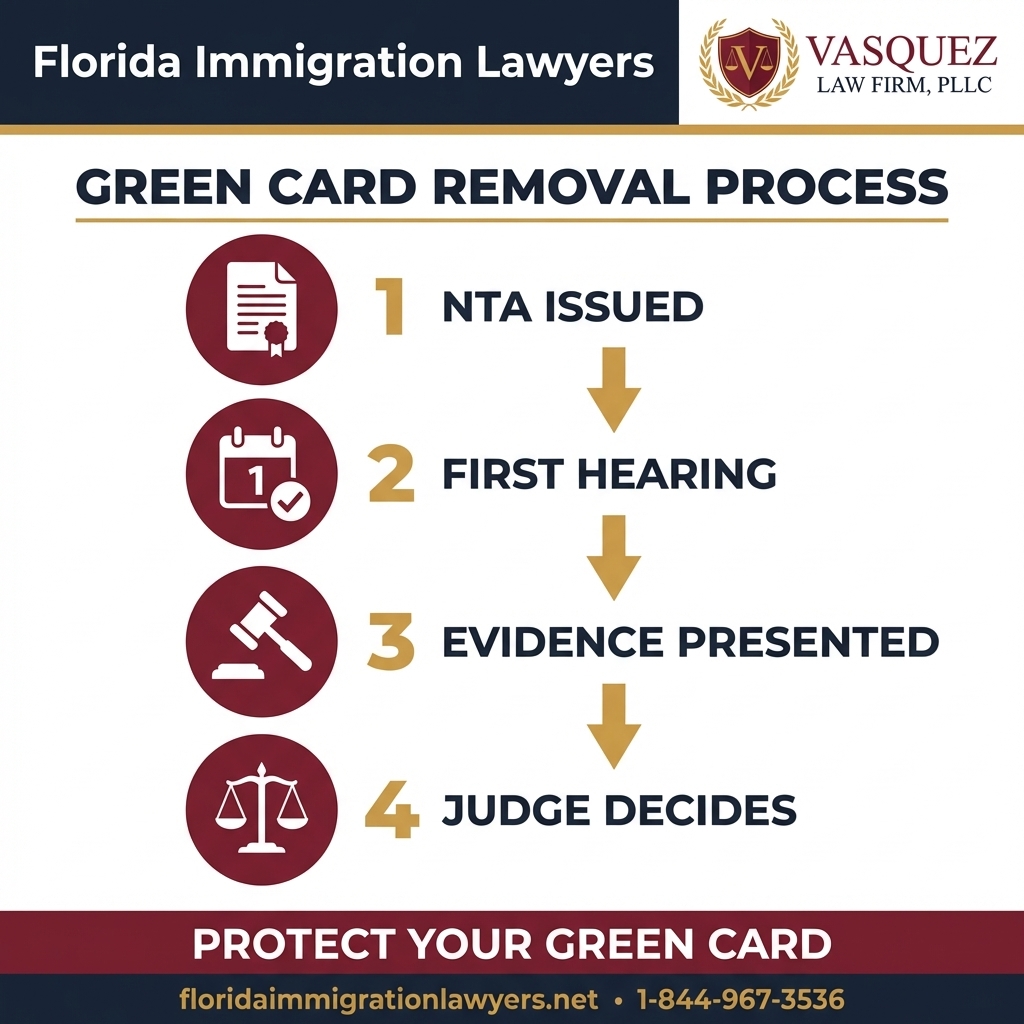
- Receive Decision from USCIS: USCIS will review your petition and evidence. If approved, you will receive a new 10-year green card. If denied, you will typically receive a Notice to Appear (NTA) in USCIS green card removal proceedings before an immigration judge.
Essential Document Checklist for I-751 Petitioners
A thorough collection of documents is paramount to the success of your I-751 petition and to avoid USCIS green card removal proceedings. The goal is to provide compelling evidence of a genuine marital relationship.
- Copy of your conditional green card (front and back).
- Copy of your spouse's green card or U.S. passport (if applicable).
- Copy of your marriage certificate.
- Birth certificates of children born to your marriage.
- Proof of joint ownership of property (deeds, mortgages, leases).
- Proof of joint financial assets (bank statements, joint credit card statements, investment accounts).
- Joint tax returns for the duration of the conditional residence.
- Proof of shared liabilities (loans, utility bills in both names).
- Insurance policies showing both spouses as beneficiaries (life, health, auto).
- Photographs of the couple together over time (family events, vacations, daily life).
- Affidavits from friends, family, or employers attesting to the bona fides of the marriage.
- Any other relevant documents proving the legitimacy of your marriage.
For waiver petitions (e.g., divorce, abuse), additional specific documentation will be required, such as divorce decrees, police reports, or medical records.
Timeline and Processing Expectations for Conditional Green Card Removal
The timeline for removing conditions can vary significantly, often causing anxiety for applicants in Florida. Understanding the typical stages and potential delays can help you manage expectations.
Upon filing Form I-751, you will receive a Form I-797C, Notice of Action, confirming receipt of your petition and extending your conditional resident status. This extension is typically for 24 months, allowing you to continue working and traveling while your petition is pending. However, processing times can fluctuate based on USCIS workload, the complexity of your case, and the specific service center handling your petition.
As of early 2026, I-751 processing times can range from 12 to 36 months or even longer. You can check current processing times on the USCIS website. Delays often occur if USCIS requests additional evidence (RFE) or schedules an interview. Be prepared for potential waiting periods and always respond promptly to any USCIS requests to avoid further delays or issues that could lead to USCIS green card removal proceedings.
Cost Factors and Fee Breakdown for I-751
Understanding the financial aspects of filing Form I-751 is crucial. While we cannot provide exact fee amounts (as they are subject to change), we can outline the general cost factors involved in removing conditions from your green card.
The primary costs include the USCIS filing fee for Form I-751 and the biometrics services fee. These fees are mandatory and must be submitted with your petition. You should always consult the official USCIS website or call them directly for the most current fee schedule.
Beyond government fees, you may incur other expenses:
- Legal Fees: Hiring an experienced immigration lawyer, like those at Florida Immigration Lawyers, can significantly increase your chances of success. Legal fees vary based on the complexity of your case and the services required.
- Document Preparation Costs: This might include fees for obtaining certified copies of documents, translation services, or postage.
Investing in professional legal assistance can be a wise decision, especially if your case is complex or if you anticipate challenges. An attorney can help ensure your petition is correctly prepared, mitigating the risk of USCIS green card removal proceedings.
Do not navigate this complex and critical process alone. The stakes are too high to risk your future in the United States. Contact Florida Immigration Lawyers today for dedicated support and expert legal guidance through every stage of your conditional green card removal process. Our team is ready to assist you.
Common Mistakes to Avoid in Conditional Green Card Removal
Making errors during the I-751 process can have severe consequences, potentially leading to USCIS green card removal proceedings. Avoid these common pitfalls to protect your residency.
- Failing to File on Time: The most critical mistake. Your I-751 must be filed within the 90-day window before your conditional green card expires. Missing this deadline can lead to automatic termination of your status and placement in removal proceedings.
- Insufficient Evidence of Bona Fide Marriage: Not providing enough compelling evidence that your marriage is genuine. USCIS looks for a strong paper trail of shared life.
- Incomplete or Inaccurate Form I-751: Errors, omissions, or inconsistent information on the form can cause delays, RFEs, or even denial. Every question must be answered truthfully and thoroughly.
- Not Responding to RFEs Promptly: If USCIS requests additional evidence, you must respond within the specified timeframe. Failure to do so will likely result in a denial.
- Failing to Update USCIS on Address Changes: You are legally required to inform USCIS of any address changes within 10 days. Missing important notices due to an outdated address can be detrimental.
- Attending the Interview Unprepared: If an interview is scheduled, be ready to answer questions about your marriage and provide any requested original documents. Inconsistent answers can raise red flags.
- Filing a Joint Petition After Divorce: If your marriage has ended, you cannot file a joint petition. You must instead file a waiver based on divorce.
- Not Seeking a Waiver When Applicable: If you've been abused, your spouse has died, or your marriage ended in divorce, you must file with a waiver. Not doing so will lead to denial.
- Assuming USCIS Knows Your Situation: USCIS only has the information you provide. Do not assume they know about your shared life or the challenges you face.
- Ignoring Legal Advice: Attempting to navigate complex immigration law without professional guidance is risky. A lawyer can identify potential issues and strengthen your case.
- Traveling Internationally Without Proof of Status: After filing I-751, your conditional green card validity is extended by the I-797C receipt. Always carry this notice with your expired green card when traveling internationally.
When to Call a Lawyer for USCIS Green Card Removal Proceedings
While some I-751 cases are straightforward, many situations warrant the immediate assistance of an experienced immigration attorney. If you are in Florida and facing any of these scenarios, it is crucial to seek legal counsel from Florida Immigration Lawyers.
You should contact an attorney if:
- You are nearing the 90-day filing deadline and have not yet prepared your I-751.
- Your marriage has ended in divorce or annulment, requiring a waiver.
- You have experienced domestic violence or abuse from your petitioning spouse.
- Your petitioning spouse has passed away.
- USCIS has issued a Request for Evidence (RFE) or a Notice of Intent to Deny (NOID).
- You have received a Notice to Appear (NTA) in USCIS green card removal proceedings.
- You have a criminal record or other inadmissibility issues.
- You believe your marriage may be questioned by USCIS during an interview.
- You have previously been denied an immigration benefit.
- You need to appeal a USCIS decision.
Our attorneys at Florida Immigration Lawyers specialize in these complex cases. We can help you gather robust evidence, prepare a compelling petition, represent you at interviews, and defend you in removal proceedings. Protecting your right to live and work in Florida is our priority.
Frequently Asked Questions (FAQs) About Conditional Green Card Removal
Q: Is ICE deporting people with green cards?
A: While green card holders have significant protections, they are not immune to deportation. Individuals with green cards can be placed in removal proceedings and deported if they commit certain crimes, engage in marriage fraud, or fail to comply with immigration laws, such as not removing conditions on a conditional green card. It is critical to understand that even permanent residents can face removal for specific violations of immigration law, as outlined in the Immigration and Nationality Act (INA).
Q: What happens if you marry a U.S. citizen and then divorce before removing conditions?
A: If your marriage to a U.S. citizen ends in divorce or annulment before you can file your I-751 jointly, you must file the petition with a waiver. This waiver allows you to file alone and demonstrate that the marriage was entered into in good faith, despite its dissolution. You must provide a copy of the final divorce decree. Proving the bona fides of the marriage without your spouse's testimony or joint documents can be challenging, making legal assistance highly advisable.
Q: Can you get a green card if you have diabetes?
A: Generally, having diabetes does not prevent you from obtaining a green card. U.S. immigration law primarily considers communicable diseases of public health significance and certain physical or mental disorders that may pose a threat to the safety or welfare of the applicant or others. Diabetes, in most cases, does not fall into these categories. However, it is essential to disclose all medical conditions during your immigration medical examination. Consult an immigration attorney if you have concerns about any specific health condition.
Q: How much does it cost to renew your green card in 2026?
A: The question of renewing a green card (Form I-90) is distinct from removing conditions on a conditional green card (Form I-751). Form I-90 is used to replace an expired or lost 10-year green card. The fees for Form I-90 are separate from I-751 fees and are subject to change. Always check the official USCIS website for the most current fee schedule for Form I-90. It is important not to confuse these two distinct processes.
Florida Immigration Lawyers is a leading immigration law firm dedicated to serving individuals and families across the entire state of Florida. From Jacksonville to Miami, and everywhere in between, our compassionate and skilled legal team provides comprehensive immigration solutions. We understand the profound impact immigration matters have on your life and your family's future.
Our services include deportation defense, family-based immigration, business immigration, asylum claims, and citizenship applications. We pride ourselves on providing personalized attention and strategic advocacy for every client. When you choose Florida Immigration Lawyers, you gain a partner committed to navigating the complex immigration system on your behalf. We offer free consultations and are available 24/7 to address your urgent legal needs. Visit our website at www.floridaimmigrationlawyers.net or call us at 1-844-967-3536. Your journey to a secure future starts with us.
Sources and References
- U.S. Citizenship and Immigration Services (USCIS) - Form I-751
- USCIS Processing Times
- Executive Office for Immigration Review (EOIR)
- 8 U.S.C. § 1186a - Conditional permanent resident status for certain alien spouses and sons and daughters.
- 8 CFR § 216.4 - Petition to remove conditions by alien spouse.
- Immigration and Nationality Act (INA) - Full Text on USCIS
This article provides general legal information and is not intended as legal advice. Every case is unique, and outcomes depend on specific facts and circumstances. Contact an attorney for advice about your particular situation. Immigration laws are subject to change, and this content reflects information current as of April 2026.
If you are facing USCIS green card removal proceedings or need assistance with your Form I-751 petition in Florida, do not delay. Your permanent residency is too important to leave to chance. Call Florida Immigration Lawyers today at 1-844-967-3536 for a free consultation. Our dedicated team is here to provide the expert legal support you deserve. Se Habla Español - Estamos aquí para ayudarle.
Do Not Navigate This Process Alone
Our experienced immigration attorneys are ready to fight for you. Get a free, confidential consultation today.
Se Habla Español
Frequently Asked Questions
Florida Immigration Lawyers
Immigration Attorney | Founder, Vasquez Law Firm
U.S. Air Force veteran and immigration attorney with thousands of cases resolved. J.D., NCCU School of Law. AILA member. Admitted to the 4th, 5th, and 11th Circuit Courts.
Available 24/7 - Free Evaluations
Related Legal Services
Our Florida immigration attorneys can help you with citizenship and naturalization, family immigration services and immigration practice areas. Call today at 1-844-967-3536 for a free consultation.
Related Links
Related Topics
Free Legal Consultation
Discuss your case with our experienced attorneys. We're available 24/7.
Se Habla Español - Estamos aquí para ayudarle.
Related Articles
Fraud Waiver Immigration in Florida: What You Need to Know
Navigating the I-601 fraud waiver process in Florida can be complex. Learn about eligibility, documentation, and how to avoid common mistakes. Contact Florida Immigration Lawyers for expert guidance.
Asylum Interview Preparation in Florida: Key Steps
Preparing for your asylum interview in Florida can make the difference in securing protection. Learn the essential steps and tips to succeed. Call Florida Immigration Lawyers for a free consultation.
Understanding the Naturalization Process Timeline in Florida
Navigating the naturalization process in Florida is crucial for those aspiring to become U.S. citizens. This guide outlines the timeline, steps, and common mistakes, ensuring you're well-prepared. Call Florida Immigration Lawyers at 1-844-967-3536 for personalized assistance and a free consultation.
Immigration Services in Jacksonville, Florida | VLF Florida
Explore comprehensive immigration services in Jacksonville, Florida. Navigate your immigration journey with expert legal guidance from Florida Immigration Lawyers. Call us for a free consultation today!