USCIS Green Card Removal Proceedings Florida: Your Expert Guide
Navigating USCIS green card removal proceedings in Florida can be incredibly stressful, especially for conditional permanent residents. This comprehensive guide covers everything from understanding your conditional status and the critical Form I-751 petition process to what steps to take if your petition is denied and you face removal in immigration court. Learn about joint filing requirements, waiver options for divorce or abuse, essential documentation, and processing timelines. We also highlight common mistakes to avoid and when it's crucial to seek expert legal assistance. If your future in Fort Lauderdale or anywhere in Florida is at stake, protecting your status is paramount. Florida Immigration Lawyers are here to help you every step of the way.
If you hold a conditional green card in Florida, you must file Form I-751 to remove conditions before it expires. Failure to do so, or a denial, can lead to uscis green card removal proceedings florida in immigration court. This process is complex and requires strong evidence to prove your eligibility for permanent residency, especially in cases of divorce or hardship. Seeking legal counsel is crucial to navigate these challenges effectively.
- Conditional green cards require filing Form I-751 to remove conditions.
- Denial of Form I-751 can initiate removal proceedings in Florida.
- Strong evidence is essential, particularly for waivers based on divorce, abuse, or hardship.
- Immigration courts in Florida, such as those in Miami and Orlando, handle these proceedings.
- Consulting a Florida immigration lawyer is highly recommended to protect your status.
Imagine the stress of having your future in Florida, a place you call home, suddenly jeopardized. For many conditional green card holders, the prospect of uscis green card removal proceedings florida is a daunting reality. You worked hard to build your life here, and now your permanent residency could be at risk.
This comprehensive guide will walk you through the complexities of conditional green card removal, the critical Form I-751 process, and what to do if you find yourself facing removal proceedings in Florida. We will cover everything from understanding your conditional status to navigating immigration court. For immediate assistance and peace of mind, please call Florida Immigration Lawyers at 1-844-967-3536 for a free consultation.
Understanding Conditional Green Cards and Removal Proceedings in Florida
A conditional green card, also known as a conditional permanent resident card, is typically issued to individuals who obtained their green card through marriage to a U.S. citizen or lawful permanent resident, and were married for less than two years at the time the green card was granted. It is also common for EB-5 immigrant investors. This status is temporary, lasting only two years, as outlined in the Immigration and Nationality Act (INA) Section 216 (8 U.S.C. § 1186a).
The purpose of the conditional period is for U.S. Citizenship and Immigration Services (USCIS) to ensure that the marriage or investment was entered into in good faith, and not solely to circumvent immigration laws. During this two-year period, you must prove that your marriage is legitimate and ongoing, or that your investment meets all requirements. Failure to do so can lead to the termination of your status and potential uscis green card removal proceedings florida.
Who Receives a Conditional Green Card?
Most commonly, conditional green cards are issued to spouses of U.S. citizens or permanent residents who have been married for less than two years when their green card application is approved. This includes individuals who adjusted status within the U.S. or obtained an immigrant visa abroad. Additionally, some employment-based immigrants, specifically EB-5 investors, also receive conditional permanent resident status.
In Florida, a state with a significant immigrant population and numerous marriage-based petitions, understanding this conditional status is vital. Many families in Fort Lauderdale, Miami, Orlando, and across the state navigate this initial two-year period. Your conditional green card will have an expiration date clearly printed on it, signaling when you must act to remove the conditions.
The Form I-751 Petition: Your Path to Permanent Residency
To transition from a conditional green card holder to a lawful permanent resident, you must file Form I-751, Petition to Remove Conditions on Residence. This petition must be filed with USCIS within the 90-day period immediately preceding the expiration date on your conditional green card. Missing this crucial deadline is a common mistake and can trigger uscis green card removal proceedings florida.
The I-751 petition serves as your official request to USCIS to review your case and determine if the conditions should be removed. The core of this petition is providing compelling evidence that the basis for your conditional status (your marriage or investment) was legitimate. This process is often referred to as the 2 year Green Card removal of conditions.
Joint Petition Filing Requirements
If you are still married to the U.S. citizen or lawful permanent resident through whom you obtained your conditional status, you will generally file Form I-751 jointly with your spouse. This joint petition requires both you and your spouse to sign the form and submit extensive documentation. The evidence should demonstrate that your marriage is bona fide and that you continue to share a life together.
Examples of evidence include joint bank accounts, joint leases or mortgages, birth certificates of children born during the marriage, joint utility bills, joint tax returns, and affidavits from friends and family who can attest to your relationship. The more evidence you can provide, the stronger your case for removing conditions will be. USCIS reviews these documents carefully to confirm the authenticity of your marriage.
Waivers of the Joint Filing Requirement
Life circumstances can change, and USCIS recognizes that not everyone can file a joint petition. You may be eligible for a waiver of the joint filing requirement if:
- Your marriage ended in divorce or annulment (this addresses the question, "What happens if you marry a U.S. citizen and then divorce?").
- Your spouse died.
- You or your child were subjected to battery or extreme cruelty by your U.S. citizen or permanent resident spouse.
- The termination of your status and removal from the U.S. would result in extreme hardship.
Filing an I-751 waiver, especially due to conditional green card divorce or abuse, requires even more detailed and sensitive documentation. For instance, if you are divorcing before your 2-year conditional period is up, you must prove the marriage was entered in good faith. This is where the expertise of a Florida immigration lawyer becomes invaluable. They can help you compile the necessary evidence and present your case effectively to USCIS, protecting you from potential uscis green card removal proceedings florida.
Step-by-Step Guide to Removing Conditions and Avoiding Removal Proceedings
Navigating the I-751 process can feel overwhelming, but breaking it down into manageable steps can help. This guide applies whether you are filing a joint petition or seeking a waiver to remove conditions on your green card.
- Understand Your Status and Deadline: Mark your calendar for the 90-day window before your conditional green card expires. This is the period during which you must file Form I-751. Filing late without a valid reason can lead to significant complications, including being placed in uscis green card removal proceedings florida.
- Gather Comprehensive Documentation: This is the most crucial step. Collect all evidence proving the legitimacy of your marriage or investment. For marriage-based petitions, this includes joint financial records, shared property deeds, utility bills in both names, birth certificates of children, and affidavits from people who know you as a couple. For waivers, specific evidence related to divorce, death, abuse, or hardship will be required.
- Choose the Right Petition (Joint or Waiver): Determine if you will file jointly with your spouse or if you qualify for a waiver. This decision significantly impacts the type of evidence and arguments you will present to USCIS.
- Complete Form I-751 Accurately: Fill out every section of Form I-751 thoroughly and accurately. Any omissions or errors could lead to delays, Requests for Evidence (RFEs), or even denial. Ensure all questions are answered honestly.
- Submit Your Petition to USCIS: Mail your completed Form I-751, all supporting documentation, and the required filing fees to the correct USCIS Service Center. The specific mailing address depends on your state of residence (Florida residents will mail to a designated USCIS Lockbox).
- Attend Biometrics Appointment: After filing, USCIS will send you an appointment notice for biometrics (fingerprints, photos, and signature). This appointment is mandatory, typically held at an Application Support Center (ASC) in Florida, such as those in Fort Lauderdale, Orlando, or Tampa.
- Prepare for a Potential Interview: While not all I-751 petitions require an interview, USCIS may schedule one if they have questions or require further clarification. If an interview is scheduled at a Florida USCIS field office (e.g., Miami, Orlando), be prepared to answer questions about your marriage or investment.
- Respond to RFEs Timely: USCIS may send a Request for Evidence (RFE) if they need more information or clarification on your submitted documents. Respond promptly and comprehensively to avoid delays or denial.
- Receive Decision: Once USCIS has reviewed your petition and all evidence, they will send you a decision notice. An approval means your conditions are removed, and you become a lawful permanent resident.
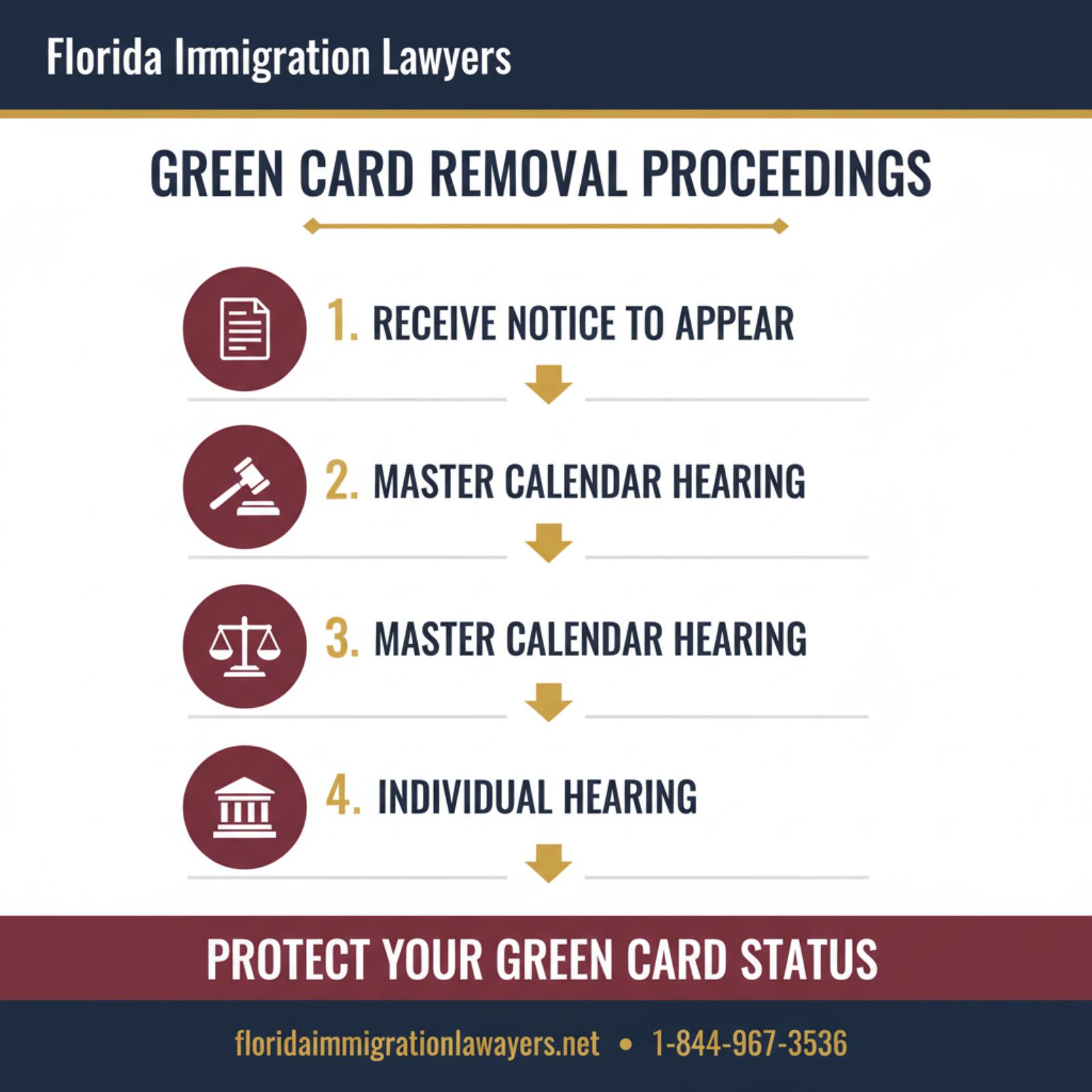
- If Denied, Prepare for Removal Proceedings: A denial of your I-751 petition will almost certainly result in USCIS issuing a Notice to Appear (NTA), initiating uscis green card removal proceedings florida in immigration court. This is a critical juncture where legal representation is essential.
Essential Document Checklist for Form I-751
A well-organized and comprehensive set of documents is the cornerstone of a successful I-751 petition. Here’s a general checklist:
- Copy of the front and back of your conditional green card.
- Copy of your marriage certificate (if applicable).
- Copies of birth certificates for any children born of the marriage.
- Joint financial documents:
- Joint bank statements, savings accounts, or credit card statements.
- Joint tax returns (IRS transcripts are preferred).
- Joint utility bills (electricity, water, gas, internet).
- Joint insurance policies (health, life, auto, home).
- Joint property documents:
- Copy of joint lease agreement or mortgage statement.
- Property deeds showing joint ownership.
- Evidence of cohabitation:
- Driver’s licenses or state IDs showing the same address.
- Mail addressed to both spouses at the same address.
- Affidavits from friends, family, or employers attesting to the bona fides of your marriage (include their contact information and copies of their IDs).
- Photographs of you and your spouse together over time, with family, and at significant events.
- For waivers based on divorce: Certified copy of the final divorce decree or annulment.
- For waivers based on abuse: Police reports, medical records, court documents, declarations from shelters, or affidavits from counselors.
- For waivers based on extreme hardship: Evidence of the hardship, such as medical records, financial documents, or country conditions reports.
- For EB-5 investors: Evidence of sustained investment and job creation.
Timeline and Processing Expectations for Conditional Green Card Removal
The Green card conditional removal processing time can vary significantly based on the USCIS Service Center handling your petition and the complexity of your case. Generally, after filing Form I-751, USCIS will send you a receipt notice (Form I-797C, Notice of Action). This notice typically extends the validity of your conditional green card for a certain period, often 24 or 48 months. This allows you to continue working and traveling while your petition is pending.
After the receipt notice, you will receive an appointment notice for your biometrics within a few weeks or months. Following biometrics, your case will be under review. Some cases are approved without an interview, while others, particularly complex waiver cases or those with questions, may require one. You can check the approximate processing times for I-751 petitions on the USCIS website by selecting your form type and the Service Center where your petition was filed. Keep in mind that these are estimates and can fluctuate.
Cost Factors and Fee Breakdown for I-751
When preparing your Form I-751 petition, it's essential to account for the associated costs. The primary cost is the USCIS filing fee for the I-751 removal of conditions petition. This fee is subject to change, so always verify the current amount on the official USCIS website before filing. There is also a separate biometrics fee that must be paid for each applicant (and any children included in the petition).
Beyond government fees, you should also consider legal fees if you choose to hire an immigration attorney. While not mandatory, legal representation can significantly improve your chances of success, especially in complex cases involving waivers or potential denials. Attorney fees vary based on the complexity of your case and the services required. In certain circumstances, you may be eligible for a fee waiver for the USCIS filing fee; check USCIS guidelines for eligibility criteria.
Do not navigate this complex process alone. The stakes are too high for your future in Florida. Contact Florida Immigration Lawyers today for expert guidance and dedicated representation.
What Happens if Your I-751 is Denied? Understanding USCIS Green Card Removal Proceedings in Florida
A denial of your Form I-751 petition is a serious matter. Unlike some other immigration applications, there is generally no direct appeal process to challenge an I-751 denial with USCIS. Instead, if your I-751 is denied, USCIS will typically issue a Notice to Appear (NTA) – Form I-862 – which initiates uscis green card removal proceedings florida. This means your case will be transferred to an immigration court under the Executive Office for Immigration Review (EOIR).
Upon receiving an NTA, you will be required to appear before an Immigration Judge in Florida (e.g., at the Miami Immigration Court, Orlando Immigration Court, or Pompano Beach Immigration Court). This is your opportunity to present your case directly to a judge and argue why your conditional status should be removed. The government, represented by an Immigration and Customs Enforcement (ICE) attorney, will argue for your removal from the United States. This situation directly addresses the question, "Is ICE deporting people with green cards?" While green card holders have more rights than undocumented individuals, they can still face deportation if their status is terminated.
During these proceedings, you have the right to due process, including the right to legal representation. "Can a green card holder be deported without due process?" The answer is no; you are entitled to a hearing before an Immigration Judge. However, navigating immigration court is incredibly challenging without an experienced attorney. Your lawyer can help you present evidence, cross-examine witnesses, and argue for forms of relief from removal, such as a new I-751 application or other forms of adjustment of status.
Challenging a Denial and Appealing in Removal Proceedings
In removal proceedings, you will have the chance to renew your I-751 application with the Immigration Judge. This means you can present new evidence or strengthen your original application arguments. The judge will then make an independent decision on whether to grant your I-751 petition. If the judge denies your I-751, they may then determine if you are deportable based on other grounds.
If the Immigration Judge orders your removal, you may have the option to appeal their decision to the Board of Immigration Appeals (BIA). Further appeals may be possible to a federal circuit court. These processes are highly complex and time-sensitive, requiring a deep understanding of immigration law and court procedures (8 U.S.C. § 1227 and 8 CFR § 1239). Having a knowledgeable Florida immigration lawyer by your side is critical to protect your rights and explore every available legal avenue.
Common Mistakes to Avoid in Conditional Green Card Removal
- Failing to File on Time: Missing the 90-day window before your conditional green card expires is a major error. It can lead directly to removal proceedings, making your case much harder to win.
- Submitting Insufficient Evidence: Simply stating your marriage is bona fide is not enough. You must provide extensive, compelling documentation. Lack of evidence is a primary reason for I-751 denials.
- Not Updating Your Address with USCIS: If you move, fail to notify USCIS. You could miss critical notices, RFEs, or interview appointments, leading to denial or even removal in absentia.
- Ignoring Requests for Evidence (RFEs): USCIS sends an RFE when they need more information. Failing to respond fully and on time will almost certainly result in a denial of your I-751 petition.
- Attempting to Conceal a Divorce or Separation: If your marriage ended, do not try to hide it. Instead, file for a waiver and provide honest, comprehensive documentation regarding the good faith of the marriage at its inception.
- Failing to Disclose Criminal History: Any criminal history, even minor infractions, must be disclosed. Concealing information can lead to severe penalties, including a finding of misrepresentation and permanent bars to immigration benefits.
- Attending Interviews Unprepared: If an interview is scheduled, research common questions and practice your answers. Be honest and consistent with your submitted documentation.
- Not Seeking Legal Advice: Many people try to navigate the I-751 process alone, only to encounter issues they cannot resolve. An attorney can prevent mistakes and strengthen your case.
- Assuming Marriage Alone is Enough: A marriage certificate alone is not sufficient. USCIS needs proof of a shared life, financial commingling, and genuine intent to establish a marital union.
- Overlooking Fee Waivers: If you meet the income guidelines, you may be eligible for a fee waiver for the I-751 filing fee. Not exploring this option can add unnecessary financial burden.
- Traveling Internationally Without Proper Documentation: After filing I-751, your green card validity is extended. Always carry your I-797C receipt notice with your expired green card when traveling abroad.
- Not Understanding the Implications of an I-751 Denial: A denial is not the end, but it signals the start of removal proceedings. Many fail to understand the severity and how to best prepare for court.
When to Call a Florida Immigration Lawyer
While some straightforward I-751 cases can be handled independently, many situations warrant the expertise of a Florida immigration lawyer. We strongly recommend contacting Florida Immigration Lawyers if any of the following apply to your situation:
- You have received a Notice to Appear (NTA) in immigration court.
- Your Form I-751 petition has been denied by USCIS.
- You are divorced, separated, or your marriage has been annulled.
- You or your child have been subjected to battery or extreme cruelty by your spouse.
- You have any criminal history, even minor arrests or convictions.
- You are unsure about the types of evidence required for your I-751.
- You have received a Request for Evidence (RFE) from USCIS.
- You are preparing for an I-751 interview at a Florida USCIS office.
- You are concerned about the processing timeline or delays in your case.
- You are facing any aspect of uscis green card removal proceedings florida.
Our experienced attorneys at Florida Immigration Lawyers understand the nuances of immigration law and the specific challenges faced by conditional green card holders in Florida. We can help you gather the necessary documentation, prepare your petition, represent you in interviews, and most importantly, defend you in removal proceedings.
About Florida Immigration Lawyers
Florida Immigration Lawyers is a leading immigration law firm dedicated to serving individuals and families across the entire state of Florida. With a deep understanding of U.S. immigration laws and a compassionate approach, we provide comprehensive legal services to help our clients achieve their immigration goals.
Our firm specializes in a wide range of immigration matters, including family-based immigration, business immigration, asylum claims, naturalization, and deportation defense. We pride ourselves on offering personalized attention, strategic advice, and aggressive advocacy for every client. We are committed to protecting your rights and securing your future in the United States.
When you choose Florida Immigration Lawyers, you gain a trusted partner committed to your success. We offer free consultations and are available 24/7 to address your urgent immigration needs. Visit our website at www.floridaimmigrationlawyers.net or call us at 1-844-967-3536 to learn how we can assist you.
Sources and References
- U.S. Citizenship and Immigration Services (USCIS) - Form I-751, Petition to Remove Conditions on Residence
- USCIS Policy Manual - Volume 6, Part G, Chapter 2: Conditional Permanent Resident Status
- Executive Office for Immigration Review (EOIR) - Immigration Courts
- 8 U.S.C. § 1186a (INA 216) - Conditional Permanent Resident Status for Certain Alien Spouses and Sons and Daughters
- 8 U.S.C. § 1227 (INA 237) - Deportable Aliens
- 8 CFR § 216 - Conditional Basis of Lawful Permanent Residence
- 8 CFR § 1239 - Notice to Appear
This article provides general legal information and is not intended as legal advice. Every case is unique, and outcomes depend on specific facts and circumstances. Contact an attorney for advice about your particular situation.
Do not face the complexities of uscis green card removal proceedings florida alone. Your future in Florida depends on taking the right legal steps. Contact Florida Immigration Lawyers today for a free consultation at 1-844-967-3536. Se Habla Español - Estamos aquí para ayudarle.
Frequently Asked Questions
Florida Immigration Lawyers
Legal Team
Our experienced attorneys at Florida Immigration Lawyers have been serving clients across Florida for over 20 years. We specialize in immigration, personal injury, criminal defense, workers compensation, and family law.