U Visa for Crime Victims Florida: Your Path to Safety
For non-citizen crime victims in Florida, the U visa offers a critical pathway to safety and legal status. This humanitarian visa is designed for individuals who have suffered substantial physical or mental abuse from qualifying criminal activity and are willing to assist law enforcement. It provides temporary legal status, work authorization, and a potential path to a Green Card, offering crucial protection against deportation. Understanding the complex requirements, from obtaining law enforcement certification to compiling extensive documentation, is vital for a successful application. Florida Immigration Lawyers specializes in guiding victims through this sensitive process, ensuring their rights are protected and their voices heard. Contact our experienced team for a free consultation to explore your eligibility and secure your future in the U.S.

The U visa offers crucial immigration relief for non-citizen victims of certain qualifying crimes who have suffered substantial physical or mental abuse and are willing to assist law enforcement or government officials in the investigation or prosecution of criminal activity. In Florida, this protection allows eligible individuals, including those in Homestead and surrounding areas, to remain in the U.S. legally, obtain work authorization, and eventually pursue a Green Card. It's a vital pathway for those who have endured trauma and are helping to uphold justice, providing a sense of safety and stability in challenging times.
- U visas provide immigration relief for victims of specific crimes.
- Victims must have suffered substantial abuse and cooperate with law enforcement.
- Benefits include legal status, work authorization, and a path to a Green Card.
- Florida Immigration Lawyers offer expert guidance for U visa applicants.
- Seeking legal assistance is critical for a successful application.
Experiencing a crime can be a traumatic and life-altering event, especially for non-citizens living in Florida. The fear of deportation, language barriers, and a lack of understanding about legal rights can often prevent victims from reporting crimes or cooperating with law enforcement. However, a specific immigration pathway, known as the U visa, exists to protect and provide relief to these vulnerable individuals. This visa is designed for victims of certain crimes who have suffered significant abuse and are willing to assist authorities in the investigation or prosecution of the criminal activity. It offers a beacon of hope, providing temporary legal status, work authorization, and a potential path to permanent residency in the United States.
Navigating the complex U visa application process in Florida can be daunting, particularly when dealing with the aftermath of a crime. This comprehensive guide from Florida Immigration Lawyers aims to demystify the U visa, explaining who is eligible, the application steps, required documentation, and what to expect during the process. We understand the unique challenges faced by crime victims in communities like Homestead, Miami, Orlando, and Tampa. Our goal is to empower you with the knowledge needed to pursue this critical form of immigration relief. Do not face this journey alone; call Florida Immigration Lawyers at 1-844-967-3536 for a free consultation and let our experienced team advocate for your safety and future.
What is the U Visa and Who is Eligible in Florida?
The U nonimmigrant status, commonly known as the U visa, was created by Congress to strengthen the ability of law enforcement agencies to investigate and prosecute cases of domestic violence, sexual assault, trafficking, and other serious crimes, while also offering protection to immigrant victims. This humanitarian visa encourages victims to come forward without fear of immigration consequences, thereby improving public safety for everyone in Florida. The Immigration and Nationality Act (INA) Section 101(a)(15)(U) (8 U.S.C. § 1101(a)(15)(U)) outlines the statutory basis for this crucial immigration benefit. To be eligible for a U visa, an individual must meet several key criteria, which are strictly enforced by U.S. Citizenship and Immigration Services (USCIS).
First, you must be the victim of qualifying criminal activity. This list of crimes is specific and includes offenses such as rape, torture, trafficking, incest, domestic violence, sexual assault, abusive sexual contact, prostitution, involuntary servitude, kidnapping, abduction, unlawful criminal restraint, false imprisonment, blackmail, extortion, manslaughter, murder, felonious assault, witness tampering, obstruction of justice, perjury, fraud in foreign labor contracting, and attempt, conspiracy, or solicitation to commit any of these crimes. Second, you must have suffered substantial physical or mental abuse as a result of the criminal activity. This abuse can manifest in various ways and is assessed on a case-by-case basis. Our attorneys can help you gather evidence to demonstrate the extent of your suffering.
Third, you must possess information concerning the qualifying criminal activity. This means you have knowledge about the crime that can be useful to law enforcement. Fourth, you must have been helpful, are being helpful, or are likely to be helpful to a federal, state, or local law enforcement agency, prosecutor, judge, or other government official investigating or prosecuting the crime. This cooperation is a cornerstone of the U visa program. Finally, the criminal activity must have violated the laws of the United States or occurred in the U.S. or its territories. For victims in Homestead, Miami, or any part of Florida, understanding these eligibility requirements is the first critical step towards securing your safety and legal status.
The U Visa Application Process: A Step-by-Step Guide for Florida Victims
Applying for a U visa is a multi-stage process that requires meticulous attention to detail and thorough documentation. For crime victims in Florida, especially those dealing with the trauma of their experience, navigating this bureaucratic maze can be overwhelming. Florida Immigration Lawyers are here to guide you through each step, ensuring your application is strong and complete. The process typically begins with obtaining certification from a qualifying law enforcement agency or government official, which is a mandatory component of your petition.
-
Obtaining Law Enforcement Certification (Form I-918, Supplement B)
The most crucial initial step is obtaining a certified Form I-918, Supplement B, known as the U Nonimmigrant Status Certification, from a qualifying law enforcement agency (LEA) or government official. This official must confirm that you were a victim of a qualifying crime and have been, are being, or are likely to be helpful in the investigation or prosecution of that crime. In Florida, this could involve working with local police departments (e.g., Homestead Police Department, Miami-Dade Police Department), sheriff's offices, state attorneys' offices, or even federal agencies like the FBI or Homeland Security Investigations. Our legal team can assist you in preparing a strong request for certification and communicating with the relevant authorities, ensuring they understand the importance of your cooperation and eligibility for the U visa.
-
Filing Form I-918, Petition for U Nonimmigrant Status
Once you have a certified Form I-918, Supplement B, you can then prepare and file Form I-918, Petition for U Nonimmigrant Status, with USCIS. This petition is the core of your application and must be accompanied by extensive evidence. Alongside the certification, you will need to submit a personal statement detailing the crime, the abuse you suffered, and your helpfulness to law enforcement. This statement is incredibly important as it tells your story in your own words. You will also need to include evidence of the qualifying crime, such as police reports, court documents, medical records, and any other supporting documentation. Including evidence of your helpfulness, such as letters from detectives or prosecutors, is also vital.
-
Submitting Supporting Documentation
Your application package will also require identity and nationality documents, such as copies of your passport, birth certificate, or other government-issued identification. If you have any inadmissibility issues (e.g., certain criminal convictions or prior immigration violations), you may need to file Form I-192, Application for Advance Permission to Enter as a Nonimmigrant. This form requests a waiver of inadmissibility, which is often granted to U visa applicants due to the humanitarian nature of the visa. Our attorneys specialize in addressing these complex issues and preparing comprehensive waiver applications to strengthen your overall petition. Filing a complete and well-organized petition is key to avoiding delays or requests for additional evidence from USCIS.
Key Documents for Your U Visa Application
A successful U visa application hinges on submitting a comprehensive and well-organized package of supporting documents. Gathering these materials can be one of the most challenging aspects of the process for crime victims in Florida, who may be dealing with emotional distress or lack access to critical records. Our firm helps you compile every necessary piece of evidence to present the strongest possible case to USCIS. Accuracy and completeness are paramount to avoid delays and ensure a favorable outcome. This checklist provides a general overview, but your specific situation may require additional documentation.
- Form I-918, Petition for U Nonimmigrant Status: The main application form, meticulously filled out and signed.
- Form I-918, Supplement B, U Nonimmigrant Status Certification: This is the crucial document from a qualifying law enforcement agency or government official, confirming your victim status and cooperation. Without this, your U visa application cannot proceed.
- Personal Statement: A detailed narrative describing the qualifying crime, the substantial physical or mental abuse you suffered, and how you were, are, or will be helpful to law enforcement. This statement should be compelling and include specific dates and events.
- Evidence of the Qualifying Criminal Activity: Police reports, incident reports, court documents, charging documents, conviction records, forensic reports, and news articles related to the crime.
- Evidence of Substantial Physical or Mental Abuse: Medical records, psychological evaluations, photographs of injuries, affidavits from therapists, social workers, or other professionals.
- Evidence of Helpfulness to Law Enforcement: Letters from police officers, detectives, prosecutors, or judges; copies of transcripts from interviews; court testimonies; or commendation letters.
- Identity and Nationality Documents: Copies of your passport, birth certificate, national identity card, or any other government-issued identification.
- Proof of Relationship (if applying for derivatives): Marriage certificates for spouses, birth certificates for children, and other evidence to prove qualifying family relationships.
- Form I-192, Application for Advance Permission to Enter as a Nonimmigrant: If you have any grounds of inadmissibility, this waiver application is essential. It requires a detailed explanation and supporting evidence for why the waiver should be granted.
- Fingerprint Fee (if applicable): For certain applicants, a biometric services fee may be required.
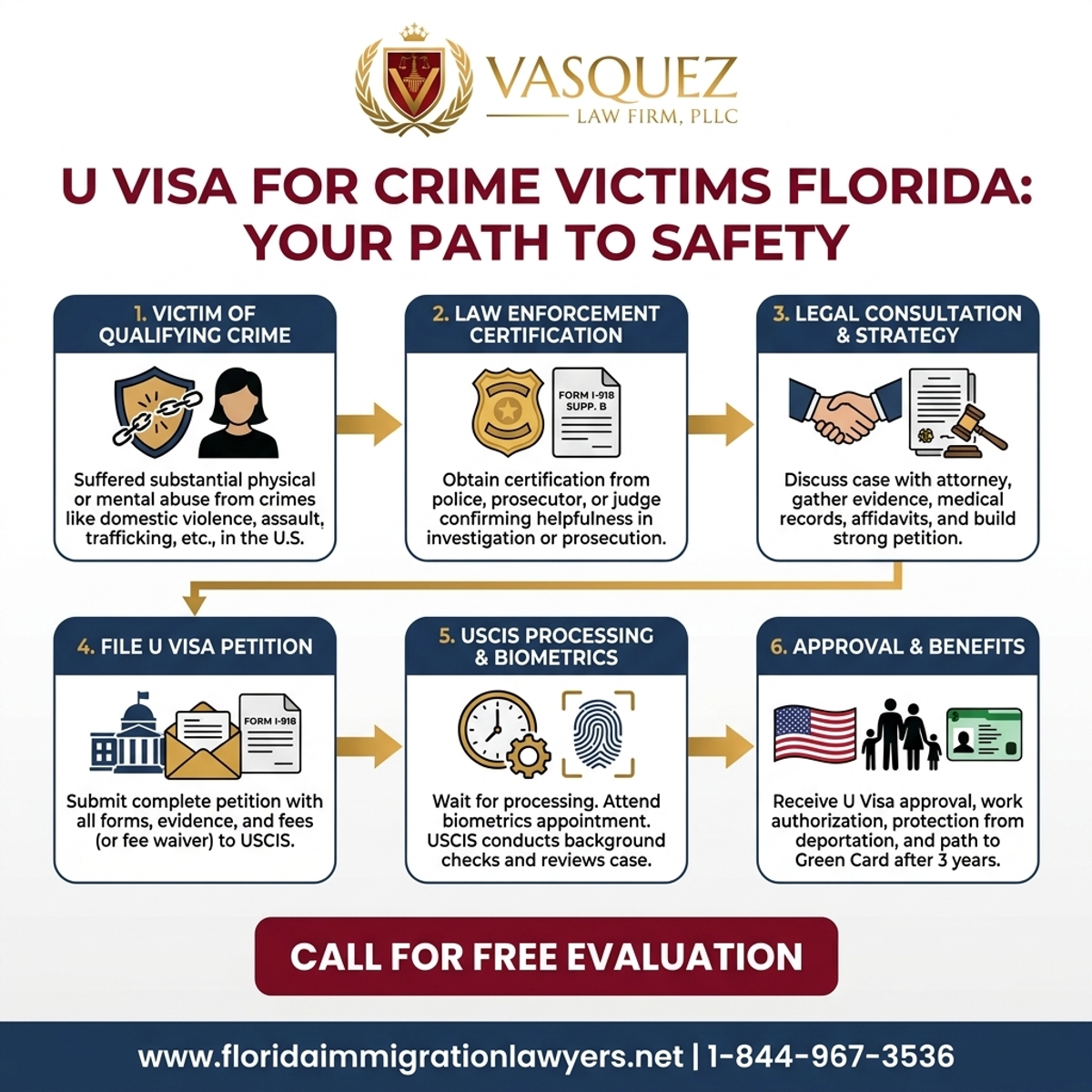
Step-by-Step Process — U Visa for Crime Victims Florida: Your Path to Safety
Understanding U Visa Processing Times and What to Expect
The U visa process can be lengthy, and understanding the typical processing times is essential for managing expectations. While USCIS strives to process applications efficiently, the high volume of petitions and the complex nature of the vetting process can lead to significant waiting periods. For applicants in Florida, patience is key, but staying informed about your case status is also important. As of 2026, USCIS processes U visa petitions in stages, and current processing times can be found on the official USCIS website, which we strongly encourage you to monitor: USCIS.
Initially, once your Form I-918 is filed, USCIS will issue a receipt notice, confirming they have received your application. This is typically followed by a notice to attend a biometrics appointment, where your fingerprints and photograph will be taken. After this, your application enters the queue for review. Due to the statutory cap of 10,000 U visas issued per fiscal year, USCIS often places eligible applicants on a waitlist. If your petition is prima facie (on its face) eligible, you may be granted deferred action and work authorization while you await an available U visa number. This deferred action provides temporary protection from deportation and allows you to legally work in the U.S. in Florida.
The waitlist for a U visa can extend for several years, sometimes up to 5-7 years, depending on the backlog. While on the waitlist with deferred action, you can live and work in Florida, providing a crucial sense of stability. Once a U visa number becomes available, USCIS will notify you and typically request additional evidence or schedule an interview. After approval, you will receive U nonimmigrant status for a period of four years. During this time, you can apply for a Green Card (adjustment of status) after three years of continuous physical presence in the U.S., provided you meet all other eligibility requirements. This path to permanent residency is a significant benefit of the U visa, offering long-term security. Our team at Florida Immigration Lawyers will help you track your case and respond promptly to any USCIS requests.
Do not navigate this complex process alone. The stakes are high, and the legal landscape is constantly evolving. Contact Florida Immigration Lawyers today at 1-844-967-3536 to ensure your U visa application is handled with the expertise and care it deserves. We offer free consultations and are ready to assist crime victims throughout Florida.
Costs Associated with a U Visa Application in Florida
Understanding the potential costs involved in a U visa application is an important part of planning for this immigration journey. While the process itself offers significant humanitarian relief, there are various fees associated with filing forms and obtaining necessary documentation. It is important to note that USCIS filing fees can change, so it is always best to check the most current fee schedule on the official USCIS website before submitting any application. Generally, the main costs for a U visa application fall into a few categories: government filing fees, legal fees, and incidental expenses.
For many U visa applicants, especially those demonstrating financial hardship, certain USCIS fees may be waived. For example, the Form I-918, Petition for U Nonimmigrant Status, typically has no filing fee. However, if you need to file Form I-192, Application for Advance Permission to Enter as a Nonimmigrant (for a waiver of inadmissibility), there is a separate fee, which may also be waived under specific circumstances for U visa applicants. Additionally, there is a biometric services fee for fingerprinting, though this too can sometimes be waived. Our attorneys can help you determine if you qualify for any fee waivers and assist you in preparing the necessary documentation to request them, alleviating some of the financial burden for victims in Florida.
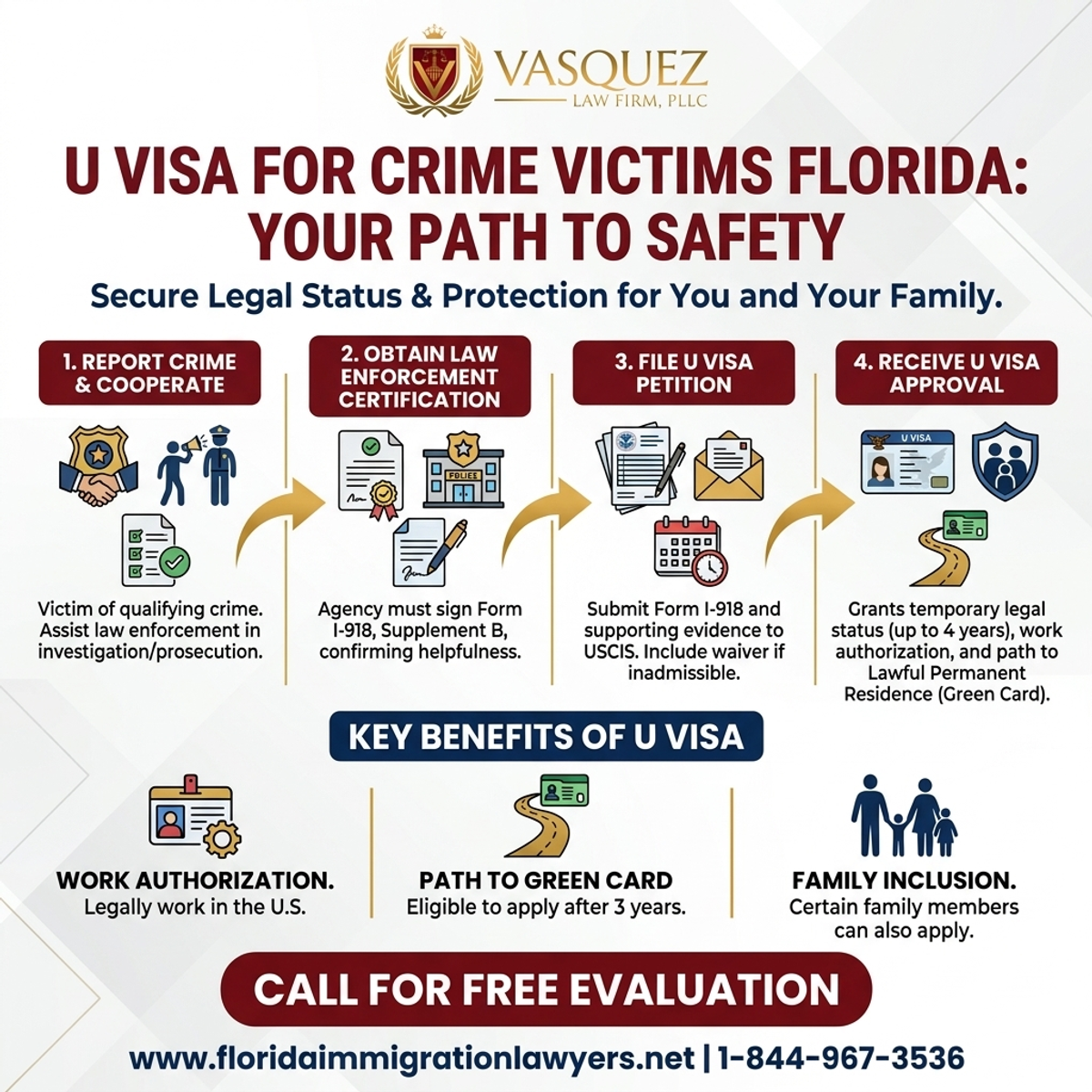
Key Statistics — U Visa for Crime Victims Florida: Your Path to Safety
Beyond government fees, legal fees for retaining an experienced immigration attorney constitute a significant portion of the overall cost. While it may seem like an additional expense, the expertise of a lawyer is invaluable for a U visa application. An attorney can ensure all forms are correctly filled out, all necessary evidence is gathered, a compelling personal statement is drafted, and communication with law enforcement for certification is handled professionally. They can also represent you in dealing with USCIS, respond to Requests for Evidence (RFEs), and navigate any complexities, such as inadmissibility issues. The investment in legal representation often pays off by increasing the likelihood of a successful outcome and avoiding costly delays or denials. Incidental expenses might include translation services for documents, postage, travel to appointments, and costs for obtaining medical or psychological evaluations.
Common Mistakes to Avoid in Your U Visa Application
The U visa application process is complex, and even minor errors can lead to significant delays or even denial. For crime victims in Florida seeking this vital relief, avoiding common pitfalls is crucial. Our team at Florida Immigration Lawyers helps clients steer clear of these mistakes.
- Failing to Obtain Law Enforcement Certification: This is perhaps the most critical error. Without a certified Form I-918, Supplement B, from a qualifying agency, your U visa petition cannot be approved. Many applicants struggle to get this certification, highlighting the need for legal assistance in communicating with law enforcement.
- Incomplete or Inaccurate Forms: Any missing information or errors on forms I-918 or I-192 can result in a Request for Evidence (RFE) or denial. Double-checking every field and ensuring consistency is vital.
- Insufficient Evidence of the Crime or Abuse: Simply stating you were a victim is not enough. You must provide compelling documentation, such as police reports, medical records, psychological evaluations, and detailed personal statements, to substantiate the qualifying crime and the substantial abuse suffered.
- Lack of Demonstrated Helpfulness: The U visa requires proof of cooperation with law enforcement. Vague statements are insufficient; you need concrete evidence like letters from officers, court transcripts, or detailed accounts of your assistance.
- Missing Deadlines or Ignoring RFEs: USCIS provides strict deadlines for responding to RFEs or other notices. Failing to respond on time will almost certainly lead to a denial.
- Not Disclosing All Inadmissibility Grounds: Attempting to hide past immigration violations or criminal history will severely jeopardize your application. It is always better to disclose all information and file a waiver (Form I-192) if necessary.
- Poorly Written Personal Statement: Your personal statement is your opportunity to tell your story. A poorly organized, inconsistent, or emotionally detached statement can weaken your case. It should be clear, detailed, and convey the impact of the crime.
- Failing to Include Derivative Family Members: Eligible family members (spouse, children, and in some cases, parents or siblings) can be included in your application. Forgetting to include them or failing to provide proof of relationship can mean they miss out on this critical relief.
- Not Seeking Legal Counsel: The complexity of U visa law, the need for law enforcement cooperation, and the detailed evidence requirements make legal representation highly advisable. Many successful U visa cases benefit from an attorney's expertise.
- Applying for the Wrong Visa Category: Some victims may mistakenly apply for asylum or other visas when a U visa is more appropriate for their specific situation as crime victims. Understanding the nuances of each visa category is crucial.
When to Call Florida Immigration Lawyers for U Visa Assistance
Navigating the U visa process is incredibly challenging, especially when you are recovering from the trauma of being a crime victim. While the information provided here offers a general overview, specific situations almost always require personalized legal advice. You should contact Florida Immigration Lawyers immediately if you are a non-citizen in Florida and have been the victim of a serious crime, such as domestic violence, sexual assault, human trafficking, or felonious assault, and you have cooperated or intend to cooperate with law enforcement. Our team is particularly experienced in assisting victims in Homestead, Miami, Orlando, and across the state.
Specific scenarios where legal intervention is critical include difficulty obtaining the law enforcement certification (Form I-918, Supplement B), having a complicated criminal history or prior immigration violations that might make you inadmissible, or if you have received a Request for Evidence (RFE) from USCIS. If you are unsure whether the crime you experienced qualifies for a U visa, or if you need assistance gathering evidence and drafting your personal statement, our attorneys can provide clarity and strategic guidance. We understand the sensitivity required for these cases and offer compassionate, effective representation. Do not risk a denial due to technicalities or lack of understanding. Let us help you secure your future and peace of mind.
Our firm specializes in a wide range of immigration services, including general immigration, asylum, deportation defense, family immigration, and citizenship. If you are seeking relief as a crime victim, our dedicated attorneys are ready to provide the support and legal expertise you need. Contact us today for a confidential consultation.
About Florida Immigration Lawyers
Florida Immigration Lawyers is a leading law firm dedicated to providing comprehensive and compassionate immigration legal services to individuals and families across the entire state of Florida. With a deep understanding of U.S. immigration law and its constant evolution, our experienced attorneys are committed to helping our clients navigate complex legal challenges and achieve their immigration goals. We pride ourselves on offering personalized attention, strategic advice, and aggressive advocacy to protect the rights and interests of those we serve.
Our firm handles a wide array of immigration matters, from family-based petitions and employment visas to asylum claims, deportation defense, and humanitarian relief options like the U visa. We understand that immigration issues can be incredibly stressful and life-altering, which is why we approach every case with empathy, professionalism, and unwavering dedication. Our team is available 24/7 to answer your questions and provide support. We offer free, confidential consultations to discuss your unique situation and explore the best legal strategies available. Serving all of Florida, including communities like Homestead, Miami, Orlando, and Tampa, Florida Immigration Lawyers is your trusted partner in securing a brighter future. Call us today at 1-844-967-3536 or visit our website at https://www.floridaimmigrationlawyers.net to learn more about how we can assist you.
Sources and References
- U.S. Citizenship and Immigration Services (USCIS)
- Executive Office for Immigration Review (EOIR)
- U.S. Department of State - Bureau of Consular Affairs
- 8 U.S.C. § 1101(a)(15)(U) - Immigration and Nationality Act (INA) Section 101(a)(15)(U)
- 8 CFR Part 214.14 - Regulations Governing U Nonimmigrant Status
- USCIS Policy Manual
Related services: immigration practice areas, business immigration, experienced immigration attorneys.
This article provides general legal information and is not intended as legal advice. Every case is unique, and outcomes depend on specific facts and circumstances. Contact an attorney for advice about your particular situation.
If you are a crime victim in Florida and believe you may be eligible for a U visa, do not hesitate to seek expert legal guidance. Your safety and future are too important to leave to chance. Call Florida Immigration Lawyers today at 1-844-967-3536 for a free consultation. Se Habla Español - Estamos aquí para ayudarle.
Do Not Navigate This Process Alone
Our experienced immigration attorneys are ready to fight for you. Get a free, confidential consultation today.
Se Habla Español
Frequently Asked Questions

William J. Vásquez
Founding Attorney · Vasquez Law Firm
U.S. Air Force veteran and immigration attorney with thousands of cases resolved. J.D., NCCU School of Law. AILA member. Admitted to the 4th, 5th, and 11th Circuit Courts.
Available 24/7 - Free Evaluations
Related Legal Services
Our Florida immigration attorneys can help you with family immigration services, immigration practice areas and free immigration consultation. Call today at 1-844-967-3536 for a free consultation.
Related Links
Related Topics
Free Legal Consultation
Discuss your case with our experienced attorneys. We're available 24/7.
Se Habla Español - Estamos aquí para ayudarle.
Related Articles
Biometrics Appointment in Florida: What to Expect in 2026
Navigating a biometrics appointment in Florida is crucial for your USCIS process. Learn what to expect, how to prepare, and common pitfalls to avoid. Florida Immigration Lawyers are here to help with personalized guidance and support.
Withholding of Removal Explained: Florida Defense in 2026
For those in Florida facing deportation and fearing persecution or torture in their home country, understanding withholding of removal is critical. This form of protection prevents removal to a dangerous country, though it differs significantly from asylum in its eligibility criteria and benefits. It requires proving a "more likely than not" chance of persecution based on protected grounds or torture, a higher standard than asylum's "well-founded fear." While withholding of removal does not lead to a Green Card, it offers mandatory protection if the stringent criteria are met, even for some individuals barred from asylum. The process involves complex legal proceedings before an immigration judge, often in Miami or Orlando immigration courts. A comprehensive application, detailed testimony, and robust supporting evidence, including country conditions reports and affidavits, are essential. Given the high stakes and intricate legal requirements, securing the expertise of a Florida immigration lawyer is paramount to building a strong defense and navigating the path to safety.
US Visa Policy Changes July 2026: What Students in Florida
As of July 2026, international students in Florida seeking a change of status to an F-1 student visa must prepare for potential adjustments to U.S. visa policies. This comprehensive guide from Florida Immigration Lawyers explores the anticipated policy changes, detailing their potential impact on application requirements, processing times, and eligibility criteria. We provide a step-by-step overview of the change of status process, including a document checklist, expected timelines, and cost considerations. Understanding these complexities and avoiding common mistakes is crucial for a successful application. With potential changes approaching, proactive planning and expert legal guidance are more important than ever. Our firm is dedicated to helping students in Tampa and across Florida navigate these challenges, offering tailored advice and robust representation. Learn how to protect your academic future and ensure a smooth transition to F-1 student status.
Dual Citizenship Lawyer: Your 2026 Guide to Naturalization
Achieving U.S. citizenship is a profound milestone, but the path to naturalization, especially with dual citizenship in mind, is fraught with legal intricacies and a critical interview process. This comprehensive guide from Florida Immigration Lawyers demystifies the journey, offering essential citizenship interview tips and highlighting the invaluable role of a dual citizenship lawyer. We cover eligibility, document preparation, timelines, and common pitfalls, all tailored for Florida residents in areas like Pembroke Pines. Discover how expert legal counsel can prepare you for your naturalization interview, address dual nationality concerns, and ensure a smooth, successful application. From initial assessment to interview representation, we provide the support needed to navigate USCIS requirements confidently. Call Florida Immigration Lawyers for a free consultation to start your journey.