TPS to Green Card Florida: Your Path to Permanent Residency
For TPS holders in Florida, transitioning to a green card is a complex but often achievable goal. While TPS provides temporary relief, it doesn't directly lead to permanent residency. Instead, beneficiaries must qualify through other immigration avenues like family-based or employment-based petitions. A critical aspect is demonstrating lawful admission, a requirement clarified by the Supreme Court's <em>Sanchez v. Mayorkas</em> decision. This article from Florida Immigration Lawyers provides a detailed guide, covering eligibility, the step-by-step application process, essential documents, timelines, and common pitfalls. We emphasize the importance of legal counsel to navigate these intricate requirements and maximize your chances of success in communities like Hialeah and across Florida.

Transitioning from Temporary Protected Status (TPS) to a green card in Florida is possible but requires navigating complex immigration laws. TPS itself does not directly lead to permanent residency, but beneficiaries can pursue other green card categories like family-based or employment-based immigration. A key factor is demonstrating a lawful admission into the U.S., which may require specific actions or prior legal status. Consulting with an experienced attorney is crucial for this intricate process.
- TPS holders can pursue a green card through other eligible categories.
- Lawful admission is generally required for adjustment of status.
- Family-based and employment-based visas are common pathways.
- The process involves multiple forms and strict eligibility criteria.
- Legal guidance from Florida Immigration Lawyers is highly recommended.
TPS to Green Card Florida: Your Path to Permanent Residency
For many individuals in Florida, Temporary Protected Status (TPS) offers a vital lifeline, providing temporary relief from deportation and work authorization. While TPS is a crucial benefit, it is not a direct path to permanent residency. However, holding TPS does not prevent you from pursuing a green card through other available immigration channels. Understanding these pathways and their specific requirements is essential for securing your long-term future in the Sunshine State.
Navigating the complex landscape of U.S. immigration law can be overwhelming, especially when considering a transition from TPS to a green card. The rules are intricate, constantly evolving, and specific circumstances can significantly impact your eligibility. This comprehensive guide from Florida Immigration Lawyers aims to demystify the process, providing clear, actionable information for TPS beneficiaries across Florida, including communities like Hialeah, Miami, and Orlando.
Our goal is to equip you with the knowledge needed to understand your options and take the necessary steps toward achieving lawful permanent resident status. We will cover eligibility requirements, the application process, required documentation, potential timelines, and common pitfalls to avoid. Remember, your journey to a green card is unique, and personalized legal advice is invaluable.
Do you have questions about your TPS status or your eligibility for a green card? Do not delay in seeking expert legal counsel. Call Florida Immigration Lawyers at 1-844-967-3536 for a free consultation today! We are here to help you understand your options and guide you every step of the way.
Understanding Temporary Protected Status (TPS) in Florida
Temporary Protected Status (TPS) is a humanitarian immigration benefit granted by the U.S. government to eligible nationals of designated countries. These designations occur when conditions in the country prevent its nationals from returning safely, or when the country is unable to handle the return of its nationals adequately. Such conditions might include ongoing armed conflict, environmental disaster, or other extraordinary and temporary conditions.
In Florida, a state with a vibrant and diverse immigrant population, many individuals from countries like Venezuela, Haiti, Nicaragua, El Salvador, and Honduras have benefited from TPS. This status allows them to live and work legally in the U.S. for a temporary period, typically ranging from 6 to 18 months, with the possibility of extension. While TPS provides much-needed stability, it is crucial to understand its temporary nature and how it relates to obtaining a green card.
Who Qualifies for TPS and its Benefits?
To qualify for TPS, individuals must generally be a national of a country designated for TPS, file during the initial registration period or a re-registration period, and meet specific eligibility requirements regarding continuous physical presence and continuous residence in the U.S. They must also pass security and background checks. TPS offers several key benefits, including protection from deportation, an Employment Authorization Document (EAD), and the ability to apply for travel authorization.
However, TPS does not automatically lead to a green card or U.S. citizenship. It is a temporary form of relief, distinct from asylum or refugee status, though individuals may hold multiple statuses simultaneously. Understanding this distinction is the first step in planning your long-term immigration strategy.
TPS and the "Lawful Admission" Requirement
A critical aspect for TPS holders considering a green card through adjustment of status is the requirement of a lawful admission. The Supreme Court's decision in Sanchez v. Mayorkas (2021) clarified that simply having TPS does not confer lawful admission for the purpose of adjusting status under INA Section 245(a) (8 U.S.C. § 1255(a)). This means that if you entered the U.S. without inspection, even if you later received TPS, you generally cannot adjust status to a green card within the U.S. unless you have another basis for lawful admission or are eligible for specific exceptions.
For many TPS holders in Florida, this requirement necessitates careful legal analysis. Some individuals may have entered legally, such as with a visa, and then overstayed before obtaining TPS. Others might have been paroled into the U.S. or may be eligible for parole in place if they are immediate relatives of U.S. military personnel. If you left the U.S. with advance parole (Form I-512) and were lawfully paroled back into the country, this may also satisfy the lawful admission requirement. This is a complex area, and understanding your specific entry history is paramount.
Navigating the TPS to Green Card Pathway in Florida
While TPS itself doesn't offer a direct green card path, it provides a stable platform from which you can pursue other avenues to lawful permanent residency. The most common pathways for TPS holders to obtain a green card are through family-based petitions, employment-based petitions, or, in some cases, asylum. Each pathway has its own set of stringent eligibility criteria and a detailed application process.
Florida Immigration Lawyers has extensive experience helping clients in Hialeah, Miami, and throughout Florida explore these options. We understand the local USCIS field office requirements and the nuances of applying for adjustment of status in our state. Our team is dedicated to providing personalized guidance to help you navigate this intricate process successfully.
Common Pathways for Adjustment of Status
Family-Based Immigration: This is often the most common route. If you have a U.S. citizen spouse, parent, or adult child (21 years or older), they may be able to file an immigrant petition (Form I-130, Petition for Alien Relative) on your behalf. For immediate relatives of U.S. citizens (spouses, unmarried children under 21, and parents of U.S. citizens aged 21 or over), a visa is immediately available, potentially allowing for concurrent filing of the I-130 and I-485 (Application to Adjust Status).
Employment-Based Immigration: If you have an employer willing to sponsor you, you might be eligible for an employment-based green card. This typically involves a U.S. employer filing a petition (Form I-140, Immigrant Petition for Alien Worker) on your behalf, often after a labor certification process. These categories are usually subject to visa bulletin backlogs, meaning there might be a waiting period.
Asylum or Refugee Status: If you fear persecution in your home country, you may have applied for asylum independently of your TPS status. If your asylum application is granted, you can apply for a green card one year after your asylum grant date. This is a distinct process but can lead to permanent residency.
Step-by-Step Guide: The Adjustment of Status Process
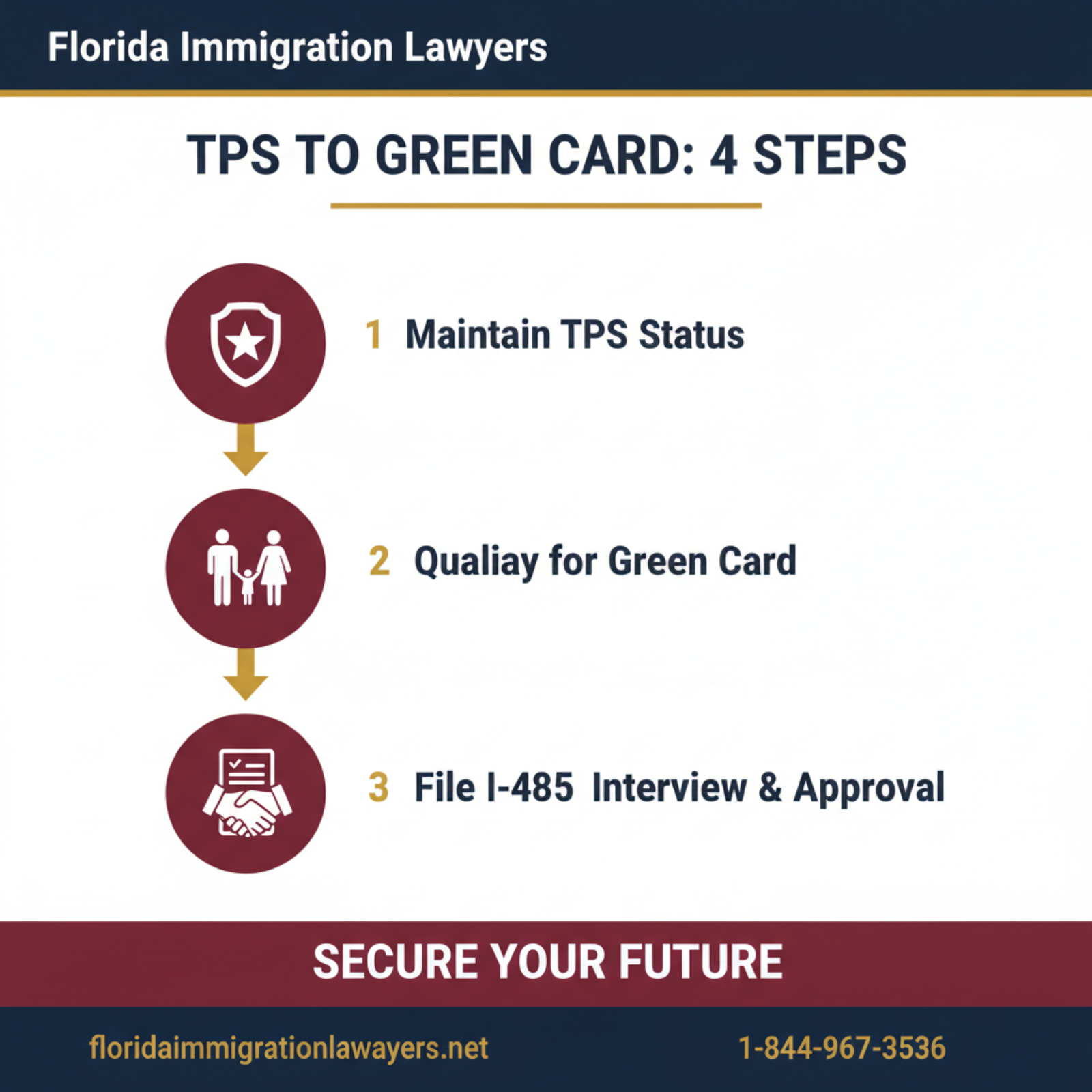
The process of adjusting status from TPS to a green card in Florida typically involves these steps. Please note that the exact sequence and required forms can vary based on your specific eligibility category and whether you need to address the lawful admission requirement.
- Determine Eligibility for an Underlying Green Card Category: First, you must establish eligibility for a green card through a family relationship, employment sponsorship, or asylum. This is the foundational step.
- Address the "Lawful Admission" Requirement: If you entered without inspection, you generally cannot adjust status in the U.S. You may need to explore options like parole in place (if applicable) or, in some limited circumstances, consular processing abroad (which carries its own risks and complexities, including potential bars to re-entry). If you traveled with advance parole and were lawfully paroled back into the U.S., this typically satisfies the lawful admission requirement.
- File the Appropriate Immigrant Petition: Your U.S. citizen relative or sponsoring employer must file the initial petition (e.g., Form I-130 for family, Form I-140 for employment). If you are an immediate relative of a U.S. citizen and meet the lawful admission requirement, you may be able to file this concurrently with your adjustment of status application.
- File Form I-485, Application to Adjust Status: Once an immigrant visa number becomes available (or is immediately available for immediate relatives), you can file Form I-485 with U.S. Citizenship and Immigration Services (USCIS). This is the application to change your status to a lawful permanent resident while remaining in the U.S.
- Attend Biometrics Appointment: USCIS will schedule an appointment for you to provide fingerprints, photographs, and a signature for background checks. This typically occurs at a local Application Support Center (ASC) in Florida.
- Prepare for Interview (if required): Most adjustment of status applicants will be scheduled for an interview at a local USCIS field office in Florida, such as those in Miami, Orlando, or Tampa. During the interview, an immigration officer will review your application and supporting documents and ask questions to confirm your eligibility.
- Receive Decision: After the interview (or waiver of interview), USCIS will make a decision on your application. If approved, you will receive your green card by mail.
Essential Documents for Your Florida Green Card Application
Applying for a green card from TPS requires a thorough collection of documents. Missing or incorrect documentation can lead to delays or even denial of your application. It is crucial to be meticulous in preparing your submission. The exact documents required will depend on your specific green card category (family-based, employment-based, etc.) and your personal history.
Florida Immigration Lawyers will help you compile a complete and accurate package. We understand the specific requirements of USCIS field offices across Florida and ensure your application meets all necessary criteria.
- Form I-485, Application to Adjust Status: The main application form.
- Form I-130 or I-140 (if applicable): The underlying immigrant petition.
- Form I-765, Application for Employment Authorization (optional): Allows you to continue working while your I-485 is pending.
- Form I-131, Application for Travel Document (optional): For advance parole if you need to travel internationally while your I-485 is pending.
- Form I-864, Affidavit of Support: Required for most family-based petitions, demonstrating financial support.
- Form I-693, Report of Medical Examination and Vaccination Record: Completed by a USCIS-approved civil surgeon in Florida.
- Birth Certificate: Your original birth certificate and a certified English translation if it's not in English.
- Passport and Visa (if applicable): Copies of your passport, visa, and I-94 arrival/departure record.
- Proof of Lawful Entry/Admission: Documentation showing your lawful entry or parole into the U.S.
- Marriage Certificate (if applicable): For spousal petitions.
- Proof of Relationship: Birth certificates of children, photos, joint bank accounts, lease agreements, etc., for family petitions.
- Employment Letters/Pay Stubs (if applicable): For employment-based petitions or to demonstrate financial stability.
- Police Clearances: From your home country and any U.S. states where you have lived.
- Photos: Passport-style photographs.
- TPS Documentation: Copies of your TPS approval notices and EADs.
TPS to Green Card Timeline and Processing Expectations in Florida
The timeline for transitioning from TPS to a green card can vary significantly, often ranging from several months to several years. This depends on various factors, including the specific green card category you are pursuing, the current USCIS processing backlogs, and the efficiency of the particular USCIS field office handling your case in Florida. For instance, an application processed at the Miami Field Office might have a different timeline than one at the Orlando or Tampa offices.
Immediate relatives of U.S. citizens (spouses, unmarried children under 21, and parents) often experience faster processing times because a visa number is immediately available. Other family-based categories and most employment-based categories are subject to visa bulletin availability, which can introduce significant waiting periods, sometimes spanning many years, depending on your country of origin and preference category.
Factors Affecting Processing Times
- Green Card Category: Immediate relative petitions are generally faster than preference categories.
- Visa Bulletin Availability: Backlogs for specific countries and preference categories can cause long delays. You can check the Department of State's Visa Bulletin for current availability.
- USCIS Workload: Processing times at USCIS service centers and field offices fluctuate based on caseloads. You can typically check current processing times on the USCIS website.
- Completeness of Application: Any missing documents or errors can lead to Requests for Evidence (RFEs) or denials, significantly prolonging the process.
- Interview Requirements: If an interview is required, scheduling delays can impact the overall timeline.
- Background Checks: Security checks are mandatory and can sometimes take an unpredictable amount of time.
USCIS Field Offices and Service Centers
Most TPS to green card applications are initially processed by a USCIS service center (e.g., Nebraska, Texas, California). If an interview is required, it will typically be scheduled at a local USCIS field office in Florida, such as in Miami, Orlando, or Tampa. Understanding which office will handle your case can sometimes provide insight into potential processing variations, though specific timelines are largely dictated by national backlogs.
Do not navigate this process alone. Contact Florida Immigration Lawyers today to ensure your application is accurate and complete, maximizing your chances for a timely approval.
Cost Factors and Fee Breakdown for Adjustment of Status
Applying for a green card involves several financial considerations, including government filing fees and potential legal fees. It is important to budget for these costs to avoid unexpected financial burdens during your application process. While government fees are standardized, legal fees will vary based on the complexity of your case and the services required.
Please note that USCIS fees are subject to change. It is always best to check the official USCIS website for the most current fee schedule. Florida Immigration Lawyers provides transparent fee structures and will discuss all anticipated costs with you during your free consultation.
Government Filing Fees
The primary government fees for adjusting status typically include:
- Form I-485, Application to Adjust Status: This fee covers the processing of your green card application and often includes the biometrics fee.
- Form I-130, Petition for Alien Relative (if applicable): Filed by your sponsoring U.S. citizen relative.
- Form I-140, Immigrant Petition for Alien Worker (if applicable): Filed by your sponsoring employer.
- Form I-765, Application for Employment Authorization (if filed separately): Sometimes included with I-485, but may have a separate fee if filed alone or before concurrent filing is possible.
- Form I-131, Application for Travel Document (if filed separately): Similar to I-765, often included with I-485 but can be separate.
- Form I-693, Report of Medical Examination and Vaccination Record: The fee for this medical exam is paid directly to the civil surgeon and is not a USCIS fee.
Fee waivers may be available for certain forms if you meet specific poverty guidelines. However, fee waivers are generally not available for Form I-130 or I-140.
Legal Fees and Other Expenses
Hiring an experienced immigration attorney is a valuable investment for a complex process like transitioning from TPS to a green card. Legal fees cover the attorney's time and expertise in:
- Evaluating your eligibility and identifying the best pathway.
- Preparing all necessary forms and compiling supporting documentation.
- Responding to Requests for Evidence (RFEs) from USCIS.
- Preparing you for your USCIS interview.
- Representing you at the interview (if requested and within the scope of representation).
- Communicating with USCIS on your behalf.
Additional expenses might include translation services for documents not in English, postage, and travel costs for biometrics appointments or interviews.
Common Mistakes to Avoid When Applying for a Green Card from TPS
The journey from TPS to a green card is fraught with potential pitfalls. Avoiding common mistakes can significantly improve your chances of a successful outcome and prevent unnecessary delays or denials. Florida Immigration Lawyers helps clients in Hialeah and throughout Florida steer clear of these errors.
- Ignoring the Lawful Admission Requirement: Many TPS holders incorrectly assume their TPS status automatically grants lawful admission. Failing to address this can lead to an I-485 denial. Always determine your entry status carefully.
- Filing Without a Qualifying Green Card Basis: You cannot simply apply for a green card because you have TPS. You must be eligible through a family member, an employer, or another specific category. Filing without an underlying petition is a guaranteed denial.
- Incomplete or Incorrect Documentation: Missing birth certificates, insufficient proof of relationship, or uncertified translations are common reasons for Requests for Evidence (RFEs) or denials. Be meticulous and organized.
- Failing to Disclose All Immigration History: Any prior encounters with immigration authorities, arrests, or previous applications must be fully disclosed, even if they seem minor. Omissions can be considered misrepresentation and lead to severe consequences, including deportation.
- Traveling Internationally Without Advance Parole: Leaving the U.S. without a valid advance parole document while your I-485 is pending can be considered an abandonment of your application and may prevent re-entry. Always consult an attorney before any international travel.
- Not Maintaining TPS Status During Application: While your green card application is pending, it is generally advisable to maintain your TPS status by re-registering if your country's designation is extended. This provides a backup status and continued work authorization.
- Ignoring Public Charge Rule Changes: The public charge rule has seen changes over the years. Understanding how it applies to your situation, especially regarding government benefits, is important.
- Providing Inconsistent Information: All your immigration applications and statements should be consistent. Discrepancies between past applications (e.g., asylum, TPS) and your current green card application can raise red flags with USCIS.
When to Call a Lawyer: Protecting Your TPS to Green Card Journey
While this article provides general information, the complexities of immigration law mean that every case is unique. Deciding to transition from TPS to a green card is a significant step with profound implications for your future. Engaging an experienced immigration attorney, particularly one familiar with Florida's specific context, is not just advisable-it is often essential for a successful outcome.
You should contact Florida Immigration Lawyers if you:
- Entered the U.S. without inspection: This is a major hurdle due to the lawful admission requirement. An attorney can assess if any exceptions or alternative pathways, such as parole in place or consular processing, might apply to your situation.
- Have a complicated immigration history: This includes prior deportations, arrests, criminal convictions, or previous denials of immigration benefits. Such issues can create inadmissibility grounds that require waivers or specialized legal strategies.
- Are unsure about your eligibility for an underlying green card category: An attorney can thoroughly review your family relationships, employment opportunities, or asylum claims to determine the most viable path.
- Received a Request for Evidence (RFE) or Notice of Intent to Deny (NOID): These notices indicate that USCIS requires more information or intends to deny your application. Responding correctly and comprehensively is critical, and legal expertise is invaluable.
- Are considering international travel: Traveling outside the U.S. while your green card application is pending, especially if you previously entered without inspection, can have severe negative consequences. Always consult an attorney before making travel plans.
- Need to understand the latest changes in immigration law: Laws and policies, including those related to TPS and adjustment of status, can change. An attorney stays current with these developments, such as the implications of Sanchez v. Mayorkas.
Florida Immigration Lawyers offers comprehensive services for TPS holders seeking permanent residency. Our attorneys are well-versed in immigration law, including family-based immigration, employment-based immigration, and citizenship. We are committed to protecting your rights and guiding you through every step of this complex journey.
About Florida Immigration Lawyers
Florida Immigration Lawyers is a leading immigration law firm dedicated to serving individuals and families across the entire state of Florida. With offices strategically located to assist clients in major hubs like Miami, Hialeah, Orlando, and Tampa, our experienced legal team provides compassionate and effective representation for a wide range of immigration matters.
Our firm specializes in various practice areas, including Temporary Protected Status (TPS), green card applications, asylum, deportation defense, family-based immigration, business immigration, and U.S. citizenship. We understand the profound impact immigration issues have on your life and are committed to achieving the best possible outcomes for our clients.
Why choose Florida Immigration Lawyers? We pride ourselves on our deep legal expertise, personalized approach, and unwavering dedication. We offer free, confidential consultations and are available 24/7 to address your urgent needs. Our bilingual team ensures that language is never a barrier to quality legal representation. Let us be your trusted partner on your immigration journey.
Contact Florida Immigration Lawyers today at 1-844-967-3536 or visit www.floridaimmigrationlawyers.net to learn more.
Sources and References
- U.S. Citizenship and Immigration Services (USCIS)
- U.S. Department of State - Visa Bulletin
- Executive Office for Immigration Review (EOIR)
- 8 U.S.C. Chapter 12 - Immigration and Nationality Act (INA)
- 8 U.S.C. § 1254a - Temporary Protected Status
- 8 U.S.C. § 1255(a) - Adjustment of status of nonimmigrant to that of person admitted for permanent residence
- 8 CFR Part 244 - Temporary Protected Status
- Sanchez v. Mayorkas, 593 U.S. ___ (2021)
This article provides general legal information and is not intended as legal advice. Every case is unique, and outcomes depend on specific facts and circumstances. Contact an attorney for advice about your particular situation.
Your journey from TPS to a green card in Florida is a significant undertaking, but with the right legal guidance, it is an achievable goal. Do not leave your future to chance. Contact Florida Immigration Lawyers today for a free, confidential consultation at 1-844-967-3536. Se Habla Español - Estamos aquí para ayudarle.
Do Not Navigate This Process Alone
Our experienced immigration attorneys are ready to fight for you. Get a free, confidential consultation today.
Se Habla Español
Frequently Asked Questions
Florida Immigration Lawyers
Immigration Attorney | Founder, Vasquez Law Firm
U.S. Air Force veteran and immigration attorney with thousands of cases resolved. J.D., NCCU School of Law. AILA member. Admitted to the 4th, 5th, and 11th Circuit Courts.
Available 24/7 - Free Evaluations
Related Legal Services
Our Florida immigration attorneys can help you with business immigration, asylum protection and deportation defense. Call today at 1-844-967-3536 for a free consultation.
Related Links
Related Topics
Free Legal Consultation
Discuss your case with our experienced attorneys. We're available 24/7.
Se Habla Español - Estamos aquí para ayudarle.
Related Articles
VAWA Immigration Relief for Abuse Victims in Florida
VAWA provides essential immigration relief for abuse victims in Florida, enabling them to apply for legal status independently. Learn how to navigate this process effectively.
Immigration Lawyer in Hialeah Florida | VLF Florida
Discover how finding the right immigration lawyer in Hialeah, Florida, can help you navigate complex immigration processes. Contact Florida Immigration Lawyers for a free consultation today!
F-1 Visa for Florida University International Students
Explore the process of obtaining an F-1 visa to study at Florida universities, with specific insights for international students in Fort Lauderdale. Understand requirements, avoid common pitfalls, and learn when to seek legal help. Contact Florida Immigration Lawyers for personalized assistance.
Understanding the Stokes Interview for Marriage Fraud in Florida
Facing a Stokes interview in Florida for marriage fraud concerns? Learn what to expect and how to prepare effectively. Contact Florida Immigration Lawyers for expert guidance and a free consultation.