Political Asylum Attorney: Navigating Florida Requirements
For those seeking refuge in Florida, understanding the complex requirements for political asylum is paramount. This guide from Florida Immigration Lawyers details eligibility criteria, the step-by-step application process, essential documentation, and typical timelines for asylum cases in 2026. We cover critical aspects such as the one-year filing deadline, the importance of a well-founded fear of persecution, and the nuances of the asylum interview. Learn about potential costs, common mistakes to avoid, and when to seek the expertise of a political asylum attorney. Our firm serves individuals across Florida, including Orlando, Miami, and Tampa, providing dedicated legal support for affirmative and defensive asylum claims. Protect your future and secure your safety with expert legal guidance.

A political asylum attorney in Florida helps individuals apply for asylum, a form of protection granted to those who fear persecution in their home country. Eligibility hinges on demonstrating a well-founded fear of persecution based on race, religion, nationality, political opinion, or membership in a particular social group. The process involves filing Form I-589, attending a biometrics appointment, and undergoing an asylum interview, often at the USCIS Asylum Office in Orlando. Navigating these complex requirements and strict deadlines, such as the one-year filing rule, is critical for a successful outcome.
- Eligibility: Fear of persecution based on five protected grounds.
- Application: File Form I-589 within one year of U.S. entry.
- Process: Includes biometrics, interview, and potential court hearings.
- Legal Aid: Essential for evidence gathering and interview preparation.
Seeking safety and a new beginning in the United States is a profound journey, especially when fleeing persecution in your home country. For those in Florida, understanding the intricate requirements for political asylum can be overwhelming. The process is fraught with legal complexities, strict deadlines, and the need for compelling evidence. Whether you are in Orlando, Miami, Tampa, or anywhere across the Sunshine State, securing protection through asylum is a critical step towards rebuilding your life.
This comprehensive guide, brought to you by Florida Immigration Lawyers, aims to demystify the political asylum process in Florida for 2026. We will cover eligibility, application steps, required documentation, timelines, and associated costs. Our goal is to provide clarity and empower you with the knowledge needed to pursue your asylum claim effectively. From the initial filing to the crucial asylum interview, every stage demands careful attention and a deep understanding of U.S. immigration law.
Do not navigate this life-altering process alone. The stakes are incredibly high, and the legal landscape is constantly evolving. A seasoned political asylum attorney can be your most valuable asset, offering expert guidance and advocacy. Call Florida Immigration Lawyers at 1-844-967-3536 for a free case review and let us help you understand your options and build a strong application.
What is Political Asylum and Who is Eligible in Florida?
Political asylum is a form of humanitarian protection under U.S. immigration law, granted to individuals who are unable or unwilling to return to their home country due to a well-founded fear of persecution. This fear must be based on one of five specific grounds: race, religion, nationality, membership in a particular social group, or political opinion. The definition of a refugee, which asylum seekers generally fall under, is codified in the Immigration and Nationality Act (INA).
Eligibility for political asylum in Florida, consistent with federal law, requires applicants to demonstrate that they have suffered past persecution or have a reasonable possibility of future persecution if they return to their home country. A "well-founded fear" means there is a genuine and objectively reasonable risk of harm. This is not merely a subjective feeling of discomfort but a fear supported by credible evidence and circumstances. Florida, with its diverse population and international airports, is a common destination for individuals seeking such protection. Many asylum seekers arrive in cities like Orlando, which hosts a significant immigrant community and a USCIS Asylum Office.
The concept of "persecution" itself is broad, encompassing threats to life or freedom, severe economic harm, arbitrary detention, torture, or other forms of severe harm. Minor annoyances or general instability do not typically qualify. Furthermore, the persecution must be inflicted by the government of the home country or by groups the government is unable or unwilling to control. Applicants must also prove a nexus, meaning a direct link between the persecution they fear and one of the five protected grounds. For example, if you fear harm because you openly criticized a totalitarian regime, that would relate to political opinion. A skilled political asylum attorney understands these nuances and can help articulate your claim effectively, referencing statutes such as INA 101(a)(42)(A).
How Do I Apply for Political Asylum in Florida in 2026?
To apply for political asylum in Florida in 2026, you generally file Form I-589, Application for Asylum and for Withholding of Removal, with USCIS or the Executive Office for Immigration Review (EOIR) depending on your immigration status. This crucial step must typically occur within one year of your last arrival in the U.S.
The application process for political asylum involves several critical stages, each with specific requirements and potential pitfalls. Whether you are applying affirmatively (not in removal proceedings) or defensively (in removal proceedings before an immigration judge), the foundational document remains Form I-589. This form requires detailed personal information, a comprehensive narrative of your fear of persecution, and a list of all dependents you wish to include in your application. The one-year filing deadline is a strict rule, and failing to meet it without exceptional circumstances can lead to a denial. For those in Florida, affirmative applications are typically processed through the USCIS Asylum Office which serves the state, often located in Orlando, while defensive applications are handled by the Orlando Immigration Court.
Here is a step-by-step guide to applying for political asylum:
- Gather Comprehensive Evidence: Before filling out Form I-589, collect all available evidence supporting your claim. This includes personal statements detailing your experiences, affidavits from witnesses, medical records of injuries, police reports, news articles, and country conditions reports from reputable human rights organizations.
- Complete Form I-589 Accurately: Fill out the entire Form I-589, Application for Asylum and for Withholding of Removal, truthfully and completely. Any inconsistencies or omissions can negatively impact your case. Ensure all questions are answered, even if it means writing "N/A" for non-applicable sections.
- Submit Your Application: If you are not in removal proceedings, mail your completed Form I-589 and supporting documents to the appropriate USCIS Service Center. If you are in removal proceedings, file it with the immigration court. Timely submission is paramount, ideally within one year of your last entry into the U.S.
- Attend Biometrics Appointment: After filing, USCIS will send you a notice for a biometrics appointment (fingerprints, photograph, signature). This data is used for background and security checks.
- Prepare for the Asylum Interview: If you filed affirmatively, you will be scheduled for an asylum interview with an asylum officer. This is a crucial opportunity to present your case verbally. Preparation with a political asylum attorney is highly recommended.
- Receive a Decision or Referral: Following the interview, the asylum officer will either grant asylum, issue a "Notice of Intent to Deny" (NOID), or refer your case to an immigration judge if they do not grant asylum and you are not in lawful status.
Understanding these steps is vital, and a knowledgeable attorney can guide you through each one, helping to prepare your application and represent you during your interview. For further details on the application process, visit the USCIS Asylum page.
What Documents Do I Need for a Florida Asylum Application?
A successful asylum application hinges on robust and credible evidence. The documents you submit must corroborate your narrative of persecution and establish a direct link to one of the five protected grounds. Gathering these materials can be an extensive process, and it is where the expertise of a political asylum attorney becomes invaluable in ensuring everything is complete and properly presented.
Here is a comprehensive document checklist for your asylum application:
- Form I-589, Application for Asylum and for Withholding of Removal: The primary application form, completed accurately and thoroughly.
- Copies of Identity Documents: This includes your passport, birth certificate, national identity card, and any other official identification from your home country.
- Proof of Entry and Status: Copies of your Form I-94 (Arrival/Departure Record), visa, and any other U.S. immigration documents.
- Personal Declaration/Affidavit: A detailed, chronological narrative of your persecution, fear, and why you cannot return to your country. This is often the most critical piece of evidence.
- Witness Affidavits: Sworn statements from individuals who witnessed your persecution or can attest to your credibility and circumstances.
- Evidence of Persecution: This can include a wide range of materials such as police reports, medical records (documenting injuries from torture or assault), court documents, arrest warrants, news articles about your situation, or official government documents targeting you.
- Country Conditions Reports: Objective reports from organizations like Human Rights Watch, Amnesty International, or the U.S. Department of State detailing human rights abuses or specific persecution patterns in your home country. These help establish the objective reasonableness of your fear.
- Proof of Membership in a Protected Group: Documents demonstrating your race, religious affiliation, nationality, political activities (e.g., party membership cards, protest photos), or ties to a particular social group.
- Marriage Certificate and Birth Certificates: If you are including a spouse or children in your application, provide copies of these vital records.
- Photographs: Passport-style photos for yourself and any dependents included in the application.
- Translations: Any document not in English must be accompanied by a certified English translation. The translator must attest that they are competent to translate and that the translation is accurate.
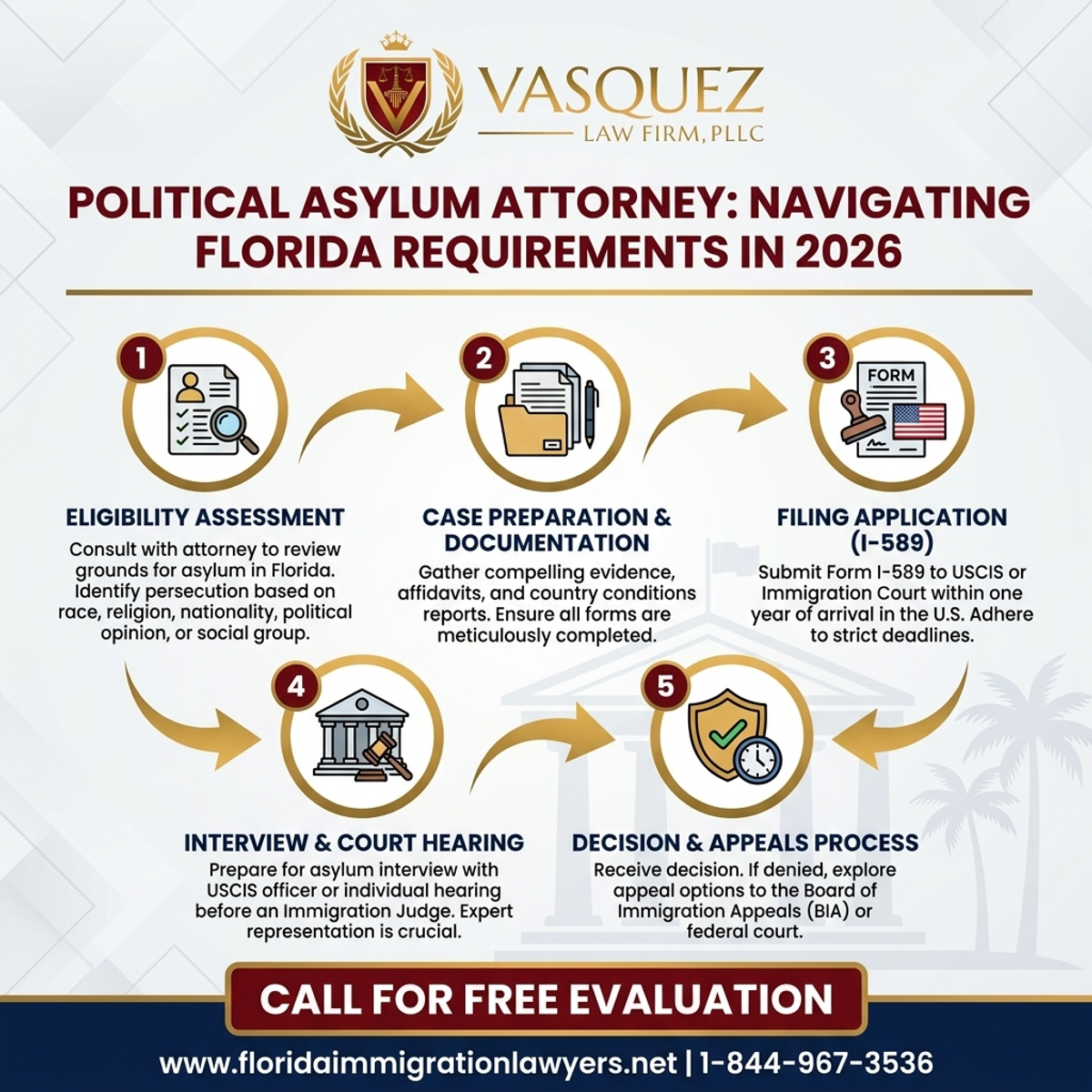
Step-by-Step Process — Political Asylum Attorney: Navigating Florida Requirements in 2026
Organizing these documents systematically and ensuring their authenticity is crucial. Inconsistencies or a lack of supporting evidence can significantly weaken your claim, making the role of an experienced legal professional indispensable.
What is the Timeline for Political Asylum Cases in Florida in 2026?
As of 2026, the timeline for political asylum cases in Florida can vary significantly due to backlogs, but generally involves filing, biometrics within weeks, an asylum interview within months, and a decision potentially taking several months to years. Defensive cases heard by the Orlando Immigration Court may face longer adjudication periods.
The processing time for political asylum applications in Florida, as across the United States, has historically been subject to significant fluctuations due to various factors including the volume of applications, resource allocation, and policy changes. While USCIS aims to interview affirmative asylum applicants who have recently filed first (a "last in, first out" scheduling policy), older cases may still face substantial delays. Defensive asylum cases, which are adjudicated by an immigration judge, can be even more protracted due to the extensive backlogs in the immigration court system, including the Orlando Immigration Court.
Here is a typical timeline for political asylum cases:
| Stage | Typical Timeframe | Notes |
|---|---|---|
| Filing Form I-589 | Immediately upon arrival (within 1 year) | Critical deadline; exceptions are rare and difficult to prove. |
| Biometrics Appointment | 3-8 weeks after filing | Required for background and security checks; failure to attend can delay or terminate case. |
| Asylum Interview (Affirmative) | 6 months - 5+ years | USCIS prioritizes recently filed cases; older cases may wait longer. Interview typically lasts 1-3 hours. |
| Decision (Affirmative) | Weeks to months post-interview | Can be granted, denied, or referred to an Immigration Judge for defensive proceedings. |
| Immigration Court Hearings (Defensive) | 1-5+ years | Multiple master calendar and individual hearings; can involve appeals to the BIA. |
| Work Authorization (EAD) Application | 150 days after filing I-589, then apply | Eligible to apply for Form I-765 (Employment Authorization Document); must wait 180 days for approval. |
It is important to remember that these are typical timeframes, and individual cases can deviate significantly. Factors such as the complexity of your case, the volume of applications at the specific USCIS Asylum Office (e.g., Orlando), and the judge's docket in immigration court can all influence processing times. Maintaining consistent communication with your political asylum attorney and promptly responding to any requests for evidence (RFEs) from USCIS or the court can help prevent unnecessary delays. The Department of Justice's Executive Office for Immigration Review (EOIR) provides resources on court backlogs.
What Are the Costs Associated with a Political Asylum Attorney in Florida?
The U.S. government does not charge a filing fee for Form I-589, the asylum application itself. However, costs for a political asylum attorney in Florida will vary based on case complexity, attorney experience, and services required, typically including legal fees, translation costs, and expert witness fees.
While the application for asylum (Form I-589) itself carries no government filing fee, there are several other costs that applicants should anticipate when pursuing political asylum in Florida. The most significant of these is often the legal fees associated with hiring an experienced political asylum attorney. These fees are not standardized and can vary widely based on the attorney's reputation, the complexity of your case, whether it is an affirmative or defensive application, and the services included (e.g., initial consultation, document preparation, interview preparation, representation at interviews or court hearings, appeals). For example, a defensive asylum case in immigration court, such as at the Orlando Immigration Court, typically involves more appearances and legal work, leading to higher fees than an affirmative application with USCIS.
Here is a breakdown of potential costs:
| Item | Typical Fee | Notes |
|---|---|---|
| I-589 Filing Fee | $0 | No government fee for the asylum application itself. |
| Attorney Fees (Affirmative Asylum) | Varies, e.g., $5,000 - $15,000+ | Can be a flat fee or hourly; depends on complexity, attorney's experience, and services rendered. |
| Attorney Fees (Defensive Asylum) | Varies, e.g., $10,000 - $25,000+ | Often higher due to multiple court appearances and extensive preparation for court proceedings. |
| Translation Services | $50 - $200 per document (or hourly) | Mandatory for any document not in English; certified translations required. |
| Expert Witness Fees | $500 - $5,000+ | For country conditions experts, psychologists, or medical professionals providing specialized testimony. |
| Medical/Psychological Evaluations | $300 - $1,500+ | For survivors of torture or trauma, to document physical or psychological harm. |
| Travel and Miscellaneous Costs | Varies | Costs for travel to USCIS interviews, court hearings, or obtaining documents. |
| Employment Authorization Document (EAD) Application | Typically $470 (Form I-765) | A separate fee for the work permit application, which can be waived in some cases. |
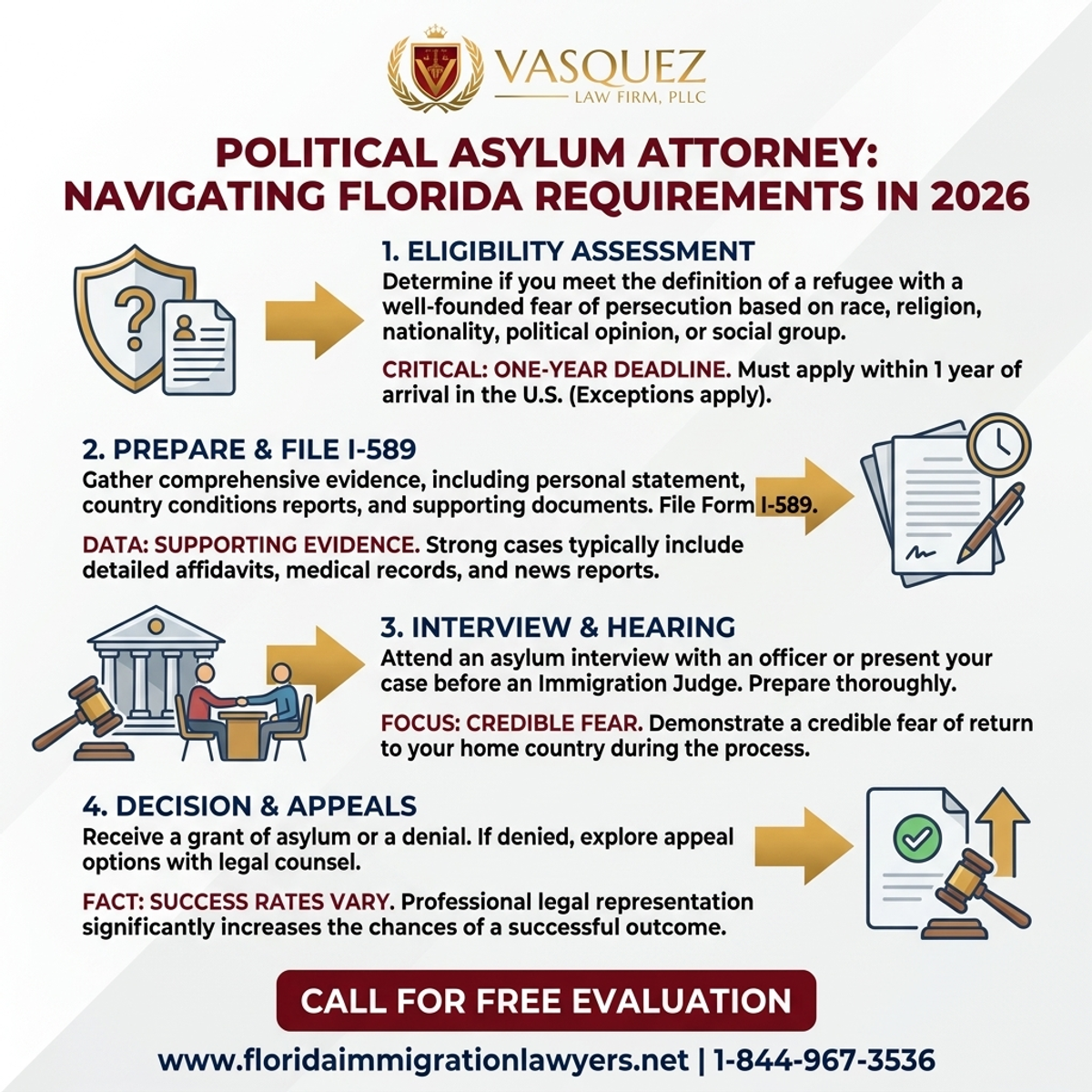
Key Statistics — Political Asylum Attorney: Navigating Florida Requirements in 2026
While these costs can seem substantial, investing in a qualified political asylum attorney often proves invaluable. Their expertise can significantly increase the chances of a successful outcome, potentially saving you from deportation or a return to a dangerous situation. Many firms, including Florida Immigration Lawyers, offer payment plans or free initial consultations to help manage these expenses. It is always wise to discuss fee structures transparently with your chosen attorney. Learn more about our legal team and their experience by visiting our attorneys page.
Do not navigate this process alone. The complexities of asylum law, the high stakes involved, and the potential for life-altering outcomes make legal representation essential. Contact Florida Immigration Lawyers today to schedule a free case review. We are here to protect your rights and help you secure a safe future in Florida.
Common Mistakes to Avoid in Your Political Asylum Application
The asylum process is unforgiving of errors. Even small mistakes can lead to significant delays or even denial of your application. Being aware of these common pitfalls can help you avoid them and strengthen your case.
- Missing the One-Year Filing Deadline: This is arguably the most critical mistake. Generally, you must file Form I-589 within one year of your last arrival in the U.S. unless you can demonstrate exceptional circumstances. Failing to meet this deadline without a valid exception can lead to automatic denial, making your case incredibly difficult to pursue.
- Lack of Evidence or Weak Documentation: Your personal testimony is vital, but it must be supported by credible evidence. Relying solely on your word without corroborating documents (e.g., police reports, medical records, country conditions reports) can weaken your claim significantly.
- Inconsistent Testimony: Any discrepancies between your written application, personal declaration, and verbal testimony during the asylum interview or court hearings can severely damage your credibility. Asylum officers and judges are trained to spot inconsistencies.
- Failing to Disclose All Information: Omitting crucial details, especially about past arrests, immigration history, or prior applications, can be perceived as an attempt to deceive. This can lead to a finding that you lack credibility and result in a denial.
- Not Understanding the "Well-Founded Fear" Standard: Many applicants misunderstand what constitutes persecution or fails to connect their fear directly to one of the five protected grounds. General fear of violence or economic hardship typically does not meet the legal standard for asylum.
- Attempting to Represent Yourself: While possible, self-representation is highly risky. Asylum law is complex, requiring a deep understanding of statutes, regulations, and case precedents. An applicant without legal training is at a distinct disadvantage against experienced government attorneys.
- Ignoring Changes in Country Conditions: Asylum officers and judges consider current country conditions. If conditions in your home country have significantly improved, you might need to present additional evidence explaining why your specific fear of persecution persists.
- Failing to Update Contact Information: Moving without notifying USCIS or EOIR of your new address can lead to missed notices for interviews or hearings, which can result in a "failure to appear" and an automatic order of removal.
- Not Preparing for the Asylum Interview: The interview is your primary opportunity to present your case. Without thorough preparation, you might struggle to articulate your story clearly, recall important details, or answer challenging questions effectively.
- Traveling Outside the U.S.: Once you apply for asylum, traveling outside the U.S. without proper authorization (advance parole) can be seen as an abandonment of your asylum claim, as it suggests you do not truly fear returning to your home country.
When to Call a Political Asylum Attorney in Florida
The decision to seek political asylum is monumental, and the process is one of the most challenging areas of immigration law. While individuals can technically file on their own, the complexities, high stakes, and potential for life-altering consequences make legal representation not just beneficial, but often essential for a successful outcome. Knowing when to engage a political asylum attorney can significantly impact your chances of approval.
You should immediately contact Florida Immigration Lawyers if any of the following scenarios apply to you:
- You are within your one-year deadline: The sooner you contact an attorney, the more time they have to gather evidence and prepare a strong application.
- You have received a Notice to Appear (NTA): If you are in removal (deportation) proceedings, you are already in a defensive asylum situation, and an attorney is critical to represent you before an immigration judge at the Orlando Immigration Court. Visit our deportation defense page for more information.
- Your case involves complex legal issues: This includes past criminal history, prior immigration denials, or if you have suffered particularly severe forms of persecution (e.g., torture).
- You need help gathering evidence: An attorney can guide you on what specific documents are needed, how to obtain them, and how to present them effectively.
- You have language barriers: While interpreters are provided for interviews, having an attorney who can communicate with you directly and prepare you for the nuances of the interview is invaluable.
- You are unsure if you meet eligibility requirements: An attorney can assess your specific situation against the legal standards for asylum and advise you on the strength of your claim.
- You are preparing for your asylum interview: This is a make-or-break moment. An attorney will meticulously prepare you for questions, help you articulate your story, and represent you during the interview itself.
- You need to file an appeal: If your asylum application has been denied, an attorney can help you understand your options for appeal to the Board of Immigration Appeals (BIA) or federal courts.
Our experienced team at Florida Immigration Lawyers is dedicated to providing compassionate and effective legal representation for asylum seekers across Florida. We understand the unique challenges faced by immigrants and are committed to protecting your rights. Contact us today for a free case review.
About Florida Immigration Lawyers
Florida Immigration Lawyers is a leading immigration law firm dedicated to serving individuals and families across the entire state of Florida. With a deep understanding of the complexities of U.S. immigration law and a compassionate approach, we are committed to providing exceptional legal representation to those seeking to build a new life in the United States. Our team of skilled attorneys brings extensive experience to a wide range of immigration matters, including humanitarian relief such as political asylum.
We pride ourselves on our client-focused philosophy, ensuring that every individual receives personalized attention and strategic legal advice tailored to their unique circumstances. From family-based petitions and business immigration to complex deportation defense and asylum claims, we are equipped to handle diverse cases with professionalism and integrity. Our firm is proud to offer bilingual services, with a dedicated team ready to assist clients in both English and Spanish, ensuring clear communication throughout the legal process. We understand the profound impact immigration cases have on our clients' lives and are committed to achieving the best possible outcomes.
For expert legal guidance and a team that genuinely cares about your future, trust Florida Immigration Lawyers. We offer free case reviews and are available 24/7 to provide the support you need. Call us today at 1-844-967-3536 or visit our website at www.floridaimmigrationlawyers.net to learn how we can help you navigate your immigration journey.
Sources and References
- U.S. Citizenship and Immigration Services (USCIS)
- Executive Office for Immigration Review (EOIR)
- U.S. Department of State
- 8 U.S.C. § 1101(a)(42)(A) - Definition of Refugee (Immigration and Nationality Act)
- 8 CFR § 208 - Asylum and Withholding of Removal (Code of Federal Regulations)
- USCIS Policy Manual, Volume 7, Part A - Asylum
Related services: asylum application process, refugee status and resettlement, humanitarian protection programs.
This article provides general legal information and is not intended as legal advice. Every case is unique, and outcomes depend on specific facts and circumstances. Contact an attorney for advice about your particular situation.
Securing political asylum is a path to safety and stability, but it is a journey best undertaken with experienced legal counsel. If you or a loved one are seeking asylum in Florida, do not delay. The time to act is now. Contact Florida Immigration Lawyers for a free, confidential case review at 1-844-967-3536. Se Habla Español - Estamos aquí para ayudarle.
If you need legal assistance, learn more about asylum lawyers in Florida, or call us at 1-844-967-3536 for a free consultation.
Do Not Navigate This Process Alone
Our experienced immigration attorneys are ready to fight for you. Get a free, confidential consultation today.
Se Habla Español
Or leave your details and we’ll call you:
Free Evaluation in 24 Hours
Or talk to us right now
AI voice assistant — available 24/7
FreeFrequently Asked Questions

William J. Vásquez
Founding Attorney · Vasquez Law Firm
U.S. Air Force veteran and immigration attorney with years of hands-on U.S. immigration experience. J.D., NCCU School of Law. AILA member. Admitted to the 4th, 5th, and 11th Circuit Courts.
Available 24/7 - Free Evaluations
Reviewed for legal accuracy by William J. Vásquez
Licensed in North Carolina; U.S. immigration is federal practice.
Related Legal Services
Our Florida immigration attorneys can help you with free immigration consultation, experienced immigration attorneys and business immigration. Call today at 1-844-967-3536 for a free consultation.
Related Links
Related Topics
Free Legal Consultation
Discuss your case with our experienced attorneys. We're available 24/7.
Se Habla Español - Estamos aquí para ayudarle.
Related Articles
Immigration Lawyer Orlando Free Consultation in Florida
For individuals and families in Orlando, Florida, navigating the complexities of U.S. immigration law requires expert guidance. An immigration lawyer in Orlando offers crucial support for everything from visa applications and green card processes to naturalization and deportation defense. This comprehensive guide details what a free consultation covers, providing a step-by-step overview of immigration pathways, essential document checklists, and expected timelines in 2026. We also highlight common mistakes to avoid, discuss the critical role of legal counsel in deportation and asylum cases, and explain why choosing a local Orlando immigration attorney is beneficial. Florida Immigration Lawyers is dedicated to serving the diverse community of Orlando with compassionate, effective legal solutions, ensuring you receive personalized advice and robust representation for a successful immigration journey.
Naturalization Ceremony Locations & Schedule 2026 in Florida
Applying for U.S. citizenship through naturalization is a significant milestone for many residents in Florida, including those in Orlando. This comprehensive guide details the naturalization process, covering eligibility requirements, the N-400 application steps, and expected timelines for 2026. We provide a document checklist for your interview, break down typical costs, and explain where naturalization ceremonies are held across Florida. Learn about the English and civics tests, and discover common mistakes to avoid. If you have questions about your eligibility or need assistance with your naturalization application, Florida Immigration Lawyers offers expert legal guidance. We are committed to helping you navigate the complexities of immigration law and achieve your dream of U.S. citizenship.
Immigration Lawyer Orlando Free Consultation: Your Defense
Facing immigration challenges in Orlando or anywhere in Florida? Secure an immigration lawyer Orlando free consultation to understand your legal options, especially if you are in removal proceedings. This guide covers the complexities of deportation defense, including reasons for removal, the step-by-step process, crucial document checklists, and cost considerations for legal representation. Learn how an experienced removal proceedings defense lawyer in Florida can help you navigate the system, avoid common mistakes, and fight for your right to remain in the U.S. Discover when to call a lawyer and how Florida Immigration Lawyers provides compassionate and effective advocacy. Start protecting your future today with a free case review.
Immigration Lawyer Orlando Free Consultation: Bond Hearings
Understanding immigration bond hearings is crucial for individuals detained by ICE in Florida. This guide covers the process, required documents, timelines, and cost factors, with a specific focus on those seeking an immigration lawyer in Orlando. Learn how an Immigration Judge determines bond eligibility based on factors like community ties and criminal history. Discover the critical role of legal representation in navigating complex procedures and advocating for a fair bond amount. Florida Immigration Lawyers offers comprehensive assistance, including free consultations, to help families reunite and pursue their immigration cases effectively. Avoid common mistakes and understand when to seek professional legal help for the best possible outcome.