PERM Labor Certification Florida: Your Guide to Employer
For employers in Fort Lauderdale, Miami, or anywhere in Florida, sponsoring a foreign national for a green card often begins with PERM labor certification. This Department of Labor process ensures no qualified U.S. workers are available for a position before a foreign national is hired permanently. Understanding the detailed recruitment, documentation, and compliance requirements is vital. Florida Immigration Lawyers offers guidance, helping businesses and individuals navigate this complex path to permanent residency. Learn about the process, timelines, costs, and common mistakes to avoid for a successful outcome. Contact us for a free consultation and personalized support.
PERM (Program Electronic Review Management) labor certification is a crucial step for many foreign nationals seeking an employer-sponsored green card in Florida. It verifies that a U.S. employer has attempted to recruit U.S. workers for a position and found none who are able, willing, qualified, and available. This process, overseen by the Department of Labor (DOL), ensures that hiring a foreign worker will not adversely affect the wages and working conditions of U.S. workers.
- PERM is mandatory for most employment-based green card petitions.
- It involves a rigorous recruitment process to test the U.S. labor market.
- The Department of Labor (DOL) reviews and certifies PERM applications.
- Proper preparation and legal guidance are essential for success.
- Florida Immigration Lawyers can assist with every step of the PERM process.
PERM Labor Certification Florida: Your Guide to Employer Sponsorship
Are you an employer in Fort Lauderdale or elsewhere in Florida looking to sponsor a skilled foreign national for a permanent position? Or are you a foreign worker seeking an employer sponsored green card to live and work long-term in the Sunshine State? The PERM labor certification process is often the foundational step in achieving permanent residency through employment.
Navigating the complexities of U.S. immigration law, particularly the detailed requirements set forth by the Department of Labor (DOL), can be daunting. From stringent recruitment efforts to precise documentation, every detail matters. A single misstep can lead to significant delays or even denial of your application, impacting your future or your business operations in Florida.
At Florida Immigration Lawyers, we understand the intricacies of the PERM labor certification process. Our experienced immigration attorneys are dedicated to guiding both employers and employees through this vital stage, ensuring compliance and maximizing your chances of success. We serve clients across all of Florida, providing personalized and strategic legal support.
Do not navigate this critical process alone. Let our firm provide the guidance you need. Call Florida Immigration Lawyers at 1-844-YO-PELEO for a free consultation to discuss your PERM labor certification needs today.
Understanding PERM Labor Certification in Florida
The Permanent Employment Certification program, commonly known as PERM, is administered by the U.S. Department of Labor (DOL). It is a mandatory prerequisite for most employment-based second preference (EB-2) and third preference (EB-3) immigrant visa petitions. Essentially, PERM ensures that a U.S. employer cannot find a qualified U.S. worker for a specific job opening before offering it to a foreign national.
The core purpose of PERM labor certification is to protect the U.S. labor market. It prevents foreign workers from displacing U.S. workers or adversely affecting their wages and working conditions. Employers in Florida, like those anywhere else in the nation, must demonstrate a genuine shortage of U.S. workers for the position they intend to fill with a foreign national.
Is a Labor Certificate the Same as a PERM?
Yes, the terms "labor certificate" and "PERM" are often used interchangeably. PERM is the current system for obtaining a permanent labor certification. Before 2005, the process was different and often referred to simply as labor certification. The PERM system was introduced to streamline the process through an online, attestation-based application.
This modern system requires employers to conduct specific recruitment activities and then attest to the DOL that they have done so and found no qualified U.S. workers. This attestation forms the basis of the PERM application. Understanding this distinction is important when discussing the permanent residency process.
Who Needs PERM Labor Certification?
Most individuals seeking an employer sponsored green card under the EB-2 (Professionals Holding Advanced Degrees or Persons of Exceptional Ability) and EB-3 (Skilled Workers, Professionals, or Other Workers) categories require an approved PERM labor certification. This includes a wide range of professionals, from IT specialists in Miami to healthcare workers in Orlando, and engineers in Tampa.
There are certain exceptions, such as individuals with extraordinary ability (EB-1), outstanding professors and researchers (EB-1), multinational executives and managers (EB-1), or those qualifying for National Interest Waivers (NIW) within the EB-2 category. These specific categories do not require a PERM labor certification. For all other EB-2 and EB-3 cases, PERM is a non-negotiable step in the permanent residency process.
The PERM Labor Certification Process: A Step-by-Step Guide for Florida Employers
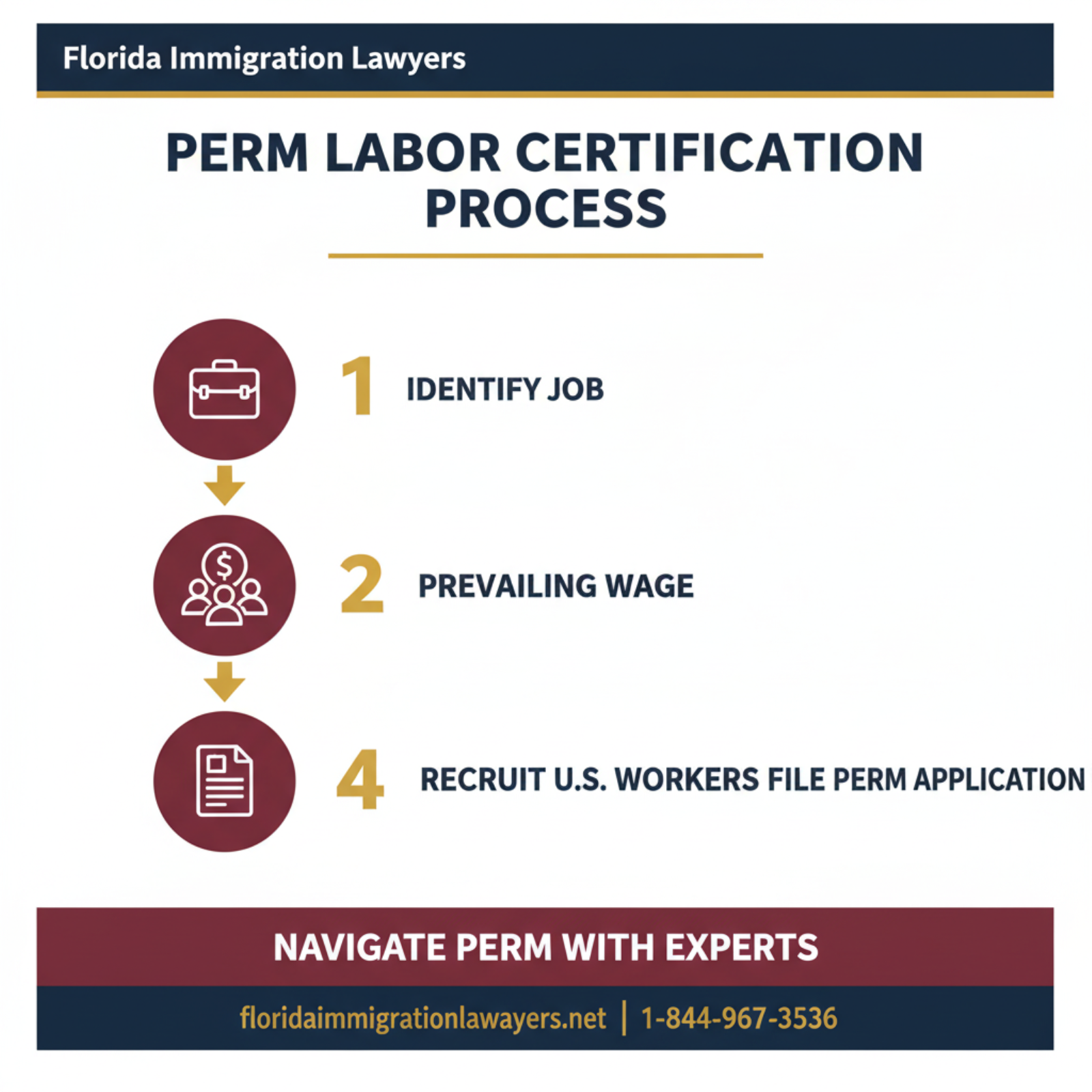
The PERM process is detailed and requires careful adherence to DOL regulations. Here is a step-by-step guide that Florida employers typically follow:
-
Determine Prevailing Wage: The employer must first obtain a Prevailing Wage Determination (PWD) from the DOL's National Prevailing Wage Center (NPWC). This ensures that the wage offered to the foreign worker meets or exceeds the prevailing wage for similar occupations in the area of intended employment, such as Fort Lauderdale. This step is crucial for protecting U.S. workers and typically takes several months.
-
Conduct Recruitment: This is arguably the most critical phase. The employer must conduct specific recruitment activities to test the U.S. labor market. These activities generally include:
- Placing a job order with the State Workforce Agency (SWA) for 30 days. In Florida, this is through CareerSource Florida.
- Placing two Sunday advertisements in a newspaper of general circulation.
- Posting a notice of filing at the worksite.
- Additional recruitment steps (three of the following): job fairs, employer's website, job search website, on-campus recruiting, trade or professional organizations, private employment firms, employee referral program, campus placement offices, local and ethnic newspapers, radio and television advertisements.
All recruitment must occur within a specific timeframe (30-180 days before filing the PERM application). The employer must keep detailed records of all recruitment efforts and responses.
-
Review Applications and Interview U.S. Applicants: The employer must review all applications received from U.S. workers during the recruitment period. If any U.S. applicant is qualified and available for the position, the PERM process cannot proceed. Employers must have legitimate, job-related reasons for rejecting U.S. applicants. A detailed recruitment report must be prepared, justifying any rejections.
-
File Form ETA-9089: If no qualified U.S. workers are found, the employer can then file Form ETA-9089, Application for Permanent Employment Certification, with the DOL. This form is an attestation by the employer that all recruitment steps were completed and no qualified U.S. workers were available. This application is filed online through the DOL's FLAG system.
-
DOL Processing and Certification: The DOL reviews the ETA-9089 application. This may involve a direct certification, an audit, or supervised recruitment. An audit requires the employer to submit all supporting documentation, including recruitment records and the prevailing wage determination. Supervised recruitment is rare but involves the DOL overseeing and approving all recruitment steps directly.
-
File Form I-140 Petition: Once the PERM labor certification is certified by the DOL, the employer must file Form I-140, Immigrant Petition for Alien Worker, with U.S. Citizenship and Immigration Services (USCIS). This petition establishes the foreign worker's eligibility for an employment-based immigrant visa category. This step typically requires the employer to demonstrate their ability to pay the offered wage.
-
Adjustment of Status or Consular Processing: After the I-140 is approved and a visa number becomes available (if applicable, based on the foreign national's country of birth and preference category), the foreign national can apply for permanent residency. This can be done either through Adjustment of Status (Form I-485) if they are already in the U.S. or through Consular Processing at a U.S. embassy or consulate abroad.
Essential Documents for Your PERM Labor Certification Application
Preparing for a PERM labor certification requires meticulous documentation. Employers in Florida must maintain comprehensive records to support their application, especially in case of an audit. Here is a general checklist of essential documents:
- Prevailing Wage Determination (PWD): Official determination from the DOL's NPWC.
- Job Description and Requirements: Detailed description of the job duties, minimum education, experience, and special requirements.
- Recruitment Documentation:
- Copies of newspaper advertisements (Sunday ads).
- Job order confirmation from the State Workforce Agency (CareerSource Florida).
- Evidence of other recruitment steps (e.g., website postings, job fair attendance, professional organization ads).
- Notice of Filing posted at the worksite.
Step-by-Step Process Guide - Recruitment Report: Detailed summary of all recruitment efforts, including the number of applicants, their qualifications, and the lawful, job-related reasons for rejecting U.S. applicants.
- Foreign National's Credentials: Copies of the foreign worker's resume, academic degrees, transcripts, and employment letters proving they meet the minimum job requirements.
- Employer's Financial Records: Documentation demonstrating the employer's ability to pay the offered wage (e.g., annual reports, federal tax returns, audited financial statements).
- Employer's Business Information: Articles of incorporation, business licenses, and other relevant company documents.
- Attorney-Client Agreement: If represented by an immigration attorney Florida, the signed agreement.
PERM Labor Certification Timeline and Processing Expectations
The PERM labor certification process is not a quick one. It involves multiple stages, each with its own processing times. Understanding these timelines is crucial for planning your permanent residency process.
How Long Does a PERM Labor Certification Take?
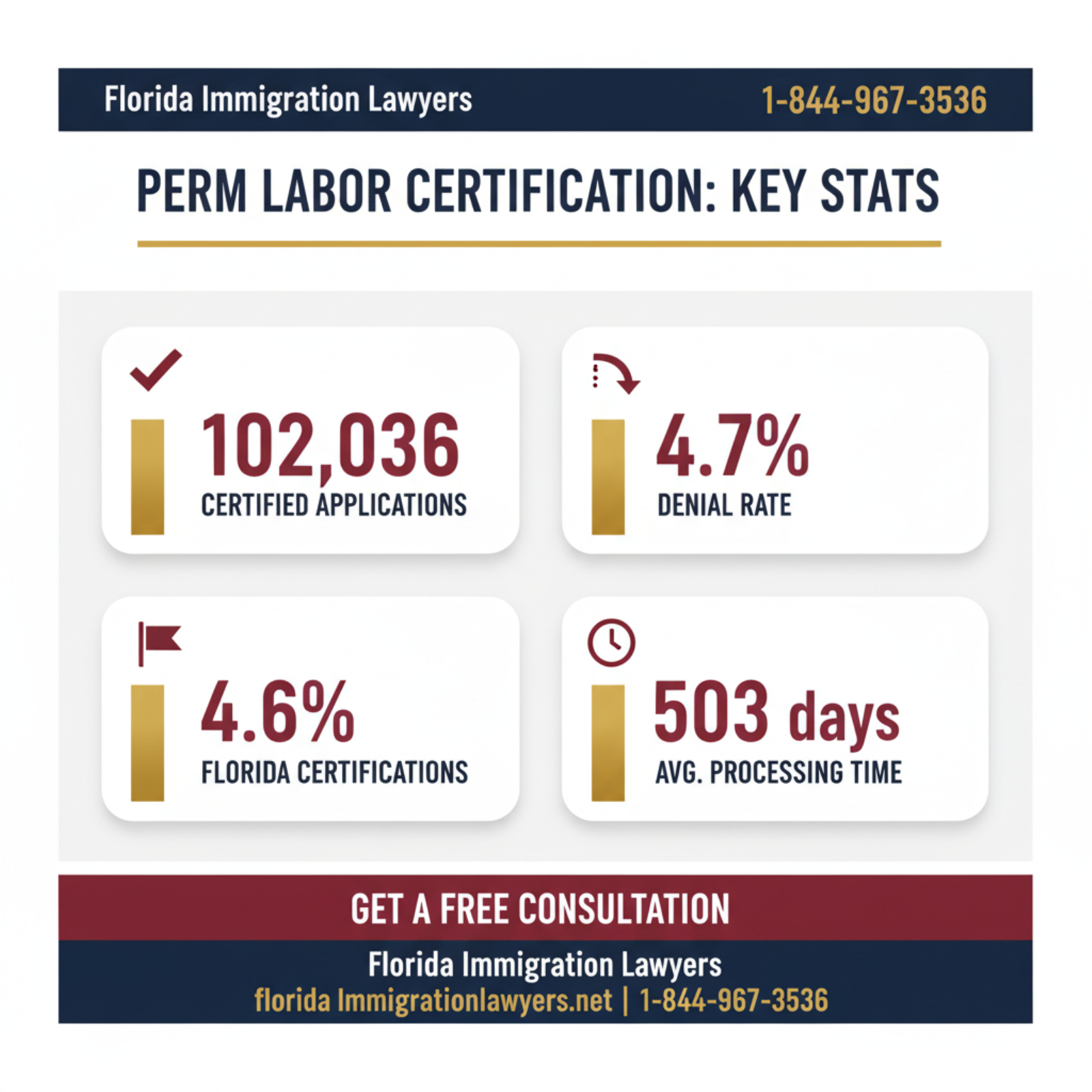
The entire PERM process, from initiating the Prevailing Wage Determination to receiving a certified ETA-9089, can take anywhere from 12 to 18 months, or even longer, depending on various factors. These factors include DOL's current caseload, whether an audit is issued, and the complexity of the job position.
Stage-by-Stage Breakdown:
- Prevailing Wage Determination (PWD): This step alone can take 6 to 9 months. The DOL reviews the job duties and requirements to determine the appropriate wage.
- Recruitment Period: Employers must conduct recruitment for at least 30 days (SWA job order) and often longer for other ads. The "quiet period" (30 days after recruitment but before filing) also adds time. This stage typically spans 2 to 4 months.
- DOL Processing of Form ETA-9089: After filing, the DOL's processing times vary significantly. For non-audited cases, it can be 6 to 12 months. If your case is selected for an audit, the processing time can extend by an additional 6 to 12 months or more, as the DOL reviews all submitted documentation.
It is important to remember that these are estimates. Government processing times are subject to change based on workload and policy shifts. You can check the current processing times on the DOL's Foreign Labor Certification website.
Cost Factors and Fees for PERM Labor Certification
While there is no government filing fee for the Form ETA-9089 itself, employers incur significant costs throughout the PERM labor certification process. These costs are primarily associated with the required recruitment activities and legal fees.
Recruitment Costs:
Employers must pay for all mandatory recruitment advertisements. This includes:
- Newspaper Advertisements: Two Sunday ads in a major newspaper can range from hundreds to thousands of dollars, depending on the publication and its circulation in areas like Miami, Fort Lauderdale, or Jacksonville.
- Professional Journal or Other Ads: If required, advertisements in professional journals or specialized websites can also incur costs.
- Job Search Websites: Fees for posting on various job search platforms.
Legal Fees:
Engaging an experienced business immigration attorney is highly recommended for the PERM process due to its complexity. Legal fees will cover:
- Preparation and filing of the Prevailing Wage Determination request.
- Guidance on drafting the job description and minimum requirements.
- Strategic advice on recruitment efforts and compliance.
- Preparation of the recruitment report and Form ETA-9089.
- Responding to any audits or requests for information from the DOL.
- Overall management of the PERM application from start to finish.
The specific legal fees can vary based on the complexity of the case and the attorney's experience. It is important to discuss these fees upfront with your chosen legal counsel. Employers are legally required to pay all costs associated with the PERM labor certification process, including recruitment and attorney fees. These costs cannot be passed on to the foreign national.
Do not navigate this process alone. The stakes are too high to risk errors. Contact Florida Immigration Lawyers today for assistance with your PERM labor certification. Our team is ready to help you achieve your immigration goals.
Common Mistakes to Avoid in PERM Labor Certification
The PERM labor certification process is rife with technicalities, and even minor errors can lead to delays or denials. Here are some common mistakes that employers and foreign nationals should avoid:
-
Inaccurate Prevailing Wage Determination Request: Failing to accurately describe the job duties and requirements when requesting the PWD can result in an incorrect wage determination, which can invalidate the entire application. This can lead to significant delays and the need to restart the process.
-
Insufficient Recruitment Efforts: Not conducting all required recruitment steps or failing to keep meticulous records of these efforts. Without proper documentation, the DOL may deny the PERM application, requiring the employer to begin recruitment again.
-
Poorly Drafted Job Requirements: Setting job requirements that are unduly restrictive or do not genuinely reflect the minimum qualifications for the position. The DOL scrutinizes requirements to ensure they are not tailored specifically for the foreign national, which can lead to an audit or denial.
-
Failure to Document U.S. Applicant Rejections: Not maintaining detailed, job-related reasons for rejecting U.S. applicants. Every U.S. worker who applies and meets the minimum qualifications must be considered. Inadequate documentation of rejections is a major red flag for the DOL.
-
Late Filing of Form ETA-9089: The PERM application must be filed within 180 days of the start of the earliest recruitment activity. Missing this deadline means all recruitment efforts become invalid, and the process must be restarted from the beginning.
-
Employer's Inability to Pay the Offered Wage: While not part of the PERM application itself, the employer's ability to pay the proffered wage is assessed during the subsequent I-140 petition. If the employer cannot demonstrate this, the entire green card process can stall. It is vital to assess financial capacity early.
-
Lack of Communication with Legal Counsel: Attempting to manage the complex PERM process without the guidance of an experienced immigration lawyer. Legal professionals can help avoid these common pitfalls and ensure compliance with all DOL regulations.
When to Call a Lawyer for Your PERM Labor Certification
Given the high stakes and intricate rules surrounding PERM labor certification, engaging legal counsel is not just advisable, it is often essential. Florida Immigration Lawyers can provide invaluable assistance at every stage.
Consider contacting us immediately if any of the following scenarios apply:
- You are an employer considering sponsoring a foreign national: We can help you understand your obligations, assess the feasibility of a PERM application, and establish a clear strategy.
- You need a Prevailing Wage Determination: Our attorneys can assist in drafting an accurate job description to ensure a correct PWD, which is foundational to the entire process.
- You are unsure about recruitment requirements: We provide detailed guidance on compliant recruitment methods and record-keeping, essential for avoiding DOL audits.
- You receive an audit notice from the DOL: An audit means the DOL wants to scrutinize your application. Our legal team can prepare and submit a robust audit response, protecting your case.
- You have a complex job position or unique requirements: Positions with unusual requirements or those that are difficult to define can be challenging for PERM. Our experience helps navigate these complexities effectively.
- You want to ensure compliance and minimize risks: Proactive legal support reduces the likelihood of errors, delays, and denials, saving you time and resources in the long run.
Our firm, Florida Immigration Lawyers, focuses on business immigration and permanent residency applications. We are well-versed in the specific requirements and nuances affecting employers and foreign nationals in Florida, from Fort Lauderdale to Pensacola. Let us be your trusted partner in achieving your immigration goals.
About Florida Immigration Lawyers
Florida Immigration Lawyers is an immigration law firm dedicated to serving individuals and businesses across the entire state of Florida. With a deep understanding of U.S. immigration law and a commitment to our clients, we provide comprehensive legal services tailored to your unique needs.
Our areas of experience include PERM labor certification, employer-sponsored green cards, family immigration, citizenship, asylum, and deportation defense. We pride ourselves on offering compassionate, effective, and results-driven representation. Our attorneys are available 24/7 to address your urgent concerns and provide free consultations to help you understand your options.
We are here to advocate for you, ensuring your voice is heard and your rights are protected throughout your immigration journey. Visit our website at Vasquez Law Firm to learn more about our team and how we can assist you.
Sources and References
- U.S. Citizenship and Immigration Services (USCIS)
- U.S. Department of Labor (DOL) - Office of Foreign Labor Certification
- U.S. Department of State - Bureau of Consular Affairs
- 8 U.S.C. Chapter 12 - Immigration and Nationality Act (INA)
- INA Section 212(a)(5)(A) - Labor Certification and Qualifications for Immigrant Visas
- 20 CFR Part 656 - Labor Certification Process for the Permanent Employment of Aliens in the United States
This article provides general legal information and is not intended as legal advice. Every case is unique, and outcomes depend on specific facts and circumstances. Contact an attorney for advice about your particular situation.
The PERM labor certification process is a critical gateway to permanent residency for many foreign nationals and a significant undertaking for sponsoring employers in Florida. With complex regulations and strict deadlines, professional legal guidance is not just beneficial, but often essential for a successful outcome.
Our dedicated team at Florida Immigration Lawyers is committed to providing comprehensive support, from the initial Prevailing Wage Determination to the final green card application. We stand ready to assist you or your business in navigating these challenges with confidence and precision.
Do not let the complexities of immigration law deter your dreams. Take the first step towards securing your future in Florida. Call Florida Immigration Lawyers today at 1-844-YO-PELEO for a free, confidential consultation. Se Habla Español - Estamos aquí para ayudarle.
What a Florida PERM Immigration Attorney Handles
PERM is a process run by employers, but it affects two parties: the Florida business that wants to keep a worker and the worker who hopes to become a permanent resident. A Florida PERM immigration attorney usually works with the employer on the labor certification, while keeping the employee informed about how each stage affects their status and future green card. We work with employers and employees across Florida by phone and secure video, in English and Spanish, and meet in person at our only office, 1111 E Amelia Street in Orlando.
Where mistakes tend to happen
- Job description: listing requirements beyond what the business actually needs can cause problems with the Department of Labor.
- Recruitment: ads, timing and how applicants are reviewed must follow the rules, and records must be kept.
- Consistency: the job, wage and duties stated in the prevailing wage request, the recruitment and Form ETA-9089 need to match.
- Audits: the Department of Labor can request documents, and a complete file makes responding easier.
After the labor certification
An approved labor certification is not a green card. The employer then files an immigrant petition, Form I-140, with USCIS. When a visa number is available for the worker's category and country, the worker can apply to adjust status in the United States or go through consular processing abroad. Wait times vary by category and country, so a lawyer reviews each case individually.
Keeping the worker in status
Many PERM workers are in H-1B or another temporary status during the process. Planning ahead helps avoid gaps. To discuss a PERM case, contact our team or read about work visas.
Local guides for nearby areas
If you live nearby, these guides may help:
More questions about PERM in Florida
Who hires the PERM lawyer, the employer or the worker?
PERM labor certification is the employer's application, so the employer is usually the client for that stage. The worker still needs clear information about timing and status, and in some cases has separate counsel for personal immigration questions.
Can a worker change jobs during PERM?
Changing employers before the labor certification and I-140 are complete usually means the new employer must start its own process. After certain stages, some workers have more flexibility. A lawyer should review the case before any job change.
Do Not Navigate This Process Alone
Our experienced immigration attorneys are ready to fight for you. Get a free, confidential case review today.
Se Habla Español
Or leave your details and we’ll call you:
Free Evaluation in 24 Hours
Or talk to us right now

AI voice assistant — available 24/7
FreeFrequently Asked Questions

William J. Vásquez
Founding Attorney · Vasquez Law Firm
U.S. Air Force veteran and immigration attorney with years of hands-on U.S. immigration experience. J.D., NCCU School of Law. AILA member. Admitted to the 4th, 5th, and 11th Circuit Courts.
Available 24/7 - Free Evaluations
Reviewed for legal accuracy by William J. Vásquez
Licensed in North Carolina; U.S. immigration is federal practice.
Related Legal Services
Our Florida immigration attorneys can help you with business immigration, deportation defense and family immigration services. Call today at 1-844-YO-PELEO for a free case review.
Related Links
Related Topics
Free Legal Case Review
Discuss your case with our experienced attorneys. We're available 24/7.
Se Habla Español - Estamos aquí para ayudarle.
Related Articles
Certificate of Eligibility for Expungement in Florida 2026
For non-U.S. citizens in Florida, understanding how a state expungement impacts immigration status is critical. A certificate of eligibility for expungement in Florida allows a criminal record to be sealed or expunged under state law. However, federal immigration agencies often disregard such state-level relief, still considering the original criminal offense as a conviction for immigration purposes. This can have severe implications for visa applications, green card eligibility, naturalization, and even lead to deportation. This guide clarifies the Florida expungement process, its limited effect on federal immigration law, and key steps to protect your status in 2026. Learn about common mistakes, required documents, timelines, and when to seek expert legal counsel from Florida Immigration Lawyers to navigate these complex issues effectively.
Immigration Lawyer Orlando Free Consultation in Florida
For individuals and families in Orlando, Florida, navigating the complexities of U.S. immigration law requires expert guidance. An immigration lawyer in Orlando offers crucial support for everything from visa applications and green card processes to naturalization and deportation defense. This comprehensive guide details what a free consultation covers, providing a step-by-step overview of immigration pathways, essential document checklists, and expected timelines in 2026. We also highlight common mistakes to avoid, discuss the critical role of legal counsel in deportation and asylum cases, and explain why choosing a local Orlando immigration attorney is beneficial. Florida Immigration Lawyers is dedicated to serving the diverse community of Orlando with compassionate, effective legal solutions, ensuring you receive personalized advice and robust representation for a successful immigration journey.
Immigration Interview Preparation Florida 2026 Guide
Facing an immigration interview in Florida? This comprehensive guide offers essential 2026 USCIS interview tips for green card and naturalization applicants. Learn how to meticulously prepare your documents, understand the typical timelines, and avoid common mistakes that could jeopardize your case. We cover what to expect at the Orlando USCIS Field Office, provide a detailed document checklist, and explain the various costs involved in the process. With insights into naturalization specifics and when to seek legal counsel, Florida Immigration Lawyers helps you approach your interview with confidence. Our firm is dedicated to empowering immigrants across Florida with the knowledge and support needed for a successful outcome. Get a free case review today.
I-601A Provisional Waiver: Florida Eligibility 2026
The I-601A provisional waiver offers a critical pathway for individuals in Florida to overcome inadmissibility due to unlawful presence. This guide, updated for 2026, explains the eligibility requirements, focusing on the crucial element of demonstrating extreme hardship to a U.S. citizen or LPR spouse or parent. Learn about the step-by-step application process, essential documents, typical costs, and current processing timelines. We also highlight common mistakes to avoid that could jeopardize your application. Whether you are in Orlando or another part of Central Florida, understanding this waiver is vital for those undergoing consular processing. Discover when to seek professional legal assistance from Florida Immigration Lawyers to navigate these complexities and secure your path to lawful permanent residency. Call us for a free case review.