Naturalization Process Florida Timeline in 2026: Your Path to U.S. Citizenship
Discover the naturalization process Florida timeline for 2026, including eligibility, filing Form N-400, biometrics, interviews, and the Oath of Allegiance. This detailed guide covers essential documents, processing expectations for USCIS field offices in Jacksonville, Miami, Orlando, and Tampa, and factors that can affect your application. Learn about common mistakes to avoid and when it's crucial to seek legal counsel. Florida Immigration Lawyers is dedicated to helping you navigate the path to U.S. citizenship with confidence. Contact us for a free consultation to ensure your application is successful.
The naturalization process Florida timeline typically ranges from 8 to 24 months in 2026, from filing Form N-400 to the Oath of Allegiance. This timeframe can vary based on the USCIS field office workload, the complexity of your case, and your responsiveness to requests. Eligibility generally requires being a lawful permanent resident for 3-5 years, demonstrating good moral character, and passing civics and English tests.
- Eligibility: 3-5 years as a lawful permanent resident.
- Form N-400 Filing: Initial application submission.
- Biometrics: Fingerprints and background checks.
- Interview: English, civics test, and eligibility review.
- Oath Ceremony: Final step to U.S. citizenship.
Naturalization Process Florida Timeline in 2026: Your Path to U.S. Citizenship
Becoming a U.S. citizen is a profound milestone for many immigrants living in Florida. It represents the culmination of years of hard work, dedication, and a commitment to building a new life in America. If you are a lawful permanent resident (green card holder) in Jacksonville or anywhere across Florida, you are likely wondering about the naturalization process Florida timeline for 2026.
Navigating the path from a green card to U.S. citizenship can seem daunting. There are specific eligibility requirements, complex forms like Form N-400, and a series of interviews and tests. Understanding each step and the potential timeline is crucial for a smooth journey.
This comprehensive guide from Florida Immigration Lawyers will walk you through the entire naturalization process, focusing on what you can expect in Florida during 2026. We will cover eligibility, the application steps, necessary documents, and factors that influence processing times. Our goal is to empower you with the knowledge needed to pursue your dream of becoming a U.S. citizen.
Do not embark on this significant journey alone. For personalized guidance and to ensure your application is meticulously prepared, call Florida Immigration Lawyers at 1-844-967-3536 for a free consultation. We are here to help you every step of the way.
Understanding Naturalization and U.S. Citizenship in Florida
Naturalization is the process by which a lawful permanent resident (green card holder) becomes a U.S. citizen. This process grants you all the rights and responsibilities of a native-born citizen, including the right to vote, hold a U.S. passport, and petition for certain family members to immigrate to the United States. It is a vital step for many individuals and families across Florida.
Achieving U.S. citizenship offers stability and security that a green card alone cannot provide. It eliminates the risk of deportation for most offenses and allows you to travel freely without fear of re-entry issues. For many in Jacksonville and other Florida communities, it means truly belonging to their adopted home.
Eligibility Requirements for Naturalization
To be eligible for naturalization, you must meet several key criteria set forth by the U.S. Citizenship and Immigration Services (USCIS). These requirements are generally outlined in the Immigration and Nationality Act (INA), specifically INA Section 316 (8 U.S.C. § 1427). Meeting these conditions is the first critical step in your naturalization process Florida timeline.
Typically, you must be 18 years or older, a lawful permanent resident for at least five years (or three years if married to a U.S. citizen), and have maintained continuous residence in the U.S. You also need to demonstrate good moral character, be able to read, write, and speak basic English, and have a fundamental understanding of U.S. history and government (civics). Additionally, you must be willing to take an Oath of Allegiance to the United States.
The Importance of Naturalization
Becoming a U.S. citizen has numerous benefits that extend beyond simply living and working in the country. It empowers you to participate fully in the democratic process by voting in federal, state, and local elections. You can also run for public office, depending on the position.
Citizenship provides enhanced protection against removal from the United States and offers greater flexibility for international travel. For families, it simplifies the process of bringing family members to the U.S. and offers certain preferences. At Florida Immigration Lawyers, we understand the profound impact citizenship has on individuals and families throughout Florida.
Step-by-Step Guide to the Naturalization Process in Florida
The naturalization process is a structured journey with several distinct stages. Understanding each step will help you prepare and manage your expectations regarding the naturalization process Florida timeline. Our firm is dedicated to guiding clients in Jacksonville, Miami, Orlando, and across the state through each phase.
-
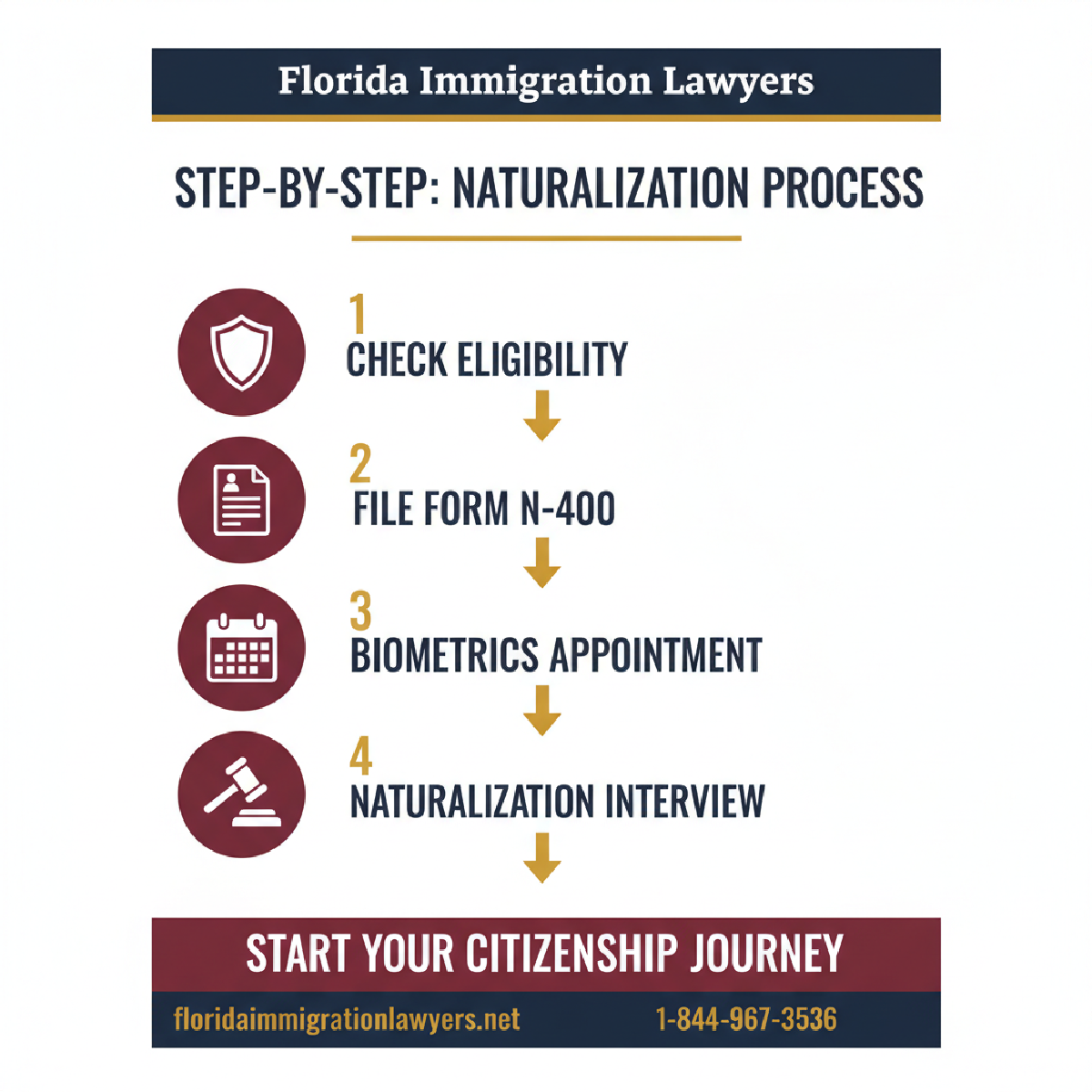
Determine Eligibility: Before filing, ensure you meet all the requirements. This includes age, continuous residence, physical presence, good moral character, and English/civics proficiency. Carefully review your green card status and any potential issues that could affect your eligibility. Consulting with an attorney at this stage can identify and address any red flags early on.
-
Prepare and File Form N-400, Application for Naturalization: This is the official application form that initiates your journey to U.S. citizenship. It is a detailed document requiring extensive personal, residential, employment, and travel history, along with questions about your moral character. Accuracy is paramount; any discrepancies can cause significant delays or even denial. You will also pay the filing fee, or apply for a fee waiver if eligible. This form is submitted to USCIS, and the address depends on your residence.
-
Attend Biometrics Appointment: After USCIS accepts your N-400 application, you will receive an appointment notice for a biometrics services appointment at an Application Support Center (ASC). This usually occurs within 3-5 weeks of filing. At this appointment, your fingerprints, photograph, and signature will be collected. These are used for background and security checks by the FBI and other government agencies.
-
Complete the Naturalization Interview: This is a critical step in the naturalization process Florida timeline. You will receive an interview notice, typically 4-7 months after your biometrics appointment, to appear at a local USCIS field office, such as the one in Jacksonville, Miami, or Orlando. During the interview, a USCIS officer will review your N-400 application, ask questions about your eligibility, test your English proficiency (reading, writing, and speaking), and administer a civics test. Being well-prepared for this interview is essential for success.
-
Receive a Decision and Attend Oath Ceremony: Following a successful interview, USCIS will issue a decision. If approved, you will typically receive a notice for an Oath of Allegiance ceremony. This ceremony is the final step, where you formally pledge allegiance to the United States and receive your Certificate of Naturalization. In some cases, the oath ceremony may be scheduled immediately after the interview, while in others, it could take a few weeks or months. This is when you officially become a U.S. citizen.
Essential Documents for Your Naturalization Application
A complete and accurate application package is vital for a smooth naturalization process. Missing or incorrect documents can lead to delays or requests for evidence (RFEs), prolonging your naturalization process Florida timeline. Gather these documents carefully before filing your Form N-400.
- Your Permanent Resident Card (Green Card).
- Your State-issued identification (Driver's License or State ID).
- Social Security Card.
- All passports (current and expired).
- Marriage Certificate, if applicable (and divorce decrees for any previous marriages of you or your spouse).
- Birth Certificates of your children (if applicable).
- Evidence of your spouse's U.S. citizenship (if applicable, e.g., birth certificate, naturalization certificate, U.S. passport).
- Tax returns for the past 3-5 years, depending on your eligibility category.
- Certified court dispositions for any arrests or citations, even if expunged or dismissed.
- Proof of selective service registration (for males aged 18-26 who resided in the U.S. during that period).
- Travel history records, including dates of all trips outside the U.S. since becoming a permanent resident.
- Any other documents requested by USCIS based on your specific answers on Form N-400.
Naturalization Process Florida Timeline & Processing Expectations for 2026
One of the most common questions we receive at Florida Immigration Lawyers is, "How long is the processing time for naturalization in Florida?" The answer, unfortunately, is not always simple, as processing times can fluctuate significantly. For 2026, applicants in Florida can generally expect a total naturalization process Florida timeline ranging from 8 to 24 months from the date of filing Form N-400 to the Oath Ceremony. This includes the time it takes for USCIS to process your N-400 application.
The current wait time for naturalization depends heavily on the specific USCIS field office handling your case. For instance, processing times at the Jacksonville USCIS office may differ from those in Miami, Orlando, or Tampa. USCIS updates its estimated processing times monthly on its website, which is a valuable resource for applicants. You can check the USCIS processing times page for the most up-to-date information relevant to your local office.
Factors Affecting Your N-400 Processing Time
Several variables can influence how long your N-400 application takes to process. The volume of applications received by USCIS plays a significant role; higher volumes often lead to longer wait times. Furthermore, the complexity of your individual case, such as a history of arrests or extensive travel, can necessitate additional review and thus extend your immigration timeline.
Your responsiveness to USCIS requests for additional evidence (RFEs) is also crucial. Delays in submitting requested documents will directly impact your processing time. Ensuring your application is complete and accurate from the outset can help prevent unnecessary setbacks. A well-prepared application reduces the likelihood of an RFE, which can significantly prolong the N-400 processing time.
Checking Your Case Status
To track your application's progress, USCIS provides an online tool where you can check your case status using the receipt number from your Form I-797C, Notice of Action. This tool offers real-time updates on where your application stands in the naturalization process Florida timeline. While it provides general information, it may not always explain why your N-400 is taking so long.
If your case is outside the normal processing times listed on the USCIS website, you may be able to submit an e-request. However, understanding when and how to do this effectively can be complex. Consulting with an experienced immigration attorney can provide clarity and assist with inquiries if your application seems stalled.
Cost Factors and Fee Breakdown for Naturalization
The naturalization process involves certain fees that applicants must pay to USCIS. These fees are subject to change, so it is always essential to check the most current fee schedule on the USCIS website for Form N-400 before filing. Generally, there is a filing fee for Form N-400 and a separate fee for biometrics services. These fees are mandatory unless you qualify for a fee waiver.
It is important to note that the biometrics fee is typically included within the N-400 filing fee, but this can vary. USCIS offers fee waivers for applicants who meet specific low-income guidelines. If you believe you may be eligible for a fee waiver, you will need to submit Form I-912, Request for Fee Waiver, along with supporting documentation. This can significantly reduce the financial burden of applying for U.S. citizenship.
Beyond the USCIS fees, you may also incur other costs. These can include expenses for obtaining necessary documents like birth certificates or court records, translation services for foreign-language documents, and travel costs for appointments. Many applicants also choose to invest in legal representation, which, while an additional cost, can provide invaluable assistance and peace of mind throughout the complex green card to citizenship journey. Florida Immigration Lawyers offers transparent fee structures and free initial consultations to discuss your specific needs.
Do not navigate this process alone. The complexities of immigration law can be overwhelming, and a small error can lead to significant delays or even denial. Contact Florida Immigration Lawyers today for expert guidance and support. We are committed to helping individuals and families across Florida achieve their immigration goals.
Common Mistakes to Avoid During the Naturalization Process
Applying for naturalization is a detailed process where even minor errors can lead to significant delays or denials. Being aware of these common pitfalls can help you avoid them and keep your naturalization process Florida timeline on track.
-
Failing to Meet Continuous Residence Requirements: Many applicants mistakenly believe they meet the continuous residence rule, but extended trips outside the U.S. can break this requirement. If you spend more than six months outside the U.S. in a single trip, it can disrupt your continuous residence, potentially resetting your eligibility period.
-
Not Disclosing All Travel History: Omissions in your travel history, even minor ones, can be perceived as misrepresentation. USCIS has access to your entry and exit records. Ensure every trip, no matter how short, is accurately reported on your N-400.
-
Incomplete or Inaccurate Form N-400: Filling out the N-400 form incorrectly or leaving sections blank without explanation is a frequent issue. This often leads to Requests for Evidence (RFEs) or even denial. Every question must be answered truthfully and completely.
-
Lack of "Good Moral Character": This is a broad requirement that can be jeopardized by certain criminal offenses, even minor ones. Issues like DUIs, tax evasion, or false claims to U.S. citizenship can be problematic. Consult an attorney if you have any criminal history.
-
Poor Preparation for the Interview: Many applicants underestimate the naturalization interview. Failing the English or civics test, or being unable to answer questions about your application, can lead to delays or a second interview, extending your N-400 processing time.
-
Not Providing All Required Documents: Submitting an application without all supporting documents, or with documents that are not properly translated and certified, is a common reason for RFEs and processing delays.
-
Not Updating USCIS with Address Changes: If you move, you are legally required to notify USCIS within 10 days using Form AR-11. Failing to do so can result in missed notices, interview appointments, or even a denial of your application without your knowledge.
-
Applying Too Early: While seemingly harmless, filing your N-400 before you meet the continuous residence or physical presence requirements will result in a denial. Ensure you calculate your eligibility dates accurately.
-
Misunderstanding the Oath of Allegiance: While typically straightforward, some applicants have issues if they cannot genuinely commit to all aspects of the oath, particularly if they have certain beliefs or affiliations. This can lead to complications during the final stage.
-
Ignoring Legal Advice: Attempting to navigate complex legal issues without professional guidance can be a major mistake. An immigration attorney can identify potential problems and help you present the strongest possible case.
When to Call a Lawyer for Your Naturalization Process
While some naturalization cases are straightforward, many applicants benefit immensely from legal representation. An experienced immigration attorney can provide invaluable support and help you avoid common pitfalls, ensuring your naturalization process Florida timeline progresses as smoothly as possible. Knowing when to seek legal counsel can make a significant difference in your journey to U.S. citizenship.
You should consider contacting Florida Immigration Lawyers if you have a criminal record, even minor offenses, as this can impact your good moral character requirement. If you have spent significant time outside the U.S. since becoming a green card holder, an attorney can help assess your continuous residence. If you have any previous immigration violations or have been involved in asylum proceedings, your case is likely more complex.
Furthermore, if you have language difficulties and are concerned about the English proficiency test, or if you have a medical condition that might exempt you from the English or civics requirements, a lawyer can guide you through the necessary waivers. Our firm also assists with complex business immigration cases that may impact naturalization. Do not wait for a denial or RFE to seek help. Proactive legal advice can save you time, stress, and potential heartbreak.
About Florida Immigration Lawyers
Florida Immigration Lawyers is a leading law firm dedicated to providing exceptional immigration legal services across the entire state of Florida. With a deep understanding of U.S. immigration law and a compassionate approach, we proudly serve individuals and families from Jacksonville to Miami, Orlando, Tampa, and beyond. Our mission is to help our clients achieve their American dream by navigating the complexities of the immigration system.
We offer a wide range of services, including assistance with naturalization and U.S. citizenship applications, family-based visas, business immigration, deportation defense, and asylum claims. Our experienced team is committed to providing personalized attention and strategic legal solutions tailored to your unique situation. We understand that every case is different, and we are here to offer clear, honest advice.
Why choose Florida Immigration Lawyers? We pride ourselves on our client-focused approach, extensive legal knowledge, and unwavering dedication. We offer transparent communication, aggressive advocacy, and a commitment to achieving the best possible outcomes for our clients. We are available 24/7 to answer your questions and provide support.
Contact Florida Immigration Lawyers today at 1-844-967-3536 or visit our website at https://www.floridaimmigrationlawyers.net to schedule your free consultation. Let us be your trusted partner on your journey to U.S. citizenship. We serve all of Florida and are ready to assist you.
Sources and References
- U.S. Citizenship and Immigration Services (USCIS)
- USCIS Form N-400, Application for Naturalization
- USCIS Check Case Processing Times
- Immigration and Nationality Act (INA) Section 316 (8 U.S.C. § 1427) - General Requirements for Naturalization
- 8 Code of Federal Regulations (CFR) Part 316 - General Requirements for Naturalization
- Executive Office for Immigration Review (EOIR) - U.S. Department of Justice
This article provides general legal information and is not intended as legal advice. Every case is unique, and outcomes depend on specific facts and circumstances. Contact an attorney for advice about your particular situation.
Your journey to U.S. citizenship is significant, and having the right legal partner can make all the difference. Florida Immigration Lawyers is here to provide the expert guidance and support you need through every stage of the naturalization process Florida timeline. We are committed to helping you achieve your dreams.
Do not hesitate. Call us today at 1-844-967-3536 for a free, confidential consultation. Se Habla Español - Estamos aquí para ayudarle.
Florida Immigration Lawyers
Legal Team
Our experienced attorneys at Florida Immigration Lawyers have been serving clients across Florida for over 20 years. We specialize in immigration, personal injury, criminal defense, workers compensation, and family law.