Naturalization Ceremony Locations and Schedule 2026 in
For those seeking U.S. citizenship, understanding the naturalization ceremony locations and schedule for 2026 in Florida is the final step in a significant journey. This comprehensive guide from Florida Immigration Lawyers provides detailed information on the naturalization process, from eligibility to the Oath of Allegiance ceremony. We cover what to expect at each stage, including document requirements, typical timelines, and associated costs. Learn about USCIS field offices in Florida, the importance of your N-445 notice, and common pitfalls to avoid. Our aim is to help you navigate this complex process with clarity and confidence, ensuring you are well-prepared for your momentous day. Contact us for expert legal guidance.

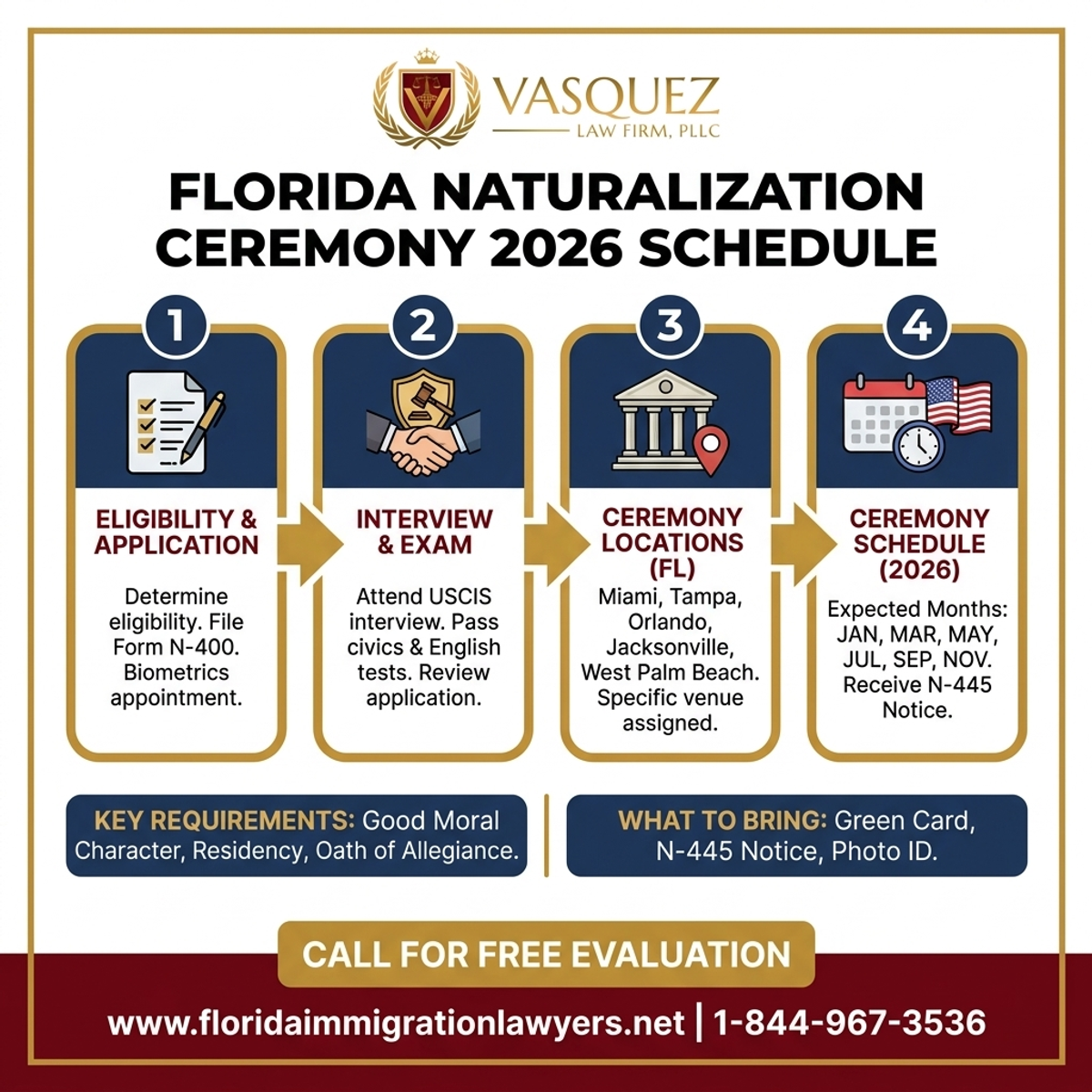
To find naturalization ceremony locations and schedule details for 2026 in Florida, applicants should refer to the Form N-445, Notice of Naturalization Oath Ceremony, issued by USCIS after their N-400 application is approved. Ceremonies are typically held at USCIS field offices in cities like Miami, Orlando, Tampa, and Jacksonville, or at local courthouses and civic centers. The exact date, time, and location are specific to each individual's notice, as schedules are not publicly published due to varying capacities and judicial involvement. Preparing for the Oath of Allegiance is the final step in becoming a U.S. citizen.
- USCIS sends Form N-445 with specific ceremony details.
- Ceremonies are held at USCIS field offices or local venues across Florida.
- Schedules are individualized and not publicly listed.
- Prepare for the Oath of Allegiance and surrender your Green Card.
Becoming a U.S. citizen is a profound milestone, representing the culmination of years of dedication and a commitment to a new home. For many immigrants in Florida, the naturalization ceremony is the final, most anticipated step in this journey. Understanding the process, especially knowing where and when your naturalization ceremony locations and schedule 2026 will take place, is crucial for a smooth transition to citizenship. This comprehensive guide from Florida Immigration Lawyers will walk you through everything you need to know about the naturalization process, focusing on Florida-specific details, what to expect, and how to prepare for your momentous Oath of Allegiance ceremony.
The path to U.S. citizenship involves several stages, from eligibility requirements to the final oath. We understand that this journey can feel complex and overwhelming, particularly when trying to navigate the various forms, interviews, and waiting periods. Our aim is to demystify the process, providing clear, actionable information to help you achieve your goal. If you have questions or need personalized guidance at any stage, do not hesitate to reach out. Call Florida Immigration Lawyers at 1-844-967-3536 for a free consultation and let our experienced team assist you.
What are the naturalization ceremony locations and schedule in Florida for 2026?
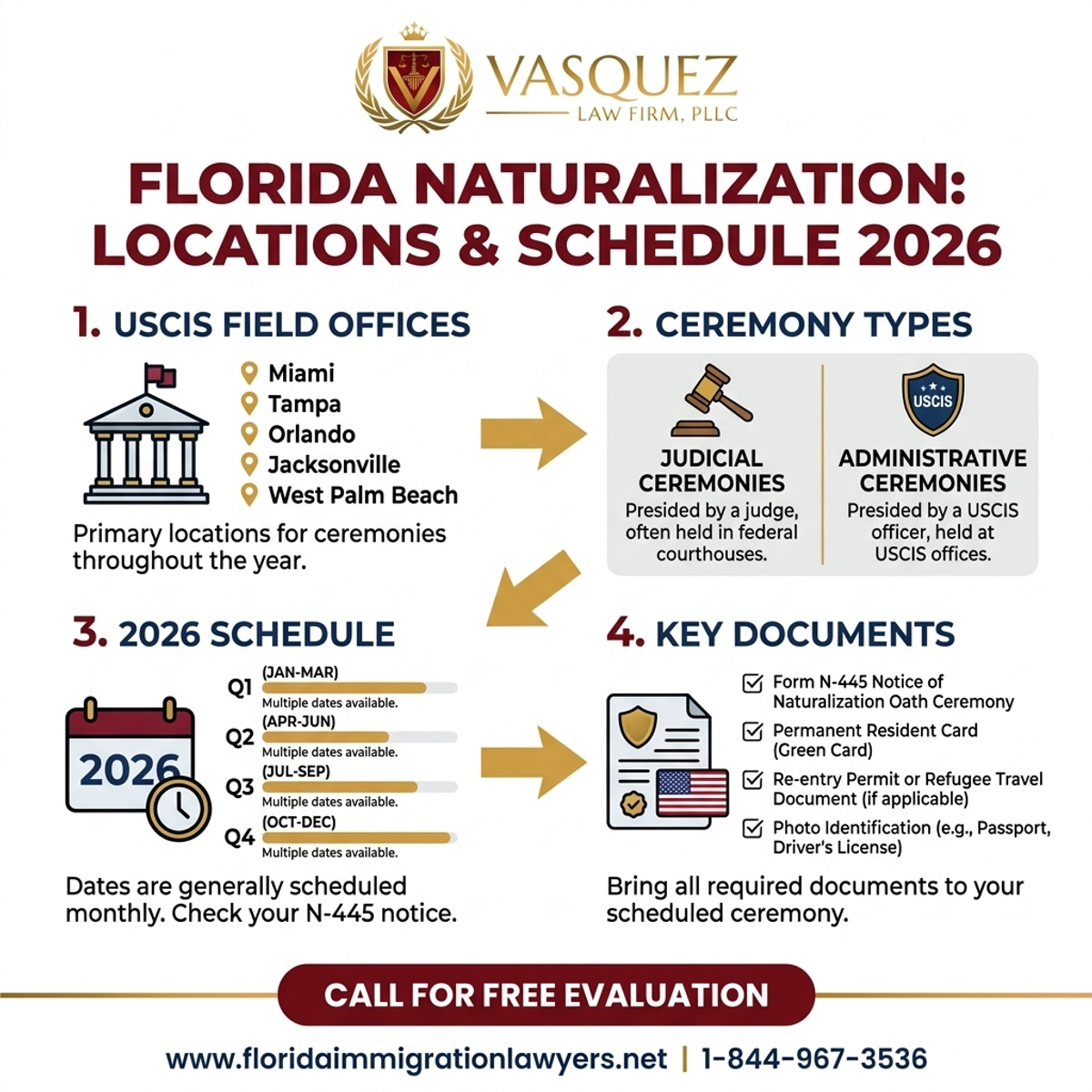
As of 2026, naturalization ceremonies in Florida are primarily held at various USCIS field offices located throughout the state, including Miami, Orlando, Tampa, and Jacksonville. Additionally, some ceremonies may take place at federal courthouses or other civic venues, particularly for larger judicial ceremonies. The specific date, time, and location for your individual ceremony will be provided on your Form N-445, Notice of Naturalization Oath Ceremony, sent to you by USCIS after your N-400 application is approved.
Unlike other public events, naturalization ceremony schedules are not generally published in advance or made available to the public. This is because they are scheduled based on the completion of individual applications, the availability of USCIS officers, and the capacity of the venues. For residents in the Kissimmee area, your ceremony will most likely be scheduled through the USCIS Orlando Field Office, or potentially the Tampa office, depending on caseloads and scheduling logistics. It is vital to carefully review your N-445 notice as soon as you receive it, as it contains all the necessary details, including instructions on what to bring and what to surrender.
There are two main types of ceremonies: administrative and judicial. Administrative ceremonies are typically smaller, held at USCIS field offices, and presided over by a USCIS official. Judicial ceremonies are often larger, held in federal courthouses, and presided over by a federal judge. The type of ceremony you attend depends on your local USCIS office's practices and the judge's availability. Both types of ceremonies involve the same solemn Oath of Allegiance, marking your official transition to U.S. citizenship. Florida Immigration Lawyers can help you understand your N-445 notice and prepare for this significant event.
How does the naturalization process work in Florida?
The naturalization process in Florida, mirroring the national standard, involves several key steps designed to ensure applicants meet all legal requirements for U.S. citizenship. This journey begins with establishing eligibility, submitting a detailed application, undergoing background checks, and successfully completing an interview and civics test. Ultimately, the process culminates in the Oath of Allegiance ceremony, where you officially pledge loyalty to the United States.
For individuals residing in Florida, the process is managed through one of the state's USCIS field offices, such as those in Miami, Orlando, Tampa, or Jacksonville. Each office handles applications from specific geographical areas, ensuring local processing. Understanding each stage is crucial for a successful application, and preparing thoroughly for each step can help minimize delays. Our firm specializes in guiding clients through every aspect of this complex journey, from initial eligibility assessment to post-ceremony advice.
Step-by-Step Guide to Naturalization:
- Determine Eligibility: Before filing, ensure you meet the requirements under the Immigration and Nationality Act (INA), specifically INA §316 for general requirements (e.g., 5 years as a permanent resident, physical presence) or INA §319 for spouses of U.S. citizens (e.g., 3 years as a permanent resident).
- Prepare and File Form N-400, Application for Naturalization: This is the primary application form. It requires detailed personal information, residency history, marital history, and responses to questions about your character and allegiance. Accuracy and completeness are paramount to avoid delays or requests for evidence (RFEs).
- Attend Biometrics Appointment: After filing, USCIS will send you an appointment notice for biometrics (fingerprints, photograph, and signature). These are used for background checks by the FBI.
- Complete the Naturalization Interview (English and Civics Test): You will be interviewed by a USCIS officer who will verify the information on your N-400. You will also take an English test (reading, writing, speaking) and a civics test (knowledge of U.S. history and government).
- Receive a Decision: After the interview, the officer may make a decision immediately, or you may receive a decision by mail later. Possible outcomes include approval, continuance (request for more information or re-test), or denial.
- Attend the Oath of Allegiance Ceremony: If approved, you will receive Form N-445, scheduling you for the final naturalization ceremony where you take the Oath of Allegiance and receive your Certificate of Naturalization.
What documents are needed for the naturalization interview and ceremony?
For your naturalization interview, it is critical to bring your Permanent Resident Card (Green Card), your passport, any supporting documents for your N-400 application, and your USCIS interview appointment notice. When attending the actual naturalization ceremony, you must bring your Form N-445, your Green Card to surrender, and any other travel documents as specifically instructed on the N-445 notice. Having all required documents organized and readily available will ensure a smooth process for both stages.
Preparing a comprehensive document checklist well in advance of your interview and ceremony can alleviate stress and prevent potential delays. USCIS officers require original documents for verification, and it's always wise to bring photocopies as well. In Florida, particularly for residents of Kissimmee, ensuring that all documents reflect your current address and status is especially important, as any discrepancies could lead to further inquiries. Florida Immigration Lawyers can help you compile and review your documents to ensure you are fully prepared.
Step-by-Step Process — Naturalization Ceremony Locations and Schedule 2026 in Florida
Document Checklist for Naturalization:
- Permanent Resident Card (Green Card)
- State-issued identification (e.g., Florida Driver's License or ID card)
- All current and expired passports and travel documents
- Marriage certificate (if applicable, especially for 3-year residency rule)
- Divorce decrees or annulment records (if applicable)
- Birth certificates of your children (if applicable)
- Proof of Selective Service registration (for males aged 18-26 at time of residency)
- Tax returns for the past five years (or three years if applying as a spouse of a U.S. citizen)
- Certified court disposition records for any arrests, citations, or criminal history, even if expunged or dismissed.
- USCIS interview appointment notice (Form I-797C)
- Form N-445, Notice of Naturalization Oath Ceremony (for the ceremony)
- Any other documents specifically requested by USCIS in an RFE (Request for Evidence)
What is the typical naturalization timeline and processing expectation in 2026?
As of 2026, the naturalization timeline can vary significantly based on the USCIS field office processing your application, the complexity of your case, and current backlogs. While there is no fixed duration, applicants in Florida can generally expect the process to take anywhere from 10 to 24 months from the initial filing of Form N-400 to attending the Oath of Allegiance ceremony. This timeframe is subject to change and can be influenced by policy updates or surges in application volumes.
For residents of Kissimmee and surrounding Central Florida areas, applications are typically processed through the USCIS Orlando Field Office. It's important to regularly check the official USCIS processing times website for the most current estimates specific to your field office. Delays can occur due to incomplete applications, requests for additional evidence (RFEs), or issues identified during background checks. Proper preparation and legal guidance can help streamline your application and potentially reduce overall processing time.
| Stage | Typical Timeframe (As of 2026) | Notes |
|---|---|---|
| N-400 Filing to Biometrics Appointment | 1-2 months | USCIS sends an appointment notice (Form I-797C) for fingerprinting and photos. |
| Biometrics to Naturalization Interview | 6-12 months | This is often the longest waiting period, varying significantly by field office. |
| Naturalization Interview to Decision | Immediately to 1-4 months | Some decisions are made on the spot; others require further review or an RFE. |
| Decision to Oath Ceremony (N-445 received) | 1-3 months | Form N-445, Notice of Naturalization Oath Ceremony, will be mailed. |
| Total Estimated Process | 10-24 months | This is an average; individual cases may be faster or slower. |
What are the costs associated with the naturalization application in 2026?
As of 2026, the costs associated with the naturalization application primarily include the USCIS filing fee for Form N-400 and the biometrics fee. It is crucial to note that USCIS fees are subject to change, and applicants should always consult the official USCIS website for the most current fee schedule before filing. These government fees are non-refundable, regardless of the application outcome.
Beyond the mandatory government fees, applicants might incur additional costs. These can include attorney fees for legal assistance, translation services for foreign documents, and fees for obtaining certified copies of records (e.g., court dispositions, marriage certificates). While not all these expenses are mandatory, investing in legal counsel can often save time and prevent costly mistakes, especially for complex cases. Florida Immigration Lawyers offers transparent fee structures and can discuss all potential costs during your free consultation.
Key Statistics — Naturalization Ceremony Locations and Schedule 2026 in Florida
| Item | Typical Fee (As of 2026) | Notes |
|---|---|---|
| Form N-400 Application Fee | Varies (Check USCIS website) | Required for processing your application for naturalization. |
| Biometrics Fee | Varies (Check USCIS website) | Covers the cost of fingerprinting and background checks. |
| Attorney Fees | Varies widely | For legal representation, advice, and preparation assistance. |
| Document Translation Services | Varies | If any supporting documents are not in English. |
| Passport Photos | $15-25 | May be required for certain applications or subsequent U.S. passport. |
| Certified Record Fees | Varies | For obtaining court records, birth certificates, etc. |
What happens at the naturalization oath ceremony?
The naturalization oath ceremony is the culmination of your journey to U.S. citizenship and a truly memorable event. Upon arrival, you will check in and typically be asked to surrender your Permanent Resident Card (Green Card). You will then review your Form N-445, Notice of Naturalization Oath Ceremony, to confirm that all information is accurate and that you have not committed any acts since your interview that would disqualify you from naturalization.
During the ceremony, a USCIS official or federal judge will lead the group of applicants in reciting the Oath of Allegiance. This solemn oath is a pledge of loyalty to the United States and signifies your commitment to its laws and Constitution. After taking the oath, you will officially be a U.S. citizen. You will then receive your Certificate of Naturalization, a crucial document that serves as proof of your U.S. citizenship. It is important to review this certificate for accuracy before leaving the ceremony.
Following the ceremony, you will have the rights and responsibilities of a U.S. citizen, including the right to vote, apply for a U.S. passport, and petition for certain relatives to immigrate. Many ceremonies also offer voter registration opportunities on-site. This is a moment of great celebration and the beginning of a new chapter in your life in Florida. Remember to safeguard your Certificate of Naturalization, as it is irreplaceable and essential for future civic actions.
Do not navigate this process alone. Contact Florida Immigration Lawyers today.
Common Mistakes to Avoid During Naturalization
The naturalization process is meticulous, and even minor errors can lead to significant delays or even denial. Avoiding common pitfalls is essential for a successful application. Here are some frequent mistakes applicants make:
- Filing with Incomplete or Inaccurate Information: Submitting an N-400 form with missing fields, incorrect dates, or inconsistent information can lead to RFEs or denial. Always double-check every entry.
- Failing to Meet Residency Requirements: Not accurately calculating continuous residence or physical presence can disqualify you. Long absences from the U.S. can break continuous residency.
- Not Disclosing All Criminal History: Even minor arrests, citations, or expunged records must be disclosed. Failure to do so can be considered a misrepresentation and lead to denial.
- Missing USCIS Deadlines: Failing to respond to RFEs or appointment notices by the specified deadline can result in your application being closed or denied.
- Failing the English and Civics Tests: Insufficient preparation for the interview's English proficiency and civics knowledge tests can lead to a re-test or denial.
- Not Updating Your Address with USCIS: Moving without notifying USCIS using Form AR-11 can result in missed notices and appointments, leading to significant problems.
- Bringing Incorrect Documents to Interview/Ceremony: Arriving without all required original documents for your interview or the N-445 for your ceremony can cause delays or prevent you from taking the oath.
- Poor Moral Character Issues: Engaging in activities that demonstrate a lack of good moral character during the statutory period can jeopardize your application.
- Incorrectly Calculating Filing Fees: Submitting the wrong fee amount can cause your application to be rejected and returned, delaying the entire process. Always check the current fees on the USCIS website.
- Not Seeking Legal Advice for Complex Cases: If you have a criminal record, previous immigration violations, or a complicated residency history, attempting to navigate the process alone is a significant risk.
When to Call a Lawyer for Naturalization in Florida
While some naturalization cases are straightforward, many benefit immensely from professional legal guidance. Knowing when to consult an experienced immigration attorney can be the difference between a smooth approval and a frustrating denial. Florida Immigration Lawyers are here to provide expert assistance throughout your journey to U.S. citizenship.
You should consider calling a lawyer if you:
- Have any criminal history, even minor arrests or expunged records.
- Have previously been denied naturalization or had an immigration application denied.
- Have taken long trips outside the U.S. that might affect your continuous residency or physical presence.
- Have complex marital history, such as multiple divorces or marriages.
- Received a Request for Evidence (RFE) or a Notice of Intent to Deny (NOID) from USCIS.
- Are unsure about your eligibility requirements or how to answer specific questions on Form N-400.
- Have concerns about passing the English or civics test, or believe you may qualify for an exemption.
- Need help preparing for your naturalization interview or require representation at the interview.
Our attorneys at Florida Immigration Lawyers possess deep knowledge of U.S. immigration law, including the intricacies of naturalization. We can review your case, identify potential issues, help you gather necessary documentation, and represent you effectively before USCIS. Serving clients across Florida, including Kissimmee, we are committed to protecting your rights and helping you achieve your American dream.
About Florida Immigration Lawyers
Florida Immigration Lawyers is a leading law firm dedicated to providing exceptional immigration legal services to individuals and families across the entire state of Florida. With a deep understanding of the complexities of U.S. immigration law, our experienced attorneys are committed to guiding clients through every step of their immigration journey, from visa applications and green cards to naturalization and deportation defense.
We pride ourselves on our client-focused approach, offering personalized strategies tailored to meet your unique needs and goals. Our team is known for its compassionate advocacy, meticulous attention to detail, and unwavering dedication to achieving positive outcomes. We offer free consultations, are available 24/7, and provide bilingual services (English and Spanish) to ensure that language is never a barrier to accessing quality legal representation. When your future in the U.S. depends on expert legal advice, trust Florida Immigration Lawyers to be your steadfast advocates.
Sources and References
- U.S. Citizenship and Immigration Services (USCIS)
- Executive Office for Immigration Review (EOIR)
- U.S. Department of State
- 8 U.S.C. Chapter 12 - Immigration and Nationality Act (INA)
- INA §316 - Requirements for Naturalization
- INA §319 - Naturalization of Spouses of U.S. Citizens
- 8 CFR Part 316 - General Requirements for Naturalization
- USCIS Policy Manual - Citizenship and Naturalization
Related services: immigration practice areas, family immigration services.
This article provides general legal information and is not intended as legal advice. Every case is unique, and outcomes depend on specific facts and circumstances. Contact an attorney for advice about your particular situation.
Embark on your path to U.S. citizenship with confidence. The experienced team at Florida Immigration Lawyers is ready to provide the guidance and support you need. For a free consultation and to discuss your naturalization process, call us today at 1-844-967-3536. Se Habla Espanol - Estamos aqui para ayudarle.
If you need legal assistance, learn more about our immigration law practice, or call us at 1-844-967-3536 for a free consultation.
Do Not Navigate This Process Alone
Our experienced immigration attorneys are ready to fight for you. Get a free, confidential consultation today.
Se Habla Español
Frequently Asked Questions

William J. Vásquez
Founding Attorney · Vasquez Law Firm
U.S. Air Force veteran and immigration attorney with thousands of cases resolved. J.D., NCCU School of Law. AILA member. Admitted to the 4th, 5th, and 11th Circuit Courts.
Available 24/7 - Free Evaluations
Related Legal Services
Our Florida immigration attorneys can help you with family immigration services, immigration practice areas and free immigration consultation. Call today at 1-844-967-3536 for a free consultation.
Related Links
Related Topics
Free Legal Consultation
Discuss your case with our experienced attorneys. We're available 24/7.
Se Habla Español - Estamos aquí para ayudarle.
Related Articles
Immigration Lawyer Orlando Free Consultation Services
Explore the vital role of immigration lawyers in Orlando and how they offer free consultations to assist with your immigration journey. Discover services available and how to prepare for your legal needs.
Political Asylum Attorney: Requirements in Florida 2026
If you're seeking political asylum in Florida, understanding the legal requirements and process is crucial. This comprehensive guide covers essential information about securing asylum, including the steps involved, necessary documentation, and common mistakes to avoid. Learn how a political asylum attorney can assist you and what to expect during the process. Call Florida Immigration Lawyers at 1-844-967-3536 for a free consultation.
Biometrics Appointment in Florida: What to Expect in 2026
Navigating a biometrics appointment in Florida is crucial for your USCIS process. Learn what to expect, how to prepare, and common pitfalls to avoid. Florida Immigration Lawyers are here to help with personalized guidance and support.
Withholding of Removal Explained: Florida Defense in 2026
For those in Florida facing deportation and fearing persecution or torture in their home country, understanding withholding of removal is critical. This form of protection prevents removal to a dangerous country, though it differs significantly from asylum in its eligibility criteria and benefits. It requires proving a "more likely than not" chance of persecution based on protected grounds or torture, a higher standard than asylum's "well-founded fear." While withholding of removal does not lead to a Green Card, it offers mandatory protection if the stringent criteria are met, even for some individuals barred from asylum. The process involves complex legal proceedings before an immigration judge, often in Miami or Orlando immigration courts. A comprehensive application, detailed testimony, and robust supporting evidence, including country conditions reports and affidavits, are essential. Given the high stakes and intricate legal requirements, securing the expertise of a Florida immigration lawyer is paramount to building a strong defense and navigating the path to safety.