Why Is Form N-600 Taking So Long? Delays in 2026
For families in Florida seeking to confirm their child's U.S. citizenship via Form N-600, delays are a common and frustrating reality in 2026. USCIS backlogs, thorough background checks, and Requests for Evidence (RFEs) are leading causes of extended processing times, often stretching beyond typical expectations. Understanding the intricate eligibility requirements for derived or acquired citizenship, meticulously preparing all necessary documentation, and responding promptly to any USCIS inquiries are crucial steps to mitigate delays. This comprehensive guide from Florida Immigration Lawyers explores the N-600 process, common pitfalls, and when professional legal assistance is indispensable for families across the state, including Orlando. Navigate the complexities with confidence and support.
As of 2026, Form N-600, Application for Certificate of Citizenship, is experiencing significant processing delays primarily due to increased USCIS backlogs, extensive background checks, and the need for Requests for Evidence (RFEs). Incomplete applications, complex eligibility issues, and interview scheduling also contribute to extended wait times. For families in Florida, these delays can be particularly frustrating, often extending processing beyond typical expectations. Understanding the common pitfalls and ensuring a meticulously prepared application can help mitigate some of these challenges.
- USCIS backlogs and increased caseloads are major factors in N-600 delays.
- Incomplete applications or missing documentation frequently lead to Requests for Evidence (RFEs) and extended processing.
- Thorough background checks and security clearances can add significant time to the N-600 process.
- Misinterpreting eligibility requirements for derived or acquired citizenship often results in denials or prolonged review.
- Interview scheduling and the efficiency of local USCIS field offices in Florida can impact overall timelines.
The journey to confirm your or your child's U.S. citizenship is a profound and often joyful one. However, for many families in Florida, the path to obtaining a Certificate of Citizenship through Form N-600 can be fraught with unexpected delays and complexities. You might be wondering, "Why is Form N-600 taking so long?" and "What can I do to expedite the process or avoid common pitfalls?" These are valid concerns for anyone navigating the intricate world of immigration law.
At Florida Immigration Lawyers, we understand the anxiety and uncertainty that come with prolonged waiting periods. Our goal with this comprehensive guide is to demystify the N-600 application process, shed light on the primary causes of delays in 2026, and provide actionable insights for families seeking a Certificate of Citizenship for their children in Orlando and across Florida. We will explore eligibility criteria, step-by-step application procedures, typical timelines, and crucial mistakes to avoid. Don't navigate this complex legal landscape alone. Call Florida Immigration Lawyers at 1-844-YO-PELEO for a free consultation and let our experienced team guide you.
Why Is Form N-600 Taking So Long and What Are Common Delay Causes in 2026?
As of 2026, Form N-600 applications are experiencing extended processing times, primarily due to a confluence of factors including persistent USCIS backlogs, the need for detailed background and security checks, and the frequent issuance of Requests for Evidence (RFEs). These elements combine to create a challenging environment for applicants seeking a Certificate of Citizenship, often leading to wait times that can span well over a year.
The U.S. Citizenship and Immigration Services (USCIS) has faced a significant increase in caseloads across various immigration benefit applications, including the N-600. This surge, coupled with resource allocation challenges, has led to a growing backlog that directly impacts processing times. Additionally, every N-600 application, especially those involving children, undergoes rigorous background and security checks by multiple government agencies. These checks are non-negotiable and can take varying amounts of time depending on an individual's history and the complexity of their case. For many applicants, a Request for Evidence (RFE) is a common hurdle. An RFE is issued when USCIS determines that an application is incomplete or lacks sufficient supporting documentation. Failing to provide all necessary evidence upfront, or responding inadequately to an RFE, can add months to the processing timeline. Furthermore, errors or inconsistencies in the application itself, misinterpretations of derived or acquired citizenship laws, and the volume of interviews scheduled at local USCIS field offices, such as those in Orlando or Miami, all contribute to the overall delay. Understanding these factors is the first step in preparing a robust application to minimize potential setbacks. For more detailed information, you can always refer to the official USCIS website.
What is a Certificate of Citizenship (N-600) and Who is Eligible in Florida?
A Certificate of Citizenship (Form N-600) is an official document issued by USCIS that serves as conclusive proof of U.S. citizenship for individuals who automatically became citizens by birth abroad to U.S. citizen parents (acquired citizenship) or through their parents' naturalization (derived citizenship). This certificate is particularly valuable for children and can be used for various purposes, including obtaining a U.S. passport, registering for school, or establishing eligibility for certain benefits.
Eligibility for an N-600 in Florida primarily falls into two categories for children: acquired citizenship and derived citizenship. Acquired citizenship applies to children born outside the United States to at least one U.S. citizen parent, provided certain conditions regarding the parent's prior physical presence in the U.S. are met. This typically falls under INA Section 301 or 309. Derived citizenship, on the other hand, applies to children who automatically become U.S. citizens when one or both of their parents naturalize, provided the child is under 18 years of age, is a lawful permanent resident (green card holder), and resides in the U.S. in the legal and physical custody of the naturalizing parent. This is governed by INA Section 320. For adopted children, INA Section 322 may apply, allowing U.S. citizen parents residing abroad to apply for a Certificate of Citizenship for their adopted child. It's crucial to understand these distinctions, as the specific requirements and documentation vary. Many families in Florida, particularly those with international backgrounds or who have recently naturalized, find themselves navigating these complex rules. Seeking clarification on your specific eligibility is a key step, as misinterpretation can lead to significant delays or even denial. Our firm focuses on citizenship applications and can help assess your unique situation.
How Do I Apply for a Certificate of Citizenship for My Child in Orlando, Florida?
Applying for a Certificate of Citizenship for your child in Orlando, Florida, involves a structured process that requires meticulous attention to detail. Following each step carefully and preparing a thorough application package can significantly reduce the likelihood of delays and RFEs. The process generally begins with determining eligibility and gathering all necessary documentation before submitting the application to USCIS.
Step-by-Step Guide for N-600 Application:
- Determine Eligibility: Confirm that your child meets the criteria for derived or acquired citizenship based on their birth circumstances and your naturalization status. This is the most crucial first step.
- Complete Form N-600: Fill out the Application for Certificate of Citizenship accurately and completely. Ensure all questions are answered, and double-check for any errors or omissions.
- Gather Supporting Documents: Compile all required evidence, including birth certificates, marriage certificates, naturalization certificates, green cards, passports, and any other documents proving the child's and parents' identities and immigration statuses.
- Pay the Filing Fee: Submit the correct filing fee with your application. As of 2026, fees are subject to change, so always verify the current amount on the USCIS website.
- Mail the Application: Send the complete application package to the appropriate USCIS Lockbox facility. The address depends on your mailing method (USPS vs. courier) and is specified in the N-600 instructions.
- Attend Biometrics Appointment: After filing, your child (if 14 or older) will receive an appointment notice for biometrics (fingerprints and photo) at a local Application Support Center, potentially in Orlando or a nearby Florida city.
- Attend Interview (If Required): USCIS may require an interview for the child and/or parent(s) to clarify information or review documents. This interview would typically take place at a USCIS field office, such as the one in Orlando.
- Receive Decision: USCIS will issue a decision, either approving the application and mailing the Certificate of Citizenship or issuing a denial.
Document Checklist for N-600 Application:
- Child's Birth Certificate (original or certified copy, with certified translation if not in English)
- Parents' Marriage Certificate (if applicable, with certified translation if not in English)
- Evidence of Parent's U.S. Citizenship (e.g., U.S. Birth Certificate, Certificate of Naturalization, U.S. Passport)
- Child's Permanent Resident Card (Green Card), Form I-551 (if applicable)
- Child's Foreign Passport with U.S. entry stamps (if applicable)
- Child's full legal name change documentation (if applicable)
- Evidence of legal and physical custody of the child by the U.S. citizen parent(s)
- Two passport-style photos of the child
- Any previous Certificates of Citizenship or Naturalization for the child or parents (if applicable)
- Certified court documents for any arrests or convictions of the child or parents (if applicable)
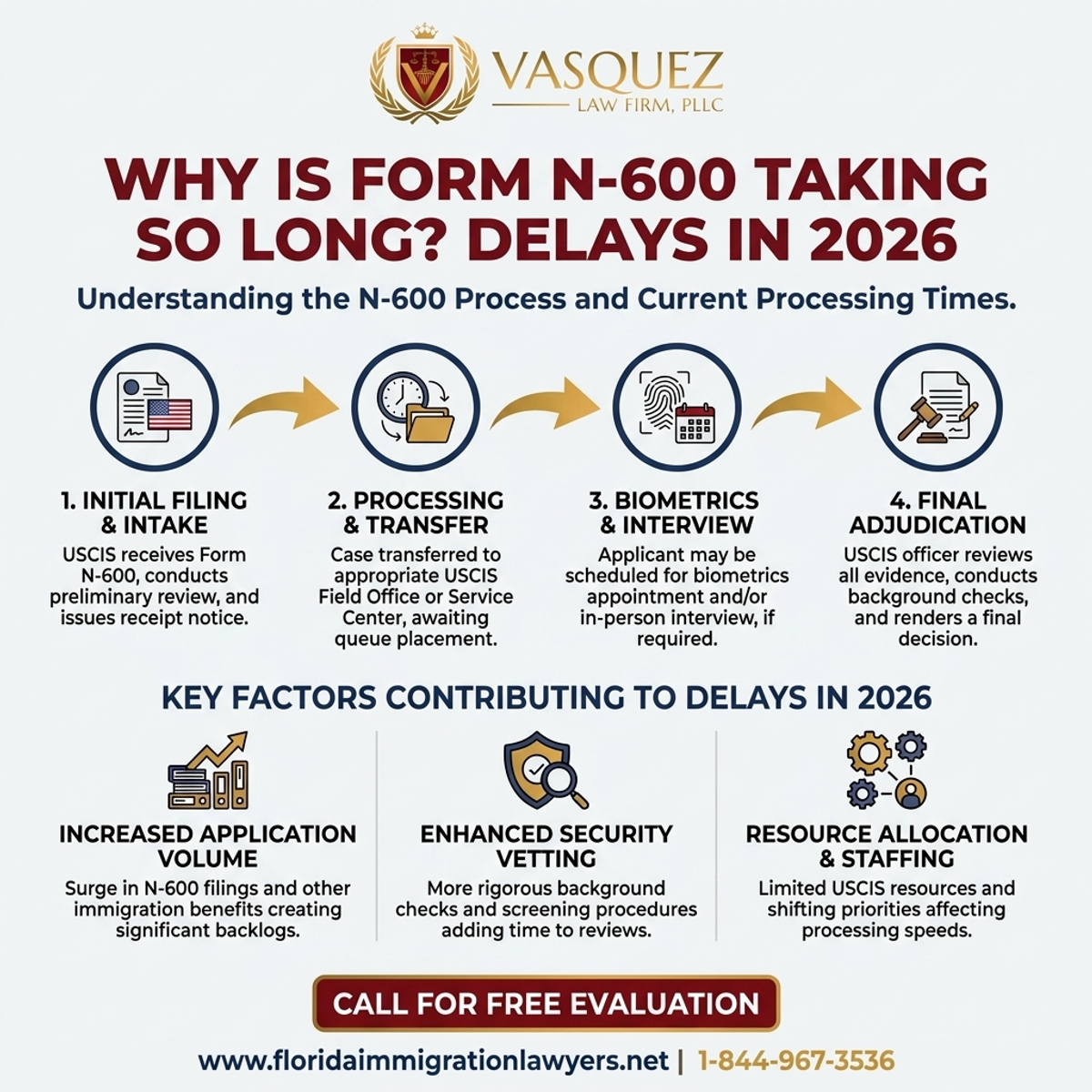
Step-by-Step Process — Why Is Form N-600 Taking So Long? Delays in 2026
Preparing a complete and accurate application package is paramount to avoiding unnecessary delays. Our team frequently assists families in family immigration matters, ensuring all documentation is correctly compiled.
What Are the Typical N-600 Processing Times and Fees in 2026?
As of 2026, the typical processing times for Form N-600, Application for Certificate of Citizenship, can vary significantly, ranging anywhere from 6 months to over 2 years, depending on the specific USCIS service center, the complexity of the case, and the volume of applications. It is crucial for applicants in Florida to manage their expectations regarding these timelines.
USCIS provides estimated processing times on its website, but these are often averages and can fluctuate. Factors like the completeness of your application, the need for an RFE, or the scheduling of an interview at a local field office (such as in Tampa or Jacksonville) can all extend these timelines. The fee associated with filing Form N-600 is also subject to change, and applicants should always consult the official USCIS website or instructions for the most current fee schedule. While the base filing fee is standard, additional costs can arise from attorney fees, translation services, or obtaining certified copies of documents. Preparing for both the financial and temporal investment is a critical part of the application process. These tables provide a general overview, but individual cases may differ.
N-600 Processing Timeline (as of 2026)
| Stage | Typical Timeframe | Notes |
|---|---|---|
| Application Submission to Receipt Notice | 1-3 weeks | USCIS sends I-797C, Notice of Action. |
| Biometrics Appointment Scheduling | 3-8 weeks after receipt | For applicants 14 years or older, at a local Application Support Center. |
| Initial Review and Background Checks | 3-12 months | Extensive inter-agency checks, a common source of delays. |
| Request for Evidence (RFE) (if applicable) | Variable (additional 2-6 months) | Response time + USCIS review. Can significantly extend timeline. |
| Interview Scheduling (if required) | 6-18 months after filing | At a local USCIS field office, e.g., Orlando, Miami. |
| Decision and Certificate Issuance | 1-3 months after interview/final review | Certificate mailed upon approval. |
| Total Processing Time | 6 months to 2+ years | Highly variable based on individual case factors and USCIS workload. |
N-600 Cost Factors (as of 2026)
| Item | Typical Fee | Notes |
|---|---|---|
| USCIS N-600 Filing Fee | Varies (check USCIS website) | No fee waivers for N-600. |
| Attorney Legal Fees | Varies widely | Depends on complexity of case and firm. Essential for complex cases. |
| Document Translation Fees | Varies per document | Required for any non-English documents. |
| Certified Copy Fees | Varies per agency | For obtaining official copies of birth certificates, marriage licenses, etc. |
| Travel Costs for Biometrics/Interview | Varies | To Application Support Center or USCIS field office in Florida. |
Navigating Complex N-600 Cases: Special Considerations for Florida Families
While the N-600 application process can be straightforward for some, many Florida families encounter unique complexities that necessitate careful handling. These complexities often arise from diverse family structures, international adoptions, or prior immigration issues that can significantly impact eligibility and processing times. Understanding these special considerations is vital to successfully obtaining a Certificate of Citizenship, especially in a state as diverse as Florida.
Overcoming Challenges with Documentation
One of the most common challenges in complex N-600 cases involves obtaining and verifying proper documentation. For families with long histories of international travel, multiple marriages, or births in countries with less robust record-keeping systems, gathering certified copies of birth certificates, marriage licenses, and divorce decrees can be arduous. In Florida, with its large immigrant population, applicants might need to provide extensive evidence to prove parent-child relationships or legal custody. USCIS requires certified translations for any document not in English, which adds another layer of complexity. Our legal team can assist in identifying alternative forms of evidence when primary documents are unavailable, or guide you through the process of obtaining necessary certifications and translations.
Impact of Criminal History or Prior Immigration Issues
Any criminal history, even minor infractions, for either the child (if applicable) or the U.S. citizen parent(s) can complicate an N-600 application. While a Certificate of Citizenship confirms a status already held, USCIS will still conduct thorough background checks. Undisclosed or unaddressed criminal records, or previous immigration violations, could lead to questions about the applicant's moral character or even impact the validity of a parent's naturalization if not properly disclosed during their own process. It is imperative to be transparent and provide all relevant court documents. For cases involving a prior deportation order or other serious immigration issues, consultation with an attorney is essential to understand potential ramifications and develop a strategy to mitigate risks. Deportation defense is a critical area where our firm provides experience.
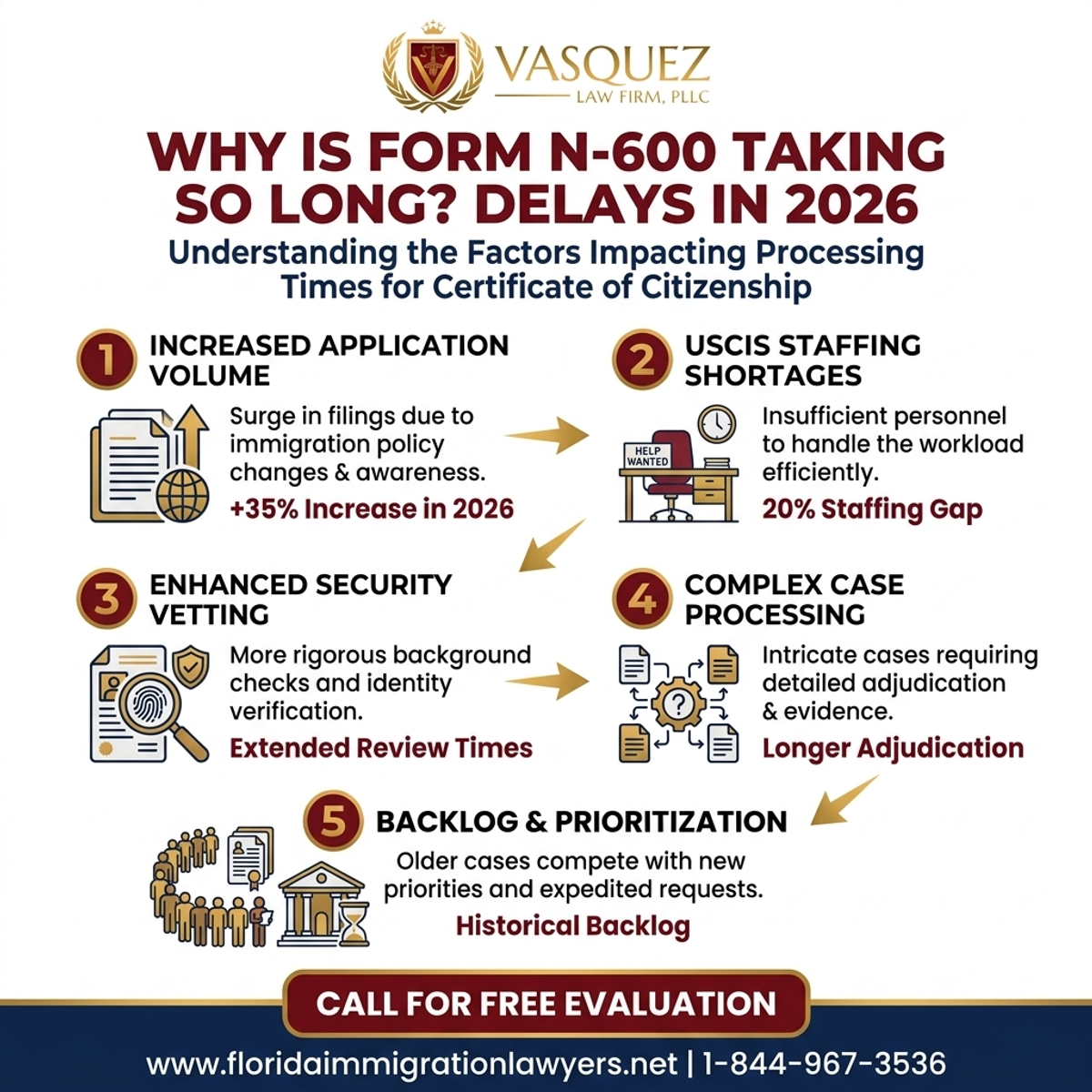
Key Statistics — Why Is Form N-600 Taking So Long? Delays in 2026
Cases Involving Adopted Children or Step-Parents
N-600 applications for adopted children require specific attention to the legality and finality of the adoption. The child must have been lawfully adopted, and the adoption must be full and final before the child turns 16 (for most cases) and before the U.S. citizen parent's naturalization. Furthermore, the child must reside in the legal and physical custody of the U.S. citizen parent(s). Cases involving step-parents can be particularly tricky, as a step-parent relationship generally does not confer derived citizenship unless the child was legally adopted by the U.S. citizen step-parent. Each of these scenarios requires precise documentation and adherence to specific sections of the Immigration and Nationality Act (INA), such as INA 322 for adopted children residing abroad. Our attorneys are well-versed in the nuances of complex immigration cases and can provide tailored advice for families with unique circumstances, ensuring all legal requirements are met for children in Florida.
Do not navigate this process alone. Contact Florida Immigration Lawyers today at 1-844-YO-PELEO for a free consultation.
Common Mistakes to Avoid When Filing Form N-600
Filing Form N-600 can be a complex process, and even minor errors can lead to significant delays or even denial. Avoiding these common mistakes is crucial for a smooth application process, especially for families in Florida.
- Incomplete Application: Failing to answer all questions or leaving sections blank without explanation. USCIS will issue an RFE or reject the application, causing substantial delays.
- Incorrect Supporting Documents: Submitting photocopies when certified copies are required, or failing to include all necessary evidence like birth certificates, marriage licenses, or naturalization certificates. This is a primary cause of RFEs.
- Missing Certified Translations: Any document not in English must be accompanied by a complete and accurate certified translation. Failing to provide this will result in an RFE or rejection.
- Misinterpreting Eligibility Requirements: Applying for an N-600 when the child does not actually meet the criteria for derived or acquired citizenship. This leads to an inevitable denial and wasted time and fees.
- Not Responding to RFEs in Time: USCIS provides a deadline for responding to Requests for Evidence. Missing this deadline can lead to denial of the application without further review.
- Incorrect Filing Fees: Submitting an incorrect fee amount or an outdated payment method. USCIS will reject the application, requiring you to resubmit and restart the processing clock.
- Failure to Disclose All Information: Withholding information about prior arrests, immigration history, or other relevant details. This can be viewed as misrepresentation and lead to severe consequences.
- Submitting Expired Documents: Providing expired passports, visas, or other identification documents. Ensure all submitted documents are current and valid.
- Incorrectly Calculating Dates: Mistakes in calculating the child's age at the time of the parent's naturalization or date of entry into the U.S. can lead to eligibility issues.
- Not Keeping Copies: Failing to make and keep complete copies of the entire application package, including all submitted documents and the check for the filing fee. This makes it difficult to respond to RFEs or track the application status.
- Attempting to Navigate Complex Cases Alone: While some cases are straightforward, those involving adopted children, prior immigration issues, or unusual family structures often benefit greatly from legal expertise, which can prevent costly errors.
When to Call a Lawyer for Your N-600 Application in Florida
While some N-600 applications may seem straightforward, certain situations warrant the expertise of an experienced immigration attorney. If you're in Florida and facing complexities with your Certificate of Citizenship application, our legal team at Florida Immigration Lawyers is ready to assist. Knowing when to seek legal counsel can save you time, money, and significant stress, especially given the lengthy N-600 processing times in 2026.
You should consider calling an attorney if:
- Your child's eligibility is unclear or complex: If you are unsure whether your child qualifies for derived or acquired citizenship, or if their situation involves unique family circumstances (e.g., adoption, remarriage, births out of wedlock, or parents naturalizing at different times).
- You have received a Request for Evidence (RFE): An RFE indicates that USCIS needs more information or clarification. Responding correctly and comprehensively is crucial, and an attorney can help you gather and present the necessary evidence effectively.
- There's a history of immigration issues: If either the child or the U.S. citizen parent(s) have had prior immigration violations, denials, or criminal records, an attorney can assess the impact and advise on the best course of action.
- You are experiencing significant delays without clear reason: If your N-600 application is taking unusually long, even beyond the published processing times, an attorney can help inquire with USCIS and potentially identify underlying issues.
- You need assistance with document gathering or translations: For complex cases involving foreign documents, an attorney can guide you in obtaining certified copies and ensuring proper translations.
- You are preparing for an interview: An attorney can help you prepare for a potential N-600 interview at a USCIS field office in Florida, ensuring you understand the questions and can present your case clearly.
Florida Immigration Lawyers offers comprehensive assistance for N-600 applications, from initial eligibility assessment to preparing and filing your application, responding to RFEs, and representing you at interviews. Don't leave your child's citizenship status to chance. Our dedicated team is here to provide the guidance and support you need.
About Florida Immigration Lawyers
Florida Immigration Lawyers is an immigration law firm dedicated to serving individuals and families across the entire state of Florida. With a deep understanding of U.S. immigration laws and a commitment to our clients, we provide compassionate and effective legal representation for a wide range of immigration matters. Our experienced attorneys focus on family-based immigration, citizenship applications like the N-600, asylum, deportation defense, and business immigration.
We pride ourselves on offering personalized legal strategies tailored to each client's unique circumstances. Our firm understands the challenges and anxieties that come with navigating the complex immigration system. We are available 24/7 to answer your questions and provide support. When you choose Florida Immigration Lawyers, you gain a dedicated advocate committed to protecting your rights and achieving the strongest possible outcome for your case. We offer free consultations, so you can explore your options without any financial obligation. Let us be your trusted partner on your immigration journey.
Phone: 1-844-YO-PELEO
Website: Vasquez Law Firm
Sources and References
- U.S. Citizenship and Immigration Services (USCIS)
- USCIS Policy Manual
- Executive Office for Immigration Review (EOIR)
- 8 U.S.C. Chapter 12 - Immigration and Nationality Act (INA)
- INA Section 301 - Nationals and Citizens of United States at Birth
- INA Section 309 - Children Born Out of Wedlock
- INA Section 320 - Children Born Outside the United States and Residing Permanently in the United States; Conditions for Automatic Citizenship
- INA Section 322 - Children Born Outside the United States; Requirements for Certificate of Citizenship
- 8 CFR (Code of Federal Regulations)
Related services: naturalization process, citizenship test preparation, dual citizenship guidance, citizenship test resources.
This article provides general legal information and is not intended as legal advice. Every case is unique, and outcomes depend on specific facts and circumstances. Contact an attorney for advice about your particular situation.
Don't let the complexities of the N-600 application process overwhelm you. Our experienced immigration attorneys are here to provide the clear guidance and dedicated representation you need. Contact Florida Immigration Lawyers today for a free, confidential consultation. Call us at 1-844-YO-PELEO. Se Habla Espanol - Estamos aqui para ayudarle.
Do Not Navigate This Process Alone
Our experienced immigration attorneys are ready to fight for you. Get a free, confidential case review today.
Se Habla Español
Or leave your details and we’ll call you:
Free Evaluation in 24 Hours
Or talk to us right now

AI voice assistant — available 24/7
FreeFrequently Asked Questions

William J. Vásquez
Founding Attorney · Vasquez Law Firm
U.S. Air Force veteran and immigration attorney with years of hands-on U.S. immigration experience. J.D., NCCU School of Law. AILA member. Admitted to the 4th, 5th, and 11th Circuit Courts.
Available 24/7 - Free Evaluations
Reviewed for legal accuracy by William J. Vásquez
Licensed in North Carolina; U.S. immigration is federal practice.
Related Legal Services
Our Florida immigration attorneys can help you with asylum protection, citizenship and naturalization and immigration practice areas. Call today at 1-844-YO-PELEO for a free case review.
Related Links
Related Topics
Free Legal Case Review
Discuss your case with our experienced attorneys. We're available 24/7.
Se Habla Español - Estamos aquí para ayudarle.
Related Articles
PERM Labor Certification in Florida: A 2026 Guide
Learn all about the PERM labor certification process in Florida, essential for employers sponsoring green card applicants. Understand the steps, document requirements, and common mistakes to avoid in this 2026 guide.
Dual Citizenship Lawyer in Florida: What You Need to Know
For Florida residents, the concept of dual citizenship, or holding two passports, offers a compelling blend of opportunities and challenges. While the U.S. generally permits dual nationality, the path to achieving this status requires a meticulous understanding of both U.S. immigration laws and the citizenship policies of your country of origin. This guide explores the definition of dual citizenship, the detailed step-by-step process for U.S. naturalization, and the significant benefits and potential pitfalls involved. We cover essential documentation, typical timelines, and cost considerations for 2026, providing crucial insights for anyone in Orlando, Miami, or across Florida considering this important legal step. Learn about common mistakes to avoid and understand when to seek professional legal counsel to navigate this complex process successfully. Florida Immigration Lawyers is here to provide expert, bilingual support for your dual citizenship journey.
EAD Advance Parole Combo Card in Florida: What You Need
An EAD advance parole combo card allows individuals with pending adjustment applications to both work and travel abroad without jeopardizing their green card application. Learn how to apply in Florida, what documents you need, and common mistakes to avoid.
Immigration Lawyer Orlando Free Consultation in Florida
For individuals and families in Orlando, Florida, navigating the complexities of U.S. immigration law requires expert guidance. An immigration lawyer in Orlando offers crucial support for everything from visa applications and green card processes to naturalization and deportation defense. This comprehensive guide details what a free consultation covers, providing a step-by-step overview of immigration pathways, essential document checklists, and expected timelines in 2026. We also highlight common mistakes to avoid, discuss the critical role of legal counsel in deportation and asylum cases, and explain why choosing a local Orlando immigration attorney is beneficial. Florida Immigration Lawyers is dedicated to serving the diverse community of Orlando with compassionate, effective legal solutions, ensuring you receive personalized advice and robust representation for a successful immigration journey.