L-1 Visa Transfer in Florida: Your Intracompany Transfer
Navigating an L-1 visa transfer to Florida requires a deep understanding of U.S. immigration law. This comprehensive guide details the L-1A and L-1B visa categories, eligibility criteria for both companies and employees, and a step-by-step application process. Learn about essential documentation, typical processing times, and associated costs. We also highlight common pitfalls to avoid and crucial scenarios where legal counsel from Florida Immigration Lawyers becomes indispensable. Our firm focuses on business immigration, ensuring your intracompany transfer to Florida is as smooth and successful as possible. Understand how to bring key talent to your Florida operations with guidance.
An L-1 visa allows multinational companies to transfer key employees, such as managers, executives, or those with specialized knowledge, from a foreign office to a qualifying U.S. office, often in Florida. This visa facilitates business expansion and ensures operational continuity by bringing essential talent to the United States temporarily.
- L-1A for managers/executives; L-1B for specialized knowledge.
- Requires a qualifying relationship between U.S. and foreign entities.
- Employee must have worked for the foreign entity for at least one year.
- Essential for businesses expanding or operating in Florida.
- Temporary, nonimmigrant work visa category.
Are you a multinational company looking to expand your operations into Florida, or an employee being transferred to a vibrant U.S. market like Pembroke Pines? The L-1 visa offers a critical pathway for intracompany transfers, allowing businesses to move essential personnel to their U.S. offices. Navigating the complexities of U.S. immigration law can be daunting, but with the right guidance, your transition can be smooth.
This comprehensive guide from Florida Immigration Lawyers will walk you through everything you need to know about the L-1 visa transfer process in Florida. We will cover eligibility requirements, the application steps, necessary documentation, and key considerations for a successful transfer. Do not embark on this journey alone; legal counsel is invaluable. Call Florida Immigration Lawyers at 1-844-YO-PELEO for a free consultation to discuss your specific L-1 visa needs today.
Understanding the L-1 Visa for Florida Intracompany Transfers
The L-1 visa category is designed for employees of international companies who are being transferred to a parent, branch, affiliate, or subsidiary in the United States. It plays a vital role in supporting global business operations and economic growth, particularly in states like Florida, which boast a dynamic international business landscape.
What is an L-1 Visa: L-1A vs. L-1B?
There are two primary subcategories of the L-1 visa: the L-1A and the L-1B. Each serves a distinct purpose based on the employee's role within the company.
- L-1A Intracompany Transferee Executive or Manager: This visa is for executives or managers transferring to a U.S. entity. An executive primarily directs the management of the organization or a major component, while a manager supervises other supervisory, professional, or managerial employees, or manages an essential function. The L-1A visa is initially granted for up to three years, with extensions possible for a maximum stay of seven years.
- L-1B Intracompany Transferee Specialized Knowledge: This category is for individuals with specialized knowledge. Specialized knowledge means knowledge of the petitioning organization's product, service, research, equipment, techniques, management, or other interests and its application in international markets, or an advanced level of knowledge in the organization's processes and procedures. L-1B visas are initially granted for up to three years, with extensions possible for a maximum stay of five years.
The U.S. Immigration and Nationality Act (INA) at INA § 101(a)(15)(L) defines the eligibility for this nonimmigrant classification. Understanding these distinctions is crucial for a successful L-1 visa transfer.
Eligibility for Companies and Employees in Florida
Both the petitioning U.S. company and the transferring employee must meet specific criteria for an L-1 visa. For the company, there must be a qualifying relationship (parent, subsidiary, affiliate, or branch) between the U.S. entity and the foreign entity. Both entities must be actively doing business, or the U.S. entity must be a new office establishing operations.
The employee must have been employed abroad by a qualifying organization for at least one continuous year within the three years immediately preceding their application. This employment must have been in an executive, managerial, or specialized knowledge capacity. The employee must also be coming to the U.S. to perform services in one of these capacities for the U.S. entity. Florida's growing economy, particularly in areas like Pembroke Pines, makes it an attractive location for such transfers, supporting a diverse range of industries.
The Step-by-Step L-1 Visa Application Process
The L-1 visa application involves several detailed steps, primarily starting with the employer filing a petition with U.S. Citizenship and Immigration Services (USCIS). Following these steps carefully is essential for a successful outcome.
-
Establish Qualifying Relationship and Business Operations: Before filing, the U.S. and foreign entities must demonstrate a clear qualifying relationship (e.g., parent, subsidiary, affiliate). The U.S. entity must be actively doing business, or for new offices, demonstrate a viable business plan and sufficient financial resources. This is a critical first step for any intracompany transfer.
-
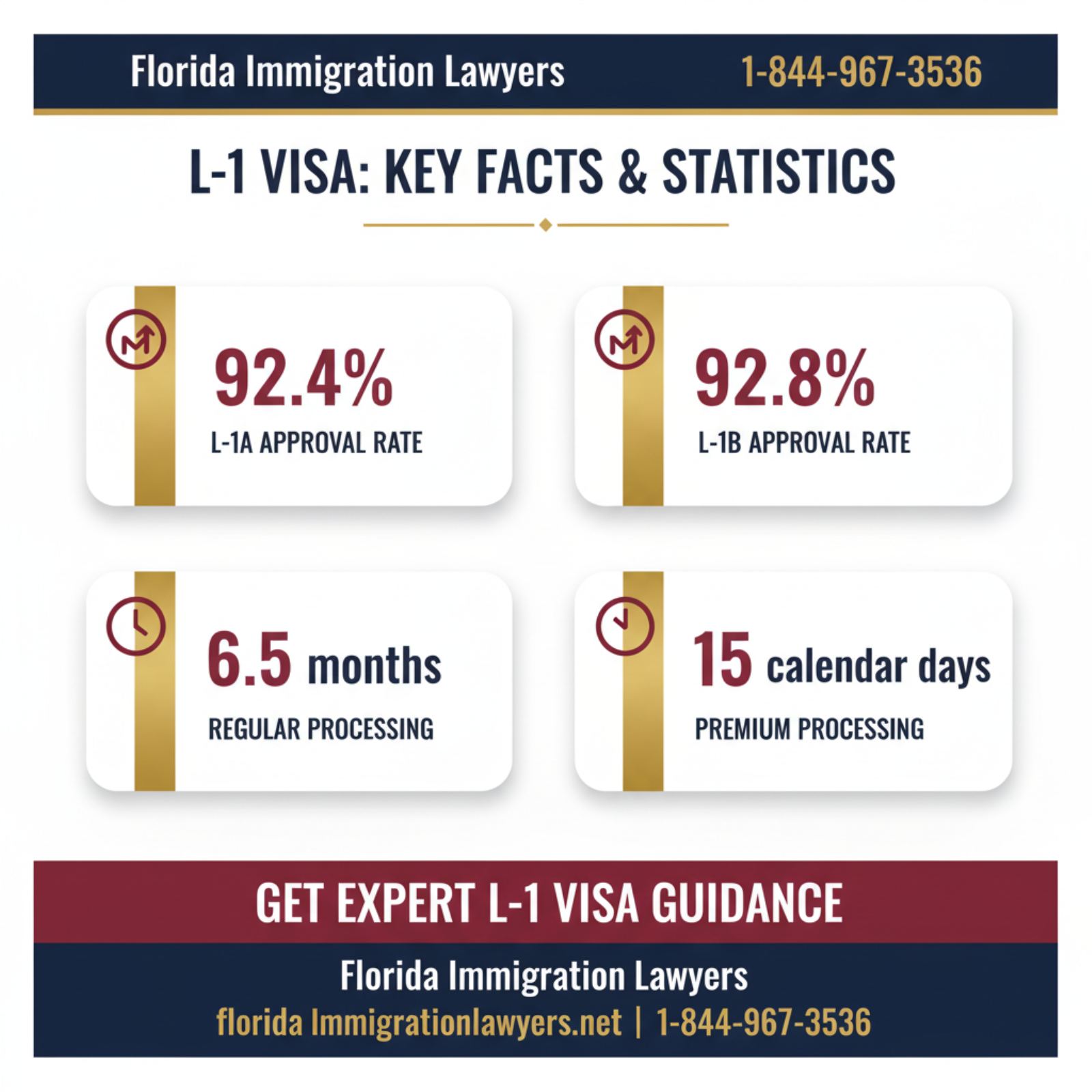
Prepare and File Form I-129, Petition for a Nonimmigrant Worker: The U.S. employer files Form I-129 with USCIS on behalf of the foreign employee. This petition must include extensive supporting documentation proving the qualifying relationship, the employee's eligibility, and the nature of the U.S. position. Employers can opt for Premium Processing Service for an expedited decision, typically within 15 calendar days, for an additional fee.
-
Respond to Requests for Evidence (RFEs): USCIS may issue an RFE if they require additional information or documentation to make a decision on the petition. A timely and thorough response to an RFE is crucial. Failure to address all points in the RFE adequately can lead to a denial of the petition. Our firm, Florida Immigration Lawyers, can help you prepare a robust RFE response.
-
Consular Processing or Adjustment of Status:
- Consular Processing: If the employee is outside the U.S. when the I-129 petition is approved, they will apply for the L-1 visa at a U.S. embassy or consulate in their home country. They will receive an interview notice and instructions for collecting necessary documents.
- Adjustment of Status: If the employee is already in the U.S. in a valid nonimmigrant status, they may be eligible to apply for an adjustment of status to L-1 status by filing Form I-485 concurrently with or after the I-129 approval. This allows them to change their immigration status without leaving the country.
-
Attend Visa Interview: For consular processing, the employee will attend an interview at the U.S. embassy or consulate. They will be asked questions about their qualifications, the company, and their job duties. This interview is a final step in the L-1 visa process.
-
Visa Issuance and Entry to the U.S.: Upon successful interview and approval, the L-1 visa stamp will be placed in the employee's passport. They can then travel to the U.S. and begin their employment with the petitioning entity in Florida.
Essential Document Checklist for Your L-1 Visa Petition
Preparing a complete and accurate set of documents is paramount for a successful L-1 visa transfer. Missing or incorrect documentation is a common cause for delays or denials. Below is a general checklist of documents typically required:
- Company Documents (U.S. and Foreign):
- Evidence of corporate structure (articles of incorporation, partnership agreements).
- Financial statements, annual reports, tax returns.
- Organizational charts clearly showing the qualifying relationship and the employee's position.
- Detailed business plan for new U.S. offices.
- Lease agreements for U.S. office space.
- Evidence of active business operations (invoices, contracts, marketing materials).
- Employee Documents:
- Copy of passport and previous visas.
- Comprehensive resume or CV.
- Proof of educational qualifications (degrees, transcripts).
- Letters from the foreign employer confirming employment, job duties, and dates of employment for at least one year within the last three.
- Foreign payroll records and tax documents.
- Detailed description of the proposed U.S. job duties and how they qualify as executive, managerial, or specialized knowledge.
- Any other evidence of specialized knowledge or managerial/executive experience.
- For L-2 dependents: marriage certificate for spouse, birth certificates for children.
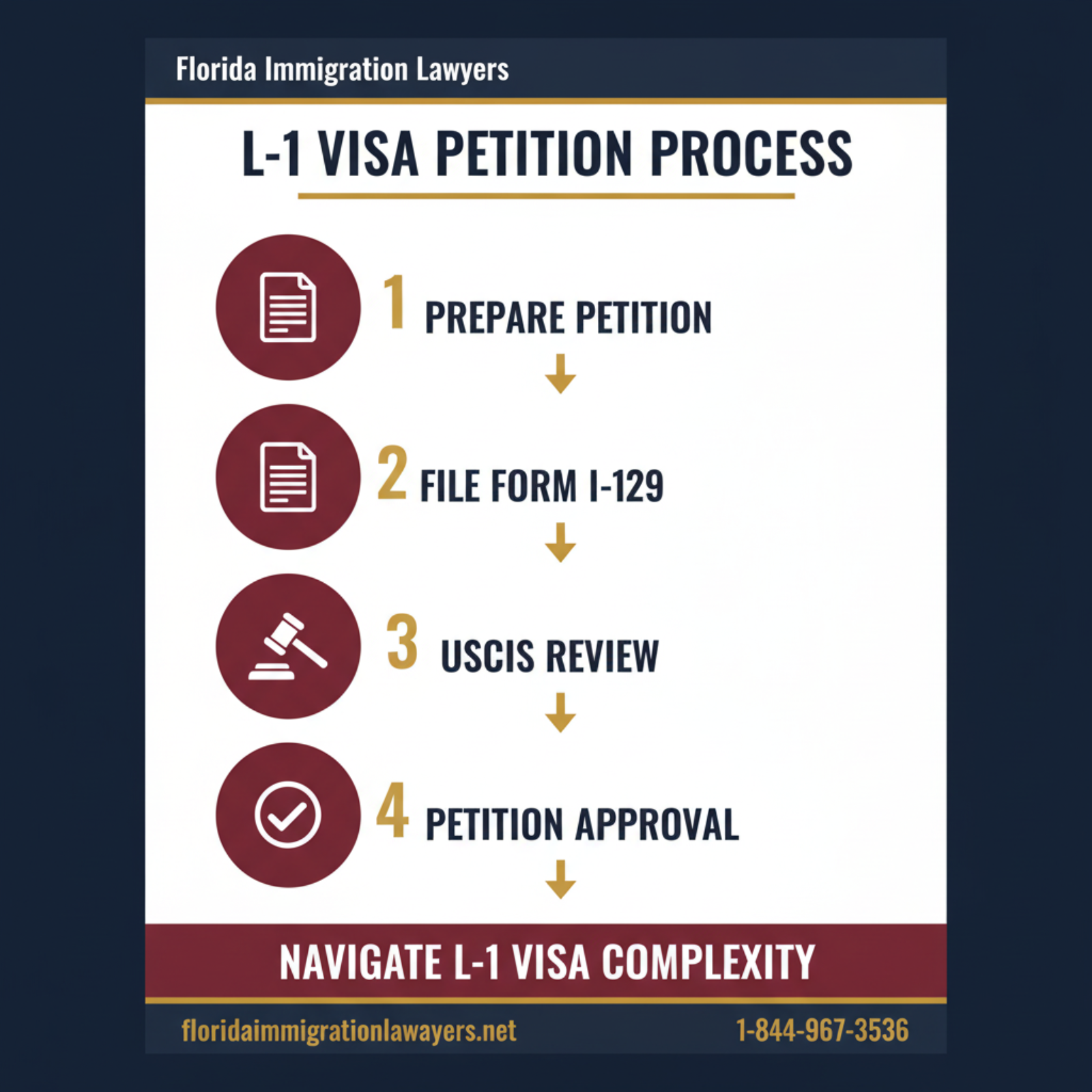
Each case is unique, and additional documents may be required based on your specific circumstances. Our experienced team at Florida Immigration Lawyers will help you compile a robust petition for your work visa.
L-1 Visa Processing Times and Expectations in Florida
Understanding the potential timeline for your L-1 visa application is crucial for business planning and personal relocation. Processing times can vary significantly based on several factors, including the specific USCIS Service Center handling your petition and whether you opt for premium processing.
Typical Processing Times
Standard processing for Form I-129 can range from several months to over a year, depending on the current USCIS workload. You can check the approximate processing times for different form types and service centers on the USCIS Processing Times page. For L-1 petitions, the Texas and California Service Centers are typically responsible.
For those requiring a faster decision, Premium Processing Service guarantees a response from USCIS within 15 calendar days for an additional fee. This can significantly reduce uncertainty and accelerate the transfer of vital employees to Florida.
Factors Influencing Timelines
Several elements can impact how long your L-1 visa transfer takes. Requests for Evidence (RFEs) are a common cause of delays, as they extend the decision-making period while USCIS awaits additional information. The complexity of the corporate structure, the completeness of the initial filing, and the current volume of applications at USCIS also play a role. Planning ahead and submitting a meticulously prepared petition can help mitigate potential delays.
Understanding the Costs Associated with an L-1 Visa
The financial aspect of an L-1 visa transfer involves various fees and expenses. These costs typically include government filing fees, legal representation fees, and other miscellaneous expenses. It is important to budget for these to avoid unexpected financial burdens.
USCIS Filing Fees
The U.S. government charges several fees for filing an L-1 petition. These include the base filing fee for Form I-129, the Fraud Prevention and Detection Fee, and the American Competitiveness and Workforce Improvement Act (ACWIA) fee for certain employers. If Premium Processing is elected, there is an additional fee for that service. These fees are subject to change, so it is crucial to check the most current amounts on the USCIS website.
Legal and Other Fees
Engaging an experienced immigration attorney like Florida Immigration Lawyers is a wise investment. Legal fees cover the attorney's time and expertise in preparing and filing the petition, responding to RFEs, and advising throughout the process. Other potential costs may include translation services for foreign documents, travel expenses for consular interviews, and courier fees. A clear understanding of all associated costs helps in financial planning for your intracompany transfer.
Do not navigate this complex process alone. The nuances of L-1 visa applications, especially concerning corporate structures and detailed job descriptions, require expert attention. Contact Florida Immigration Lawyers today to ensure your L-1 visa petition is prepared accurately and efficiently, minimizing delays and maximizing your chances of success. Our team is ready to assist your company and employees with their immigration needs.
Common Mistakes to Avoid During Your L-1 Visa Transfer
Navigating the L-1 visa process can be complex, and certain missteps can lead to significant delays or even denials. Being aware of these common mistakes can help you prepare a stronger petition for your L-1 visa transfer.
-
Insufficient Evidence of Qualifying Relationship: Failing to clearly demonstrate the corporate relationship (parent, subsidiary, affiliate, branch) between the U.S. and foreign entities is a frequent error. Provide robust documentation like stock certificates, organizational charts, and financial statements to prove common ownership and control.
-
Not Meeting Managerial/Executive or Specialized Knowledge Definitions: USCIS strictly scrutinizes job duties. Merely using titles like "manager" is not enough. The petition must clearly outline duties that align with the regulatory definitions for L-1A or L-1B. For L-1A, focus on supervisory responsibilities or directing the organization. For L-1B, detail unique or proprietary knowledge.
-
Failure to Prove Prior Foreign Employment: The employee must have worked for the foreign entity for at least one continuous year in a qualifying capacity within the three years preceding the petition. Inadequate proof, such as missing payroll records or vague employment letters, can lead to denials.
-
Inadequate Business Plan for New Offices: For new U.S. offices, a comprehensive and realistic business plan demonstrating viability, financial capacity, and the intention to support the executive or managerial position is crucial. Vague or unrealistic plans often result in RFEs or denials.
-
Incorrectly Defining U.S. Job Duties: The proposed U.S. job duties must clearly match the L-1A or L-1B criteria. Ensure the description avoids tasks that are primarily operational or clerical, especially for L-1A petitions. The duties should reflect the high-level nature of the position for this work visa.
-
Not Responding Fully to RFEs: When USCIS issues a Request for Evidence, it is critical to address every point raised with thorough and relevant documentation. A partial or unclear response can be as detrimental as no response at all.
-
Failure to Maintain Status: If the employee is already in the U.S. and adjusting status, maintaining their current nonimmigrant status throughout the L-1 application process is vital. Any lapse in status can jeopardize the adjustment of status application.
-
Attempting to Switch Employers Without a New Petition: An L-1 visa is employer-specific. If an L-1 visa holder wishes to work for a different company, even an affiliated one, a new L-1 petition must be filed by the new employer and approved by USCIS. You cannot simply transfer your L-1 status to an unrelated entity.
-
Ignoring L-2 Dependent Issues: Family members (spouse and unmarried children under 21) can apply for L-2 visas. However, failing to include their documentation or address their specific needs can complicate the overall immigration process for the entire family.
-
Overlooking Corporate Restructuring Impact: If the petitioning company undergoes a merger, acquisition, or significant corporate restructuring during the L-1 visa's validity, it may impact the qualifying relationship. Such changes often necessitate an amended or new L-1 petition to maintain valid status.
When to Consult a Florida Immigration Lawyer for Your L-1 Visa
While this guide provides general information, the complexities of L-1 visa law often require personalized legal advice. Consulting with an experienced Florida immigration lawyer is highly recommended, especially in certain scenarios. Florida Immigration Lawyers is here to provide the assistance you need.
Specific Scenarios Requiring Legal Help
- Complex Corporate Structures: If your company has a multi-layered or unusual corporate structure, proving the qualifying relationship can be challenging. An attorney can help articulate and document this relationship effectively.
- New Office Petitions: Establishing a new U.S. office for an intracompany transfer requires a detailed business plan and careful documentation. Legal counsel ensures all requirements are met to prove the viability of the new entity.
- Previous Denials or RFEs: If your company has previously received an RFE or a denial for an L-1 petition, an attorney can analyze the reasons and strategize a stronger re-filing or appeal.
- Mergers, Acquisitions, or Corporate Restructuring: If the U.S. or foreign entity undergoes significant changes like an acquisition or merger, it can impact the L-1 visa's validity. An attorney can advise on whether an amended petition or a new filing is necessary to maintain compliance. This directly addresses the question: What happens to the L-1 visa if the company is acquired?
- Questions about L-1A vs. L-1B Eligibility: Accurately determining if a position qualifies as executive, managerial, or specialized knowledge can be subjective. An attorney provides clarity and helps present the strongest case.
Our team at Florida Immigration Lawyers understands the unique challenges faced by businesses and individuals in Florida. We offer comprehensive services for all aspects of business immigration, including the L-1 visa. Do not leave your future to chance; empower yourself with legal representation. Visit our attorneys page to learn more about our team, or contact us directly for assistance.
About Florida Immigration Lawyers
Florida Immigration Lawyers is an immigration law firm dedicated to serving individuals and businesses across the entire state of Florida. Our experienced team of attorneys focuses on a wide range of immigration matters, from family-based petitions and citizenship applications to complex business and employment visas, including the L-1 visa for intracompany transfers.
We pride ourselves on providing compassionate, client-focused legal representation. We understand the profound impact immigration decisions have on your life and business, and we are committed to guiding you through every step of the process with clarity and dedication. Our firm offers free consultations and is available 24/7 to address your urgent immigration needs.
When you choose Florida Immigration Lawyers, you are partnering with a team that possesses deep knowledge of U.S. immigration law and a strong commitment to achieving positive outcomes for our clients. We serve all of Florida, including major hubs like Orlando. Contact us today at 1-844-YO-PELEO or visit Vasquez Law Firm to schedule your free consultation and learn how we can assist you with your immigration goals.
Sources and References
- U.S. Citizenship and Immigration Services (USCIS)
- Immigration and Nationality Act (INA) - Specifically INA § 101(a)(15)(L) and INA § 214(c)(2)(A)
- 8 Code of Federal Regulations (CFR) § 214.2(l) - Rules for L-1 Intracompany Transferees
- U.S. Department of State - L-1 Intracompany Transferee Visa
This article provides general legal information and is not intended as legal advice. Every case is unique, and outcomes depend on specific facts and circumstances. Immigration laws are subject to frequent change. Contact an attorney for advice about your particular situation and the most current legal requirements.
Your journey through the U.S. immigration system for an L-1 visa transfer does not have to be a source of stress. With the dedicated support of Florida Immigration Lawyers, you can approach the process with confidence and clarity. We are committed to providing you with personalized, effective legal solutions tailored to your unique needs in Florida.
Take the first step towards a successful intracompany transfer. Call Florida Immigration Lawyers today at 1-844-YO-PELEO for a free consultation. Se Habla Español - Estamos aquí para ayudarle.
Do Not Navigate This Process Alone
Our experienced immigration attorneys are ready to fight for you. Get a free, confidential case review today.
Se Habla Español
Or leave your details and we’ll call you:
Free Evaluation in 24 Hours
Or talk to us right now

AI voice assistant — available 24/7
FreeFrequently Asked Questions

William J. Vásquez
Founding Attorney · Vasquez Law Firm
U.S. Air Force veteran and immigration attorney with years of hands-on U.S. immigration experience. J.D., NCCU School of Law. AILA member. Admitted to the 4th, 5th, and 11th Circuit Courts.
Available 24/7 - Free Evaluations
Reviewed for legal accuracy by William J. Vásquez
Licensed in North Carolina; U.S. immigration is federal practice.
Related Legal Services
Our Florida immigration attorneys can help you with asylum protection, citizenship and naturalization and immigration practice areas. Call today at 1-844-YO-PELEO for a free case review.
Related Links
Related Topics
Free Legal Case Review
Discuss your case with our experienced attorneys. We're available 24/7.
Se Habla Español - Estamos aquí para ayudarle.
Related Articles
EB-5 Investor Green Card in Florida: A 2026 Guide
Explore how to obtain an EB-5 investor green card in Florida. Learn about the investment requirements, processes, and benefits of participating in this program. Discover how Florida's economic landscape can be an ideal setting for your investment. Contact Florida Immigration Lawyers for a free case review.
Certificate of Eligibility for Expungement in Florida 2026
For non-U.S. citizens in Florida, understanding how a state expungement impacts immigration status is critical. A certificate of eligibility for expungement in Florida allows a criminal record to be sealed or expunged under state law. However, federal immigration agencies often disregard such state-level relief, still considering the original criminal offense as a conviction for immigration purposes. This can have severe implications for visa applications, green card eligibility, naturalization, and even lead to deportation. This guide clarifies the Florida expungement process, its limited effect on federal immigration law, and key steps to protect your status in 2026. Learn about common mistakes, required documents, timelines, and when to seek expert legal counsel from Florida Immigration Lawyers to navigate these complex issues effectively.
Immigration Lawyer Orlando Free Consultation in Florida
For individuals and families in Orlando, Florida, navigating the complexities of U.S. immigration law requires expert guidance. An immigration lawyer in Orlando offers crucial support for everything from visa applications and green card processes to naturalization and deportation defense. This comprehensive guide details what a free consultation covers, providing a step-by-step overview of immigration pathways, essential document checklists, and expected timelines in 2026. We also highlight common mistakes to avoid, discuss the critical role of legal counsel in deportation and asylum cases, and explain why choosing a local Orlando immigration attorney is beneficial. Florida Immigration Lawyers is dedicated to serving the diverse community of Orlando with compassionate, effective legal solutions, ensuring you receive personalized advice and robust representation for a successful immigration journey.
Immigration Interview Preparation Florida 2026 Guide
Facing an immigration interview in Florida? This comprehensive guide offers essential 2026 USCIS interview tips for green card and naturalization applicants. Learn how to meticulously prepare your documents, understand the typical timelines, and avoid common mistakes that could jeopardize your case. We cover what to expect at the Orlando USCIS Field Office, provide a detailed document checklist, and explain the various costs involved in the process. With insights into naturalization specifics and when to seek legal counsel, Florida Immigration Lawyers helps you approach your interview with confidence. Our firm is dedicated to empowering immigrants across Florida with the knowledge and support needed for a successful outcome. Get a free case review today.